The handle
http://hdl.handle.net/1887/26944
holds various files of this Leiden University
dissertation
Author: Verschoor, Stephan Alexander
Learning about goals:
Development of action perception and
action control
2
The research in this thesis was supported by the Netherlands Organization for Scientific
Research (NWO), grant number 400-05-112.
3
Learning about goals:
Development of action perception and
action control
Proefschrift
ter verkrijging van
de graad van Doctor aan de Universiteit Leiden, op gezag van Rector Magnificus Prof.mr. C.J.J.M. Stolker,
volgens besluit van het College voor Promoties te verdedigen op woensdag 25 juni 2014
klokke 10.00 uur
door
Stephan Alexander Verschoor
4
Promotor: Prof. Dr. B. Hommel
Co-promotor: Dr. S. Biro
Manuscriptcommissie: Prof. Dr. E. Crone
5
Chapter 1 Introduction 7
Chapter 2 Means selection information overrides outcome selection information in goal attribution
41
Chapter 3 Evidence for a unitary goal concept in 12-month-old infants 61
Chapter 4 Outcome potential influences twelve-month-olds’ interpretation of a novel action as goal-directed
79
Chapter 5 Explicit learning of arbitrary and non-arbitrary action-effect relations in adults and 4-year-olds
109
Chapter 6 Explicit learning of arbitrary and non-arbitrary action-effect relations in adults and 4-year-olds
129
Chapter 7 From outcome prediction to action selection: Developmental change in the role of action-effect bindings
149
Chapter 8 The developing cognitive substrate of sequential action control in 9- to 12-month-olds: Evidence for concurrent activation models
185
Chapter 9 Summary and conclusions 223
7
Chapter 1: Introduction
“For the things we have to learn before we can do, we learn by doing”
(Aristotle, Nicomachean Ethics)
“We must perceive in order to move, but we must also move in order to perceive”
9
This thesis aims to answer some questions with regard to how infants learn to perceive and perform goal-directed action. To address these two interrelated aspects of goal-directed action, the thesis employs a range of behavioral, occulomotor and pupillary measures designed to tap into developmental changes and the cognitive mechanisms that underlie these abilities. The first section of chapter 1 will introduce the general topic. The second section will focus on how infants perceive third-person goal directed action. A third section will focus on how infants learn about goals by experience. The fourth section will give a short overview of the remaining chapters. Readers should expect a certain amount of overlap between chapter 1 and chapters 2 to 8 since they are submitted/ accepted/ published as stand-alone articles.
General Background
Let us consider why our question “how do infants learn to perceive, and perform goal-directed action?” is of serious importance. The world today is (as it has always been) an ever changing hostile and
complex place in which humans aspire to live comfortable and fulfilling lives. Fortunately humans are endowed with the ability to act on their environment, since sitting back and letting it all flow by is not an option. In order to act effectively upon our environment we need to be able to set goals. “How are we able
to set such goals?” thus can be considered a life and death question.
10
Some authors have suggested that the rudimentary capability to have first-person goals (Rizzolatti & Craighero, 2004; Rochat, 2001) and perceive third-person goals (Meltzoff & Moore, 1977) is with us from birth on—or even earlier; while others stress that the capacity is learned (e.g., Piaget, 1962). However, given the complexity and flexibility of human behavior and the dramatic changes the mind and body undergo during development, it is rather unlikely that such innate goals remain stable across the lifespan (Elsner & Hommel, 2004). Since our survival and life fulfillment critically depend on having complex goals, it seems necessary to assume that we learn new goals or modify existing goals during our
lifetime.
A new question thus arises; if goals are not (all) innate, how do we acquire them? In principle the (folk-psychological) answer to that question seems quite simple, namely through experience and observing others. However, under closer, more scientific scrutiny these answers are not so straightforward. These answers lead to new questions that result in more complicated answers: “How does one acquire new goals through observation?” and “How does one acquire new goals through experience?”. These more philosophical questions inevitably result in more elaborate and complicated
answers. Along these lines many authors have focused on observation of third-person action as an important source for acquiring new goals, while other theorists have focused more on acquiring new goals through active exploration. Although these questions and approaches are to some extent separated throughout the dissertation for presentational purposes, one should keep in mind that theoretically and empirically these approaches are heavily interrelated. The crosstalk between the observation of third-person action and action experience is most prominently displayed in chapter 4 wherein action experience actually alters and aids third-person action perception.
11
of new goals is led by the profound developmental changes in mind and body that take place during this period in life. Indeed, the concept of goal itself might develop from a primitive to a more complex concept during this period as indicated by the emergence of more complex goal-directed behaviors with progressing age. Such developmental conceptual changes in goals may be mediated by advances in short- and long-term memory (for a review, see Rovee-Collier, 1999), knowledge of the physical world (such as object permanence (Piaget, 1936), and developmental changes in the cognitive system that mediate goal representation itself. Unraveling the answer to the question mentioned above “How do we learn about goals” is an ongoing effort in cognitive science.
12
Learning about goals by perceiving third-person actions
The human race is essentially social. It relies on meaningful communication for sharing knowledge on successful survival strategies gathered throughout the generations. Meaningful communication is impossible without goal perception, the ability to perceive goals in others’ behavior. This ability can thus be placed at the very core of humanity. Furthermore, inferences about others’ goals, enables the prediction of behavior and thus greatly enhances our ability to react correctly and timely to others. This is of great advantage in any social situation.
Indeed our everyday experiences are heavily influenced by the ability for goal perception. Goal perception is pervasive and immediately effects our perception, memory and reasoning about any third-person actions (e.g., Woodward, Sommerville, Gerson, Henderson & Buresh, 2009). To illustrate, the propensity readily makes us interpret impoverished events, like the movement of two dimensional geometrical figures, as goal directed (e.g., Heider & Simmel, 1944; Osaka, Ikeda & Osaka, 2012). Thus it seems that our cognitive systems actively try to make sense of the world by interpreting any perceived movements in terms of intentions and goals. As a result of this propensity we do not experience life as a succession of physical movements but rather parse events in terms of more meaningful terms such as goals. Indeed, the propensity to perceive goals, also help us to control our environment by enabling us to predict and explain behavior of others.
13
underpin such processing (Ravenscroft, 1997). Although the definition mentioned above only mentions “humans”, there is ample evidence that humans also use mindreading for machines and animals. However
these actors are not incorporated in the definition since insisting that mental state attributions to animals are not metaphorical is compatible with such attributions being “systematically false”. Therefore, the precise extension of the ToM remains under debate. Some theorists would even contend that the same
processes involved in ToM also apply to first person mindreading by assuming simulational processes.
ToM, through communication, enables typical human phenomena such as language and culture. Since these phenomena are human prerogatives, some researchers postulate intention reading ability to be restricted to the human race (for a review see: Lurz, 2011). Nonetheless, some evidence indicating intention reading in animals such as chimpanzees does exist (e.g. Premack & Woodruff, 1978; for a review see Call & Tomasello, 2008). Many of the (philosophical) arguments against interpreting these studies as evidence for animal mindreading abilities, such as posing consciousness and language ability (e.g. Davidson, 1985) or “mentalese” (a hypothetical language in which concepts and propositions are represented in the mind without words) (Fodor, 1975) as prerequisites (for a review see: Lurz, 2009), may also apply to infants. Nonetheless, it seems reasonable to assume that the intention reading ability evolved to a greater extent in the human race. Thus, since full blown ToM becomes apparent later in human development, behavior that infants show, when consistent with goal attribution, may be interpreted as evidence for an emerging ability to read intentions. Nevertheless theorists are divided with regard to how ToM develops, some see infants as actively exploring the environment to accumulate and falsify hypothesis regarding the ToM (Gopnik & Meltzoff 1997), while others see it as an ability that is to a large extent innate and matures during childhood (Scholl & Leslie 1999).
14
great interest, whether infants actually ascribe mental states, such as beliefs and desires, to others. Alternatively, they may rely on contingencies between the observable cues in the environment and target behaviors, trigger stereotypical motor patterns that are innate, or rely on mental simulation that doesn't require having mental state concepts (Andrews, 2012). Indeed, theorists have proposed that intention reading need not be mentalistic in content (Gergely, Nadasdy, Csibra, & Biro, 1995). They propose that intention attribution in the mentalistic sense evolves from teleological interpretations. To illustrate: the teleological answer to the question “Why did the chicken cross the road?” would be: “To get to the other side” whereas the mentalistic answer would be “Because it wanted to go to the other side”. Notice that
both answers explain the observed behavior, but only the mentalistic answer refers to the mind of the chicken. An even deeper philosophical divide concerns the subjectively perceived causal structure of mental states. On the one hand, theorists such as Fodor (1987) maintain that intentional states are in fact causal in producing behavior, while other theorists such as Dennett (1987) propose that concepts of intentional states, such as belief, desire, and perceiving, are theoretical concepts that exist by virtue of, and are determined by, a common-sense psychology or folk-psychology (ToM). According to Dennet, for another to have intentional states, is for its behaviors to be well predicted and explained by the principles of folk psychology (ToM) (Lurz, 2009). The ascribed intentional states do not necessarily refer to real structural or functional states in the brain or body. He thus proposes that ToM is epiphenomenal to behavior predictive strategies.
These philosophical considerations aside, theorists like Sodian (2011) propose, analogues to the teleological view (e.g., Gergely et al., 1995), that early infants’ goal attribution relies on a “lean level of analysis” working solely on the assumption that an agent’s (intentional) action is goal oriented. Only the
15
analysis” thus suggesting a developmental pathway. She bases this assumption on a number of studies
that show that individual differences in goal attribution in habituation tasks at the ages of 6–14 months, predicted the performance on a ToM test at preschool age in several independent studies (Aschersleben, Hofer, & Jovanovic, 2008; Wellman, Lopez-Duran, LaBounty, & Hamilton, 2008; Wellman, Phillips, Dunphy-Lelii, & Lalonde, 2004). Whatever the exact ontogeny and content of goal attributions, let us
now turn to methods for investigating the development of goal attribution in infancy.
Methods of assessing goal perception
16
by observation, even though relatively few experiments are devoted to understanding the phenomenon of imitation itself (Jones, 2009).
One of the aims of Piaget’s elaborate genetic epistemological stage theory (1962) was to account
for the emergence of imitation. Others have suggested an innate apprehension of equivalences between acts of the self and those of others that enables imitation (Melzoff, 2007). Meltzoff & Moore (e.g., 1977) and others have presented evidence suggesting that a rudimentary innate ability to imitate (very simple) gestures such as protruding ones tongue or mouth opening is present in neonates (see Anisfeld, 1991 for a review). These findings are under heavy debate (Jones, 2009) and even if one does accept the behavior in these studies as imitation or emulation of a goal-directed action, the goal itself is not new in the sense that the infants never protruded their tongues before. Thus although imitation is seen as one of the most important steps in the development of the human brain (Hayek, 1952), its onset and the exact cognitive mechanisms that enable the translation of third-person goal-directed behavior into first person behavior remain open for discussion (Jones, 2009).
Imitational research has provided a wealth of concepts regarding action perception (e.g., Meltzoff, 2007), nonetheless one could conclude that methods that use imitation as a derived measure of goal attribution might not be ideally suited to the task. There are several reasons for this conclusion. Firstly, the concept of imitation itself is ill defined. Furthermore (partly due to its troublesome definition) its developmental onset is vague at best. Differences in the onset of goal perception versus imitation could thus produce results that under- or overestimate the capacity of goal perception. Additionally, there is a large motivational component in imitational studies, meaning that infants might simply not “want” to
17
A method that may be more suitable for measuring goal perception in third-person action is the preferential looking time method as developed by Fantz (1958). In (simple) preferential looking time studies infants are habituated to (or familiarized with) a certain stimulus until attention decreases by a predefined amount. Thereafter they are confronted with a second stimulus that is different on some dimension. Attention recovery or looking longer at the second stimulus is taken as evidence that the infants noticed the change along that dimension and thus perceived the dimension, which resulted in more elaborate processing. If applied meticulously and with the right control conditions, this technique could in principle asses if and how infants perceive an action as goal-directed if one changes the stimuli in the right way. Although, just like in imitation, the cognitive mechanisms subservient to the phenomenon of habituation are under discussion (Colombo & Mitchell, 2009), preferential looking time has an important advantages over imitational measures; since the phenomenon is robustly present at birth (e.g., Friedman, Nagy & Carpenter, 1970) the measure does not run the risk of failing to detecting goal perception due to onset issues. The vast majority of recent studies on goal perception utilize this method. Recent advances in the suitability for infant research of eye tracking, EEG and near infrared spectroscopy have brought these methods within the grasp of developmental cognitive research.
Some seminal findings using looking time measures
18
Before the test trials infants were shown that the location of the two toys were swapped. Woodward then measured the dishabituation to two different test events; in one of the events the same toy was grasped at the new location and in the other test events the new toy was grasped at the old location. In this study 9-month-olds dishabituated more to the new toy same location presentation than to the old toy different location presentation. The infants now expected the actor to continue to grasp the same toy even though it was in a different location. With appropriate controls, this study was taken as evidence for goal attribution for familiar human actions in 9-month-old infants. Goal attribution is now widely accepted to emerge in infants around 6 months (e.g., Biro & Leslie, 2007; Woodward, 1998; Kamewari, Kato, Kanda, Ishiguro,
& Hiraki, 2005).
Figure 1. Woodwards 1998 paradigm. Infants were habituated to a hand grasping a toy at one of two locations. From habituation to test the toys change sides. Infants dishabituate more to a change of goal (Test event 1) than to a change of location
(Test event 2) indicating the infants expects the actor to have the same goal as during habituation. This figure is partly adapted
from Woodward (1998).
Habituation event
Test event 1 Test event 2
19
Another seminal line of research into goal attribution using similar methodology, aimed at assessing how infants rely on the selection of action means for goal attribution, was started by Gergely et al. (1995). In their experiment twelve-month-old infants were habituated to an animated circle that approached another circle either in an efficient or inefficient manner. In the “efficient approach” condition, the circle jumped over an obstacle in order to get to the other circle, while in the “inefficient approach” condition the circle jumped although the obstacle was not located between the two circles. In
20
Figure 2. Gergely et al. (1995) paradigm. Infants were habituated to either the efficient or the inefficient goal approach wherein a small circle approaches a big circle (in the inefficient condition the obstacle was not in between the two circles yet the
circle still jumped). During test they were shown either the old or the new action now without any obstacles. Only infants in the
efficient goal approach condition dishabituate more to a the old action than to the new action. This indicates the infants expected
the small ball to efficiently approach the big ball given the changed situational constraints. This figure is partly adapted from
Gergely et al. (1995).
Theoretical approaches to third-person action perception
By now there is a large body of evidence that demonstrates an emerging understanding of third-person action in infancy during the second part of the first year (e.g., Biro & Leslie, 2007; Woodward, 1998; Kamewari, Kato, Kanda, Ishiguro, & Hiraki, 2005). Yet, the cognitive mechanisms that subserve such an understanding and their developmental origins are still under heavy theoretical debate. Proposed theories differ along a number of dimensions, mostly motivated by the scientific traditions from which they evolved, and thus deliver partially contrasting explanations (Paulus, 2011). However, the mechanisms suggested are often not mutually exclusive but rather should be seen as complementary, reflecting on different processes involved in goal attribution (that nonetheless might follow a certain
Old action
Inefficient goal approach
New action Efficient goal approach
21
temporal order in development). Theoretical confusion and debate is for a large part due to inaccurate definitions within the field, and the often difficult to prove claims of nativism versus constructivism or maturation versus experience.
The nativist- versus constructivist- divide in third-person goal perception, closely mimics the historic divide in language-acquisition theory; while Chomsky (1965) suggests innate modules specifically evolved for language acquisition, Vygotsky (1985) stresses experience as the main drive behind language acquisition. Similarly some propose hardwired full-fledged action understanding (Fodor, 1987) or “core principles” to guide emerging intention reading (e.g., Carey & Spelke, 1994), while others
stress constructivist sensori-motor processes whereby action understanding emerges through experience (e.g., Piaget, 1962). Another dimension that differentiates theories is whether individual (e.g. Gergely & Csibra, 2003) or social processes are highlighted (Király, Csibra & Gergely, 2013).
To illustrate, several, sometimes interrelated processes have been suggested as fundamental for a full-fledged percept of a third-person goal-directed action. For one, the observant has to be able to parse the continuous stream of events in a way that enables him to select a certain sequences of events that is likely to contain a goal-directed action. Several different processes might play a role in such a parsing ability. A process hypothesized to be important for the selection of events that could contain goal-directed action, is that of actor detection. The logic behind this hypothesis is that the mere presence of a moving actor is in itself is a good predictor of goal-directed action occurring. Some theorize that the process of actor detection develops as a result of infants’ experiences with human agents (e.g., Meltzoff, 1995;
22
Another process, hypothesized to be important for parsing events, is the detection of significant changes in the physical world, in other words, the detection of action effects. Such effects are hypothesized to aid the interpretation of an end state as a goal state. Again, several mechanisms have been suggested for this interpretational process. Some stress the detection of surface features of the end state such as its’ saliency (for a review, see: Elsner 2007) or spatiotemporal properties (e.g., Gergely et al.,
1995), while others stress more elaborate cognitive processes such as the internal emulation of the action to assess the end state as a goal (Meltzoff, 2007). Another major point of divergence for theories on the perception of goal-directed action is the perception of novel, versus familiar actions. Some experience-oriented theorists, working in the grounded or embodied cognition tradition, such as Woodward (1998) stress that in order to interpret an action as goal-directed the action has to be within the infants action repertoire. Others stress mechanisms that do not rely on action repertoire but utilize more abstract interpretational principles (e.g., Gergely et al., 1995).
As outlined above theoretical standpoints clearly diverge on a number of dimensions. For clarity three of the main theories regarding third-person action understanding will now be highlighted: motor resonance, teleological reasoning and action-effect theory.
Motor resonance
23
grounded- cognition theories state that cognition (and thus action understanding) is grounded in bodily experiences.
Di Pellegrino and colleagues (1992) were the first to document neurons in the premotor cortex of macaque monkeys that fire when executing a grasping movement, and when a similar action is observed. This result was only obtained for goal-directed (object-directed) actions; mimicry of such actions did not produce the effect. Such findings gave rise to the idea that monkeys use the same brain regions responsible for planning actions to interpret third-person actions. Theorists suggested that by feeding information about the observed action into their own motor system, the monkeys were able to interpret the observed action in terms of a goal by simulating the action as if they were performing it themselves. Later findings suggesting a homologous MNS in humans (e.g., Gazzola & Keysers, 2009), extended this theory of action understanding through inverse planning to humans. A number of researchers went on to proposed the MNS and its’ ability to “share” motor representations, to be the foundational cornerstone for
higher order social processes, such as motor learning, imitation, perspective taking, understanding facial emotions and empathy (e.g., Rizzolatti, Fogassi & Gallese, 2001). Although the theory has many proponents, there are also some theorists that fear that over-interpretation of the available data gave rise to the MNH (e.g., Hickok, 2009). They propose that mirror neurons play only secondary roles in action understanding.
24
experience. He states that a primitive, developing capacity to represent “supramodal” codes generated by the MNS is present at birth. He derives this assumption from his imitation research on neonates (Meltzoff & Moore, e.g. 1977). Others see the MNS as an emergent property of hebbian- (Hanuschkin, Ganguli & Hahnloser, 2013; Del Giudice, Manera, & Keysers, 2009) or associative- (Heyes, 2010) learning mechanisms and thus experience. Again these views are hard to disentangle experimentally. However, the main prediction of the MNH and the “Like me framework” is that the ability to perceive goal-directed action develops as a function of action experience and that it is restricted to human (or human like)
agents.
The application of motor resonance theory gained large scale support in developmental science due to the seminal VoE work of Woodward (1998) (for an explanation of the methodology see above and Figure 1). Woodward found evidence for goal attribution in 9-month-old infants, but only when the puppet show was performed by a human arm, not when the actor was a rod, or when the actor performed an unfamiliar back-of-the-hand-dropping action (Woodward, 1999). This was taken as evidence that infants have to be familiar with the action presented in order to interpret it as goal directed. Furthermore it suggests that the actor has to be human (some might comment that the macaques’ MNS reacted to human
motion, however humans are more like macaques than like rods). Furthermore Guajardo and Woodward (2004) showed that 7- and 12-month-old infants in a similar paradigm were unable to attribute a goal to an actor wearing a glove unless they were familiarized with the actor wearing gloves prior to the task. Sommerville, Woodward and Needham (2005) additionally showed that 3-month-old infants can attribute a goal when they observe an actor wearing a mitten if they are allowed to practice making contact and picking up toys by using a mitten covered with Velcro fabric.
25
attribution in infants to non-human actors. These studies used paradigms very similar to that of Woodward (1998). Biro, Csibra and Gergely (2007) argue that not only cues such as human features or human-biomechanical motion can elicit identifying an actor as such, but additionally propose cues such as self propulsion and behavioral cues such as equifinal movement to account for goal attribution to non-human agents. Furthermore Luo and Baillargeon (2005) found that goal attribution in a Woodward type paradigm did not take place when during familiarization only one object was presented, suggesting that infants only attribute a goal when the actor can express a preference. Thus, although the MNH has generated research that indicates that infants more readily interpret human- as opposed to non-human action as goal directed, this may be due to additional agency cues in human action not to the MNS. Thus the MNH may yet turn out to be an ineffective “weapon of mass explanation”.
Action-Effect Learning
26
Although the theory was initially non developmental and mainly used to explain first-person action perception (see section 2 of the introduction), by now it has been extended to the development of third person action perception. This was done under the influence of theoretical elaborations on action-effect theory like the Theory of Event Coding (TEC) (Hommel, Müsseler, Aschersleben, & Prinz, 2001) and the discovery of the MNS. In TEC the authors proposed that humans use the same distal features to represent their own and others’ actions. Although these distal codes are similar to the “supramodal” codes
Meltzoff (2007) proposes, TEC does not make the assumption that they are inborn. Thus action-effect theory is in itself not sufficient to explain goal attribution in third-person action. It additionally needs some kind of internal representational overlap between first-person- and third-person action representations.
Indeed, salient action effects have been shown to aid third person goal attribution (e.g., Biro & Leslie, 2007; Jovanovic, Kiraly, Elsner, Gergely, Prinz & Aschersleben, 2007, for a review, see: Hauf, 2007) even for unfamiliar actions (Kiraly, Jovanovic, Prinz, Aschersleben, & Gergely, 2003). Furthermore infants are more likely to imitate actions that have a salient action effect (Hauf & Aschersleben, 2008; Klein, Hauf & Aschersleben, 2006; for a review, see: Elsner 2007; Melzoff, 2007). And several studies have shown that own action experience (and thus action-effect knowledge) does affect the perception of third-person goal directed action (e.g., Hauf, Aschersleben & Prinz, 2007; Sommerville & Woodward, 2005a, 2005b).
Teleological reasoning
27
infants perceive an action as goal directed when it follows the principle of rational action which states that “an action can be explained by a goal state if, and only if, it is seen as the most justifiable action towards the goal state that is available within the constraints of reality” (Csibra & Gergely, 1998). The action thus needs to be efficient towards the end state, considering the situational constraints, for goal attribution to occur. The theory is teleological in the sense that it does not require any mentalistic explanations to be attributed by the observer it requires that the end state of a certain action be explained by the action and the situational constraints (contrary for instance to the “like me” framework of Meltzoff (2007).
Teleological reasoning is considered the core of the full blown theory of mind which allows humans to attribute intentions, feelings and (false) beliefs to others (Premack & Woodruff; 1978). Csibra and Gergely (1998) state that the principle of rational action is the initial state of the infants’ naïve psychological theory whereupon can be elaborated by adding mentalistic explanations later in development.
The results of Gergely et al. (1995) and others who used similar paradigms (e.g., Csibra, Gergely, Biro, Koós, & Brockbank, 1999; Csibra, Biro, Koós, Gergely, 2003; Csibra, 2008; Wagner & Carey, 2005; Sodian, Schoeppner, & Metz, 2004) indeed suggest that means-selection information is crucial to goal attribution. Support for the theological stance also comes from imitation studies (e.g., Gergely, Bekkering & Kiraly, 2002) which show that infants’ imitation also depends on the efficiency of the shown action (for a contradictory view on these results see Paulus, Hunnius, Vissers & Beckering, 2011a-2011b; Beisert et al., 2012).
28
Learning new goals by experience
The second question explored in this thesis is “How do infants acquire new goals through experience?”. Infants start to show evidence of (primitive) being goal-directed in their behavior from a
very early age on. The onset of intentional behavior depends on the exact definition of goal-directed action adhered to. If one does not dwell too long on in how far these behaviors are actually planned and intentional, primitive and easily disrupted goal-directed behaviors such as moving a hand towards the mouth (Butterworth & Hopkins, 1988) or orienting towards sound (Zelazo, Brody, & Chaika, 1984) are evident in neonates (e.g., Bertenthal, 1996; Metzoff & Moore, 1997; von Hofsten, 2004). Slightly more demanding behaviors such as grasping an interesting object in order to examine it, appear around 5 months of age (Bertenthal & Clifton, 1998; Clearfield & Thelen, 2001). More sophisticated intentionally planned goal-directed behavior, for which infants need to be able to distinguish means from ends, starts to appear around nine months of age (Claxton, Keen, & McCarty, 2003; Hauf, 2007; Willatts, 1999; Piaget, 1936; Woodward & Sommerville, 2000; Woodward et al., 2009).
Altogether these findings underline a developing ability to represent first-person action goals. In principle goals could be innate and just mature during development. However, given the world’s
ever-changing nature and complexity, and the dramatic development the mind and body of infants undergo, it is plain common sense to assume that goal representations are not innate, finite and permanent (e.g., Greenwald, 1970; Hommel & Elsner, 2009).
Piaget (1936) was the first cognitive developmental psychologist, to systematically research the origin of emerging knowledge during infancy. In his genetic epistemological approach (origin of knowledge) he firstly suggested that goals should be adaptive to the infant’s changing skills and abilities.
29
with their effects into schemata necessary for perception and action, he does not elaborate on the underlying cognitive mechanism (Piaget, 1954).
Ideomotor theory
Exactly such a mechanism was proposed in the late nineteenth century, though largely neglected in psychology for a century. Following the lead of Lotze (1852) and Harless (1861), James (1890) suggested a cognitive mechanism that does what Piaget (1936) proposed; it provides actors with action goals that are rooted in their own sensorimotor experience. In his ideomotor theory James stated that all actions are necessarily involuntary when being carried out for the first time. Indeed, if one defines action as goal-directed movement, it presupposes some sort of anticipation of its effect. This again implies knowledge on action-effect relationships, which needs to be acquired before the action can be carried out “in order to” produce the outcome intentionally. Ideomotor theory suggests that such knowledge is
acquired on the fly: whenever people move, they automatically and unintentionally create bidirectional associations between the perceived effects and the motor pattern producing them. This association brings the movement under voluntary control: Once acquired, the agent can now activate the motor pattern producing a movement by “thinking of” (i.e., endogenously activating the representation of) a perceptual
30
Hommel, 2001) and is now part of a broader theoretical movement stressing the interplay between perception and action (Hommel et al., 2001; Meltzoff, 2007; Meltzoff & Prinz, 2002).
Seminal findings
The quintessential paradigm that showed the formation and use of bidirectional action-effect associations was developed by Elsner and Hommel (2001). They designed the “two stage model of voluntary action” (Figure 3). Their paradigm closely resembles the two stages. In the first stage (the
31
Figure 3. Two stage model by Elner and Hommel (2001). At stage1, the motor patter producing a particular effect is
automatically integrated with the cognitive codes representing this effect. At stage 2, the motor pattern is intentionally executed
by activating the cognitive codes that represent its effect. This figure is partly adapted from Elsner and Hommel (2001).
32
This seminal finding motivated numerous demonstrations of bidirectional action-effect acquisition in humans ranging from 4-year-olds (Eenshuistra, Weidema & Hommel, 2004; Kray, Eenshuistra, Kerstner, Weidema & Hommel, 2006) to adults (e.g., Elsner & Hommel, 2001). Action-effect acquisition was found for a wide range of actions and Action-effects (for a review see: Hommel & Elsner, 2009), suggesting a general action-effect integration mechanism. Additionally, action-effect acquisition has been found after just one trial (Dutzi & Hommel, 2009), suggesting that the mechanism is fast-acting and implicit. Action-effect acquisition is modulated by the same factors that influence instrumental learning (e.g., temporal contiguity and contingency of movement and effect: Elsner & Hommel, 2004) and does not depend on voluntary attention (Dutzi & Hommel, 2009; Elsner & Hommel, 2001; Band, Steenbergen, Ridderinkhof, Falkenstein & Hommel, 2009). Together with the fact that it was also found in animals (see Elsner & Hommel, 2001), this suggests that action-effect integration it is a fairly low-level and automatic process (Elsner & Hommel, 2004). Except for Band et al. (2009) the studied mentioned above all involve the activation of actions thru presenting the effect that previously produced them. However recently a new type of paradigm emerged that assesses activation of expected effects by producing the action that normally precedes them. In such paradigms sensory attenuation (attenuation, in terms both of phenomenology and cortical response) to expected action effects is found (e.g., Cardoso-Leite, Mamassian, Schütz-Bosbach & Waszak, 2010; Hughes, Desantis, & Waszak, 2013b; for a review see: Hughes, Desantis & Waszak, 2013a).
Corroborating evidence for ideomotor processes in infancy
33
action understanding in 7 months-olds (e.g., Biro & Leslie, 2007; for a review, see: Hauf, 2007; Kiraly et al., 2003) and imitation in 9-months-olds (Hauf & Aschersleben, 2008; Klein et al., 2006; for a review, see: Elsner 2007; Meltzoff, 2007). Even though these findings do not provide direct evidence for bidirectional action-effect acquisition, theories that emphasize similar representational formats for first-person experience and observed action (e.g., Fabbri-Destro & Rizzolatti, 2008; Hommel et al., 2001; Meltzoff, 2007; Tomasello, 1999), and conceptualize action understanding as inverse planning (Melzoff, 2007; Baker, Saxe & Tenenbaum, 2009) consider them corroborative. Other corroborating evidence was found in studies that show very young infants to be sensitive to action-effect contingencies. For instance, newborns actively adjust their sucking rate in response to their mothers’ voice as ongoing conditional
feedback (DeCasper & Fifer, 1980) and 2-month-olds pursue interesting action effects by intentionally varying their sucking rate (Rochat & Striano, 1999) or varying gaze direction (Watson, 1967; for a review, see Gergely & Watson, 1999). Another line of research by Carolyn Rovee-Collier shows that action effects aid memory retrieval for actions from two months of age (Rovee & Rovee, 1969; for a review, see Rovee-Collier, 1999). Telling as these studies may be (they show that action contingent effects play an important role in infant behaviour and memory) they were not designed to directly asses the bidirectionality of action-effect associations and their use for action planning and may thus confound actual action-effect learning with simple operant conditioning. Nonetheless, these findings may reflect a developing ability for learning action-effect contingencies.
Validating ideomotor theory as a developmental theory
34
in infancy is premature since the most important piece of the puzzle is still missing: direct evidence for uptake of bidirectional action-effect associations in infancy. Such evidence would greatly validate the application of ideomotor theory as a developmental theory for goal perception. Furthermore, it would greatly broaden the scope for ideomotor theory as a whole. Thus the first aim of the second section of the thesis will be to generate such evidence. Under the assumption that we will succeed at fulfilling the first aim, the second aim regarding the application of ideomotor to developmental psychology will be to
discover the developmental pathway the uptake of bidirectional action-effect associations follows.
35
Outline of the thesis
As mentioned above the main question of the current thesis can be divided into two, to a certain degree, interrelated questions: “How do infants learn about goals be perceiving third-person action?” and “How do infants learn new goals by experience?”. The questions of the first part of the thesis, regarding
the perception of third-person action, will mainly concern what kinds of information infants use for goal attribution, and their relative importance. The importance of the chosen outcome of an action will be compared to the importance of the efficiency of the action in regard to the (changing) situational constraints. Furthermore, we will explore the role action experience plays in goal attribution. Another aim of this part of the thesis will be to establish if the different VoE paradigms (one type of paradigm concentrates on outcome selection information, the other type systematically varies the efficiency of actions in relation to changing situational constraints) tap into a unitary concept of goal. The questions of the second part of the thesis, regarding the way infants pick up new goals by experience, will mainly concern the conformation of the ideomotor processes for first-person action perception and action control
in infancy. In addition, the developmental timeline of these principles will be investigated.
Chapter 2 investigates the relationship between findings from the Woodward-(1998) and the Gergely et al. (1995) type paradigm. In the Woodward-type paradigm infants are shown actions in which the actor consistently chooses one of two possible outcomes, whereas in the Gergely-type paradigm the actors use efficient means, depending on situational constraints, toward one outcome. Since these paradigms capitalize on different kinds of information the question arises which type of information is more important for goal attribution. To answer this question, we combined the two types of information into one VoE paradigm.
36
possible outcomes. In other words, does observing an actor efficiently adjusting his action to situational constraints, lead infants to expect that the actor will continue to approach the same goal after another potential outcome is presented in the scene? Such transfer would indicate that both the Woodward- (1998) and Gergely et al.-(1995) type paradigms tap into the same unitary concept of goal that relies on both
outcome- and means- information.
In the fourth chapter we explore the question if first-person experience with a certain movement, or only first-person action-effect associations, can influence goal attribution to a novel action wherein no
effects are presented.
The second part of the thesis will concern the second of our two questions “How do infants learn new goals by experience?” To further validate ideomotor theory as a cognitive developmental theory, as a
starting point, chapter five replicates previous findings (Eenshuistra et al., 2004; Kray et al., 2006) that indicate that 4-year-old children can form bidirectional action-effect associations and compare their performance to adults. The secondary aim of the study was to investigated whether action-effect associations are also acquired under explicit-learning conditions and whether familiar action-effect relations (such as between a trumpet and a trumpet sound) are learned the same way as novel, arbitrary relations are.
The next two chapters represent the first attempts to provide direct evidence for the spontaneous acquisition of bidirectional action-effect associations in infancy. In chapter six we applied a highly simplified version of the Elsner and Hommel paradigm (2001).
37
that both 7- and 12-months olds (and adults) can use acquired action-effect bindings to predict action outcomes but only 12-months-olds (and adults) showed evidence for employing action-effects to select actions. This dissociation supports the idea that infants acquire action-effect knowledge before they have developed the cognitive machinery necessary to make use of that knowledge to perform intentional
actions.
In the last empirical chapter of the thesis we used the newly developed methodology from chapter seven to investigate, from an ideomotor point of view, how infants represent sequential action. We aimed to contrast chaining-, concurrent- and integrated models of sequential-action representation. 9- and 12- month olds were taught action sequences consisting of two elementary actions. Thereafter the secondary action was selectively activated to assess any interactions with the primary action.
38
The seven empirical chapters in this thesis are either published, under revision, or submitted in
international psychological journals. They are inserted in the thesis in their original submitted or
published form. To honor the co-authors, a list of references is presented:
Chapter 2,
Verschoor, S. A. & Biro, S. (2012). Primacy of information about means selection over outcome
selection in goal attribution by infants. Cognitive Science, 4, 714-725.
Chapter 3,
Biro, S., Verschoor, S., & Coenen, L. (2011). Evidence for a unitary goal-concept in 12 months old infants. Developmental Science, 6, 1255-1260.
Chapter 4
Biro, S., Verschoor, S. A., Coalter, E., & Leslie, A. M. (Under revision). Outcome potential influences twelve-month-olds’ interpretation of a novel action as goal-directed.
Chapter 5
39 Chapter 6
Verschoor, S. A., Weidema, M., Biro, S. & Hommel, B. (2010). Where do action goals come
from? Evidence for spontaneous action-effect binding in infants. Frontiers in Cognition, 1,201.
Chapter 7
Verschoor, S., Spapé, M., Biro, S., Hommel, B. (2013). From outcome prediction to action selection: Developmental change in the role of action-effect bindings. Developmental Science, 16,
801-814.
Chapter 8
41
Chapter 2: Means selection information overrides
outcome selection information in goal attribution
43
Abstract
45
Introduction
To infer that an observed action is goal-directed (as opposed to random or accidental), i.e., that it is performed in order to achieve a particular outcome, one can make use of two types of information that can be directly observed in a given situation. One type of information consists of the observation of the way in which the actor adjusts the action to the situational constraints in order to achieve the end-state. Relying on this type of information implies the understanding of the relation between the means and the goal and the expectation that the actor will select the most efficient means action toward the goal. The other type of information consists of the observation that there are potential alternative outcomes and that the actor expresses a choice for a particular outcome via the action. We refer to these two types of information as "means selection" and "outcome selection" information, respectively.
46
interpretation of goal-directed actions, namely means selection information is primary to outcome selection information. In other words, means selection information can override outcome selection information1.
In this paper we investigate whether the relationship between the two types of information is similar in infants' interpretation of observed actions as in adults' interpretation, that is, whether means selection information also holds primacy over outcome selection information. Infants' ability to interpret observed actions as goal-directed has been investigated using two distinct experimental paradigms that have so far tested if and how infants can rely on one or the other type of information. However, until now no research has addressed the question of how infants interpret observed actions when the two types of information are present simultaneously.
Evidence for reliance on outcome selection information was found by showing that infants, after having watched an actor repeatedly acting upon (e.g. grasping) one of two objects, expect that the actor will continue to direct the action toward the same target after the spatial arrangement of the two objects has been altered (e.g., Woodward, 1998, 1999; Kiraly et al., 2003; Biro & Leslie, 2007). Furthermore, when outcome selection information is not provided in this experimental paradigm, that is, when the actor’s action could not express a choice because there was only one object present, infants do not
generate the expectation that the actor will act upon the same object after a novel object has been introduced (Baillargeon & Luo, 2005; Biro et al, 2012; Hernik & Southgate, 2012). Note that in these settings no (unambiguous) means selection information is available because the information about
1 Note that we consider only directly observable information here. Additional, not directly perceivable or
previous information about the actor (traits, habits, preferences, and beliefs) or the situation can alter the
interpretation of means selection information and may allow disambiguating the goal (e.g., if you know that the
47
situational adjustment of the action is non-sufficient (see Biro et al, 2012). Together, these findings suggest that outcome selection information is critical in infants’ goal-attribution and that they rely on it from at least as early as 6 months.
The second experimental paradigm demonstrates infants' reliance on means selection information (Csibra et al., 1999, 2003; Sodian et al, 2004; Csibra, 2008). Infants are typically presented with a scenario in which there is only one potential outcome, which the actor repeatedly achieves by adjusting the action to the situational constraints (e.g., approaching a target by getting around an obstacle). When the situational constraints change, infants are found to predict that the actor will perform a novel and efficiently adjusted means action to achieve the original outcome (as opposed to repeating the familiar but no longer efficient means). If, however, the actor’s action is not adjusted to the situation efficiently in the initial scenario, then infants do not generate a particular expectation about the new means action of the actor in a new situation. Thus, means selection information also has an important place in infants’ early (also from around 6 months) goal-directed action interpretation.
In the present study we investigate how infants deal with situations which provide both types of information, means selection and outcome selection, to disambiguate the goal. Does means selection information have primacy over outcome selection information as in adult cognition? Or does outcome selection information dominate in infants’ developing ability to attribute goals? The crucial situation, in
48
inefficient toward this goal. If, on the other hand, means selection has primacy, then infants would not attribute a goal when the means is inefficient, even in the presence of outcome selection information.
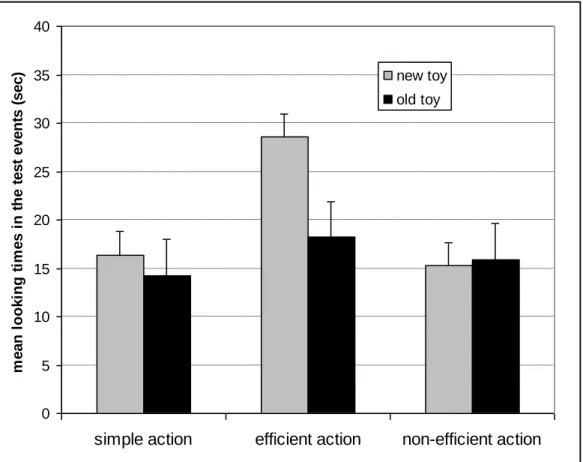
To test this question, infants participated in three conditions. The Efficient Action condition involved familiarizing infants with a hand that first opens one of two transparent boxes that each contain a toy and then grasps the toy. In the non-efficient Gratuitous Action condition, the hand performs the same action, but the toys are in front of the boxes. Opening the box is therefore unnecessary and does not relate efficiently to the grasping2. In the non-efficient Superfluous Action condition, the boxes are not present, the hand grasps one of the toys after making some unnecessary movements in the air above and behind the toy (which actually mimic the opening of a box). The test events were identical for all conditions: two toys are present in swapped positions (no boxes) and the hand simply grasps either the same toy as before or the other toy. If outcome information has primacy over means selection information, then infants in all conditions should expect the hand to grasp the same toy as before. This expectation would be indicated by looking longer in the new toy test event than in the old toy test event in all three conditions. If means selection is the dominant source of information, then infants should attribute a particular goal and thus look longer in the new toy test event than in the old toy test event only in the Efficient Action condition, but not in the non-efficient conditions. Furthermore, the two types of non-efficient approaches allow us to investigate whether the inefficiency of the action can only prevent goal attribution if there is only one action involved (as in the Superfluous Action condition) or when the means can be considered as a part of a sequence, a sub action leading to an overarching goal (as in the Gratuitous Action condition). One could argue that inferring the goal by considering the inefficiency of a sub-action might be too demanding for young infants, and thus they might only rely in their interpretation on the second reaching action
2 These two conditions were based on a previous study in which it was shown that 12-month-olds
understand the causal relationship between opening a box and getting the object inside, and that they understand that
49
containing only outcome information. In the case of the presence of this transitional period, we would expect longer look in the new toy than in the old toy test event in the Efficient and the Superfluous Action conditions but not in the Gratuitous Action condition.
Method
Participants
Seventy-two 7-month-olds (mean age=31.10 weeks; SD=1.7 weeks; 36 girls and 36 boys) and seventy-one 9-month-olds (mean age=39.60 weeks; SD=1.08 weeks; 39 girls and 32 boys) were randomly assigned to one of three conditions: Efficient Action (23, 24), Gratuitous Action (24, 24) and Superfluous Action (24, 24, respectively). An additional eight 7-month-olds and fourteen 9-month-olds were excluded
due to experimental error (3, 7) and fussiness (5, 7, respectively).
Stimuli
50
51
52 Apparatus and Procedure
During the experiment infants sat on their caregivers' lap in a curtained experimental booth. The stimuli were presented on a 31 inch widescreen monitor that was placed approximately 70 cm in front of infants' eye level. Two hidden cameras recorded the infants' faces and the stimuli. The on-line experimenter, who was blind to the condition, used specially built software (Schrama & Biro, 2005) to control stimulus presentation and to register infants' looking. At the start of trial the experimenter used an attention getter sound. When the infant was looking at the screen, the experimenter started the presentation of the event. If the infant watched the test event for less than 5 sec, then the trial was ignored and started again. (This was the minimum time required to ensure that the infants saw which toy was grasped in the test events.) If the infant looked away for more then 2 sec or if 120 sec had elapsed, the test event ended. Each infant saw both types of test events. The order of the presentation of the test events (New goal first/second), the type of object touched during familiarization (bear/ball), and the object’s
position (left/right side of the stage) were counterbalanced in all conditions.
The looking times of the test-phase and familiarization phase were re-coded off-line by a secondary coder. The inter-coder reliability for the test events was 96.86%.
Results
53
Figure 2. Mean looking times during familiarization for all conditions (s). The actual durations of the familiarization events were 5 seconds in events 1-2, 15 seconds in events 3-6 and the pre-test event lasted 10 seconds.
FAMILIARIZATION EVENTS IN THE THREE CONDITIONS
0 2 4 6 8 10 12 14 16
1 2 3 4 5 6 7
54
Second, the effects of order, gender, and toy position on the looking times in the test events were investigated. None of these factors had any main or interaction effect. These variables were therefore omitted from further analyses. A repeated-measures ANOVA was conducted on the looking times in the test events with condition, age-group and toy type (ball vs. bear) as between-subject variables. A significant main effect of condition was found [F(2,131)=4.258, p=0.016, effect size: 0.06]. Pair-wise comparisons indicated that infants overall looked longer in the Gratuitous Action than in the Superfluous Action condition (p=0.005). There was, however, no difference between the two non-efficient conditions
and the Efficient condition. No main effects or interactions with age-group were found.
55
Figure 3. Mean looking times and standard errors (s) in the two test events by the three conditions. (* = p < 0.05) TEST EVENTS IN THE THREE CONDITIONS
0 5 10 15 20 25 30
Efficient Gratuitous Superfluous
56
Furthermore, a three-way interaction between test-type, condition and toy type was found [F(1,131)=4.056, p=0.020, effect size=0.058]. Follow-up tests revealed that only in the Gratuitous Action condition and only when the ball was the target, infants looked longer in the Old toy test event than in the New toy test event (t(23)=3.130, p=0.005, two-tailed), in the other conditions infants produced the same
looking patterns in the two test events for both toys.
Discussion
We have investigated the nature of the relationship between outcome selection and means selection information in young infants' goal attribution. Infants were presented with situations in which both types of information were available to interpret and generate an expectation about the goal of an observed action. We found that 7- and 9-month-old infants only expected the actor to continue to direct the action toward the same target if both types of information were converging on the same goal-directed interpretation (Efficient action condition). In the other two situations, in which the outcome information could be used to disambiguate the goal but the means selection information did not justify this interpretation, infants did not generate a specific expectation about the actor's goal in a new situation (non-efficient action conditions). These findings together support the hypothesis that means selection information holds primacy over outcome selection information in infants’ action interpretation.
57
ability is also supported by previous evidence showing that by 5½ months infants can understand the physical constraints of containment events in goal attainment (Baillargeon, Graber, DeVos & Black, 1990), which is certainly necessary for the evaluation of the efficiency of the means in our containment event.
Recall that while the looking patterns in the non-efficient conditions were different from that in the Efficient condition, they were also different from each other. Looking equally long in the two test events in the Superfluous Action condition suggests that infants had indeed no specific expectation about which toy would be grasped. In the Gratuitous Action condition, infants looked significantly longer in the old toy than in the new toy test event. While this looking pattern also shows that infant did not expect the same goal to be achieved, the difference might reflect the fact that infants encoded the action in terms of its spatial properties (see also Woodward, 1998, Experiment 2). Infants might thus have expected to see the action to be performed on the same side of the stage as in the new toy event. One can speculate that the presence and the manipulation of the box in the Gratuitous Action condition highlighted the spatial position of the action, while the mimicked action in Superfluous Action condition did not tie the action as clearly to one side of the stage because no box was present to emphasize a particular location.
A further caveat that needs to be considered is whether infants in the Gratuitous Action condition might have evaluated the action of opening the empty box as being efficient action - despite our intention for it to look inefficient - by inferring that the goal of the action was to put a toy into the box3. Since the boxes were no longer present in the test events, this interpretation was not tested in the test events and this possibility can thus neither be verified nor rejected. However, we argue that this interpretation is quite unlikely, because it requires the inference of a hypothetical state of affairs since this goal has not been seen achieved. Inferences about hypothetical scenarios are above the level of the representational ability
58
of infants at the age tested in the current study (Csibra et al., 2003; Bellagamba & Tomasello, 1999). Furthermore, in the familiarization events, after opening the box the hand kept grasping the toy for 5 sec until the end of the event, which would be unnaturally long if the goal had been putting the toy into the box. Note, however, that such an interpretation of the familiarization phase of the Gratuitous Action condition would have involved relying on the means selection information rather than on the outcome selection information. Hence, it would not change our main argument about the relation between the two
types of information.
Our findings provide a crucial piece of supporting evidence for a proposed theory about the mechanism underlying infants’ understanding of goal-directed actions. This theory states that infants are
equipped with an abstract interpretational system, the teleological stance, which represents goal-directed actions by relating three elements: the observed action, the end state of the action, and the physical context in which the action takes place (Gergely & Csibra, 2003). The central claim of this theory - that infants only attribute a goal to an action if the action can be evaluated as an efficient action toward the end-state in the given situation - has so far only been supported by relatively indirect evidence. The experimental paradigm that had been used to investigate this theory tested infants’ predictions about the
59
Another related point that needs to be addressed is how our design and research questions differ from those of Woodward and Sommerville (2000). In that study 12-month-olds were shown the same familiarization events as in the Efficient and the Gratuitous Action condition of the present study. However, in the test events, only the two means actions were shown and not the goal attainment: the boxes were still present, the toys were either inside or in front of the boxes, and the hand only touched one of the boxes without grasping the toy. Therefore, the finding that infants did not have specific expectations about the means in their non-efficient condition did not necessarily prove that they did not interpret the grasping of one of the toys in the familiarization phase as goal-directed. While both the current and Woodward and Sommerville’s experiments provided simultaneous presence of outcome
selection information and means selection information, only the present study clarified that means selection information overrides outcome selection information in specifying the goal of the observed action.
60
The demonstration of the primacy of means selection information does not imply that outcome selection information is unimportant in action understanding. On the contrary, it is very useful information when it is the only observable information one can rely on and it is very likely crucial for understanding and attributing preferences. In fact, there is an on-going debate about whether the experimental paradigm that investigates sensitivity to outcome selection information alone (Woodward, 1998) is a test for preference attribution rather than for goal attribution or both (Luo & Baillargeon, 2005; Hernik & Southgate, 2012; Jacob, 2012). In any case, recent studies have demonstrated that 9- and 12-month-old infants can transfer their goal attribution from a situation that contains only means selection information to another situation in which only outcome selection information is available (Biro et al, 2012; Hernik & Southgate, 2012). These findings suggest that these two types of information feed into a unitary goal concept.
61
Chapter 3: Evidence for a unitary goal concept in
12-month-old infants
63
Abstract
65
Introduction
Goal-directed actions never take place in an empty space, they are embedded in a particular situation. To interpret an observed action as goal-directed, that is, to infer that its outcome is not random or accidental but carries explanatory power about the action, one can make use of two types of information in a given situation. One type of information consists of the observation that, to achieve the goal, the actor adjusts the action to the situational constraints. We refer to this type of information as "means selection". The other type of information is the availability of alternative outcomes and the expression of a preference for a particular outcome by the actor's action ("outcome selection").
Infants' ability to interpret actions as goal-directed has been investigated using two distinct experimental paradigms that have separately tested if and how infants can rely on one or the other type of information. The first paradigm, introduced by Amanda Woodward (1998), assesses infants' sensitivity to outcome selection. Typically, infants are habituated to an event in which two distinct toys sit on a stage and an actor repeatedly acts upon, for example grasps, one of the toys. Thus, infants observe that the actor consistently chooses one of two potential targets. In the test events the locations of the toys are swapped and the actor acts upon either the same toy or the other toy. Infants are found to look longer in the other toy than in the same toy test event. This looking pattern (combined with appropriate controls that excluded simple association) is interpreted as evidence for infants' ability to encode the action as directed to a particular outcome and to expect that the actor will continue to act to achieve the same outcome.
Further evidence that outcome selection is critical for infants’ expectations in this paradigm