
[MS-SSTP]:
Secure Socket Tunneling Protocol (SSTP)
Intellectual Property Rights Notice for Open Specifications Documentation
Technical Documentation. Microsoft publishes Open Specifications documentation for protocols, file formats, languages, standards as well as overviews of the interaction among each of these technologies.
Copyrights. This documentation is covered by Microsoft copyrights. Regardless of any other terms that are contained in the terms of use for the Microsoft website that hosts this
documentation, you may make copies of it in order to develop implementations of the technologies described in the Open Specifications and may distribute portions of it in your implementations using these technologies or your documentation as necessary to properly document the implementation. You may also distribute in your implementation, with or without modification, any schema, IDL's, or code samples that are included in the documentation. This permission also applies to any documents that are referenced in the Open Specifications. No Trade Secrets. Microsoft does not claim any trade secret rights in this documentation. Patents. Microsoft has patents that may cover your implementations of the technologies
described in the Open Specifications. Neither this notice nor Microsoft's delivery of the
documentation grants any licenses under those or any other Microsoft patents. However, a given Open Specification may be covered by Microsoft Open Specification Promise or the Community Promise. If you would prefer a written license, or if the technologies described in the Open Specifications are not covered by the Open Specifications Promise or Community Promise, as applicable, patent licenses are available by contacting [email protected].
Trademarks. The names of companies and products contained in this documentation may be covered by trademarks or similar intellectual property rights. This notice does not grant any licenses under those rights. For a list of Microsoft trademarks, visit
www.microsoft.com/trademarks.
Fictitious Names. The example companies, organizations, products, domain names, e-mail addresses, logos, people, places, and events depicted in this documentation are fictitious. No association with any real company, organization, product, domain name, email address, logo, person, place, or event is intended or should be inferred.
Reservation of Rights. All other rights are reserved, and this notice does not grant any rights other than specifically described above, whether by implication, estoppel, or otherwise.
Tools. The Open Specifications do not require the use of Microsoft programming tools or programming environments in order for you to develop an implementation. If you have access to Microsoft
programming tools and environments you are free to take advantage of them. Certain Open Specifications are intended for use in conjunction with publicly available standard specifications and network programming art, and assumes that the reader either is familiar with the aforementioned material or has immediate access to it.
Revision Summary
Date Revision History Revision Class Comments
2/22/2007 0.01 Version 0.01 release
4/3/2007 0.01 Version 0.01 release
6/1/2007 1.0 Major Updated and revised the technical content.
7/3/2007 1.1 Minor Updated technical content.
7/20/2007 1.1.1 Editorial Changed language and formatting in the technical content.
8/10/2007 1.1.2 Editorial Changed language and formatting in the technical content.
9/28/2007 1.1.3 Editorial Changed language and formatting in the technical content.
10/23/2007 1.1.4 Editorial Changed language and formatting in the technical content.
11/30/2007 1.1.5 Editorial Changed language and formatting in the technical content.
1/25/2008 1.1.6 Editorial Changed language and formatting in the technical content.
3/14/2008 2.0 Major Updated and revised the technical content.
5/16/2008 2.0.1 Editorial Changed language and formatting in the technical content.
6/20/2008 2.0.2 Editorial Changed language and formatting in the technical content.
7/25/2008 2.0.3 Editorial Changed language and formatting in the technical content.
8/29/2008 2.0.4 Editorial Changed language and formatting in the technical content.
10/24/2008 2.0.5 Editorial Changed language and formatting in the technical content.
12/5/2008 3.0 Major Updated and revised the technical content.
1/16/2009 3.0.1 Editorial Changed language and formatting in the technical content.
2/27/2009 3.0.2 Editorial Changed language and formatting in the technical content.
4/10/2009 4.0 Major Updated and revised the technical content.
5/22/2009 5.0 Major Updated and revised the technical content.
7/2/2009 6.0 Major Updated and revised the technical content.
8/14/2009 7.0 Major Updated and revised the technical content.
9/25/2009 8.0 Major Updated and revised the technical content.
11/6/2009 8.0.1 Editorial Changed language and formatting in the technical content.
12/18/2009 8.0.2 Editorial Changed language and formatting in the technical content.
1/29/2010 8.0.3 Editorial Changed language and formatting in the technical content.
3/12/2010 8.0.4 Editorial Changed language and formatting in the technical content.
4/23/2010 8.0.5 Editorial Changed language and formatting in the technical content.
Date Revision History Revision Class Comments
7/16/2010 9.1 Minor Clarified the meaning of the technical content.
8/27/2010 10.0 Major Updated and revised the technical content.
10/8/2010 11.0 Major Updated and revised the technical content.
11/19/2010 11.1 Minor Clarified the meaning of the technical content.
1/7/2011 11.1 None No changes to the meaning, language, or formatting of the
technical content.
2/11/2011 11.1 None No changes to the meaning, language, or formatting of the
technical content.
3/25/2011 11.1 None No changes to the meaning, language, or formatting of the
technical content.
5/6/2011 11.1 None No changes to the meaning, language, or formatting of the
technical content.
6/17/2011 11.2 Minor Clarified the meaning of the technical content.
9/23/2011 12.0 Major Updated and revised the technical content.
12/16/2011 13.0 Major Updated and revised the technical content.
3/30/2012 13.0 None No changes to the meaning, language, or formatting of the
technical content.
7/12/2012 13.0 None No changes to the meaning, language, or formatting of the
technical content.
10/25/2012 13.0 None No changes to the meaning, language, or formatting of the
technical content.
1/31/2013 13.0 None No changes to the meaning, language, or formatting of the
technical content.
8/8/2013 14.0 Major Updated and revised the technical content.
11/14/2013 14.0 None No changes to the meaning, language, or formatting of the
technical content.
2/13/2014 14.0 None No changes to the meaning, language, or formatting of the
technical content.
5/15/2014 14.0 None No changes to the meaning, language, or formatting of the
technical content.
6/30/2015 15.0 Major Significantly changed the technical content.
10/16/2015 15.0 No Change No changes to the meaning, language, or formatting of the
Table of Contents
1 Introduction ... 7
1.1 Glossary ... 7
1.2 References ... 8
1.2.1 Normative References ... 8
1.2.2 Informative References ... 9
1.3 Overview ... 10
1.4 Relationship to Other Protocols ... 11
1.5 Prerequisites/Preconditions ... 11
1.6 Applicability Statement ... 12
1.7 Versioning and Capability Negotiation ... 12
1.8 Vendor-Extensible Fields ... 12
1.9 Standards Assignments ... 12
2 Messages ... 13
2.1 Transport ... 13
2.2 Message Syntax ... 13
2.2.1 SSTP Packet ... 13
2.2.2 SSTP Control Packet... 14
2.2.3 SSTP Data Packet ... 15
2.2.4 SSTP Attributes ... 16
2.2.5 Encapsulated Protocol ID Attribute ... 17
2.2.6 Crypto Binding Request Attribute ... 18
2.2.7 Crypto Binding Attribute ... 19
2.2.8 Status Info Attribute ... 21
2.2.9 Call Connect Request Message (SSTP_MSG_CALL_CONNECT_REQUEST) ... 24
2.2.10 Call Connect Acknowledge Message (SSTP_MSG_CALL_CONNECT_ACK) ... 25
2.2.11 Call Connected Message (SSTP_MSG_CALL_CONNECTED) ... 27
2.2.12 Call Connect Negative Acknowledgment Message (SSTP_MSG_CALL_CONNECT_NAK) ... 30
2.2.13 Call Abort Message (SSTP_MSG_CALL_ABORT) ... 33
2.2.14 Call Disconnect Message (SSTP_MSG_CALL_DISCONNECT)... 35
2.2.15 Call Disconnect Acknowledge (SSTP_MSG_CALL_DISCONNECT_ACK), Echo Request (SSTP_MSG_ECHO_REQUEST), and Echo Response (SSTP_MSG_ECHO_RESPONSE) Messages ... 37
3 Protocol Details ... 39
3.1 Common Details ... 39
3.1.1 Abstract Data Model ... 39
3.1.1.1 State Machine... 39
3.1.1.1.1 State Machine Call Disconnect ... 39
3.1.1.1.2 State Machine Call Abort ... 41
3.1.2 Timers ... 42
3.1.2.1 Abort-Related Timers... 42
3.1.2.2 Disconnect-Related Timers ... 42
3.1.2.3 Hello Timer ... 43
3.1.3 Initialization ... 43
3.1.4 Higher-Layer Triggered Events ... 43
3.1.5 Processing Events and Sequencing Rules ... 43
3.1.5.1 Status and Error Handling ... 43
3.1.5.2 SSTP Packet Processing ... 44
3.1.6 Timer Events ... 44
3.1.6.1 Abort Timer Processing ... 44
3.1.6.2 Disconnect Timer Processing ... 44
3.1.6.3 Hello Timer Processing ... 44
3.1.7.1 Interface with PPP ... 44
3.1.7.2 Interface with HTTPS ... 45
3.2 Client Details ... 45
3.2.1 Abstract Data Model ... 45
3.2.1.1 State Machine... 47
3.2.1.1.1 Call Establishment ... 47
3.2.2 Timers ... 48
3.2.2.1 Negotiation Timer ... 48
3.2.3 Initialization ... 48
3.2.4 Higher-Layer Triggered Events ... 48
3.2.4.1 Establish SSTP Tunnel Event ... 49
3.2.4.2 Disconnect SSTP Tunnel Event ... 49
3.2.5 Processing Events and Sequencing Rules ... 50
3.2.5.1 Status and Error Handling ... 50
3.2.5.2 Crypto Binding ... 50
3.2.5.2.1 Input Data Used in the Crypto Binding HMAC-SHA1-160 Operation ... 51
3.2.5.2.2 Key Used in the Crypto Binding HMAC-SHA1-160 Operation ... 51
3.2.5.2.3 Input Data Used in the Crypto Binding HMAC-SHA256-256 Operation .... 53
3.2.5.2.4 Key Used in the Crypto Binding HMAC-SHA256-256 Operation ... 53
3.2.5.3 Packet Processing ... 54
3.2.5.3.1 General Packet Validation ... 54
3.2.5.3.2 Receiving an SSTP_MSG_CALL_CONNECT_ACK Message ... 54
3.2.5.3.3 Receiving an SSTP_MSG_CALL_CONNECT_NAK Message ... 55
3.2.5.3.4 Receiving an SSTP_MSG_CALL_ABORT Message ... 56
3.2.5.3.5 Receiving an SSTP_MSG_CALL_DISCONNECT Message ... 56
3.2.5.3.6 Receiving an SSTP_MSG_CALL_DISCONNECT_ACK Message ... 57
3.2.5.3.7 Receiving an SSTP_MSG_ECHO_REQUEST Message ... 57
3.2.5.3.8 Receiving an SSTP_MSG_ECHO_RESPONSE Message ... 58
3.2.6 Timer Events ... 58
3.2.6.1 Negotiation Timer Processing ... 58
3.2.7 Other Local Events ... 58
3.2.7.1 Client-Side Interface with PPP ... 58
3.2.7.2 Client-Side Interface with HTTPS... 59
3.3 Server Details ... 59
3.3.1 Abstract Data Model ... 59
3.3.1.1 State Machine... 60
3.3.1.1.1 Call Establishment ... 60
3.3.2 Timers ... 62
3.3.2.1 Negotiation Timer ... 62
3.3.3 Initialization ... 62
3.3.4 Higher-Layer Triggered Events ... 63
3.3.5 Processing Events and Sequencing Rules ... 63
3.3.5.1 Status and Error Handling ... 63
3.3.5.2 Packet Processing ... 63
3.3.5.2.1 General Packet Validation ... 63
3.3.5.2.2 Receiving an SSTP_MSG_CALL_CONNECT_REQUEST Message... 63
3.3.5.2.3 Receiving an SSTP_MSG_CALL_CONNECTED Message ... 64
3.3.5.2.4 Receiving an SSTP_MSG_CALL_ABORT Message ... 66
3.3.5.2.5 Receiving an SSTP_MSG_CALL_DISCONNECT Message ... 66
3.3.5.2.6 Receiving an SSTP_MSG_CALL_DISCONNECT_ACK Message ... 67
3.3.5.2.7 Receiving an SSTP_MSG_ECHO_REQUEST Message ... 67
3.3.5.2.8 Receiving an SSTP_MSG_ECHO_RESPONSE Message ... 67
3.3.6 Timer Events ... 68
3.3.6.1 Negotiation Timer Processing ... 68
3.3.7 Other Local Events ... 68
3.3.7.1 Server-Side Interface with PPP ... 68
3.3.7.2 Server-Side Interface with HTTPS ... 69
4 Protocol Examples ... 70
4.1 HTTPS Layer Establishment ... 70
4.2 HTTP Layer Teardown ... 70
4.3 SSTP Layer Establishment ... 71
4.4 SSTP Layer Teardown ... 71
4.5 Handling HTTP Proxies ... 72
4.6 Handling the HTTPS Termination Proxy ... 73
4.7 Crypto Binding ... 73
5 Security ... 78
5.1 Security Considerations for Implementers ... 78
5.2 Index of Security Parameters ... 78
5.3 Attack Scenarios ... 78
5.3.1 Unauthorized Client Connecting to an SSTP Server ... 78
5.3.2 Unauthorized SSTP Server Accepting Connections from a Genuine SSTP Client ... 79
5.3.3 Man in the Middle ... 80
6 Appendix A: Product Behavior ... 83
7 Change Tracking ... 86
1
Introduction
This document describes the Microsoft Secure Socket Tunneling Protocol (SSTP), a mechanism to transport data-link layer (L2) frames on a Hypertext Transfer Protocol over Secure Sockets Layer (HTTPS) connection. The protocol currently supports only the Point-to-Point Protocol (PPP) link layer (for more information, see [RFC1661]).
This protocol has two main deployment modes:
The SSTP server directly accepts the HTTPS connection.
In this scenario, the SSTP server accepts the HTTPS connection, which is similar to a virtual private network (VPN) server positioned on the edge of a network. The Secure Sockets Layer/Transport Layer Security (SSL/TLS) certificate is deployed on the SSTP server. The SSTP server is positioned behind an SSL/TLS load balancer.
In this scenario, the SSTP server is positioned behind an SSL/TLS load balancer that terminates the SSL/TLS connections (and therefore, the SSL/TLS certificate is installed) and forwards the decrypted HTTP traffic to the SSTP server. There is an implicit relationship of trust between the load balancer (or trusted man-in-the-middle) and the SSTP server.
Sections 1.8, 2, and 3 of this specification are normative and can contain the terms MAY, SHOULD, MUST, MUST NOT, and SHOULD NOT as defined in [RFC2119]. Sections 1.5 and 1.9 are also normative but do not contain those terms. All other sections and examples in this specification are informative.
1.1 Glossary
The following terms are specific to this document:
globally unique identifier (GUID): A term used interchangeably with universally unique identifier (UUID) in Microsoft protocol technical documents (TDs). Interchanging the usage of these terms does not imply or require a specific algorithm or mechanism to generate the value. Specifically, the use of this term does not imply or require that the algorithms described in [RFC4122] or [C706] must be used for generating the GUID. See also universally unique identifier (UUID).
HTTPS termination proxy: A proxy server that accepts incoming HTTPS connections, decrypts the SSL, and passes on the unencrypted HTTP payload to other servers.
Hypertext Transfer Protocol Secure (HTTPS): An extension of HTTP that securely encrypts and decrypts web page requests. In some older protocols, “Hypertext Transfer Protocol over Secure Sockets Layer” is still used (Secure Sockets Layer has been deprecated). For more information, see [SSL3] and [RFC5246].
Secure Sockets Layer (SSL): A security protocol that supports confidentiality and integrity of messages in client and server applications that communicate over open networks. SSL uses two keys to encrypt data-a public key known to everyone and a private or secret key known only to the recipient of the message. SSL supports server and, optionally, client authentication (2) using X.509 certificates (2). For more information, see [X509]. The SSL protocol is precursor to Transport Layer Security (TLS). The TLS version 1.0 specification is based on SSL version 3.0 [SSL3].
SHA1 hash: A hashing algorithm defined in [FIPS180] that was developed by the National Institute of Standards and Technology (NIST) and the National Security Agency (NSA).
SHA-1 hash: A hashing algorithm as specified in [FIPS180-2] that was developed by the National Institute of Standards and Technology (NIST) and the National Security Agency (NSA).
SSL/TLS handshake: The process of negotiating and establishing a connection protected by
Secure Sockets Layer (SSL) or Transport Layer Security (TLS). For more information, see
[SSL3] and [RFC2246].
SSTP client: A computer that implements the Secure Socket Tunneling Protocol (SSTP), and that initiates an SSTP connection to an SSTP server over TCP port 443.
SSTP far end: An entity that has sent an SSTP message that is currently being processed by an
SSTP peer and to whom the response is sent by the SSTP peer.
SSTP management layer: An entity that manages the SSTP layer on the SSTP client as well as on the SSTP server.
SSTP peer: An entity that processes an SSTP message.
SSTP server: An entity on a network that implements the SSTP and that listens for SSTP connections over TCP port 443.
SSTP tunnel: An encrypted tunnel using the SSTP on an HTTPS (SSL/TLS protocol) connection. state machine: A model of computing behavior composed of a specified number of states,
transitions between those states, and actions to be taken. A state stores information about past transactions as it reflects input changes from the startup of the system to the present moment. A transition (such as connecting a network share) indicates a state change and is described by a condition that would need to be fulfilled to enable the transition. An action is a description of an activity that is to be performed at a given moment. There are several action types: Entry action: Performed when entering the state. Exit action: Performed when exiting the state. Input action: Performed based on the present state and input conditions. Transition action: Performed when executing a certain state transition.
MAY, SHOULD, MUST, SHOULD NOT, MUST NOT: These terms (in all caps) are used as defined in [RFC2119]. All statements of optional behavior use either MAY, SHOULD, or SHOULD NOT.
1.2 References
Links to a document in the Microsoft Open Specifications library point to the correct section in the most recently published version of the referenced document. However, because individual documents in the library are not updated at the same time, the section numbers in the documents may not match. You can confirm the correct section numbering by checking the Errata.
1.2.1 Normative References
We conduct frequent surveys of the normative references to assure their continued availability. If you have any issue with finding a normative reference, please contact [email protected]. We will assist you in finding the relevant information.
[MS-DTYP] Microsoft Corporation, "Windows Data Types".
[MS-PEAP] Microsoft Corporation, "Protected Extensible Authentication Protocol (PEAP)".
[RFC1334] Lloyd, B., and Simpson, W., "PPP Authentication Protocols", RFC 1334, October 1992, http://www.ietf.org/rfc/rfc1334.txt
[RFC1661] Simpson, W., Ed., "The Point-to-Point Protocol (PPP)", STD 51, RFC 1661, July 1994, http://www.ietf.org/rfc/rfc1661.txt
[RFC1945] Berners-Lee, T., Fielding, R., and Frystyk, H., "Hypertext Transfer Protocol -- HTTP/1.0", RFC 1945, May 1996, http://www.ietf.org/rfc/rfc1945.txt
[RFC1994] Simpson, W, "PPP Challenge Handshake Authentication Protocol (CHAP)", RFC 1994, August 1996, http://www.ietf.org/rfc/rfc1994.txt
[RFC2104] Krawczyk, H., Bellare, M., and Canetti, R., "HMAC: Keyed-Hashing for Message Authentication", RFC 2104, February 1997, http://www.ietf.org/rfc/rfc2104.txt
[RFC2119] Bradner, S., "Key words for use in RFCs to Indicate Requirement Levels", BCP 14, RFC 2119, March 1997, http://www.rfc-editor.org/rfc/rfc2119.txt
[RFC2246] Dierks, T., and Allen, C., "The TLS Protocol Version 1.0", RFC 2246, January 1999, http://www.rfc-editor.org/rfc/rfc2246.txt
[RFC2284] Blunk, L. and Vollbrecht, J., "PPP Extensible Authentication Protocol (EAP)", RFC 2284, March 1998, http://www.ietf.org/rfc/rfc2284.txt
[RFC2616] Fielding, R., Gettys, J., Mogul, J., et al., "Hypertext Transfer Protocol -- HTTP/1.1", RFC 2616, June 1999, http://www.rfc-editor.org/rfc/rfc2616.txt
[RFC2716] Aboba, B. and Simon, D., "PPP EAP TLS Authentication Protocol", RFC 2716, October 1999, http://www.ietf.org/rfc/rfc2716.txt
[RFC2759] Zorn, G., "Microsoft PPP CHAP Extensions, Version 2", RFC 2759, January 2000, http://www.ietf.org/rfc/rfc2759.txt
[RFC2818] Rescorla, E., "HTTP Over TLS", RFC 2818, May 2000, http://www.rfc-editor.org/rfc/rfc2818.txt
[RFC2965] Kristol, D. and Montulli, L., "HTTP State Management Mechanism", RFC 2965, October 2000, http://www.ietf.org/rfc/rfc2965.txt
[RFC3079] Zorn, G., "Deriving Keys for Use with Microsoft Point-to-Point Encryption (MPPE)", RFC 3079, March 2001, http://www.ietf.org/rfc/rfc3079.txt
[RFC3174] Eastlake III, D., and Jones, P., "US Secure Hash Algorithm 1 (SHA1)", RFC 3174, September 2001, http://www.ietf.org/rfc/rfc3174.txt
[RFC3748] Aboba, B., Blunk, L., Vollbrecht, J., Carlson, J., and Levkowetz, H., "Extensible Authentication Protocol (EAP)", RFC 3748, June 2004, http://www.ietf.org/rfc/rfc3748.txt
[RFC5280] Cooper, D., Santesson, S., Farrell, S., et al., "Internet X.509 Public Key Infrastructure Certificate and Certificate Revocation List (CRL) Profile", RFC 5280, May 2008,
http://www.ietf.org/rfc/rfc5280.txt
[SHA256] National Institute of Standards and Technology, "FIPS 180-2, Secure Hash Standard (SHS)", August 2002, http://csrc.nist.gov/publications/fips/fips180-2/fips180-2withchangenotice.pdf [SSL3] Netscape, "SSL 3.0 Specification", http://tools.ietf.org/html/draft-ietf-tls-ssl-version3-00 [SSLPROXY] Luotonen, A., "Tunneling SSL Through a WWW Proxy", March 1997,
http://tools.ietf.org/html/draft-luotonen-ssl-tunneling-03
1.2.2 Informative References
[RFC1750] Eastlake III, D., Crocker, S., and Schiller, J., "Randomness Recommendations for Security", RFC 1750, December 1994, http://www.ietf.org/rfc/rfc1750.txt
[RFC2865] Rigney, C., Willens, S., Rubens, A., and Simpson, W., "Remote Authentication Dial In User Service (RADIUS)", RFC 2865, June 2000, http://www.ietf.org/rfc/rfc2865.txt
[RFC4306] Kaufman, C., "Internet Key Exchange (IKEv2) Protocol", RFC 4306, December 2005, http://www.ietf.org/rfc/rfc4306.txt
1.3 Overview
This document specifies the Secure Socket Tunneling Protocol (SSTP). SSTP is a mechanism to encapsulate Point-to-Point Protocol (PPP) traffic over an HTTPS protocol, as specified in [RFC1945], [RFC2616], and [RFC2818]. This protocol enables users to access a private network by using HTTPS. The use of HTTPS enables traversal of most firewalls and web proxies.
Many VPN services provide a way for mobile and home users to access the corporate network remotely by using the Point-to-Point Tunneling Protocol (PPTP) and the Layer Two Tunneling
Protocol/Internet Protocol security (L2TP/IPsec). However, with the popularization of firewalls and web proxies, many service providers, such as hotels, do not allow the PPTP and L2TP/IPsec traffic. This results in users not receiving ubiquitous connectivity to their corporate networks. For example, generic routing encapsulation (GRE) port blocking by many Internet service providers (ISPs) is a common problem when using PPTP.
This protocol provides an encrypted tunnel (an SSTP tunnel) by means of the SSL/TLS protocol. When a client establishes an SSTP-based VPN connection, it first establishes a TCP connection to the SSTP server over TCP port 443. SSL/TLS handshake occurs over this TCP connection.
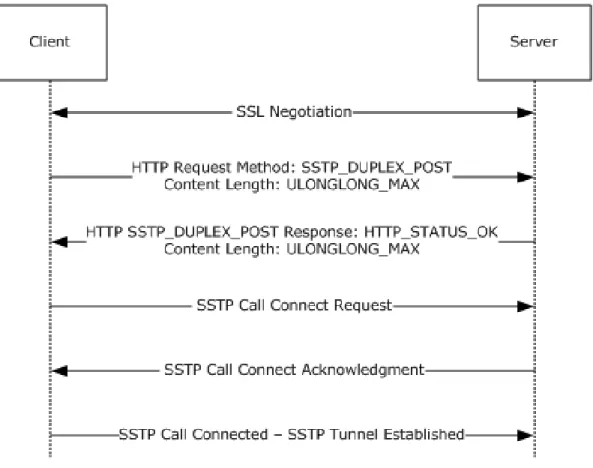
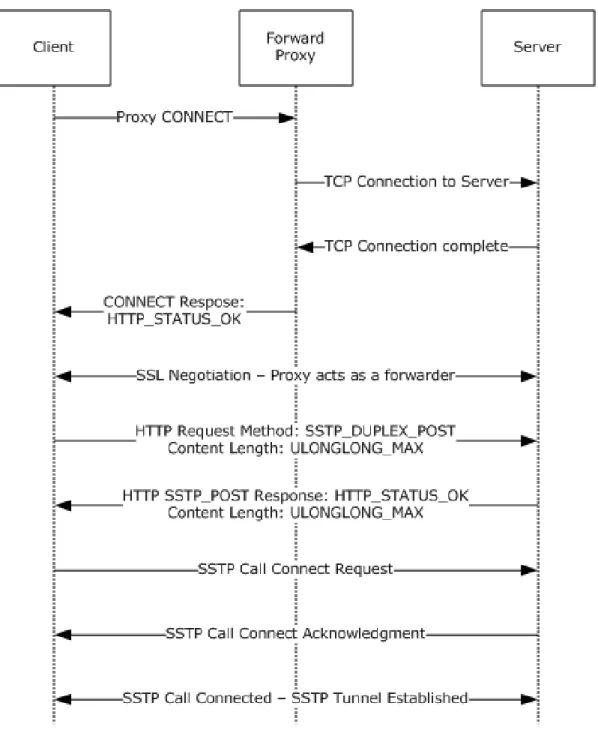
After the successful negotiation of SSL/TLS, the client sends an HTTP request with content length encoding and a large content length on the SSL protected connection (see section 3.2.4.1 for more details). The server sends back an HTTP response with status HTTP_STATUS_OK(200). The specific request and response details that are discussed earlier can be found in section 4.1. The HTTPS connection is now established, and the client can send and receive SSTP Control Packets and SSTP Data Packets on this connection. HTTPS connection establishment when a web proxy is present is specified in [SSLPROXY].
SSTP performs the following features:
Allowing delineation of PPP frames from the continuous stream of data that is sent by using HTTPS. For more information about PPP, see [RFC1661].
Negotiation of parameters between two entities. See section 1.7 for more details.
Extensible message format to support new parameters in the future. For more information, see section 2.2.
Security operations to prevent a man-in-the-middle attacker from relaying PPP frames
inappropriately over SSTP. SSTP uses keying material generated during PPP authentication for crypto binding (sections 3.2.5.2 and 3.3.5.2.3).
SSTP Control Packets contain messages to negotiate parameters and to ensure that there is no untrusted man-in-the-middle. SSTP Data Packets contain PPP frames as payload.
In an SSTP–based VPN, the protocol layer negotiation occurs in the following order: The TCP connection is established to an SSTP server over TCP port 443.
SSL/TLS handshake is completed. HTTPS request-response is completed. SSTP negotiation begins.
PPP negotiation is initiated, and PPP authentication is completed or bypassed. SSTP negotiation is completed.
PPP negotiation is completed.
The connection enters a ready state for transportation of any network layer (for example, IP packets).
The following encapsulation operations occur on the client:
Application packets are encapsulated over any transport protocol (for example, TCP and UDP). Transport layer packets are encapsulated over a network protocol (for example, IP).
Network layer packets are encapsulated over a PPP data-link layer. PPP packets are encapsulated over SSTP.
SSTP Packets are encapsulated over SSL/TLS. SSL/TLS records are encapsulated over TCP. TCP packets are encapsulated over IP.
IP packets are sent over any data-link layer (such as Ethernet or PPP). For more information about PPP, see [RFC1661].
On the server side, operations to remove the encapsulation occur in reverse order.
1.4 Relationship to Other Protocols
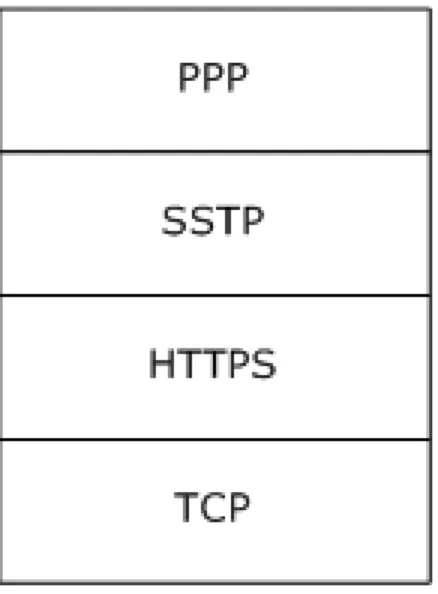
The following network stack diagram shows the relationship of this protocol to other protocols.
Figure 1: SSTP protocol stack
The Secure Socket Tunneling Protocol (SSTP) allows encapsulation of PPP traffic over HTTPS. As a result, SSTP uses both PPP and HTTPS for operation. For more information about HTTPS, see [RFC1945], [RFC2616], and [RFC2818]. For more information about PPP, see [RFC1661].
1.5 Prerequisites/Preconditions
1.6 Applicability Statement
The Secure Socket Tunneling Protocol (SSTP) is useful for establishing VPN connections over public networks. If this protocol is run in a high-loss environment, then TCP connections might encounter limited data transfer rates over this protocol.
1.7 Versioning and Capability Negotiation
The Secure Socket Tunneling Protocol (SSTP) contains version fields in all the messages. This functionality allows a server implementation to support multiple versions of SSTP and to determine what version is implemented on the client. The server then uses that version of protocol behavior for SSTP negotiation.
SSTP also allows for negotiation of SHA1 and SHA256 for hashing. The negotiation is as specified in sections 2.2.7, 2.2.6, 2.2.10, 3.2.5.2, and 3.2.5.3.2.
The server presents the hashing functions that it supports, and the client selects the hashing function that it also supports from this list. If both the client and server support both SHA1 and SHA256, then the client prefers SHA256 over SHA1.
1.8 Vendor-Extensible Fields
The Secure Socket Tunneling Protocol (SSTP) has no vendor-extensible fields.
1.9 Standards Assignments
The Secure Socket Tunneling Protocol (SSTP) has not been assigned any standards from any accepted industry standards body.
2
Messages
2.1 Transport
Because SSTP runs by means of an HTTPS connection, SSTP relies entirely on HTTPS for the reliable delivery of its messages. The SSTP client MUST authenticate the SSTP server by using HTTPS authentication. The SSTP server MAY<1> authenticate the SSTP client by using HTTPS client authentication. The SSTP server SHOULD authenticate the SSTP client by using PPP authentication. Therefore, PPP authentication is required even when the SSTP server authenticates the SSTP client by using HTTPS authentication. For more information about PPP authentication, see [RFC1661] section 3.5.
2.2 Message Syntax
2.2.1 SSTP Packet
The following diagram shows the format of this packet when is sent on the HTTPS connection. The fields of the header MUST be transmitted in byte order from left to right.
0 1 2 3 4 5 6 7 8 9 1
0 1 2 3 4 5 6 7 8 9 2
0 1 2 3 4 5 6 7 8 9 3 0 1
Version Reserved C LengthPacket
Data (variable) ...
Version (1 byte): An 8-bit (1-byte) field that is used to communicate and negotiate the version of SSTP that is used. The upper 4 bits are the MAJOR version, which MUST be 0x1, and the lower 4 bits are the MINOR version, which MUST be set to 0x0. This means that the 8-bit value of the Version field MUST be 0x10 and corresponds to Version 1.0.
Reserved (7 bits): This 7-bit field is reserved for future use. MUST be set to zero when sent and MUST be ignored on receipt.
C (1 bit): A 1-bit field that is used to indicate whether the packet is an SSTP control packet or an SSTP data packet (the data packet is used for sending a higher-layer payload). The value is 1 if it is a control packet and zero if it is a data packet.
Name Value
Data packet 0
Control packet 1
LengthPacket (2 bytes): A 16-bit unsigned integer in network byte order that packs data for two fields, configured in the following format.
0 1 2 3 4 5 6 7 8 9 1
0 1 2 3 4 5 6 7 8 9 2
0 1 2 3 4 5 6 7 8 9 3 0 1
R (4 bits): This 4-bit field is reserved for future use. MUST be set to zero when sent and MUST be ignored on receipt.
Length (12 bits): A 12-bit unsigned integer in network byte order that MUST specify the length, in bytes, of this entire packet, including the 4-byte SSTP header (that is, Version, 7-bit Reserved field, 1-bit C field, 4-bit R field, and 12-bit Length field).
Data (variable): A variable-length field. The length of this field is equal to the value of the field Length, minus 4. This field contains either the SSTP control message when field C is equal to 1 (see section 2.2.2), or the payload from a higher-layer protocol when field C is equal to zero (see section 2.2.3). SSTP data packets carry PPP frames as payload (which includes PPP control frames as well as PPP data frames). For more information, see [RFC1661].
2.2.2 SSTP Control Packet
This packet is a type of SSTP packet that is used by both the client and the server to send control messages to each other. The following diagram specifies the format that MUST be used for the SSTP control messages. Because this message is a type of SSTP packet, it follows the format of an SSTP packet (section 2.2.1).
The fields of the structure MUST be transmitted in network byte order from left to right.
0 1 2 3 4 5 6 7 8 9 1
0 1 2 3 4 5 6 7 8 9 2
0 1 2 3 4 5 6 7 8 9 3 0 1
Version Reserved C LengthPacket
Message Type Num Attributes
Attribute 1 Attribute 2 Attribute N (variable)
...
Version (1 byte): An 8-bit (1-byte) field that is used to communicate and negotiate the version of SSTP that is used. The upper 4 bits are the MAJOR version, which MUST be 0x1, and the lower 4 bits are the MINOR version, which MUST be set to 0x0. This means that the 8-bit value of the Version field MUST be 0x10 and corresponds to Version 1.0.
Reserved (7 bits): This 7-bit field is reserved for future use. MUST be set to zero when sent and MUST be ignored on receipt.
C (1 bit): A 1-bit field that is used to indicate whether the packet is an SSTP control packet or an SSTP data packet. The value MUST be set to 1 for control packets.
LengthPacket (2 bytes): A 16-bit unsigned integer in network byte order that packs data for two fields, configured in the following format.
0 1 2 3 4 5 6 7 8 9 1
0 1 2 3 4 5 6 7 8 9 2
0 1 2 3 4 5 6 7 8 9 3 0 1
R (4 bits): This 4-bit field is reserved for future use. It MUST be set to zero and ignored on receipt.
Length (12 bits): A 12-bit unsigned integer in network byte order that MUST specify the length, in bytes, of the entire SSTP packet, including the 4-byte SSTP header (that is, Version, 7-bit Reserved field, 1-bit C field, 4-bit R field, and 12-bit Length field).
Message Type (2 bytes): A 16-bit field in network byte order that specifies the type of message. It MUST be one of the following values.
Name Value
SSTP_MSG_CALL_CONNECT_REQUEST 0x0001
SSTP_MSG_CALL_CONNECT_ACK 0x0002
SSTP_MSG_CALL_CONNECT_NAK 0x0003
SSTP_MSG_CALL_CONNECTED 0x0004
SSTP_MSG_CALL_ABORT 0x0005
SSTP_MSG_CALL_DISCONNECT 0x0006
SSTP_MSG_CALL_DISCONNECT_ACK 0x0007
SSTP_MSG_ECHO_REQUEST 0x0008
SSTP_MSG_ECHO_RESPONSE 0x0009
Num Attributes (2 bytes): A 16-bit field in network byte order that specifies the number of attributes in the message.
Attribute 1 (4 bytes): MUST contain the first attribute. Attribute 2 (4 bytes): MUST contain the second attribute.
Attribute N (variable): An ordered list of variable-sized attributes that compose an SSTP control message. Each attribute MUST follow the format as specified in section 2.2.4.
2.2.3 SSTP Data Packet
The SSTP data packet is a type of SSTP packet that is used by both the SSTP client and SSTP server to send a higher-layer payload (that is, a PPP frame) to each other. The following diagram specifies the format that MUST be used for the SSTP data packet. For more information, see [RFC1661].
The fields of the structure MUST be transmitted as bytes from left to right.
0 1 2 3 4 5 6 7 8 9 1
0 1 2 3 4 5 6 7 8 9 2
0 1 2 3 4 5 6 7 8 9 3 0 1
Version Reserved C LengthPacket
Data (variable) ...
Version (1 byte): An 8-bit (1-byte) field that is used to communicate and negotiate the version of SSTP being used. The upper 4 bits are the MAJOR version, which MUST be 0x1, and the lower 4
bits are the MINOR version, which MUST be set to 0x0. This means that the 8-bit value of the Version field MUST be 0x10 and corresponds to Version 1.0.
Reserved (7 bits): This 7-bit field is reserved for future use. MUST be set to zero when sent and MUST be ignored on receipt.
C (1 bit): A 1-bit field that is used to indicate whether the packet is an SSTP control packet or an SSTP data packet. The value MUST be set to zero to indicate a data packet that carries higher-layer payloads.
LengthPacket (2 bytes): A 16-bit unsigned integer in network byte order that packs data for two fields, configured in the following format.
0 1 2 3 4 5 6 7 8 9 1
0 1 2 3 4 5 6 7 8 9 2
0 1 2 3 4 5 6 7 8 9 3 0 1
R Length
R (4 bits): This 4-bit field is reserved for future use. MUST be set to zero when sent and MUST be ignored on receipt.
Length (12 bits): A 12-bit unsigned integer in network byte order that MUST specify the length, in bytes, of the entire SSTP packet, including the 4-byte SSTP header (that is, Version, 7-bit Reserved field, 1-bit C field, 4-bit R field, and 12-bit Length field).
Data (variable): A variable-length field that contains the higher-layer payload. SSTP data packets carry encapsulated protocol frames as payload. The protocol encapsulated in the Data field is determined from previously received Encapsulated Protocol ID Attribute (section 2.2.5). SSTP currently supports only PPP [RFC1661] as the encapsulated protocol (see section 2.2.5 for details). The length of this field is equal to the value of the field Length, minus 4.
2.2.4 SSTP Attributes
The following diagram specifies the format that MUST be used for all SSTP attributes. The fields of the structure MUST be transmitted as bytes from left to right.
0 1 2 3 4 5 6 7 8 9 1
0 1 2 3 4 5 6 7 8 9 2
0 1 2 3 4 5 6 7 8 9 3 0 1
Reserved Attribute ID LengthPacket
Value (variable) ...
Reserved (1 byte): This 8-bit field is reserved for future use. MUST be set to zero when sent and MUST be ignored on receipt.
Attribute ID (1 byte): An 8-bit (1-byte) field that is used to specify the type of attribute; its value MUST be one of the following.
Name Value
SSTP_ATTRIB_ENCAPSULATED_PROTOCOL_ID 0x01
Name Value
SSTP_ATTRIB_CRYPTO_BINDING 0x03
SSTP_ATTRIB_CRYPTO_BINDING_REQ 0x04
LengthPacket (2 bytes): A 16-bit unsigned integer in network byte order that packs data for two fields, configured in the following format.
0 1 2 3 4 5 6 7 8 9 1
0 1 2 3 4 5 6 7 8 9 2
0 1 2 3 4 5 6 7 8 9 3 0 1
R Length
R (4 bits): This 4-bit field is reserved for future use. MUST be set to zero when sent and MUST be ignored on receipt.
Length (12 bits): A 12-bit unsigned integer in network byte order that MUST specify the length, in bytes, of the entire SSTP attribute, including the 4-byte attribute header (that is, 1-byte Reserved field, 1-byte Attribute ID, 4-bit R field, and 12-bit Length field).
Value (variable): A variable-length field with length equal to field Length minus 4 that contains the attribute-specific data.
2.2.5 Encapsulated Protocol ID Attribute
The following diagram specifies the format that MUST be used for the Encapsulated Protocol ID
attribute. This attribute is used to negotiate the higher-layer protocols that are supported by the client and server.
The client proposes the list of higher-layer protocols that it wants to send on the SSTP connection. If the server supports the protocols that are specified by the client, then a negative acknowledgment (NACK) response is not sent. Otherwise, the server sends a NACK response with the list of protocols that it does not support.
The fields of the structure MUST be transmitted as bytes from left to right.
0 1 2 3 4 5 6 7 8 9 1
0 1 2 3 4 5 6 7 8 9 2
0 1 2 3 4 5 6 7 8 9 3 0 1
Reserved Attribute ID LengthPacket
Protocol ID
Reserved (1 byte): This 8-bit field is reserved for future use. MUST be set to zero when sent and MUST be ignored on receipt.
Attribute ID (1 byte): An 8-bit (1-byte) field that is used to specify the type of attribute; its value MUST be 0x01 for the Encapsulated Protocol ID attribute.
LengthPacket (2 bytes): A 16-bit unsigned integer in network byte order that packs data for two fields, configured in the following format.
0 1 2 3 4 5 6 7 8 9 1
0 1 2 3 4 5 6 7 8 9 2
0 1 2 3 4 5 6 7 8 9 3 0 1
R Length
R (4 bits): This 4-bit field is reserved for future use MUST be set to zero when sent and MUST be ignored on receipt.
Length (12 bits): A 12-bit unsigned integer in network byte order that MUST specify the length of the Encapsulated Protocol ID attribute. This field MUST be set to 0x006.
Protocol ID (2 bytes): A 2-byte field in network byte order that contains the following value. Note that SSTP Version 1 currently supports only PPP frames. For more information, see [RFC1661].
Name Value
SSTP_ENCAPSULATED_PROTOCOL_PPP 0x0001
2.2.6 Crypto Binding Request Attribute
The following diagram specifies the format that MUST be used for the Crypto Binding Request attribute. This attribute is used by the SSTP server to communicate the supported hashing methods and nonce to the SSTP client.
The fields of the structure MUST be transmitted as bytes from left to right.
0 1 2 3 4 5 6 7 8 9 1
0 1 2 3 4 5 6 7 8 9 2
0 1 2 3 4 5 6 7 8 9 3 0 1
Reserved Attribute ID LengthPacket
Reserved1 Hash Protocol Bitmask
Nonce (32 bytes) ... ...
Reserved (1 byte): This field is reserved for future use. MUST be set to zero when sent and MUST be ignored on receipt.
Attribute ID (1 byte): An 8-bit (1-byte) field that is used to specify the type of attribute; its value MUST be 0x04 for the Crypto Binding Request attribute.
LengthPacket (2 bytes): A 16-bit unsigned integer in network byte order that packs data for two fields, configured in the following format.
0 1 2 3 4 5 6 7 8 9 1
0 1 2 3 4 5 6 7 8 9 2
0 1 2 3 4 5 6 7 8 9 3 0 1
R (4 bits): This 4-bit field is reserved for future use. MUST be set to zero when sent and MUST be ignored on receipt.
Length (12 bits): A 12-bit unsigned integer in network byte order that MUST specify the length of the Crypto Binding Request attribute. Its value MUST be 40 (that is, 0x028).
Reserved1 (3 bytes): This 24-bit field is reserved for future use. MUST be set to zero when sent and MUST be ignored on receipt.
Hash Protocol Bitmask (1 byte): This 1-byte bitmask field is used (with the
ServerHashProtocolSupported state variable described in section 3.3.1) to specify the hashing methods allowed by the server that the client uses to compute the Compound MAC in the Crypto Binding attribute. For more information, see section 3.2.5.2. The following bits are defined.
Name Value
CERT_HASH_PROTOCOL_SHA1 0x01
CERT_HASH_PROTOCOL_SHA256 0x02
Nonce (32 bytes): A 256-bit unsigned integer that contains a temporally unique (or random) value. For more information, see [RFC1750].
2.2.7 Crypto Binding Attribute
The following diagram specifies the format that MUST be used for the Crypto Binding attribute. This attribute is sent by the SSTP client to the SSTP server and is used to ensure that the SSTP client and SSTP server participated in SSL negotiation and higher-layer authentication (that is, PPP
authentication). For more information, see [RFC1661].
Note Without the Crypto Binding attribute, an untrusted man-in-the-middle can relay the PPP packets that are received by the client on another protocol (for example, over wireless) on the SSTP connection without the knowledge of the SSTP client and SSTP server.
The fields of the structure MUST be transmitted as bytes from left to right.
0 1 2 3 4 5 6 7 8 9 1
0 1 2 3 4 5 6 7 8 9 2
0 1 2 3 4 5 6 7 8 9 3 0 1
Reserved Attribute ID LengthPacket
Reserved1 Hash Protocol
Nonce (32 bytes) ... ...
Cert Hash (variable) ...
...
Compound MAC (variable) ...
Padding1 (variable) ...
Reserved (1 byte): This 8-bit field is reserved for future use. MUST be set to zero when sent and MUST be ignored on receipt.
Attribute ID (1 byte): An 8-bit (1-byte) field that is used to specify the type of attribute; its value MUST be 0x03 for the Crypto Binding attribute.
LengthPacket (2 bytes): A 16-bit unsigned integer in network byte order that packs data for two fields, configured in the following format.
0 1 2 3 4 5 6 7 8 9 1
0 1 2 3 4 5 6 7 8 9 2
0 1 2 3 4 5 6 7 8 9 3 0 1
R Length
R (4 bits): This 4-bit field is reserved for future use. MUST be set to zero when sent and MUST be ignored on receipt.
Length (12 bits): A 12-bit unsigned integer in network byte order that MUST specify the length of the Crypto Binding attribute. Its value MUST be 104 (that is, 0x068).
Reserved1 (3 bytes): This 24-bit field is reserved for future use. MUST be set to zero when sent and MUST be ignored on receipt.
Hash Protocol (1 byte): A 1-byte field that specifies the Cert Hash type and hash algorithm that is used for Compound MAC calculation. Its value MUST be one of the following.
Name Value
CERT_HASH_PROTOCOL_SHA1 0x01
CERT_HASH_PROTOCOL_SHA256 0x02
Nonce (32 bytes): A 256-bit unsigned integer that contains a temporally unique (or random) value. For more information, see [RFC1750]. This value MUST be the same as what is received from the SSTP server in the Crypto Binding Request attribute.
Cert Hash (variable): A variable-length field in network byte order that contains either the SHA1 hash[RFC3174] or the SHA256 hash [SHA256] of the server certificate. The hash algorithm to be used is specified by the Hash Protocol field in the message. The server certificate is an X.509 certificate as described in [RFC5280]; it is available as a part of the SSL/TLS handshake ([SSL3] section 5.6.2 and [RFC2246] section 7.4.2). The SSL/TLS handshake happens during the HTTPS session setup. For more details on the SSL/TLS handshake, see [SSL3] section 5.6 and [RFC2246] section 7.4. The length of this field is either 20 bytes when SHA1 hash is used or 32 bytes when SHA256 hash is used.
Padding (variable): This field is reserved for future use. MUST be set to zero when sent and MUST be ignored on receipt. This field is either zero bytes long when the SHA256 Cert Hash is used, or 12 bytes long when the SHA1 Cert Hash is used.
Compound MAC (variable): A variable-length unsigned integer that contains the value that is used to cryptographically associate the higher-layer authentication (that is, PPP authentication) with the lower-layer HTTPS connection and therefore ensure that the SSTP client and the SSTP server participated in both of them. (For more information, see section 3.2.5.2 and also see [RFC1661].) This field is either 20 bytes long when the SHA1 Hash Protocol is used for Compound MAC
computation, or 32 bytes long when the SHA256 Hash Protocol is used for Compound MAC computation.
Padding1 (variable): A variable-length field that is reserved for future use. MUST be set to zero when sent and MUST be ignored on receipt. This field is either zero bytes long when the SHA256 Cert Hash is used, or 12 bytes long when the SHA1 Cert Hash is used.
2.2.8 Status Info Attribute
The following diagram specifies the format that MUST be used for the Status Info attribute. Both the client and server use this attribute to indicate to each other the reason for failure and the unsupported attributes. This attribute can be used to indicate the status of only one attribute at a time; that is, if the server wants to indicate the status of multiple attributes, then it is necessary to respond with multiple Status Info attributes.
The fields of the structure MUST be transmitted as bytes from left to right.
0 1 2 3 4 5 6 7 8 9 1
0 1 2 3 4 5 6 7 8 9 2
0 1 2 3 4 5 6 7 8 9 3 0 1
Reserved Attribute ID LengthPacket
Reserved1 AttribID
Status AttribValue (variable)
...
Reserved (1 byte): This 8-bit field is reserved for future use. MUST be set to zero when sent and MUST be ignored on receipt.
Attribute ID (1 byte): An 8-bit (1-byte) field that is used to specify the type of attribute; its value MUST be 0x2 for the Status Info attribute.
LengthPacket (2 bytes): A 16-bit unsigned integer in network byte order that packs data for two fields, configured in the following format.
0 1 2 3 4 5 6 7 8 9 1
0 1 2 3 4 5 6 7 8 9 2
0 1 2 3 4 5 6 7 8 9 3 0 1
R Length
R (4 bits): This 4-bit field is reserved for future use. MUST be set to zero when sent and MUST be ignored on receipt.
Length (12 bits): A 12-bit unsigned integer in network byte order that MUST specify the length of the Status Info attribute. Its value MUST be the length of the AttribValue field plus 12. Reserved1 (3 bytes): This 24-bit field is reserved for future use. MUST be set to zero when sent and
MUST be ignored on receipt.
AttribID (1 byte): A 1-byte field that specifies the attribute ID whose status is given by the Status Info attribute. Its value MUST be one of the following.
Name Value
SSTP_ATTRIB_NO_ERROR 0x00
SSTP_ATTRIB_ENCAPSULATED_PROTOCOL_ID 0x01
SSTP_ATTRIB_STATUS_INFO 0x02
SSTP_ATTRIB_CRYPTO_BINDING 0x03
SSTP_ATTRIB_CRYPTO_BINDING_REQ 0x04
For example, if the Encapsulated Protocol ID that is suggested by the client is not acceptable to the server, then it replies with a Status Info attribute that contains AttribID = 0x01 (that is, SSTP_ATTRIB_ENCAPSULATED_PROTOCOL_ID), Status = 0x00000004 (that is,
ATTRIB_STATUS_VALUE_NOT_SUPPORTED), and AttribValue = the value proposed by the client. Status (4 bytes): A 4-byte field that specifies the reason for the failure. Its value MUST be one of the
following.
Value Meaning
ATTRIB_STATUS_NO_ERROR 0x00000000
This Status value SHOULD be used as part of the Status Info attribute to indicate the scenario in which there is no error event to report. For example, the higher-layer initiated disconnect is a normal scenario. In such a case, the SSTP peer can send a Status Info attribute that has this status value.
ATTRIB_STATUS_DUPLICATE_ATTRIBUTE 0x00000001
This status value MUST be used to indicate multiple occurrences of a specific attribute. The AttribID of the Status Info attribute denotes the attribute that is occurring more than one time in the message.
ATTRIB_STATUS_UNRECOGNIZED_ATTRIBUTE 0x00000002
This status value MUST be used to indicate the presence of an unrecognized attribute that is received from the far end. The AttribID field of the Status Info attribute specifies the attribute that is received from the far end that is not recognized by the SSTP peer.
ATTRIB_STATUS_INVALID_ATTRIB_VALUE_LENGTH 0x00000003
This status value MUST be used when the length of the attribute (specified by AttribID in the Status Info attribute) that is received from the SSTP far end differs from the expected length of the attribute defined in each attribute id section.
ATTRIB_STATUS_VALUE_NOT_SUPPORTED This status value MUST be used when the
Value Meaning
0x00000004 in the Status Info attribute) that is received
from the SSTP far end is not supported by this SSTP peer.
ATTRIB_STATUS_UNACCEPTED_FRAME_RECEIVED 0x00000005
This status value MUST be used when the message type that is received from the far end is not acceptable for the current state of the SSTP peer.
ATTRIB_STATUS_RETRY_COUNT_EXCEEDED 0x00000006
This status value MUST be used when the connection is being aborted because the retry count is exceeded for an operation. For example, if the SSTP client failed to provide the acceptable values for the attributes in the connect request that are rejected by the server with a call connect NACK for a predefined number<2> of consecutive times, then the server aborts the connection and uses this status value.
ATTRIB_STATUS_INVALID_FRAME_RECEIVED 0x00000007
This status MUST be used to stop
connections when the message type or the frame format that is received from the SSTP far end is not recognized by the SSTP peer. ATTRIB_STATUS_NEGOTIATION_TIMEOUT
0x00000008
This status MUST be used to abort connections when the far end has not responded in a timely manner and a time-out results. See sections 3.2.2 and 3.1.2 for timeout value in various scenarios.
ATTRIB_STATUS_ATTRIB_NOT_SUPPORTED_IN_MSG 0x00000009
This status MUST be used while sending a SSTP_MSG_CALL_ABORT when the attribute that is received from the far end is not supported in the specified message or the expected attribute is not received in the specified message. For example:
The SSTP server receives an
SSTP_MSG_CALL_CONNECTED message with one of the attributes with attribute Id equal to SSTP_ATTRIB_STATUS_INFO and status not equal to
ATTRIB_STATUS_NO_ERROR.
The SSTP server receives an
SSTP_MSG_CALL_CONNECTED message not having Crypto Binding attribute.
ATTRIB_STATUS_REQUIRED_ATTRIBUTE_MISSING 0x0000000a
This status MUST be used in the NACK of a Call Connect Request message when a mandatory attribute for the message was not sent by the far end. The SSTP client MUST send
SSTP_ATTRIB_ENCAPSULATED_PROTOCOL_I D as a part of
SSTP_MSG_CALL_CONNECT_REQUEST. If this value is not present, then the SSTP server MUST send an
SSTP_MSG_CALL_CONNECT_NAK that has a status of this value and an AttribID of
Value Meaning
SSTP_ATTRIB_ENCAPSULATED_PROTOCOL_I D.
ATTRIB_STATUS_STATUS_INFO_NOT_SUPPORTED_IN_MSG 0x0000000b
This status MUST be used while sending a NACK when the SSTP server receives an SSTP_MSG_CALL_CONNECT_REQUEST message, and one of the attributes with attribute ID equal to
SSTP_ATTRIB_STATUS_INFO has status not equal to ATTRIB_STATUS_NO_ERROR. AttribValue (variable): A variable-length field in network byte order that specifies the original value
of the attribute that is proposed by the client in the Call Connect Request message that is sent back by the server in the Call Connect Negative Acknowledgment message. It is not present (that is, it is of zero length) in the Call Connect Negative Acknowledgment message if the mandatory attribute is not sent by the client in the Call Connect Request message; or if the attribute that is sent by the client in the Call Connect Request message is not understood by the server. The mandatory and optional attributes for a given message are covered in the respective message description. This field MUST NOT be present (that is, it is of zero length) in any other case where the Status Info attribute is present. The maximum length of this field MUST be 64 bytes. If the original attribute is greater than 64 bytes, only the first 64 bytes are sent back.
2.2.9 Call Connect Request Message (SSTP_MSG_CALL_CONNECT_REQUEST)
The following diagram specifies the format that MUST be used for this message. This message MUST be the first message that is sent by the SSTP client after it establishes an HTTPS connection with the server. The client uses this message to request the establishment of an SSTP connection with the server. Note that this message follows the format of an SSTP control packet.
The fields of the structure MUST be transmitted in network byte order from left to right.
0 1 2 3 4 5 6 7 8 9 1
0 1 2 3 4 5 6 7 8 9 2
0 1 2 3 4 5 6 7 8 9 3 0 1
Version Reserved C LengthPacket
Message Type Num Attributes
Reserved1 Attribute ID LengthPacket1
Protocol ID
Version (1 byte): An 8-bit (1-byte) field that communicates and negotiates the version of SSTP. The upper 4 bits are the MAJOR version, which MUST be 0x1, and the lower 4 bits are the MINOR version, which MUST be set to 0x0. This means that the 8-bit value of the Version field MUST be 0x10 and corresponds to Version 1.0.
Reserved (7 bits): This 7-bit field is reserved for future use. MUST be set to zero when sent and MUST be ignored on receipt.
C (1 bit): A 1-bit field that is used to indicate whether the packet is an SSTP control packet or an SSTP data packet. The value MUST be 1 for a message that is a control packet.
LengthPacket (2 bytes): A 16-bit unsigned integer in network byte order that packs data for two fields, configured in the following format.
0 1 2 3 4 5 6 7 8 9 1
0 1 2 3 4 5 6 7 8 9 2
0 1 2 3 4 5 6 7 8 9 3 0 1
R Length
R (4 bits): This 4-bit field is reserved for future use. MUST be set to zero when sent and MUST be ignored on receipt.
Length (12 bits): A 12-bit unsigned integer in network byte order that MUST specify the length, in bytes, of the entire message.
Message Type (2 bytes): A 16-bit field in network byte order that specifies the type of message. It MUST be 0x0001 (SSTP_MSG_CALL_CONNECT_REQUEST).
Num Attributes (2 bytes): A 16-bit field in network byte order that specifies the number of
attributes in the message. This value MUST be 0x0001 because SSTP Version 1 supports only the Encapsulated Protocol ID attribute by using a Protocol ID value of PPP. For more information, see [RFC1661].
Reserved1 (1 byte): This 8-bit field is reserved for future use. MUST be set to zero when sent and MUST be ignored on receipt.
Attribute ID (1 byte): An 8-bit (1-byte) field that is used to specify the type of attribute; its value MUST be 0x01 for the Encapsulated Protocol ID attribute.
LengthPacket1 (2 bytes): A 16-bit unsigned integer in network byte order that packs data for two fields, configured in the following format.
0 1 2 3 4 5 6 7 8 9 1
0 1 2 3 4 5 6 7 8 9 2
0 1 2 3 4 5 6 7 8 9 3 0 1
R1 Length1
R1 (4 bits): This 4-bit field is reserved for future use. MUST be set to zero when sent and MUST be ignored on receipt.
Length1 (12 bits): A 12-bit unsigned integer in network byte order that contains the value 0x006 for the Encapsulated Protocol ID attribute length.
Protocol ID (2 bytes): A 2-byte field in network byte order that contains the value 0x0001 (that is, SSTP_ENCAPSULATED_PROTOCOL_PPP ). Note that SSTP Version 1 supports only the transport of PPP frames. For more information, see [RFC1661].
2.2.10Call Connect Acknowledge Message (SSTP_MSG_CALL_CONNECT_ACK)
The following diagram specifies the format that MUST be used for this message. The server sends this message in response to an acceptable Call Connect Request message from a client. Note that this message follows the format of an SSTP control packet (section 2.2.2).
The fields of the structure MUST be transmitted in network byte order from left to right.
0 1 2 3 4 5 6 7 8 9 1
0 1 2 3 4 5 6 7 8 9 2
0 1 2 3 4 5 6 7 8 9 3 0 1
Version Reserved C LengthPacket
Reserved1 Attribute ID LengthPacket1
Reserved2 Hash Protocol Bitmask
Nonce (32 bytes) ... ...
Version (1 byte): An 8-bit (1-byte) field that is used to communicate and negotiate the version of SSTP that is being used. The upper 4 bits are the MAJOR version, which MUST be 0x1, and the lower 4 bits are the MINOR version, which MUST be set to 0x0. This means that the 8-bit value of the Version field MUST be 0x10 and corresponds to Version 1.0.
Reserved (7 bits): This 7-bit field is reserved for future use. MUST be set to zero when sent and MUST be ignored on receipt.
C (1 bit): A 1-bit field that is used to indicate whether the packet is an SSTP control packet or an SSTP data packet. The value MUST be 1 for a Call Connect Acknowledge message that is a control packet.
LengthPacket (2 bytes): A 16-bit unsigned integer in network byte order that packs data for two fields, configured in the following format.
0 1 2 3 4 5 6 7 8 9 1
0 1 2 3 4 5 6 7 8 9 2
0 1 2 3 4 5 6 7 8 9 3 0 1
R Length
R (4 bits): This 4-bit field is reserved for future use. MUST be set to zero when sent and MUST be ignored on receipt.
Length (12 bits): A 12-bit unsigned integer in network byte order that MUST specify the length, in bytes, of the entire Call Connect Acknowledge message. This field MUST be set to a value of 48 (0x030).
Message Type (2 bytes): A 16-bit field in network byte order that specifies the type of message. It MUST be 0x0002 (that is, SSTP_MSG_CALL_CONNECT_ACK).
Num Attributes (2 bytes): A 16-bit field in network byte order that specifies the number of attributes in the message. This value MUST be 1 for these messages because they contain the Crypto Binding Request attribute only.
Reserved1 (1 byte): This 8-bit field is reserved for future use. MUST be set to zero when sent and MUST be ignored on receipt.
Attribute ID (1 byte): An 8-bit (1-byte) field that is used to specify the type of attribute; its value MUST be 0x04 for the Crypto Binding Request attribute.
LengthPacket1 (2 bytes): A 16-bit unsigned integer in network byte order that packs data for two fields, configured in the following format.
0 1 2 3 4 5 6 7 8 9 1
0 1 2 3 4 5 6 7 8 9 2
0 1 2 3 4 5 6 7 8 9 3 0 1
R1 Length1
R1 (4 bits): This 4-bit field is reserved for future use. MUST be set to zero when sent and MUST be ignored on receipt.
Length1 (12 bits): A 12-bit unsigned integer in network byte order that MUST specify the length of the Crypto Binding Request attribute. Its value MUST be 40 bytes, that is, 0x028.
Reserved2 (3 bytes): This 24-bit field is reserved for future use. MUST be set to zero when sent and MUST be ignored on receipt.
Hash Protocol Bitmask (1 byte): This 1-byte bitmask field is used (with the
ServerHashProtocolSupported state variable described in section 3.3.1) to specify the hashing methods allowed by the server that the client uses to compute the Compound MAC in the Crypto Binding attribute. For more information, see section 3.2.5.2. The following bits are defined. A 1 MUST be placed in the appropriate bit position to select the supported hash protocol. The server MUST select at least one hash protocol. If the server selects both the SHA256 and the SHA1 hash protocols and the client supports both hash protocols (as indicated by the value of the ClientHashProtocolSupported state variable described in section 3.2.1), then the client MUST select the SHA256 protocol. For more information about how the client processes the Hash Protocol Bitmask when it receives a Call Connect Acknowledge message, see section 3.2.5.3.2.
0 1 2 3 4 5 6 7 0 0 0 0 0 0 B A Where the bits are defined as:
Value Description A
CERT_HASH_PROTOCOL_SHA1 is enabled when A=1 and is disabled when A=0. B
CERT_HASH_PROTOCOL_SHA256 is enabled when B=1 and is disabled when B=0.
Nonce (32 bytes): A 256-bit unsigned integer that contains a temporally unique (or random) value. For more information, see [RFC1750].
2.2.11Call Connected Message (SSTP_MSG_CALL_CONNECTED)
The following diagram specifies the format that MUST be used for this message. The client sends this message to the server as a response to the Call Connect Acknowledge message after SSL/TLS
handshake and higher-layer authentication (that is, PPP authentication) are completed. This message marks the completion of SSTP negotiation. It cryptographically binds the SSL/TLS handshake and PPP authentication so that a man-in-the-middle attacker cannot relay PPP packets that are received on another medium. For example, wireless packets could be received that are not intended for SSTP communication during protocol operation and could represent an attack. For more information about the PPP authentication phase, see section 3.5 of [RFC1661].
0 1 2 3 4 5 6 7 8 9 1
0 1 2 3 4 5 6 7 8 9 2
0 1 2 3 4 5 6 7 8 9 3 0 1
Version Reserved C LengthPacket
Message Type Num Attributes
Reserved1 Attribute ID LengthPacket1
Reserved2 Hash Protocol Bitmask
Nonce (32 bytes) ... ...
Cert Hash (variable) ...
Padding (variable) ...
Compound MAC (variable) ...
Padding1 (variable) ...
Version (1 byte): An 8-bit (1-byte) field that communicates and negotiates the version of SSTP that is being used. The upper 4 bits are the major version, which MUST be 0x1, and the lower 4 bits are the minor version, which MUST be 0x0. This means that the 8-bit value of the Version field MUST be 0x10 and correspond to Version 1.0.
Reserved (7 bits): This 7-bit field is reserved for future use. MUST be set to zero when sent and MUST be ignored on receipt.
C (1 bit): A 1-bit field that specifies whether the packet is an SSTP control packet or an SSTP data packet. The value MUST be 1 for a Call Connect Request message that is a control packet. LengthPacket (2 bytes): A 16-bit, unsigned integer in network byte order that packs data for two
fields, which are configured in the following format.
0 1 2 3 4 5 6 7 8 9 1
0 1 2 3 4 5 6 7 8 9 2
0 1 2 3 4 5 6 7 8 9 3 0 1
R (4 bits): This 4-bit field is reserved for future use. MUST be set to zero when sent and MUST be ignored on receipt.
Length (12 bits): A 12-bit, unsigned integer in network byte order that specifies the length of a Call Connected message. Its value MUST be 112 (that is, 0x070).
Message Type (2 bytes): A 16-bit field in network byte order that specifies the type of this message. It MUST be 0x0004 (that is, SSTP_MSG_CALL_CONNECTED).
Num Attributes (2 bytes): A 16-bit field in network byte order that specifies the number of
attributes in this message. This value MUST be 1 because SSTP supports only the Crypto Binding attribute in a Call Connected message.
Reserved1 (1 byte): This 8-bit field is reserved for future use. MUST be set to zero when sent and MUST be ignored on receipt.
Attribute ID (1 byte): An 8-bit (1-byte) field that is used to specify the type of the attribute. This value MUST be 0x03 for the Crypto Binding attribute.
LengthPacket1 (2 bytes): A 16-bit, unsigned integer in network byte order that packs data for two fields, which are configured in the following format.
0 1 2 3 4 5 6 7 8 9 1
0 1 2 3 4 5 6 7 8 9 2
0 1 2 3 4 5 6 7 8 9 3 0 1
R1 Length1
R1 (4 bits): This 4-bit field is reserved for future use. MUST be set to zero when sent and MUST be ignored on receipt.
Length1 (12 bits): A 12-bit, unsigned integer in network byte order that specifies the length of the Crypto Binding attribute. Its value MUST be 104 (that is, 0x068).
Reserved2 (3 bytes): This 24-bit field is reserved for future use. MUST be set to zero when sent and MUST be ignored on receipt.
Hash Protocol Bitmask (1 byte): A 1-byte field that specifies the Cert Hash Type and hash algorithm that are used for Compound MAC calculation. Its value MUST be one of the following.
Name Value
CERT_HASH_PROTOCOL_SHA1 0x01
CERT_HASH_PROTOCOL_SHA256 0x02
Nonce (32 bytes): A 256-bit, unsigned integer that contains a temporally unique (or random) value. (For more information, see [RFC1750].) This value MUST be the same as the value received from the SSTP server in the Call Connect Acknowledge message (and stored in the ClientNonce state variable described in section 3.2.1). This behavior ensures that a man-in-the-middle attacker cannot cause a replay attack.
Cert Hash (variable): A variable-length field in network byte order that contains either the SHA1 hash or the SHA256 hash (as specified by the Hash Protocol Bitmask field in this message) of the server certificate that is obtained during SSL/TLS handshake and stored in the
ClientCertificateHash state variable (described in section 3.2.1). The length of the field is either 20 bytes long when the SHA1 hash is used or 32 bytes long when the SHA256 hash is used.
Padding (variable): A variable-length field that is reserved for future use. MUST be set to zero when sent and MUST be ignored on receipt. This field is either zero bytes long when the SHA256 Cert Hash is used or 12 bytes long when the SHA1 Cert Hash is used.
Compound MAC (variable): A variable-length, unsigned integer containing the value that is used to cryptographically associate the higher-layer authentication (that is, PPP authentication) with a lower-layer HTTPS connection. This association ensures that the SSTP client and the SSTP server participated in both PPP authentication and HTTPS connection. (For more information, see section 3.2.5.2 and [RFC1661].) This field is either 20 bytes long when the SHA1 hash protocol is used for Compound MAC computation or 32 bytes long when the SHA256 hash protocol is used for
Compound MAC computation.
Padding1 (variable): A variable-length field that is reserved for future use MUST be set to zero when sent and MUST be ignored on receipt. This field is either zero bytes in length when the SHA256 Hash Protocol is used for Compound MAC computation or 12 bytes in length when the SHA1 Hash Protocol is used.
Value Meaning
0 Reserved
2.2.12Call Connect Negative Acknowledgment Message
(SSTP_MSG_CALL_CONNECT_NAK)
The following diagram specifies the format that MUST be used for this message. This message is sent by the SSTP server in response to an unacceptable Call Connect Request message that is sent by the SSTP client. Note that this message follows the format of an SSTP control packet, as specified in 2.2.2. This message MUST have one or more Status Info attributes. This message MUST NOT have any other attribute.
The fields of the structure MUST be transmitted in network byte order from left to right.
0 1 2 3 4 5 6 7 8 9 1
0 1 2 3 4 5 6 7 8 9 2
0 1 2 3 4 5 6 7 8 9 3 0 1
Version Reserved C LengthPacket
Message Type Num Attributes
Reserved1 AttributeID LengthPacket1
Reserved2 AttribID
Status AttribValue (variable)
...
Version (1 byte): An 8-bit (1-byte) field that is used to communicate and negotiate the version of SSTP that is being used. The upper 4 bits are MAJOR version, which MUST be 0x1, and the lower 4 bits are MINOR version, which MUST be set to 0x0. Therefore, the 8-bit value of the Version field MUST be 0x10 and corresponds to Version 1.0.



![[MS-SRCHCSOM]: Search Client Query Protocol. Intellectual Property Rights Notice for Open Specifications Documentation](data:image/gif;base64,R0lGODlhAQABAIAAAP///wAAACH5BAEAAAAALAAAAAABAAEAAAICRAEAOw==)