www.wipro.com
Ashish Kumar Mandal
Author :
DB2 to Oracle database Migration during JD
Edwards Upgrade
Table of contents
...02
1. INTRODUCTION
...02
2. DATABASE INSIGHT
...03
...03
3. MIGRATION CHALLENGES
4. MIGRATION APPROACH
...04
...05
5. BEST PRACTICES FOR DATABASE MIGRATION
6. CONCLUSION
...05
7. ABOUT THE AUTHOR
Enterprise Resource Planning (ERP) is a framework or a management system that automates the flow of data between different functions and databases thereby increasing productivity and performance. There are several ERP suite vendors in the market like SAP, Oracle, BANN and SIEBEL and each one of them vary with respect to the industry verticals they cater to or the technology they are based on.
Oracle’s JD Edwards(JDE) EnterpriseOne is a comprehensive ERP software with a low total cost of ownership. It addresses the business, technical and functional needs and meets the compliance requirements. It supports the needs of enterprises across industry verticals and geographies and offers flexibility in terms of databases, operating systems and hardware that can be integrated.
The question about which is the most suitable platform and database for ERP is universally debated with no clear answer emerging as yet. Despite significant discussions on the subject, however, each recommendation, issue, or problem that arose out of them stemmed from the user specific experience and cannot be applied in all situations.
The database platform is decided based on the factors relevant to the enterprise. Some of the key factors considered while choosing the database platform for JD Edwards are :
02
Introduction
Database Insight
While this white paper focuses only on IBM DB2/400 database migration to Oracle Database on AIX operating system, the migration approach would hold true for other supported database versions and operating systems as well.
DB2/400 database has several pros and cons. The advantages are as follows:
In-house expertise
Company’s long term strategy & vendor support Total cost of ownership
Pros and cons of each platform
Little administrative intervention to maintain stability
Scales vertically very well i.e., DB2 gives the best performance on OS400 Operating System compared to DB2 on Windows
Database is integrated with OS and hence better performance The disadvantages of DB2/400 database are:
Expensive hardware/software Involves high annual maintenance cost
Moderate to expert skill set to support the Operating System/Database
Oracle Database on the other hand has
This white paper discusses the process of migration JD Edwards Objects and Data from DB2/400 to Oracle.
There is no direct path to database migration from DB2 to Oracle. It is therefore essential to use a third party tool for the same which comes with its own set of advantages and challenges.
Migration Challenges
Migration Approach
1. JDE Platform pack installation: JDE platform pack installation on the required server creates the required target schema on the Oracle database
2. Database Backup: Backup of existing schemas such as Server Map, Central Objects, Business Data, Control Tables, Data Dictionary and Object Librarian for failovers
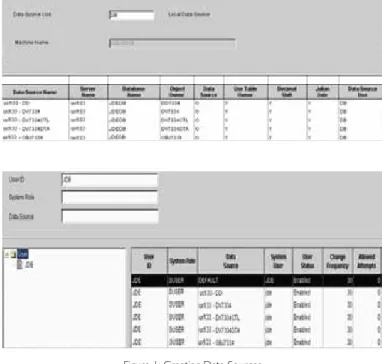
3.Data Source Creations: Data Sources in current JDE Legacy system should be created which point to target schemas on Oracle DB. The migration user should be identified and access should be provided to the new data sources created.
Migration of JDE database server from DB2/400 to Oracle involves several steps :
Does not scale well horizontally i.e., difficult to integrate with other operating systems
Limited third party software
Best vertical scaling
Greater stability compared to windows Lesser susceptibility to virus attack Better third party software support
Support on majority of operating systems available Cost Effective than DB2
Benefits
Faster Database Migration - Typically, an enterprise with high volume of data ranging in TBs may prefer using such tools
Easy to track migration and test results - GUIs and conversion logs help track and test the migrated data better
Technology partners such as Wipro bring in significant experience in performing complex migrations. They help enterprises plan and execute the migration better and faster with minimal chances of data corruption or miss. They also reduce the capital and operating expenditure of the third party tool for the enterprise.
Challenges
High Cost of the tool - Enterprises with significantly low amount of data may not find it necessary to invest in such migration tools
Database Value conversion mismatch- Some key Data Fields may have possible datatype mismatch post migration. All third party tools do not take care of the JDE database datatype conversions, leading to data corruption.
Figure 1: Creating Data Sources
Where JDEDB & ux1133 are the new JDE Oracle Database and Server names respectively
4. Identification of Library sizes on AS400: The current library sizes should be tracked and the target Oracle schema sizes should be resized accordingly.
Few best practices that can help enterprises reduce the cost of migration and mitigate performance issues that may arise post migration are:
Best practices for Database Migration
Using standard JDE Batches to perform the migration
Using Standard JDE Batches takes care of all database data-field type conversions across databases during the data migration. The log files generated during the migration gives the record count, conversion time for each table in the database. This helps plan the Go-Live migration approach with specific timelines.
The standard Universal Batch Engines (UBEs) for data migration also takes care of the table and Index creation. This reduces the chances of possible spec or index corruption drastically. Also, the data compatibility with the JDE programs/application logic is taken care of.
Using standard UBEs and interactive methods to verify the data sanity
The data once migrated needs to be verified for completeness and sanity. Since the migration is done using standard UBEs data sanity is taken care of by the JDE process. Manual interactive methods need to be implemented to check the data completeness post migration in the new database.
Verifying corrupt or missing indices and object build specifications
Post Migration spec and indices need to be verified to avoid any performance degradation. The same is verified and missing or corrupt indices are rebuilt.
Comparing the table record counts from source and target schemas/libraries to verify successful data copy.
Executing index and specification verification UBE to verify the data table specifications and indices post migration.
Verifying the data copy log files generated during migration.
7. Migration Verification: Data sanity across the two platforms should be conducted and includes
Each of these steps helps verify the objects and corresponding records in the current system.
Figure 4 : Running the Migration Reports
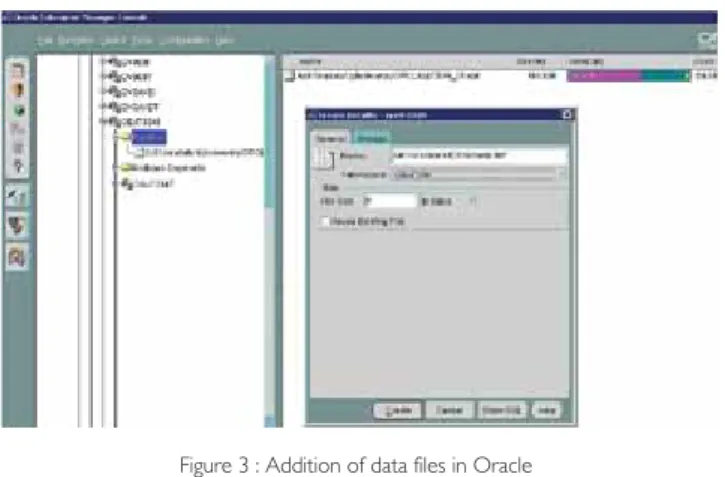
5. Addition of data files in Oracle as per the sizes identified above.
6. Running the Migration Reports: Database Creation UBE is selected and executed with appropriate processing options for source (DB2) and target (Oracle) data source details.
Figure 3 : Addition of data files in Oracle Figure 2 : Identifying the Library sizes on AS400
About The Author
Ashish Kumar Mandal has around 6.5 years of industry experience as a JD Edwards CNC Administrator / Consultant performing system study, requirements gathering, server sizing, performance tuning, analysis, design and development for JD Edwards ERP administration. He has extensive experience in Server Installation, Upgrade, Server and Database Migration, System Administration, Package Management and CNC Implementation for various EnterpriseOne releases.
At the time of writing this paper, Ashish was working on a cross platform data migration and JDE release upgrade project. As part of the project, the responsibilities included project planning, being cross-skilled to take up activities like Load Runner script development for performance testing, data migration, Go-Live and post production support.
DB2 - Oracle database migration procedure ensures timely and accurate migration of data from legacy DB2 database to target Oracle database using standard JDE reports. As like any approach, this migration procedure has its advantages and disadvantages.
Conclusion
Ensures data sanity while migration from source to target database; verified by migration logs and table counts.
Multiple migration reports can be executed from different terminals with specific data selections for simultaneous data migration.
Execution process if interrupted does not require entire data copy. Migration process can be resumed from the last erroneous table. Standard JD Edwards processes followed for the migration, no additional costs incurred on procuring third party migration tools.
Evaluating and selecting the right migration procedure is critical for an enterprise to migrate effectively. For this, experts such as Wipro can play a major role and pave the way for success.
Disadvantages
Process may not suitable for large databases where database size exceeds 1 TB.
Time consuming process compared to third party migration tools available in the market like SQLWays.
© Copyright 2012. Wipro Technologies. All rights reserved. No part of this document may be reproduced, stored in a retrieval system, transmitted in any form or by any means, electronic, mechanical, photocopying, recording, or otherwise, without express written permission from Wipro Technologies. Specifications subject to change without notice. All other trademarks mentioned herein are the property of their respective owners. Specifications subject to change without notice.
WIPRO TECHNOLOGIES, DODDAKANNELLI, SARJAPUR ROAD, BANGALORE - 560 035, INDIA TEL : +91 (80) 2844 0011, FAX : +91 (80) 2844 0256, email : [email protected]
North America South America Canada United Kingdom Germany France Switzerland Poland Austria Sweden Finland Benelux Portugal Romania Japan Philippines Singapore Malaysia Australia WWW.WIPRO.COM NYSE:WIT