Jennifer S. Scully. Online Educational Resources on Presidential Library Websites
Administered by the National Archives and Records Administration. July 2012. 38 pages. Advisor: Ronald Bergquist
This study describes an analysis of the educational resources found on the thirteen presidential library websites that are administered by the National Archives and Records Administration. The survey was conducted to determine the availability, variety, and content present online among the presidential websites. All of the libraries provided some educational resources from lesson plans, bibliographic, biographic, primary source, curriculum guides, and other resources. The most beneficial to teachers are the resources like lesson plans and the guides to understanding the curriculum and the primary sources in regards to the collection. None of the libraries examined provided all of these valuable resources to the educator but rather a combination of some of the resources.
Headings:
ONLINE EDUCATIONAL RESOURCES ON PRESIDENTIAL LIBRARY WEBSITES ADMINISTERED BY THE NATIONAL ARCHIVES AND RECORDS
ADMINISTRATION
by
Jennifer S. Scully
A Master’s paper submitted to the faculty of the School of Information and Library Science of the University of North Carolina at Chapel Hill
in partial fulfillment of the requirements for the degree of Master of Science in
Information/Library Science.
Chapel Hill, North Carolina July 2012
Approved by
Table of Contents
Introduction ... 3
Literature Review... 3
Educational resources on cultural heritage sites ... 3
Presidential library systems ... 5
Education in presidential libraries ... 6
Presidential libraries web presence ... 9
Methods... 10
Educational Resources ... 14
Results ... 17
Conclusions ... 25
Works Cited ... 28
Appendix A: Presidential Library and Museum Web Sites ... 32
Table of Figures
Figure 1: LBJ Library: Explanation of the change in website address ... 12
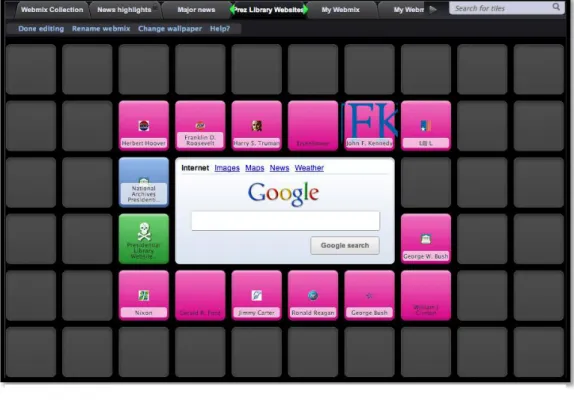
Figure 2: Symbaloo Reference Tool ... 13
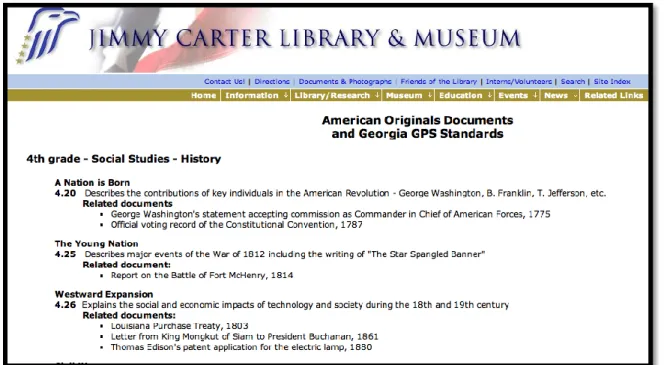
Figure 3: Jimmy Carter Library & Museum: Example of a web resource addressing the state curriculum standards... 15
Figure 4: Gerald R. Ford Library and Museum Website: An example of external website notification ... 16
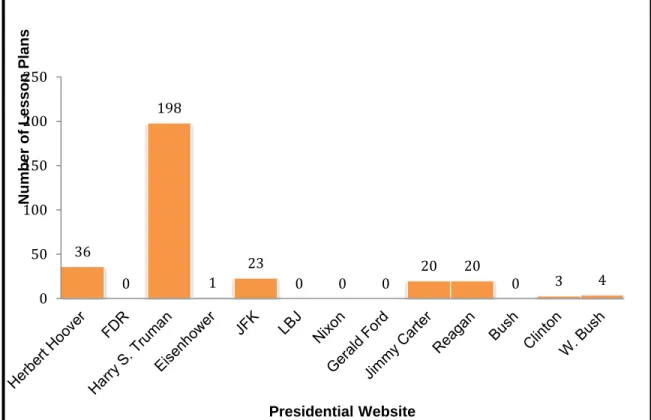
Figure 5: Number of Lesson Plans... 18
Figure 6: An example of an exhibit not meeting research criteria ... 21
Figure 7: An example of an exhibit that does meet research criteria ... 22
Figure 8: An example of an interactive game ... 23
Introduction
Presidential libraries were established to preserve the documents and legacies of the presidents who have served our country. Before the presidential library system many private groups and organizations had established foundations to preserve presidents’ collections such as the Thomas Jefferson Monticello Foundation for Thomas Jefferson and the James Monroe Museum and Memorial Library. However, these libraries were not sanctioned by the National Archives and Records Administration (herein after referred to as NARA) and the presidential library system, which has only covered the presidents since Herbert Hoover.
The presidential library system began in 1939 when Franklin D. Roosevelt donated his papers to the federal government and established a library and museum to preserve his presidential history. According to the Presidential Libraries: A Brief History on the National Archives website, “Roosevelt's decision stemmed from a firm belief that Presidential papers are an important part of the national heritage and should be accessible to the public. He asked the National Archives to take custody of his papers and other historical materials and to administer his library” (National Archives and Records Administration [NARA], 2010).
In House Report No. 110 (2007), the Committee on Oversight and Government Reform summarized the Presidential Libraries Act (1955) as guidelines and procedures for federally maintained libraries and “…established a policy for creating federally
maintained presidential libraries that are built with private funds. The Act requires
foundations or other organizations to raise money and build the libraries” (NARA, 2010).
Subsequently after they have been built and the president has left office, the libraries are
then passed over to National Archives and Records Administration to administer.
The Presidential Records Act (1978) declared all documents created during the presidency as property of the state and directed these documents to be turned over to NARA once the president left office. It also legally made these documents public property rather than private property and set guidelines for the restriction and public access of these documents. “Specifically, the PRA allows for public access to Presidential records through the Freedom Of Information Act (FOIA) beginning five years after the end of the Administration, but allows the President to invoke as many as six specific restrictions to public access for up to twelve years” (NARA, 2010).
The Presidential Libraries Act (1986) required private endowments to be created to help relieve the financial obligations of NARA.
and George W. Bush. These presidential libraries and museums are important resources for finding information regarding the Presidents of the United States of America. Each of the libraries also has a presidential library website where users can find information and digital collections of important historic documents. Presidential libraries are unique institutions because they are a blend of library, repository, archive, museum, and special collections. The Office of Presidential Libraries oversees the libraries and describes them on the website page Learn about the Presidential Libraries as,
…not traditional libraries, but rather repositories for preserving and making accessible the papers, records, and other historical materials of U.S. Presidents. Presidential Libraries and Museums are great treasures of our nation’s history. They are important sources for historians and other researchers studying our presidents and our history. In addition to archiving and preserving presidential papers and objects, presidential libraries and museums bring history to millions of visitors from around the world. (NARA, 2010)
Also, as these libraries begin to digitize their collections on their websites their
collections are becoming more accessible. In a Report to Congress (2009) the libraries
were mentioned in regard to the internet, “Over the last 20 years, the Internet has
transformed information delivery and public expectations. It has also provided an opportunity for the Presidential Libraries to expand the knowledge of Presidential records to a much broader audience” (p. 29-30).
As a former teacher, the author found that she looked for websites that helped bridge the gap between primary source collections and the classroom by providing resources that were directed to the educator. This paper will explore the online
the professional resources that provide helpful information to assist teachers in their classrooms.
Literature Review
The following section reviews the literature related to the research topic of this paper. Some literature regarding digital technologies and resources discusses how they have changed education as well as enriched it. These studies also highlight the effective presentation of these digital resources. Other studies focus on the presidential libraries themselves and the unique administrative and financial differences that each individual library faces. Studies focus on educational resources and initiatives in the presidential library system, discuss the types of educational programs, the change in them over the past 40 years, and where the programs have been provided.
Educational resources on cultural heritage sites
Some of the literature related to digital technology and resources on educational websites discusses how these resources enrich educational practices. For example, Weiss, Benmayor, O’Leary, and Eynon (2002) suggest that these new digital
technologies and libraries, “…are transforming our classrooms from spaces of delivery to spaces of active inquiry and authorship” and are, “…empowering students to become researchers, storytellers, historians, oral historians, and cultural theorists in their own right” (p. 154).
advertise themselves to a national or even a global audience. They are places where museums can actually bring the educational experience right into the virtual visitor’s home or classroom” (Lantzer, 2003, para. 40).
Beal, Mason and Martorella (2009) agree and state, “Teachers and students are no longer limited by the resources within a school to learn about a topic….they now have access to millions of resources such as e-texts, movie clips, art, data, primary sources and maps” (p. 284). Also Bolick, Hicks, Lee, Molebash, and Doolittle (2004) state that by, “Providing teachers and students with opportunities to access materials for the purpose of historical inquiry will enrich history instruction in unique and powerful ways” (p. 212).
Other literature focuses on effective use of digital resources on cultural heritage sites. Digital archives and collections can be overwhelmingly vast and teachers need bridges to help them find the right material to use with their students. Teachers also need to teach historical context when using digital archives and to be able to scaffold student learning. Tally (1996) found that, “Teachers need, in short, lesson plans or student research guides, that suggest how parts of a vast collection can be used to accomplish common curriculum objectives, and that also suggest helpful supplementary reading.” Bolick et al. (2004) reinforce the importance of having resources about how to use the digital library resources like digital history toolkits, available to educators:
We believe that the most effective toolkits should include a combination of descriptive, analytical, and evaluative tools. While toolkits have some
Also there is an emphasis on the importance of the educator in the development of these resources. Cherry (2010) sees an issue with the development of some educational material for digital collections and argues that, “…there has been very little—almost nothing—written about educating the digitizers about more effective presentation of their materials for the schools (italics in original)” (p. 446-447). Although libraries and special collections have seen themselves as important to the dissemination and availability of historic information for education, Cherry states,
…there has been very little published in the professional archives and library literature concerning the research into cognitive development and historical thinking, not to mention the resulting strategies for structuring and
contextualizing online primary source materials for the classroom. (p. 447) Presidential library systems
Much of the research on the presidential libraries discusses how each library is administered and funded. According to the NARA website, each library is run by the Office of Presidential Libraries, which is a subgroup within NARA that, “…oversees budget submissions for the system [and] coordinates the development and
implementation of NARA policies and procedures.” Each library also is administered by
an “individual support organizations.” These organizations are responsible for planning, funding, and development while the president is still in office. These “support
Cochrane (2006) describes how each presidential library is funded and administered in very different ways. They are partly funded by NARA but also must seek additional private funding. She argues that these libraries and their exhibits, collections, and websites vary greatly in content, design, and accessibility from one another. She attributes this to the decentralized nature of the relationship between the library and the government.
Hackman (2006) argues that NARA should have a more active role in the
administration of presidential libraries and implement, “better policies and practices” (p. 183). Hackman (2006) also argues that NARA’s top priority is to preserve government documentation of the current present and the most recent president who left office but that the entire system needs attention because, “the public, and prime supporters as well are unable to know what each library, individually and as part of this system, is seeking to accomplish and how”. He does not think that strategic planning would threaten the individuality of each library but rather,
Would raise the level of internal analysis and communication and improve decision making and the allocation of resources within libraries and across the system. And it should also improve communication, resource development, and program coordination with the nongovernment partners and supporters that NARA prizes so highly.” (p. 172)
Education in presidential libraries
educational dimension at the Presidential Libraries has been given any real thought” (Baptiste, 2007).
Literature on educational programs is becoming more abundant as awareness that these institutions should be used for educational purposes also increases. Baptiste and Townsend (2008) found that before the 1970s there were no official education programs, “If ‘programs’ existed at all, they consisted mainly of worksheets for students to
complete when their class visited the Library's museum” (Minimal efforts section, para.
1). Potter argues that around the 1980s libraries started encouraging the use of historical documents during visits or in the classroom and by the 1990s some libraries were
participating in the National History Day Program (as cited in Baptiste and Townsend,
2008 , Minimal efforts section, para. 2).
Hackman (2004) discusses that some libraries seemed to be more aware of the need to provide students and teachers with resources. He attributes this to several reasons:
strong examples provided by the Hoover and Truman libraries in the late nineties, encouragement from the Office of Presidential Libraries which brought together education staff in the libraries, a 2000 survey and report on education programs in the libraries by the Office of Presidential Libraries, and the efforts of this office to help the libraries hire professional educators when opportunity has arisen. (p. 22) In addition he finds that most decisions about the programs were coming from the individual libraries,
though the Office of Presidential Libraries has fostered the sharing of experience through more frequent meetings of specialists within the libraries, including education specialists and museum curators. But no significant policies or
Hackman argues that libraries lacked strategic plans and urges the Office of Presidential Libraries to require the libraries to have strategic visions, support the creation and planning of the plan and to publish them online.
Just two years later, Potter examines the development of educational programs that were available to both younger children and teens. She finds that the programs aimed at older students, “ranged from contests to the facilitation of on-site research and elaborate simulation experiences” (p. 135). Also she discusses the outreach efforts of the museums to bring education to the classroom like “traveling trunk programs and video lending libraries” (p. 136). Potter’s research primarily focuses on programs within the physical library and travelling outreach programs. She briefly notes that the websites offered,
a section specifically for educators and students, but they vary greatly on the depth and breadth of their offerings. Most explain procedures for scheduling guided tours for school groups, some offer detailed descriptions of their programs for educators and students, a few offer lesson plans…and all offer biographical information about their respective president. (p. 138)
The scope of what was available online to educators was not examined fully in this report.
educating the public. Han provides suggestions for the Korean presidential library drawing from his observations of the U.S. libraries.
Han, like Potter, focuses on educational programs that were for the most part physical real-life experiences that would occur at Presidential Libraries and Museums like school group tours, programs, and professional development for teachers.
Presidential libraries web presence
Literature concerning the preservation of presidential library websites was available. Gupta conducts a case study using the Franklin D. Roosevelt Library and Museum and looks at the long time preservation goals. His goal is to “determine how these valuable collections can be preserved within an arbitrary persistent store in a scalable, infrastructure independent manner” (p. 3). He proposes an infrastructure-independent representation of Presidential Library websites and suggests that the data on these websites should be in a database.
Several observations can be made from the literature review presented above. First, the education world is moving to using more digital resources and thinking about how to most effectively present these to educators. Presidential libraries are unique institutions that house collections of primary sources that can be used for educational purposes by teachers. However, most of the literature on the resources has focused on the educational program in place at the physical libraries and fails to go into much detail about what is available online. The research in this study will focus on the educational resources available on the websites like lesson plans, curriculum alignments, primary sources, interactive exhibits, and virtual experiences that would be considered online educational resources. Another thing to consider is that many of the sites have been updated, revamped, or migrated to new sites in the past six years.
Methods
The purpose of this research was to investigate the current online educational resources available to educators on the thirteen presidential library and museum websites. A parallel purpose was also to determine the types of resources available and to examine the consistency of them from website to website.
these websites. However, a first glance at a presidential library website would not inform an educator of the variety and type of resources that would be available.
The web addresses for the thirteen presidential library websites administered by NARA were obtained from the National Archives Presidential Library and Museum’s page called “Visit the Libraries Online” at
http://www.archives.gov/presidential-libraries/visit/websites.html and are included in Appendix A. This presidential libraries and museums website list did not include the current Barack Obama presidential library website which is currently still in development. Also the link from the NARA website to George W. Bush’s presidential website directs the user to a page that states that the website has moved to another address and provided the link
The website addresses were compiled and then entered into a symbaloo.com account, which is a free site to bookmark websites, a quick and convenient way for the researcher to access to the presidential library website addresses.
The data was collected over a twenty-four hour period by the researcher to maintain accuracy and consistency in the collection of the information.
The data collected reflected the types of educational materials and resources that were available online. ”Online” meant that the resources were found on the libraries’ identified servers, accessed using a computer and did not require the teacher or child to visit the specific presidential library or museum to use these resources. Past research has emphasized the educational programs available at the libraries and although they are educational resources, this study excluded programs that were located at the physical location and focused on the online resources. Lesson plans or activities that were intended to be used at the library like the webpage “Elementary School Field Trips to the Herbert Hoover Presidential Library-Museum Pre & Post Visit Activities”
(http://www.ecommcode.com/hoover/hooveronline/PrePostActivities/boyhood.html) were not counted as online resources.
This study investigated the educational resources available on the presidential library and museum websites particularly in respect to the lesson plans, multimedia resources, resources for helping teachers, biographical information about the president, and bibliographic resources. All of these sites have digitized material available for researchers and are valuable resources. However, this study was looking for already developed resources for educators. The presidential libraries and museums are different from one another and therefore it was important to develop criteria for each of the elements before recording it on a spreadsheet (see Appendix B).
Educational Resources
Educational Resources identified were resources that would help educators teach about the presidents and history without having to leave the classroom.
Lesson plans:
o Yes/No: Recorded if they did or did not have them. These lesson plans had to be hosted at the presidential library website not a link to an external lesson plan on another website.
o Number: of lesson plans excluding ones that included a physical visit to the library.
o Alignment: If the lessons were aligned to the state or national standards.
Teacher resource for using resources for understanding the state or national
educational standards: This would include a page of the standards and what documents on the site would address those standards like this example from the Jimmy Carter Library and Museum.
Other online resources:
o Exhibits: included both interactive and static exhibits but descriptions of exhibits that were permanently, currently, or previously on display at the museum were excluded unless the content from the exhibit was displayed. If there was a link to an exhibit on an external site it was also excluded like this one on the Gerald Ford website.
o Virtual tours: video or virtual tour of the museum or library.
o Interactive game: game for students to interact with on the site about the president or his lifetime.
o Podcasts: podcasts with presidents, staff, library and museum staff, audio tours of museum were all included.
Primary Source Resource: identified if there was a resource for using primary
sources for learning; recorded it if it was targeted for both students and teachers specific help for teachers.
Biographical Resource: not a link, not a source but historic information regarding the
president and his life.
Bibliographies: both bibliographies and links to online resources. List of links to
online sources, external links, or reading lists.
Before collecting the data a sample experiment was conducted to ensure the criteria definitions were defined enough. To assess the rating system for the criteria
another librarian was asked to participate in a sample trial of extracting the information from the websites. This was performed to check the inter-rater reliability of the study meaning to examine the extent to which the two individual agreed. The information that the two individuals collected on the sample presidential library website were compared and discussed. Some of the criteria was tweaked and perfected before the researcher completed all of the research.
Results
Educational resources in this study referred to the online resources available to educators to assist them to teach in their classrooms without having to physically visit the library and museum. All of the websites were very different in their design and layout however every one of them had a place specifically for educators/teachers to use.
The range of the number spans from none to almost two hundred lesson plans at the Truman Library and Museum. Some of the libraries and museums that were not included as offering lesson plans did offer a few lessons but they required the teacher and class to physically visit the presidential site. Also some of the libraries offered teaching suggestions, which teachers could use to produce lessons.
The combined number of lesson plans available to educators was 305. Of these 305 lesson plans all eight of the presidential libraries and museums had these aligned to the state standards of the state that they were located within. So one hundred percent of the lesson plans were aligned to the state standards and told teachers exactly what objectives could be taught with them.
36
0
198
1 23
0 0 0 20 20 0 3 4
0 50 100 150 200 250 Nu mb er o f Lesson P lans Presidential Website
Only two of the 13 libraries had links to lesson plans that were hosted on external websites. The two libraries that had external lesson plans available were the Nixon and Jimmy Carter Presidential Libraries and Museums. The Jimmy Carter Website had 22 external lesson plans, which were hosted by the Jimmy Carter Center. These 22 lessons were actually developed units and were rich with resources and primary documents. Georgia state educators developed these units with money funded by Coca Cola. The Nixon Website had one external lesson plan, the link was to a lesson plan on the National Archives website titled “Teaching With Documents: Beyond the Playing Field - Jackie
Robinson, Civil Rights Advocate” found at
http://www.archives.gov/education/lessons/jackie-robinson/.
Multimedia features were present on the websites that could be used by teachers to enhance their classrooms. Most of the websites provided something in addition to a collection of primary sources for their users.
The exhibit above shows a past exhibit and while it has pictures of the exhibit it only has a description of the physical layout and not the content of the exhibit like the video or informational place cards present in the images. An example of an exhibit that was included as a research for teachers would be the Gerald R. Ford Library and
Museum’s online exhibit about investigating Watergate (on the following page):
This exhibit allowed viewers to investigate Watergate from the trial to the Senate hearings, the battle for the tapes, trials and tribulations, and the aftermath. It also offered primary source documents for examining, an overview, people, a timeline, and movie reels.
Virtual/video tours in this study meant a virtual or video tour of the library or museum and was not referring to videos clips from the presidents’ archives. Three of the 13 (23%) libraries had virtual or video tours of the museum or library available for
viewing online. Although this did not include audio tours it is worth noting that the George H. W. Bush Library did provide an audio tour of the museum online.
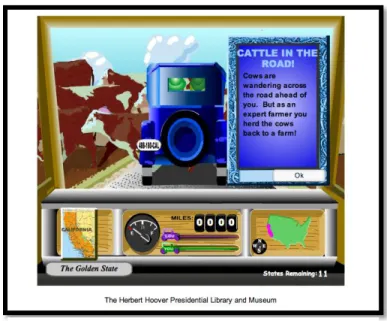
Interactive games were available on two of the 13 (15%) websites; the Eisenhower and FDR libraries had these for students to play. The Herbert Hoover website had two games: for example, one of them on the Herbert Hoover website students could drive across America answering facts about the states that they were driving through:
It’s worth noting that the Lyndon B. Johnson website did not have a game, but that they used to have one on the previous website. LBJ Presidential Library and
Musuem was the newly migrated site but it is possible that some of the content still may be migrated to the newer site in the future.
Each site was examined to see if there were podcasts available to online users to listen or subscribe to. Podcasts in this case meant that they were podcasts of the
presidents, staff, library and museum staff, or audio tours of museum. Five of the 13 (38%) websites provided access to podcasts.
As for having resources for understanding and teaching primary sources many of the websites provided information for understanding primary sources within a lesson plan or provided analyzing primary source worksheets for students. However only four of the 13 libraries provided a stand alone document/guide to assist teachers in teaching about primary sources like this one:
It is important to note that the Herbert Hoover resource was specific to
understanding photographs as primary sources in the classroom but was included because it was a stand-alone resource. But if the websites that did include a lesson plan or
provided primary source worksheets for students for understanding primary sources then the number would be double and would be eight of the 13 libraries.
Biographical resources provide information, often chronological, about a person’s life. Students and teachers both can use these to discover more about the president but not specifically just his presidency. All 13 of the presidential websites offered online users biographical sketches of the presidents lives and most of them also had a biographichal sketch of the first lady.
Bibliographic resources in this study were collections of additional books and/or websites about the president that users could use to find more information. Teachers can use these to quickly access more information for their professional knowledge or for their classrooms. 11 of the 13 (85%) websites had resources for learning more about the president. A few of these websites even provided separate lists one for teachers and one for students like the Gerald R. Ford Presidential Library and Museum’s website.
Conclusions
available to teachers on the sites. This variety is due to the fact that these libraries are unique from one another and also that some have been more successful than others at procuring private funding to develop such resources on their websites. For example, at the Jimmy Carter Library and Museum, an educational grant from Coca Cola allowed the library to work with educators to develop rich educational units developed by teachers. However, it would have been beneficial to educators if these sites consistently provided them lesson plans, primary source resources, and curriculum guides regarding the collections to best inform their students in their classrooms.
Many of the libraries hosted content that was developed by educators for
educators by providing educational summer seminars/workshops for teachers where these resources were created and then were put onto the websites. Educational specialists in these libraries need to seek and write grants to find money to fund programs that will foster collaboration between teachers and the library to produce these valuable resources. These resources need to continue to be created by educators in the state in which the library is located because they are the local experts.
Usability was not considered in this study but it is important to note that it may need to be further examined in regards to the education materials available online on these sites. Some resources may not have been identified because the author was unable to locate them on these sites. Also libraries could consider doing usability studies about their educational resources.
how they use the website currently for educational purposes. Surveys could be informal and could occur in the physical library when school teachers and classes visit, or online, or it could target teachers around the state where the presidential library is located.
In conclusion the presidential library websites have a web presence that has evolved over the years as the internet and digital collections have become more common place. Also schools and educators are seeking more resources online because of
Works Cited
Baptiste, H. P. (Ed.) (2007). The U.S. presidency and social justice: Implications for public education. San Francisco: Caddo Gap Press.
Baptise, H. P., & Townsend, K. (2008). Examining the presidential libraries: students find biases and recommend a multicultural perspective. Multicultural
Education, 16(1), Retrieved from
http://www.freepatentsonline.com/article/Multicultural-Education/193510682.html
Beal, C., Mason Bolick, C., & Martorella, P. (2009). Teaching social studies in middle and secondary schools. (5th ed., p. 423). Boston: Pearson.
Bolick, C.M., Hicks, D., Lee, J., Molebash, P., & Doolittle, P. (2004). Digital libraries: The catalyst to transform teacher education. AACE Journal, 12(2), 198-217. Retrieved from http://editlib.org/p/4813
Cochrane, L. S. (2006). Is there a presidential library subsystem?. The Public Historian, 28(3), 143-164.
Fawcett, S. (2006). Presidential libraries: A view from the center. The Public Historian, 28(3), 13-36. Retrieved from
http://www.jstor.org/stable/10.1525/tph.2006.28.3.13
Gupta, A. National Archives and Records Administration and Advanced Research Projects Agency ITO Intelligent Computing Testbed, San Diego Supercomputer Center TECHNICAL REPORT. (2001). Preserving presidential library websites. Retrieved from
http://scholar.googleusercontent.com/scholar?q=cache:qxJQTHxaUp4J:scholar.go
ogle.com/&hl=en&as_sdt=0,34
Hackman, L. J. (2004). Presidential libraries: A background paper on museums and their public programs. Museums in presidential libraries, Princeton, NJ. Retrieved from http://www.princeton.edu/~artspol/Presidential Libraries A Background Paper December 2004.pdf
Hackman, L. J. (2006). Toward better policies and practices for presidential libraries. The Public Historian, 28(3), 165-184. Retrieved from
http://www.jstor.org/stable/10.1525/tph.2006.28.3.165
Development & Technology, 1(1), 39-60. Retrieved from
http://www.ijkcdt.net/journal/ijkcdt/vol1_no1/ijkcdt_vol1_no1_a03.pdf
H.R. Rep. No. 110, 110th Cong., 1st Sess. 43. (2007) Retrieved from U.S. Government Printing website: http://www.gpo.gov/fdsys/pkg/CRPT-111hrpt43/pdf/CRPT-111hrpt43.pdf
Lantzer, J. S. (2003). The public history of presidential libraries: How the presidency is presented to the people. Journal of the Association for History and Computing, 6(1), Retrieved from http://hdl.handle.net/2027/spo.3310410.0006.101
National Archives and Records Administration Office of Presidential Libraries. (2010). Learn about the presidential libraries. Retrieved from
http://www.archives.gov/presidential-libraries/about/
National Archives and Records Administration Office of Presidential Libraries. (2010). Presidential libraries: A brief history. Retrieved from
http://www.archives.gov/presidential-libraries/about/history.html
National Archives and Records Administration. (2009). Report on alternative models for
presidential libraries issued in response to the requirements of PL
110-404. [Washington, D.C.] : National Archives and Records Administration.
Retrieved from www.archives.gov/presidential-libraries/reports/report
Potter, L. (2006). Education programs in the Presidential Libraries: A report from the field. The Public Historian, 28(3), 133-142.
Tally, B. (1996). History goes digital: Teaching with the Web in the classroom. Retrieved February 20, 2007, from http://www.dlib.org/dlib/september96/09tally.html
Weis, T., Benmayor, R., O, C., & Eynon, B. (2002). Digital technologies and pedagogies. Social Justice, 29(4), 153-167. Retrieved from
http://libproxy.lib.unc.edu/login?url=http://search.proquest.com.libproxy.lib.unc.e
Appendix A
Presidential Library & Museums Web Sites:
Herbert Hoover Library http://hoover.archives.gov/
Franklin D. Roosevelt Library http://fdrlibrary.marist.edu/
Harry S. Truman Library http://trumanlibrary.org/
Dwight D. Eisenhower Library http://eisenhower.archives.gov/
John F. Kennedy Library http://jfklibrary.org/
Lyndon B. Johnson Library http://lbjlib.utexas.edu/
Richard Nixon Library http://www.nixonlibrary.gov/
Gerald R. Ford Library http://www.fordlibrarymuseum.gov/
Jimmy Carter Library http://jimmycarterlibrary.gov/
Ronald Reagan Library http://www.reaganlibrary.com/
George H. W. Bush Library http://bushlibrary.tamu.edu/
Clinton Presidential Library http://clintonlibrary.gov/
Appendix B: Data
H o o ve r FD R Tr u m an Eisen h o we r JFK LBJ Nixon Ford Carte
r R e ag an GHW B u sh Cl in to n GWB u sh
Lesson plans y/n y n y y y n n n y y n y y
# 36 0 198 1 23 0 0 0 20 20 0 3 4
Aligned to standards y y y y y y n y y External LPs 0 0 0 0 0 0 1 0 22 0 0 0 0
Resource for
curriculum/standards
n y n n n n n n y n n n n
Multimedia
interactive exhibit n y n n y n y y n y y n y online exhibit y y n n y n y n n n n n n
virtual/video tours n n n n y n n y n y n n n interactive games y n y n n n n n n n n n n
podcasts n n y n y y n n n y y n n
Resource for Primary sources y y n y n n n n n n n n y
Biographical Resource y y y y y y y y y y y y y
Bibliography/Related links y y y y y n y y y n y y y
Hoover: photographs
FDR: Few suggestions in curriculum guide
LBJ: on old website but has not been migrated to this new one Nixon: analysis worksheets for analyzing primary sources Ford: bibliographic info for both students and teachers Ford: analysis worksheets for analyzing primary sources
Carter: Carter center website. LP are called units very well developed (Coca Cola funded), some of the units have resources for primary sources
Reagan: one lesson plan addresses primary sources but not a resource on its own GHWBush: 12 lessons but had a required visit to the museum