ABSTRACT
A three-dimensional model for the simulation of transient groundwater flow is devel¬ oped. The model is called REGFED for REGional flow using Finite Elements and Dif¬ ference methods. A review of groundwater flow and contaminant transport concepts and theory reveals that three-dimensional representation of groundwater systems is essential for realistic simulation of flow and transport. From an analysis of currently available
ground-water flow models and algorithms, it is apparent that a mixed numerical method consisting
of finite-elements and finite diff"erences is a suitable method for solving the groundwater
flow equation in three dimensions. An algorithm known as ALALS (Alternate sublayer
And Line Sweep) is selected for the basic model algorithm.
Finite elements are applied to areal components, and flnite differences are applied to vertical components of flow. The model accomodates both conflned and unconfined groundwater flow problems and is also capable of handling the draining and refilling of individual elements or entire layers. Because of the model's efficient algorithm, it can accomodate thousands of nodal unknowns with minimal computer storage and CPU time. Quasilinear unconfined groundwater flow problems are solved using a Picard iteration scheme. Entire confined layers are skipped in the iteration scheme in order to decrease the CPU time required to solve the problem. The model is validated under a wide assortment of conditions including confined flow, confined flow with partially screened wells, unconfined
flow, combined confined/unconfined flow, and flow with drained and refilled layers. A
heuristic error analysis shows that model results compare well with validation results. Mass-balance errors for various groundwater flow problems are minimal for most cases.
The convergence speed and stability of the iteration scheme is evaluated for solu¬ tion of unconfined groundwater flow problems. A benchmark comparison using sample groundwater flow problems was performed with the REGFED model and with the USGS McDonald-Harbaugh model. Example applications further demonstrate the flexibility of the model.
TABLE OF CONTENTS
Table of Contents ... ii
List of Figures... iv
List of Tables... vi
Acknowledgements... vii
1. Introduction ... 1-1
1.1 Background and Motivation ... 1-1
1.1.1 Relationship between Groundwater Flow and Contaminant Transport 1-1 1.1.2 Importance of Modeling Flow in Three Dimensions ... 1-5
1.1.3 Importance of Modeling Unconfined Flow... 1-9
1.2 Research Goal and Objectives ... 1-13 1.3 Methodology... 1-15 2. Theoretical Background and Literature Review... . Z'i 2.1 Governing Equations for Groundwater Flow ... 2-1 2.1.1 Theory: Darcy's Law... . 2-1 2.1.2 Theory: Groundwater Flow Equation ... 2-2 2.1.3 Theory: Unconfined Groundwater Flow ... 2-4 2.2 Solutions of Groundwater Flow Equations... 2-5 2.2.1 Analytical Flow Models ... 2-5
2.2.2 Numerical Flow Models ... 2-6
2.2.3 Indirect Velocity Estimation ... 2-12 2.2.4 Direct Velocity Estimation... 2-14 3. Development of Confined Flow Model ... 3-1 3.1 Overview of Model Algorithm ... 3-1 3.2 Derivation of Algorithm... 3-2 3.3 Application of Boundary Conditions and Source and Sink Terms .... 3-13
3.4 Matrix Solution Methods ... 3-16 3.5 Other Model Features... 3-18
3.5.1 Steady-State Case...,... 3-18
3.5.2 Mass Balance Computation... 3-19 4. Development of Unconfined Flow Model ... 4-1 4.1 Overview of Model Algorithm ... 4-1
4.2 Picard Iteration... 4-3
4.3 Skipping Confined Layers ... 4-6 4.4 Draining, Refilling Selected Nodes... 4-8
4.5 Storage Estimation... 4-12
5. Testing of Model Accuracy and Sensitivity ... 5-1
5.1 Confined Flow... 5-2
6. Model Applications ... 6-1
6.1 Two-Well Tracer Test... 6-1
6.2 Flow within a Multi-Level Monitoring Well... 6-4 6.3 Flow in an Aquifer/Aquitard Groundwater System ... 6-7 6.4 Comparison with McDonald-Harbaugh Model ... 6-10
7. Conclusions and Recommendations... 7-1 7.1 Conclusions... 7-1 7.2 Recommendations... 7-1 8. Notation... 8-1 9. References ... 9-1
LIST OF FIGURES
1.1 Heterogeneities Influencing Dispersion... 1-6
1.2 Typical Three-Dimensional Groundwater Flow and Transport Problem . . 1-8
1.3 Vertical Variations in Hydraulic Conductivity... 1-10
1.4 Hypothetical Layered Aquifer... 1-11
1.5 Comparision of Vertically Averaged and Layered Contaminant Transport
Simulations... 1-12
1.6 Confined and Unconfined Aquifers ... 1-14
2.1 Effect of Semi-Confining Layer on Groundwater Flow... 2-10
3.1 Three-Dimensional Discretization of Aquifer Domain ... 3-4
3.2 Block-Centered Approach ... 3-7
3.3 Linear Triangular Finite Element... 3-11
3.4 Flow Diagram for ALALS Algorithm ... 3-14
3.5 Typical Boundary Conditions for Groundwater Flow ... 3-15
3.6 Flow Diagram for Steady State Case... 3-20
4.1 Schematic Represntation of Saturated Thickness ... 4-4
4.2 Flow Diagram for Picard Iteration ... 4-7
4.3 Illustration of Layer-Skipping... 4-9
4.4 Flow Diagram for Layer-Skipping... 4-10
4.5 Draining and Refilling of Nodes... 4-11
4.6 Flow Diagram Draining/Refilling Nodes... 4-13
4.7 Unconfined/Confined Nodes ... 4-15
5.1 Single Pumped Well, Radially-Symmetric, Homogeneous Aquifer . . . 5-3
5.2 Comparison of Analytical and Numerical Solutions: Confined Flow .... 5-5
5.3 Partially Penetrating Well... 5-7
5.4 Comparison of Analytical and Numerical Solutions: Partially Penetrating Well 5-8
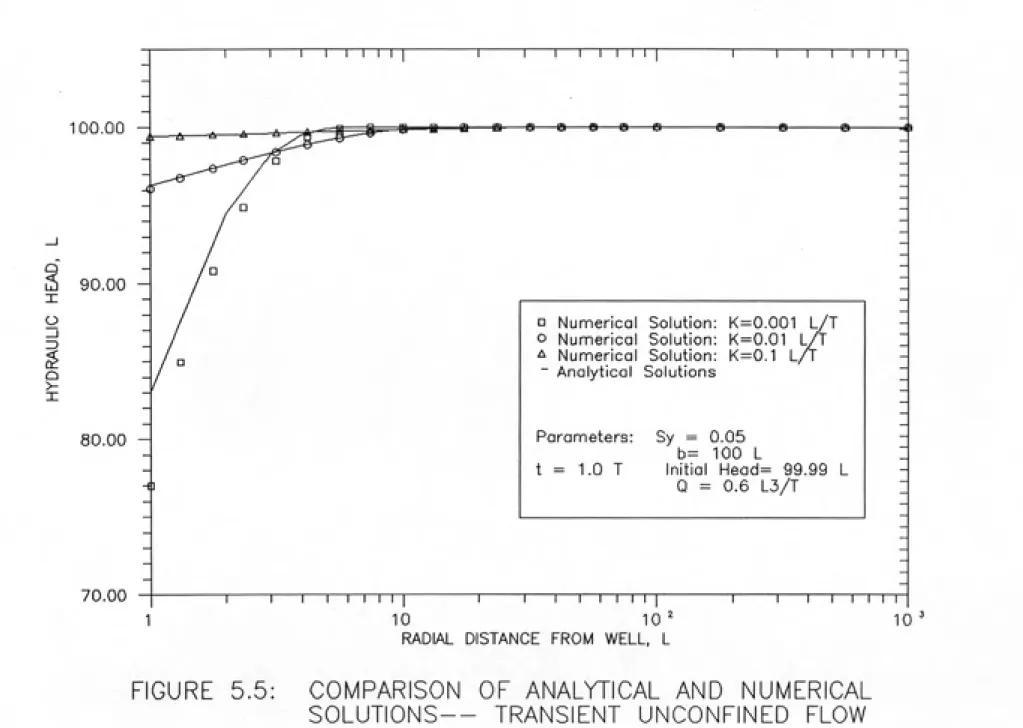
5.5 Comparison of Analytical and Numerical Solutions: Unconfined Flow . . . 5-11
5.6 Illustration of Steady State, One-Dimensional Unconfined Flow... 5-12
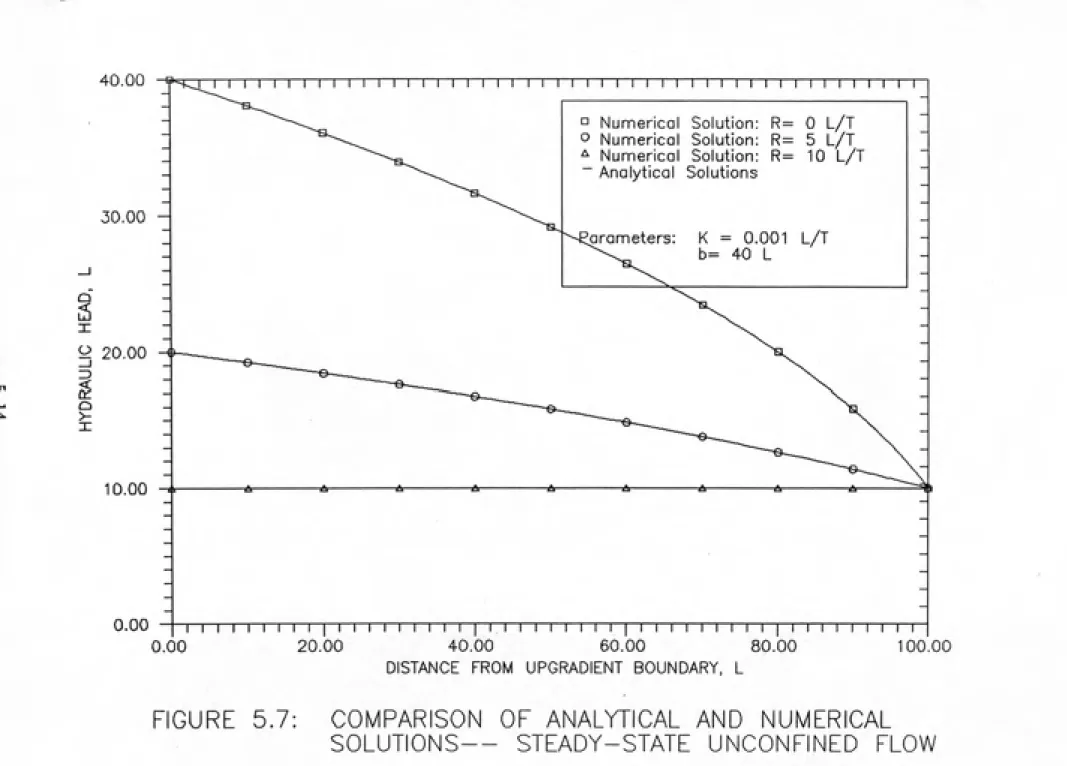
5.7 Comparison of Analytical and Numerical Solutions: Steady State Unconfined Fldavl4
5.8 Comparison of Analytical and Numerical Solutions: Steady State Unconfined Flow
with Recharge... 5-15
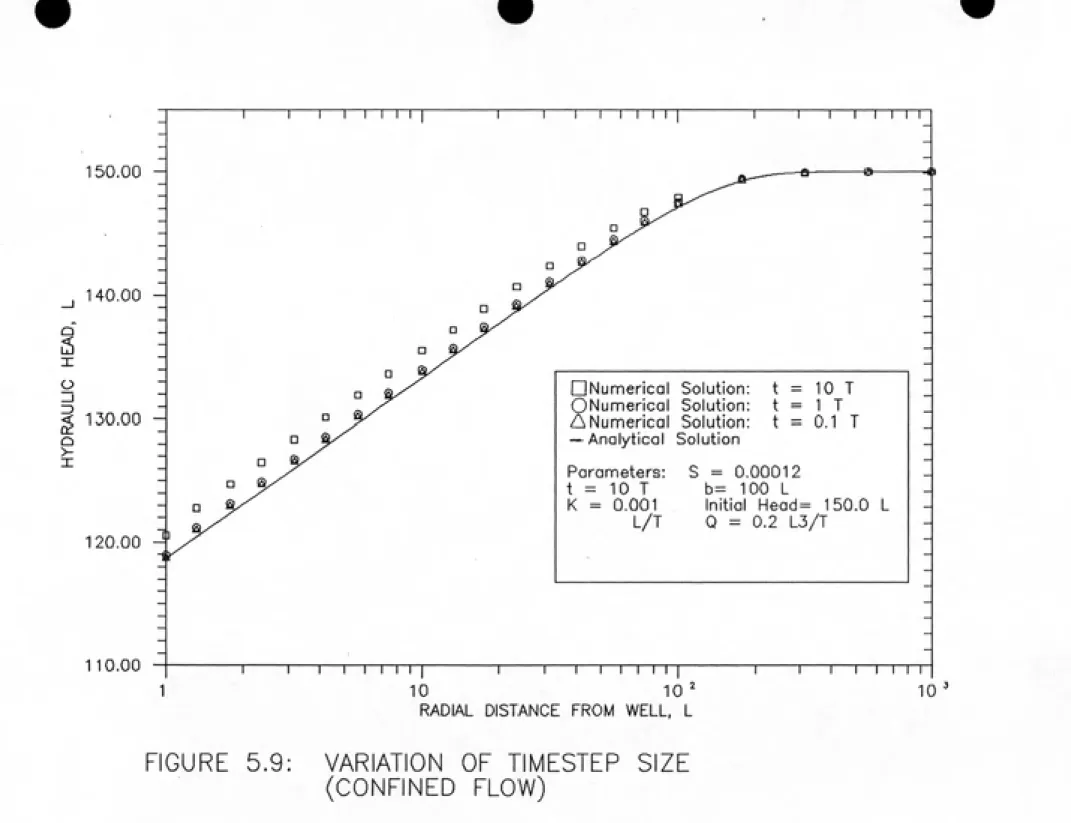
5.9 Variation of Model Parameters: Timestep Size (Confined Flow)... 5-18
5.10 Variation of Model Parameters: Horizontal Discretization (Confined Flow) 5-19
5.11 Variation of Model Parameters: Vertical Discretization (Confined Flow) . . 5-21
5.12 Variation of Model Parameters: Maximum Allowable Error (Unconfined Flow) 5-22
5.13 Variation of Model Parameters: Maximum Allowable Iterations (Unconfined
LIST OF TABLES
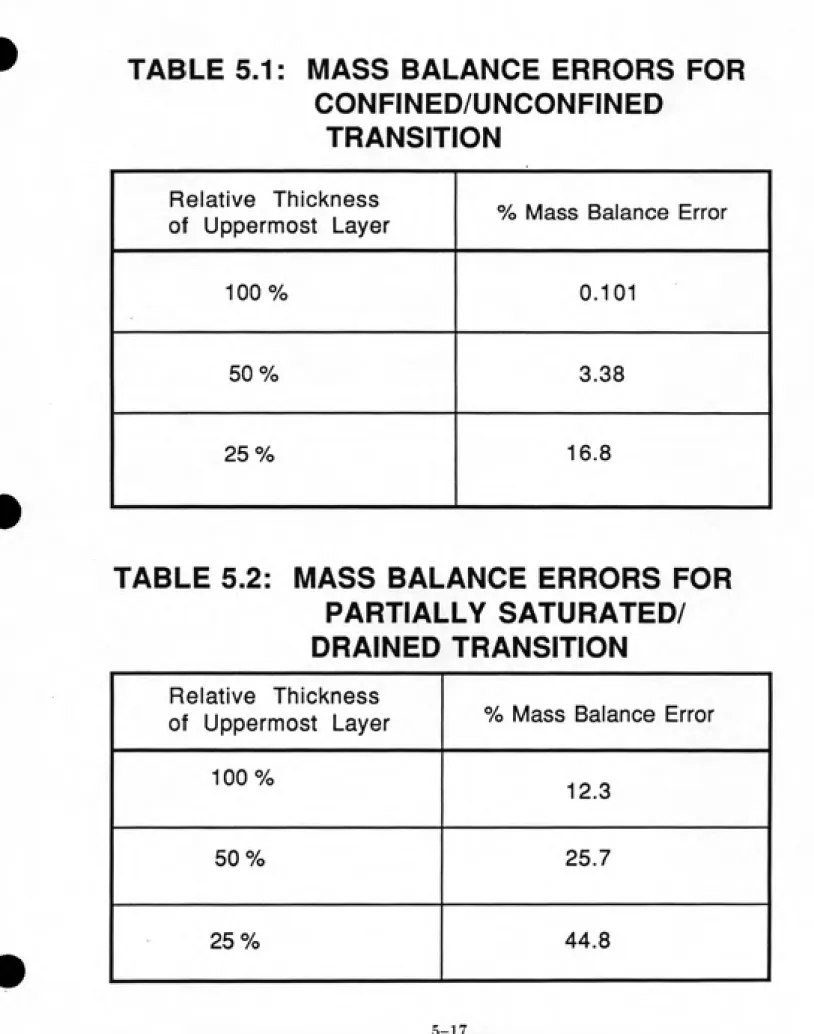
5.1 Mass Balance Errors for Confined/Unconfined Transition... 5-17
5.2 Mass Balance Errors for Partially Saturated/Drained Transition ... 5-17
5.3 Parameters Used in Test Cases... 5-28
ACKNOWLEDGEMENTS
Thanks first to my intrepid advisor. Dr. Cass T. Miller. Without his encouragement
and guidance, this research never would have gotten off the ground. He has helped reveal to me the many fascinating facets of the groundwater field.
To my office-mates, thank you for bearing with me. Thanks especially to Joe Pedit for his valuable insight and reminders that this isn't the most important thing in the world.
But most of all, thank you Harriet for your love and support. I couldn't have done it
1 INTRODUCTION
1.1 Background and Motivation
Approximately half the population of the U.S. depends on groundwater for its drink¬
ing water supplies. There is growing evidence that this resource, once thought to be
contaminant-free, is being contaminated by municipal, industrial, and agricultural wastes.
Researchers are thus focusing upon studying the mechanisms responsible for contaminant
transport in groundwater systems. To prevent the further deterioration of groundwater
quality, researchers are developing methodologies for monitoring, analyzing, and predict¬
ing the movement of contaminants in the subsurface. Predictive models of groundwater
contaminant transport can provide the information needed for the accurate assessment of
health risks resulting from contamination of drinking water supplies, or for the design and
evaluation of measures for renovating contaminated groundwater aquifers.
1.1.1 Relationship between Groundwater Flow and Contaminant Transport
One of the most important factors in predicting the movement of contaminants in
models can be developed in the context of groundwater contamination problems.
In order to understand the relationship between groundwater flow and contaminant
transport, one must examine the equations that govern the hydrodynamics of contam¬
inant transport. Determinstic and stochastic approaches for mathematically describing
contaminant transport are possible. This report focuses upon deterministic apporaches
for transport and flow, due to the relative difficulty of applying the stochastic approach to
practical contaminant transport problems.
The advective-dispersive equation is generally considered to be the equation that
governs contaminant transport (Anderson, 1979), although other researchers have proposed
different approaches (Gillham et al., 1982; Tompson, 1986). The advective-dispersive
equation considers solute flux to be the result of the average bulk movement of the fluid in
the direction of groundwater flow (advection) and a Fickian-type mixing in the displacing
fluid (dispersion) (Gillham et al., 1984). For saturated flow in heterogeneous porous media,
the general form of the advective-dispersive equation is written as
^ = V . (D . VC) - V. VC + (^) + T{C) (1.1)
^ / rxnwhere
C — solute phase concentration [MjL^)
t = time (T)
V — vector of average groundwater pore velocity {L/T)
D = hydrodynamic dispersion tensor {L'^/T)
V- = divergence operator
V = gradient operator
(W)rin = reactive term (M/L^/T)
Reactive processes such as sorption, chemical reactions, and biological degradation can
play important roles in the fate of contaminants and should also be accounted for in any
model of non-conservative groundwater contaminant transport. The focus of this report is
not on the reactive portion of Equation 1.1, but concentrates on the the hydrodynamics.
The conservative form of Equation 1.1 implies that
(
/ rxnwhich reduces Equation 1.1 to
^ = v-(D •vc)-tr-vc + r(c) (1.3)
atBear (1972) describes the hydrodynamic dispersion tensor as the sum of two compo¬
nents, which can be represented asDij = arvSij + {ai - aT)viVj/v + D* (1,4)
where
Dij = i,j term of dispersion tensor [L^ /T)
i,j = components of Cartesian coordinate system ar — transverse dispersivity (L)
ai = longitudinal dispersivity (L)
V = average groundwater pore velocity {L/T)
D*
ͣ
= effective molecular diffusion coefficient [L^ /T)
Sij = Kronecker delta function [dimensionless]
= 0 for i 7^ j
The product of dispersivity and flow velocity is known as the mechanical disper¬ sion component. The mechanical mixing is a process introduced by averaging irregular
advective displacements taking place within the porous groundwater matrix (Fried and
Cornabous, 1971). In active groundwater flow through a granular medium, mechanical
dispersion is usually dominant over diff'usion, and so the D* term is often a relatively
small component.
By examining Equation 1.2, one can see that groundwater velocity, through the advec¬ tive term, is a crucial part of the advective- dispersive approach to modeling contaminant transport, for a typical groundwater aquifer. In addition, Equation 1.4, which describes the dispersion tensor, includes velocity-dependent terms.
Various mathematical solutions to the advective-dispersive equation have been pro¬ posed. These solutions have been compared to experimental results from laboratory-scale soil columns. The solutions have been shown to provide accurate representations of conser¬
vative solute transport, under laboratory conditions (Gillham et al., 1984). Longitudinal
dispersivities have been found that range within a couple of orders of magnitudes of each
other ( 10""* to 10""^ meters). However, when the solutions of the advective-dispersive
equation are applied to fleld-scale tracer tests, longitudinal dispersivities in the range of
1 to 100 meters have been commonly reported (Gelhar et al., 1985). This variation in
dispersivity poses a difficulty in the use of predictive models of solute transport based onthe advective-dispersive equation.
The discrepancies between longitudinal dispersivities obtained from laboratory- and field-scale experiments have led some researchers to conclude that dispersivity is a pa¬
rameter which is scale-dependent (Fried, 1975; Feaudecerf and Sauty, 1978; Sudicky and
Cherry, 1979; Pickens and Grisak, 1981). The scale dependency is generally attributed
^
Bear, 1977; Schwartz, 1977; Anderson, 1979).Heterogeneities can be found in a range of scales in the geological media. Figure 1.1
illustrates various types of heterogeneities that occur and the subsequent effect on velocity
distributions. These heterogeneities affect the velocity field, and therefore groundwater
flow, at all scales. Figure 1.1 illustrates that heterogeneities can occur from the grain-size
scale to the geologic- layering scale. The layering scale could, if necessary, be identified
and mapped by careful drilling, sampling or geophysical logging. If the smallest scale of
heterogeneities in a deterministic-type media could be identified and accounted for, then
the differences in advection or groundwater flow could be accurately simulated. However,
these heterogeneities cannot be identified by conventional methods of field testing (Freeze
and Cherry, 1979). As long as the smallest heterogeneities cannot be identified, it is
important that models of groundwater flow provide accurate simulations, using the best
available information from the scales that can be identified.
The dispersivity parameter is a result of averaging over scales larger than the smallest
scales. The average linear groundwater velocity that is used as input to the
advective-dispersive equation reduces the individual velocities in the interstitial flow paths to a
single value (Freeze and Cherry, 1979). Averaging of velocities often goes one step further
where individual velocities within layers of different hydraulic conductivities are averaged
to a single value. The result of this averaging is that the observed dispersity parameters
contain the deviations in velocities at the scale over which the flow has been averaged
(Anderson, 1984). Deterministic models of the advective-dispersive equation cissume that
hydrodynamic process occur over measurable scales. If the models included the smallest
heterogeneities, theoretically there would be no deviations in velocities over a small scale,
and therefore the dependence of prediciting hydrodynamics on dispersivities would be
reduced.
ass^-#
FIGURE 1.1
DISPERSION PHENOMENA
Mixing in individual pores
••SSi-v.-^^v::
Mixing by molecular
diffusion
Mixing of pore channels
Higher
avers
Macrodispersive Spreading ^ Iimiobile Fluid
The majority of contaminant transport models have been developed over two dimen¬
sions (Burnett and Frind, 1987). In these cases, important aquifer properties such as
velocity magnitudes and directions are spatially averaged over the relevant dimensions
(usually the vertical dimension). This approach dooms the prediction of contaminant
transport to failure, in all but the simplest of groundwater systems. Figure 1.2 provides
a schematic illustration of a typical three-dimensional groundwater flow and contaminant
transport problem.Various researchers have reported that three-dimensional modeling of flow and con¬
taminant transport improves the accuracy of such simulations relative to two- or
three-dimensional simulations. Stochastic analyses performed by Freeze (1975) and Gelhar
(1976) show that there is considerably less variation about a mean hydraulic head value
for three-dimensional flow models than for two- and one-dimensional models. Increases in
these variations tend to inflate the value of dispersion and produce poor predictive ability
in contaminant transport models.The scale eff"ects on dispersion that were discussed previously may be an artifact of
the dimensionality of the models employed to predict dispersion (Domenico and Robbins,
1984). Results of Domenico and Robbins (1984) indicate that a "scaling-up" of dispersivity
will occur when the dimensionality of a model fails to match that of a natural system.
Molz et al. (1983) conclude that the vertical distribution of hydraulic conductivity (and
the subsequent effect on mixing) is a key parameter that aff"ects overall dispersivity.
Burnett and Frind (1987) describe variations in hydrodynamic parameters in three
dimensions that influence the shape of a contaminant plume. Arnett et al. (1977) report
that three-dimensional models of contaminant movement compare better with observed
contaminant movement at the Hanford, Washington site, than for two-dimensional models.
Vertically-layered groundwater systems are often found in the field (Huyakorn et al.,
FIGURE 1.2
TYPICAL 3-D GROUNDWATER FLOW AND TRANSPORT PROBLEM
INFILTRATION
AQUIFER 1
lAQUITARD 1
LANDFILL
AQUIFER 2
^____________
^^^^^^2^^^
^^^^^^^^Ml
AQUIFER 3
W^^s^^^^^^^^^^^^^
^i^^:^;^^^^^^^^;^:^^^^^J
CROSS-SECTIONftL
VIEW
\
INFLOW
LANDFILL
orders of magnitude (Sudicky, 1986). If the variations in flow caused by the differences are
not taken into account, at best only averaged contaminant concentrations can be predicted
rather than in the individual layers. The presence of a high conductivity layer may direct
the contaminants toward this layer, the effects of which may be ignored in a one- or
two-dimensional analysis. Results from Sudicky (1986) and Molz (1986) showing the vertical
distribution of hydraulic conductivities are shown in Figure 1.3. These results show that
hydraulic conductivity, and thus velocities, can vary more than an order of magnitude in
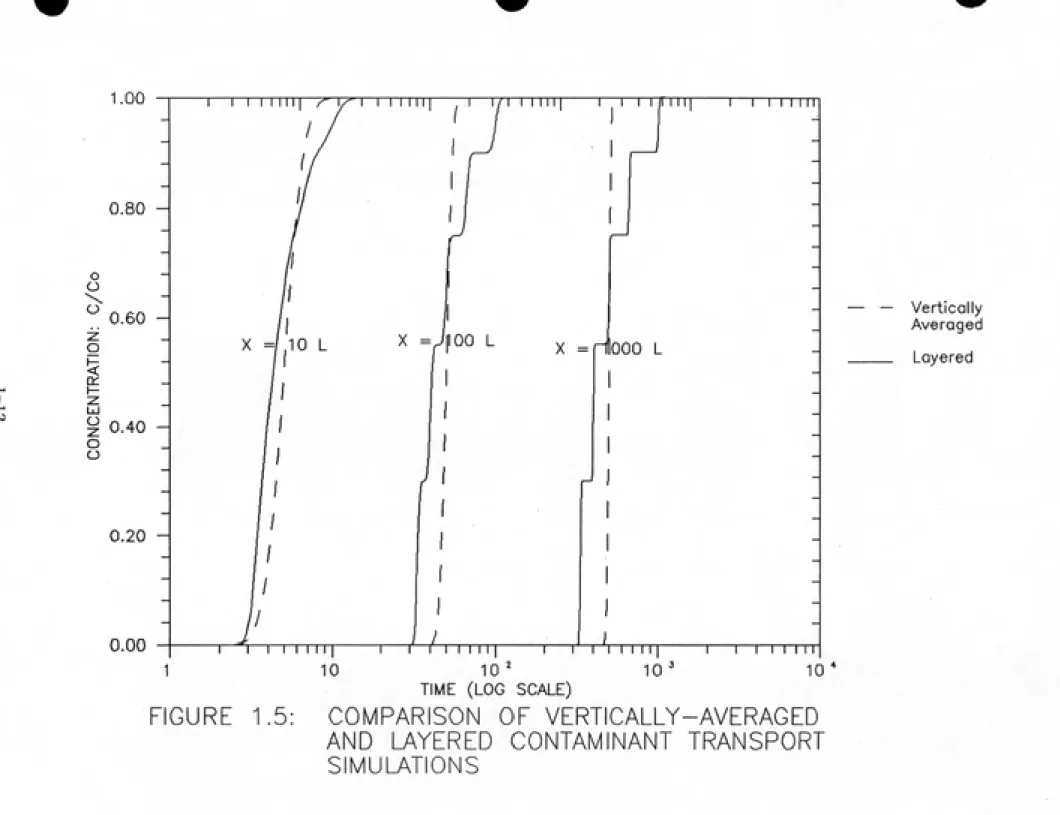
the vertical direction.The effects of the vertical averaging of groundwater velocity distributions can be
shown through some hypothetical simulations. An analytical model of the one dimensional,
conservative form of the advective-dispersive equation (Bear, 1979) was applied to two
cases: 1) a five-layer aquifer, with each layer having a different groundwater velocity, and
a line source of contaminant, as shown in Figure 1.4; and 2) the same aquifer, but with
the velocities of the five layers averaged into a single value of velocity. The simulations
were performed at three different positions down-gradient from the contaminant source.
The value of longitudinal dispersivity for the second case was fitted to the results from the
first case at the first down-gradient position. All other parameter values were the same for
each case.
The results are shown in Figure 1.5 (note that the time axis has a log scale). These
results show that, at the first position (where the dispersivity was fitted), the vertically
averaged results resemble the non-vertically averaged resits. However, cis the simulations
move farther from the contaminant source, the vertically averaged results no longer resem¬
ble the non-vertically averaged results. Thus, the vertical variations cannot be averaged
while expecting the simulations to provide accurate results.
1.1.3 Importance of Modeling Unconfined Flow
FIGURE 1.3
VERTICAL VARIATIONS IN HYDRAULIC CONDUCTIVITY
After Sudicky (1986) and Molz (1986)
219.231 M.om 211.138 - 2tl.5«
n
" 2H.238
c
g 2lt.0«
> 217.738
r Core 15
«j
HIT T1IIIIJ
I ͣ ...1 ,...'"I ..."^
21S.3* 213.095 218.M5
r Core 16
— 2t8.S9B
" 2H.J6
e
g 211.095
> 2l7.i«
-U 10 10 10 Hydraulic Conductivity (ca/s)
I I Miim—I I "I iimi ' ' ' "'1'
217.595 217.3«
-10 ͣ 10
Hydrau1i c Conduct i v i ty
10
(ca/s)
• MO.7)
• M 3 8) ..I'i 6.6)
• (ͣ; 9 91 .115 2.9)
.IS6,0 159.0)
FIGURE 1.4
HYPOTHETICAL LAYERED AQUIFER
CONTAMINANT SOURCE
V= 3.0
V = 2.0 L/T
§
V = 1.0 L/T
PARAMETERS
Retardation =1.0
Longitudinal Dispersion = 1.0
LT
5 Layers
Layer Thicl<ness
= 0.2 L
^
x = 10 L X = 100 L X = 1000L
Is5
O
o o
<
o O
o
1 .uu —
...r r r ii iii| /' \r\
1 1 mT| -.I' in 1 mil 1 1 II 1 mf...1 1 1 1 1 III
/
/
f /1 /
1
1
h(
1 .—ͣ' 1
-ll \ \ 1
-0.80 - 1
\
J (
:
i
0.60
-\
J
-X =/ 10
LX =JfOO L
X =1000 L
-i
1
-0.40 - M 1
;
\\
[-1 1
1
—
0.20 - /
/
1
-/
1'
1:
n r\r\
1 y
1U.UU 1 lllll
I'i 1 1 1 1 1111 ( 1 1 1 1 1 II i| 1 1 1 1 1 1II
— Vertically Averaged __ Layered
1 10 10' 10^ 10*
TIME (LOG SCALE)FIGURE 1.5: COMPARISON OF VERTICALLY-AVERAGED
table). Flow in confined aquifers is bounded above and below by impervious layers.
Un-confined aquifers are bound below by an impervious layer, but are bound above by the
top of the water table. Figure 1.6 shows a schematic representation of the two types of
aquifers. Most contamination cases can be found in unconfined aquifers, due to the lack
of a protective confining layer and thus an increased vulnerability over confined aquifers.
Shallow unconfined aquifers are particularly susceptible to pollution from contaminants
when little or no treatment is afforded by the overlying strata (Guvanasen and Volker,
1981).
However, most of the available flow models either do not accomodate unconfined flow
at all or do so unreliably. Modeling an unconfined groundwater system as a confined
system usually is inaccurate because the flow regimes may differ greatly between the two
types of systems. The presence of a free upper boundary in an unconfined aquifer can
significantly affect groundwater velocities, especially in shallower aquifers. These differ¬
ences can translate to poor estimates for the movement of groundwater contaminants, if
the wrong system is modeled.
1.3 Research Goals and Objectives
Thus, the goal of this research is to develop a versatile model that accurately and
efficiently simulates confined and unconfined groundwater flow in three dimensions.
The objectives to be met with this research are:
1) To develop a three-dimensional numerical model for simulating confined
ground-water flow.
2) To develop a three-dimensional numerical model for simulating unconfined
ground-water flow, using the confined flow model for the basic structure so that a combination
of confined and unconfined flow can be accomodated in the final model.
3) To test the accuracy of both the confined and unconfined flow portions of the final
FIGURE 1.6
CONFINED AND UNCONFINED AQUIFERS
sz
WATER TABLE
d
UNDERGROUND TUNCONFINED AQUIFER
ilENTIOMETRIC
SURFACE
4) To apply the model to some hypothetical groundwater flow situations.
1.3 Methodology
To meet the first objective, an algorithm consisting of a numerical solution of the
groundwater flow equation is selected. This algorithm, called the ALALS algorithm (for
ALternate sublayer And Line Sweep procedure) has been described in the literature. The
complete derivation of this algorithm is performed. Next, a structured and commented
computer code that incorporates the ALALS algorithm is developed. Various modifications
of the algorithm are also included in the code, such as the ability to simulte steady-state
as well as transient problems, and a provision for calculating mass balance errors. The
result is a model for simulating confined flow.
The model developed under the first objective is then modified to include unconfined
flow. The equation describing unconfined flow is not linear, as it was the confined case.
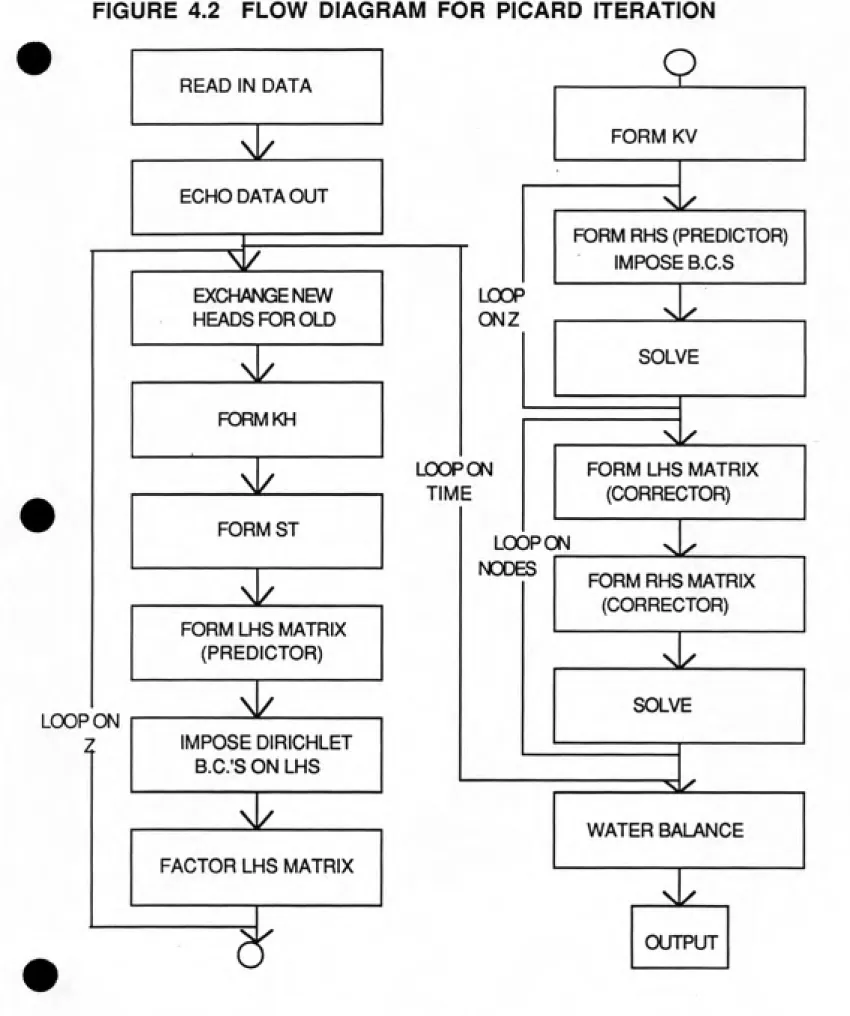
An iterative algorithm (Picard iteration) is utilized to solve the unconfined flow equation.
Application of the iterative algorithm results in a significant increase in computaional
effort over the confined model. The computational eff^ort is reduced by modifying the
iterative algorithm to include unconfined aquifer layers only. Other problems resulting
from modeling unconfined flow, such as the draining and reflUing of aquifer layers, are
incorporated into the model. The resulting model can simulate confined and unconfined
flow separately or at the same time. The model is named REGFED for REGional flow
using Finite Element and Differences methods.
The third objective involves testing the accuracy of the unconfined and confined por¬
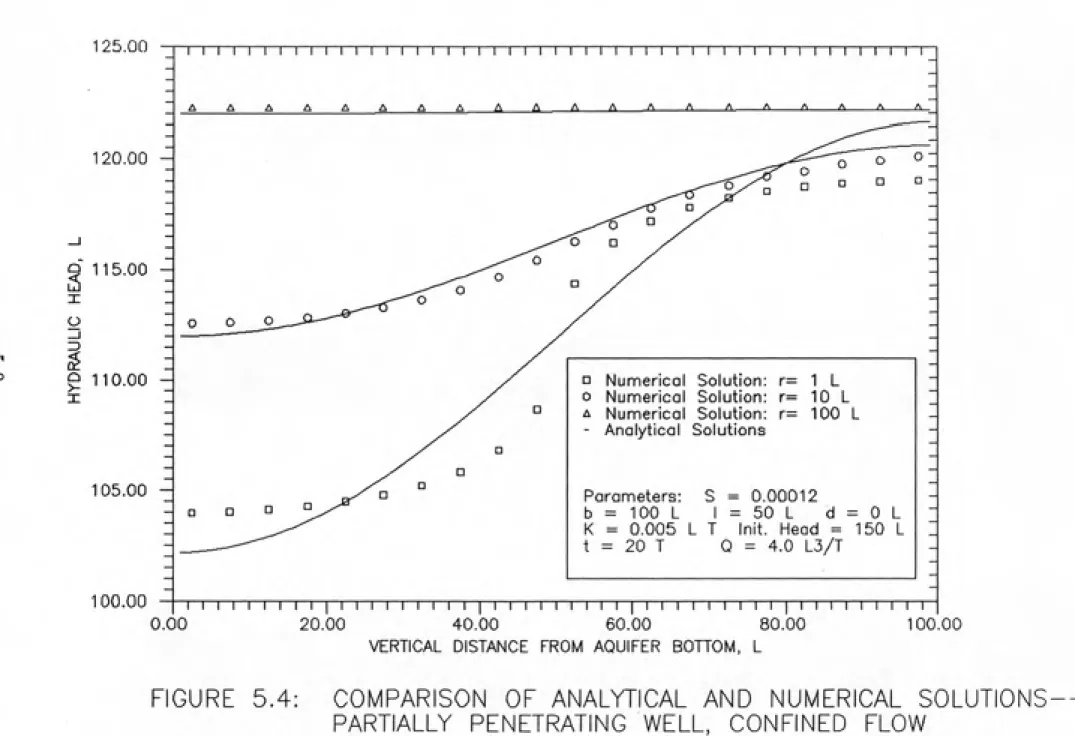
tions of the model. In this research, accuracy is evaluated by graphical comparisons of
model results with results from analytical solutions. In a few cases where analytical mod¬
analyzed by graphical comparisons of model results with analytical solution results.
Hypothetical applications are simulated with the model. The example applications
include flow within a monitoring well, flow in an aquifer-confining layer system, and flow
resulting from a two-well tracer test. In addition, the performance of the model is com¬
pared to the most popular three-dimensional public domain groundwater flow model, the
McDonald-Harbaugh model. This comparison provides a way to gauge the relative effi¬
ciency of the WELFED model. The total computational time required for each model to
2 THEORETICAL BACKGROUND AND LITERATURE RE¬
VIEW
The determination of groundwater flow requires the evaluation of either or both of
the hydraulic head variable or the velocity variable. Hydraulic head is a measure of fluid
potential; it consists of the sum of a pressure head and an elevation head. Most groundater
flow models simulate distributions of hydraulic heads. Groundwater velocity is the velocity
variable found in the advective-dispersive equation. Velocity is proportional to the negative
of the groundwater gradient (Darcy's Law).
Generally, there are two approaches towards simulating groundwater flow velocities:
the indirect and direct method. The indirect method- the most popular- consists of sim¬
ulating hydraulic head distributions and then using Darcy's Law to approximate
ground-water velocities. The direct method uses Darcy's Law directly to simulate groundground-water
velocities. This report focuses on simulating distributions of hydraulic heads.
Before discussing the approaches toward obtaining hydraulic head and velocity, the
classical theories of groundwater flow should be reviewed. By examining the theory first,
one can understand the necessary steps in each approach.
2.1 Governing Equations for Groundwater Flow
2.1.1 Theory: Darcy's Law
, = -k|^ m
where
q = specific discharge (L/T)
K = hydraulic conductivity [L/T)
h — hydraulic head (L)
1^ = groundwater gradient [dimensionless]
Darcy's law is valid for groundwater flow in any direction in space. However, it should
be understood that the specific discharge calculated from Darcy's Law is a macroscopic
concept, which is averaged over a portion of the porous medium. The specific discharge is
clearly diff"erentiated from the velocities encountered in the actual path of the fluid particle
through a porous medium (Bear, 1979).
The average velocity, v, represents the flow that passes through only the portion of
the porous medium occupied by voids in the porous matrix. The average velocity is found
in the advective and dispersive terms of the advective-dispersive equation. It is obtained
by
tJ = - (2.2)
nwhere
V — average groundwater pore velocity [LfT]
n — porosity [dimtnsionltss)
The continuity equation for groundwater flow is a partial differential equation that
describes the conservation of fluid mass during flow through a porous medium. The
ground-water flow equation for saturated flow in confined aquifers is generally represented as
V.(K
ͣ
Vh) + Tih)^Ss~ (2.7)
atwhere
h = hydraulic head (L)
K = hydraulic conductivity tensor [L/T)
S3 = specific storage (l/X)
r{/i) = source or sink term {1/T)
The cissumptions implied in this equation are that (1) the flow of water is laminar, (2)
the fluid is incompressible and of constant density, (3) the porous medium is rigid, and (4)
the unsaturated portion of flow can be negelected. Assumptions (1) through (3) are most
commonly applied in groundwater flow analysis. Assumption (4) involves the unsaturated
region. This region involves the two- phase flow of air and water and is found directly
above the top of the water table (see Figure 1.6). Unsaturated flow is important when
considering infiltration of fluids from above the water table. The unsaturated portion
of flow is neglected in this report, because the difficulty of modeling unsaturated flow
outweighs the practical advantages to be gained.
Equation 2.3 can be simplified further by assuming that the components of the con¬
ductivity tensor are aligned with the directions of the gradients of head. This assumption
allows for the consideration of only the diagonal components of the conductivity tensor
d (^^ dh\ d (^^ dh\ d /,, dh\ ^,,, ^ dh
where
Kx,Ky, Kz — components of conductivity in the x, y, and z directions, respectively [LjT)
2.1.3 Theory: Unconfined Flow
When examining flow in unconfined aquifers, the physics governing flow change. These
changes are reflected in the groundwater flow equation. The conductivity parameters found
in Equation 2.4 are constant for confined flow. However, for unconfined flow, vertical
averaging produces the transmissivity parameter, which is a function of the saturated
thickness of the aquifer. The storage parameter found in Equation 2.4 also changes for
unconfined aquifers, to represent the saturated/unsaturated interaction of the aquifer.
In order to analyze unconfined flow with Equation 2.4, the equation is often vertically
averaged (using the Dupuit assumptions of negligible vertical gradients). The averaging
produces the new parameters of transmissivity (the vertically averaged hydraulic conduc¬
tivity) and storativity (the vertically averaged specific storage). Vertical averaging also
eliminates the terms that are a function of z. Equation 2.4 can be rewritten as
where
Tx,Ty = components of transmissivity in the x, and y directions, respectively, where
T = Kh {L^/T)
T'{h) ~ vertically averaged source or sink term {LjT)
The resulting differential equation is more difficult to solve, because it is no longer a
linear function of h (hydraulic head).
2.2 Solutions of the Groundwater Flow Equation
Solutions to groundwater flow equations such as 2.4 or 2.5 can be solved for the
hydraulic head variable. Analytical and numerical solutions of the flow equations are
used in the analysis of groundwater flow. However, analytical solutions usually are not
sophisticated enough to handle heterogeneous aquifers of irregular shape that are most
often encountered in the field. The analysis and prediction of aquifer performance in such
situations is normally carried out by numerical simulation. However, analytical solutions
can be used for some types of aquifer evaluations and also serve as convenient benchmarks
for evaluating the accuracy of numerical models.
2.2.1 Analytical Flow Models
Simulations of hydraulic head distributions have been performed for at least 50 years.
Theis (1935) solved a radial form of the groundwater flow equation to obtain an analytical
expression for the change in hydraulic head around a pumped well in a confined aquifer.
Many other analytical solutions for various types of flow have been produced since Theis.
In the case of unconfined flow, transient groundwater flow is more difficult to sim¬
ulate. The analytical (and numerical) solutions available to analyze unconflned flow are
consequently fewer than those for confined flow. Analytical solutions proposed to simulate
unconfined flow are still under scrutiny by groundwater researchers. The problems arise
from the fact that the top boundary (also known as the free surface) of the aquifer moves
(Streltsova, 1973; Bear, 1979). These assumptions basically mean that vertical gradients
within the aquifer can be ignored. These assumptions give rise to the Boussinesq equation
for unconfined flow:
d (,^ dh\ d (^^ dh\ .,,, ^ dh
Freeze and Cherry (1979) identified three approach^ to analyze unconfined flow in
pumped wells. The first recognizes that the unconfined problem involves a
saturated-unstaurated flow system in which changes in hydraulic head are accompanied by changes
in the moisture content above the water table. An analytical solution for this case was
presented by Kroszynski and Dagan (1975). However, the conclusions from this and other
studies (Taylor and Luthin, 1969; Cooley, 1971) is that hydraulic heads are not substan¬
tially affected by including the unsaturated flow component.
The second approach is to use the confined aquifer (the Theis equation) defined in
terms of specific yield instead of storativity. This method effectively relies on the Dupuit
assumptions. Jacob (1950) has shown that this approach is nearly correct as long as
drawdowns are small in comparison with saturated thickness. The third approach is based
on the concept of a delayed water-table response. Neuman (1972) presents an analytical
solution for this approach. After long times or at a long enough distance from the well,
the hydraulic head distributuon eventually mimics the Theis solution for unconfined flow.
2.2.2 Numerical Flow Models
Numerical simulations of confined and unconfined groundwater flow are also well
established. Various numerical methods are available for solving the groundwater flow
equations. These methods include finite differences, finite elements, finite element- finite
difference hybrids, and boundary integral equation methods (BIEM).
years. This method is relatively easy to apply, as long as the problem domain has bound¬
aries that are relatively regular in shape. Irregular boundaries are simulated inefficiently
with finite differences. The accuracy of results obtained from finite difference methods is
generally lower than results from finite elements, given the same number of nodes used in
the discretization. However, the computational effort required to solve a finite difference
problem is usually smaller than for finite elements, given the same level of desired accuracy
(Faust and Mercer, 1981).
With finite-elements, problems can be solved using fewer unknowns than for finite
differences, given the same degree of accuracy. Finite element methods have the advan¬
tage of being able to fit irregular boundaries without additional comptutational effort over
simpler boundaries. In addition, finite elements provide values of the dependent variable
over the entire problem domain, not just at selected nodal locations as in finite differences.
However, the computational cost of three-dimensional finite element applications is pro¬
hibitive, due to the large amount of data and operations that must be carried through the
computational procedure.
Hybrid finite element-finite difference methods combine the good points from both
methods. Irregular boundaries are usually encountered in the horizontal or areal directions,
therefore, finite elements are applied in this direction. Vertical changes in parameters such
as hydraulic conductivity often occur as changes from one parallel layer to another, which
makes for a suitable application of finite differences. By reducing the dimensionality over
which finite elements are applied, the computational cost of the applied method is reduced.
The BIEM also has the advantage of providing flexible boundaries. It is also especially
suited for unconfined flow problems. However, this method contains some serious draw¬
backs. First, current theory does not allow for the convenient solution of time dependent
problems. Second, model parameters must be constant within the domain- a substantial
disdvantage for any method where heterogeneous conditons are encountered.
cross-sectional or areal models. There are at least two two-dimensional aquifer-simulation
programs that have been completely documented and widely applied in North America.
These programs are the Trescott-Pinder-Larson model (Trescott et al., 1976) and the
Illinois Water Survey model (Prickett and Lonnquist, 1971). Both of these models utilize
finite difference formulations to produce head distributions.
Numerical methods for simulating two-dimensional unconfined flow have also been
proposed. The problem of locating the position of the free surface is usually resolved
by approximating the free surface location and then iterating, successively solving the
complete flow problem, and relocating the approximate surface. Alternatively, if it is not
necessary to determine the position of the free surface, heads are approximated only at
fixed nodal positions (the approach taken in this research).
Neuman and Witherspoon (1971) developed what is believed to be the earliest nu¬
merical model in which vertical gradients are not assumed to be negligible. Their tran¬
sient, two-dimensional flow model is based on the finite element method^ The free surface
boundary is simulated by changing the location of the nodes at the top of the aquifer as
the hydraulic head changes.
The Boundary Integral Equation Method (BIEM) has been employed by Liggett
(1977) and Lennon et al. (1980) to resolve the free surface problem. The advantage of
using the BIEM is that the flow equations at the free surface at the boundary depends only
on boundary data and thus the free surface can be located without solving the complete
fiow problem (Liggett, 1977). However, the disadvantage of the BIEM is that hydrologic
paramters are assumed to be constant over the entire domain. In addition, most BIEM
theory has been developed for steady-state conditions only. Applications of the BIEM to
subsurface hydrology problems are found in Huyakorn and Pinder (1983).
Trescott and Larson (1977) compared the efficiency of various iteration methods for
simulating unconfined flow. Using a two- dimensional finite difference model, they found
(LSOR) and the Alternating Direction Implicit procedure (ADI) for solving the nonlinear
free-surface problem. Huyakorn and Pinder (1983) offer general procedures for solving
nonlinear flow problems by iteration. These procedures include the Newton-Raphson and
Picard iteration procedures.
Complexity and high computational cost are usually the reasons for avoiding
three-dimensional analyses. Modeling transient unconfined flow in three dimensions is especially
difficult because the top boundary of the water table must be moveable and because of the
quasilinearity of the equations. However, as was discussed in Chapter 1, there are many
instances where two-dimensional approaches are not adequate.
Three-dimensional groundwater flow models can be described as either "fully"
three-dimensional, in order to distinguish them from "quasi" three-dimensional models. The
fully dimensional models represent all dimensions of flow equally. The quasi
three-dimensional models, however, take advantage of the fact that groundwater systems of¬
ten consist of several aquifers separated by confining or semi-confining layers. These layers
transmit water and interconnect the aquifers to various degrees. The contrast in permeabil¬
ity between the confining layers and the aquifers is usually several orders of magnitude.
The system can be simplified by assuming that vertical components of flow within the
aquifer are negligible and that the horizontal components of flow in the confining layers
are negligible. Figure 2.1 shows how the presence of a semi-confining layer can affect flow
in a layered system.
The quasi three-dimensional approach is attractive to many researchers because of
the reduced computational costs resulting from the assumptions described above.
Bre-dehoeft and Pinder (1970) used a finite difference scheme in their transient, quasi
three-dimensional flow model. Finite elements were employed by Chorley and Frind (1978) in a
transient, quasi three-dimensional model. They showed that their model required about
4al. (1982) developed a quasi three-dimensional flow model that also simulated land sub¬
FIGURE 2.1
EFFECT OF SEMI-CONFINING LAYER
ON GROUNDWATER FLOW
Z!
HYDRAUUC CONDUCTIVITY
= 0.01 L/r
ͣ
AQUITARD
HYDRAUUC CONDUCTIVITY
= 0.0001 UT
HYDRAUUC
CONDUCTIVITY
Gambolati et al. (1986) also used finite elements to simulate transient, quasi three- di¬ mensional flow. Several three-dimensional numerical models have been proposed for flow
analysis.
Fully three-dimensional flow models also have been developed. Freeze (1971) was per¬
haps the first researcher to develop a fully three-dimensional model of transient
ground-water flow. He used a finite difference formulation to solve the groundground-water flow equation.
The model included the unsaturated zone and could accomodate both confined and
un-confined conditions. Narasimhan and Witherspoon (1976) developed a general model for
transient, three-dimensional flow based on the integrated finite difference approach. Con¬
fined and unconfined flows were included in the formulation of the model.
Trescott (1976) developed a transient, three-dimensional, finite difference flow model for confined aquifers. Winter (1978) derived a steady-state, three-dimensional, finite differ¬ ence model to analyze the interaction between lakes and groundwater flow. An integrated
model for flow and transport employing finite differences was developed by Reeves and
Cranwell (1981). The SWENT model, developed by Intera Environmental Consultants (1983), simulates flow, energy and radionuclide transport. The model utilizes finite dif¬ ferences to solve the various equations. There are other models which couple flow with transport, but they do not have the ability to check fiow results independently. (Anderson, 1979).
The USGS McDonald-Harbaugh model (McDonald and Harbaugh, 1984) is another
transient dimensional flow model that uses finite differences. Of all the the
three-dimensional flow models, it is the most fully documented and widely applied (International Ground Water Modeling Center, 1987).
The finite element method is another method for solving the groundwater flow equa¬
tion. Narasimhan et al. (1978) employed three- dimensional finite elements to model
unconfined flow, but assumed that flow was horizontal at or near the free surface, and
Tanji (1976) used a three-dimensional finite element model in the analysis of flow in Sutter
Basin, California. This model is mainly suited for steady-state flow (Frind and Verge,
1978). Huang and Sonnenfeld (1974) used three-dimensional finite elements to analyze
the time-dependent drawdown in the vicinity of a well. Frind and Verge (1978) solved the
unsaturated-saturated form of the groundwater flow equation. The model employs finiteelements to simulate three-dimensional flow.
Gupta et al. (1984) developed the FE3DGW model, using a finite element scheme.
This transient flow model was applied to the groundwater basin beneath Long Island, NewYork. Babu et al. (1982) produced a hybrid finite difference-finite element scheme for
analyzing transient, three-dimensional flow. This scheme was employed later by Huyakornet al. (1986). Gambolati et al. (1986) developed a three-dimensional, transient flow model.
This model has the feature of automatically generating the finite element discretization scheme.
2.2.3 Indirect Velocity Estimation
Groundwater velocities can be estimated from simulated head distributions. Having
obtained the head field, the velocity field is determined from Darcy's Law (Equation 2.1)
by using some type of numerical differentiation. The advantage to the indirect estima¬ tion approach is that head distributions can be verified easily in the field. Heads can be measured at the desired spatial locations, in all spatial dimensions, with relatively simple
equipment and procedures.
The numerical differentiation can be performed by using either the finite difference or finite element method. A simple example of numerical differentiation by finite differences is as follows.
where
Ax = distance between spatial location Xi and Zi+i (L) Ah = change in hydraulic head from Xj to Xi+i (L) n = porosity [dimensionless]
The differentiation is followed by averaging of hydraulic conductivities over a single
finite element so that a continuous distribution of velocities is obtained. Pinder (1973), Reeves and Duguid (1975), and Segol (1976) simulated head distributions using finite ele¬
ment flow models. These researchers used numerical differention of the head distribution
to produce velocities located at the center of each element. Pinder et al. (1981) and Abri-ola and Pinder (1982) introduced a finite element interpAbri-olation method to obtain a head
gradient estimation in two and three dimensions. Because the interpolation function ap¬
plied was linear, this approximation is essentially the same as the numerical differentiation
of the previous work.
However, when applying the differentiation approach to heads obtained by conven¬ tional finite element methods, there is a resulting discontinuity in the velocity at nodal
points and element boundaries (Yeh, 1981). The discontinuity leads to a violation of the conservation of mass around a single element. In areas where there are significant vari¬
ations in hydraulic conductivity, the resulting error can range from very small to several
hundred percent (Yeh, 1981). In addition, applying the approach to aquifers with low hydraulic gradients can result in roundoff errors that produce spurious gradients (Frind et al., 1985).
Because of the problems with the differentiation approach, some researchers have introduced methods of estimating velocities from head distributions that somewhat over¬
come these inaccuracies. Yeh (1981) applied the finite element method to the velocity
field, after obtaining the head field with the same finite element method. The velocity
proposed creating a "dual" discretization mesh for estimating velocities. In this method a
second discretization scheme for estimating velocities is created that is shifted away from the discretization scheme used to estimate heads. This approach somewhat avoids the dis¬ continuity problem and satifies the conservation of mass principles to an acceptable degree
(Batu, 1984).
2.2.4 Direct Mehtods of Obtaining Velocity
The direct estimation of groundwater velocities is a relatively new approach. Direct es¬
timation of velocities avoids the mass balance and discontinuity problems described above.
However, the results obtained from a direct method are not easily verifiable in the field.
Currently, the instrumentation available for measuring velocities in groundwater relies on sending heat pulses out through the water and measuring the time it takes for those pulses to reach a heat sensing device. This type of instrumentation produces an unacceptable
degree of error. Tracer tests are unreliable for predicting velocities because of dispersion effects. Examples of this approach are scarce, due to the newness of the approach and the
difficulty of field verification.
Segol et al. (1975) presented an approach where finite element theory is used to
obtain the head and velocity fields simultaneously, by carrying the derivative terms for
velocity through the finite element estimation. Zijl (1984) applied a non-porous media fluid dynamics approach where pressure (or hydraulic head) is eliminated and a set of equations for the vorticity and vector potentials is produced. The vector potentials are applied to
Darcy's Law, resulting in a velocity vector field. This method required fewer computer operations and less computer storage to solve a flow problem to the same accuracy as a
hydraulic head estimator (Zijl, 1984).
functions can only provide velocities for steady-state conditions. Zijl (1986) applied both the stream function and a direct velocity approach. Derivation of the velocity expressions was performed by vector analysis.
A more general approach to the problem is to employ Hermite finite elements (Van Genuchten et al., 1977). This type of finite element provides continuity at the element
nodes for higher-order derivatives, and can provide solutions for groundwater gradients at the nodes. However, the computational effort required to simulate a groundwater flow
3 DEVELOPMENT OF CONFINED FLOW MODEL
3.1 Overview of Model Algorithm
The development of any model upon which engineering decisions are to be based should
be founded on a set of engineering criteria. The first step in developing the confined flow
model of this research is to select a basic algorithm for solution of the flow equations. From the discussion in Chapter 1, several of criteria concerning the model algorithm canbe formalized. The criteria can be stated as
• The algorithm should provide accurate solutions
• The algorithm should be able to represent the true nature of the physical system, e.g. fully three-dimensional representation
In addition to the above, there are other criteria which should be applied to any algorithm that is to be used in a groundwater flow model:
• The algorithm should utilize state -of-the-art procedures
• The algorithm should be computationally efficient (in terms of speed and storage
requirements)
• The algorithm should be flexible, e.g. be able to adapt to irregular boundaries,
multiple stresses, etc.
The literature review in Chapter 2 identified the various methods available for solv¬ ing the three-dimensional groundwater flow equation. These methods included finite dif¬ ferences, finite elements, finite element-finite difference hybrids, and boundary integral equation methods (BIEM).
From the discussion in Chapter 2, it is evident that the hybrid finite element-finite difference method is suitable for solving three-dimensional groundwater flow problems.
and later refined by Huyakorn et al. (1986). The algorithm is best known by its acronym, ALALS, for ALternate sublayer And Line Sweep. The ALALS algorithm is designed to
solve transient groundwater flow problems in three dimensions.
The algorithm employs a finite element method in the areal plane, and a finite differ¬ ence method in the vertical dimension. The algorithm is especially suited for multilayer
systems because it maintains the inherent flexibility of the finite element discretization in
the areal plane, where it is needed most.
The algorithm allows for the uncoupling of the vertical equations while the areal
equations are being solved, thus making it computationally more efficient than other fully three-dimensional algorithms. This efficiency heis been demonstrated by Huyakorn (1986)
a model devloped from the ALALS algorithm is compared to a two-dimensional and a
three-dimensional finite element model. The ALALS model required considerably less
CPU time to simulate a sample problem than either of the two finite element models. The derivation of the ALALS algorithm, and a discussion of additional refinements included in the confined flow model are found in the following sections.
3.2 Derivation of Algorithm
Transient groundwater flow in a confined aquifer is described by:
,, art \ a 1^ an \ d f ^^ dh\ „,,, „ dh , ,
if.^ ) + ^ ( if»^ ) + g; [K.-g-^] + m = S.^ (3.1)
^r^§;) + |;(^»5r)
This equation can be solved by combining the Galerkin finite element method and the
finite difference method (Huyakorn et al. 1986). The finite difference and finite element
methods are reviewed in Appendix 1. In this case, a three-dimensional aquifer region is divided into a number of layers, and each layer is subdivided into a number of elements, as
or element types may also be applied by substituting the appropriate basis functions. For
some special cases of boundary or other conditions different elements may be more suitable. The discretization is performed so that each sublayer has the same projected area
in the x-y plane. The resulting three-dimensional elements need to have planar vertical sides, but the bases and tops do not need to be parallel to each other. The discretization thus allows for layering that is not necessarily parallel to the x-y plane. By dividing the
three-dimensional region into sublayers, finite elements can be applied to the individual sublayers. Thus, finite elements are applied only in the x-y plane.
The first step in the finite element procedure is to approximate (hydraulic head) by a trial function:
h{x,y,z,t) w h{x,y,z,t) = ^Nn{x,y)hn{z,t) (3.2)
where
h = hydraulic head (L)
h = trial function for hydraulic head (L)
Na{x,y) = two-dimensional basis function in the x-y plane /in = nodal parameter dependent on z and time (L)
Tixy — number of nodes in the x-y plane of each layer
Applying the Galerkin criterion over the x-y plane, the weighted residual approxima¬
tion of Equation 3.1 becomes
R
^^ dh\ d I dh\ dldh\ ^,,, ^ dh
dx dy = 0
for i = l,...,nxj/
FIGURE 3.1
THREE-DIMENSIONAL DISCRETIZATION OF AQUIFER DOMAIN
S<ib(«y«r 4
S«l>lay«r 3
Sublayer 2
S<ibl«y«r 1
where
N\ = two-dimensional basis function in the x-y plane R = x-y problem domain
The cross-sectional area R. over which the integration in (3.3) is performed is assumed
to remain unchanged in the z- direction. This assumption allows for the use of a single
discretization in the x-y plane. Substitution of (3.2) into (3.3) yields
II-
dxd_
K.
dx
Y^Nr^K
+
dy dz \ ' dz
+T{h)-Ssi:\Y,N^h^
dx dy = Q(3.4)
for i = l,...,nj;y
Integration by parts using Green's Theorem reduces the order of the highest deriva¬
tives. This operation gives
//(-
-~II-tA-dNj dh dN\dh
dx dx " dy dy
z— I dx dy +
dx dy +
II-dt
11 NJ{h) dxdy+ i
dxdy+ <pNi{Kn^ I dB
dhfor i = l,...,n
(3.5)
xy
where
S = boundary of the cross-section of Z o- = outward normal derivative on B
dn
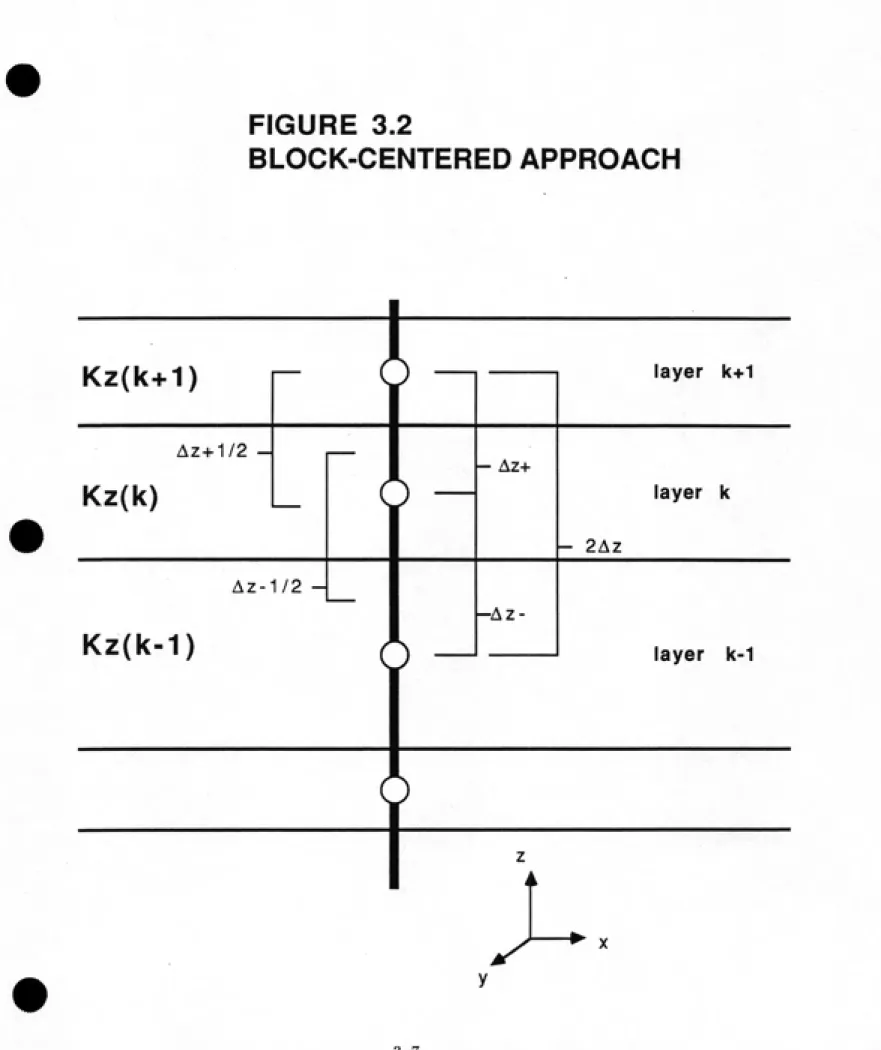
A finite difference approximation is applied to the z-derivative terms of (3.5), using
a central difference, block-centered approach. The block-centered approach refers to the
location of the nodes in the finite difference approximation and is illustrated in Figure
3.2. By using a block-centered approach, discontinuities in hydraulic conductivity can be
treated by taking a harmonic mean of the conductivity divided by the layer thickness. This
approach reduces the z-derivative terms to
§-M)-lMt^'^'
n=ldz \ ^ Az\ n=l
N
n=l
r^ I fen,k+l - fen.kA y- /^n,k-^n,k-l
Az_^Az J V Az-Az
where
indices k -h |,k — /rocl2,k -|-1, and k — 1 are as shown in Figure 3.2
Az terms are as shown in Figure 3.2 (L)
Kz+ = upper-weighted, harmonic-mean hydraulic conductivity [LjT) Kz- — lower-weigh ted, harmonic-mean hydraulic conductivity {LjT)
and harmonic mean is defined as Kz — ^„'^ ,,. where
d = total thickness [L)
d\ = thickness of individual layer (L)
K\ — hydraulic conductivity in indivdual layer [LjT)
FIGURE 3.2
BLOCK-CENTERED APPROACH
Kz(k+1)
i
layer k+1
Az+1/2
-r
- Az+Kz(k)
C
|) —
layer k- 2Az Az1/2
-1
-Az-Kz(k-I)
S —J
layer k-1X^AT,
n = l N
EiVn
n = l
K,^
K.
^n,k+l ~ fcn,k
if. ^n,k ~ ^n,k-l
A2_A2
A2+A2
hnk + 1
^^jJff^H- "
ͣ
n=l A2;+A2 A2_A2
/ln,k (3.7)
N
+ E^"
n=l
if.
Az-A^
^ii,k-The next step is to approximate the temporal derivatives using finite differences. An
explicit, forward-difference approximation provides a first-order correct approximation.Applying this approximation yields
dh dh d N hl^^ - h\
dt dt dt -^ ^ ^ ^^ dt ^ ^ At
n=l n=l n=l
(3.8)
where
1 — index for present time step 1 + 1 = index for next time step
At = time increment for time step [T)
The remaining derivative terms can be expressed as follows
* N N
dh dh d v—v ,^ . , , v^ , , V
dx dx dx
n=l n=l
dx (3.9)
- N N
dh dh d \-^ ^r , t ^ v^ . / \
^ ^ ^ n=l n=l
dN^
dy (3.10)
By time-lagging the z-component terms, the original set of n^j, by n^ terms are split
into Tiz subsets of equations, each of which contains rixy equations. Time-lagging the
z-component terms implies that these terms are evaluated at the old (1) time step, while
the other components are evaluated at the new (1+1) timestep. The resulting equations
can be split into two parts, the first representing a prediction of the approximate valuesof head at the new (1+1) timestep, and the second representing the corrected approximate
values of head at the new (1+1) timestep. Splitting the equations in this manner allows
for computations in the x-y plane to be separated from computations for the z-direction,
thus easing the computational burden.
Instead of explicitly writing all terms of the two equations, they can be represented in matrix form as
iKHuwr''+^ ic^vr^' - Ch}i)
(3.11):{f(/.)}i'+^)* + {Fmi;-''^' + {KL . h)[_, - [{KU + KL)
ͣ
h]i + {KU
ͣ
h)i^.
and
[if^].wr^^'+^(wr^-{MO
={f (/.)}!'+')' + {F(/.)}i'+^)* + {KL
ͣ
h)it\ - [{KU + KL) . h)i+' + {KU • h)il\
(3.12) where
index * refers to predicted solutions and
[{h}('-^^) ~ {hy) = Sf N,S.^ dx dy
[ST]At
{T{h)}= ff N;T{h) dxdy
R.
{m}^^N;(Knl^) dB
{KL
ͣ
h)k-i - [{KU + KL)
ͣ
h]k + [KU
ͣ
h)k+i = JJ Nif, (if.g) dx dy
The model considered in this paper utilizes linear triangular elements in the x-y plane, as shown in Figure 3.3. The basis functions for this type of element are as follows.
^ni = ^[(2;n,yn„ - Xn,^yn^) + (yn, " ynJ\X + (x„„ - Xn^)y\
Ki = -^[{^nr^Vni - XmVnJ + (yn„ " yni)x + (x„, - Xn^)y]
^^"^ " ^[(^'i.^''. - ^n,yn,) + {yrti ' ynj)x + (Xn, - Xn,)y] (3.37)
where
ni,nj, and Um = nodal indices on triangular element
Xi,Xj,Xm,yi,yj, and t/m = coordinates of triangle vertices (L) Ae = area of triangle {L'^)
These basis functions are substituted into Equations 3.11 and 3.12 and subsequently
differentiated and integrated.
FIGURE 3.3
LINEAR TRIANGULAR ELEMENT
I
ͣ
JD "' (xi.yi)
/
o
\
j/^
numbering\
^i.^^^^^
convention\
nj "^ ^
^^^...^^^^^
\
(xj,yj)
•
"^^^
^ nm
computational procedure. The first step is to lump-diagonalize the [ST] matrix, which
contains the storage terms, and the [KU], [KU+KL], and [KL] matrices, which contain the
vertical flow terms. The algorithm used to himp-diagonalize is as follows.
an = 2_^^i3 ' '^iy — ^ for i # j (3.13)
j where
fltj = i,j element of [A] matrix
This approach greatly simplifles the computation of the two equations (3.11 and 3.12).
However, the lump-diagonalizing procedure implicitly assumes that the values of terms in[A] do not differ signifcantly over the nodes of a single element. The set of equations in
(3.11) can be termed the predictor equations.
The flrst stage of the solution procedure amounts to a layer-by-layer solution of the
predictor equations for h^^'^^^*. After the sublayer-sweeping operation has been completed,
the second stage of the algorithm is achieved by solving Equation 3.12 for h^^'^^\ the
corrective version of the flow equation. It is apparent that there are several terms in
(3.11) that are identical to those in (3.12). There is no need to solve the entirety of both
equations. The repeated terms can be eliminated by taking the difference of (3.11) and
(3.12), thus obtaining
= {KL • h)it\ - [{KU + KL) . h][+' + {KU • h)i\\ (3-14)
-{KL
ͣ
h)i_, + {{KU + KL) • h)i - {KU • h)[+,
The overall coefficient matrix on the right-hand-side of Equation 3.14 can be made
and [KL] are lump-diagonalized. A highly efficient tridiagonal solver such as the Thomas
Algorithm can be used to solve (3.14). The second stage of the computational procedure
thus involves solving rixy subsets of equations, with each subset containing n^ equations
with ng unknowns. The resulting solutions for h^''^^' are the current hydraulic head values
at the nodes on a vertical line along the complete thickness of the aquifer domain.
The computational procedure for setting up and solving the predictor and corrector
equations is summarized in Figure 3.4. The procedure is repeated for each time step until
the maximum number of timesteps (specified by the user) is reached. No iterations within
the timestep are necessary for the confined flow case, because direct solution procedures
are used.
3.3 Application of Boundary Conditions and Source and Sink Terms
Suitable boundary conditions and source or sink terms can be applied to the ALALS
algorithm. The most commonly applied boundary conditions for groundwater flow prob¬
lems are the Neumann or Dirichlet boundary conditions. Typical boundary conditions and
sources or sinks are shown in Figure 3.5.
The Neumann boundary condition can be generalized as
du{x,y,x,t)
dn
= g{x,y,z,t) (3.15)
B
where
n = outward normal vector
B = problem boundary
g = arbitrary boundary function
LOOP ONZ
FIGURE 3.4
FLOW DIAGRAM FOR ALALS ALGORITHM
READ IN DATA
.NJ^
ECHO DATA OUT
FORMKH
2^
FORM ST
jvk
FORM LHS MATRIX
(PREDICTOR)
^
IMPOSE DIRICHLET
B.C.'S ON LHS
Nk
FACTOR LHS MATRIX
jsk:
EXCHANGE NEW HEADS FOR OLD
W
2.
FORM KVLOOP ONZ
FORM RHS (PREDICTOR),
IMPOSE B.C.S
Vj^
SOLVE
LOOP ON
TIME
Si^
FORM LHS MATRIX
(CORRECTOR)
LOOP ON NODK
nL^
FORM RHS MATRIX
(CORRECTOR)
^
SOLVE
WATER BALANCE
N^
FIGURE 3.5
TYPICAL BOUNDARY CONDITIONS,
SOURCES AND SINKS FOR
GROUNDWATER FLOW
RECHARGE
r^i
BOUNDARY
RJUX
CONSTANT HEAD BOUNDARY
NO FLOW BCO^DARY
by simply placing the free edge of an element on the relevant boundary. In the z-direction,
no flow conditions are imposed by setting the relevant portion of the the vertical flow
component equal to zero (see Equation 3.11). For example, at the top layer of an aquifer
system, the condition of no flow onto the top reduces the expression for vertical flow
components from Equation 3.11 as follows.
//
m£ (^^Ij I dxdy= (KL
ͣ
/i)^_i - \{KU + KL)
ͣ
h)[ (3.16)
Fluxes into boundary elements can be applied in all three dimensions by integrating
the flux over the relevant element and applying the resultant to the nodes of the element.
The hydrologic quantity of recharge is an example of a boundary flux that may be applied
in groundwater flow. The integration is analogous to the boundary term found in Equation
3.5. Recharge can be handled as follows
11TM
dx dy = recharge (3.17)
R
where
Fr = recharge rate {L/T)
Dirichlet boundary conditions can be generalized as
UB (x, y, z, t) = f{x, y, z, t) (3.18)
where