ABSTRACT
NANCY B. JONES. The Use of EPA's Currently Recommended
Default Concentrations as Initial and Boundary Conditions In
the Urban Airshed Model. (Under the Direction of Dr. Harvey
E. Jeffries).
EPA's list of recommended default concentrations, from the Guideline for Regulatory Application of the Urban Airshed Model, were substituted for SAI's AIRQUALITY, BOUNDARY, and
TOP CONC files In the Atlanta 5-cltles PLANR approach study.
These concentrations were also substituted for the ROM
(Regional Oxidant Model) derived AIRQUALITY, BOUNDARY and TOP CONC files in the ROM/UAM interface test case for the New York domain.
In the case of Atlanta, where the differences between the
original and default values were small, the peak
concentrations each hour were within a few ppb of each other
and domain-wide there were only changes of 10 to 15 ppb in theconcentration contours. However, both runs miss the peak
measured concentration by one-half.
The default input concentrations were usually less than
half of the ROM derived ones in the New York domain. Here
there is a large decrease in the model output of ozone, up to 80 ppb near the southern boundary and 50 to 60 ppb in the area of maximum concentrations. Even with these large decreases,
the difference between the UAM/ROM output concentrations and
the observed ozone concentrations are greater than the
difference between the UAM/ROM and the default run forecast
ABSTRACT...i i
TABLE OF CONTENTS...iii
ACKNOWLEDGEMENTS...v
LIST OF TABLES AND FIGURES...vl
1. INTRODUCTION AND BACKGROUND...1
1.1 INTRODUCTION...1
1.1.1 MAGNITUDE OF THE U.S. OZONE NON-ATTAINMENT PROBLEM...1
1.1.2 CHEMICAL AND PHYSICAL PROCESSES IN OZONE FORMATION...4
1. 2 PHOTOCHEMICAL MODELS...4
1.2.1 BACKGROUND...4
1.2.2 URBAN AIRSHED MODEL (UAM)...6
1.2.3 REGIONAL OXIDANT MODEL (ROM)...10
1, 3 UAM APPLICATIONS...12
1.3.1 PLANR APPROACH IN ATLANTA...12
1.3.2 UAM/ROM INTERFACE FOR NY DOMAIN...18
1.3.3 DEFAULT VALUES FOR INITIAL AND BOUNDARY CONDITIONS...25
2. PURPOSE AND APPROACH...27
2 . 1 PURPOSE...27
2 . 2 APPROACH...27
3. RESULTS...28
3 .1 ATLANTA...28
3 . 2 NEW YORK...39
4. DISCUSSION...62
4 . 1 FINDINGS...64
XV
REFERENCES...67
APPENDIX A: ATLANTA...Al
LIST OF TABLES AND FIGURES...A2
APPENDIX B: NEW YORK...81
I would like to thank Dr. Harvey E. Jeffries for his
encouragement, technical assistance and guidance during my study at the Department of Environmental Sciences and Engineering. I would also like to thank Dr. Donald L. Fox and
Dr. David Leith for their reading, listening and assistance.
Thanks also go to Carey Ji-Cheng Chang and Gerald R.
Gibson, without whom the UAM would not have run, making this work impossible; and to everyone in rooms 119 and 120 who've
listened to and helped me. Thanks go to Dr. James M.
Godowich, for his suggestions and help in obtaining data
files.
I especially would like to thank my husband Philip for
his encouragement and his help filling my prior role; and
Lauren and Adam for helping to raise each other and their not
so quiet acceptance of another day exceeding the National
Academy of Pediatrics recommendation for television viewing by
LIST OF TABLES AND FIGURES vx
TABLES
Table 1. Classified Ozone Non-Attainment Areas...3
Table 2 . Uam Input Files...9
Table 3. Observations Available for PLANR Study...14
Table 4. Default Concentrations from EPA Reg. Guide...25
Table 5. Default Concentrations as Input into Model...26
FIGURES Fig. 1. Fig. 2. Fig. 3. Fig. 4. Fig. 5. Fig. 6. Fig. 7. Fig. 8. Fig. 9. Fig. 10 Fig. 11 Fig. 12 Fig. 13 Fig. 14 Fig. 15 Fig. 16 Fig. 17 Fig. 18 Fig. 19 Fig. 20 1988 Population Above NAAQS...2
VOC/NOX/O3 Total Daily Cycle...5
Atmospheric Processes Treated in a Column of Grid Cells...7
UAM Simulation Program Input & Output...8
The ROMNET Domain for the Northeast...10
ROM Layer Characterization...11
UAM Domain for Atlanta...13
Atlanta Diagnostic Wind Model Output, 17L...16
Atlanta Original Ozone Contours, 17L..., . . 17
Flow Chart for ROM/UAM...19
New York Domain...20
Day 1, UAM/ROM Derived Winds, 17L...21
Day 1, UAM/ROM Ozone Contours, 17L...22
Day 2, UAM/ROM Derived Winds, 17L...23
Day 2, UAM/ROM Ozone Contours, 17L...24
Atlanta Initial Cond. 5-Cities Vs. Default...29
Atlanta Boundary Cond. 5-Cities Vs. Default...30
Atlanta Top Cone. 5-Cities Vs. Default...31
Atlanta Default Ozone Contours, 17L...32
Fig. 21. Conyers Observed Vs. Predicted Ozone...35
Fig. 22. Dekalb Observed Vs. Predicted Ozone...36
Fig. 23. Atlanta Ozone Frequency Dist. by Cell...37
Fig. 24. Atlanta Ozone Culm. Percen. Freq. Dist. by Cell...38
Fig. 25. NY Initial Cond. UAM/ROM Vs. Default...40
Fig. 26. NY Top Cone. UAM/ROM Vs. Default...41
Fig. 27. NY Boundary Cond. UAM/ROM Vs. Default,
NOx/Oj, West, Lev 1&2...42
Fig. 28. NY Boundary Cond. UAM/ROM Vs. Default,
NOX/O3, West, Lev 3,4&5...43
Fig. 29. NY Boundary Cond. UAM/ROM Vs. Default, VOC/CO, West, Lev 1&2...44
Fig. 30. NY Boundary Cond. UAM/ROM Vs. Default, VOC/CO, West, Lev 3,4&5...45
Fig. 31. NY Boundary Cond. UAM/ROM Vs. Default,
NOX/O3, South, Lev 1&2...46
Fig. 32. NY Boundary Cond. UAM/ROM Vs. Default,
NOX/O3, South, Lev 3,4&5...47
Fig. 33. NY Boundary Cond. UAM/ROM Vs. Default, VOC/CO, South, Lev 1&2...48
Fig. 34. NY Boundary Cond. UAM/ROM Vs. Default,
VOC/CO, South, Lev 3,4&5...49
Fig. 35. NY Default Ozone Contours, Day 1 17L...52
Fig. 36. NY Default Ozone Contours, Day 2 17L...53
Fig. 37. NY Change in Ozone Contours, Day 1 17L...54
Fig. 38. NY Change in Ozone Contours, Day 2 17L...55
Fig. 39. Hampstead Observed Vs . Predicted Ozone...56
Fig. 40. Middleton Observed Vs. Predicted Ozone...57
Fig . 41. Day 1, Observed 15L Ozone Cone...58
Fig. 42. Day 2, Observed 15L Ozone Cone...59
Fig. 43. NY Ozone Frequency Dist. by Cell...60
1. INTRODUCTION AND BACKGROUND
1.1 INTRODUCTION
1.1.1 MAGNITUDE OF THE U.S. OZONE NON-ATTAINMENT PROBLEM
Since the passage of the initial Clean Air Act (CAA) ,
much progress has been made in reducing the levels of all of
the criteria pollutants, except ozone. Despite a 1979
relaxing of the standard from 0.08 to 0.12 parts per million
(ppm), (taking one hour averaged concentrations, the expected
number of days per year with a daily maximum ozone level above
0.12 ppm must not be more than one) 98 areas in the United
States were classified as non-attainment in ozone by the
Environmental Protection Agency (EPA) in 1991 (See Table 1).
[EPA,1991b] It is estimated that one half of the population
of the United States lives in areas which are not in
compliance with the current standard, while it is still
debated whether that standard is a safe limit from a public
health viewpoint. In 1989, the relaxed standard was only
supported by one half of the members of the Ozone
Subcommittee, of the Clean Air Scientific Advisory Committee
to the EPA. The remainder of the members recommended a
reduced upper limit. [Lippraan, 1989]
For the latest year that statistics are available, 1988,
standard exceeded (Fig. 1).[EPA.1988] High levels of ozone in
the atmosphere are known to cause adverse human health effects
ranging from transitory respiratory changes to structural
changes in the lung. Crop damage and degradation of materials
are also results of high levels of ozone.
For those non-attainment areas classified as serious and
above, and also for interstate moderate areas (See Table 1),
the 1990 Clean Air Act Ammendments (CAAA) requires the use of
"photochemical Grid models" to demonstrate prospected
attainment. The EPA has interpreted this to mean the UAM,
unless equivalency can be shown.
People in counties with 1988 air quality above
primary National Ambient Air Quality Standards.
pollutant PM10 S02 CO N02 Ozone Lead AnyNAAQS 1 9r \
b" ^
1'"r \
l:,:™^f:!^::;ͣ:s;SSBSJ:fSWs::J:::! ;t.:^ ^ 1 20 40 60 80
millions of people
100 120 140
Figure 1. 1988 Population Above NAAQS.
Of the people affected by air quality above the
Table 1. Classified Ozone Non-Attainment Areas.
Listed by classification. (Source: EPA. 1991b)
Extrtm* • Los Angolss-South Coast Air Basin, CA
Chicago-Gaiy-Laka County, IL-IN Houston-GaKrsston-Brazoria, TX
MilwaukM-Racina, Wl
Baltimors, MD
Phiiadslphia-Wnm-Trent, PA-NJ-OE-MD
Atlanta, GA
Baton flouga, LA
Beaumont-Port Arthur, TX
Boston-LawrancA-Worcester (E.MA), MA-NH
a Paso, TX Groatsr Connacticut
Muskogon, Ml Atlantic City, NJ
Charisston, WV
Chartotts-Gastonia, NO CIncinnati-Haniiiton, OH-KY Claveland-Akron-Lorain, OH Dallas-fort Worth, TX
Oayton-Springfiald, OH
Oatroit-Ann Arbor, Ml Grand Rapids, Ml
GrMnsboro-Wlnston Salam-H Point, NC Huntington-Ashland, WV-KY
Kawaune* Co, Wl Knox & Lincoln Cos, ME Lewiston-Aubum, ME
Louisvilla, KY-IN
Manitowoc Co, Wl
Albany-Schenactady-Troy. NY
Allentown-Bathlaham-Easton, PA-NJ
Altoona, PA
Birmingham, AL
Buffalo-Niagara Falls, NY Canton. OH
Cherokaa Co, SO
Columbus, OH Door Co, Wl
Edmonson Co, KY
Efia, PA
Essax Co (Whitafaca Mtn). NY Evansvilla, IN
Greanbriar Co, WV Hancock & Waldo Cos. ME Harrisburg-Lsbanon-Cartisla, PA Indianapolis. IN
Jafferson Co, NY Jersay Co, IL
Johnsto\wn. PA
Kent and Queen Anna's Cos, MO
Area Ozone design value Deadline
Classification (parts per million) Marginal .121 up to .138 Moderate .138 up to.160 Serious .160 up to .180 Severe .180 up to .280 Extreme .280 and above
New York-N New Jer-tong Is, NY-NJ-GT
Southeast Oasart ModHIad AQMA, CA
S»nn-13
Serious
Modarata
San Olago, CA
Ventura Co, CA
I
Portsmouth-Oover-Rochester, NH ProvManca (Alt RQ. R>
Sacramento Metro, CA
San Joequin Valley, CA
Sheboygan, Wl
Springfield (Western MA), MA Washington, OC-MO-VA
Mlami^bft Lauderdala-W. Palm Beach, FL
Monterey Bay, CA
NashvUle,TN
Parkaraburg. WV
Phoarac AZ
Pittsburgh-Baavar Valley, PA Portland, ME
Raleigh-Ourtiam, NC Readkig. PA
Richmond-Petersburg, VA
Salt Lake City, UT
San Frandsco-Bay Area, CA
Santa Bari>ani-Santa Maria-Lompoc, CA St Louis. MO-IL
Toledo, OH
MarginMl
Knoxviie, TN Lake Chartas, LA Lancaster, PA
Laxington-Fayatta, KY
Manchester, NH
MemfMs, TN
Norfoik-Vlr. Beach-Newport News, VA Owensboro, KY
Paducah. KY
Portland-Vancouver AQMA, OR-WA Poughkaepsie, NY
Reno. NV
Scranton-Wilkas-Barra, PA Seattla-Tacoma, WA
Smyth Co, VA (White Top Mtn)
South Bend-EIkhart IN
Sussex Co, OE
Tampa-St. Patarsburg-Clearwatar, FL
Walworth Co, Wl
York, PA
Youngstown-Warren-Sharon. OH-PA
(SubMatginai Kansas City. MO-KS)
3 years after enactment 6 years after enactment
9 years after enactment
The formation of ozone near the earth's surface peaks
during the summer months when the incoming solar radiation is
strongest. Coupled with the more intense radiation and
resulting increase in photolysis of ozone precursors, is the
retreat northward of the polar frontal boundary in the summer.
As a result there is an increased frequency of capping high
pressure conditions, where the vertical dilution of pollutants
is supressed. These conditions in turn allow emissions to
build up into large concentrations of primary pollutants.
Figure 2 shows the cycle of volatile organic carbons
(VOC) and NOx (all nitrogen species), in the lowest level of
a 20 Km grid cell from the Regional Acid Deposition Model
(RADM) . OH radicals react with VOC and are recreated in a
cycle. The cyclic process oxidizes NO to NO^ and the NO2
photolizes to reproduce the NO and to produce ozone.
1.2 PHOTOCHEMICAL MODELS
1.2.1 BACKGROUND
Photochemical models are mathematical descriptions of
atmospheric transport, diffusion, and chemical reactions of
pollutants. Their input data characterizes the emissions,
topography and meteorology of the region, while their output
describes the regions air quality. [NAS,1992]
The principal use of air quality models is to predict
future compliance with standards after planned emission
reductions. To confidently predict the results of these
planned reductions, the ability of the model to replicate past
r ^ (T)
H-< OQ l_j 1-5 O CO ' I ft) ?r 3 < O o n w X ^^ H- O ri- H cr o ft
rt-> •2 *< . '< n .-^ h-' C_ fD
S "J
QfQ o
- n
New York cilv area (20 km) 3.96 OH Cycles
34.1 ppb new OH
propagalioi) and Icnniiialioii
PoH=0.747
AVOC= 112.9ppbV 135.1 ppb OH
13.18 ppb by organics : ^^^^^^^ (N0-^N02 ) / VOC
20.92 ppb by inorganics;
= 1.84
48.1 ppb from emiss.
0.4 ppb lost by met
47.9 ppb new NO
N0-^N02 = 208.2 ppb (N0->N02) / NO,
210.1 ppb NO
reacted
---ͨ
100.9 ppb OH
re-created
[Q3]p/[N02]p
5.76 ANO,= 36.17ppbV
Pno=0-772
propagation and termination
0.709
162.3 ppb NO
re-created
---ͨ
[03]p=147.6ppb
4.39 NO Cycles
63.8 ppb [Oali™,
5.9 ppb [OaUct „ 65.6 ppb [O3]
met[O3], =139.9 ppb
empirical kinetic modeling approach (EKMA) was the model
required by EPA for use in attainment demonstrations. EKMA isa simpler trajectory model in which a "box" is moved along,
expanded and contracted by the meteorological conditions,
while passing over sources the emissions are added, and the
chemical reactions occur as the "box" moves. This model may
still be acceptable to EPA in some moderate non-attainment
areas.
Grid based (Eulerian) models use a three-dimensional
set of cells in which the species are passed from cell to cell
according to the meteorological conditions. The choice of the
dimensions of the grid cells implies that input data (winds,
turbulence, emissions, etc.) are resolved to that scale. [NAS,
1992]
1.2.2 URBAN AIRSHED MODEL (UAM)
The basis for the UAM is the atmospheric diffusion or
species continuity equation.
d/dt(c) + ud/dx(c) + vd/dy(c) + wd/dz(c) - D{dVdx^(c) +
dVdy^(c) + dVdz^(c)} = S - L (where d is the partial deriv)
( or Dispersion - Molecular Diffusion = Sources - losses)
The system of partial differential equations describes the
production of ozone and other species by expressing them as a
function of: advection, turbulent diffusion, chemical reactions, emissions and sinks such as surface deposition.The solution of the coupled mass balance equation provides a
time dependent concentration of the species in the model. For
each three to eight minute time interval, for each grid cell,
the model solves the mass balance equations using the method
These are:
Step 1-solve advection/diffusion in the x-direction;
Step 2-solve advection/diffusion in the y-direction;
Step 3-add emissions & solve vertical advection/diffusion;
Step 4-perform chemical transformation of pollutants.
T Tnupom 2 TmipeR a 8
1
Tnmtpon Elavaad Twpipott Bsviud I I Tfipott tlBBlpOH Graoi^-UvillRo«4w«y Mif wh Effi
INVE]ISDNTOP
TnnipoR
DfVBUIONBASB
. GROUND SUKFACE
I to 10 HlwMin »j
Figure 3. Atmospheric Processes Treated in a Column of Grid Cells. (Source: EPA, 1990b)
The kinetics mechanism for the chemical transformation of
pollutants in the latest version of the UAM is the Carbon Bond Mechanism IV (CBM-IV). Due to computational constraints, the mechanisms of ozone formation in the atmosphere can not be
expressed explicitly. In CBM-IV, reactive species are lumped
into surrogate groupings with similar kinetic characteristics.
The UAM uses up to thirteen input files, and outputs three files. (See Figure 4 & Table 2) Two episodes were
modeled for this report which had previously been set up and
which came with the UAM tapes as test cases. As a result time
Boundary Cond. Rxn Rates Control
[ diffbr£ak[
( regionrop ( ( emissions (
(tb>iperatok(
TEIWAIN
(opooral)
PTSOORCH ( ( AKQUALITYC
(boundary^
( TOPCONC {
(cHEMPARAMf (SD
SMCOmXOLUAM
.^ SinuUdaa
-/ INSTAKr* ( f AVERACB f f DEPOSTIKJuf
Instant can be used as an initial condition file to
restart model.
Figure 4. UAM Simulation Program Input and Output Files
Table 2. UAM Input Files. (Source: U.S.EPA, 1990b)
AIRQUAUTY This file specifies the initial concentrations for each of the CB-IV state species (see Table 2-1) in each grid cell at the start of the
simulation.
BOUNDARY This file contains the locations of the modeling domain boundaries
and the concentrations of each species used as boundary conditions along each lateral boundary for each level,
CHEMPARAM This file contains information on the chemical species to be simula¬
ted, including reaction rate constants, upper and lower bounds,
activation energy, reference temperature, and resistance to surface
sinks.
OtFFBREAK This file specifies the daytime mixing height and nighttime inver¬
sion height for each column of cells at the beginning and end of
each hour of the simulation.
EMISSIONS This file specifies the ground-level emissions of all emitted species
to be simulated for each grid cell and each hour of the simulation. These species will usually be a subset of those listed in Table 2-1,
although any additional species not recognized by UAM will simply be ignored by the UAM.
METSCALARS This file contains hourly values of meteorological parameters that do not vary spatially. These scalars are the NO2 photolysis rate
constant, the concentration of water vapor, the temperature
gradient above and below the diffusion break, the atmospheric pres¬
sure, and the exposure class (a measure of the near ground-level atmospheric stability due to surface heating or cooling).
PTSOURCE This file contains point source information, including the stack
height, temperature, flow rate, the plume rise (effective stack height). Che grid ceil that contains the stack, and emission rates for
all emitted CB-IV species for each point source for each hour of the
simulation.
RECIONTOP This file specifies the height above ground of the top of the model¬
ing regioru It can vary both spatially and temporally, but the usual
practice is to set it to a constant.
SIMCONTROL This file contains simulation control information, including the
period of simulation, model options, and information on integration time steps.
TEMPERATUR This file specifies the surface temperature for each hour and grid
ceU.
TERRAIN This file contains values for surface roughness and deposition factor
(or each grid cell.
TOPCONC This file specifies the concentration of each CB-IV state species
(Table 2-1) (or the area above the top of the modeling domain.
VINO This file specifies the x- and y-direction components of wind
velocity for every grid cell for each hour of the simulation. Also
contained in this file are the maximum wind speeds (or the entire
domain and the average wind speed at each boundary (or each hour
1.2.3 REGIONAL OXIDANT MODEL (ROM)
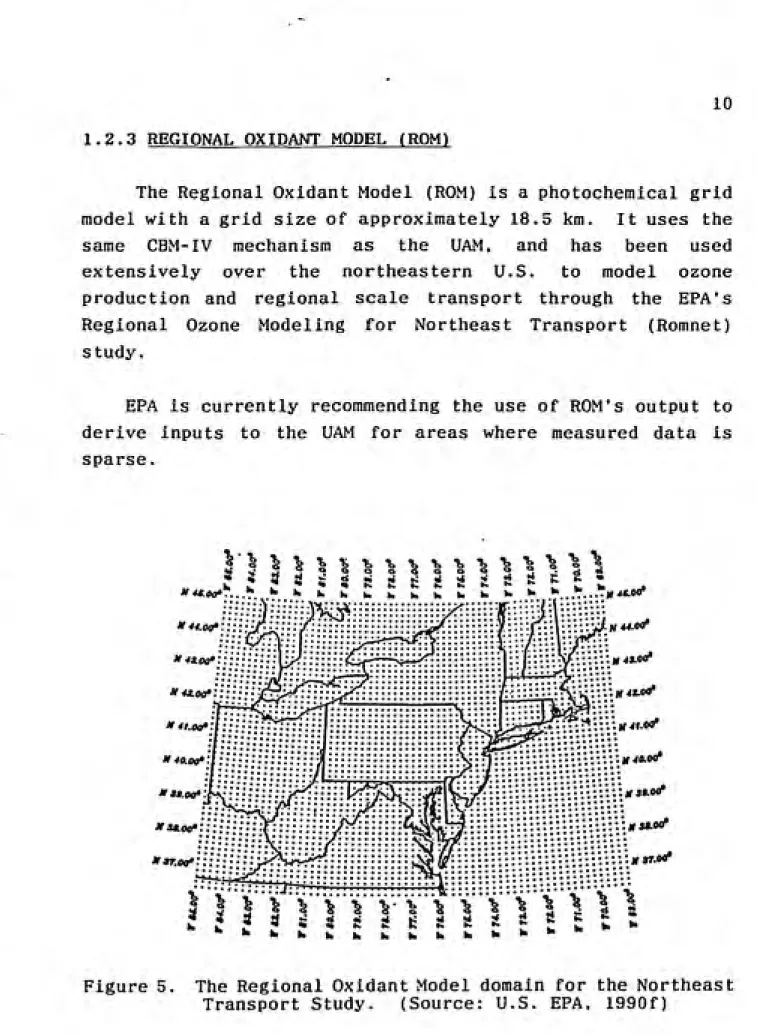
The Regional Oxidant Model (ROM) is a photochemical grid model with a grid size of approximately 18.5 km. It uses the same CBM-IV mechanism as the UAM, and has been used extensively over the northeastern U.S. to model ozone production and regional scale transport through the EPA's Regional Ozone Modeling for Northeast Transport (Romnet)
study.
EPA is currently recommending the use of ROM's output to derive inputs to the UAM for areas where measured data is
sparse.
•b -k "k \
t> W h. k. hi k.
'\'\'\W\\
s c ^Figure 5. The Regional Oxidant Model domain for the Northeast
11
In the ROM, for the horizontal component of the mass
continuity equation is solved over the 19 km grid to determine
the transport. The vertical resolution is coarse and uses alower resolution, layer-averaged wind field to save
computation time.
The model takes into account the effects of cumulus
clouds on vertical transport, nighttime wind shear and
tubulence associated with the nocturnal jet, and terrain
influenced motions. Originally written as a four layer model,
the ROM-2.1 does not use the surface layer.Layer Functions 0«vliiiM Layer 3 Layer 2 Layer 1 Layer 0
Oownward Iramport of llraloipherle oiona
Upward IrinipofI by
aimului cloudl
3. Liquid and gai phai*
pholochamlilry
4. Long rang* trampert
by fiaa •tmotphtra
1. Gat pliata phelochamitliy
2. Turbulenc* aitd wind ihear
adacli on lianiport and
dilluilon
3. Oepoiillon on mounlalni
4. Laka and marina layart
' 1. Eflecl on reaelion rala of
nibgriil icala legragalion of fraih and aged polluiani* 2. Qround dtpoiilion
3. Spatial variation in mean
concenttalioni ihie to lina
point and aiaa loiMcai
Figure 6. Regional Oxidant Model Layer Characterization.
1.3 UAM APPLICATIONS
The UAM has been exercised successfully using specially
derived data bases obtained from field studies. In these
cases, the model has performed well, resulting in the EPA's recommending its use by the states in the attainment demonstrations required by the CAA.
1.3.1 PLANE APPROACH IN ATLANTA
In the raid-eighties, EPA contracted with Systems Applications International (SAI) to demonstrate the low-cost
application of the UAM in five cities, using what was called
the PLANR approach. That is, SAI used National Weather
Service meteorological data, routinely measured ozone
observations, and the 1985 NAPAP emissions inventory, instead
of conducting the special field program that had been used in past applications.
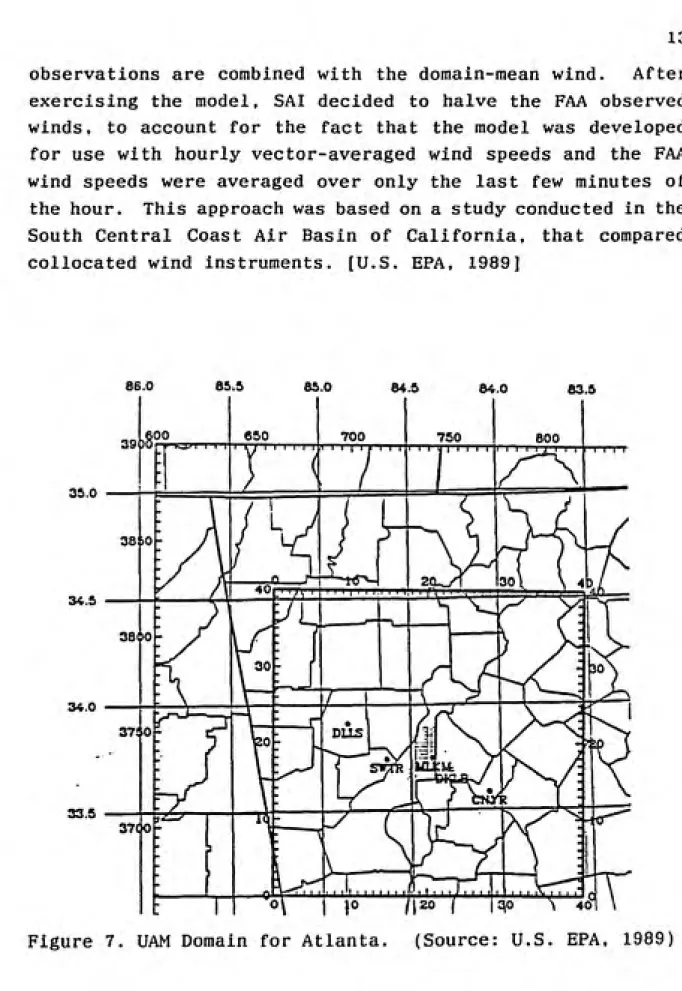
The prepared computer files for one of these cities, Atlanta, is included on the UAM program tapes received from EPA, and is the "original" Atlanta simulation referred to in this paper. The simulation begins on 1200L June 3, 1984 and simulates the high ozone episode of June 4, 1984. The domain
consists of a 40X40 array of 4km grid cells.
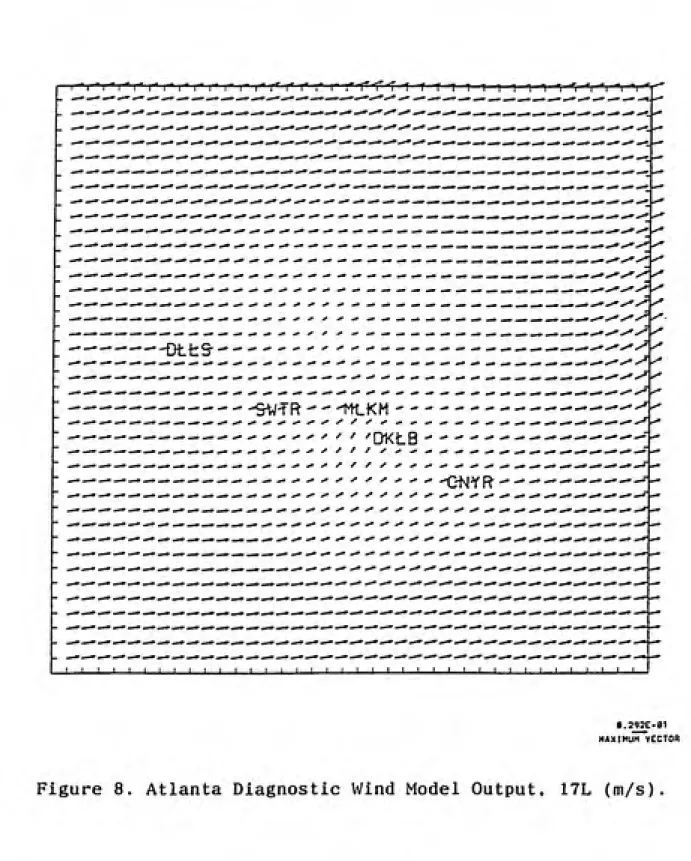
The wind fields were created using the Diagnostic Wind
Model (DWM), supplied as part of the UAM distribution, to
obtain 14 vertical levels of winds. These were then averaged
to the UAM 5-layer structure, and adjusted to eliminate
vertical velocity through the top.
An hourly wind field is created in two steps. First, a
13
observations are combined with the domain-mean wind. After
exercising the model, SAI decided to halve the FAA observed
winds, to account for the fact that the model was developed
for use with hourly vector-averaged wind speeds and the FAA wind speeds were averaged over only the last few minutes of
the hour. This approach was based on a study conducted in the South Central Coast Air Basin of California, that compared
collocated wind instruments. [U.S. EPA, 1989]
86.0 es.s 85.0 84.5 S4.0 83.5
35.0
34.5
34.0
33.5
5
381 »0
Table 3. Observations Available for PLANR Study. (Source:
U.S. EPA, 1989)
Surface observations and data available:
wind speed (WS), wind direction (WD), temperature (T), dewpoint temperature (TD) and pressure (P).
Site Name
Location UTMX
UTM (Zone 16)
UTMY Variables Measured
Atlanta Hartsfield
International Airport 739.580 3726.148 WS, WD, T, Td. p
Dobbins Naval Air Station 729.590 3755.498 WS, WD, T, Td- p
Fulton County (Charlie
Brown) Airport 729.9^7 3740.709 WS, WD, T, ^D Dekalb Peachtree Airport 749.7214 3752.306 WS, WD, T, Td Conyers Monastery Monitor 772.248 3719.869 WS. WD
South Dekalb Panthersville
Monitor 752.780 3730.991 WS, WD, T, h
Upper-air observation sites, locations, and distance from Atlanta used in this study.
Location UTM Coordinate
UTMX
839.644
s (Zone 16)
UTMY
Dj At
stance fro:
Site Name Ut
35°
Lon;^
57' 83° 19'
-lanta (ks)
Athens, GA 3763.429 109
Nashville, TN 36° 15' 86° 34' 538.182 4012.482 199
Greensboro, NC 36° 5' 79° 57' 1134.426 4016.946 U91
Wayeross, GA 31° 15' 82° 24' 937.394 3467.152 328
Centerville-Brent AL 32° 54- 87° 15' 475.841 3640.638 275
Ozone monitor names and locations.
UTM Location (Zone 16)
Monitor JD Monitor Name UTMX UTMY
15
In the Atlanta study, for the initial concentrations,
boundary conditions and top concentration input, SAI used the following values:
VOC 25 ppbc(using EKMA default speciation)
Isoprene 0.0001 ppb
NOx 1 ppb (75:25 N02:N0) Ozone 40 ppb
CO 200 ppb.
In the Atlanta Study, maximum ozone concentration in
excess of 150 ppb was predicted by the model however, it was
well north of the Conyers Monastery (CNYR) where a daily
maximum of 145 ppb was recorded. For more information about
r I' I" r r r rT' r r r -r r f"r<'''\ t t t t t i i t i -i -i -^i ͣ I i I (
•-fDttS---•--- ' ' 'DKtB
ON^R
J_____I_____\_____I_____I_____1_____I_____I_____1_____I_____I_____I I I_____I_____1_____I_____\---1_____I_____I_____I---1---1---1---1_____I_____\_____I_____I_____i_____I_____I_____I_____I_____i---L.
HAXIMUH VECTOR
17
-1—I—I—I—I—1—I—I—I—I—I—I—I—r "1—I—:—I—1—I—I—I—I—I—I—I—I—I—r
80
&0
41 .8
1.3.2 UAM/ROM INTERFACE FOR NEW YORK DOMAIN
As a portion of the ROMNET study for the northeast, the
EPA contracted with Computer Sciences Corporation (CSC) to
develop an interface system between the ROM model and the
smaller scale UAM. Thus, for cities where routine
meteorological and air quality data are scarce and funds are
not available for large scale studies, the ROM model output
can be accessed for use as input into the UAM. While
temporally the Interface is straightforward, since both models
use one-hour resolution steps, there are spatial framework
differences in the models.Horizontally the UAM is based on a cartesian coordinate
system with a finer grid spacing (generally 2 to 8 kilometers)
and a smaller domain (around 200 kilometers). Conversely, the
ROM is based on a latitude-longitude system, with a horizontal
resolution of 1/4 degrees longitude and 1/6 degrees latitude
(approximately 19 kilometers at midlatitudes) and the domain
is about 1000 kilometers. In the UAM, the vertical diffusion
break is the key in marking the separation of layers of cells
above and below the mixing height, however, the ROM model has
no emulation for the diurnally-varying diffusion break height.
In the ROM/UAM interface, the horizontal wind fields are
matched from ROM's layer 1 to the two lowest layers of the
UAM, and ROM's layer 2 to the three upper layers.
There are seven interface programs. Four produce input
files for the UAM preprocessors, and the other three produce
binary files for use directly in the UAM program. Figure 9
Indicates which files are replaced by the output files of the
en c
n
n
en o i— o d-o
C (T> C
o h« o
ft a cr
•• OR p
CWrl-CO W o
rr "5
mm
>• o
"v.
•- C to > co 2
o
URBAN AIRSHED MODELING SYSTEM
IdXKT I
c a
uwrr 1 |w>na| jtrwm. Tvntn u_ rwawc 1—. ͣ NDAIT|Dinno«le Wind Mode 1
1 •
h rr
L -j
i •
' 1
• tUHVNC 1 1
111
Emiiiloru PnpncttHr Syitcm m^]
rmia i___ NOTE:(*) indiatei processor b replaced by ROM/UAM Interface
(1) domain iptdfic ((drain and chemistrj)
(2) episode specific
(3) growth factors can be applied
(4) control factors can be applied
IUU J
1 »
DUfUT UAMrn
Interfacing is performed for initial, boundary, and top
concentrations of 17 of the 23 pollutant species in the UAM CB-IV. For the other 6 species (NXOY, CRES, MGLY, OPEN, PNA,
and ETOH), values are determined by the steady-state,
lower-bounds values in the CHEMPARAM file. Non-ROM derived input,
such as winds or concentrations, can also be used together with the ROM input. Finally the UAM/ROM interface does not provide emissions, simulation control or chemistry parameters
input to the UAM.
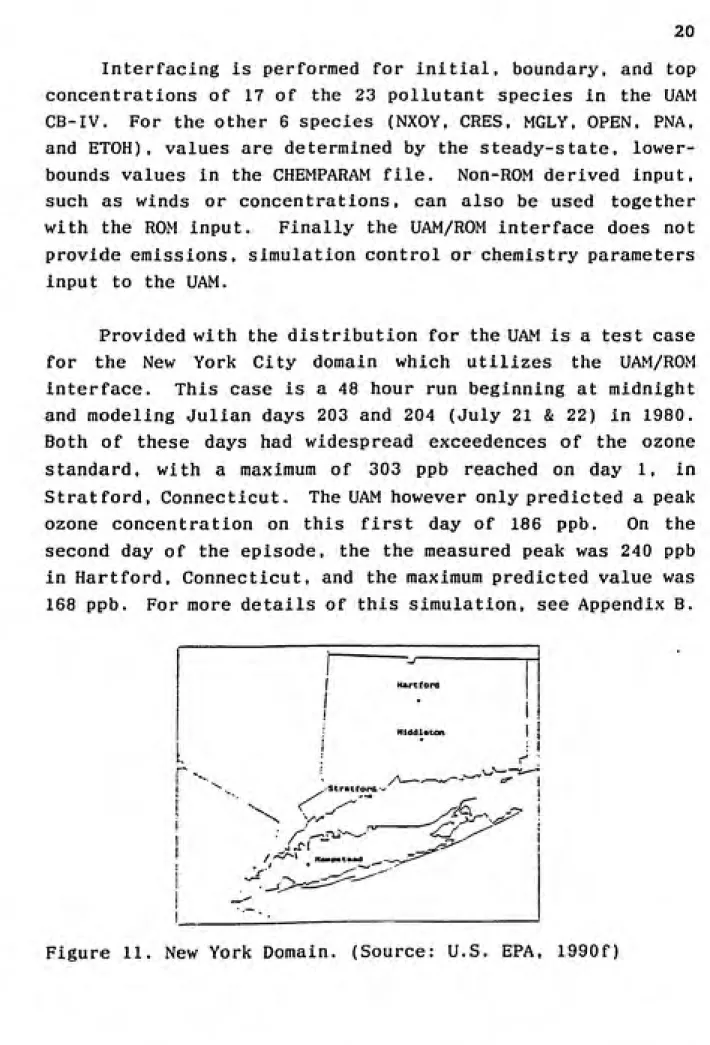
Provided with the distribution for the UAM is a test case for the New York City domain which utilizes the UAM/ROM interface. This case is a 48 hour run beginning at midnight and modeling Julian days 203 and 204 (July 21 & 22) in 1980. Both of these days had widespread exceedences of the ozone standard, with a maximum of 303 ppb reached on day 1, in Stratford, Connecticut. The UAM however only predicted a peak ozone concentration on this first day of 186 ppb. On the second day of the episode, the the measured peak was 240 ppb in Hartford, Connecticut, and the maximum predicted value was 168 ppb. For more details of this simulation, see Appendix B.
21
l\
i ]
\ \
\
M \ ^ M M \ \ \
\ \ \ \ \ \ \ \ \J
1 '
1 i i
i
t \ \ \ \ \ V \ \ \ V
\ \ \ \ \ \ \ \ J1 \ 1 1 1 I T" 1 1^ ^
\ \ \ \ \ Vf^ \ \ nAa
\ \ \ \ \ 1 \ 1 J
t 1
t t M M \\ V ^ ^^ \ \ \ \ \ t t 1 J
[ 1 f ^
! 1 t 1 t 1 -A \ \ \ J>\\ \ \ \ \ \ \ \ J
f1 ^ ^
fff!1\<\\\^\\\\N\\\J
}
i A Af t 1 1 \ \ \)\ \y7^ ^ Y \ N \ \ \ N J
'f
t 4 </ / / / f f m \ \it/\ \ \ \ \ \ \ \ J
~f f f f
/ / / / / f t\t \ ^ vV/mC^ "^ "^ ^ ^ "^ "^
f ' f f
/ / f / f / 1 [ \ \ V 0,0/v.^ X \ \ \ \ ^J
-
r f M 1 ^ V V---A
^ ^ ^'^ N \ \ N ^J
. ' III t
\ \ \ \ \ N ^ i. ,_ ..__-.__-»-
.-^vjx \ \ \ \ -J
1 •
\ \ \ \ N •»-. ._'^L..,__.,,__ͣ<__ͣ*-
.-^N^AN \ \ \ -J
< «
\ \ \ -v^^^^JV.^^-
.v,\iY \ \ V J
^ ^
r
\
r
N V ^_______ ,_______\ N \/\ \ \ \\\\ N V N>^
^
- r \
\v,-._______.V\>e]\\\ ^\\ ^ ^ "J
^j
r^r-\-\-
\--— /\- .\ \C^ \ N \H ^ N ^|
'i
. \ \ \ \
N V...\ V \^\L> "^ ^V
L \ \ ^^
^l- \ \ N \
N s V...^^"^^X^^"^ "^ I
, \ \ ^
\- \ \ \ \
N N N V... -^^"^ YA ^ M
\|
. \ \ \ \V V V V...^'
ͣ
"^^ H ^ iJ
\j- \ \ \ \
\ \ \ \ V > . . ./. ' / Pft^v-O-I 1 y~\
\i. \ N \ \
\\\\\v.../'^// »!<|/r\ / /t J
v^
. \ \ \ \\\\\\\>.y.///// /""-O/ / ^ -I
^J
. N \ N \\ \ \ \ \ \ ,,/.///// / /T / i
\. \ \ \ \
\\\\\\x/. /-////////}
\. \ \ \ \
\ \ \ \ \ \ v/ . 1 f ^ /////// 1
r]- \ \ \ \\\\\\\/v^.if///////|
\ N N N \ \ \ \ \ \./r(\ \)\tittff///v
m 1
^
I 1 1! M 11 IJ I I M
i \t -M-V 23Ai
\ V.v \ \ \ \ \ \ \ \ \ \ \ \ \ \ \ \ \ \ \ \ \ \\\\\\\\ \\\\\\\NN N N N \ Vv,^ N \ N N N^^-.
V. N NN Nv. v.^.
\ \
\ \ N N
Xl X
N.
N \\\ \ \/
\ \/\ \ \
"s N W »>. ""N V. \ \ \
V V. ^N \
N1^ \ \ \\
\ \ \ \ V
v|.\ \ \ \ \ \\NV^^VVN
N\\\\\NV«s.»s.^xN\
^NW^^^v^vN \ \ )( \ \ \ \
k'sv^'v.^v.vn n n y\ s n s \
.VV.v^v^vVNNX \/\ \ \ \ \ \
^ V. V, V, v. v, \. v. N.-Vrrv \. \ \, \ \ \
\ \ \ \ \
\
\
A
\ \ \ S \ \
\ \ \ \
N \ \ \ \ \ N
\ \ \ \ \ \ N
N \ \ \ \ \ N
\ \ ^ \ \ \ ^
HtM \
^^
ͣ
-^
25
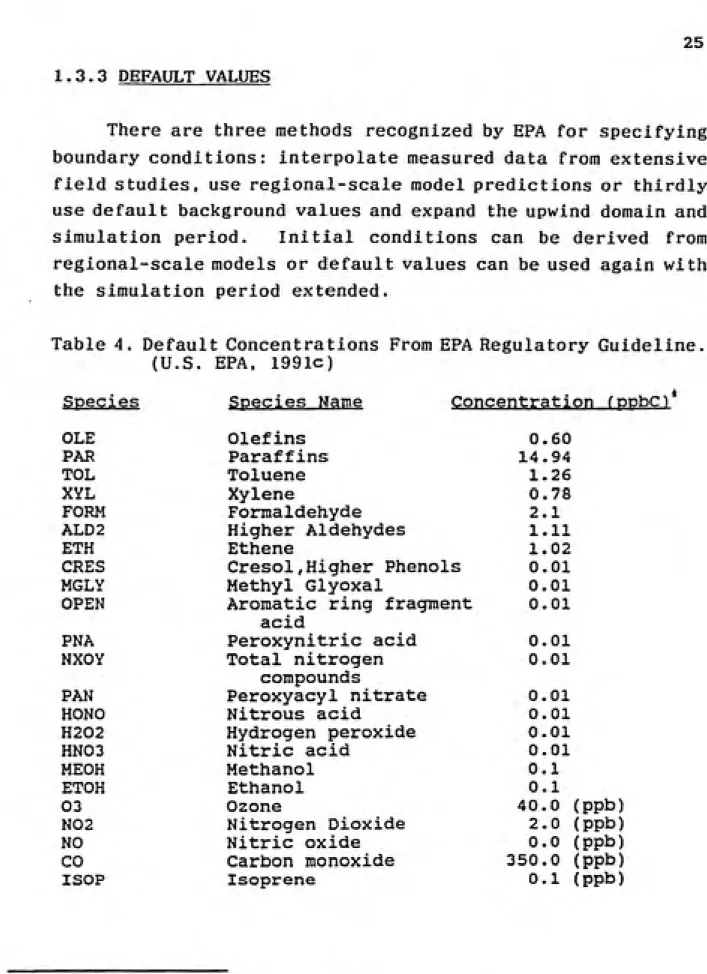
1.3.3 DEFAULT VALUES
There are three methods recognized by EPA for specifying
boundary conditions: interpolate measured data from extensive
field studies, use regional-scale model predictions or thirdly
use default background values and expand the upwind domain and simulation period. Initial conditions can be derived fromregional-scale models or default values can be used again with
the simulation period extended.
Table 4. Default Concentrations From EPA Regulatory Guideline
(U.S. EPA, 1991c)
Species Species Name Co
OLE Olefins
PAR Paraffins
TOL Toluene
XYL Xylene
FORM Formaldehyde
ALD2 Higher Aldehydes
ETH Ethene
CRES Cresol,Higher Phenols
MGLY Methyl Glyoxal
OPEN Aromatic ring fragment
acid
PNA Peroxynitric acid
NXOY Total nitrogen
compounds
PAN Peroxyacyl nitrate
HONO Nitrous acid
H202 Hydrogen peroxide
HN03 Nitric acid
MEOH Methanol
ETOH Ethanol
03 Ozone
N02 Nitrogen Dioxide
NO Nitric oxide
CO Carbon monoxide
ISOP Isoprene
Concentration fpobcV
0.60 14.94 1.26 0. 2, 1. 1. 0, 78 1 11 02 01 0.01 0.01 0.01 0.01 0, 0, 0, 0. 0, 0. 40. 2, 0, 350, 0, 01 01 01 01 1 1 0 0 0 0 1 (PPb) (ppb) (ppb) (ppb) (ppb)4
Currently EPA is recommending that, whenever feasible, the UAM/ROM Interface System be used to derive initial and boundary conditions. Further, they recommend that the winds
from the interface system also be used to prevent
inconsistencies in mass fluxes passing through the domain. If
the area to be modeled is not within the ROM domain and if
measured data are not adequate, then they recommend that the
default values in Table 4 be used. [U.S. EPA, 1991cJ
Some errors exist in Table 4 as printed by the EPA, Table
5 contains the default concentrations as input into the
simulations, after clarification from EPA and the creators of the CB-IV mechanism.
Table 5. Default Concentrations as Input into Model DEFAULT VALUES
AIRQUALITY, BOUNDARY & TOP CONC
CONC. PPM CONC.(PP
SPECIES C #
NO O.OOE+00 O.OOE+00
N02 2.00E-03 2.00E+00
03 4.00E-02 4.00E+01
ETH 5.10E-04 2 1.02E+00 OLE 3.00E-04 2 6.00E-01 PAR 1.49E-02 1 1.49E+01 TOL 1.80E-04 7 1.26E+00 XYL 9.75E-05 8 7.80E-01 FORM 2.10E-03 1 2.10E+00 ALD2 5.55E-04 2 l.llE+00 ORES 1.43E-06 7 l.OOE-02 MGLY 3.00E-06 3 9.00E-03 OPEN 2.00E-06 5 l.OOE-02
PNA l.OOE-05 l.OOE-02
NXOY l.OOE-05 l.OOE-02
PAN l.OOE-05 1 l.OOE-02 MEOH l.OOE-04 1 l.OOE-01 ETOH 5.00E-05 2 l.OOE-01
I SOP l.OOE-04 l.OOE-01
CO 3.50E-01 1 3.50E+02
HONO l.OOE-05 l.OOE-02
H202 l.OOE-05 l.OOE-02
2. PURPOSE AND APPROACH
2.1 PURPOSE
The purposes of this project were: 1) to learn to operate
the UAM, its preprocessors, and the NCAR (National Center for
Atmospheric Research) Graphics programs; 2) to conduct a
sensitivity analysis of ozone predictions to initial and
boundary conditions. In this study, EPA's table of default
concentrations (Table 4) , were substituted for SAI-derived
inputs for an Atlanta scenario and for EPA's UAM/ROM Interface
predicted values for a New York scenario.
2.2 APPROACH
The two test cases which accompany the UAM code were
rerun using the concentrations recommended by EPA as default
values. Table 4 contains the list of default boundary
conditions as recommended for use by the EPA, and used to
replace the AIRQUALITY, BOUNDARY and TOPCONC files in both the
Atlanta and the New York simulations. Some questions were
raised about the concentrations listed in table 4, such as
lumped species carbon numbers, necessary for conversion from
ppbc to the required ppm input to the model. Table 5 contains
the concentrations as input into the simulations, after
clarification from EPA and creators of the CB-IV mechanism.
It is necessary to mention again that, the wind field is
adjusted so that the vertical velocity through the top is
zero. Thus no interchange takes place across the region top,
3.1 ATLANTA
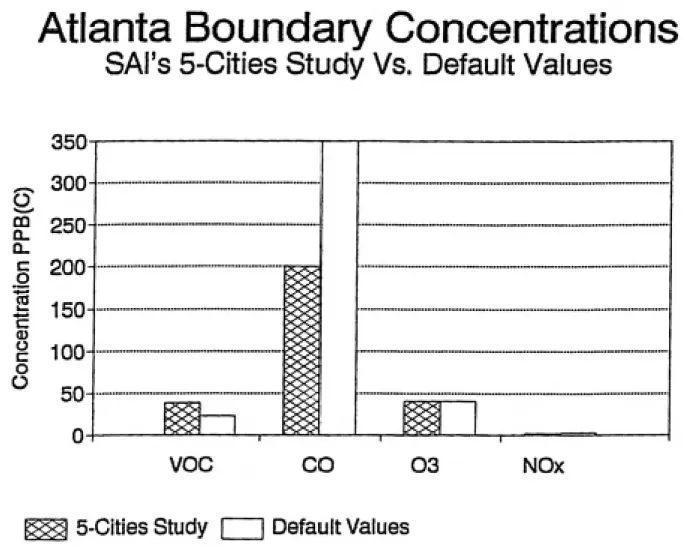
Figures 16, 17 and 18 contrast the inputs to the three
files where the default values were substituted for the input
derived by SAI. In this instance, there is very little
difference between the initial and boundary conditions, with the exception of the much increased amounts of CO in thedefault simulation. Appendix A contains tables presenting the
concentrations depicted in the graphs in greater detail.The interesting result is how little change was made in
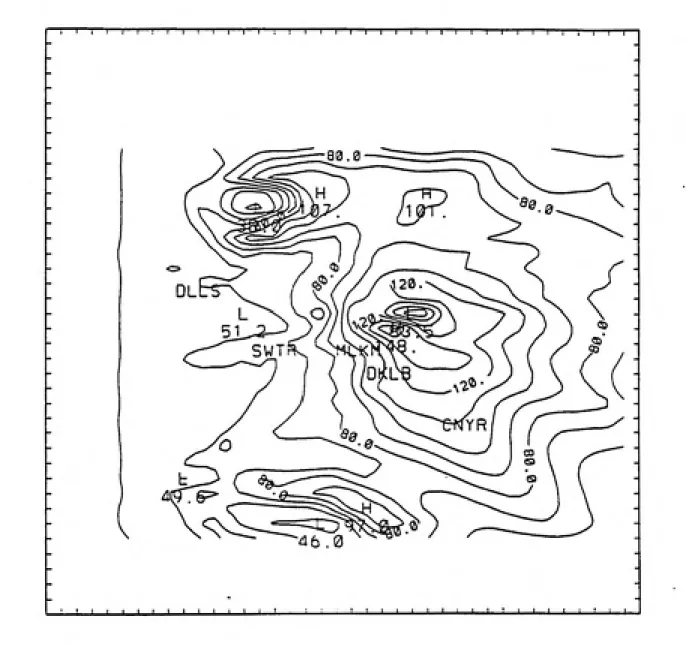
the output of the model. The maximum concentration of 148 ppb
at 17L (Figure 19), was nearly identical to the 150 ppboriginally forecast. Figure 20 shows the results of
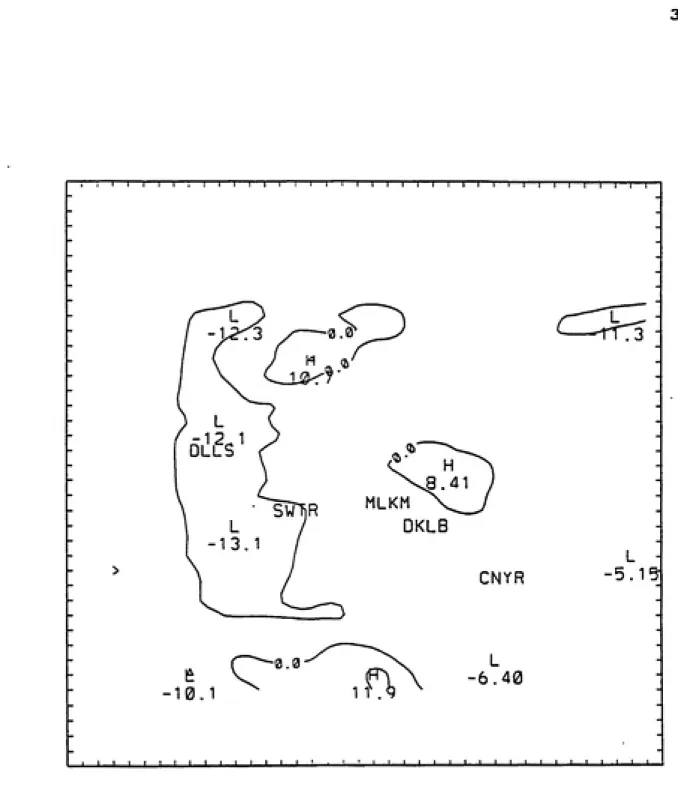
subtracting the cell by cell concentration of the defaultoutput from the concentrations derived originally. Upwind of
the city the large area of negative contours reflect thedefault run forecasting approximately 20% greater
concentrations of ozone formed. The areas where the run
original forecast higher values are all correlated with point
sources of NOX.29
Atlanta Initial Air Quality Cone.
SAI's 5-Cities Study Vs. Default Values
350 300
g
g 250
I 200
I 150
c(D
^
100-o
" 50
fs^^n
M
i
^
^
voc CO 03 NOX
^ 5-Cities Lev. 1&2 ^ 5-Citles 3,4&5
Default ValuesAtlanta Boundary Concentrations
SAI's 5-Cities Study Vs. Default Values
350
_ 3004
O
g 250
I 150
c 0)
B
100-o
^
50-voc CO 03 NOx
5-Cities Study | | Default Values
31
Atlanta Top Concentration
SAI's 5-Cities Study Vs. Default Values
350
300-O
^ 250
1 200
I 150
c
^ 100
o
^ 50
VOC CO 03 NOx
5-Cities Values I I Default Values
T—I—I—I—!—I—I—r T---1---1---1---1---1---!---1---1---\---!---1---1---1---!---r
S0
~dt .<2
_i_______I_______I_______I_______I---1---1---1---\---1---L. _;_______I_______I_______I_______I______I______i_______1_______I_______1_______1_______I______I_______I_______I_______L.
33
1—I—I—I—r "1—1—I—I—\—]—1—]—[—r
MLKM
DKLB
10.1
0.a
CNYR
L
•6.40
L
ͣ
5. 151
_i_______I_______I I I I I I_______I_______I_______I_______I_______I—i—1_ I
I_______I_______I______I_______)_______I_______I_______I_______I_______I_______I_______i-Figure 20. Atlanta Change in Ozone Contours, 17L (ppb).
concentration at the Conyers site at night, (the graph begins at midnight, 12 hours after the simulation had begun). Both runs miss the peak concentration at the Conyers site by one-half, and seriously underestimate the concentration throughout
the afternoon hours. At the Dekalb site, the model runs come
much closer to predicting the afternoon concentrations, with
a timing error begun as early as 9 a.m. being the dominant
feature.
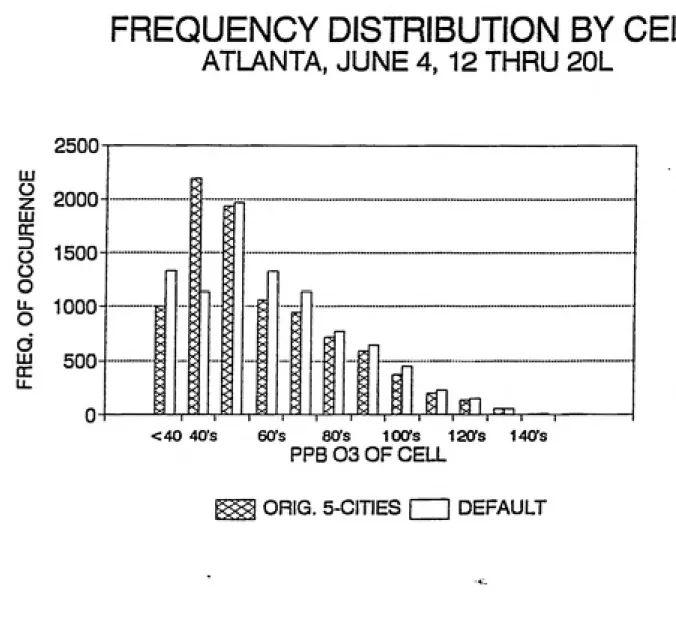
A cell by cell frequency distribution comparison of the two runs concentrations was done, with the results are shown
in Figures 23 and 24. Four cells were deleted from the north,
west, and south sides for this comparison, because when SAI
originally made their study a decision was made to reduce the domain size. This also explains the blank areas of the wind and contour diagrams. This analysis shows that the original
35
OBSERVED VS. PREDICTED VALUES
CONYERS MONASTERY
150 m z o N o m Q-100 50-n ͤ ͤ ͤ n ͤn n ͤ ͤ ͤ ͤ ͤ
1---1---i---1---r
4
1---1---1---1---r
12
8 12 16
HOURS (FIRST 12 OMITTED)
\-,. n -1---1---1---1---r 20 ͤ MEASURED---S-CITIES DEFAULT
Figure 21. Conyers Observed Vs. Predicted Ozone.
OBSERVED VS. PREDICTED VALUES
DEKALB JR. COLLEGE
150
m 100
O M O m
CL a.
50
ͤ
HOURS (FIRST 12 OMITTED)
ͤ
MEASURED---5-CITIES
DEFAULT37
FREQUENCY DISTRIBUTION BY CELL
ATLANTA, JUNE 4, 12 THRU 20L
2500
LU
z 2000
111
cc
O 1500-O
O
O
LU
az
u.
1000-500
04
<40 40's
ffla-i
r-a-i60's ao's IOCS 120's
PPB03 0FCELL
140's
ORIG. 5-CITIES DEFAULT
FREQUENCY DISTRIBUTION BY CELL
ATLANTA, JUNE 4, 12 THRU 20L
C/)
100 o
U- 80
O
LU
O 60
<
h-ͣz.
LU
o 40
oc
LU
Q-20
d 0
—I---1---1---1---1---1---i---1---1---1---1---1---r40 60 80 100 120 140 160
PPB 03 OF CELL
ORIG. 5-CITIES -- DEFAULT
Figure 24. Atlanta Ozone Culmulative Percentage Frequency
39
3.2 NEW YORK
The New York domain is very different than the Atlanta
one. Large amounts of ozone and its precursors are transported into the region. Only CO is increased when
substituting the default concentrations for the ROM derived
ones. At 350 ppbC the default CO is consistently higher than the ROM value. Otherwise, the ROM derived input is generally twice the default values. Figures 25 through 34 track the initial air quality condition, and the boundary conditions at
the upwind sides of the domain for the first 24 hours of the
simulation. Again the TOP CONC default file is only included
for consistency and has no effect on the outcome of the
simulation.
Unlike Atlanta, varying the Initial and boundary conditions did have a profound effect upon the outcome of the
simulation (Figures 35 & 36). The area of maximum concentrations occured in the same region for both the UAM/ROM
run and the default value run, roughly along the Connecticut coast, in the same area where the peak observations were.
However, on the first day the area of greatest change In forecast ozone concentration was along the southern boundary, where the default input ozone concentration was less than half
the ROM value. Figure 37 shows the first day difference, with the default concentrations subtracted from the UAM/ROM ones.
There is nearly a linear progression in the decrease of the
concentration difference as one progresses northward,
N.Y. Initial Air Quality Cone.
ROM Derived Vs. Default Values
350
^ 3004
O
^ 250
I 200
I 1504
(U
^ 1004
o
^ 50
^
voc CO 03 NOx
UAM/ROM Lev. 1&2 ^ UAM/ROM 3,4&5
Default Values41
N.Y. Top Concentration File Input
ROM Derived* Vs. Default Values
350
^ 300^
O
g° 250
I 150
c <u
^ 100
o
O
50
P^?^
voc CO 03 NOx
ROM Derived Values I I Default Values
"^Average of first 24 hrs.
125
CQ
CL Q_
C
o
15
0)
o
c
o
O
100-75
50-
25-0
N.Y. Boundary Conditions
ROM Derived Vs. Default Values
West Edge, Levels 1&2
UAM/ROM 03
Default 03
UAM/ROM NOx
.Default NQx.
—1---1---1---1---r-2 4 6
—1 I---1 I---1---i---1---1---1---1---;---i---1---1---1—
8 10 12 14 16 18 20 22
Time in hours (first 24 hrs.)
24
Figure 27. New York Boundary Conditions UAM/ROM Vs. Default
43
125
CQ
Q-C
q
ͣ
(3
c
0)
o c
O
O
100
75i
50-25H
N.Y. Boundary Conditions
ROM Derived Vs. Default Values
West Edge, Levels 3,4&5
UAM/ROM 03
Default OS
UAM/ROM NOx .Default.NQx
0~'~T---1---1---1---1---1---\---1---1---1---i---'---1---1 1---1---1---1---1---1---1 T
2 4 6 8 10 12 14 16 18 20 22 24
Time in hours (first 24 hrs.)
Figure 28. New York Boundary Conditions UAM/ROM Vs. Default.
N.Y. Boundary Conditions
ROM Derived Vs. Default Values
400-
350-WestEdge,
Levels 1&2Default CO
o CD CL
300-^
250-c
O
c
200-
150-'^^'^^___________
UAM/ROM CO^..--^''';'^
0)
o
1
o
O
100-^----^x^
5
0-\.^__
UAM/ROM VOC..-^^ 1
——--__ ^..^.-^'^''^ 1
-I----1----1----1----1----1----1----1----1----1----1----1----1----i----1
'^°^^°|mt|V>f'^|----1----1----1—r-2 4 6 8 10 1'^°^^°|mt|V>f'^|----1----1----1—r-2 14 16 18 '^°^^°|mt|V>f'^|----1----1----1—r-20 '^°^^°|mt|V>f'^|----1----1----1—r-2'^°^^°|mt|V>f'^|----1----1----1—r-2 '^°^^°|mt|V>f'^|----1----1----1—r-24
Time in hours (first 24 lirs.)
Figure 29. New York Boundary Conditions UAM/ROM Vs. Default
45
400
350-o 300
m
n
Q- 250
c
o
ͣ
55 200
1^
+-• c 0)
o 150
c
O
O
100 50
N.Y. Boundary Conditions
ROM Derived Vs. Default Values
West Edge, Levels 3,4,&5
Default CO
UAM/ROM CO
JJAM/ROMVOC.
Time in hours (first 24 hrs.)
T—I—!—I—I—I—[—I—I—;—I—I—I—I—I r r " r ~i i—i—i—i—r^
2 4 6 8 10 12 14 16 18 20 22 24
125
OQ
CL
Q-C
o
C
0)
o c
o o
100
75-
50-
25-N.Y. Boundary Conditions
ROM Derived Vs. Default Values
South Edge, Levels 1&2
UAM/ROM 03
Default 03
UAM/ROM NOx
Default NOx
—I---1---1---1---1---1---1---1---1---1---1---1---1---1---1---1---1---1---1---1---1---1---r
2 4 6 8 10 12 14 16 18 20 22 24
Time in hours (first 24 hrs.)
47
N.Y. Boundary Conditions
ROM Derived Vs. Default Values
125
CQ
Q-Q. C o
o
c
o o
100-
75-50
25-South Edge, Lev6ls3,4&5
UAM/ROM 03
Default 03
UAM/ROMjNjOx^
Default NOx
0~^---1---1---1---1---1---1---1---1---1---1---1---1---1---1---1---1---1---1---1---1---!---T"
2 4 6 8 10 12 14 16 18 20 22 24
Time in hours (first 24 hrs.)
Figure 32. New York Boundary Conditions UAM/ROM Vs. Default
N.Y. Boundary Conditions
ROM Derived Vs. Default Values
400
South Edge, Levels 1&2
350
o 300
CQ
Q-CL 250
c
o
B 200
u. c
o 150 c
o O
100
50-Default CO
UAM/ROM CO
UAM/ROM VOC
DefaultVOC'
T---1---1---1---1---1---1---;---1---1---1---1---1---1---i---1---1---1---1---1---1---1---1 I
2 4 6 8 10 12 14 16 18 20 22 24
Time in hours (first 24 hrs.)
Figure 33. New York Boundary Conditions UAM/ROM Vs. Default
400 350
^ 300
m
§: 250
c
ͣͣ
§ 200
§ 150
c
^ 100
50-N.Y. Boundary Conditions
ROM Derived Vs. Default Values
South Edge, Levels 3,4&5
Default CO
UAM/ROM CO
UAM/ROM VOC
Default VOC
49
Time in hours (first 24 hrs.)
"1 I I---1 I I i I 1 i i ~i I I I I i I 1 I r
2 4 6 8 10 12 14 16 18 20 22 24
On the second day of the simulation, a day where observed concentrations were much lower, the pattern of the change in
forecast ozone was much different. Here there was not the
zonal variation which reflected the decrease of each boundary from its earlier value, rather the change was greatest at the center of the domain and over New York City itself (Figure
38).
For the comparison of observations to 4 nearest cell
forecast concentrations, Hampstead, Long Island and Middleton,
Connecticut were chosen (See Figure 11). These locations were chosen because they were some distance inland, and so less likely to be influenced by difficult to model land-sea
breezes, and because they were somewhat in the center of the
domain and so less likely to be influenced by the boundary condition variation. The comparisons begin at noon on the first day, 12 hours after the beginning of the simulation, and
continue until sunset on the second day.
Hampstead (Figure 39) reflects a near center city
location, less likely to have variations caused by transport errors. Although the UAM/ROM simulation misses both days peaks, and is slower to decrease after the peak is reached, it
does an adequate job of modeling the diurnal variations. The default run underestimates the observed concentration
throughout most of the time period, however its lack of accuracy is not so very different than that of SAI's 5-cities run for Atlanta which they considered a success (Figures 21 &
22) .
For Middleton, which is near the center of the domain, and far enough inland to be away from the land-sea breeze effect, the model performance was much worse. Here we see less of a difference between the UAM/ROM and default run's
51
both afternoons. A look at the wind vectors forecast by the
ROM in Appendix B, shows that for much of the day a westerly
component of the wind was predicted for this region, this
would advect relatively clean air from the Catskill region of
New York over the region. The ozone observations suggest that
the urban plume was blown in a northeasterly direction
directly over central Connecticut (Figures 41 & 42).
A cell by cell frequency distribution of concentrations shows that the default run produces an excess of cells with concentrations below 70 ppb and very few above 150 ppb. The UAH/ROM output produces a more normal distribution (Figure 43)
-I---1---\---\---r-%^
I I_________' I ' '_________I_________I_________L. -J________1________' I I________L.
53
a®
_ 4
-i_____\_____l_l___L_J_____L. _l_____I_____I_____l_ _l_____I_____i_____L.
34 .8
Figure 37, New York Change in Ozone Contours. Day 1 17L (ppb)
55
40 .0
©
Figure 38. New York Change in Ozone Contours, Day 2 17L (ppb)
OBSERVED VS. PREDICTED VALUES
HAMPSTEAD. NY
300
250-LU
200-n'
O 150
\n ͤ °
HOURS (FIRST 12 OMITTED)
ͤ
MEASURED---UAM/ROM
DEFAULTFigure 39. Hampstead Observed Vs. Predicted Ozone.
57
OBSERVED VS. PREDICTED VALUES
MIDDLETON, CT
300
250
d
150-°
ͤ
E^Q-O-*"!—I—I—I—I—I—I—I—I—I—I—I—I—I—1—I—I—I—I—I—I—I—I—I—I—I—i—I—I—I—r 16 20 24 4 8 12 16 20
HOURS (FIRST 12 OMITTED)
ͤ
MEASURED---UAM/ROM ... DEFAULT
Figure 40. Middleton Observed Vs. Predicted Ozone.
Figure 41. Day 1, Observed 15L Ozone Concentrations. Daily
maximum for large portion of region. (Source:
59
Figure 42. Day 2, Observed 15L Ozone Concentrations. Daily
maximum for large portion of region. (Source:
FREQUENCY DISTRIBUTION BY CELL
NEW YORK, DAY 203, 12 THRU 20L
1200 O 1000
<40 40'S 60's 80's 100'S 12as IAD's ISO's ISO's
PPB 03 OF CELL
UAM/ROM DEFAULT
61
FREQUENCY DISTRIBUTION BY CELL
NEW YORK, DAY 203, 12 THRU 20L
C/5
100
LU
O
Ll_ 80
o
LU
o 60
<
1-Z
LU
O 40
CC
LU CL
20 ^
_J
ID
O 0 t---1---r^—I---1---1---1---1---1---1---\---1---r 40 6,0 80 100 120 140 160
PPB 03 OF CELL
180
UAM/ROM -- DEFAULT
In their Regulatory Guide, EPA suggests the best case scenario for determining the initial and boundary conditions would be based on an intensive field program, with modeled
data filling in any gaps. While resources are seldom
available to obtain this type of data, and regional models do not provide complete coverage of the U.S., EPA has provided default concentrations. [U.S. EPA, 1991b] In this case the initial and boundary conditions were replaced with those
default concentrations, and the results are at times dramatic.
The two sets of input files were generated from different methods, Atlanta's input files being gathered from limited readily available air quality and meteorological data, while New York's was generated by the UAM/ROM interface. The two domains modeled were also very different, Atlanta is
surrounded by a large expanse of rural areas, presumably then clean background air is being transported into the domain. Also because of this, the default values which the EPA has
recommended are very close to the values selected by SAI in
the initial modeling. Conversely, New York is part of the larger eastern corridor, where ozone and precursors are not only being emitted into the domain, but also a large portion is transported in from upwind metropolitan areas. In this
case, the default input concentrations were often less than half of the ROM predicted ones. Thus we are able to compare
the results of the two extremes in variation of initial and
64
I do not attempt to address the appropriate use of
default values. In their Regulatory Guideline, EPA is very
clear that these values should be limited to areas surrounded
by large areas of low-density anthropogenis emissions, with an
extended domain, and in areas without regional transport of ozone and its precursors. This is a first step in the
sensitivity analysis which EPA recommends when the default values are used.[U.S. EPA, 1991bl
It is apparent that the Atlanta simulation fits the guidance criteria for use of the default values. However,
caution should be taken in assuming the validity of the input concentrations, and the lack of dependence of the output on the varied initial and boundary conditions. When these input
files were prepared for the original run, their values were determined in a similar manner. SAI assumed concentrations
which were generally accepted as reasonable background air values, and these have changed very little. A more powerful
test of the validity of these concentrations and the association between the initial and boundary conditions and model output, would be a comparison between use of the default
values and the use of measured values from an extensive field
study. Unfortunately these input files were not available, however this topic is covered in the 5-cities study in a
4.1 FINDINGS
Meteorological uncertainty has a greater impact on model
performance than variations in initial and boundary
conditions. When comparing model output to observed air
quality data, both the original 5-Clties and the UAM/ROM, and
their default runs, were a superior match at the near center
city locations (Figures 22 & 39), than at the corresponding
transport dependent locations (Figures 21 & 40) .
Secondly, in the case of Atlanta, while in both instances
the model predicts a peak concentration very close to the
observed, it is not near the location of this observation. This can be attributed to either an incorrect characterization
of the wind field, or to the prudent placement of monitors by
the regulated. The model consistently predicts a trough in
the ozone contours along the line of monitors in Atlanta,
without more complete monitor coverage, it is impossible to
seperate underprediction of concentrations throughout the
domain from transport errors.
Thirdly, in the New York simulations, there is a greater
discrepency between the observed concentrations (Figures 41 &
42) and the UAM/ROM predictions, then between the two
simulations (Figures 13, 15, 35-38 & Appendix B) . In this
case, as in the possibility of domain-wide underprediction in
Atlanta, the error may lie in the prediction of excess
dilution resulting from a too high mixing height. This mixing
height variation could be the true cause of the 303 ppb ozone
observation at the Coast Guard Lighthouse in Strattford, with
the pollutants trapped below the low-level inversion set up by
66
scale model (wind fields were generated from the ROM for this
application).
The impact of variations in initial and boundary
conditions is very real however, and the impact on model ozone
output increases proportionately with changes in the input concentrations. In Atlanta, where the deviation of the default inputs from the original is small, the change in the
model output is also small. Whereas in New York, where most of the inputs were reduced by half or more, the change in model ozone output is great. The change in output is in the range of 50 to 60 ppb throughout the areas of maximum forecast concentrations, during the afternoon hours. This would reflect the change in forecast locally produced ozone. Near the southern boundary, where the change in transported ozone
4.2 FURTHER WORK
Implicitly, two questions were discussed here: 1) how adequate are the default input concentrations for the initial and boundary files in various scenarios, and 2) what is the impact of changes in these initial and boundary conditions on
the final output ozone concentrations.
In the first case, a comparison of the use of default concentrations, to ROM derived ones, and measured ones from a
field study on the same episode would be the first choice. Secondly the New York domain could be worked with further by
varying the wind field to affect horizontal transport and the
vertical velocity dependent mixing height.
As an exercise in the effects of initial and boundary inputs to a model, both domains could be rerun with further variations in the input concentrations, either incremented as
67
REFERENCES
Air and Waste Management Association, 1988. "Ozone Control Strategies, The Scientific and Technical Issues Facing
Post-1987" . Transactions of an APCA International Speciality Conference. Air and Waste Management Association.
Gery, M., Personal Communication, May 1992.
Jang, J., "Sensitivity of Ozone to Model Grid Resolution", thesis presented to the Department of Environmental Science
and Engineering, at Chapel Hill, N.C., in 1992, in partial
fulfillment of the degree of Doctor of Philosophy.
Lippman, M. , 1989. "Health Effects of Ozone: A Critical Review", Journal of the Air and Waste Management Association, 39:672-695.
National Academy of Sciences, 1992. Rethinking the Ozone Problem in Urban and Regional Air Pollution, Washington, DC, National Academy Press.
Seinfeld, J.H., 1988. "Ozone Airquality Models: A Critical
Review", Journal of the Air Pollution Control Association, 38:616-645.
U.S. Environmental Protection Agency, 1982. "A Regional-Scale
(1000 Km) Model of Photochemical Air Pollution: Part 1, Theoretical Formulation", EPA-600/3-85-035, Office of Air
Quality Planning and Standards, Research Triangle Park, NC.
U.S. Environmental Protection Agency. 1989. "5-City Urban Airshed Model Study", Draft report. Office of Air Quality Planning and Standards, Research Triangle Park, NC.
U.S. Environmental"Protection Agency, 1990a. "National Air Quality and Emissions Trends Report", 1988, EPA-450/4-90-002. Office of Air Quality Planning and Standards, Research Triangle Park, NC.
U.S. Environmental Protection Agency, 1990b. "User's Guide for
the Urban Airshed Model, Volume I: User's Manual for UAM
(CB-IV)", EPA-450/4-90-007a, Office of Air Quality Planning and
U.S. Environmental Protection Agency, 1990c. "User's Guide for the Urban Airshed Model, Volume II: User's Manual for UAM
(CB-IV) Modeling System", EPA-450/4-90-007b, Office of Air Quality
Planning and Standards, Research Triangle Park, NC.
U.S. Environmental Protection Agency, 1990d. "User's Guide for the Urban Airshed Model, Volume III: User's Manual for the
Diagnostic Wind Model", EPA-450/4-90-007c, Office of Air Quality Planning and Standards, Research Triangle Park, NC. U.S. Environmental Protection Agency, 1990e. "User's Guide for
the Urban Airshed Model, Volume IV: User's Manual for the Emissions Preprocessor System", EPA-450/4-90-007d, Office of
Air Quality Planning and Standards, Research Triangle Park,
NC.
U.S. Environmental Protection Agency, 1990f. "User's Guide for the Urban Airshed Model, Volume V: Description and Operation of the ROM-UAM Interface Program System", EPA-450/4-90-007e, Office of Air Quality Planning and Standards, Research Triangle Park, NC.
U.S. Environmental Protection Agency, 1991a. "Regional Modeling for Northeast Transport (ROMNET)", EPA-450/4-9I-002a.
Office of Air Quality Planning and Standards, Research
Triangle Park, NC.
U.S. Environmental Protection Agency, 1991b. "Ozone and Carbon
Monoxide Areas Designated Nonattainment", EPA report. Office
of Air Quality Planning and Standards, Research Triangle
Park, NC.
U.S. Environmental Protection Agency, 1991c. "Guideline for
the Regulatory Application of the Urban Airshed Model", EPA-450/4-91-013 Office of Air Quality Planning and Standards,
LIST OF TABLES AND FIGURES
TABLES
Table Al. Atlanta 5-Cities Initial, Boundary, Top
Concentration Input by Species...A2 FIGURES
Fig. Al. Atlanta Mxing Height and Region Top...Al Fig. A2. Atlanta Diagnostic Wind Model (DWM)
Winds 09L (m/s)...A3
Fig. A3. Atlanta DWM Winds 12L (m/s)...A4
Fig. A4. Atlanta DWM Winds 15L (m/s)...A5
Fig. A5. Atlanta DWM Winds 18L (ra/s)...A6
Fig. A6 . Atlanta Original Ozone Contours, 12L...A7
Fig. A7. Atlanta Original Ozone Contours, 15L...A8
Fig. AS. Atlanta Original Ozone Contours, 18L...A9 Fig. A9. Atlanta Default Ozone Contours, 12L...AlO
Fig. AlO. Atlanta Default Ozone Contours, 15L...All
Fig. All. Atlanta Default Ozone Contours, 18L...A12
Fig. A12. Atlanta Change in Ozone Contours, 12L...A13
Fig. A13. Atlanta Change in Ozone Contours, 15L...A14
A1
MIXING HEIGHT & REGION TOP
ATLANTA, FROM 5-CITIES STUDY
CO cc LJJ
I-LU
I-r
LU
r
1400-TIME
MIXING HT. --- REGN. TOP