Melanie S. Sorrell. Comparing Physician and Nurse Site Search Behavior within the North Carolina AHEC Digital Library. A Master’s Paper for the M.S. in Library Science degree. April, 2012. 52 pages. Advisor: Jaime Arguello
The North Carolina AHEC Digital Library (ADL) is an electronic network of resources for in-state health care providers to easily access select medical and pharmaceutical information. A quick retrieval of subscription-specific content is available through a site search tool on the ADL website. A cursory review of transaction logs for website searching revealed a large number of failed patron search attempts, which prompted a study to learn how the site search tool is being used and what the ADL can do to improve search effectiveness. A comparison between physician and nurse search behavior from 2010 will be performed to see which factors yield successful and unsuccessful results, the average number of queries per subject session, and which resource links are used by patrons. The study outcome will guide menu changes to the ADL website to improve the site search experience for patrons.
Headings:
Database searching
Information-seeking strategies
Querying (Computer science)
Digital libraries
Medical informatics
COMPARING PHYSICIAN AND NURSE SITE SEARCH BEHAVIOR WITHIN THE NORTH CAROLINA AHEC DIGITAL LIBRARY
by
Melanie S. Sorrell
A Master’s paper submitted to the faculty of the School of Information and Library Science of the University of North Carolina at Chapel Hill in partial fulfillment of the requirements for the degree of Master of
Science in Library Science.
Chapel Hill, North Carolina April, 2012
Approved by:
Table of contents
Introduction ... 2
North Carolina AHEC Digital Library Background and Format ... 2
Table 1 ... 5
Figure 1 ... 6
Figure 2 ... 7
Table 2 ... 8
Research Questions ... 11
Related Work ... 11
Methodology ... 20
Table 3 ... 23
Results and Analysis ... 23
Figure 3 ... 23
Table 4 ... 24
Table 5 ... 25
Table 6 ... 25
Table 7 ... 26
Table 8 ... 26
Table 9 ... 27
Table 10 ... 27
Discussion ... 28
Conclusion ... 32
Acknowledgements... 34
Appendix 1 ... 35
Appendix 2 ... 37
Introduction
The North Carolina AHEC Digital Library (ADL) site search is an effective
mechanism by which to locate licensed content through query submission. The study presented here was undertaken to evaluate the effectiveness of searching by physicians
and nurses, the two occupational groups that are the focus of ADL outreach efforts and constitute the largest percentage of ADL members (M.B. Schell, personal
communication, November 29, 2011). Using a transaction log analysis, common
behaviors were assessed and coded to form categories that could be addressed individually. The outcomes may assist in planning changes and updates for the ADL
website menu construction and learning how to better educate patrons to achieve more productive searches.
North Carolina AHEC Digital Library Background and Format
The North Carolina Area Health Education Center (AHEC) Program was created in response to needs for uniform delivery of health care across the state. It partners with
academic institutions, health care agencies, and other organizations to provide resources for the health care industry’s workforce demands (Johnston, 2007; McDuffee, 2000;
“North Carolina AHEC – Mission,” 2011). A crucial part of this mission is the North
providing an electronic network of resources and services designed to assist North Carolina health specialists with their professional information needs (McDuffee, 2000;
Schell, 2003). The website offers electronic books and journals and aggregates links to evidence-based medicine (EBM) databases, continuing education materials, drug
formularies, and electronic bibliographic databases (See Appendix 1). Primary vendors are Ovid, Swets, EBSCO, and Elsevier (Flake, 2010; “North Carolina AHEC Library - Resources,” 2011). Many of these materials serve as key tools in the practice of EBM,
choosing the best evidence to inform clinical decisions (Hersh, Stavri, and Detmer, 2006). Some may use ADL for clinical fact-finding and others find it valuable for
research.
The titles for select materials may be quickly found by patrons through a site search, which functions as a navigational tool for the ADL website. The success rate for
retrieved results for this tool is unknown, but a brief review of the ADL Structured Query Language (SQL) database transaction logs showed that many keyword submissions
yielded no results (i.e. “0” hits) (M.B. Schell, personal communication, December 2, 2011). If a query is ineffective, then the patron might not acquire the desired results (M.B. Schell, personal communication, September 1, 2011). The reasons for these low
outputs are the focus of this study and the conclusions will signify ways to improve the search process for ADL patrons.
The ADL began in September 2000 as a portal to licensed content for University of North Carolina (UNC) - Chapel Hill medical student trainers (i.e. preceptors), faculty, staff, medical residents, and community health practitioners (M.B. Schell, personal
consortium members of the ADL and at least one even integrated the ADL into its electronic medical record system for more direct access for clinicians (Flake, 2010).
Additionally, ADL sells individual memberships to health care workers unaffiliated with hospitals. The ADL has about 19,000 members with at least 4,061 physician and 7,607
nurses. These numbers exclude the non-members who use hospital computers without a log-in password and the patrons who have an institutional membership password. Counting those accessing content through institutional memberships, there are
approximately 66,000 potential patrons. The number would be higher if the tally included anyone (e.g., non-members) using the ADL site through internet access (M.B. Schell,
personal communication, September 1, 2011; November 29, 2011).
A privacy policy link, located at the bottom of the ADL homepage, explains that the ADL collects information on the user’s web browser automatically. The patron IP
address, computer browser type, and search terms are stored in the ADL SQL database, along with the time of day the patron logged into the ADL site and the linked content
viewed on the site. The data is used by the ADL to facilitate collection development, promotion, and product development (“North Carolina AHEC Digital Library - Privacy,”
2011). Session logins are classified as the time a session began (i.e. when the user name
and password were entered) (Schell, 2009). When a member logs into the site, the ADL webpages present resources that are matched to a particular membership (Schell, 2011).
Basic resources are available to those “guests” who visit the webpage without logging into the site.
Located at the top right-hand corner of the ADL home page is a dual function box
site searches. The site search box, a single repository search engine, was added in 2005. Site search is selected via a radio button and searches publisher names, ADL-assigned
health categories, and names of resources (e.g., book titles, journal names, and database names, names of websites), and words in URL strings. Links to those items are provided,
if found. When the search results display, they are listed alphabetically under their resource group (See Table 1), but are not ranked according to relevancy. The lists of the
resource types remain static on the page.
Table 1
Resource Groups as Site Search Result Categories
If results (i.e. 0 “hits”) are not obtained, an explanation is automatically given as to how the search could be adjusted as in Figure 1. There is not a separate list of
instructions for the site search box on the ADL homepage that a patron may read prior to beginning a search.
1 Databases
2 Journals
3 Books
4 Practice guidelines
5 Continuing Education
6 Websites
7 Mobile
8 Clinical Answers
9 Clinical Trials
10 Journal Collections
11 Libraries
Figure 1
ADL Screen Display for Zero-Hit Search
Figure 2 is an example of what the patron sees for a results list. The “note” reminds patron that the search involves journal titles, not article titles or author names.
The resource links take the patron straight to the licensed content, such as, the New England Journal of Medicine.
In addition, Table 2 provides a clearer picture of how data are stored in the SQL
transaction log. The nurse with the Name ID of #12415 attempted twice to find results related to “C-reactive proteins.” Both of these queries are too specific for the site search,
link-outs. Physician #332 reformulated the search term to a journal title recognized by the ADL database. As the associated LoginID #881123 is followed down the column, it
shows that the link was clicked a second time after Physician #36468 logged-in and began searching.
Figure 2
Table 2
ADL Transaction Log
Key
Site search ID = Identification for each entered search term or query.
LogIn ID = Identification automatically assigned to member upon log-in. A different number will be assigned upon subsequent logins.
Site Search Date = Date and time of day (military time) for each action. Search terms = Queries entered by patron to search ADL content. Hits = Number of results acquired.
Name ID = Permanent identification of ADL member. Occupation = Nurse or physician member.
URL Name = Title of link clicked by patron.
A federated search tool was added on January 1, 2010 to the ADL. Unlike the site search, which is equivalent to a website map, the federated search scans across the ADL and internet for text within journal articles and databases. Members may choose either
tool, but must use different types of queries to search each one successfully because of the content that is delivered. After a quick appraisal of the site search transaction logs
revealed an unanticipated high number of queries without ensuing results, ADL administrators believed it would be useful to learn what types of queries were being
SiteSearchId LoginID SiteSearchDate Search Terms Hits NameID Occupation URLName
54912 880285 1/1/2010 2:36 C-Reactive Protein in neonates 0 12415 Nurse 54913 880285 1/1/2010 2:36 C-Reactive Protein 0 12415 Nurse 54914 880306 1/1/2010 8:46 prostate cancer 0 15042 Nurse 54915 880306 1/1/2010 8:46 prostate 0 15042 Nurse 54916 880306 1/1/2010 8:46 cancer 43 15042 Nurse 54917 880306 1/1/2010 8:47 cancer prostate 0 15042 Nurse 54918 880306 1/1/2010 8:47 cancer 43 15042 Nurse
54918 880306 1/1/2010 8:48 Nurse Cancer Fact Sheets 54918 880306 1/1/2010 8:48 Nurse Cancer Topics
54918 880306 1/1/2010 8:48 Nurse American Journal of Clinical Oncology (archival access only) 54950 881123 1/4/2010 11:37 the journal of trauma 0 332 Physician
54951 881123 1/4/2010 11:38 Journal of Trauma 4 332 Physician
54951 881123 1/4/2010 11:38 Physician Journal of Trauma: Injury, Infection, and Critical Care 54953 881126 1/4/2010 11:42 journal womens health 0 36468 Physician
54954 881126 1/4/2010 11:42 journal of womens health 0 36468 Physician 54955 881126 1/4/2010 11:42 womens health 7 36468 Physician
54951 881123 1/4/2010 11:44 Physician Journal of Trauma: Injury, Infection, and Critical Care 54976 881473 1/4/2010 14:32 trali 11 33948 Physician
submitted in the site search box. If any of those queries are more appropriate for the federated search, patrons could be better educated about these two different options and
changes be proposed for the website.
This research is a system evaluation based on patron interaction data comparing queries of physicians to those of nurses over a period of 12 months and reviewing the
corresponding search results. This statistics are important to the ADL because site search has a valuable function which displays results according to resource type for easy
assessment by patrons and must be used correctly to achieve patron satisfaction.
Two occupational groups are the subjects of this study – physicians and nurses. They are chosen because physicians and nurses comprise the largest percentage of ADL
members, are targeted for outreach efforts, and the ADL wants to increase usage of resources for these particular healthcare professionals (M.B. Schell, personal
communication, November 29, 2011; M.B. Schell, personal communication, March 27, 2012). By examining query choice aligned to these two occupations, new ADL resource groups may be created and the order of these groups altered on the website. Such changes
would save health professionals time and would direct them towards a more useful search result. Depending upon the research outcome, the ADL may adjust the display layout
according to the profession of the patron. Instructions for improved site searching could be added to the site as a link (M.B. Schell, personal communication, August 29, 2011).
concentrate on how health care personnel develop a clinical question, narrow their
searches, and access journal articles or abstracts from search engines or other information
retrieval systems (Chambliss and Conley, 1996; Dee and Stanley, 2005; Doig and Simpson, 2003; Hersh, Crabtree, Hickam, Sacherek, Friedman, Tidmarch, Mosbaek, and
Kraemer, 2002; Westbrook, Coiera, and Gosling, 2005). If already familiar with this type of federated searching, physicians and nurses may employ this strategy for the ADL site
search box and not receive the results they need with this finding aid.
Search success is defined for the purposes of this project as returning one or more hits upon data entry. Further success is considered when a (Uniform Resource Locator)
URL is clicked.
Librarians are the primary audience for this paper, as they are providing requested evidence to patrons in clinical settings (Eldredge, 2000) and creating vertical search
engines for targeted content, as in Bracke, Howse, and Keim (2008). This investigation contributes to the evidence based medicine community by revealing ways health professionals search within a site for licensed content and suggesting how to achieve a
successful outcome when using such a tool. This, in turn, will help guide librarians in the functional and visual design of the ADL website and in the teaching of ADL workshops
for health care staff. This investigation will add to the scant literature comparing how physicians and nurses achieve favorable outcomes when pursuing information within a
Research Questions
1. Is the search experience different between physicians and nurses when using the
North Carolina AHEC Digital Library site search tool? How might the ADL site search tool contribute to a failed attempt to retrieve results? Is one occupational group more
likely to commit certain types of errors? Is one group more successful than the other? What normally leads to failure (e.g., misspellings, lacking a subscription for a particular journal, author name, article title, or a query too specific for a site search)? Are
unsuccessful queries re-entered by the patron?
2. Which occupational group uses the ADL site search tool more frequently –
physicians or nurses? How many subject sessions were submitted during the sample time of January 1, 2010 to December 31, 2010? How many links are typically clicked by each
occupational group? Which links are clicked and sites visited?
3. Are a minority of patrons using the site search box so frequently that they may skew the data?
Related Work
My literature search and review of relevant literature uncovered only a few
“information retrieval,” “physician AND search,” and “nurse AND search” in the Library
Literature & Information Science index, the Library and Information Science Abstracts
index, CINAHL, MEDLINE, and Embase for relevant articles published between 2000 and 2012. “Physician AND nurse searching literature” entered into MEDLINE retrieved a
review article from the limited realm of comparing physician to nurse search success for online internet-based evidence (Younger, 2010). “Physician nurse search information” was used in Google Scholar. The “Content Analysis” chapter in the UNC-CH School of Information and Library Science “Research Methods” course textbook, Applications of
Social Research Methods to Question in Information and Library Science, listed several
articles that were helpful in providing a basis for how the content analysis might be structured for the master paper’s methodology. Additional publications were discovered
in the reference sections of several articles mentioned above through this “snowball” or “chaining” method and others were kindly given to me by my Master’s paper advisor, Dr.
Jaime Arguello.
Literature in four main areas was acquired to inform the methodologies used in this project, which included material on resources used by physicians and nurses for clinical decision assistance, data preparation, data selection, and content analysis. Journal articles, book chapters, and other master’s papers provided excellent background to better
understand information-seeking behavior on the internet, in personal libraries, and
through academic library catalogs.
During the course of the day, physicians generate a number of questions spanning patient diagnosis and treatment to specific information about drugs (Alper, Stevermer,
Chambliss, Pifer, and Stavri, 2000; Gorman, 2001). An example of this is where
Chambliss and Conley (1996) categorized family practice physician questions over 217
half-days as adult medicine, pediatric, gynecologic, and dermatologic issues and learned that finding answers can be expensive tedious. Librarians can play a key role in creating
more efficient ways to address the expediency of a literature search.
A number of studies determined the resource needs of physicians and nurses. What was found was that these clinicians relied upon journals, textbooks, colleagues,
drug reference manuals, educational activities, protocol manuals, personal libraries, and electronic databases to address their queries. Preferences were dependent upon familiarity
with electronic searching, library proximity, availability of colleagues, and whether the clinician practiced in a rural or urban setting (Barta, 1995; Cogdill, 2003; Curtis, Weller, and Hurd, 1997; Dee and Stanley, 2005; Fakhoury and Wright, 2000; Gorman 2001;
Pyne, Newman, Leigh, Cowling, and Rounce, 1999; Rasch and Cogdill, 1999; Urquhart and Davies, 1997).
Similar resource preferences and use among physicians and nurses were
highlighted in Andrews, Pearce, Ireson, and Love (2005) and in Doney, Barlow, and West (2005). Query formulation or success was not examined. Younger (2010) published
a review of how online tools were used by physicians and nurses to search for information in the healthcare environment, along with availability of computers and
knowledge of tools designed for the hectic clinical wards. A systematic review aimed at determining how library services support clinical decision–making and the effect information had on patient care (Weightman and Williamson, 2005). Hersh, Crabtree,
study to compare the ability of medical and nursing students to choose correct answers using MEDLINE. Findings included that after database searching, the medical students
chose correct answers to clinical scenarios more frequently than the nursing students. Previous experience with MEDLINE and spatial visualization skill attributed to locating
the needed literature, making appropriate assessments using retrieved information, and applying what was learned to answer questions accurately or convert incorrect answers to
a correct answer.
According to a study by Huntington, ten seconds tends to be the maximum amount of time a user will spend on a home page to locate the topic of interest before
ending or amending the search (Huntington, Nicholas, and Warren, 2004). Having this knowledge, in combination with the realization that busy physicians in particular do not have much time for query reformulation, it is important that the ADL site search results
be accurate and relevant (Merry, 1997). The ADL wants to increase site search satisfaction. Once it is established how physician and nurse patrons are searching and
what obstacles are encountered, the ADL librarians can make changes to enhance the retrieval process.
Many primary care physician questions can be satisfactorily answered by
electronic databases (Alper, Stevermer, White, and Ewigman, 2001; Chambliss and Conley, 1996). A comparison of health information databases used by nursing students
and clinical nurses was conducted by Dee and Stanley (2005) and found that the most popular resources were CINAHL, PubMed, cancer.gov, and MEDLINEplus. Of the large biomedical literature databases, MEDLINE is often chosen first by health professionals to
citations are made possible at no cost through United States tax-payer funding (Cleary, Hunt, and Horsfall, 2009; “NCBI – Copyright and Disclaimers,” 2009; Wong, Wilcynski,
and Haynes, 2006). Multiple databases should be explored if a comprehensive search is needed to ensure biomedical and clinical journals are accessible (Allen, Jacobs, and
Levy, 2006; Grajek, Calarco, Frawley, McKay, Miller, Paton, Roderer, and Sullivan, 1997). The ADL offers links to many different resources for its guests and member
patrons.
Strategies used for other databases are not always appropriate for the ADL site search. Since indexing methods and thesauri differ between databases, strategies used for
MEDLINE should not be directly reproduced for other databases (Wong et al., 2006). As with MEDLINE, it is easy to become too specific with a site search (Vincent, Greenley, and Beaven, 2003). MEDLINE and Google-type search strategies submitted to the ADL
site search box would lower the chances of finding desired material since journal article titles and author names are not indexed for the ADL site search tool.
Transaction logs are valuable for research purposes when analyzing web-based
systems with an evaluation process consisting of data collection, preparation, and analysis (Jansen, 2006). A transaction log (i.e., web log, transaction file) is a file which
captures the communications between that system and the person searching for
information in that system (Jansen, 2006). As data files form the basis of a physical or digital library’s collection, librarians and information scientists study ways in which the
Measuring the effectiveness of library services pinpoints where time should be spent implementing changes around the physical library space or modifying the digital
interface. Unless a patron brings a problem to the attention of the library staff or an evaluation is performed, administrators may be unaware of service limitations. Moulaison
(2008) and Ciliberti, Radford, Radford, and Ballard (1998) considered the reasons for unsuccessful searches conducted by patrons. When librarians at the College of New Jersey wondered if their OPAC needed to be updated and how it might fit into a new
website, Moulaison initiated this study at a medium-sized academic library. Ciliberti et al. (1998) raised concerns about the patron’s ability to use electronic tools satisfactorily
and with material availability after using the OPAC. These inquiries looked at whether patrons use simple queries or the advanced search and to gained insight into why some patron searches are unsuccessful due to misspellings or typographical errors. Server
transaction logs were manipulated and the number of terms used in keyword searches, the success rate of finding the desired item, and the use of advanced features were revealed.
Focus was directed to patron responses to failure. It was learned that patrons usually submit 1-3 terms to an OPAC search box, rarely read instructions, infrequently
implement Boolean operators, and use limits 10% of the time. On the other hand, making
physical searching more difficult, items are not always shelved correctly by either library staff or patrons returning those items in the stacks (Moulaison, 2008; Ciliberti et al.,
1998).
Since one of the major questions for the ADL project is the examination of failed searches, the information contained in these articles will be helpful when constructing
search box. As in the Moulaison (2008) study, a Microsoft Excel spreadsheet will work
nicely for the ADL study as a relational database of extracted data.
Transaction logs were also manipulated by Liu (2010) and Villen-Rueda, Senso, and Moy-Anegon (2007) when evaluating search interfaces and options in a university library OPAC. The articles provided statistical evidence about simplifying basic search
boxes, choosing default settings, and identifying whether browsing or analytical searches are performed more frequently by patrons. Web server transaction log data were filtered
to identify the useful search query string patterns and queries were run to fulfill field assignments. Data were stratified by Liu into three different usage groups by search
frequencies (e.g., 5; 5-100; 100< searches). Not surprisingly, most patrons preferred default settings in the basic search interface and used only one search box. Statistical analysis of Villen-Rueda’s results was performed with the chi- squared test as well as in
the Sokoloff (2006) study of the NC Health Info index on improving search success through taxonomy simplification. Delving further into the reasons for ineffective
searches, Peters (1989) calculated that, typographical errors, together with misspelled words, accounted for over 20% of input errors. Less than 1% demonstrated a lack of clarity about the general structure of the database. Methods of data collection,
preparation, and analysis presentation in those studies will serve as templates for the approaches to classifying data in the ADL project.
Voluminous amounts of data are possible when extracting the anticipated information from database transaction logs, but Nicholas and Huntington (2003)
presented their case for micro-mining, which uses a sample from the total amount of data
allows for a closer scrutiny of user characteristics and through this micro-mining, may give a more accurate view. Applying this theory to ADL content analysis, a characteristic
sample of physician and nurse search sessions will be extracted from a twelve-month sample. Replicating some of the methodologies from this article, the number of sources
viewed through link-outs and a representative number of users will be tallied.
Huntington, Nicholas, and Warren (2004) utilized transaction log analysis to support the hypothesis of whether health website searches increased when topic visibility
was improved on homepage menus. The prominent menu item links were clicked more frequently. Digital visibility was proven to be essential in determining how to keep the
attention of website visitors. As ADL resource groups are listed in the same order each time, regardless of relevancy, this could affect which links are being clicked by ADL
patrons.
Huntington and Nicholas (2006) recognized that some website menus are inadequately constructed to demonstrate available content. Therefore, patrons, who do not look past the top two results, will often leave the site dissatisfied. Search expressions
in query logs spanning 12 days were analyzed to develop a user-centered menu for a particular topic of diabetes. The top 20 search strategies were found, categorized, and
compared to content menus for three separate websites. None of the websites contained all categories in their menus, meaning that only about one third of inquiries were met and
many patrons must go elsewhere for their answers about diabetes. A new six-point menu was proposed for these websites that would comprise the top categories in these query submissions. These studies establish the importance of adding design features in ADL to
This study employs similar methodologies to those used by Huntington and Nicolas (2006) by linking transaction log data with website menu construction.
Comparable fields in extracted files will be utilized when data is extracted from the ADL server. Also, keyword terms are classified in a manner similar to that used by Huntington
et al. (2006), albeit on a smaller scale. As a new menu was proposed in the article, a similar approach is used by considering new ADL resource types for altering placement in the results list. One method employed by Huntington and Nicholas (2006) was to
follow an individual as their search was conducted on the internet and British Broadcasting Corporation health websites for multiple sessions. Although user
identification would allow for following individuals over a long time period, it is beyond the scope of this project, but could be implemented for future studies.
As previously mentioned the ADL site search box retrieves item titles and groups
them according to resource type. A relevancy ranking might be helpful to ADL patrons who require rapid and pertinent responses. Foust, Bergen, Maxeiner, and Pawlowski (2007) described a tool that was built at the University of Pittsburgh’s Health Sciences
Library System to search the full-text of 2,500 book titles in one easy step. Results were narrowed through clustering technology where a clustering engine placed results into
hierarchical folders.
Coding for keyword changes in transaction logs, as described in Lau, Coiera,
study, in which participants answered questions in clinical scenarios. Keyword
substitution, addition, or deletion represented semantic reformulations.
A database with content similar to that of the ADL is the Turning Research Into Practice (TRIP) meta-search engine used throughout the United Kingdom and
internationally (Meats, Brassey, and Heneghan, 2007). When the system was examined
by an independent authority for the purposes of improving the database, a count of unique terms or unique phrases was made. Selecting the best evidence for a clinical case
begins with formulating a clinical question (Hersh, Stavri, and Detmer (2006). The Meats et al. (2007) report discovered that most clinicians use a single term, avoid Boolean
operators, and require more training in formulating a clinical question. These
characteristics may be helpful when using the ADL site search tool because results are limited to titles of journals, books, databases, among others, and do not extend to article
titles or text in the body of the work.
Methodology
A mixed-methods approach is used to evaluate how search behavior differs between occupations. Data downloaded from the ADL SQL database is assessed through quantitative design to calculate numeric totals of queries and subject sessions. I am the
only one conducting the content analysis and use qualitative methods to gather textual information and interpret queries to learn about which factors affect searching the ADL
website. Employing additional coders is not an option for this project due to time and budget constraints, though the research might be strengthened if multiple coders could
As mentioned in the Zhang and Wildemuth (2009) chapter on “Qualitative Analysis of Content,” I look for patterns using inductive analysis for the queries. My
health sciences background helps in the interpretation of what the physicians or nurses were trying to find, more than if I had not worked in a clinical setting. Conventional
qualitative content analysis drives the development of coding categories.
All the data are de-identified, so an exemption by the UNC-CH Office of Human Research Ethics Institutional Review Board (IRB) was granted (study # 12-0214). As
mentioned earlier, the ADL Privacy Policy alerts website patrons that their entries are stored for use by ADL staff, so all patrons are considered duly informed.
Member queries submitted between January 1, 2010 and December 1, 2010 to the
ADL site search box are de-identified by ADL information technology staff and
transferred from the SQL database to an MS Excel spreadsheet. Along with queries (i.e.
search terms) the following information is also available in the spreadsheet, member login date and time, identification number for each login session, number of hits for each query, and title of the link the patron clicked on after results were provided. Data
belonging to patrons of occupations other than physicians and nurses are filtered and excluded from analysis. The total number of queries submitted within the set data range
will be realized using the summation feature in MS Excel.
Subject sessions are determined manually by grouping the log-in session queries
by subject. If the patron changes the topic, there may be multiple search sessions (i.e. subject sessions) that occur within one log-in session. In that event, the first topic is
A sampling pattern of every tenth subject session is analyzed within 12,798 Excel
rows. Therefore, 472 subject sessions (1,261 rows) are coded.
Those queries which ended in failure are represented as “0 hits”. From the queries with one or more hits, the title of the result, which was clicked on by the patron, is listed in a separate column and will indicate which results are most popular. Codes are
assigned to each category. A manual review of unsuccessful queries is conducted to look for misspelled words, whether the same query was re-entered multiple times, or other
queries that are too specific for the site search box, such as journal article titles, journal article content, author names, etc. An “other” category is added in the codes to include
situations in which the patron enters a topic which may not be an indexed ADL resource category, a publication that does not exist, added punctuation or the title abbreviation prevented the retrieval of licensed content, words switched in a title, syntactic errors, or
an incompletely entered journal name. A “subscription” code is also created to cover those times when a journal title does exist, but it is suspected that a patron may not have
access it to through their institutional subscription or when the ADL does not subscribe to that title for any of its patrons. Typographical errors are included in the category of
misspellings. Submitting such entries is considered an “error.”
For the queries with “0” hits, a number “1” is entered for the presence of each
category error and the number “0” entered if absent. A list of resource links clicked are
gathered to gain an understanding of which links are most popular.
Table 3 outlines the categories that are assessed and for which purpose each is
Table 3
Code Category
M Misspelled words
T Title of journal article
N Query is too narrow or specific
A Author name
R Re-entering unsuccessful query S Subscription for content may not exist
O Other reasons not covered by defined categories
Results and Analysis
The 472 subject sessions were split evenly (237 subject sessions for nurses and
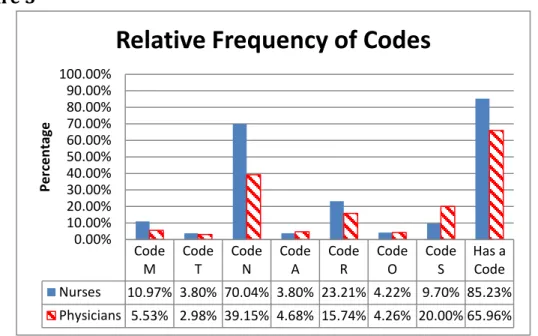
235 for physicians). To determine if one occupational group is more likely to have a failed search due to a certain error, a one-sided two-sample z-test was run on the coded categories. In Figure 3, the relative frequencies of category codes for physician and nurse
subject sessions are displayed.
Figure 3 Code M Code T Code N Code A Code R Code O Code S Has a Code Nurses 10.97% 3.80% 70.04% 3.80% 23.21% 4.22% 9.70% 85.23% Physicians 5.53% 2.98% 39.15% 4.68% 15.74% 4.26% 20.00% 65.96%
0.00% 10.00% 20.00% 30.00% 40.00% 50.00% 60.00% 70.00% 80.00% 90.00% 100.00% Per ce n tage
A hypothesis test was performed to see if the differences between these
percentages are statistically significant. The null hypothesis is that physician and nurses
are equally as likely to have a search fail due to each of the assigned categories. The small p-value will provide evidence that the null hypothesis is false and concludes that
physicians and nurses are significantly different for each category.
A one-sided two sample z-test was done for each category code. Table 4 shows the p-values for each test. The codes of M, N, R, and S are significantly different across
the two groups, unlike the other codes which are well above conventional significance thresholds.
Table 4
Category p-value Conclusion
Code M 0.015 Nurses are more likely to misspell
Code T 0.234
Nurses and physicians are not different with respect to this category
Code N 6.00E-13 Nurses are more likely to enter narrow searches
Code A 0.317
Nurses and physicians are not different with respect to this category
Code R 0.02 Nurses are more likely to repeat unsuccessful searches
Code O 0.492
Nurses and physicians are not different with respect to this category
Code S 0.0007
Physicians are more likely to encounter subscription issues
Has at least one
error code 2.88E-07
Nurses are more likely to commit an error of type M,T, N, A, R, or O
number of hits, or if the physician or nurse chosen to click on a link after a successful
search.
The sample averages of each of these variables, grouped by occupation, are totaled in Table 5. Nurses averaged more (2.24) attempts per subject session compared to 1.80 for physicians, for an average of the two groups of 2.02. The nurses did not average
as many hits per subject session.
Table 5
Averages Nurse Physician Total
Number of searches in a session 2.24 1.80 2.02
Total number of hits in a session 19.62 24.83 22.21
Number of linkouts in a session with at least one hit 2.18 1.73 1.53
Each of these variables is analyzed further in the following tables. The number of searches per subject session is dichotomized by examining subject sessions where one
search was performed versus multiple searches in a session. Tallies are presented in Table 6. Nurses had multiple attempts per subject session – 139 times out of 237 versus the
physicians with 106/235.
Table 6
Number of searches in a session Nurse Physician Total
One 98 129 227
Two or more 139 106 245
The search experience was further evaluated by investigating the variable of total number of hits per session, which are shown in Table 7. Of the 237 subject sessions,
nurses had one or more hits 74 times and physicians had 116/235.
Table 7
Total number of hits in a session Nurse Physician Total
Zero 163 119 282
One or more 74 116 190
Total 237 235 472
Table 8 holds the counts of how many sessions had links that were clicked. The first row acknowledges the number of times that the patron did not click on a URL. As a zero link-out could be indicative of the patron not finding what they need in the results list, this variable could be considered a “success index.” Nurses clicked on links 55
times/74 sessions while physicians did the same 98 times/116 sessions. Are these
differences significant?
Table 8
Number of sessions with corresponding link-outs Nurse Physician Total
Zero 19 18 37
One or more 55 98 153
Total 74 116 190
The null hypothesis that the physicians and nurses have similar behavior regarding these three variables is tested. The p-values are reported below in Table 9. A
level (α) equals 0.05, it is clear that nurses conduct more searches per subject session, see
a results display of zero hits more often, and do not click on as many links when
compared to physicians.
Table 9
Variable being tested p-value Conclusion
Number of searches in a session 0.0013
Nurses conduct more searches per session than physicians do.
Total number of hits in a session
3.00E-05
Nurses experience more searches that results in zero hits than physicians do.
Number of linkouts in a session
with at least one hit 0.0477
Nurses experience more searches with zero links clicked than physicians do.
When analyzing so much data, could one patron be responsible for the majority of
the searching and contribute disproportionately to the data? Table 10 shows this is not the case, in which the top ten patrons are listed. There are 2 nurses and 8 physicians who are the most frequent users of the site search, but of the 472 total subject sessions analyzed in
2010, the top-rated physician only conducted 8 separate subject session searches.
Table 10
Name IDs of top users Number of sessions Occupation
31493 8 Physician
12415 7 Nurse
40827 5 Nurse
27670 4 Physician
4908 3 Physician
8965 3 Physician
12253 3 Physician
12426 3 Physician
23044 3 Nurse
Discussion
The data available are valuable assets by which to learn how search behavior and
ADL website contribute to obtaining relevant results through the ADL site search box for content.
Since January 1, 2010, ADL patrons had the option of performing a federated search to retrieve abstracts, journal articles, or database content or do a site search to
obtain links within resource groups, in which availability is limited by institutional
subscriptions. Wanting to improve the search experience for patrons and understand more about how a particular segment of the ADL membership (e.g., physicians and nurses) was
using the site search tool, the ADL needed particular aspects of the collected data to be investigated and I requested to be part of the project.
This study compared site search queries and results, based upon occupation to
discover how physicians and nurses search and reveal the differences in outcomes when using the site search tool. Those which were unsuccessful were scrutinized for human
error, misunderstanding of how the site search box is to be used, lack of content due to subscription restrictions, or inability of the tool to compensate for a wide range of query composition. Results will guide the ADL staff in determining what changes could be
made to improve the search experience for ADL patrons.
It was uncovered that when nurses use the site search box, they submit more
as physicians. It is unknown if this indicates that the links are irrelevant or that the links
are being perceived as unhelpful.
Nurses are more likely to misspell search terms or have a typographical error, thereby needing repeat the search. This can be corrected with more careful effort at the
keyboard or checking the correct spelling in advance.
Nurses are also inclined to over-specify for this single repository search engine. As the site search only looks for licensed content, and does so for only titles of journal
names, books, databases, among others, and resource groups. This happened in over 70% of the searches performed by nurses – the most frequent of all the categories.
Query reformulation may occur to narrow or broaden a topic. In a recent study by Du and Evans (2011) it was recognized that almost all of their study participants built over 10 search queries for research topics, which a mean of 15 queries (range of 4 to 26).
This is far more than the 2000 publication by Spink, Jansen, and Ozmultu that identified 2.84 queries per user when searching the Excite browser and is more in line with the
ADL result average of 2.02 searches per subject session for physicians and nurses.
Physicians encounter negative results by looking for items that either their institution does not subscribe to or that the ADL does not carry at any subscription level.
Visiting the available listings menu could give patrons an idea of what is obtainable before trying a site search for journal or book titles.
the ADL website or through a web browser. It represents an error when used for site
search, since entering an article title or author name will return no hits.
The nurses repeated failed searches nearly a quarter of the time and physicians did so in 15% of their sessions. Since the keyword entry is retained on the results screen, it is puzzling why some patrons insist on re-entering the same exact queries with no
difference in results. Peters (1989) also noticed this occurrence and humorously coined the term “incredulous repetitions,” since the patron apparently couldn’t believe what was
displayed on the screen. An extreme example of this was found in one of the ADL
subject searches that was not among the sessions chosen for content analysis. A physician entered the acronym “ENT” (i.e. ear, nose, and throat) 89 times within a few minutes.
The database which was frequently searched for, but not accessible by all, was the UpToDate clinical support system. Patrons spelled it with and without dashes and spaces
between words during reformulations, but it appeared to be only covered by certain subscription levels. It is a very popular resource and it is suggested that the ADL discuss with the institutions whether to include it in their subscriptions. Another possibility is to
amend the ADL database dictionary code to accommodate the various alterations.
Appendix 2 is the listing of all URLs clicked by nurses and physicians. Duplicates
were deleted. It gives a picture of which are the most popular with these two groups and reinforces the need to continue providing that content. A total of 294 links were clicked,
Several search errors fit into the category of “other.” When this occurred, searches were for titles that may not exist. For two queries, a journal title existed, but the patron
added a date or some punctuation which prevented a hit. Sometimes a website URL was copied and pasted into the box. Syntactic errors, such as incorrect word order for a
journal title were observed, as were abbreviations for materials.
Some of the ineffective searching practices can be addressed during ADL
teaching workshops or described in an instruction document on the website. Misspellings
and use of author names or article titles are easy enough to rectify. The process of
choosing the right keywords that are included in resource group content will need pointed
instruction and experience using the tool. Once a patron visits the journal list or similar groups, s/he will have a better idea of which titles to search for in the future. Uncertain of how the site search tool may work or due to past failures locating needed information, it
appears from the content analysis that some employ more of an explorative nature, as described in Du and Evans (2011).
Broad topics were occasionally searched and seemed to be reasonable entries, but resulted in zero hits. Perhaps adding “drug manual” or “formulary” would be helpful
resource group headings. Also, a category for cardiac life support could aid those looking
for the Basic or Advanced Cardiac Life Support manuals for their mandatory cardiac resuscitation courses. “Infusion therapy” was a popular search term, as was “nursing
theory.” These suggestions may be too narrow for the general resource groups, but maybe
Although the resource group name “clinical answers” is available on the website, I could not retrieve that title. It may have been in a results list earlier in my study, but
leads me to wonder which other resource groups I am not finding within my subscription level and how this affects other patrons. The same was true for “journals” and “journal collections.” One particular term, “websites,” did not list when trying the exact spelling, yet “website” brought up the group. The inability to access resource groups by name
complicates the effort to see if the groups should be ordered differently in the results list.
The ADL was sent a copy of the analyzed data and will see which materials were desired, but were not apparently covered by subscriptions. Paired with personal
suggestions by patrons, the ADL could gather valuable information for what resources may be added to the digital collection.
Conclusion
The frequency by which patrons are performing searches that are not returning
results is highlighted in this project. The data show where the ADL can change system performance with respect to these behaviors and during instructional periods. There is now a better understanding of how the ADL can redesign its site, such as programming the site search tool to be more “forgiving” of misspellings or various ways popular item
names are entered with dashes or spaces. Patrons can be better informed of the best ways
The approach used in this study could be applied to similar websites or library OPACs for transaction log analyses. The errors considered are relatively easy to examine
and for patrons to correct, once made aware of the deficiencies of particular concepts. More complicated than patron training might be the program design to adapt to so many
potential misspellings or semantic revisions.
This content analysis is not the definitive answer to why a patron may have a successful search. The process lends itself to incremental success as real accomplishment
is found on several levels – the results list, which URLs were clicked, and if the patron found what was needed on those sites. Without a survey, it will remain unknown why the
patron stopped searching when receiving 0 hits or even when resource links were clicked on when retrieved. Did the patron become frustrated at the ADL content or were they called away, possibly to continue the search at another time? When the patron did click
on a link was it because the patron found what they needed or was the link an interesting distraction unrelated to the original search? The qualitative analysis also cannot interpret
why the same queries are repeated once or twice when 0 hits are returned.
It is unknown why physicians reached results more quickly with fewer
misspellings. Educational levels, familiarity with similar tools, attention to detail may
play a role, but these are only assumptions. Without speaking to the patrons about why particular terms were entered or their understanding about effective use of the site search
tool, some questions will remain unanswered.
patrons, who have many demands placed upon them. Periodic evaluations will help to keep the high quality of service presently provided. Future directions for the ADL to
appraise the effectiveness of the collection and its tools could be to perform a closer examination of keyword strings, isolate a name identifying number and follow that
individual through searches over a period of time, or to choose themes and search with synonyms if a particular topic is deemed pertinent and important. Any direction the ADL choses to go, it will certainly strive to continue its valuable service to the health care
field.
Acknowledgements
I am indebted to Mary Beth Schell, NC AHEC Digital Library Director, for her willingness to work with me and allow the use of ADL data for this Master’s project.
Many thanks are extended to Susan Wei for her statistical analysis. Dr. Jaime Arguello
provided excellent guidance for the project as my Master’s paper advisor. His reliability and enthusiasm provided encouragement throughout the months of data mining, analysis,
Appendix 1
Examples of Select ADL Resources
1. Cochrane Database of Systematic Reviews – Database of high-level overviews of primary research addressing clinical questions using systematic methods to
minimize bias.
2. CINAHL Plus with Full Text – Electronic bibliographic database owned and
operated by EBSCO Publishing, the Cumulative Index to Nursing and Allied Health Literature is a comprehensive resource for nursing and allied health
literature.
3. New England Journal of Medicine – The oldest continuously published medical periodical is available through the ADL journals database for current and archival
issues.
4. PubMed – The interface which allows searching of the National Center for Biotechnology Innovation (NCBI) MEDLINE online database of biomedical
abstracts and citations.
5. ICD-9-CM-Volumes 1,2,3 (2012) STAT!Ref Overview – The electronic version
6. National Library of Medicine Drug Information Portal – Database of selected drug information from the U.S. National Library of Medicine, along with other
federal agencies.
7. Trauma Image Database – A repository of classified and searchable images,
submitted by trauma care professionals, available for educational use.
8. TRIP Database – A clinical search tool to quickly locate the highest quality
Appendix 2
Links clicked by physicians and nurses January 1-Dec 31, 2010
1 AACN Advanced Critical Care
2 About Herbs, Botanicals & Other Products
3 ACP PIER: Physician's Information & Education Resources 4 Adams and Victor's Principles of Neurology
5 Addressing Barriers to Learning Newsletter 6 ADHD Health Services Across North Carolina 7 Advanced Emergency Nursing Journal
8 Agency for Healthcare Research & Quality Evidence Based Practice
9 AIDS
10 Alternative Medicine Review
11 American Academy of Medical Acupuncture 12 American Academy of Osteopathy
13 American Academy of Pediatrics 14 American College of Cardiology
15 American College of Obstetricians and Gynecologists 16 American Diabetes Association
17 American Family Physician 18 American Heart Journal 19 American Journal of Medicine
20 American Journal of Respiratory and Critical Care Medicine 21 American Journal of Sports Medicine
22 American Journal of Surgery 23 Anesthesia & Analgesia 24 Annals of Internal Medicine 25 Annals of Surgery
26 Annual Review of Nursing Research
27 Archives of Disease in Childhood Fetal & Neonatal Edition 28 Archives of Surgery
29 Area L AHEC Continuing Education 30 Arthroscopy
31 Avery's Neonatology
32 Bates Visual Guide to Physical Examination 33 Best Practice: Falls in hospitals
36 Brain Injury: Complications and Medical Problems 37 Breastfeeding Review
38 British Journal of Neuroscience Nursing 39 Cardiology Clinical Statements/Guidelines 40 Case Management Advisor
41 Charlotte AHEC Continuing Education 42 Circulation
43 Clinical Dermatology (Habif) 44 Clinical Journal of Pain 45 Clinical Nursing Research 46 Clinical Oncology (Abeloff)
47 Clinical Orthopaedics & Related Research 48 Clinical Toxicology (Ford)
49 Clinical Trials at UNC 50 Cochrane Library
51 Congestive Heart Failure Tutorial 52 COPD Guidelines
53 Critical Care Clinics
54 Critical Care Nursing Quarterly 55
Cultural Competence in Health Care: Emerging Frameworks and Practical Approaches
56 Current Opinion in Endocrinology & Diabetes (archival access only) 57 Dartmouth Atlas of Health Care
58 Delmar's Fundamental & Advanced Nursing Skills
59 Diabetes Awareness & Patient Education for Hispanic/Latino Americans 60 Dietary Guidelines for Americans, 2005
61 Drugs in Pregnancy and Lactation 62 DSM-IV-TR
63 e-Anatomy
64 EBM Reviews - Cochrane Central Register of Controlled Trials 65 EBM Reviews - Cochrane Database of Systematic Reviews 66 E-Books in the Health Sciences - Search the UNC Collection 67 Epocrates
68 European Heart Journal
69 Evidence Based Nursing Tutorial 70 Fall Management Guidelines 71 Fall Prevention
72 Fall Prevention Program Manual 73
Fall Prevention Project: Check it out!: Some things you can do to reduce your risk of falling
76 Fundamental Immunology (Paul), 6th. ed.
77 Guideline: Preventing pressure ulcers & skin tears 78 Hand Clinics
79 Health Affairs
80 Health Care Reform and Health IT Stimulus: ARRA and HITECH 81 Health Education & Behavior
82 Health Topics: What Are Ways to Prevent Falls and Related Fractures? 83 Healthcare Benchmarks & Quality Improvement
84 Injury
85 Injury Center: Falls Among Older Adults: Brochures and Posters 86 International Journal of Health Promotion & Education
87 International Journal of Psychiatric Nursing Research 88 International Orthopaedics
89 Internet Journal of Medical Informatics
90 JAMA
91 Joint Commission National Patient Safety Goals 92 Joint Commission Perspectives
93 Journal of Ambulatory Care Management 94 Journal of Analytical Toxicology
95 Journal of Arthroplasty
96 Journal of Bone & Joint Surgery (American Volume) 97 Journal of Bone & Joint Surgery (UK Volume) 98 Journal of Cultural Diversity
99 Journal of ECT (archival access only) 100 Journal of Hand Surgery [American Edition] 101 Journal of Infusion Nursing
102 Journal of Intravenous Nursing
103 Journal of Nursing Administration (JONA) 104 Journal of Nursing Care Quality
105 Journal of Nursing Research
106 Journal of Oral & Maxillofacial Surgery 107 Journal of Orthopaedic Trauma 108 Journal of Patient Safety
109 Journal of Pediatric Gastroenterology & Nutrition 110 Journal of Pediatric Oncology Nursing
111 Journal of Pediatric Orthopaedics (archival access only) 112 Journal of Pediatrics
113 Journal of Psychosocial Nursing & Mental Health Services 114 Journal of Shoulder & Elbow Surgery
117 Journal of the American Society of Nephrology 118 Journal of trauma
119 Journal of Trauma: Injury, Infection, and Critical Care 120 Key Topics in Neonatology
121 Knee
122 Legal Eagle Eye Newsletter for the Nursing Profession 123 Mayo Clinic Proceedings
124 MD Consult
125 Medical Letter on Drugs & Therapeutics 126 MEDLINE 1950 - present
127 Medscape Free CME 128 MEDSURG Nursing 129 Men in Nursing
130 Michigan Informatics Tutorials: Evidence-Based Public Health 131 Micromedex
132 National Center for Complementary & Alternative Medicine 133 National Center for Cultural Competence
134 National Center for Patient Safety 2004 Falls Toolkit 135 Neonatology
136 New England Journal of Medicine 137 North Carolina Medical Society 138 Nursing Best Practice Guidelines 139 Nursing Research
140 Online Neurology Reference 141 Operative Anatomy
142 Oral Diseases
143 Orthopedic Patient Education Library 144 Orthopedics
145 Ovid MEDLINE (2004-present) 146 Patient Education Management
147 Patient Safety Solution 2: Patient Identification 148 Patient Safety: Achieving a New Standard for Care 149 PDR® Family Guide To Over-The-Counter Drugs 150 Pediatric Nephrology
151 Pediatric Patient Education 152 Pediatric Policy & Guidelines 153 Pediatrics in Review
154 Preventing Medication Errors: Quality Chasm Series 155 Preventing Pressure Ulcers: A Patient's Guide 156 Primal Anatomy.tv
158 PubMed Central: Free Archive of Life Sciences Journals 159 PubMed Medline
160 Quality Management in Health Care 161 Radiologic Technology
162 Radiology
163 Real Living with Multiple Sclerosis 164 Red Book
165 Research & Theory for Nursing Practice
166 Rosens Emergency Medicine: Concepts and Clinical Practice (Marx) 167 Search PubMed for Complementary and Alternative Medicine articles 168 Search PubMed for Traumatic Brain Injury Articles
169 Series of Articles on Cultural Competence 170 Skeletal Trauma (Browner)
171 Southern Medical Journal
172 Southern Online Journal of Nursing Research 173 Stroke
174 Surgery
175 Surgical Clinics of North America 176 Textbook of Clinical Neurology (Goetz)
177 Unequal Treatment: Confronting Racial and Ethnic Disparities in Health Care 178 UptoDate
References
Allen, M. P., Jacobs, S. K., & Levy, J. R. (2006). Mapping the literature of nursing: 1996-2000.
Journal of the Medical Library Association, 94(2), 206-220. Retrieved from
https://auth.lib.unc.edu/ezproxy_auth.php?url=http://search.ebscohost.com/login.aspx?
direct=true&db=c8h&AN=2009191029&site=ehost-live&scope=site
Alper, B. S., Stevermer, J. J., White, D. S., & Ewigman, B. G. (2001). Answering family
physicians' clinical questions using electronic medical databases. Journal of Family
Practice, 50(11), 960-965. Retrieved from
https://auth.lib.unc.edu/ezproxy_auth.php?url=http://search.ebscohost.com/login.aspx?
direct=true&db=aph&AN=5657363&site=ehost-live&scope=site
Andrews, J. E., Pearce, K. A., Ireson, C., & Love, M. M. (2005). Information-seeking behaviors
of practitioners in a primary care practice-based research network (PBRN). Journal of the
Medical Library Association : JMLA, 93(2), 206-212.
Barta, K. (1995). Information-seeking, research utilization, and barriers to research utilization
of pediatric nurse educators. Journal of Professional Nursing, 11(1), 49-57.
doi:10.1016/S8755-7223(95)80073-5
Bracke, P. J., Howse, D. K., & Keim, S. M. (2008). Evidence-based medicine search: A
customizable federated search engine. Journal of the Medical Library Association, 96(2),
108-113. Retrieved from
http://vnweb.hwwilsonweb.com.libproxy.lib.unc.edu/hww/jumpstart.jhtml?recid=0bc05f7
a67b1790e06bc114cd79d5996bfa1c32b225f9ccb8f6ccb3451cae0968f195e6959e0385b&f
Chambliss, M. L., & Conley, J. (1996). Answering clinical questions. Journal of Family Practice,
43(2), 140-144. Retrieved from
https://auth.lib.unc.edu/ezproxy_auth.php?url=http://search.ebscohost.com/login.aspx?
direct=true&db=aph&AN=9703201473&site=ehost-live&scope=site
Ciliberti, A. C., Radford, M. L., Radford, G. P. & Ballard, T. (1998). Empty handed? A material
availability study and transaction log analysis verification. The Journal of Academic
Librarianship, 24(4), 282-289. Retrieved from
http://vnweb.hwwilsonweb.com/hww/jumpstart.jhtml?recid=0bc05f7a67b1790e06bc114
cd79d59963661aa2bdeea453423f4059fcf4a71f855af9e34e5d8ba85&fmt=H
Cleary, M., Hunt, G. E., & Horsfall, J. (2009). Conducting efficient literature searches:
Strategies for mental health nurses. Journal of Psychosocial Nursing & Mental Health
Services, 47(11), 34-41. doi:10.3928/02793695-20090930-03
Cogdill, K. W. (2003). Information needs and information seeking in primary care: A study of
nurse practitioners. Journal of the Medical Library Association, 91(2), 203. Retrieved from
https://auth.lib.unc.edu/ezproxy_auth.php?url=http://search.ebscohost.com/login.aspx?
direct=true&db=aph&AN=9580106&site=ehost-live&scope=site
Curtis, K., Weller, A., & Hurd, J.Information-seeking behavior of health sciences faculty: The
impact of new information technologies. Bulletin of the Medical Library Association, 410.
Retrieved from
http://www.ncbi.nlm.nih.gov.libproxy.lib.unc.edu/pmc/articles/PMC226298/;
Dee, C., & Stanley, E. E. (2005). Information-seeking behavior of nursing students and clinical
nurses: Implications for health sciences librarians. Journal of the Medical Library
Association, 93(2), 213-222. Retrieved from
https://auth.lib.unc.edu/ezproxy_auth.php?url=http://search.ebscohost.com/login.aspx?
Doig, G. S., & Simpson, F. (2003). Efficient literature searching: A core skill for the practice of
evidence-based medicine. Intensive Care Medicine, 29(12), 2119-2127.
doi:10.1007/s00134-003-1942-5
Doney, L., Barlow, H., & West, J. (2005). Use of libraries and electronic information resources
by primary care staff: Outcomes from a survey. Health Information and Libraries Journal,
22(3), 182-188. doi:10.1111/j.1471-1842.2005.00561.x
Du, J. T., & Evans, N. (2011; 2011). Academic users' information searching on research
topics: Characteristics of research tasks and search strategies. The Journal of Academic
Librarianship, 37(4), 299-299-306. Retrieved from
https://auth.lib.unc.edu/ezproxy_auth.php?url=/docview/896177768?accountid=14244
Eldredge, J. (2000). Evidence-based librarianship: An overview. Bulletin of the Medical Library
Association, 88(4), 289-302. Retrieved from
http://www.mlanet.org.libproxy.lib.unc.edu/research/science1.html
Ely, J. W., Osheroff, J. A., Gorman, P. N., Ebell, M. H., Chambliss, M. L., Pifer, E. A., & Stavri,
P. Z. (2000). A taxonomy of generic clinical questions: Classification study. BMJ: British
Medical Journal (International Edition), 321(7258), 429. Retrieved from
https://auth.lib.unc.edu/ezproxy_auth.php?url=http://search.ebscohost.com/login.aspx?
direct=true&db=aph&AN=3425387&site=ehost-live&scope=site
Fakhoury, W. K. H., & Wright, D. (2000). Communication and information needs of a random
sample of community psychiatric nurses in the united kingdom. Journal of Advanced
Nursing, 32(4), 871-880. Retrieved from
https://auth.lib.unc.edu/ezproxy_auth.php?url=http://search.ebscohost.com/login.aspx?
direct=true&db=aph&AN=6058128&site=ehost-live&scope=site
Flake, D. (2010). No password required-A case study of integrating the library's electronic
resources into the hospital's electronic medical record. Journal of Hospital Librarianship,
Foust, J. E., Bergen, P., & Maxeiner, G. L. (2007). Improving e-book access via a
library-developed full-text search tool. Journal of the Medical Library Association, 95(1), 40-45.
Retrieved from
http://vnweb.hwwilsonweb.com/hww/jumpstart.jhtml?recid=0bc05f7a67b1790e06bc114
cd79d5996f2cd01e5aaebf4c99197a1d2b41496ef85458d8904f2978d&fmt=P;
Gorman, P. (2001). Information needs in primary care: A survey of rural and nonrural primary
care physicians. Paper presented at the MEDINFO 2001: Proceedings of the 10th World
Congress on Medical Informatics, 10 338-342. Retrieved from
http://books.google.com.libproxy.lib.unc.edu/books?id=DaBdlWBkvEUC&pg=PA338&dq=
medinfo+V.+patel+2001+proceedings+of+the+10th+world+gorman+congress+paul+go
rman&hl=en&ei=-SzcTtDfO8u_tge38bGCAg&sa=X&oi=book_result&ct=result&resnum=1&ved=0CDYQ6AEw
AA#v=onepage&q&f=false;
Grajek, S., Calarco, P., Frawley, S., McKay, J., Miller, P., Paton, J., . . . Sullivan, J. (1997).
Evaluating IAIMS at yale: Information access. Journal of the American Medical
Informatics Assocation, 4, 138-149. Retrieved from
http://jamia.bmj.com.libproxy.lib.unc.edu/content/4/2/138.full?sid=347fac62-d603-4794-b225-417ddbf16b5c
Hersh, W., Crabtree, K., Hickam, D., Sacherek, L., Friedman, C., Tidmarsh, P., . . . Kraemer,
D. (2002). Factors associated with success in searching MEDLINE and applying evidence
to answer clinical questions. Journal of the American Medical Informatics Assocation,
9(3), 283-293. Retrieved from
http://jamia.bmj.com.libproxy.lib.unc.edu/content/9/3/283.full?sid=d6a2864b-a1d3-42bc-8abb-eb20061a3bb8
Hersh, W., Stavri, P. Z., & Detmer, W. M. (2006). Information retrieval and digital LIbraries.
in health care and biomedicine (pp. 660-697). New York, NY: Springer. Retrieved from
http://search.lib.unc.edu?R=UNCb4883454
Huntington, P., Nicholas, D., Jamali, H. R., & Watkinson, A. (2006). Obtaining subject data
from log files using deep log analysis: Case study OhioLINK. Journal of Information
Science, 32(4), 299-299-308. Retrieved from
https://auth.lib.unc.edu/ezproxy_auth.php?url=/docview/57674079?accountid=14244
Huntington, P., & Nicholas, D. (2006). Improving the relevance of web menus using search
logs: A BBCi case study. Aslib Proceedings, 58(1), 118-128.
doi:10.1108/00012530610648716
Huntington, P., Nicholas, D., & Warren, D. (2004). Digital visibility and its impact upon online
usage: Case study of a health web site. Libri, 54(4), 211-220. Retrieved from:
http://vnweb.hwwilsonweb.com/hww/jumpstart.jhtml?recid=0bc05f7a67b1790e06bc114
cd79d5996c99fb6cf4a0a43e9ea18b6f7f255fbcda9591545576b4c76&fmt=P
Jansen, B. J. (2006). Search log analysis: What it is, what's been done, how to do it. Library &
Information Science Research (07408188), 28(3), 407-432.
doi:10.1016/j.lisr.2006.06.005
Johnston, R. (2007). Providing interlibrary loan to health workers in medically underserved
rural areas: An area health education center in action. Journal of Interlibrary Loan, 17(3),
41-48.
Lau, A., Coiera, E., Zrimec, T., & Compton, P. (2010). Clinician search behaviors may be
influenced by search engine design. Journal of Medical Internet Research, 12(2), e25.
Retrieved from http://www.jmir.org/2010/2/e25/
Liu, W. (2010). Remote users' OPAC searching habits: A comparative case study through web