1
AN ANALYSIS OF EARLY MISSISSIPPIAN BURIALS FROM MOUND C AT OCMULGEE, GEORGIA
By Rachel Metcalf
Honors Thesis Curriculum in Archaeology
University of North Carolina at Chapel Hill
2017
Approved:
2
TABLE OF CONTENTS
1. Mound C: Methods and Research Questions……….. 8
Introduction……….. 8
Research Questions……….. 9
Theoretical Approaches to Mortuary Practice………. 9
Sources of Skeletal Data……….. 10
2. Ocmulgee National Monument and the Macon Plateau………. 12
Chronology……….. 13
Community Organization at Ocmulgee………... 15
Invasion or Isolated Development: Emergence of the Macon Plateau……… 16
Excavation History………... 18
Mound C Excavation……….... 19
Railroad Construction……….. 20
Excavation Issues………. 21
3. Mound C Burials………. 23
Sub-mound……… 23
Mound I………. 27
Mound II……… 28
Mound III……….. 30
Mound IV……….. 31
3
Mound VI and Mound VII ………... 35
Village Site……… 36
New Sod and Old Sod………... 38
Group I and Group II………. 40
Burials with No Associated Level………. 41
Mound C Grave Goods……….. 44
4. Burial Patterns………. 47
Issues with Skeletal Identification………. 47
Burial Patterns by Mound Level……… 48
Burial Type……… 48
Burial Position………... 49
Grave Goods……….. 50
Burial Frequency………... 54
Burial Patterns Overall……….. 55
Age and Sex………... 55
Burial Type……… 56
Burial Position………... 57
Grave Goods……….. 57
Pathological Patterns………. 58
5. Discussion of Burial Patterns………. 59
4
Identifying Important Burials………... 60
Secondary Burials………. 63
Secondary Burials as Cosmological Displays……….. 63
Mound-top Structures or Charnel Houses………. 64
Ritual Bone-Handling and Reburial……….. 64
Conclusions………... 65
List of Figures 1. Map of Ocmulgee National Monument……… 13
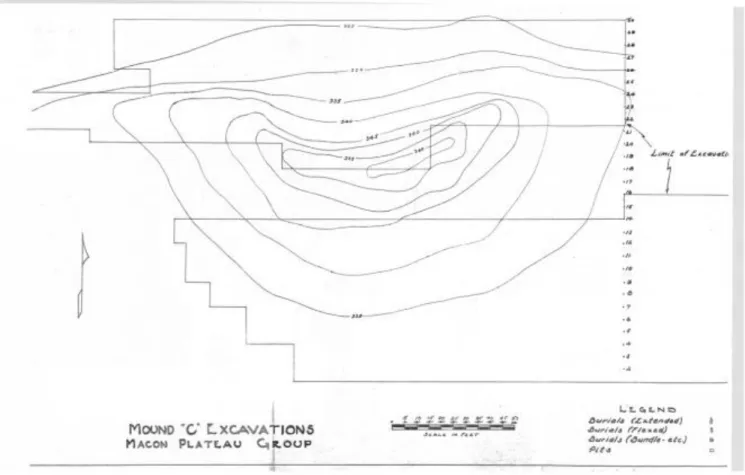
2. Map of excavation limits……….. 20
3. Site map with railroad cuts………... 21
4. Seriation graph showing burial type by mound level………... 49
5. Seriation graph showing the distribution of burial positions by mound level……….. 50
6. Seriation graph showing grave goods by mound level………. 51
7. Total number of burials by mound level………... 54
8. Sherratt diagram of burial goods by age and sex……….. 57
9. Sketch of Burial 69 of the sub-mound level……….. 61
10. Sketch of Burial 14……… 62
List of Tables 1. Sub-mound Burials………... 24
5
4. Mound IV Burials……….. 32
5. Mound -V/V Burials……….. 34
6. Mound VI Burials……….. 36
7. Mound VII Burials………. 36
8. Village Site Burials……… 37
9. Old Sod Burials………. 38
10. New Sod Burials……… 40
11. Group I Burials……….. 40
12. Group II Burials………. 41
13. Burials with No Level Recorded………42-43 14. Age and Sex Totals……… 55
15. Count and Percent of Burial Types, Overall……….. 55
16. Count and Percent of Burial Positions, Overall………. 56
6
ACKNOWLEDGEMENTS
I would like to thank my advisor, Dr. Vin Steponaitis, for his guidance and
encouragement throughout this year-long research project. I am also grateful for the support of my committee members Dr. C. Margaret Scarry and Dr. R.P. Stephen Davis. I would like to especially thank the staff at the Southeast Archaeological Center in Tallahassee – David Morgan, Richard Vernon, Jessica McNeil, and Hannah Marshall – who graciously accommodated my research plans and provided me with all the field notes, photographs, and sketches from the Ocmulgee excavations. A special thanks to Bennie and Elaine Keel, who were the most generous hosts during my trip to Tallahassee; Dorothy Lippert and Christopher Dudar at the Smithsonian Institution for providing invaluable skeletal data; and friends and family that have supported me throughout this process – thank you for your unwavering support.
This project was generously supported by the Michael P. and Jean W. Carter Research
7 ABSTRACT
Rachel Metcalf: An Analysis of Early Mississippian Burials from Mound C at Ocmulgee, Georgia
8 CHAPTER 1
MOUND C: METHODS AND RESEARCH QUESTIONS
Introduction
My research focuses on Mound C of Ocmulgee National Monument in Macon, Georgia, and both its construction and burial activity during the early Mississippian Macon Plateau occupation from 900 A.D. to 1150 A.D. (Fairbanks 2003:15 [1956]; Hally 1994:95). Mound C, also referred to as the “Funeral Mound,” was a platform mound composed of seven building layers, each capped by hard clay or sand, and a sub-mound layer including burials dug shortly before mound construction. All construction stages were built by the same early Mississippian cultural group (Fairbanks 2003:39), and the people they interred in the mound – their age and sex, their grave goods, their status, and their role in the mortuary ritual – are the focus of this study.
Charles Fairbanks, archaeologist and author of The Archaeology of the Funeral Mound, described three possible reasons for periodic mound construction: (1) cyclical additions
prescribed by a larger social or ideological system, (2) layers added by a new chief to cover those of their predecessor, or (3) “calendrical arrangement which required periodic rebuilding”
9
Research Questions
When I first started reading about Mound C, there were two questions I wanted to answer: what was the structure of Ocmulgee society as reflected in the burial patterns, and what was the significance of so many secondary burials? The primary objective of this thesis is to contribute to the existing research about Ocmulgee archaeology and its inhabitants by providing an analysis and explanation of burial patterns in Mound C. The secondary objective of this research will be to explain the social and ideological systems that are represented in these early Mississippian burials.
Theoretical Approaches to Mortuary Practice
In this thesis, I will apply current Mississippian mortuary theory to the interpretation of the Mound C burials. These current theories were built upon and reference earlier approaches to understand burial patterns. Both Lewis Binford and Arthur Saxe wrote articles in the 1970s that formed this early “representationist” approach to mortuary practice (Sullivan and Mainfort 2010:3-4). The representationist approach interpreted burial patterns as reflective of the fullest-achieved social persona, or social role, of an individual at death (cited in Sullivan and Mainfort 2010:3). In “Mortuary Practices: Their Study and Their Potential” (1970), Binford described variability in mortuary practice and its usefulness in identifying larger social and cultural
systems. In simple societies with egalitarian organization, burial treatment would be expected to vary based on age or sex, with more distinction added to burials of individuals who achieved status through contribution to the society. Societies with more complex structure, like
10
More recent theoretical approaches to Mississippian mortuary practices identify that there are more factors affecting mortuary variability than just hierarchy and the “social persona” (Sullivan and Mainfort 2010:5). Burial is a ritual carried out by the living, not the dead, and the social personas represented in burial are not always indicative of someone’s true role in society. Instead, burials can be used to construct “cosmograms,” or displays of universal origin, where individuals are buried to reflect an ideological, rather than personal, identity (Sullivan and Mainfort 2010:46, 48). Status burials and reburial rituals could also be used to reinforce the high status of the living descendants and their own continuity and role in society (Sullivan and
Mainfort 2010:33). I think the burials in Mound C best fit with these latter theoretical
approaches. The presence of individuals of all ages, including children, in the Mound C burials suggests an ascribed system of social hierarchy. Additionally, the amount of secondary burials that were rearticulated or bundled together with elaborate grave goods could represent
constructed cosmological displays.
Sources of Skeletal Data
The data used for skeletal analysis was compiled from several sources, three originating from the Smithsonian Institution. Skeletal data, primarily age and sex, was compiled from four different sources: Charles Fairbanks’ Archaeology of the Funeral Mound (1956), Mary Powell’s 1986 report in David Hally’s Ocmulgee Archaeology, 1936-1986 (1994:116-129) and a 2014 skeletal analysis report (Lippert 2014) with osteology lab data (Dudar 2014) from the
11
The oldest Smithsonian report was Powell’s skeletal analysis included in Ocmulgee
Archaeology, 1936-1986. In 2014, the Smithsonian Institution conducted further skeletal analysis
of the Ocmulgee burials to identify and repatriate culturally affiliated remains (Lippert). The mortuary data produced by this report filled in many of the gaps in Fairbanks’ report and also provided more accurate age and sex estimates. Data from the Smithsonian’s osteology lab (Dudar 2014) additionally lists pathological conditions and identifies remains that have since been re-associated with other burials. While Fairbanks’ data included important details from field notes like burial orientation, grave goods, and mound level, the most recent age and sex data published by the Smithsonian are both more reliable and offer more specific age range estimates.
12 CHAPTER 2
OCMULGEE NATIONAL MONUMENT AND THE MACON PLATEAU
Ocmulgee National Monument (Figure 1) contains an early Mississippian site, composed of 8 mounds and one earthlodge, in Macon, Georgia (Hally 1994:130). The site is situated on the Macon Plateau, approximately 15 m above the Ocmulgee River floodplain – a notable location considering that most riverside Mississippian sites in the southeast are located in the river’s floodplain, not above it. Ocmulgee National Monument covers 0.7 square km of land. It was established as a national monument by President Franklin Delano Roosevelt in December 1936 (Hally 1994:23, 84, 94).
13
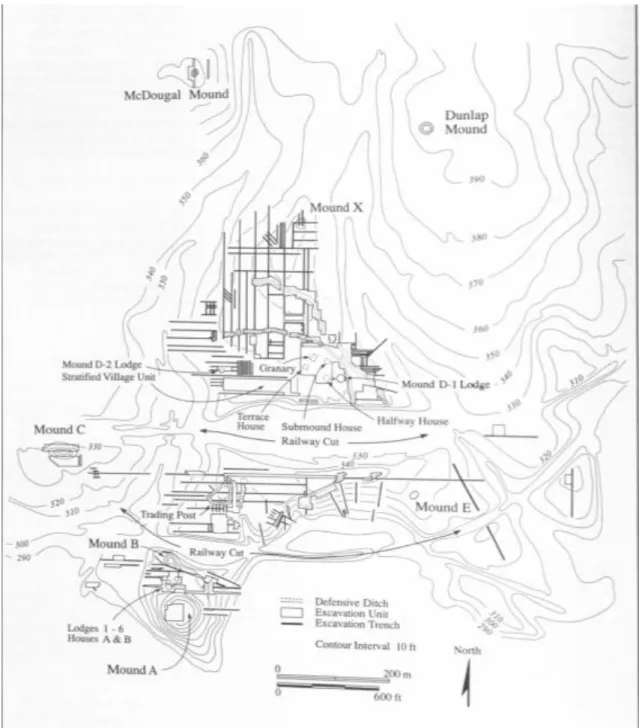
Figure 1. Map of Ocmulgee National Monument1
Chronology
Fairbanks described three periods of occupation at Ocmulgee, in relation to Mound C: pre-mound, mound-building, and post-mound (Fairbanks 2003:37). The Middle Woodland
14
cultures that existed in central Georgia immediately before Mississippian invasion included Swift Creek and Napier; of the two, Swift Creek was better represented (Fairbanks 2003:Table I). These “Early Farmers,” as Fairbanks described them, of the Swift Creek culture had limited agriculture (Fairbanks 2003:11-12). The Swift Creek culture in central Georgia was rapidly pushed out by the arrival of Macon Plateau culture in 900 A.D. Fairbanks described this group as “Master Farmers” for their full maize agriculture and community structure (Fairbanks 2003:15). Modern chronology estimates that early Mississippians arrived later around 950 A.D. and abandoned the site by 1150 A.D. – a brief 200 years of occupation (Hally 1994:95).
Fairbanks identified Ocmulgee as a good example of an early Mississippian site for its three key features: temple mounds, an earth lodge, and Mississippian type pottery and temper (Fairbanks 2003:13). Ocmulgee certainly had early Mississippian mounds, although it cannot be said what types of structures existed atop them, and the only earthlodge at Ocmulgee dates to the Macon Plateau phase, around 1015 A.D. (Wilson 1964:202). Pottery at Ocmulgee was primarily plain and undecorated, but was made with grit or shell temper in a “round base Mississippian type” (Fairbanks 2003:13).
15
Community Organization at Ocmulgee
Despite Fairbanks’ description of Ocmulgee as fitting a typical Mississippian site, Ocmulgee was not organized in the same way as later Mississippian settlements. As stated above, the geographic spread of Ocmulgee mounds suggests that there was no central plaza – a defining feature of later Mississippian sites – but rather smaller squares near each mound (Fairbanks 2003:47). Excluding a central plaza was possibly a planned, rather than organic, construction. Mississippian settlements were often planned from the very beginning, including the plaza size, which would be built according to the population size of the site (Pauketat 2007:95).
16
John Blitz (1999) identified several mound organization patterns. The Macon Plateau is described as an “isolated multiple mound center” where a single political mound center is connected directly to the local community and households, not divided up between auxiliary centers controlled by subchiefs (Blitz 1999:582). Blitz described this pattern of isolated mound centers as specific to the South: “In other words, the spacing of most [Southern Appalachian] centers implies that resource flows were directed to a specific center, and did not pass through a hierarchical chain of subordinate centers centrally organized to support a superordinate regional center” (1999:589).
To summarize, the Macon Plateau is thought to have developed as a simple, isolated chiefdom, where power and resources were centralized and not distributed downward through subchiefs and remote mound centers. Fairbanks did identify a “secondary town” of the early Mississippian phase (Fairbanks 2003:57), likely referring to Brown’s Mount, another Macon Plateau site located less than 10 km southeast of Macon. Hally hypothesized that mound centers located less than 18 km apart belonged to the same polity (cited by Blitz 1999:580). By this definition, Brown’s Mount should be included as part of the Ocmulgee/Macon Plateau polity (Wilson 1964:202).
Invasion or Isolated Development: Emergence of the Macon Plateau Occupational changes at Ocmulgee have been explained using several different
17
and Ocmulgee, and to the apparent dissimilarity between Swift Creek ceramics (precursor to the Macon Plateau phase) and the subsequent Bibb Plain styles of the early Mississippian period. Both Fairbanks and Gordon Willey, two archaeologists who worked extensively with Ocmulgee data, were convinced of the migration theory based on this ceramic evidence (Hally 1994:131).
With the arrival of New Archaeology in the 1960s, however, there was a shift in the interpretation of the Macon Plateau emergence. After years of interpreting Mississippian growth and cultural change primarily as a product of population movement (Blitz 1999:590),
archaeologists revisited the theory of Mississippian emergence at Ocmulgee. Instead of
migration, archaeologists argued that cultural development or diffusion of Mississippian culture in central Georgia could have resulted in the early Mississippian society at Ocmulgee. Another argument pointed out that Ocmulgee was abandoned and never reoccupied by Mississippian peoples, despite a common trend for sacred mound sites to be periodically abandoned and reoccupied later, and it implied that Ocmulgee was never reoccupied because later
Mississippians had no cultural connection to the site (Hally 1994:137).
But in the late twentieth century, archaeologists again favored the migration theory, based on ceramic evidence and limited connection between the Macon Plateau phase and both previous and following cultural materials. The current theoretical interpretation favors a “balanced
approach” (Hally 1994:137) to migration and development, where migration does not have to be the explanation for all Mississippian sites, but also cannot be automatically ruled out for sites like Ocmulgee. I believe this current argument for migration is stronger and more
18
no evidence of local acculturation or influence. The Mound C burials then likely represent a group of individuals who migrated to central Georgia for some reason.
The Macon Plateau was abandoned around 1150 A.D. for reasons unknown, but several theories exist to explain the rapid abandonment (Hally 1994:95) Some state that the site was abandoned and not reoccupied for a long time because of "lingering fear of the place" or was avoided because of the cultural taboos practiced by the Macon Plateau people (Pauketat
2007:115). Other theories consider warfare as the catalyst for rapid Mississippian occupation and abandonment (Blitz 1999:580). I think that environmental factors, like severe drought or over-cultivation of agricultural fields, should also be considered, especially for a community that relied on subsistence agriculture (Fairbanks 2003:47).
Excavation History
19
Arthur R. Kelly was chosen as director of the first Ocmulgee excavations. James A. Ford, a then-undergraduate with several years field experience, was chosen as Kelly’s assistant (Hally 1994:17). Early field notes include observations from both Kelly and Ford. In June 1936, Ocmulgee hosted a small group of graduate students for a summer field school. One of those graduate students, Gordon Willey, was asked to stay on as Kelly’s assistant after the summer ended. Willey would later become the senior foreman archaeologist during the CCC project. Charles Fairbanks, whose research on Mound C is referenced throughout this thesis, took over as Ocmulgee’s CCC senior foreman archaeologist in 1938 (Hally 1994:21-23, 25).
Mound C Excavation
20
Figure 2. Map of excavation limits.2
Railroad Construction. Long before excavations began, railroad construction in the 19th
century partially destroyed Mound C and Mound B, known as the Lesser Temple Mound. The Central of Georgia railroad made two east-west cuts through the Macon Plateau: one cut south of the earthlodge, and another just north of Mound A and Mound B (Figure 3). Mound C was also cut through on the northeast face by the railroad (Fairbanks 2003:17). The cut faces of the mounds revealed burials and cultural materials.
21
Figure 3. Site map with railroad cuts.3
Excavation Issues. Federal programs at Ocmulgee hired unskilled laborers to assist with
excavation. Kelly formed an archaeological night school to train some of the workers in more
22
23 CHAPTER 3 MOUND C BURIALS
There are at least seven identifiable levels of construction in Mound C, as well as a sub-mound level predating sub-mound construction and several layers that can only be roughly dated to mound-building activities. In total, 98 prehistoric burials were spread throughout one pre-mound level, seven construction levels, and several undefined levels. In this section, I will describe all the mound levels associated with the Macon Plateau period, beginning with the sub-mound level and ending with Mound VII, the seventh and final construction level of Mound C.
Each section will include a description of the related burials, grave goods, and mound structures of that level. I will also describe those burials not assigned a specific mound level. Information about the burials was compiled from field notes, Fairbanks’ 1956 report
Archaeology of the Funeral Mound, and the most recent Smithsonian skeletal evaluations (when
available). Specific references to field notes and the Smithsonian skeletal analyses are included separately in the mound level tables. Every burial described references information from “Table IV. Summary of Burials” (Fairbanks 2003:89-90).
Sub-mound
24
burials, five were described as log tombs. Half the burials in the sub-mound area contain grave goods, many very elaborate. In general, the burials in this area are more elaborate than burials in subsequent levels. Fairbanks describes this difference in elaboration as indication of the
changing social importance of individuals, not changing cultures (Fairbanks 2003:39).
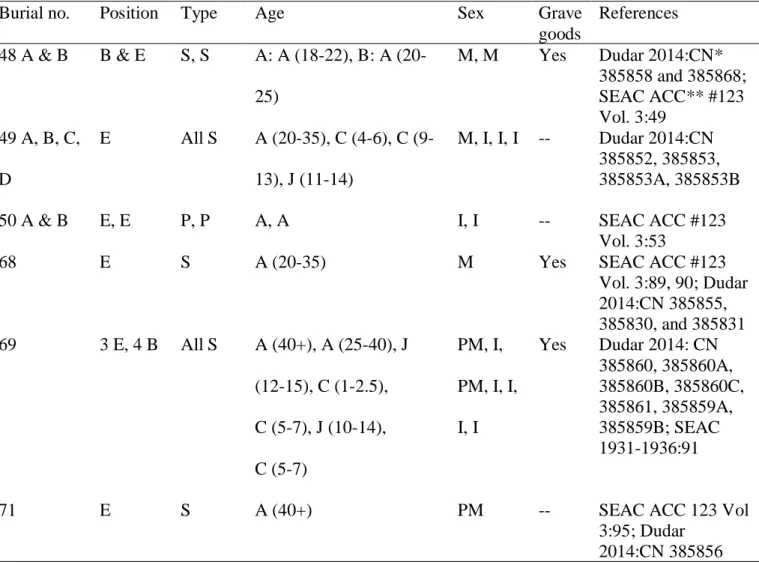
Table 1. Sub-mound Burials.
Burial no. Position Type Age Sex Grave
goods
References 48 A & B B & E S, S A: A (18-22), B: A
(20-25)
M, M Yes Dudar 2014:CN* 385858 and 385868; SEAC ACC** #123 Vol. 3:49
49 A, B, C, D
E All S A (20-35), C (4-6), C (9-13), J (11-14)
M, I, I, I -- Dudar 2014:CN 385852, 385853, 385853A, 385853B
50 A & B E, E P, P A, A I, I -- SEAC ACC #123
Vol. 3:53
68 E S A (20-35) M Yes SEAC ACC #123
Vol. 3:89, 90; Dudar 2014:CN 385855, 385830, and 385831 69 3 E, 4 B All S A (40+), A (25-40), J
(12-15), C (1-2.5), C (5-7), J (10-14), C (5-7)
PM, I, PM, I, I, I, I
Yes Dudar 2014: CN 385860, 385860A, 385860B, 385860C, 385861, 385859A, 385859B; SEAC 1931-1936:91
71 E S A (40+) PM -- SEAC ACC 123 Vol
3:95; Dudar 2014:CN 385856
Position: B = Bundled, E = Extended Type: S = Secondary, P = Primary Age: A = Adult, J = Juvenile, C = Child
Sex: M = Male, PM= Probable Male, F = Female, PF = Probable Female, I = Indeterminate * CN = catalogue number in Smithsonian inventory. Corresponds to skeletal remains.
25
Three burials in this level contain multiple interments. The sub-mound area contains numerous children and juveniles, always buried with at least one adult individual. Dudar’s osteology report (2014) identified at least 17 individuals buried in the Sub-Mound area. All individuals were males, probable males, or indeterminate – no females were identified. Nine of the individuals were identified as adults (18+), and eight were identified as either juveniles or children, ranging from 1-15 years of age. The youngest adult was 18, and the oldest were at least 40 years old at the time of death.
Burial 48 A & B contained a double burial of two young adult males buried in a log tomb. Skeletal analysis notes recorded 48-B as “large and robust…indicating a high level of physical activity.” The male in 48-B was 20-25 years old and buried in a rearticulated extended position, and the male in 48-A was 18-22 years old buried in a bundle. Burial 48-B contained numerous beads: 387 barrel-shaped beads and 17,582 disc beads. Comingled remains and inaccurately recorded provenience information made the identification of the two individuals complicated, and previous estimates recorded a probable female in Burial 48 that has since been unassociated with that burial.4
Burial 49 was a log tomb containing individuals A, B, C, and D, including an adult male aged 20-35 and three subadults of indeterminate sex, aged 4-6, 9-13, and 11-14. The original field notes only list three individuals for Burial 49 (A, B, and C), an adult and two juveniles, but further skeletal analysis by the Smithsonian identified a fourth individual. All the individuals
4 Burial 48 was one of the most complicated burials to accurately determine the age, sex, and position of the
26
were possibly rearticulated, not uncommon in the sub-mound area. No grave goods were recorded. The subadult aged 11-14 had hypoplastic defects and large carious lesions.
Burial 50 A & B was the only burial described in the sub-mound level that contained two fully extended (non-rearticulated) individuals. These are the only remains from the sub-mound level that are not included in SI inventory and could not be reassessed for more specific age and sex data.5 The log tomb burial contained two adults of indeterminate sex, buried with no grave goods. Field notes indicate that the two individuals were buried closely together, possibly wrapped in a skin or bark covering. Fairbanks described the burial as a log tomb.
Burial 68 was also described as a log tomb. It contained an adult male aged 20-35 with pathological evidence of mild foot trauma, slight osteoarthritis, and stress lesions at the clavicle and tibia. The individual was buried in a rearticulated extended position with 14 shell beads on the right side. Burial 68 was likely a ceremonial reburial; the field notes state that flesh was scraped from the bones which then were painted with red oxide, and finally rearticulated and wrapped in skins. In addition to Burial 68, two additional finds contained human remains. Finds 66 and 67 were located closely to Burial 68, but were found outside of the log tomb. Find 66 contained two vertebrae and two foot bones of an adult of indeterminate age and sex, and Find 67 contained very fragmentary remains of an adult of indeterminate sex. Fairbanks referred to these two finds as possible retainer burials to Burial 68 (Fairbanks 2003:24).
Burial 69 contained the most remains with at least seven individuals, including two adults and five subadults. One adult was at least 40 years old and a probable male. The second adult was between 25-40 years old of indeterminate sex and had linear hypoplasia. A probable male subadult aged 12-15 had trauma to the right arm. A subadult aged 5-7 of indeterminate sex had
5The remains from Burial 50 A & B were not collected at the time of excavation. Field notes state, “Bones very
27
linear enamel hypoplasia. A second subadult also aged 5-7 had large carious lesions and linear hypoplasia, and a subadult aged 10-14 had faint linear hypoplasia and inflammation/infection to two fingers. Three individuals were buried extended, and four were buried bundle. The
articulation of the 12 to 15-year-old subadult means it was likely one of the three extended individuals. Burial 69 contained a variety of grave goods and a large volume of shell beads. In all, one shell gorget, 26,000 olivella beads, two “discoidals,” three bone pins, and one conch dipper were recorded. Field notes listed an additional object, a celt (Find #65), with the burial goods.
Burial 71 was the only burial in the sub-mound level not described as a log tomb. Burial 71 contained a probable male at least 40 years of age buried in a rearticulated extended position. Field notes contain little description of the burial. Field notes only describe the burial as “Bones in bad state of decay.” Field notes also recorded the burial as a bundle, but a later handwritten note by Fairbanks said that was an error. Photographs of Burial 71 show an extended burial. Skeletal analysis recorded that two teeth were lost antemortem, and the burial contained comingled subadult remains. No grave goods were recorded for this burial.
Mound I
28
associated with burial mounds than temple mounds (Fairbanks 2003:24).6 Overall, Mound I provided no pertinent burial information.
Mound II
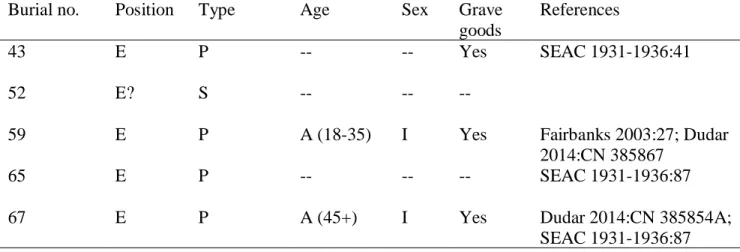
In Mound II, excavators recorded seven burials: 43, 52, 59, 65, 67, 75, and 77 (Fairbanks 2003:25). Table 2 lists these burials. Mound II burials are different from other levels in that almost all the burials were recorded as extended.7 Previous and subsequent levels have a more equal mix of bundled and extended burials. While four of the burials from Mound II contained grave goods, they were generally less elaborate than the sub-mound burials. Age and sex data for Mound II is much less complete than the sub-mound level. Of seven individuals buried, three could be aged, but none could be definitively sexed. All three aged individuals were identified as adults.
Table 2. Mound II Burials.
Burial no. Position Type Age Sex Grave goods
References
43 E P -- -- Yes SEAC 1931-1936:41
52 E? S -- -- --
59 E P A (18-35) I Yes Fairbanks 2003:27; Dudar
2014:CN 385867
65 E P -- -- -- SEAC 1931-1936:87
67 E P A (45+) I Yes Dudar 2014:CN 385854A;
SEAC 1931-1936:87
6
Fairbanksbased this theory on similar post holes that have been found at other southern mound sites including Crooks Site, Marksville, and Kolomoki (Fairbanks 2003:25).
7Fairbanks noted that a photo of Burial 52, recorded as extended, showed a bundle burial instead (Fairbanks
29
Table 2. Mound II Burials, Continued. Burial no. Position Type Age Sex Grave
goods
References
75 E S A I -- SEAC 1931-1936:103
77 -- -- -- -- Yes
Burials 43, 52, 65, and 77 had no associated age or sex data. The only information
available for these burials is compiled from field notes and Fairbanks’ interpretations. Field notes for Burial 43 indicate that the remains were very decayed and reinterred after excavation. Grave goods included a broken “crude clay effigy” (what Fairbanks referred to as an unfired clay mass) and a few pot sherds (Fairbanks 2003:Table IV). Burial 52 contained no grave goods, and field notes did not describe the remains. Burial 65 also lacked grave goods and a description of the fragmentary remains, but field notes indicate that Burial 65 cut through the torso of Burial 67, and so was possibly buried after Burial 67. Burial 77 was not described in the field notes, but Fairbanks said the burial contained beads, shell, and a shredded white substance (possibly wood) in his burial remarks (Fairbanks 2003:Table IV).
30
inventory and could not be reassessed for more specific estimates. Field notes only show a sketch of the burial, but Fairbanks described it as “fragmentary, rearticulated on back” (Fairbanks 2003:Table IV).
Mound III
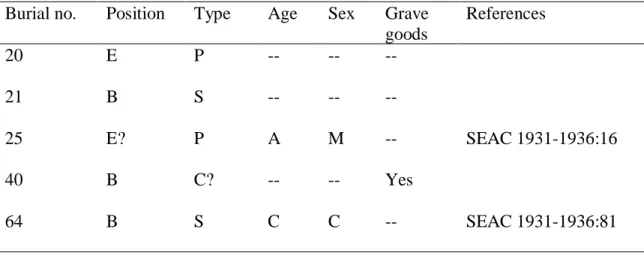
The surface of Mound III contained evidence of some type of mound-type structure, possibly a shelter protecting against mound-top erosion. Fairbanks noted an increase in the number of bundle burials in this level; of the five burials recorded, three were categorized as bundles (Fairbanks 2003:28-29). Mound III provided little demographic information. It included Burials 20, 21, 25, 40, and 64 (Table 3), none of which were included in any of the recent Smithsonian skeletal analyses. Excavation notes recorded age and sex estimates only for two burials: 25 and 64. Burial 25 contained the remains of an adult male, initially recorded as a bundle burial, but Fairbanks noted that the placement of long bones could indicate it was extended. Burial 64 contained the bundled remains of a child. Field notes indicate that the remains were so severely decomposed that they were reinterred.
Table 3. Mound III Burials. Burial no. Position Type Age Sex Grave
goods
References
20 E P -- -- --
21 B S -- -- --
25 E? P A M -- SEAC 1931-1936:16
40 B C? -- -- Yes
31
Burials 20 and 21were buried closely together. Burial 20 was extended while Burial 21 was a bundle. Neither contained grave goods. Burial 40 was the only Mound III burial to contain grave goods; the cremated remains of an indeterminate individual were buried with a small pot and mussel shell. The increase of bundle burials in this level compared with the majority extended burials in Mound II could suggest that a series of ritual reburials had taken place.
Mound IV
32
Table 4. Mound IV Burials.
Burial no. Position Type Age Sex Grave
goods
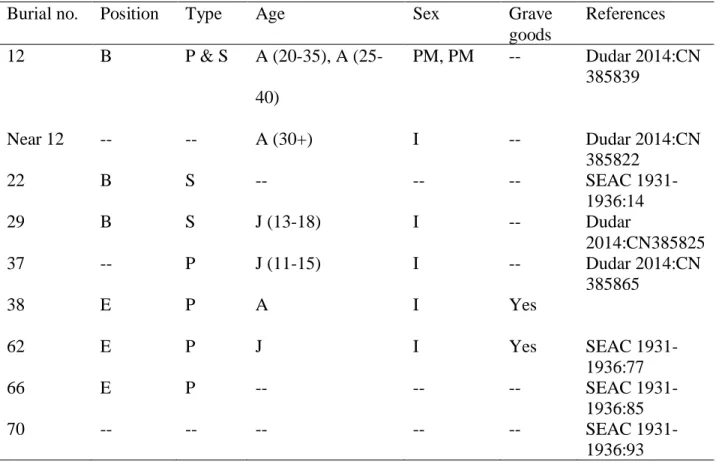
References 12 B P & S A (20-35), A
(25-40)
PM, PM -- Dudar 2014:CN 385839
Near 12 -- -- A (30+) I -- Dudar 2014:CN
385822
22 B S -- -- -- SEAC
1931-1936:14
29 B S J (13-18) I -- Dudar
2014:CN385825
37 -- P J (11-15) I -- Dudar 2014:CN
385865
38 E P A I Yes
62 E P J I Yes SEAC
1931-1936:77
66 E P -- -- -- SEAC
1931-1936:85
70 -- -- -- -- -- SEAC
1931-1936:93
Burials 29 and 37 contained the remains of juveniles. Burial 29 contained the bundled remains of a juvenile aged 13-18. Burial 37 contained teeth and mandible fragments of a juvenile aged 11-15. No burial position was recorded. Neither Burials 29 or 37 contained grave goods.
33
The remaining three burials, Burials 22, 66, and 70, were not assigned age and sex estimates, and none were buried with grave goods. Fairbanks first described Burial 22 as “a refuse, rather than a burial, pit” (Fairbanks 2003:29), but later listed it as a bundle burial in Table IV of the appendix. Field notes only say that a short piece of bone was found that could possibly have been deposited by water and make no mention of a bundle burial. Burial 66 was described as extended and the badly decayed bones were reinterred. Burial 70 had no recorded position, and no bones were described in the field notes.
Mound -V and Mound V
34
Table 5. Mound -V/V Burials.
Burial no. Position Type Age Sex Grave
goods
References
15 B S -- -- -- SEAC 1931-1936:11
19 B S -- -- -- SEAC 1931-1936:13
24 E & B P, S, S I, I, I I, I, I -- Lippert 2014:34
32 -- -- A (16-25) I -- Dudar 2014:CN 385826
35 E P A F -- SEAC 1931-1936:25
42 E P -- -- --
44 B S, S A (30-50), I PM, PM -- Lippert 2014:34
45 B S -- -- --
51 -- -- -- -- --
55 B S -- -- --
57 B? S -- -- Yes SEAC 1931-1936:67;
SEAC 1934:7
63 F? P -- -- --
While Mound -V lacked more complete skeletal description and elaborate burials
35
Burials 15, 19, and 57 were not assigned any age or sex estimates. Burial 15 was described as a disintegrated bundle burial, and Burial 19 contained only fragmentary pieces of bone that were reinterred. Burial 57 was also unable to be aged or sexed; only two pieces of long bone were recovered from the burial. The grave goods for Burial 57, however, were well
described. Between the two long bones, excavators removed two pieces of a copper plate and copper-covered puma jaws. Other burial features included remnant matting and possibly animal fur (Fairbanks 2003:31). Field notes suggested that Burial 57 had some type of log or wood covering, possibly a log tomb. Evidence of a trench and charcoal on the mound platform suggests that a larger structure or palisade existed on the summit of Mound V (Fairbanks 2003:30).
In Ocmulgee Archaeology: 1936-1986, a skeletal analysis by Mary L. Powell stated that
Mound V contained the most burials, “14 interments containing a minimum of 17 individuals” (Powell 1994:123); however, Fairbanks records only five burials associated with Mound V. It is possible that Powell included the seven burials from Mound -V in her description of Mound V. Since the levels seem to occur closely in time, I will also include Mound -V and Mound V together as a single level during burial analysis.
Mound VI and Mound VII
36
the individuals. Field notes indicate that the burial contained a pile of long bones with 4-5 decayed lower jaws, with possible evidence of upper skulls present at burial. The field notes stated that the inclusion of skulls was notable because most bundle burials in Mound C excluded skulls.
Table 6. Mound VI Burial. Burial no. Position Type Age Sex Grave
goods
References
60 B S, S, S A, A, A I, I, I -- Lippert 2014:35; Hally 1994:123; SEAC 1934:34
The only recorded burial in Mound VII is Burial 58, an extended burial with no grave goods. It contained the poorly preserved remains of an individual aged 12-20 of indeterminate sex. The individual was described as an adolescent in field notes. The most recent Smithsonian analysis identified linear hypoplasia.
Table 7. Mound VII Burial. Burial no. Position Type Age Sex Grave goods
References
58 E P J (12-20) I -- SEAC 1934:18; Dudar
2014:CN 385868A
Village Site
37
the sub-mound burials and the Village Site, but had no definitive evidence for that claim (SEAC 1934:23-24). Burials 38-1, 38-2, and 38-3 were described and mapped in notes. Only Burial 38-3 contained grave goods. Burials 38-1 and 38-2 were both extended burials of indeterminate adults located approximately 2.5 feet below the surface. Both remains were poorly preserved, and Burial 38-1 was additionally damaged by a “road machine.”8
Table 8. Village Site Burials. Burial no. Position Type Age Sex Grave
goods
References
38-1 E P A I -- SEAC ACC Vol.
10:137-141
38-2 E P A I -- SEAC ACC Vol.
10:137-141
38-3 F P A I Yes SEAC ACC Vol.
10:137-141
41-1 F P A I --
41-2 B S -- -- --
Burial 38-3 contained an indeterminate adult buried partially flexed on the right side. Grave goods included a Bibb Plain pot, a clay pipe, a celt, and several shell objects. Many of the flexed remains in the Village Site were associated with historic burials, but the presence of the Bibb Plain pot in this burial connected it chronologically to the Macon Plateau phase at Ocmulgee (Fairbanks 2003:35). An unidentified animal jaw bone was found just above the human skull, and several flint flakes were found just below the flexed legs.
8Burials 1, 2, and 3 were located near or within the current parking area adjacent to Mound C. Burials
38
New Sod and Old Sod.
Some mound areas could only be roughly dated to mound-building activities or post-construction periods. The Old Sod level was associated with the mound-building period, while the New Sod level most likely represented later developments following Mound C erosion and historic occupation of the site (Fairbanks 2003:34). The Old Sod level contained Burials 41, 53, 56, and 61 (Table 9).9 Half the burials were bundled, half were extended, and half contained grave goods. Burial 41 was a fragmentary extended burial of an indeterminate adult with one small pot sherd located near the body. Burial 53 contained the extended remains of an indeterminate individual found with shell beads lying across the lower leg. Burial 56 was a bundle burial with only one bone and a few teeth. Burial 61 was also a bundle burial, described in field notes as an “intrusive burial.” It contained four Bibb Plain sherds.
Table 9. Old Sod Burials. Burial no. Position Type Age Sex Grave goods
References
41 E P A I -- SEAC 1931-1936:37
53 E S -- -- Yes SEAC 1931-1936:59
56 B S -- -- --
61 B P -- -- Yes SEAC 1931-1936:75
Burials in the New Sod level could have been intrusive to the completed mound, but the inclusion of several Macon Plateau grave goods suggests that at least some New Sod burials
9Several other burials, including Burials 31, 34, 36, and 39, were associated with the Old Sod, but Fairbanks
39
represent burial activity by the mound builders. There are four burials included in the New Sod: 46, 47, 54, and 72 (Table 10). All but one burial contains grave goods. Burial 46 was a possible cremation burial with a variety of grave goods, including a Bibb Plain jar, shell beads, and two shell spoons. Field notes describe the burial as “Sub Mound,” located approximately three feet below Mound I base. Fairbanks also described a bark cover over the burial. Besides the possible cremation, Burial 46 appears similar to burials from the sub-mound level. Burials 47 and 72 were both extended burials with grave goods. Burial 47 contained an indeterminate adult,
approximately six feet in length. Fairbanks identified in Table IV that Burial 47 included grave goods, but he did not describe them in his adjacent burial remarks or mound level descriptions (2003:34). Field notes do not describe grave goods for Burial 47 either.
40
Table 10. New Sod Burials. Burial no. Position Type Age Sex Grave
goods
References
46 F C? -- -- Yes SEAC 1931-1936:45
47 E P A I Yes SEAC 1931-1936:47
54 B S -- -- -- SEAC 1931-1936:61
72 E S -- -- Yes SEAC 1931-1936:97
Group I and Group II
In addition to Old Sod and New Sod levels, Fairbanks described two classes of inclusive mound pits: Group I, “those lying under the water-deposited sandy wash from the mound stages,” and Group II, “those which penetrated that [sandy] wash but do not reach as high up as the humus cover of the mound” (Fairbanks 2003:33). The sandy wash began forming at the base of Mound II, and the humus layer refers to the thick soil covering over the completed mound (Fairbanks 2003:Figure 3). By my estimate, Group I burials would have been dug before the sand cap of Mound II or Mound III was added, and Group II burials must have at least been dug after Mound II but before the completion of Mound VII.
Table 11. Group I Burial. Burial no. Position Type Age Sex Grave
goods
References
80 E P A (18+) I -- Dudar 2014:CN 385823
41
All the burials in this group were recorded as extended. Both Burials 27 and 88 contained single interments of adult males; Burial 27 contained an individual 35-50 years, and Burial 88
contained an individual 20-35 years. Grave goods in Burial 27 included a white chalky substance and decayed wood. Burial 86 A & B was a double burial of two extended adult individuals of indeterminate sex. Although no grave goods were recorded, this burial was notable for the arrangement of the individuals. 86 A & B were buried in opposite directions with the head of 86 A toward the west, and the head of 86 B toward the east. This arrangement is unique in Mound C. Burial 87 contained an individual with no age or sex estimates. Fairbanks indicated that it contained grave goods, but the field notes are blank.
Table 12. Group II Burials. Burial no. Position Type Age Sex Grave goods
References
27 E P A (35-50) M Yes Dudar 2014:CN 385846
SEAC 1931-1936:17 86 A & B E, E P, P A, A I, I -- SEAC 1931-1936:125
87 E P -- -- Yes SEAC 1931-1936:126
88 E P A (20-35) M -- Dudar 2014:CN 385857
Burials with no associated level
42
and three contained child remains. Only two individuals could be sexed, one male and one female. The remaining individuals were both unaged and unsexed.
Table 13. Burials with No Level Recorded. Burial no. Position Type Age Sex Grave goods
References
7 -- -- A I --
8 E P A I --
9 PF P C I -- SEAC 1931-1936:8
10 E P A I -- SEAC 1931-1936:8
11 E P C (2-3) I -- Dudar 2014:CN 385838;
SEAC 1931-1936:9
13 B S -- -- -- SEAC 1931-1936:10
14 E P A (30+) PF Yes Dudar 2014:CN 385829
16 E P C (9-12) I -- Dudar 2014:CN 385841
18 B S A (30-50) I -- Dudar 2014:CN 385843
23 B S -- -- --
26 E P A (30-45) M -- Dudar 2014:CN 385845
28 E P -- -- --
73 B S -- -- --
74 F P A I -- SEAC 1931-1936:101
76 -- -- -- -- Yes Fairbanks 2003:Plate 17;
SEAC 1931-1936:105
43
Table 13. Burials with No Level Recorded, Continued. Burial no. Position Type Age Sex Grave
goods
References
82 B? C? -- -- --
83 E P -- -- --
84 E P -- -- --
85 -- -- -- -- Yes
89 E P -- -- Yes SEAC 1931-1936:129
Burials 7, 8, 9, 10, 11, 14, 16, 18, 26, and 74 were assigned either age or sex estimates. Burial 7 was a skull of an adult of indeterminate sex. Burial 8 was an extended burial of an indeterminate adult. Burial 9 contained a child buried in a circular pit. Fairbanks described the burial as partly flexed, but field notes are less certain: “Apparently body was lying out straight, but on account of condition of bones could not determine if legs were flexed seemed to be on back” (SEAC 1931-1936:8).
Burial 10 contained the extended burial of an indeterminate adult in very poor condition. Burial 11 was an extended burial of a child aged 2-3 years that had carious lesions. Burial 16 contained an extended child aged 9-12. Burial 18 contained a skull-only burial of an
indeterminate adult aged 30-50. Burial 26 was an extended burial of an adult male aged 30-45. Burial 74 contained an adult of indeterminate sex with legs partly flexed to the right.
44
II, but excavation notes did not describe the burial. Both Burial 81and Burial 85 contained a single shell bead: Burial 81 notes described a columella shell bead buried near teeth, and Burial 85 contained one shell bead buried with a few teeth and bone fragments. Burial 89 contained an extended burial of an indeterminate individual buried with a celt and a projectile point.
Mound C Grave Goods
Before I begin an analysis of the burial patterns from each level and overall, I want to describe the grave goods recorded. Grave goods described in Mound C can be divided up into six material categories: pottery, shell, stone, bone, wood, and copper. Shell was the most common grave good, followed by stone, pottery, and bone. Copper and wood occurred less frequently. The following section describes and quantifies the grave goods in these prehistoric burials.
About 88% of the pottery excavated from Ocmulgee was Bibb Plain type. Bibb Plain was characterized as smooth, but not polished, predominantly red-brown pottery with plain exteriors (Fairbanks 2003:43, 79). Fairbanks described the ceramic style at Ocmulgee as “drab and uninspired” for such a large site, but the lack of interest in pottery decoration did not signify a lack of cultural complexity (Fairbanks 2003:40). Excavators recovered 8,251 sherds and 5 whole or reconstructed pots from the entire site. More than half of the Bibb Plain pottery from the Macon Plateau was grit tempered, another 40% was shell tempered, and only 5% was both grit and shell tempered. Other clay objects found included human or bird effigies and a clay pipe (Fairbanks 2003:43, 84).
45
C grave goods. Halstead Plain pottery in Mound C included 2 effigy bottles and one human effigy located in the adjacent Village Site. Bibb Plain pottery included bottles and jars (Fairbanks 2003:Plates 17 and 18).
Shell objects included beads, gorgets, shell dippers or cups, and whole shells. Whole conch shells and cups were recovered from Mound C. These cups were plain and undecorated conch shells, unlike those commonly associated with the Southern Cult and “Black Drink” (Fairbanks 2003:46). Like Bibb Plain pottery, the shell work from the Macon Plateau was also generally plain. Four types of shell beads were found in Macon Plateau burials: olivella beads, conch shell beads, marginella beads, and flat, barrel-shaped beads (Fairbanks 2003:46). Both Burials 38 and 69 featured a single conch shell placed over the individuals. Burials that contained thousands of beads scattered on and around the individuals could indicate beaded clothing or wraps. Shell gorgets were found in two burials, one in the sub-mound and one in the Village Site. At least one of those gorgets was made from conch shell (Fairbanks 2003:22).
Very few bone objects were found in the burials. The lack of bone objects could be the result of environmental or cultural factors. Environmentally, extremely acidic clay soils, heavy rainfall, and high temperatures at Ocmulgee contributed to poor bone preservation. Culturally, if bone objects were made in this environment, they were most likely only used for decorative or ornamental use, rather than utilitarian use (Fairbanks 2003:47). The only bone grave goods recorded were bone pins in Burial 69 of the sub-mound level (Fairbanks 2003:Table IV).
46
Chapter 4, were an interesting tool inclusion in an otherwise decorative grave good deposit. The chunkey stones of sub-mound Burial 69 do not appear elsewhere in the Mound.
Metal and wood both occurred infrequently in Mound C burials. The only metal
47 CHAPTER 4 BURIAL PATTERNS
In the 79 burials studied, a minimum of 98 individuals were identified. Of those 98 individuals, 15 were adult males, 2 were adult females, 23 were adults of indeterminate age, 9 were children, 7 were juveniles, one was a male of indeterminate age, and 43 individuals were both unaged and unsexed. The Mound C demographics were predominantly adult and male; however, only a small portion of individuals could be both aged and sexed, so this pattern exists in a very small available sample.
Issues with Skeletal Identification
One of the biggest challenges I encountered during my research of Mound C was the lack of skeletal data. I began my research looking exclusively at Fairbanks’ mortuary data from The
Archaeology of the Funeral Mound (2003 [1956]). He compiled this report based on field notes
48
While many of the burials in Mound C were reassessed and given more accurate age, sex, and pathological information, less than half of the total burials studied could not be given any estimates.
Burial Patterns by Mound Level
Burial Type
The two main burial types in Mound C were primary and secondary burials, with some evidence of cremation in Burials 40, 46, and 82. Burials described as primary contained a body buried very shortly after death; there was no burial treatment of bone-handling or rearticulation of bones. Secondary burials included burials that exhibited rearticulated bones or bundled bones. These burials are considered secondary because the primary interment would have been
exhumed, possibly treated or rearranged, and then reburied.
A seriation graph (Figure 4) tracks the changes in burial types throughout Mound C construction.10 The most obvious pattern is that secondary burials were most prominent in the sub-mound level, but made a swift decrease through Mound II. Also notable is the periodic increase and decrease of the primary burials, and increasing the number of secondary burials from Mound II to Mound V. Every level except Mounds VI and VII contained a mixture of primary and secondary burials.
Fairbanks noted a pattern seen throughout mound levels of one extended and one bundled burial in the same interment (Fairbanks 2003:32). While there were plenty of instances of
extended and bundle burials occurring together, the extended burials were often rearticulated and
10Figure 4 only includes chronologically definite mound levels. Levels not associated with specific periods of
49
considered secondary burials. Burials 12 and 24 were the only two burials where both primary and secondary burials were interred together. Field notes stated that most bundle burials in Mound C had few, if any, associated burial objects (SEAC 1934:34).
Figure 4. Seriation graph showing burial type by mound level. Each hash mark represents one individual.
Burial Position
In the previous section, I described burial types (primary, secondary, cremated, and unknown) by mound level. I now want to describe the different burial positions represented in the mound levels. Burial positions include extended burials (both primary and secondary), bundle burials, flexed or partially flexed burials, and unknown burials. I identified extended burials as either primary or secondary burials that were laid out in anatomical order (or
mimicking that arrangement, as in rearticulated extended burials). Bundle burials were secondary burials that contained remains in either individual bundles or larger piles of comingled remains. Flexed burials arranged individuals on their side in a crouching or fetal position, with the legs
Primary Secondary Cremation
Mound VII
I
Mound VI
III
Mound -V/V
IIII
IIIIIIIIII
Mound IV
IIIII
III
Mound III
II
II
I
Mound II
IIII
II
50
flexed under the body. Unknown burials were either not described during excavation or were too deteriorated to identify a burial position.
Figure 5 graphs the distribution of burial positions by mound level. Extended burials occur most often in the sub-mound level, but decrease through subsequent levels. In contrast, bundled burials increase to Mound -V/V and then sharply decrease in Mounds VI and VII. Only one flexed burial was recorded for Mound -V/V, and unknown burials were identified in Mound II, Mound IV, and Mound -V/V. Most levels had both bundled and extended burials, except levels Mound II, Mound VI, and Mound VII.
Extended Bundled Flexed Unknown
Mound VII
I
Mound VI
III
Mound -V/V
III
IIIIIII
I
II
Mound IV
III
III
III
Mound III
II
III
Mound II
IIIIII
I
Sub-mound
IIIIIIIII
IIIII
Figure 5. Seriation graph showing the distribution of burial positions by mound level. Each hash mark represents one individual.
Grave Goods
I described in Chapter 3 the different grave good materials in Mound C: stone, bone, shell, pottery, metal, and wood. Here I provide an analysis of those materials by mound level. Figure 6 graphs the distribution of grave goods by mound level.
Sub-mound. The sub-mound level had the most burials with shell goods, including shell
51
suggests that individuals were wrapped in beaded cloth or wearing beaded adornments at burial, and the conch dipper could be associated with the “Black Drink” of the Southeastern Ceremonial Complex (Fairbanks 2003:46). Burial 69 of the sub-mound included the only discoidals (or chunkey stones) and bone pins in Mound C burials.11 Overall, sub-mound burials were the most elaborate and richly decorated in the mound.
Bone P ins P ot te ry W ood Chunke y S tone s S he ll Be ads Conc h S he ll M ul le rs S he ll G orge t Ce lt Coppe r M us se l S he ll
Mound -V/V
II
Mound IV
I
III
Mound III
I
I
Mound II
II
I
II
Sub-mound
III
II
IIII
I
I
I
Figure 6. Seriation graph showing grave goods by mound level. Each hash mark represents one object. For shell beads, one hash mark represents one lot of beads.
Mound II. Pottery first appeared in burials in the second construction level. Two burials
contained pottery, including an “unfired clay mass” and a Halstead Plain bottle (Fairbanks 2003:Table IV). Two burials contained shell beads, but in a much lower quantity than the sub-mound burials. Burial 67 featured an individual with shell beads around the legs, indicating a type of shell leg apparel or jewelry. A shredded white substance identified as wood was recorded
11Plate 21 (Fairbanks, p. 68) features a “large stone discoidal” from the village area. No burial number or find
52
in Burial 77. Mound II grave goods were underwhelming compared to the elaborate nature of the previous sub-mound burials. The Halstead Plain bottle, which probably held liquid for ritual use (Fairbanks 2003:27), was the most notable grave good.
Mound III. Grave goods occurred even less frequently in the third construction level.
Burial 40 contained the only grave goods of Mound III: a small, polished Bibb Plain jar at the center of the burial and a mussel shell (Fairbanks 2003:28, Table IV).
Mound IV. Burials in the fourth construction level were the first and only burials to
contain stone mullers, or “rubbing rocks” (SEAC 1931-1936:77). Burials 38 and 62 both contained muller stones with single, extended individuals. In Burial 38, the muller and a conch shell were placed above the bones, and Burial 62 contained 2 muller stones and 4 pebbles (Fairbanks 2003:Table IV), though field notes describe the “pebbles” as 2 pieces of possible copper ore and 2 pieces of flint rock (SEAC 1931-1936:77). Worked pieces of stone are uncommon in Mound C, as are tools. The mullers are an interesting inclusion in a mound otherwise filled with non-utilitarian decorative and ritual objects.
Mound -V and Mound V. No grave goods were recorded for Mound -V. Mound V
featured the only burial with metal goods. Burial 57 contained copper-covered puma jaws and grooved copper plates with a radiating sun design (Fairbanks 2003:Plate 23). Some type of matting and fur were present in the burial, but all other grave good materials were absent. Copper goods only appeared in Mound V.
Mound VI and Mound VII. No grave goods were recorded for either level.
Group I and Group II. No grave goods were recorded for Group I. Group II grave goods
53
grave goods, but field notes and sketches make no mention of finds or burial furniture (SEAC 1931-1936:126; SEAC 1934:86-89). It was probably incorrectly recorded.
New Sod and Old Sod. Similarly, Burial 47 of the New Sod level was listed as containing
grave goods, but field notes (SEAC 1934:33) specifically stated that no burial furniture was found. New Sod burials featured a Bibb Plain bottle and jar, shell beads, 2 mussel-shell spoons, and one projectile point. Although this level is undefined in terms of mound-construction
chronology, the presence of characteristic Bibb Plain pottery firmly dates it to the Macon Plateau phase. The Old Sod yielded less grave goods, only featuring some disc shell beads and 4 Bibb Plain sherds (Fairbanks 2003:34, Table IV).
No Level. Five burials with no recorded level contained grave goods. Two burials
contained goods similar in form to grave goods identified in recorded levels. Burial 14 featured shell beads placed along the legs and neck, indicating a burial wrap, jewelry, or other adornment (SEAC 1933-1934:40), like those in the sub-mound level and Mound II. Also found was a pot only described as having a “peculiar design” (SEAC 1931-1936:10). Burial 76 contained another Halstead Plain effigy bottle, almost identical in form to the one found in Burial 59 of Mound II (Fairbanks 2003:Plate 17). Burials 81 and 85 each contained a lone shell bead with no other grave goods, and Burial 89 contained a projectile point (Fairbanks 2003:Table IV).
Burial Frequency
54
mound construction. The swift decline in burial activity in the final two construction levels could be representative of the decline and abandonment of the Macon Plateau.
Figure 7. Total number of burials by mound level. Excludes Group I & II, New and Old Sod, and the Village Site because those levels do not have definite chronological dates for construction.
Burial Patterns Overall
Age and Sex
Table 14, modeled after Saxe (1971:Table 2), lists the age and sex of all 98 individuals studied. Individuals could be grouped into one of seven age groups: advanced adult (40+), mid-adult (25-40), young mid-adult (18-25), mid-adult (no age estimate associated), juvenile (13-18), child (0-12), and indeterminate (no age). Sex could be listed as male, probable male, female, probable female, or indeterminate. More than half of the individuals could be aged, but 83% could not be
0 2 4 6 8 10 12 14
Sub-mound Mound II Mound III Mound IV Mound -V/V Mound VI Mound VII
55
assigned sex estimates. Even without complete sex information, there was a notable difference between the numbers of males and females in the mound.
Table 14. Age and Sex Totals.
Burial Type
Of the 98 Mound C individuals studied, 42 were interred in primary burials, 44 were interred in secondary burials, 9 were not assigned a burial type12, and 3 were possibly cremated (Hally 1994:Table 11.2). Table 15 shows the percent of individuals by burial type. Primary and secondary burials occur at a near-even percentage in Mound C.
Table 15. Count and Percent of Burial Types, Overall.
Primary Secondary Cremated Unknown Total
Count 42 44 3 9 98
Percent 43% 45% 3% 9% 100%
12Burials not assigned a burial type usually resulted from fragmentary or eroded remains or poorly described field
notes (Based on Table 11.1, Hally 1994:117-119).
Ad van ced Ad ult Mid -A
dult
Ad ult
Yo un
g A dult
Juv enil e Ch ild Ind eter min ate Su b-g rou p T
ota ls
Gro up T
ota ls
Per cen
t
Male 1 3 1 3 0 0 0 8
Probable Male 3 2 0 0 1 0 1 7
Female 0 0 1 0 0 0 0 1
Probable Female 0 1 0 0 0 0 0 1
Indeterminate 2 2 16 3 6 9 43 81 81 83%
Totals 6 8 18 6 7 9 44 98
15
2
15%
56
Burial Position
Table 16 shows the number and percent of individuals buried in each position. Half of the burials in Mound C were extended, roughly a third were buried in bundles, and less than a sixth were flexed or had no known burial position. Although primary and secondary burials appeared at almost the same number within the mound, a larger gap exists between extended and bundle burials. This gap is explained by the presence of several secondary extended, or rearticulated, burials.
Table 16. Count and Percent of Burial Positions, Overall.
Extended Bundle Flexed Unknown Total
Count 49 34 6 9 98
Percent 50% 35% 6% 9% 100%
Grave Goods
I created a diagram based on an image from Andrew Sherratt (1982) that plots grave goods by age and/or sex (Figure 8). Individuals identified as “Adult,” “Juvenile,” or “Child” only, with no age or sex estimation, are included below the male/female graph. Not every burial contained grave goods. Several burials with age and sex information do not contain grave goods, and those that do contain multiple grave goods, like Burial 69, contain multiple interments.
57
F
ig
ur
e 8. S
he rr att di agr am of bu ria l goods by a ge a nd s ex. G re en boxe s r epr es ent pr im ar y bur ia ls , a nd blue boxe s re pr es ent s ec ond ar y bur ia ls . S ec tion l abe le d “ A dul t” inc lu de s a ll in di vi dua ls tha t c oul
d only be
a ge d a s a dul t w ithout a s pe cif ic a ge r ang e. A dul t, J uve ni le , a nd C hi ld s ec ti on s be lo w th e m ale /f em ale c ha rt coul
d not be
s
ex
58
included because individuals in those burials could not be aged or sexed. The diagram shows several interesting patterns in grave good burials. First, shell beads occur in both male and female burials, and they also appear in burials of all ages. Second, Burial 69 is easily identifiable as one of the richest burials for its grave good variety. It also is the only Mound C burial to contain chunkey stones and bone pins. Third, pottery is not associated with any males, but it is included in the single female burial on the diagram. Finally, the burials with the most varied grave goods each contain a conch shell and shell gorget. Burial 69 of the sub-mound and Burial 38-3 of the Village Site each have at least 4 different types of grave goods included in burial.
Pathological Patterns
I will briefly describe the pathological patterns existing in the prehistoric burials,
although I do not intend to make a detailed bioarchaeological analysis of the individuals. Dental pathology of any type was the most recorded pathological condition. It included carious lesions, antemortem tooth loss, and hypoplastic defects. Hypoplasia was most common among juveniles. A total of 2 adults, 5 juveniles, and 2 children exhibited slight to moderate hypoplasia. Carious lesions were less common, but were identified in 1 adult, 1 juvenile, and 2 children. Antemortem tooth loss was only recorded for three adults, no children or juveniles.
Other pathological conditions included trauma, arthritis, and infection. Only two
59
CHAPTER 5
DISCUSSION OF BURIAL PATTERNS
In this final section, I will interpret the Mound C burial patterns based on burial
demographics and statistics listed in Chapter 4, and I will apply modern Mississippian mortuary theory to these burial patterns.
Mound Burials: Who is Included, and Who is Missing?
The inclusion of a wide range of ages and sexes in Mound C burials could be an indication of ascribed status by birth or descent group, rather than achieved status. In Lewis Larson’s study of social stratification at Etowah, he described a lack of craft or occupation tools as evidence of an ascribed status system (1970:66). Aside from the stone mullers in Mound IV, there is a noticeable lack of tools in the Mound C burials, despite high-volume shell bead production and less frequent projectile point production. By Larson’s reasoning, these Mound C individuals would represent what Larson described as "a descent group set apart from other such groups in the society" (Larson 1970:67).
In Pauketat’s chapter “Missing Persons in Mississippian Mortuaries,” he avoids the typical approach of identifying who is buried in mounds, and rather questions, “Who is
missing?” (Sullivan and Mainfort 2010:25). Using Cahokia’s Mound 72 as an example, Pauketat reasoned that an interment of several women and children in Mound 72, lacking any male
60
missing from Mound C. Only two Mound C burials contained females, and only one of those burials (Burial 14) was subject to more accurate age and sex estimates at the Smithsonian.
Identifying Important Burials
I originally named this section “Identifying Important Individuals,” but realized that the importance or status reflected in a burial could have little to do with the actual individual buried. Instead of looking for important individuals, it makes more sense to identify important burials, because the people interred could have had more importance as an ideological symbol than as an individual. “Important” burials include those with elaborate or varied grave goods, or high-volume goods that required extensive craft labor or non-local material.
The number of individuals buried in Mound V combined with the elaborate copper burial goods of Burial 57 suggest a burial of importance. Copper materials are not seen anywhere else in the mound, except in a single burial associated with Mound D (Fairbanks 2003:46). The increase in burials in these levels could be explained as retainer burials for Burial 57. Field notes do not feature any sketches of Burial 57.
61
shell on top. Both conch and olivella shells are marine shells; their presence in central Georgia indicates that the Macon Plateau people likely had trade networks that extended to the coast.
Figure 9. Sketch of Burial 69 of the sub-mound level. Three extended individuals were buried on top of four bundled individuals. Sketch #27, SEAC ACC 123 Vol. 2.
62
Burial 38-3 with the sub-mound burials. There are few burials outside the sub-mound level that display such varied grave goods.
Finally, Burial 14 should be considered as a burial of importance as the only burial to include a female with grave goods. This burial contained a mid-adult probable female buried with more than 400 shell beads along the neck and legs and a single pot. Burial 14 was recorded with no mound level, but the arrangement of beads is similar to sub-mound and Mound II
burials. These beads likely belonged to a necklace or burial wrap. As the only female burial with grave goods, it is hard to establish a pattern of goods based solely on sex, but it is important to note that no identifiable males were buried with pottery. A sketch of the burial shows the arrangement of the bones but not the in-situ location of burial goods (Figure 10).