by Lindsey C. Tear
A Master's paper submitted to the faculty of the School of Information and Library Science of the University of North Carolina at Chapel Hill
in partial fulfillment of the requirements for the degree of Master of Science in
Library Science.
Chapel Hill, North Carolina July, 1999
Approved by:
CONTENTS
LIST OF ILLUSTRATIONS... 3
LIST OF TABLES ... 4
Chapter 1. INTRODUCTION ... 5
2. RELEVANT LITERATURE... 8
3. METHODOLOGY... 16
4. SURVEY RESULTS... 21
5. CONCLUSION AND RECOMMENDATIONS... 37
Appendix A. SURVEY INSTRUMENT ... 42
B. COVER LETTER – FIRST MAILING ... 47
C. COVER LETTER – SECOND MAILING ... 49
LIST OF ILLUSTRATIONS Figure
LIST OF TABLES Table
1. Response to the first mailing ... 19
2. Response to the first and second mailings combined... 20
3. Responses to Question 1... 23
4. Responses to Question 2... 24
5. Responses to Question 3... 25
6. Responses to Question 4... 26
7. Responses to Questions 5 and 6... 28
CHAPTER 1 INTRODUCTION
Orange County Public Library's mission is to provide library services to all the citizens of Orange County, North Carolina, from the community of Prospect Hill in the north to the town of Carrboro in the south and everywhere in between. The county is itself quite diverse, ranging from rural communities and farmland in the north and west to the bustling town of Chapel Hill, home of the University of North Carolina and the southwestern point of North Carolina's fast-growing Triangle region, in the southeast. The main library is located near the center of the Town of Hillsborough, a small pre-Revolutionary War community that serves as the county seat. McDougle Middle School in Carrboro houses the Carrboro branch of the library, which opened its doors in May 1995.1 The total resident population of Orange County was 107,648 in 1995, up 14.7 percent from the 1990 population of 93,851.2 The estimated population in 1998 was 110,116, up 1.4 percent just from the previous year's 108,585 estimate.3 The Orange
1. Jennifer Ann Donaldson, “A User Survey of the Carrboro Public Library” (Master's paper, School of Information and Library Science of the University of North Carolina at Chapel Hill, 1996), 6. 2. U.S. Bureau of the Census, USA Counties 1996: General Profile (ONLINE. Census Bureau. Available: http://tier2.census.gov/usac/usac.htm [13 July 1999]).
3. U.S. Bureau of the Census, County Population Estimates for July 1, 1998 and Population Change for July 1, 1997 to July 1, 1998. (ONLINE, 1999. Census Bureau. Available:
County Public Library is considering ways to keep pace with the increasing needs of its growing community.
Purpose of the Study
Recently, some space has become available to the library in a building owned by the Town of Carrboro. The Town of Carrboro has proposed that the space be used for a small branch comprising an Internet kiosk as its main feature, plus a small print collection of recent bestsellers, newspapers and magazines.
Others, notably members of the library's Board of Trustees and the Friends of the Library, have suggested that the needs of the citizens of northern Orange County be considered as well before making such a financial commitment. Service to northern Orange County currently consists only of a limited-run mobile van and the library in Hillsborough, which is a considerable distance from several communities. Service to Carrboro, on the other hand, includes the branch library, while Carrboro residents also have easy access to Chapel Hill and the University of North Carolina’s library facilities.
populations. A survey of the existing literature turns up few studies of this sort
CHAPTER 2
RELEVANT LITERATURE
Little research is reported in the literature dedicated to assessing the needs of communities in general; studies tend to focus on already-established user populations. The amount of research that assesses community needs by actually asking the members of the community is even smaller. Nevertheless, there are a few useful surveys that can serve as examples and a springboard for further research. Other studies consulted explore ways of expanding the base of service beyond the library's traditional users. Finally, literature on planning and conducting surveys was helpful in the actual design and distribution of the Orange County survey.
Examples of Community Surveys
A two-fold survey published in 1995 by Bernard Vavrek examined the needs of both public library users and nonusers in rural settings. The first part of the study was a user survey in libraries located in towns with a population of fewer than 25,000. The second part of the study was a telephone survey of a random sample of rural residents. The second study revealed that thirty-eight percent of those surveyed felt they had no need to use the library at all. The author suggests that this may be because many in the
newspapers and magazines. The survey also found that rural public library users were women seven times out of ten.4
Rural residents surveyed in Vavrek's study selected computerized information, books on tape, and job training as services that they would like to see the library provide. Information needs that residents prioritized but that were not being sufficiently met by the library included social services, education programs, and health and medical information. The disparity between library users and nonusers can be seen in their library priorities; for example, bestsellers ranked high with users, but nonusers considered news and
government information the most important, with bestsellers ranking much lower on their list of priorities.5
A 1990 study "Assessing Library Needs in Rural America"6 is especially helpful for Spanish-speaking communities, since it surveys the Soledad library, a rural branch of the Monterey County (CA) Free Libraries serving a predominantly Hispanic population. There are a significant number of Spanish-speaking residents in northern Orange County, North Carolina. The Monterey County library undertook a combined telephone/door-to-door survey of the community, with the result that a bilingual reference collection and a general Spanish-language collection are now maintained for residents. Also, children's services were high on the list of community priorities, so English and Spanish story hours
4. Bernard Vavrek, "Rural Information Needs and the Role of the Public Library," Library Trends 44 (Summer 1995): 27, 29-30.
5. Ibid., 31-32.
were implemented. The sample survey instrument included is useful to reference as an example, as is the sample survey included in Vavrek's article.
"Public Participation in Strategic Planning of Library Services"7 describes a case study of the experience of Anaheim Public Library in integrating community and staff input in to its strategic planning process. The public was involved in the project at four different levels. Two of the study's methods of gathering data involved soliciting information from a citizens' advisory committee, composed of twenty-four members of varying age and ethnicity, and from six community focus groups representing schools, religious organizations, and members of the Friends of the Library. Anonymous surveys and comment forms were available in the library, thus constituting a user-centered rather than a community-centered approach. The community-centered element of the study, a "Future Libraries Visioning Forum," was open to the public and attended by almost two hundred people. The community focus group method was considered as a means of augmenting the planned mail survey of Orange County, but had to be rejected due to time and resource constraints. Focus groups require an interest in and commitment to the library planning process on the part of participants; the Orange County survey was
intended to reach a general population that would not be expected to be overly concerned about library issues.
Two similar telephone surveys, one in Mecklenburg County, NC8 and one in Henry County, MO,9 demonstrate a model that would be inappropriate to emulate for the
purposes of this study. Both asked a few questions about desired library services, then asked how often the respondents used the library and how willing they were to see more funds devoted to their public libraries. The results of both surveys ostensibly showed overwhelming community support for the library; however, this researcher suspects that the desire to please the telephone interviewer may have biased the response. Confidential mail surveys, such as the one conducted as the basis of this study, relieve some of the social pressure on respondents to affirm their support for the library. Telephone surveys, although conducted with the community at large in mind, are better suited for fundraising or public relations purposes.
Outreach to Library Nonusers
Janet M. Lange used a survey to address the needs of four categories of community residents: typical library users, marginal users, potential users, and typical nonusers. Of these, the category of "potential users" needs some explanation; they are defined as people who are involved in other community activities, are more educated than the typical nonuser, and are more likely to be "converted" to library use through improved services.10 Lange found, as did many earlier studies, that distance from the library was an
8. Carol Myers, "A Tool for Measuring Success," North Carolina Libraries 46 (Fall '88): 161-2. 9. Sue Abernathy, "Friends Conduct Survey for Henry County Library," Show-Me Libraries 41 (Summer 1990): 23.
important factor in frequency of use. She also found that a childhood history of positive experience with libraries was a determining factor in adult use of a library. These two findings demonstrate the importance of providing geographically convenient services and concentrating on children's services to ensure the future of the library.11
The article "Public Library Outreach Services" explores public library outreach programs, such as prison services, book vans, and career and parenting skills classes for teenage mothers. 12 These services reach those not traditionally interested in libraries. The article singles out literacy programs and the factors that contribute to their success to explore in depth, but the principles discussed, such as the need to address a range of issues when designing outreach programs, can be generalized to include other services.13
Shubert finds that outreach works when policy makers have established it as a priority, when program staff is committed and skilled, when outreach is an integral part of overall library service, and when outreach clients are involved in planning and evaluations of services. Other suggestions for successful outreach programs include making sure that the library cooperates with other government and community agencies and that hours of operation are tailored to fit the busy schedules of the people in the community.14
11. Janet M. Lange, "Public Library Users, Nonusers, and Type of Library Use," Public Library Quarterly 8 (1987-1988): 61-3.
12. Joseph F. Shubert, "Public Library Outreach Services." Bookmark 49 (Summer 1991): 271. 13. Ibid., 273-4.
Planning Community Surveys
Literature devoted to the planning and administration of community surveys was also found to be essential to this study's preparation. The Public Library Association's landmark publication A Planning Process for Public Libraries15 was among the first to acknowledge the need for comprehensive planning at the local level. The subsequent publication of Planning and Role Setting for Public Libraries16 further refined PLA recommendations for standards and measurements. Analysis of community input is one facet of the PLA recommendations, and the PLA templates of citizen and user telephone and mail surveys proved useful when developing the questionnaire for the Orange County study.
Miller and Miller's Citizen Surveys: How to Do Them, How to Use Them, What They Mean17 is written from the perspective of a local government seeking to understand the viewpoints of its citizens, so many of its recommendations were applicable to the design of a public library survey of community needs. Citizen Surveys is a step-by-step guide to conducting surveys, from development to administration to coding for data analysis. Sample surveys are included for reference. The book also gives practical information, such as balancing accuracy against cost, using the United States Census to
15. Vernon E. Palmour, Marcia C. Bellassai, and Nancy V. DeWath, A Planning Process for Public Libraries (Chicago: American Library Association, 1980).
16. Charles R. McClure et al, Planning and Role Setting for Public Libraries: A Manual of Options and Procedures (Chicago: American Library Association, 1987).
verify that data is representative of the target population, and simplifying questionnaire layout to facilitate use by the respondent.
The article "Planning and Implementing a Community Survey"18 describes the planning process used to conduct a survey of user needs in Grande Prairie, Alberta. The article gives a detailed timeline of the processes that were necessary to prepare for the survey and make it successful, such as random generation of addresses, which had to be repeated several times due to refusals, duplicates, and addresses outside the target area. Such a timeline is useful to illustrate the actual nuts-and-bolts and pitfalls of a real-life survey. One of the study's conclusions, that the researchers really needed a three-month extension to analyze the data adequately, emphasizes that surveys often take longer than expected. The Alberta study's example encouraged realistic expectations and an
awareness of the possible difficulties of conducting a mail survey.
Survey Questions: Handcrafting the Standardized Questionnaire,19 although over a decade old, is still relevant to survey research. Its focus is the crafting of questions to meet the needs of specific surveys, dealing with question order, measuring intensity, when to use open- and closed-ended questions, and pretesting.
Knowing Your Community and Its Needs20 is a short pamphlet that considers diverse methods of formally and informally getting to know a community. Census data
18. Amy Soltys, "Planning and Implementing a Community Survey," Canadian Library Journal
42 (October 1985): 245-9.
19. Jean M. Converse and Stanley Presser, Survey Questions: Handcrafting the Standardized Questionnaire (Beverly Hills, Calif.: Sage, 1986).
and local and county government statistics are the two formal methods most useful to the Orange County project. Knowing Your Community and Its Needs also recommends informal community research, such as physically walking around a community to get a feel for its businesses and neighborhoods, ethnic groups, and schools.
Implications for This Study
A review of the literature on the subject demonstrates that a community survey can be an effective way get to know the opinions of nonusers and marginal users of the library as well as those who use the library on a regular basis. This type of survey often sheds light on why some people don't use the library and what would be needed to encourage use by a wider segment of the population. Community surveys also provide an
opportunity to explore which traditional and nontraditional library services fit best with the profile of a community and the needs of its current and potential library users.
The Orange County Public Library survey was intended primarily to discover what kinds of new services the community would support in light of the opportunity to expand service with the proposed Internet kiosk in Carrboro. On the basis of this original intent and the existing literature, the survey was finally designed with two very specific purposes in mind:
1) to assess the community's level of interest in services such as those proposed for the library; and
CHAPTER 3 METHODOLOGY
The Orange County Public Library had already made the decision to conduct a survey by mailing a questionnaire to a sample of county residents. The researcher, in consultation with her advisor and the Library Director, designed the questionnaire.21 Vavrek's study22 and a community survey conducted by the Library Director in 198123 contributed slightly modified questions to the survey.
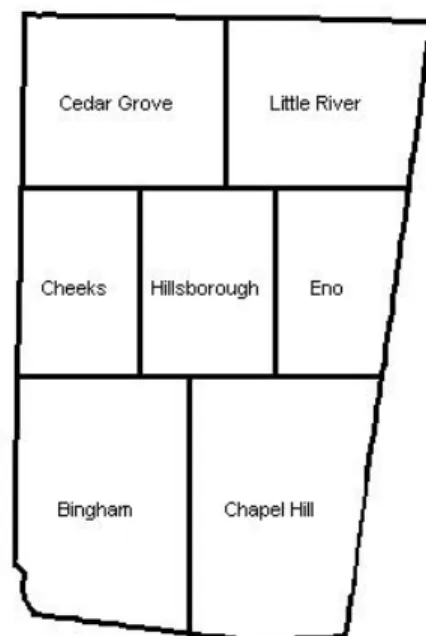
In order to ensure a representative cross-section of Orange County residents, it was decided that the survey should be stratified by township. There are seven townships or administrative districts in the county. They are Cedar Grove (northwest corner of the county), Little River (northeast corner of the county), Cheeks (Efland and Mebane), Hillsborough (Hillsborough), Eno (Hillsborough and Durham), Bingham (southwest corner of the county) and Chapel Hill (Chapel Hill and Carrboro).
21. Appendix A contains a copy of the questionnaire that was mailed.
22. Bernard Vavrek, "Rural Information Needs and the Role of the Public Library," Library Trends 44 (Summer 1995): 21-48.
Fig. 1. Townships of Orange County, NC. Map not drawn to scale.
The researcher decided on a sample size of 100 households from each township for a total of 700 households to be surveyed. This sample size would be large enough to expect a reasonable number of responses, yet small enough to keep the administration of the survey manageable.
The sample of residents was taken from the property tax rolls at the Orange County tax office. The decision to select the sample from the tax rolls was somewhat problematic, since it would exclude most renters, and renters make up a significant portion of the county's residents. (The only renters represented in the property tax listing are those who have made leaseholder improvements on the properties they are renting.) According to U.S. Census data, 44.7 percent of Orange County citizens lived in a residence owned by someone else in 1990;24 this proportion is not likely to have
decreased significantly in the ensuing years. However, the property tax roll was the only available source that separated residents by township. Also, the library is supported in large part by the taxes paid by Orange County property owners. Though this
consideration in no way implies that the opinions of Orange County residents who do not own property are unimportant to the library, a survey of property owners may have the advantage of presenting a more stable picture of community wants and needs. In the end, separation by township was deemed more important to the survey than eliminating the bias that might come from using the tax rolls to gather a sample.
The process of selecting the sample was as follows. The tax rolls are accessible to the public as bound computer report printouts, with a terminal nearby accessing a database containing more detailed information. First, the researcher estimated the number of
listings for a given township by multiplying the approximate number of listings per page by the number of pages. This number was divided by 100 to obtain a number n. A random number was selected between 1 and n. Selection began with the entry corresponding to this random number, and proceeded selecting every nth entry until the sample size of 100 households was reached.
there was any doubt, the researcher made every effort to discover the actual tenant of the property by researching the listing in the database. If the actual tenant could not be ascertained, the entry was skipped and the next consecutive entry in the list was selected. Finally, there were a significant number of commercial property owners. Since this survey was designed to reach county residents, all commercial listings were ignored.
The questionnaire, along with a cover letter25 and self-addressed stamped
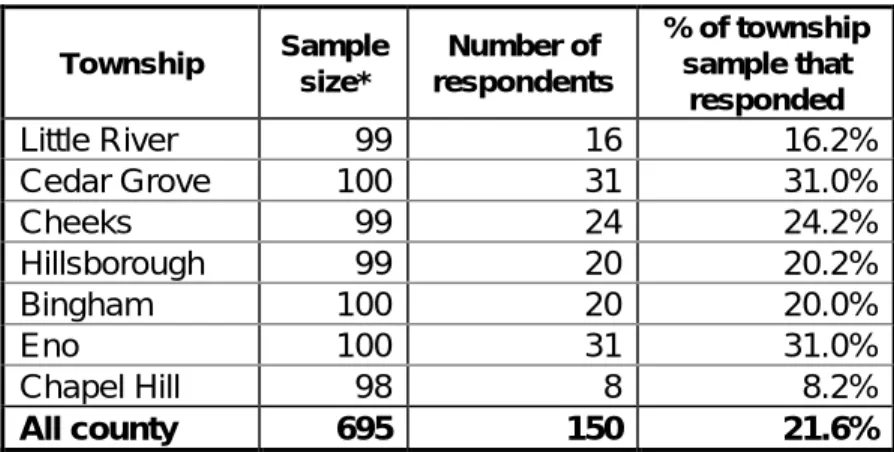
envelope, was mailed in the second week of February 1999, and responses were collected through April 1, 1999. Each mailed survey was marked with a number which identified the township and linked the questionnaire with a specific name and address; however, this linkage was for administrative purposes only, and confidentiality of citizen responses was maintained in reporting the data. Slightly over twenty percent of those surveyed
responded; numbers by township were as follows:
Township Sample size*
Number of respondents
% of township sample that
responded
Little River 99 16 16.2%
Cedar Grove 100 31 31.0%
Cheeks 99 24 24.2%
Hillsborough 99 20 20.2%
Bingham 100 20 20.0%
Eno 100 31 31.0%
Chapel Hill 98 8 8.2%
All county 695 150 21.6%
*Sample size was originally 100 per township, and was slightly reduced due to undeliverable surveys.
Table 1. Response to first mailing.
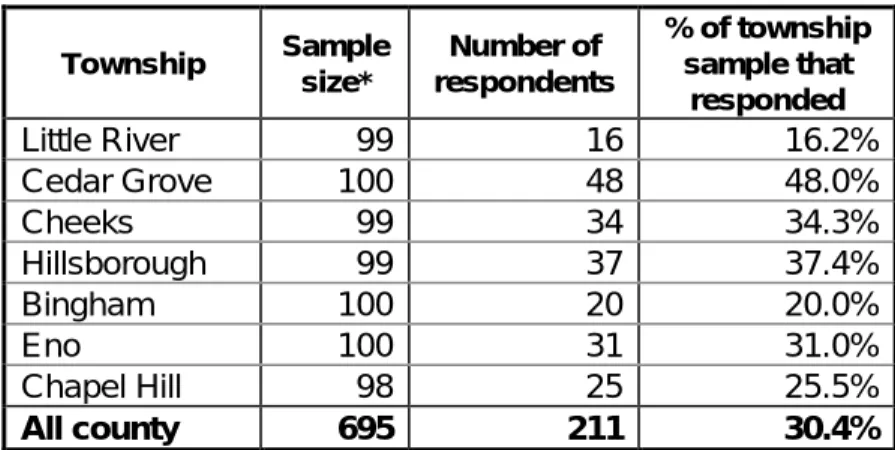
This response was insufficient to generalize with confidence to the whole population, and it was determined that a second mailing was necessary to try to raise the response rate. The second mailing, with a new cover letter attached,26 was sent on April 14, 1999 to those in the original sample who did not respond, and responses were collected through the month of May. The second wave of returned questionnaires raised the response rate to slightly over thirty percent overall.
Township Sample size*
Number of respondents
% of township sample that
responded
Little River 99 16 16.2%
Cedar Grove 100 48 48.0%
Cheeks 99 34 34.3%
Hillsborough 99 37 37.4%
Bingham 100 20 20.0%
Eno 100 31 31.0%
Chapel Hill 98 25 25.5%
All county 695 211 30.4%
*Sample size was originally 100 per township, and was slightly reduced due to undeliverable surveys.
Table 2. Response to first and second mailings combined.
After all the questionnaires had been received, the data from the questionnaires was coded and entered into a spreadsheet for ease of manipulation. Some of the data was also entered into the statistical software package SPSS for further analysis.
CHAPTER 4 SURVEY RESULTS
Two hundred eleven usable questionnaires were returned from the 695 valid Orange County addresses sampled for a response rate of 30.4 percent. Although the response rate did not reach the fifty percent or more hoped for, the data gathered proved sufficient to illustrate trends of library use and citizen interest in library services from all corners of the county.
Response
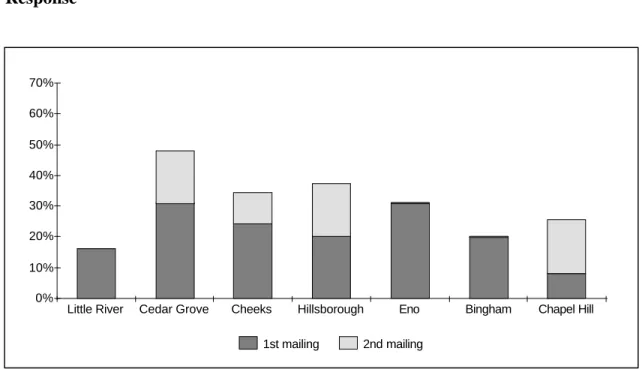
Fig. 2. Response to mailing by township.
Response to the survey varied by township. Cedar Grove Township, in the northeastern part of the county, returned the greatest percentage of surveys by far (48.0
0% 10% 20% 30% 40% 50% 60% 70%
Little River Cedar Grove Cheeks Hillsborough Eno Bingham Chapel Hill
percent). Interestingly, Cedar Grove's closest neighbor to the west, Little River, had the lowest response rate, with only 16.2 percent of questionnaires returned. The other
townships in decreasing order of response were Hillsborough (37.4 percent), Cheeks (34.3 percent), Eno (31.0 percent), Chapel Hill (25.5 percent) and Bingham (20.0 percent). Response rate is not necessarily an indicator of interest in the library, since other factors come into play, such as the amount of free time a person might have to devote to filling out and returning the questionnaire. However, the variation in response rate bears noting as a possible indication of each community's level of interest, as well as community regard for the importance of contributing to the library's decision-making processes.
Frequency of Use
The first and second survey questions asked the respondent to indicate how often members of the household use the Hillsborough and Carrboro branches of the library. Fifty-five (36.4 percent) of those who responded from the five northernmost townships --Eno, Hillsborough, Cheeks, Cedar Grove and Little River -- indicated that they never use the Hillsborough branch of the library. Since residents of these townships are
more than once a year, twenty-four (15.9 percent) claimed to use the library on a monthly basis, while fourteen (9.3 percent) said they used the library every week.
Frequency of use -Hillsborough branch
Entire county
Northern townships
*
Daily 0 0
Weekly 17 14
Monthly 31 24
Less than once a month 34 31
Once a year or less 35 27
Never 89 55
Total valid responses 206 151
*Little River, Cedar Grove, Cheeks, Hillsborough, and Eno townships.
Table 3. Responses to Question 1, "How often do you (and other members of your household) use the Orange County Public Library’s main branch in Hillsborough?"
When analyzing responses pertaining to use of the Carrboro library, responses from the southernmost townships of Bingham and Chapel Hill reflect those who would be more likely for reasons of geography to choose the Carrboro library over the main branch. Still, forty of fifty-four respondents from these townships claimed never to use the
Frequency of use -Carrboro branch
Entire county
Southern townships
*
Daily 3 3
Weekly 2 2
Monthly 2 1
Less than once a month 4 3
Once a year or less 7 5
Never 185 40
Total valid responses 203 54
*Bingham and Chapel Hill townships.
Table 4. Responses to Question 2, "How often do you (and other members of your household) use the Orange County Public Library’s Carrboro branch located in McDougle Middle School?"
When data for the Hillsborough and Carrboro branches of the library are
combined, 43.4 percent of respondents to the survey claim to use one or both branches of the library more than once a year.
Library Services
As expected, books, magazines and newspapers were the most popular library services selected, used by an even fifty percent of respondents. Considering that 43.4 percent of respondents could even be considered Orange County Public Library users (i.e., they use either branch of the library more than once a year), it is safe to assume that virtually all library users are aware of and take advantage of this service.
Service Number % of valid responses
Books, magazines, newspapers 101 50.0%
Videocassettes 46 22.8%
Public photocopy/fax machines 45 22.3%
Art exhibits 43 21.3%
Books-on-tape 35 17.3%
Question answering (reference) service 32 15.8%
Children’s programs 29 14.4%
Internet access 24 11.9%
Meeting space 21 10.4%
Genealogy/local history service 20 9.9%
Large print material 13 6.4%
Voter registration 10 5.0%
Word processor or typewriter 10 5.0%
Job listings 9 4.5%
Telephone reference/reserve service 9 4.5%
Telephone directories/phone fiche 7 3.5%
Other 5 2.5%
Extension van outreach service 4 2.0%
Adult programs 3 1.5%
Service to the blind 2 1.0%
Table 5. Responses to Question 3, "Which of the following Orange County Public Library services have you (or other members of your household) used? Check all that apply." Carrboro and Hillsborough data combined.
Reasons for Non-Use
This question was modeled on a question from Vavrek's telephone study27 to allow for comparison. The number one reason for not using the Orange County Public Library more often, given by almost thirty percent of respondents, was the response, "I use other libraries."28 Vavrek's survey reported 25.3 percent of respondents answering "Yes" or "Somewhat" to the same question.
27. Bernard Vavrek, "Rural Information Needs and the Role of the Public Library," Library Trends 44 (Summer 1995): 43-4.
Reason for non-use of library Number % of valid responses
I use other libraries 63 29.9%
Library is too far away 42 19.9%
I have no need to use the library 33 15.6%
I don't have enough time 28 13.3%
Other (including parking) 24 11.4%
I'm not sure what the library has to offer
22 10.4%
Library doesn't have what I want 20 9.5%
Library hours are inconvenient 15 7.1%
I am physically unable 3 1.4%
No transportation 1 0.5%
Table 6. Responses to Question 4, " We realize there are many reasons that county residents don’t use the Orange County Public Library more often. Are the following concerns to you (and other members of your household)? Check all that apply."
Almost twenty percent of respondents indicated that one reason they don't use the library more often is that it is too far away. Little River respondents were most concerned about the distance to the library; half of them selected this option on the survey. In
comparison with Vavrek's findings (17.1 percent responding "Yes" or "Somewhat"), there were fewer Orange County respondents that were concerned about this issue.
Grove township. Alternately, it may be indicative of a bias toward library users in the responses to the Orange County survey.
Other reasons given by more than ten percent of respondents were "I don't have enough time" and "I'm not sure of what the library has to offer." Seven respondents wrote that parking is a concern for them, even though it was not listed as an option. Six of the seven were from the five northern townships, and the seventh mentioned the Hillsborough library specifically, so it was assumed that the references were to the limited parking at the main branch in Hillsborough. Inconvenient hours were mentioned several times as an issue with the Carrboro library, which is only open when McDougle Middle School is out of session.
Only one person indicated that he or she had no means of transportation to the library, and only three reported being physically unable to get to the library. Although these sorts of concerns should never be ignored, it appears that they are not serious barriers to library use at this time.
Other Libraries
Library Number % of valid responses
Chapel Hill Public Library 64 33.0%
Durham County Public Libraries 32 16.5%
Alamance County Public Library 29 15.0%
Other public libraries 9 4.7%
School libraries 67 34.2%
University libraries 63 32.1%
Table 7. Responses to Questions 5 and 6, "Do you (and other members of your household) use other public libraries?" and " Do you (and other members of your household) use: School libraries? University libraries?"
Of course, usage of these libraries strongly corresponds to geographic location. Residents of Little River and Cheeks townships in the western part of the county were much more likely to use Alamance County Public Libraries, especially the Mebane branch. One person commented, “I live five miles from the Mebane library, why should I drive fifteen miles?” Over half of Eno township respondents use the Durham County Public Libraries. And 85.2 percent of respondents from Bingham and Chapel Hill townships use the Chapel Hill Public Library, as opposed to 12.9 percent of respondents from the five northern townships. Hillsborough township residents were the most likely (54.5 percent) to say that they do not use other public libraries. Cedar Grove and Cheeks residents were also less likely to use other libraries, with about half of respondents from each township selecting this option.
Thirty-four percent of respondents claimed that they or members of their
household use school libraries. These respondents were also much more likely to be users of Orange County Public Library more than once a year. Thirty-two percent use
Internet Use
Seventy-two percent of those who responded to the question regarding Internet use indicated that they do use the Internet in some capacity. Most of these Internet users access the Internet from home (73.8 percent) and/or work (65.2 percent). Other access points mentioned include schools, libraries, and the homes of friends or relatives. Internet access varies somewhat by township, with a slightly higher percentage of residents of Bingham and Chapel Hill townships using the Internet (88.7 percent versus 66.2 percent of respondents from the five northern townships).
0 10 20 30 40 50
19 or younger 20-29 30-39 40-49 50-59 60 or older
Internet non-users Internet users
Fig. 3. Internet use by age of respondent.
Not surprisingly, Internet usage was strongly dependent on the age of the
Many in library circles fear that the Internet is in the process of supplanting the library as the local community's source of information. This study's findings should help alleviate these fears; respondents who use the Internet are actually more likely to use the library as well. There is a positive correlation between library use more than once a year and Internet use. Sixty-five percent of respondents classified as library nonusers or low users use the Internet, while 82.4 percent of the library users are also Internet users.
New and Expanded Services
Service Number % of valid responses
More computer and Internet training 65 30.8%
Ability to search the library catalog
from a local site 52 24.6%
Expanded Internet service 31 14.7%
More computers available for word
processing and reference 27 12.8%
Delivery service of library materials to a
local site 24 11.4%
Literacy services 6 2.8%
Table 8. Responses to Question 8, " Which of the following services would you (and other members of your household) use if the library made them available? Check all that apply."
This section of the questionnaire addressed the types of new and expanded library services that those surveyed would use if they were made available. The most popular among respondents was the suggestion of more computer and Internet training, supported by 30.8 percent of respondents.
range from World Wide Web access to the library catalog to terminals placed in public locations around the county. Any interpretation, however, includes the implication that the catalog should be more readily accessible from various locations. The library's Web site does include a link to the catalog via Telnet, but the link could not be gotten to work when checked for the purposes of this study. Internet users were much more interested in this option (34.0 percent of Internet users versus just 7.4 percent of nonusers).
The interest shown in delivery of materials to a local site (11.4 percent), more computers for word processing and reference (12.8 percent), and expanded Internet access (14.7 percent) was roughly equal. Internet users were more likely to be interested in more Internet access in the library: 19.9 percent of Internet users versus 5.6 percent of non-Internet users. Demonstrated interest in literacy services was low (2.8 percent); however, those in need of literacy services may be less likely to fill out and return a questionnaire.
Age
The average age of household members reported by respondents to the survey was considerably higher than that of the average Orange County citizen according to 1990 U.S. Census data.29 The bias created by mostly surveying homeowners is likely
responsible for this. However, the percentage of children and young adults under the age of nineteen was almost the same as that reported by the census, so that households with children were proportionately represented in the survey results.
0.00% 5.00% 10.00% 15.00% 20.00% 25.00% 30.00%
19 or younger
20-29 30-39 40-49 50-59 60 or older
% reported in survey % from 1990 U.S. Census
Fig. 4. Percentages of household members in each age group reported in this survey compared to percentages reported in 1990 U.S. Census data.
Of those actually filling out the questionnaire, the greatest number (35.4 percent) were age 60 or older. Only six people who listed their age as under 30 filled out
questionnaires. Respondents tended to be the oldest or second-oldest members of their households.
Sex
Seventy-one percent of those filling out the questionnaires were women. Since the U.S. Census indicates that in 1990 52.6 percent of Orange County citizens were female and 47.4 percent were male,30 the number of women answering the survey is
30. U.S. Bureau of the Census, Census of Population and Housing, 1990: Summary Tape File 3A
significant. Since there is no way to tell if these women are the only ones in their households using the library, we cannot conclude, as Vavrek could in his survey, that seven out of ten library users are women.31 However, this finding may suggest that women may take a greater interest in the library and ways to improve its services.
Occupation
Respondents to this survey reported a wide range of occupations and professions. A sampling includes: University professor, horse farm manager, construction worker, registered nurse, freelance writer, secretary, and realtor.
Of those who answered this question, 107 (58.8 percent) reported working at some sort of job, fifty-six (30.8 percent) are retired, sixteen (8.8 percent) described
themselves as homemakers, and three (1.6 percent) are students. The U.S. Census Bureau reported Orange County's 1990 labor force at 52,739. This figure represents 67.7 percent of the county's population over the age of 16.32 It would be expected that the Orange County labor force percentage would be higher. However, most of the library surveys were filled out by older household members, and the fact that surveys were mailed primarily to owner-occupied households probably biased the results upward in age, and therefore toward more retirees.
31. Bernard Vavrek, "Rural Information Needs and the Role of the Public Library," Library Trends 44 (Summer 1995): 27.
Household Size
The average number of residents per household reported in the survey was 2.63. This result is not far removed from the 1990 U.S. Census figure of 2.93 persons per family in Orange County. When one-person households, which are not included in the census definition of "family," are figured in, the census average drops to 2.31 persons per household.33
Length of Residence
Sixty percent of respondents have lived at their current address for at least ten years. Fourteen percent have been resident for less than three years, and 25.6 percent for three to ten years. Though there were no census records with which to compare this data, it seems that the average length of residence reported in this survey exceeds what would be expected. This is especially true since Chapel Hill has a significant student population. The reported length of residence is probably influenced by the bias created by using the tax rolls to collect the survey sample. On the other hand, the survey benefits from gathering the opinions of those who have had ample opportunity to experience the library's services.
33. U.S. Bureau of the Census, Census of Population and Housing, 1990: Summary Tape File 3A
Other Comments
At the end of the questionnaire, a free-form section was provided to give
respondents the opportunity to give less structured feedback. Some quotations from these comments are given below, along with a discussion of trends.
Little River: "I know it may be costly, but the bookmobile was of great benefit to us." Cedar Grove: "Need a location in Northern Orange (i.e., Cedar Grove, Caldwell, Schley)." Cedar Grove: "It's a shame Orange County doesn't have more branch libraries, for example in the Cedar Grove area. Alamance County has four libraries. Chatham, which is very rural has at least three. Why do we not have another?" Respondents showed interest in expanded service to the far northern part of the county. According to the library, it would be impossible at this time to reinstate bookmobile service for
economic and logistical reasons; however, other options are being explored for service to outlying areas of the county.
Little River: "I would like to see a larger collection of audio cassettes - specifically fiction." Hillsborough: "I'm interested in reading new books and your investment in them is incredibly limited." Eno: "More current book selections. Best sellers." Cedar Grove: "The selection of books and magazines is good." Although some respondents indicated satisfaction with the collection, many offered recommendations for development. Books-on-tape were suggested most often, followed by best sellers. Some showed concern that even though the library may hold a given book, all the copies are often checked out.
and can't get their children to the library during the week. What about evening or weekend times for Storytime." Children's services were praised over and over in the comments. Respondents suggested more videocassettes and books-on-tape for children, and demonstrated a desire for children's programs at various hours.
CHAPTER 5
CONCLUSION AND RECOMMENDATIONS
The purpose of this study was twofold: to assess how proposed new library services would be received, and to understand barriers to library use in order to begin the process of breaking those barriers down. It is to be hoped that the input of Orange County residents from all parts of the county has provided a snapshot of the library needs and desires of a fairly representative segment of the population. Based on the results of the survey, this researcher has several recommendations for using the results to assist in determining the future direction of library services in Orange County.
First of all, the library should continue its focus on technology, especially Internet access and computer training. The survey results suggested that the Internet is now being used by a majority of county residents; even among those sixty years of age and older, traditionally the age group slowest to adopt new technology, almost half are accessing the Internet. As the Internet is touching all of society, library planners are wise to recognize the need to provide greater access and access tools such as training. The southern part of the county is moving especially rapidly toward near-universal use of the Internet; as discussed earlier in this study, a higher percentage of citizens in this part of the county access the Internet. The Internet kiosk proposed for the town of Carrboro would go a long way toward meeting the community’s need for expanded access and more training.
determining factor in adult library use.34 This study finds that families that use school libraries are more likely to use the public library as well. It follows that children's services and programs are absolutely vital to the long-term health of the public library.
It is also crucial that the library put energy and resources toward tailoring services and publicity to reach out to those who are not currently using the library on a regular basis. Of course, regular users of the library should expect that the excellent level of service they are accustomed to will continue. But it has been suggested by the results of this study that those who are proficient at seeking out the information they need will gather it from various sources, rather than being dependent on just one source. For example, as mentioned earlier in this study, Internet users are actually more likely to use the library than those who are not connected are. Also, the results showed that those who use other libraries are more likely to use the Orange County Public Library as well.
In order to increase use of the library by those who usually don’t take advantage of its services, it is important to understand the information needs of nonusers. Vavrek suggests that nonusers are not usually recreational readers (or at least don't use the library to fulfill this need).35 Yet, "[t]he typical user continues to perceive the public library as a place of books. Consistently, public opinion research has reaffirmed the fact that
34. Janet M. Lange, "Public Library Users, Nonusers, and Type of Library Use." Public Library Quarterly 8 (1987-1988): 62-3.
bestsellers are more popular among library users than asking reference questions."36 This study's data affirms this finding: exactly half of respondents have used the books,
newspapers, and magazines at the library, while 15.8 percent have used reference services and only 4.5 percent have used phone reference. Users are aware of library books and use them. They are not as aware of the possibility of "full-service" rather than "self-service" information at the library. Vavrek also posits that when people state that they have no need to use the library, often the real reason is that they don't understand exactly what the library is and what it has to offer them.37 If this is true, then the library needs to put effort into selling itself to the public as an "information center" that has the capacity to meet many of the information needs of all community residents. More attention to advertising throughout the community could have a significant impact on use of library services.
The library may want to emphasize the information access that both current facilities and new centers such as the one proposed for Carrboro will provide. Even more importantly, it should be stressed that library staff are available and proactive in assisting patrons using the new services. In fact, assistance should be kept in mind when
publicizing any current or future services. Signs and flyers in library should be designed to allow patrons to find information for themselves if they are not comfortable asking for assistance. If patrons do require assistance, however, it should be clear that they are welcome to come to the desk not just for circulation but to ask questions of any kind. Patrons need to know that library staff are available not just for help finding a particular
36. Bernard Vavrek, "Rural Information Needs and the Role of the Public Library," Library Trends 44 (Summer 1995): 25.
book on the shelf, but also for help determining which resources the patron needs in the first place.
Finally, during this period of growth in Orange County, library planners should carefully consider the need for increased facilities. The Internet kiosk proposed for Carrboro would enhance service to the rapidly growing Chapel Hill-Carrboro area, especially if formal or informal Internet training were included among its programs. Also, the new facility would bring the added benefit of increasing library hours in the town of Carrboro. Carrboro Public Library hours are inconvenient for many, but its current schedule cannot be altered greatly because it shares facilities with McDougle Middle School.
Also, serious consideration should be given to planning for a future permanent presence in northern Orange County. The fact that almost half of questionnaires sent to Cedar Grove were returned and the fact that there were several explicit requests for more service to the area in the "Comments" section of the survey warrant a greater investment in library services for this area of the county. Although a full-service branch may be out of the realm of possibility, perhaps a mini-branch or library station such as the one proposed for Carrboro could share space with a school or community center. If a library presence is established in the northern part of the county, it will be important to attract non-library users using the publicity measures and emphasis on patron assistance that have been recommended for the library as a whole. Reference and access to community information, training programs, Internet access, and especially children's services may garner a
Anyone who has ever worked in a library knows that for every improvement or expansion that is made, there are a dozen others that cannot be realized because of time, financial, or staffing constraints. Decisions to change, expand, or reduce service must be made with the knowledge that committing to one program means giving up another. By commissioning a community survey, the Orange County Public Library and the County Commissioners demonstrated a commitment to ensuring that decisions regarding the future of the library are made with the needs of Orange County residents in mind. The findings of the survey highlight several specific opportunities for improvement and growth, such as emphasis on technology and children's services, outreach through publicity and community education, and planning for long-term growth and expansion of service
ORANGE COUNTY PUBLIC LIBRARY SURVEY - 1999
Section I: You and the Library
1. How often do you (and other members of your household) use the Orange County Public Library’s main branch in Hillsborough?
ƒ
Dailyƒ
Weeklyƒ
Monthlyƒ
Less than once a monthƒ
Once a year or lessƒ
Never2. How often do you (and other members of your household) use the Orange County Public Library’s Carrboro branch located in McDougle Middle School?
ƒ
Dailyƒ
Weeklyƒ
Monthlyƒ
Less than once a monthƒ
Once a year or lessƒ
Never(If you never use either branch of the Orange County Public Library, please skip the shaded question below.)
3. Which of the following Orange County Public Library services have you (or other members of your household) used? Check all that apply.
Hillsborough Carrboro branch branch
ƒ
ƒ
Adult programs(deaf and hard-of-hearing, Internet classes)
ƒ
ƒ
Art exhibits
ƒ
ƒ
Books, magazines, newspapersƒ
ƒ
Books-on-tape
ƒ
ƒ
Children’s programs(Storytimes, Summer Reading Program)
ƒ
ƒ
Extension van outreach service
ƒ
ƒ
Genealogy/local history serviceƒ
ƒ
Internet access
ƒ
ƒ
Job listings
ƒ
ƒ
Large print materialƒ
ƒ
Meeting space
ƒ
ƒ
Public photocopy/fax machinesHillsborough Carrboro Branch branch
ƒ
ƒ
Question answering (reference) serviceƒ
ƒ
Service to the blind
ƒ
ƒ
Telephone directories/phone ficheƒ
ƒ
Telephone reference/reserve serviceƒ
ƒ
Videocassettes
ƒ
ƒ
Voter registration
ƒ
ƒ
Word processor or typewriter
ƒ
ƒ
Other – please indicate: ___________________________ __________________________________________________4. We realize there are many reasons that county residents don’t use the Orange County Public Library more often. Are the following concerns to you (and other members of your household)? Check all that apply.
ƒ
Library is too far awayƒ
No transportationƒ
Library hours are inconvenientƒ
Library doesn’t have what I wantƒ
I have no need to use the libraryƒ
I’m not sure of what the library has to offerƒ
I don’t have enough timeƒ
I am physically unableƒ
I use other librariesƒ
Other – please indicate: _____________________________________________ _____________________________________________________________________5. Do you (and other members of your household) use other public libraries? If so, please check all that apply:
ƒ
Alamance County Public Libraries (includes Chatham County)ƒ
Chapel Hill Public Libraryƒ
Durham County Public Librariesƒ
Other – please indicate: _____________________________________________ _____________________________________________________________________6. Do you (and other members of your household) use: School libraries?
ƒ
Yesƒ
NoUniversity libraries?
ƒ
Yesƒ
No7. Do you (and other members of your household) use the Internet: From home?
ƒ
Yesƒ
NoFrom work?
ƒ
Yesƒ
NoFrom elsewhere?
ƒ
Yesƒ
No Please indicate:_____________________8. Which of the following services would you (and other members of your household) use if the library made them available? Check all that apply.
ƒ
More computers available for word processing and referenceƒ
Expanded Internet serviceƒ
More computer and Internet trainingƒ
Literacy servicesƒ
Delivery service of library materials to a local siteƒ
Ability to search the library catalog from a local siteSection II: About you and your household
1. Please answer the following information about yourself:
Age:
ƒ
19 or underƒ
40-49 Sex:ƒ
Maleƒ
20-29ƒ
50-59ƒ
Femaleƒ
30-39ƒ
60 or overOccupation: ____________________________________
3. Please complete the following for each additional member of your household.
Age:
ƒ
19 or underƒ
40-49ƒ
20-29ƒ
50-59ƒ
30-39ƒ
60 or overSex:
ƒ
Maleƒ
FemaleAge:
ƒ
19 or underƒ
40-49ƒ
20-29ƒ
50-59ƒ
30-39ƒ
60 or overSex:
ƒ
Maleƒ
FemaleAge:
ƒ
19 or underƒ
40-49ƒ
20-29ƒ
50-59ƒ
30-39ƒ
60 or overSex:
ƒ
Maleƒ
FemaleAge:
ƒ
19 or underƒ
40-49ƒ
20-29ƒ
50-59ƒ
30-39ƒ
60 or overSex:
ƒ
Maleƒ
FemaleAge:
ƒ
19 or underƒ
40-49ƒ
20-29ƒ
50-59ƒ
30-39ƒ
60 or overSex:
ƒ
Male
ƒ
FemaleAge:
ƒ
19 or underƒ
40-49ƒ
20-29ƒ
50-59ƒ
30-39ƒ
60 or overSex:
ƒ
Maleƒ
Female4. How long have you lived at your current address?
ƒ
Less than 3 yearsƒ
3-10 yearsƒ
More than 10 yearsSection III: Additional comments
If you have any additional comments or suggestions that might help Orange County Public Library to better serve you and your family, please let us know by writing them below.
_____________________________________________________________________ _____________________________________________________________________ _____________________________________________________________________ _____________________________________________________________________
APPENDIX B
The following is the text of the letter that accompanied the first mailing of the questionnaire.
January 25, 1999
Dear Orange County citizen,
You are invited to participate in a survey of Orange County residents being conducted by the Orange County Public Library. The purpose of this study is to find out how residents currently use the library and which library services are most important to them. We will use the results of this survey to help the Orange County Public Library plan for the future and better serve the needs of county residents. Your participation is greatly appreciated. Please complete the attached questionnaire and return it to me in the enclosed envelope. The questionnaire should not take more than fifteen minutes of your time to complete. Your responses on this questionnaire are completely confidential. We will not use your name, address, or any other personal information in reporting the results, but will compile and summarize results by township. All personal information will be destroyed when the study is finished.
If you have any questions about this survey, please contact me. I am assisted in the design and analysis of the survey by a University of North Carolina faculty member, Dr. Evelyn Daniel (919-962-8062) and Lindsey Tear, a graduate researcher.
Your opinions and ideas are important to us. Thank you for taking the time to share them by participating in this survey.
Sincerely,
Brenda W. Stephens
APPENDIX C
The following is the text of the letter that accompanied the second mailing of the questionnaire.
April 8, 1999
Dear Orange County citizen,
We have not yet received your 1999 Orange County Public Library survey. Another copy of the questionnaire and a postage-paid return envelope are enclosed in case yours have been misplaced.
The time you take to complete this questionnaire is important to help the library plan for the future and better serve the needs of Orange County residents. Even if you rarely or never use the Orange County Public Library, your input is vital to our understanding of the needs and wishes of the people in our communities. And if you do visit the library on a regular basis, we are interested in hearing about your experiences with us, both positive and negative.
If you have already returned your questionnaire to us, please disregard this letter and accept our thanks. If you have any questions about this survey, please do not hesitate to contact me. I am assisted in the design and analysis of this survey by a University of North Carolina faculty member, Dr. Evelyn Daniel (919-962-8062) and Lindsey Tear, a graduate researcher.
Your opinions and ideas are important to us. Won't you please take a few minutes of your time now to help the library better serve its community?
Sincerely,
Brenda W. Stephens
BIBLIOGRAPHY
Abernathy, Sue. "Friends Conduct Survey for Henry County Library." Show-Me Libraries 41 (Summer 1990): 23.
Cassell, Kay Ann. Knowing Your Community and Its Needs. Chicago: Library Administration and Management Association/ALA, 1988.
Converse, Jean M. and Stanley Presser. Survey Questions: Handcrafting the Standardized Questionnaire. Beverly Hills, Calif.: Sage, 1986.
Donaldson, Jennifer Ann. “A User Survey of the Carrboro Public Library.” Master's paper, School of Information and Library Science of the University of North Carolina at Chapel Hill, 1996.
Lange, Janet M. "Public Library Users, Nonusers, and Type of Library Use." Public Library Quarterly 8 (1987-1988): 49-67.
McClure, Charles R., et al. Planning and Role Setting for Public Libraries: A Manual of Options and Procedures. Chicago: American Library Association, 1987.
Miller, Thomas I., and Michelle A. Miller. Citizen Surveys: How to Do Them, How to Use Them, What They Mean. Washington, D.C.: International City Management Association, 1991.
Myers, Carol. "A Tool for Measuring Success." North Carolina Libraries 46 (Fall 1988): 161-2.
Palmour, Vernon E., Marcia C. Bellassai, and Nancy V. DeWath. A Planning Process for Public Libraries. Chicago: American Library Association, 1980.
Rosen, Elizabeth McClure. "Assessing Library Needs in Rural America." Journal of Youth Services in Libraries 4 (Fall 1990): 87-90.
Saxton, Matthew L. and Ruth D. Greiner. "Public Participation in Strategic Planning of Library Services: Soliciting, Assessing, and Balancing Community and Staff Input." Public Libraries 37 (March/April 1998): 126-32.
Soltys, Amy. "Planning and Implementing a Community Survey." Canadian Library Journal 42 (October 1985): 245-9.
Stephens, Brenda Wilson. A Study to Examine and Evaluate the Collection at the Orange County Public Library. Research report, School of Library Science of North Carolina Central University, 1981.
U.S. Bureau of the Census. Census of Population and Housing, 1990: Labor Force and Commuting Data for Orange County, North Carolina. ONLINE. Census Bureau. Available: http://www.census.gov/ [11 July 1999].
---. Census of Population and Housing, 1990: Summary Tape File 3A. ONLINE. Census Bureau. Available: http://www.census.gov/ [5 July 1999].
---. County Population Estimates for July 1, 1998 and Population Change for July 1, 1997 to July 1, 1998. ONLINE. 1999. Census Bureau. Available:
http://www.census.gov/population/estimates/county/ co-98-1/98C1_37.txt [13 July 1999].
---. USA Counties 1996: General Profile. ONLINE. Census Bureau. Available: http://tier2.census.gov/usac/usac.htm [13 July 1999].
Vavrek, Bernard. "Rural Information Needs and the Role of the Public Library." Library Trends 44 (Summer 1995): 21-48.