Jerica M. Vogel. Getting their chat’s worth: A study of chat widget placement in academic licensed research databases. A Master’s Paper for the M.S. in L.S. degree. April, 2014. 31 pages. Advisor: Chad Haefele.
The University of North Carolina at Chapel Hill Library has used Libraryh3lp as its chat reference platform for approximately six years. In that time, the placement of chat widgets has expanded to include library web pages, Articles+, the catalog, and Serials Solutions pages. One important location remained to explore: placement of a chat widget in library-licensed databases. If a user is in a database, they would currently need to open a new browser tab and navigate back to the library’s Contact Us page to initiate a chat. In an effort to meet users closer to their point of need, a widget was embedded in UNC’s databases licensed from EBSCOhost. After a trial period, the resulting chat logs and transcripts were analyzed. By embedding the widget in databases, where a good portion of research is performed, the number and overall proportion of research-related chat questions increased. Headings:
Academic libraries – Reference services.
College and university libraries -- Reference services Databases – Research
GETTING THEIR CHAT’S WORTH:
A STUDY OF CHAT WIDGET PLACEMENT IN ACADEMIC LICENSED RESEARCH DATABASES
by Jerica Vogel
A Master's paper submitted to the faculty of the School of Information and Library Science of the University of North Carolina at Chapel Hill
in partial fulfillment of the requirements for the degree of Master of Science in
Library Science.
Chapel Hill, North Carolina April, 2014
Approved by:
Table of Contents
List of Figures ... 2
Introduction ... 3
Motivation for Study ... 3
Literature Review... 6
A Brief History of Chat Reference ... 6
Vendors and Platforms ... 7
Chat Reference Question Types ... 8
Motivation to Ask Questions Through Chat ... 9
Chat Widget Placement ... 11
Methodology ... 13
Data Collection ... 15
Coding Transcripts ... 16
Results ... 18
Discussion ... 20
Implications on Practice ... 21
Study Limitations ... 22
Conclusion ... 24
Suggestions for Further Research ... 24
List of Figures
Figure 1 ... 4
Figure 2 ... 5
Figure 3 ... 14
Figure 4 ... 18
Introduction
Virtual reference services, such as email and chat, are increasingly included in library reference offerings, and are becoming more popular among library users as a form of reference communication. In a 2002 Associated Research Libraries survey, approximately 54% of academic libraries used chat reference (Turner and Ronan, p. 9). A survey done by Devine, Paladino, and Davis nine years later showed this percentage to be at least 85% (p. 198). With such a majority of libraries offering chat reference services, chat has become a staple of academic library offerings.
The major benefit from chat reference is that users can ask questions at the exact time they encounter a problem - whether that problem is in regards to confusion about a circulation policy, contact information for a library staff member, assistance with research, or a question about online access to materials - and receive immediate assistance. However, this rising popularity brings up the question of whether or not chat widgets are placed in locations where users can easily find them during their research process.
Motivation for Study
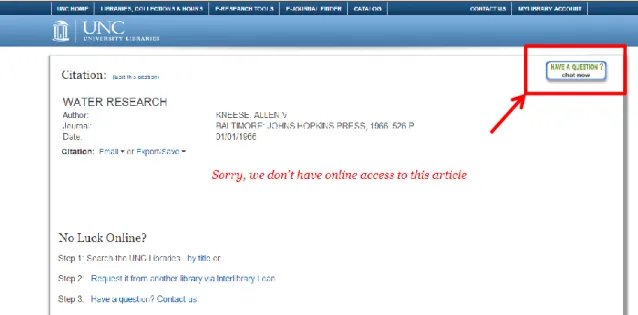
the chat to stay active. If the user navigates away from that page, the chat disconnects, and a new chat will need to be started. The second way chat can be added is though a linked button (see Figure 2). When the button is clicked, a chat widget is opened in a new window. This allows the user to continue their search from the original browser window, but it requires the user to change between windows (e.g. type in one window, but search in another). Once the user receives a response, the user needs to go back to the browser where they were accessing library resources to try out any suggestions. Then s/he would have to go back to the chat window to ask further questions.
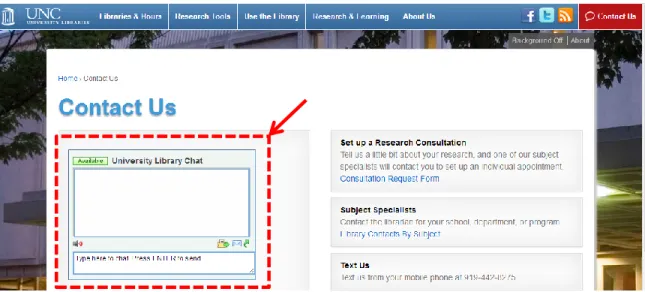
Figure 1. An embedded chat widget on the UNC Libraries’ Contact Us Page. Currently, chat reference is accessible at many points throughout the library website: the Contact Us page (http://library.unc.edu/ask/), each branch page, in the catalog, and in Articles+ (the libraries’ unified search service provided by Serials Solutions), among other library managed site locations.
page, and then initiate a chat. Obviously, adding another chat widget will increase traffic, but the aim of this study is almost exclusively concerned with the content of chats. The goal of this paper is to discover if embedding a chat widget into an academic library-licensed database platform will increase the proportion of research-related questions that come into the UNC chat reference service points. By embedding a chat widget in a database, librarians are more likely to reach users in the midst of their research process. If support is available where users search, they might be encouraged to ask for assistance with research, including choosing keywords and subject terms, selecting appropriate databases, or other library resources to investigate.
Literature Review
A Brief History of Chat Reference
With the introduction of tools that took advantage of the Internet, such as email and instant messaging, new avenues of patron interaction began to present themselves. Among these was virtual reference; users could now receive synchronous or asynchronous reference assistance through their internet connection, without the need to leave their homes or pick up a phone. Chat, or the synchronous text-based online interaction between a library user and a librarian, was just one of the methods that developed. According to Matteson, Salamon, and Brewster (2011), the earliest instance of chat reference being used in academic libraries happened in 1996 (p. 173). It became a hot trend in libraries, since questions could now be answered much faster than through e-mail exchanges. In 2000, Curtis reported that students at the University of Georgia had already begun depending on the Internet for research (p. 128-129). Not surprisingly, this coincided with mainstream Internet use in the mid-1990s; the Internet saw explosive growth rates between 1995 and 1997 (Coffman & Odlyzko, 1998). As a response to the growing dependence on Internet searching, the University of Georgia decided to implement chat reference, and Curtis also suggested that chat “may well be the future of academic reference service” (p. 131).
of chat users (p. 343).The authors held focus groups of undergraduate students to discover why they were not taking advantage of chat, and it was discovered that low usage had several reasons. These reasons ranged from students asking their instructors for help instead of the library to being unaware of reference services (p. 348).
However, chat reference statistics turned around, and now at least 85% of academic libraries in the United States employ a chat reference service (Devine et al. 2011, p. 198). During chat reference’s rise in popularity, many issues have been recognized and studied. For example, Arnold and Kaske (2011) studied how the quality of chat reference interactions compared to that of in-person interactions, Pomerantz and Luo (2006) investigated user motivations for utilizing chat reference, and Franz and Westra (2010) delved into the impact that chat widget placement has on chat traffic. Still, chat continues to be a heavily-used resource in academic libraries, even as in-person reference questions continue to decline (Association, 2013).
Vendors and Platforms
Widget”, 2012). However, no information directly from ProQuest publicly supports this option. Information about embedding widgets on other platforms was similarly unavailable.
Some libraries have even created homegrown systems such as Libraryh3lp and IM Collaborator to serve their needs, which makes it even easier for libraries to incorporate this service into their existing reference service (Sessoms & Sessoms 2008; Kern & Ward, 2009).
Chat Reference Question Types
One concern to reference librarians, with the introduction of chat reference, was the possibility that a user would not ask the same questions that they would in-person or by phone. There has been some disagreement in the field as to whether or not this has been the case. Fennewald (2006) studied a week’s worth of chat transcripts from Penn State’s chat service and found that there were a higher proportion of reference questions among the chats than among those fielded in-person (p. 25). Yet, this study is not completely generalizable due to the fact that only 29 chats were reviewed in comparison to over 4,000 in-person inquiries; the proportions are likely to be strongly skewed with such drastically different amounts of questions.
from being approximately 43% to near 20% of questions asked (p. 197). However, there was a striking increase in the proportion of policy & procedural questions. In contrast to Fennewald’s one-week study, the Arendt and Graves study found that chat reference was used more for policy/procedural and holdings questions than it was for reference inquiries – a combined 65% of questions asked by the end of the study (p. 197). There was no information about the change in these question types at the library’s in-person reference service.
As more studies are done, Arendt and Graves’s results seem to be becoming more common. Maximiek, Rushton, and Brown (2010) also found that reference questions were not the number one type of question asked by users. In fact, it placed third, with more questions being asked about website navigation and questions asking for instruction (p. 365). However, there is some disagreement between studies about the number and percentage of chat questions that are reference or research related. As compared to Arendt and Graves (2011) and Maximiek et al., Wan et al’s 2009 study of Texas A&M’s chat service found that 84% of chats received were reference related, as opposed to directional, technical, hours-related, and general inquiries (p. 78). Clearly, the situation will be different at each institution, but as there is no visible trend regarding what questions users will posit with chat reference, it is important that we investigate ways to encourage users to ask research-related questions at their point of need.
Motivation to Ask Questions Through Chat
reference services. Some students may not want to leave their computer to ask for help, and enjoy the ability to continue searching while talking to a librarian. Others who are “intimidated by the reference desk may appreciate asking a question anonymously” (p. 34). She was specifically discussing students using chat at universities, but in general, her idea that anonymity may be a powerful instigator for chat reference is important to keep in mind.
Ward (2005) came to a similar conclusion in a survey of undergraduate and graduate students. One question in the survey asked for a respondent’s reason for choosing the chat service. While 50% of the 341 undergraduates surveyed said that they “thought it was the quickest” method, another response category was significant. Student said that they “don’t like asking questions in person” (7%) (p. 37). This strengthens the likelihood that anonymity is valuable to library users, especially undergraduate students.
library’s reputation with its user base.
Because convenience is important to users, the accessibility of a chat service needs to be just as convenient as the speed at which a question can be asked and answered. Indeed, part of the usefulness of chat reference is the ability to “meet users where they are”, so that
assistance can be requested at the moment of need (Aguilar et al. 2011, p. 355). Therefore, the placement of chat widgets is essential and cannot be overlooked. When chat reference was beginning to take hold, researchers were interested in finding out the best places on the library’s website to place a widget to increase chat traffic. Graybill and Bicknell Holmes (2013), as well as Frantz and Westra (2010), found that placing chat widgets in more locations on library webpages, especially those that received the highest traffic, increased chat traffic. While an increase in traffic improves the return on investment of chat software, there has been little research done on how placement affects the types of questions that are asked.
Chat Widget Placement
Additionally, these two studies were very narrow in that they had only looked into placing chat widgets on library-owned web pages; it is sensible to have a widget on library web pages, but research is also done in library-licensed databases. If widgets are only placed on library webpages, a user would need to navigate back to the library’s site in order
implementation.
Arendt and Graves also stated that they added a widget to their (EBSCO) databases, but their chat platform did not collect the referring URL, so the researchers were unable to determine which chats originated from the databases’ widget (p. 188). They did report an increase in chat traffic immediately after the widget was added, but they had no evidence to support that the increase was due only to the addition. Similarly, since they could not know where the chat originated, they were not able to determine the proportion of question types asked by users who began a chat session in an EBSCO database.
Methodology
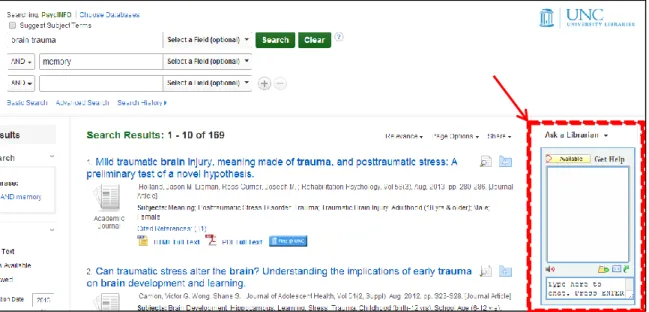
On October 2, 2013, a UNC Libraries Libraryh3lp chat widget was embedded into the EBSCO platform for all EBSCO databases that UNC licenses (see Figure 3). This was intentionally done without any advertising in an attempt to avoid encouraging users to take advantage the database chat widget. By allowing users to discover the widget on their own, the traffic would be more representative of future database widget traffic, were the widget to remain in place long-term.
Libraryh3lp is an ideal platform for this study because of its ability to assign embedded buttons and widgets to a specific queue and to include the referring URLs in chat logs. The queue capability was especially significant. A queue is a way to route incoming chats to a particular service point or individual staff member. For example, a chat widget on a branch library webpage can be assigned a queue so that all chats from that widget only go to that branch’s service point. This also allows anyone compiling chat statistics to quickly isolate chats received from a specific queue, in addition to any other parameters that are relevant.
The EBSCO database platform was chosen because it has a fairly steady and high level of traffic. As such, the data gathered from chat transcripts would be the most likely to be representative of UNC chat traffic in general. There are also only a few platforms that allow for embedded chat at this time, including EBSCO and ProQuest.
searching, and also below detailed records. Though UNC has access to a large number of EBSCO databases, a portion of those are accessible through our affiliation with NC LIVE. Due to licensing agreements, the widget will be available in EBSCO databases that UNC licenses on its own, but only some of the databases that are shared with NC LIVE. The widget addition affected 72 databases, such as Academic Search Complete, Historical Abstracts, and PsycINFO.
Figure 3. An example of the placement of the embedded chat widget when viewing search results in UNC’s subscription to EBSCO’s PsycINFO database.
Data Collection
Data was collected and reviewed between October 2, 2013 and November 13, 2013. First, chat logs were downloaded into an Excel spreadsheet. Chat logs are the data collected about each chat session, including a system generated ID number, duration of the session, a referring URL, and other descriptors. The logs were downloaded to allow for sorting and easier analysis. Then, chat transcripts, or the text record of each conversation between the user and librarian, were read in the Libraryh3p online administrative site, instead of being downloaded individually. This was done for two main reasons. The first is that if the transcripts were to be copied into a separate document, it would be difficult to match them to their corresponding log. The second reason was to ensure that the transcripts remained confidential. Though rare, some users offer, or are asked for, contact information. By not making copies of the transcripts, any personal information was not duplicated outside the system.
Coding Transcripts
Chat transcripts were coded using a binary scheme: a chat is either research-related or it is not. For the purposes of this study, a research-related chat was defined using a variation of a classification scheme developed by Arnold and Kaske (2005) (p. 179-180). The ready reference, specific search, and research question categories were combined due to the relative sample size of this study, and for ease of classification. Questions in these categories range from answers which can be easily found in reference sources to users “seeking detailed information to assist in specific work…Research questions differ from
other inquiries in that most involve trial-and-error searching or browsing” (p. 179).
Any chats that involve any of the following types of questions were not considered research-related:
Known-item searching
Locating print materials
Technology assistance, including trouble with authentication and browser
incompatibility
Library policy or directional queries
then to discover how the addition of the EBSCO widget has affected the overall statistics for chat reference.
Results
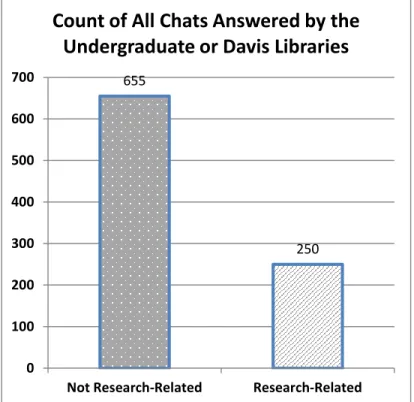
During the six week test period, 905 chats were received and answered by the Davis and Undergraduate Library (UL) reference desks. Using the previously described binary coding system, 655 chats were determined to not be research-related, while 250 were research questions requesting information such as search strategies, keyword assistance, and resource recommendations (see Figure 4).
Figure 4. Chart showing the distribution of chats received and answered by the Davis and Undergraduate Library reference services.
These 905 chats were further divided by the chat queue from which they were received. The interest of this paper lies in the chats received from the newly created ebsco
655
250
0 100 200 300 400 500 600 700
Not Research-Related Research-Related
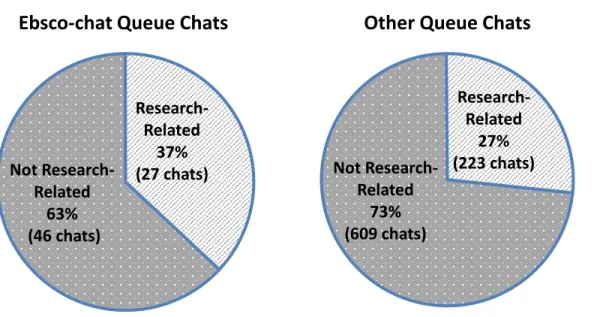
chat queue. When chats received from the queue were isolated, a total of 73 chats were found. Of the 73 chats received from the ebsco-chat queue, 27 were determined to be research-related, while the remaining 46 did not involve any research-related questions. Contrastingly, of the 832 chats from received from the queues other than the ebsco-chat queue, 609 chats were not research-related, and 223 chats asked research-related questions.
While ebsco-chat queue chats constitute only approximately eight percent of the total chats reviewed, it is a significant amount given that this new service was not advertised to users. To better see and understand any differences in the proportion of research-related chats, the counts of chats were viewed as percentages. Here, it can be seen that there were significantly more research-related chats originating from the ebsco-chat queue (see Figure 5).
Figure 5. Proportions of chats based on binary coding. The left chart displays the proportion of chats received from the ebsco-chat queue. The right chart displays the chats received by all other chat queues and answered by the UL or Davis reference desks.
Not Research-Related 63% (46 chats) Research-Related 37% (27 chats)
Ebsco-chat Queue Chats
Not Research-Related 73% (609 chats) Research-Related 27% (223 chats)
Discussion
Overall, users who contact the UNC Libraries through chat are 10% more likely to have a research-related question when they begin a chat from inside a database as compared to beginning a chat from a library-maintained site. With a ten percent increase in research-related questions, it seems reasonable to assert that placing a library chat widget in as many licensed database platforms as possible will give users the most opportunities to ask for assistance in finding resources for their research needs. In fact, NC LIVE, a consortium of North Carolina libraries that provides online access and assistance with online resources, added an embedded widget to its EBSCO databases and ProQuest Wall Street Journal on March 10, 2014. In a post, NC LIVE mentions that the new “chat box will allow patrons to get live help from a librarian without leaving their search” (“NCKnows”, 2014).
This study was done using only one database platform because this was a pilot project. Nevertheless, other vendor platforms do have the capability to allow libraries to embed their own chat reference widgets, such as ProQuest. It would be interesting to see the changes that could happen if the UNC chat widget were added to as many licensed database platforms as possible. For instance, would in-person reference transactions significantly decrease? Or would there be a sharp spike in research-related questions received through chat reference?
queue. From the entire set of chats, 28% were categorized as research-related. When the chats from the ebsco-chat queue were removed, 27% of the remaining chats were research-related. This is most likely because the chats initiated in the EBSCO databases made up a relatively small proportion of all of the chats reviewed, just around 8%. Still, the one percent difference is encouraging. It means that 8% of the chats contributed a measurable increase to the overall percentage of research-related chats. With more data, that proportion of research-related questions in chat may continue to increase.
Implications on Practice
If chat widgets are added to licensed research databases, as well as maintained on library webpages, significant changes could be implemented in academic library reference desks. As fewer and fewer questions were asked at reference desks, libraries began questioning the value of keeping a reference desk open. One such library, M.I.T.’s Rotch Library, cited its own decline in reference transactions and the fact that more transactions concerned directional or policy information as their impetus for consolidating user services into a single service point (Flanagan and Horowitz, 2000, p. 330). At this combined service desk, librarians spent fewer hours per week staffing the desk, but they felt that “they were encountering patrons more frequently” and “catching questions that might not have been caught otherwise” (p. 336). Similar findings were made by Murphy et al. (2008), Horne,
Ragon and Wilson (2012), and Aggarwal and Powers (2013), among others.
in-person reference questions. Librarians would still answer reference questions via chat, and any other methods that fit into a particular library’s service model needs, but librarians could use the time that would have been spent at the desk towards other job duties: consultations, projects, committee work, and more.
Similarly, a greater number of questions received via chat reference may necessitate a rethinking of reference training. Single service points, such as at the UNC Health Sciences Library, usually involve cross-training staff: librarians learn circulation duties, and support staff learn basic reference skills (Moore, McGraw, & Shaw-Kokot, 2001, p. 81). When a higher number of transactions take place through chat, the method of chat reference training for librarians and support staff may need to be enhanced.
Luo (2009) noted in a study of chat reference training techniques that a greater emphasis was placed on software fluency rather than “other reference competencies” (p. 221). Similarly, if users begin to take stronger advantage of chat reference services, much more emphasis will need to be placed on training staff in areas such as how to conduct a reference interview, textually explaining search strategies, and teaching chat users whenever possible. Devine et al. (2011) found that approximately 69% of libraries who use chat service do, in fact, include “best practices for conducting virtual reference interviews” in their chat training programs (p. 201). Still, if there is any possibility that chat will become the main medium for reference questions, that percentage will need to be higher. This is especially true for single service points. All staff will need to be skilled in conducting reference interviews to ensure that the user gets the answer they are really looking for.
Study Limitations
Conclusion
A chat widget was embedded in the University of North Carolina at Chapel Hill Library’s subscription of EBSCOhost platform databases. Until this time, options for chat at this university had existed mainly on library maintained webpages, but never within a licensed database. With the data collected from the six week test period, it appears that users are more likely to contact the library’s chat reference service with a research-related questions as compared to when chats are initiated from another webpage. Due to the promising results found in this study, the chat widget was not removed and will likely remain active.
While it is true that adding more widgets will naturally increase the traffic, and therefore the workload of the reference staff, it is more in line with the mission of academic libraries to offer as many opportunities as possible to aid students, faculty, staff, and (in the case of public universities) the community in their research endeavors. But, given the promising results of this study, academic libraries should investigate the possibility of adding a chat widget to their database platforms.
Suggestions for Further Research
research-related questions. For example, if a search interface is considered difficult to use, would a user be more likely to ask for assistance with a research strategy? Conversely, it would be interesting if more user-friendly interfaces result in fewer research questions asked. Answers to that question could have many ramifications. Were it to be discovered that non-intuitive interfaces do, in fact, lead to more research-related questions, a library may to choose vendors with more user-friendly vendor platforms, or it might lead vendors to redesign their search interfaces.
Also, this study was conducted for a period of six weeks at one university. An opportunity to do a longitudinal study across multiple colleges, universities, and public libraries would aid in the generalizability of results, and would serve to determine how similar chat behavior and questions types are across current library users. Locally, the data from the NCKnows chat service would be a prime dataset to analyze for this. NCKnows answers questions, mainly channeled through NC LIVE, from across the state of North Carolina, asked by users of all types of libraries (About NCKnows). Since NC LIVE will be embedding a widget in some of its databases, a large, longitudinal study would be possible.
Bibliography
Aggarwal, I., & Powers, M. (2013). Increasing Library Access and Enhancing Reference Support through a Shared Services Model. The Reference Librarian, 54(3), 236– 244. doi:10.1080/02763877.2013.774864
Aguilar, P., Keating, K., Schadl, S., & Reenen, J. van. (2011). Reference as Outreach: Meeting Users Where They Are. Journal of Library Administration, 51(4), 343– 358. doi:10.1080/01930826.2011.556958
Arendt, J., & Graves, S. J. (2011). Virtual question changes: reference in evolving environments. Reference Services Review, 39(2), 187–205.
Arnold, J., & Kaske, N. K. (2005). Evaluating the Quality of a Chat Service. portal: Libraries and the Academy, 5(2), 177–193. doi:10.1353/pla.2005.0017
Association of Research Libraries, Statistics & Assessment. (2013). Service Trends in ARL Libraries, 1991‐2012 [Graph]. Retrieved from:
http://www.arl.org/storage/documents/service-trends.pdf
Bicknell-Holmes, T. (2007). Chat & Instant Messaging for Reference Services: a Selected Bibliography. Nebraska Library Association Quarterly, 38(4), 3–8. Chat Widget Now in ProQuest Databases. (2012, September 14). Reference at Newman
Coffman, K., & Odlyzko, A. (1998). The Size and Growth Rate of the Internet. First Monday, 3(10). Retrieved from
http://firstmonday.org/ojs/index.php/fm/article/view/620
Curtis, S. (2000). Listening to generation X. Journal Of Educational Media & Library Sciences, 38(2), 122-132.
Devine, C., Paladino, E. B., & Davis, J. A. (2011). Chat Reference Training After One Decade: The Results of a National Survey of Academic Libraries. The Journal of Academic Librarianship, 37(3), 197–206. doi:10.1016/j.acalib.2011.02.011 EBSCO Support: How can I add Widgets to EBSCOhost or EBSCO Discovery Services?
(2014, February). EBSCO Support. Retrieved March 21, 2014, from http://support.ebsco.com/knowledge_base/detail.php?id=4713
Fennewald, J. (2006). Same Questions, Different Venue. The Reference Librarian, 46 (95-96), 21–35. doi:10.1300/J120v46n95_03
Flanagan, P., & Horowitz, L. R. (2000). Exploring new service models: can consolidating public service points improve response to customer needs? At MIT, 26(5), 329– 338. doi:10.1016/S0099-1333(00)00139-7
Frantz, P., & Westra, B. (2010). Chat Widget Placement Makes All the Difference! OLA Quarterly, 16(2), 16–21.
Graybill, J. O., & Bicknell-Holmes, T. (2013). Location, Location, Location: The Impact of IM Widget Placement. College & Undergraduate Libraries, 20(1), 72–86. Horne, A. S., Ragon, B., & Wilson, D. T. (2012). An Innovative Use of Instant
Kern, K., & Ward. (2009). The best of all possible worlds: IM Collaborator for virtual reference. In D. Mueller (Ed.), Pushing the edge: explore, engage, extend, : proceedings of the Fourteenth National Conference of the Association of College
and Research Libraries, March 12-15, 2009, Seattle, Washington. Chicago: Association of College and Research Libraries.
Luo, L. (2009). Effective training for chat reference personnel: An exploratory study. Library & Information Science Research, 31(4), 210–224.
Matteson, M. L., Salamon, J., & Brewster, L. (2011). A systematic review of research on live chat service. Reference & User Services Quarterly, 51(2), 172-190.
Maximiek, S., Rushton, E., & Brown, E. (2010). Coding into the Great Unknown: Analyzing Instant Messaging Session Transcripts to Identify User Behaviors and Measure Quality of Service. College & Research Libraries, 71(4), 361–373. Moore, M. E., McGraw, K. A., & Shaw-Kokot, J. (2001). Preparing Staff to Work at a
Single Service Desk. Medical Reference Services Quarterly, 20(1), 79–86. Murphy, B., Peterson, R. A., Vines, H., Von Isenburg, M., Berney, E., James, R.,
Rodriguez, M., & Thibodeau, P. (2008). Revolution at the Library Service Desk. Medical Reference Services Quarterly, 27(4), 379–393.
Naylor, S., Stoffel, B., & Van Der Laan, S. (2008). Why Isn’t Our Chat Reference Used More? Finding of Focus Group Discussions with Undergraduate Students. Reference & User Services Quarterly, 47(4), 342–354.
Pomerantz, J., & Luo, L. (2006). Motivations and uses: Evaluating virtual reference service from the users’ perspective. Library & Information Science Research, 28(3), 350–373. doi:10.1016/j.lisr.2006.06.001
Sekyere, M. (2009). Embedding an IM Widget in Research Databases: Helping Users at their Point-of-Need. Electronic Journal of Academic and Special Librarianship, 10(2). Retrieved from
http://southernlibrarianship.icaap.org/content/v10n02/sekyere_k01.html Sessoms, P., & Sessoms, E. (2008). LibraryH3lp: A New Flexible Chat Reference
System. The Code4Lib Journal, (4). Retrieved from http://journal.code4lib.org/articles/107
Tenopir, C. (2004). Rethinking Virtual Reference. Library Journal, 129(18), 34. Turner, C. A., & Ronan, J. (2002). Chat reference. Washington, DC: Association of
Research Libraries, Office of Leadership and Management Services. Retrieved from http://catalog.hathitrust.org/Record/003853642
Wan, G. (Gary), Clark, D., Fullerton, J., Macmillan, G., Reddy, D. E., Stephens, J., & Xiao, D. (2009). Key issues surrounding virtual chat reference model: A case study. Reference Services Review, 37(1), 73–82.