Rachel J Hinrichs. Perceptions and Knowledge of Privacy Risks in Mobile Apps. A Master’s Paper for the M.S. in L.S degree. April, 2016. 43 pages. Advisor: Brad Hemminger
Consumers often have little knowledge about the extent of privacy risks taken when using mobile applications (apps) on their smartphones, and are unlikely to be informed by federal regulations or privacy certifications. A survey was distributed to smartphone users to determine their perceptions and knowledge of privacy risks in mobile apps, and if these perceptions vary in different contexts (i.e., a health app vs. flashlight app). This study found that people appear to see privacy in mobile apps as contingent and context-dependent. While smartphone users were found to have a good understanding of privacy risks, they considered user rating and price to be more important factors to consider than privacy when selecting a mobile app. Presentation, clarity, and context all influence people’s decisions to install and use mobile apps. This study has important implications for how privacy permissions and ratings can be presented to best inform consumer decisions.
Headings:
Privacy
Cellular phones
PERCEPTIONS AND KNOWLEDGE OF PRIVACY RISKS IN MOBILE APPS
by
Rachel J. Hinrichs
A Master’s paper submitted to the faculty of the School of Information and Library Science of the University of North Carolina at Chapel Hill
in partial fulfillment of the requirements for the degree of Master of Science in
Library Science.
Chapel Hill, North Carolina
April 2016
Approved by
_______________________________________
Table of Contents
Table of Contents ... 1
Table of Figures ... 2
Introduction ... 3
Literature Review... 6
Information Privacy Theories ... 6
Common Privacy Risks in Mobile Apps ... 9
Consumer Attitudes and Preferences towards Privacy Risks in Mobile Apps ... 11
Methods for influencing or informing consumers’ decisions about privacy ... 12
Literature Review Summary ... 13
Methods... 15
Selection of Method ... 15
Population & Sampling ... 15
Survey Content... 16
Ethics... 19
Results ... 21
Sample Demographics ... 21
Mobile App Selection ... 23
Privacy Permission Selection in Context ... 26
Privacy Risk Knowledge... 29
Discussion ... 33
R1. How does selection of a mobile app differ when the privacy rating, user rating, and price are altered? What factor is considered the most important to selection of a mobile app? ... 33
R2. How do people negotiate privacy risks when selecting or allowing privacy permissions, and do their choices vary in different contexts? ... 34
R3. What level of knowledge of mobile app privacy risks do adults who own smartphones have? ... 35
R4. How does age, gender, type of smartphone and level of experience relate to privacy risk knowledge? ... 36
Limitations ... 36
Conclusion ... 38
Table of Figures
Figure 1. Data types for the privacy permission selection ... 19
Figure 2. Gender of Participants ... 21
Figure 3. Ages of Participants ... 22
Figure 4. Type of Smartphone Owned ... 23
Figure 5. How long have participants owned a smartphone ... 23
Figure 6. Example question ... 24
Figure 7. Mobile App Selection 1 ... 24
Figure 8. Mobile App Selection 2 ... 25
Figure 9. Mobile App Selection 3 ... 25
Figure 10. Mobile App Selection 4 ... 26
Figure 11. Mobile App Selection 5 ... 26
Figure 12. FoodWise: Privacy Permission Selection ... 27
Figure 13. Navigator: Privacy Permission Selection ... 28
Figure 14. BrightLight: Privacy Permission Selection ... 29
Figure 15. Privacy Risk Knowledge Scores ... 30
Figure 16. ANOVA analysis for original age groups & privacy risk knowledge score ... 31
Introduction
In the last decade, the use of mobile technology has grown at an incredible
rate. The rapid adoption of mobile phones, especially smartphones, by consumers created
a new market for mobile applications (mobile apps). Mobile apps often combine
smartphone capabilities for accessing global positioning systems (GPS) and networks
such as 3G and 34 to create interfaces for social networks sites, news feeds, games, health
trackers, and even banking. As a result, mobile apps combine all kinds of personal
information, some highly sensitive, into one device.
Because mobile apps are useful and convenient, consumers often install and use
them with little regard for privacy risks. Mass data collection has become part of
everyday life as people rely on the mobile technology for monitoring, storing, and
distributing data (Shklovski, Mainwaring, Skúladóttir, & Borgthorsson, 2014). Mobile
devices can automatically collect and distribute users’ location, personal information, and
behavior in real-time. These privacy threats are different than online privacy threats, and
potentially more serious (Xu, Gupta, Rosson, & Carroll, 2012). For example, pictures and
social media posts can reveal social relationships; geographical data can reveal current
and past locations; and accelerometer data can be used to identify the user’s current
activities.
Efforts by federal agencies and private sector organizations in the United States to
mobile health apps. The Food and Drug Administration (FDA) has the authority to
regulate “medical devices” (Furberg, 2013). Only mobile apps that meet the FDA’s
definition of a medical device fall under the FDA’s jurisdiction, and, even then, the
regulation of medical device apps is primarily for safety and effectiveness purposes
(Furberg, 2013). Private organizations like Happtique developed standards for mobile
health apps that include operability, privacy, security, and content (Misra, 2014). In 2014,
however, they experienced a setback when security flaws were found in a number of their
certified mobile apps (Misra, 2014). The certification process was also very lengthy and
complicated; the company had only been able to certify 70 mobile apps after one year.
Because the mobile app market is relatively cheap and easy to enter, it is difficult, if not
impossible, for federal agencies and certification companies to keep up with the volume
of mobile apps available.
For now, consumers will need to make their own decisions in a “buyer beware”
market. Information privacy research can help explain some consumer behavior in
selecting and using mobile apps despite their privacy risks. Information privacy research
is not new, but has largely changed with the growth of new technologies, especially
mobile-based ones (Smith, Dinev, & Xu, 2011). The research in this area is preliminary,
and is mostly found in conference proceedings. This study will add to this area of
research by examining people's knowledge and perceptions of privacy risks in mobile
apps. In particular, this study will determine if people have different privacy risk
concerns in different contexts, and how they negotiate privacy risks when selecting apps
R1. How does selection of a mobile app differ when the privacy rating, user
rating, and price are altered? Which of these factors is considered most important when
selecting an app?
R2. How do people negotiate privacy risks when allowing privacy permissions,
and do their choices vary in different contexts (i.e., a complex vs. simple app)?
R3. What level of knowledge of mobile app privacy risks do adults who own
smartphones have?
R4. Does age, gender, type of smartphone, and level of experience affect privacy
Literature Review
This literature review will describe 1) several of the most predominant theories in
information privacy in relation in mobile apps; 2) common privacy risks and issues in
mobile apps; 3) consumers’ attitudes and perceptions regarding mobile apps and privacy;
and 4) researchers’ methods for raising user awareness of privacy risks and influencing
decision-making.
Information Privacy Theories
Privacy Calculus. One of the most prevalent theories about information privacy
and disclosure is privacy calculus, or the notion of privacy as a commodity (Keith, Babb,
& Lowry, 2014; Smith et al., 2011). According to this theory, disclosing information is
considered a trade-off between benefits and costs. This tradeoff can create a privacy
paradox where people claim they have high levels of privacy concerns, but still release
private information in many circumstances (Smith et al., 2011). A person's concept of
privacy changes depending on the benefits he or she expects to receive. For example,
some people may be willing to enter personal health information in order to use a food
and nutrition tracker, which they see as highly beneficial. Norberg and colleagues found
that for all types of information, including financial, personal identification, and
preferences, actual disclosure of information exceeded the individual's’ intentions
their nationally representative survey of U.S. and Japanese smartphone users (n=1114
U.S. participants and n=2000 Japanese participants) (Fife & Orjuela, 2012). Their results
suggest that people are generally not aware that their data are collected or sold to a third
party; instead, their actions are influenced by habits, expectations, and cultural practices.
Other researchers have expanded the idea of a privacy paradox to include
personalization. When using a mobile device, one of the benefits that users consider is
personalization. Personalization can potentially make the experience of using a mobile
device more gratifying by delivering individualized services (Sutanto, Palme, Tan, &
Phang, 2013). In order to reap the benefits of individualized services, users may forfeit
their privacy. In a study comparing a non-personalized mobile app to a personalized one,
Sutano and colleagues found that participants used the personalized one more, but their
satisfaction was undermined by increased privacy concerns (Sutanto, 2013). Interestingly,
their dissatisfaction with privacy concerns was not enough to overcome the benefits of
using the personalized mobile app.
Two limitations of the privacy calculus are that it does not account for risks and
benefits over time or bounded rationality. Individuals often have limited information,
time, and knowledge when making decisions about privacy (Acquisti & Grossklags,
2005). Given a greater knowledge of the risks, or the time to consider them, users may
behave differently. Further, information disclosure decisions can change over time.
Individuals may discount future risk for present benefits, but become more concerned
with privacy risk once the benefit has been achieved (Keith et al., 2014).
Prospect Theory. Privacy calculus can often predict information disclosure
Prospect theory can better account for privacy-related behavior over time. Instead of
considering risks and benefits at that moment, individuals consider reference points when
making decisions (Keith et al., 2014). For example, if the benefits of disclosing
information are increasing over time, the individual is in a “gain” position from their
original reference point, and will become more risk averse. On the other side, if the
benefits of information disclosure are decreasing over time, the individual is in a “loss”
position, and will be willing to disclose more information to get back to the original
reference point. This theory was supported in Keith and colleagues’ longitudinal study of
information privacy on mobile devices. In contrast to most studies on privacy risks, this
study calculated user’s actual behaviors versus their intentions by having participants use
a mobile app for 12 weeks. They found that the participants’ behavior followed prospect
theory more closely than privacy calculus theory. This means that participants became
more risk adverse in a gain position, and less risk adverse in a loss position. Though this
is the only mobile app privacy study done based on prospect theory, the use of actual
behavior versus intended behavior gives it a strong research design that other studies
should follow if possible.
Contextual Integrity Theory. While the above theories are concerned with how
people choose to disclose information, Helen Nissenbaum’s theory of contextual integrity
considers context-dependent information flows and social norms (Nissenbaum, 2010). In
other words, in different contexts people have different privacy expectations, or, as
Nissenbaum describes them, personal information flows. What constitutes personal
information in one context may be different in another. In terms of mobile devices and
considered appropriate for some mobile apps (location sharing in a GPS app), but not in
others (location sharing in a dictionary app).
A couple of studies examine context and privacy in terms of mobile apps (Lin et
al., 2012; Shklovski et al., 2014). Shklovski’s study investigated attitudes towards data
leakage and tracking on smartphones in different contexts through interviews (n=13), and
a survey (n=187) (Shklovski et al., 2014). He made several findings, including that
people’s expectations of appropriate tracking and data gathering varied between different
types of apps. The notion of “creepiness” that many participants described in their
interviews was due to the realization that the apps were more than they seemed, and were
acting in ways the participants did not agree to or expect. Lin and colleagues had similar
findings in their study of privacy expectations and purposes (Lin et al., 2012). Using
crowdsourcing on Amazon Mechanical Turk, they had the particpants check off what
type of privacy permissions they would consider reasonable for various types of mobile
apps. Like in Shklovski’s study, participants were highly concerned when mobile apps
collected information they did not expect; however, Lin and colleagues found that if users
were informed why a given data was being used, their privacy concerns could be allayed
to some extent.
Common Privacy Risks in Mobile Apps
Before analyzing people’s perceptions of apps, it is useful to first see what
privacy risks are prevalent in mobile apps, and how are they presented to consumers in
the app itself or in its description in the app store. Most of these studies focus specifically
One approach to studying privacy issues in mobile apps is analyzing the content
of privacy policies. Sunyaev and colleagues assessed the availability, scope, and
transparency of health-related mobile app privacy policies (Sunyaev, Dehling, Taylor, &
Mandl, 2014). Of the 600 most popular apps on the iOS and Android stores, only 30.5%
had privacy policies, and these policies were very long and written at a college reading
level (Sunyaev et al., 2014). If users wanted to read the privacy policies, which may not
be likely, the policies may be too difficult to understand or not even available. A report
from the Privacy Rights Clearinghouse analyzed the privacy policies, permissions
required, and content of 43 popular health and fitness apps, both paid and free
(Ackerman, 2013). They found that 26% of free apps and 40% of paid apps had no
privacy policy, and that less than 50% of apps notify users of information they make
public or send to third-parties (Ackerman, 2013). Note that this report may have inherent
bias due to the authors’ affiliation; however, their analysis started with no knowledge of
the mobile apps selected, and the evaluation was carefully documented and made
available on their website. Mobile app privacy policies are not easily accessible to
consumers either because they do not exist or because they are written and presented in a
way that no one would read them.
Researchers have also used technical analysis of data practices of mobile apps.
Several studies had users install an app that would track personal data flow. One showed
that access to address book information is the biggest concern, and that over half of the
connections made by apps are insecure (Ferreira, Kostakos, Beresford, Lindqvist, & Dey,
2015). The other study found that the majority of application network data is sent to
study, Fu and colleagues found that user location data is frequently sent without the user's
consent or understanding of the reasons for it (Fu, Yang, Shingte, Lindqvist, & Gruteser,
2014). The Privacy Rights Clearinghouse also did a technical analysis, and found that
only 10-13% of apps encrypt all connections to the developer, and that about a third of
apps tested sent data to a party not covered in the privacy policy (Ackerman, 2013).
These studies reveal that privacy risks are fairly extensive, and are most related to
personal information and location services.
Consumer Attitudes and Preferences towards Privacy Risks in Mobile
Apps
Many studies have sought to find out how much consumers know about privacy
risks, and what their perceptions of privacy risks in mobile apps are. These studies have
used a variety of primarily qualitative methods, including surveys, interviews,
observations, and focus groups, and have identified several themes.
First, as per Nissenbaum’s contextual integrity theory, Atienza and colleagues
have found that consumer attitudes are highly contextualized and more nuanced than the
privacy paradox suggests (Atienza et al., 2015). In their study of 24 focus groups with
256 participants, Atienza and colleagues found that participants’ concerns about privacy
depended on the type of information, where and when the information is accessed, and
who is seeing the data. Control was an important issue. Many participants were willing to
reveal personal information in order to reap the benefits of personalization and
usefulness, but wanted to control when and where this happened.
Several studies show that privacy concerns vary by age, degree of use, and risk
knowledge. One study found that the degree of concern about privacy and security issues
because older adults tend to have less experience with mobile devices. A study of African
American young adults found that the participants were not generally concerned about
privacy (Park & Jang, 2014). The young adults were generally unaware of data leakage or
third party advertisers, and referred instead to interpersonal privacy concerns such as
locking their phone so a family member could not access it. Perceived skill level also
appears to influence privacy concerns. As consumers’ perceived skill level increases,
they seem less concerned with privacy, perhaps due to increased use of mobile devices,
or confidence in their ability to control the situation (Keith, Thompson, Hale, Lowry, &
Greer, 2013). Another study by Pew Research, however, found no consistent
demographic answers by age, income, education, or gender when participants were asked
about their opinions on data sharing in various contexts (Rainie, et. al., 2016). Consumer
attitudes toward privacy are overall nuanced, contextual, and possibly related to age,
skills, and degree of use.
Methods for influencing or informing consumers’ decisions about
privacy
Because many consumers have little knowledge of privacy risks and are unlikely
to be informed by federal regulations or mobile app certification programs, researchers
have been developing methods for influencing or informing consumers’ decisions when
selecting mobile apps. Android currently has a permission system that is intended to
inform users about the privacy risks involved with certain mobile apps. Before installing
an app, the consumer can review the permission requests, and cancel the installation if it
seems excessive. While this permission system is an important step in providing privacy
information to consumers, Felt and colleagues in their study of 308 Android users found
it (Felt et al., 2012). They concluded that these warnings do not help users make privacy
decisions.
Some studies have modified the Android permission display, or created a new
one, to see if it would play a more active role in app selection. The first study modified
the Android permissions display into a simplified privacy checklist that fits on the main
app description screen (Kelley, Cranor, & Sadeh, 2013). The location of the checklist is
important because consumers may have already made their decision regardless of the
privacy permissions if they have already clicked install. In this way, the checklist may be
more likely to influence consumer decisions. Kelley and colleagues found in both a lab
study and a large-scale online survey that users noticed the new display, and that it
affected their selection decisions, especially when deciding between similar apps (Kelley
et al., 2013). Another couple of studies designed new privacy indicators based on
warning design theory (Bal, 2014) and visual framing effects (Choe, Jung, Lee, & Fisher,
2013). Both found that the visual representation of privacy risk quickly and effectively
informed consumers of the risks involved, and influenced their decisions to some extent.
Representing privacy risks visually and in a simplified manner before installation appears
to help inform consumers of privacy risks, and may influence their final decision.
Literature Review Summary
Based on the studies above, consumers appear to make cost-benefit decisions
based on the specific context when it comes to privacy. Many consumers also have little
knowledge about the extent of the privacy risks taken when using mobile apps. Further,
they are unlikely to be informed by federal regulations or privacy certifications because
degree of privacy risk appears to help inform and influence consumers’ decisions.
However, it is unknown whether these would have an effect in a “real-life” scenario
where consumers are also considering factors such as user reviews and cost. In
conducting this literature review, there appears to be a need to determine how people
negotiate privacy risks when selecting apps and allowing privacy permissions in different
contexts, and whether privacy risk knowledge and demographic factors correlate with
Methods
The following section will describe the methods, population, sampling, data
collection, and plans for analysis of this study.
Selection of Method
This study will use a self-administered, web-based survey to gather data. A survey
is ideal for this type of research for several reasons. One, surveys are designed so that
only small percentage of the population is needed to draw conclusions about the larger
population (Wildemuth, 2009). This means less time and resources are required to gather
data. Two, surveys can allow the researcher to analyze several variables at one time. This
study will analyze several variables, including age, privacy rating, user rating, price,
privacy permissions, and privacy risk knowledge. The questions in this survey will also
be close-ended making this analysis easier. Third, web-based surveys can be distributed
widely and cheaply, which could potentially increase the diversity of the sample. This
would also allow more subgroups to be represented in the analysis, for example those
with a high versus low privacy risk knowledge.
Population & Sampling
The population of interest is adults (18 years and older) who own or use a
smartphone. This population is purposely broad to enable the identification of subgroups.
The most important requirement is that the population uses a smartphone, otherwise they
A convenience sample was taken by distributing the Qualtrics survey link via an
email message to university mailing listservs that include undergraduate and
post-graduate students, faculty, and staff. It was also distributed via the investigator’s social
networks on Facebook and Twitter. Snowball sampling was also used because the
investigator's friends and family forwarded the link to their contacts. The survey was
open for a three-week period during which the participants could click on the link and
submit their responses via Qualtrics. While a convenience sample is not ideal for
representative sampling, it was sent to different mailing listservs and groups that include
individuals of different ages and in different locations to attempt to diversify the sample.
In order to encourage participation, participants were offered the chance to enter a
drawing for one of four $50 Amazon gift cards. Funding for this incentive was provided
by a Carnegie Grant through the School of Information and Library Science at the
University of North Carolina at Chapel Hill. After completing the questionnaire,
participants had the option to enter their email address. Email addresses were exported to
a spreadsheet, and four were selected using a random number generator. These gift cards
were distributed in March 2016.
Survey Content
The survey consisted of four sections.
Section 1: Demographics. This section first confirmed that the participant is over
the age of 18 and owns a smartphone, which are both requirements to take this survey.
Then the participant was asked basic demographic questions such as age, gender, and
student type (if they are a student). It also asked how long the person has owned a
Section 2: Mobile app selection. This section seeks to answer R1: How does
selection of a mobile app differ when the privacy rating, user rating, and price are
altered? Which of these factors is considered most important when selecting an
app? Mobile app stores typically display a price and a user rating on a 5-point scale for
each app. This section will display both the price and user rating, but also add a privacy
rating on a 5-point scale, with 1 being a poor privacy rating (i.e., lack of security) and 5
being an excellent privacy rating (i.e., high security). The privacy rating is included to
test how it affects the participants’ selection of a mobile relative to the user rating and
price. Because this section deals with user perceptions of privacy risks as a component of
the decision-making process when selecting apps, it was placed first in the survey (after
the demographics) to prevent bias. If it was placed later in the survey, the participants
will likely realize the survey is about privacy, which may affect their responses.
This section was based on the survey done by Choe and colleagues (Choe et al.,
2013). Their study tested whether presenting positively- and negatively-framed privacy
rating scales with or without a user rating of 3 affected the participants’ selection of a
mobile app. This survey built on their design by incorporating price and varying the user
and privacy rating scores to a greater extent. The goal was to find a threshold where
participants balanced the perceived privacy risks with the user rating and price. A pilot
test helped to determine which combinations of privacy and user ratings and price were
the most appropriate. In order to rank the factors in order of importance to the
participants, each combination of privacy rating, user rating, and price will be sorted
Section 3: Privacy Permission Selection. This section focuses on R2: How do
people negotiate privacy risks when selecting or allowing privacy permissions, and do
their choices vary in different contexts (i.e., a complex vs. simple app)? There are many
different types of privacy permissions for mobile apps, and participants may feel some
are more important to them than others. For example, some participants may want to turn
off location-finding services, but will let the app access their contact information.
Further, participants may believe some privacy permissions are appropriate in certain
types of apps, but not in others.
Because appropriate permission settings may be perceived differently in various
contexts, three different apps were briefly described to the participants:
1. FoodWise: Track your diet and exercise, and easily connect to other devices,
such as Fitbit, or to your selected contacts to motivate each other. Receive personalized
goals based on your diet profile, or enter your own goals based on advice from your
doctor or dietitian.
2. Bright Light: This app instantly turns your phone into a flashlight. Now with
an easy-to-use interface and strobe mode.
3. Navigator: This GPS app will find routes, restaurants, shopping, friends, and
more!
Participants were then given a list of data types that the app could collect. For
each data type, they indicated whether they would, would not, or would maybe allow the
data to be collected. Participants were reminded that limiting data access might affect the
Figure 1. Data types for the privacy permission selection Data Types
Contact information Location-sharing Photos/camera Audio/microphone Contacts list
Social media – Facebook Social media – Twitter
Medical information – Physical (height, weight, gender) Medical information – Diagnoses (diabetes, asthma, food allergies)
Section 4: Privacy Risk Knowledge. This section focuses on R3: What level of
knowledge of mobile app privacy risks do adults who own smartphones have? This
section was based off the privacy risk knowledge survey conducted by Parks and
colleagues with some question additions and subtractions (Park & Jang, 2014). This
section consisted of 8 true/false questions on privacy risks in mobile technology. The sum
of correctly answered questions is the user’s privacy risk knowledge score.
To answer R4: Does age, gender, type of smartphone, and level of experience
affect privacy risk knowledge?, analysis of variance (ANOVA) will used to determine
whether there were any significant differences between the variables. If ANOVA shows
any significant difference between variables, the Scheffe test will be used to determine
between which variables there was significant difference.
Ethics
Survey methods are generally low-risk in that they do not cause physical harm
and are unlikely to cause psychological harm. The main ethical concerns for this study
are the assurance of privacy and anonymity. No identifying information will be retained.
wanted to enter the drawing; these email addresses were exported, and then deleted
shortly after the drawing was completed.
Because this study deals with human subjects, it was submitted to the University
of North Carolina at Chapel Hill’s Institutional Review Board (IRB) for review. All
study methods, procedures, and materials were approved by IRB in January 2016 before
Results
Sample Demographics
After the survey was open for 3 weeks, 111 surveys were submitted. Eight surveys
were not complete; participants dropped the survey around the start of section 2
(selecting a mobile app) or section 3 (selecting privacy permissions). These surveys were
removed. The total of complete surveys was N=103, a completion rate of 93%.
The combination of convenience and snowball sampling gathered a sample that
skewed young, female, tech-savvy, and Apple-friendly. Figures 3 and 4 show the age and
gender of the participants who completed the test. Seventy-two participants reported that
they are students (65% of the total sample); 74% of the students are master’s students and
25% are undergraduates.
Figure 2. Gender of Participants
78% 21%
1%
Gender of Participants (n=111)
Female Male
Figure 3. Ages of Participants
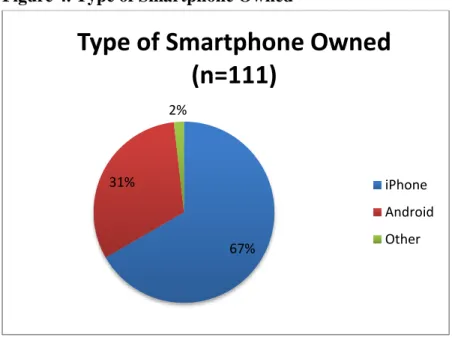
Participants were also asked what kind of smartphone they own, and how long
they have owned a smartphone. Apple users and tech-savvy individuals were
over-represented in this survey likely due to the survey being sent to the School of Information
and Library Science email lists. iPhone users were 68% of the responses. By far most
participants have owned a smartphone for at least three years, with 38% having owned a
smartphone for over 5 years.
21
55 14
10 7 4
0 10 20 30 40 50 60
18-22 23-29 30-39 40-49 50-59 60+
Number of Participants (n=111)
A
ge
R
an
ge
s
Figure 4. Type of Smartphone Owned
Figure 5. How long have participants owned a smartphone
Mobile App Selection
This section had participants compare two mobile app descriptions that included
user and privacy ratings on a 5-point scale, and a price, either free or $.99. These three
67% 31%
2%
Type of Smartphone Owned
(n=111)
iPhone Android Other 3 2 14 47 440 5 10 15 20 25 30 35 40 45 50 Less than 6 months
6 months to a year 1-2 years 3-4 years More than 5 years
Number of Participants (n=110)
Year s o f E xp e ri e n ce
factors were varied in order to see how participants negotiate privacy risks with price and
user ratings, two of the main criteria people use to select between apps to install.
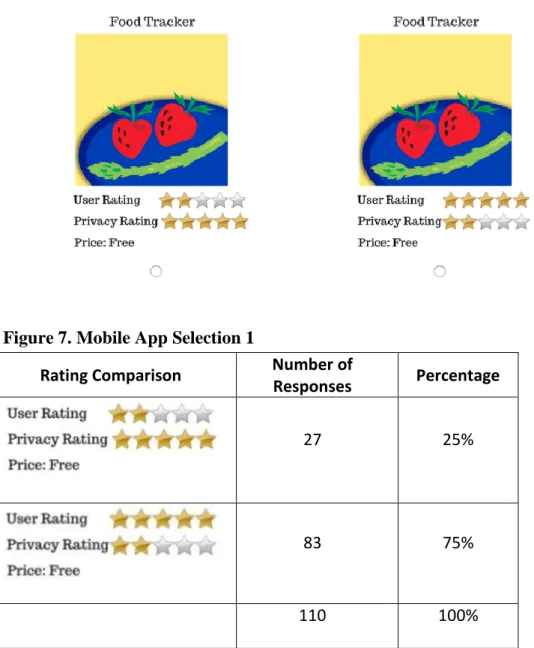
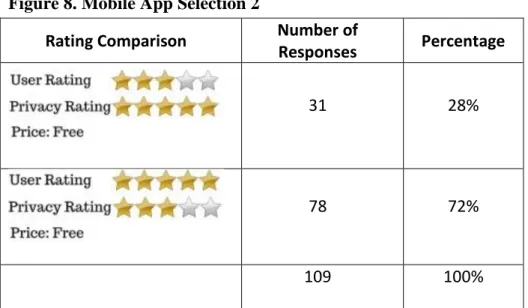
The first three questions compared apps with varying user and privacy ratings
with the price held constant at free. As Figures 4-6 show, about 75% of the participants
for each question selected the app with highest user rating over the privacy rating.
Figure 6. Example question
Figure 7. Mobile App Selection 1
Rating Comparison Number of
Responses Percentage
27 25%
83 75%
Figure 8. Mobile App Selection 2
Rating Comparison Number of
Responses Percentage
31 28%
78 72%
109 100%
Figure 9. Mobile App Selection 3
Rating Comparison Number of
Responses Percentage
80 73%
29 27%
109 100%
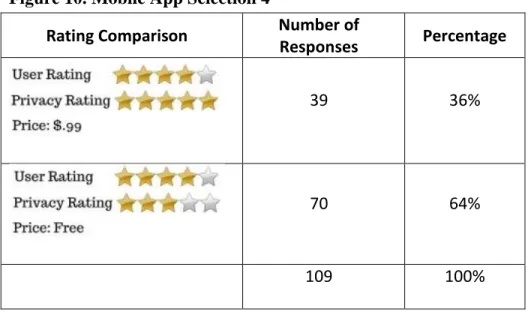
The last two questions compared apps with varying prices and privacy ratings,
while the user rating was held constant at 4 stars. 64% of the participants selected the free
app with a privacy rating of 3, when compared to the $.99 app with a privacy rating of 5.
This percentage, however, dropped to 50% when the privacy rating was 2. In other
words, participants were more willing to install a paid app when the privacy rating
Figure 10. Mobile App Selection 4
Rating Comparison Number of
Responses Percentage
39 36%
70 64%
109 100%
Figure 11. Mobile App Selection 5
Rating Comparison Number of
Responses Percentage
53 50%
54 50%
107 100%
Privacy Permission Selection in Context
This section had participants select which types of data they would or would not
allow three mobile apps to access. The mobile apps varied in complexity, from a health
participants indicated that they would not allow the mobile apps to access their data.
There were, however, some exceptions based on the type of mobile app.
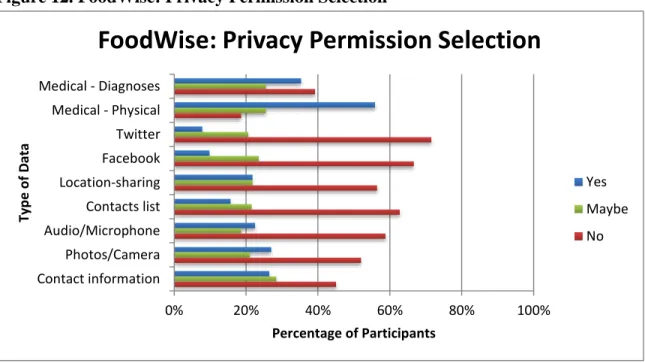
For FoodWise, the health and food tracker, most participants indicated that they
would not allow the app to collect most data with the exception of physical medical
information (e.g, height, weight, gender). It may be that participants considered physical
medical information a reasonable type of data for this app to collect in order to function
properly or to be personalized for their needs. While more participants declined access to
diagnoses medical information (e.g., diabetes, asthma, food allergies), the percentage
between ‘no’ and ‘yes’ was very close (39% versus 35%, respectively), again indicating
that many participants were negotiating between the privacy risk and the benefits of
making their medical data accessible.
Figure 12. FoodWise: Privacy Permission Selection
Similarly, for the Navigator mobile app that uses GPS, participants were more
willing to allow access to their location data with 76% participants selecting ‘yes’ and
0% 20% 40% 60% 80% 100%
Contact information Photos/Camera Audio/Microphone Contacts list Location-sharing Facebook Twitter Medical - Physical Medical - Diagnoses
Percentage of Participants
Ty p e o f D ata
FoodWise: Privacy Permission Selection
12% selecting ‘maybe.’ Sometimes GPS apps use audio to give directions. Most
participants denied access to the audio/microphone at 43%, but those allowing access was
very close at 39%.
Figure 13. Navigator: Privacy Permission Selection
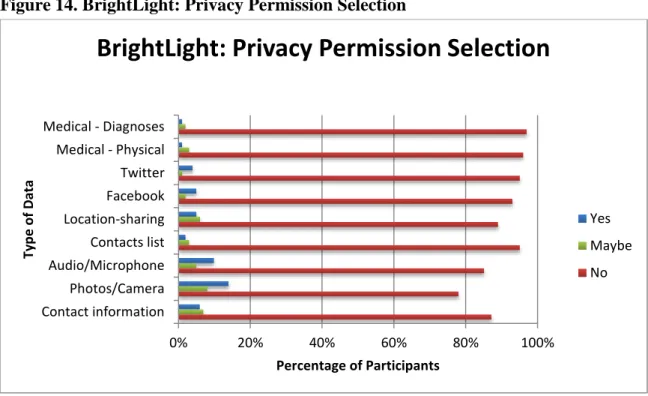
By far the majority of participants were opposed to allowing BrightLight, the
flashlight app, to access their data. A flashlight app generally only needs access the flash
on the camera in order to function, though it is unknown how many participants would
know this. There is a slight increase in participants selecting ‘yes’ (14%) and ‘maybe’
(8%) for the photos/camera option, which could indicate that a small percentage of
participants were aware of this and were willing to allow the app to access the camera
flash. Otherwise, participants were very opposed to allowing a flashlight app collect any
data.
0% 20% 40% 60% 80% 100%
Contact information Photos/Camera Audio/Microphone Contacts list Location-sharing Facebook Twitter Medical - Physical Medical - Diagnoses
Percentage of Participant
Ty
p
e
o
f D
ata
Navigator: Privacy Permission Selection
Figure 14. BrightLight: Privacy Permission Selection
Privacy Risk Knowledge
Each participant answered 8 true/false questions on privacy risks related to mobile
phones and apps. The privacy risk knowledge score was calculated by adding 1 point for
every correct answer and 0 points for every incorrect answer for a high score of 8. The
average privacy risk knowledge score was 5.4. Only two participants received perfect
scores of 8, and all participants answered at least 2 questions correctly. Figure 15displays
the number of participants who got each score.
0% 20% 40% 60% 80% 100%
Contact information Photos/Camera Audio/Microphone Contacts list Location-sharing Facebook Twitter Medical - Physical Medical - Diagnoses
Percentage of Participants
Ty
p
e
o
f D
ata
BrightLight: Privacy Permission Selection
Figure 15. Privacy Risk Knowledge Scores
Participants were well aware that companies and social media websites monitor
their browsing and use their data for advertising. Most participants answered questions
such as “Most mobile apps, such as m-Facebook or m-Yahoo, monitor and record your
browsing” correctly (89%). Nearly all participants answered, “Companies today have the
ability to place an ad that targets you based on information collected on your mobile
phone” correctly (99%). Participants were less certain, however, on more technical
questions. 60% of users answered true for the question “The goal of encrypted data
transmission is that only the user can see the data,” when the answer is false.
ANOVA was used to determine if there are differences in privacy risk knowledge
between subgroups. Differences in age, for example, may show that older adults are less
or more knowledgeable about privacy risks than adults under 30. Because this sample
was skewed to people in their 20s and had much lower amount of participants older than
40, ANOVA was performed twice, once with the original age groups (18-22, 23-29, 30-3,
0 5 10 15 20 25 30 35 40
0 1 2 3 4 5 6 7 8
Number of Participants (N=104)
Sc o re (0 -8, h ig h e st is 8)
40-49, 50-59, and 60+), and again with participants in their 40s, 50s, and 60+ grouped
together (18-22, 23-29, 30-39, 40+). ANOVA with the original age groups found that
there was a significant difference between the groups. ANOVA with the combined older
age group did not find a significant difference between the groups. This difference could
be because there were very few participants in the 40-49, 50-59, and 60+ age ranges
compared to the 18-22 and 22-29 age groups. Combining the 40s, 50s, 60s age groups
made a sample closer in size to the 18-22 and 22-29 age groups, but there was no longer
any significant difference. A more comparable sample size between age groups could
confirm if there is no difference in privacy risk knowledge between different age groups.
Figure 16. ANOVA analysis for original age groups & privacy risk knowledge score
Source of Sum of d.f. Mean F Variation Squares Squares
between 20.00 5 4.001 3.218 error 121.8 98 1.243
total 141.8 103
The probability of this result, assuming the null hypothesis, is 0.0099
Figure 17. ANOVA analysis for combined age groups & privacy risk knowledge score
Source of Sum of d.f. Mean F Variation Squares Squares
between 7.850 3 2.617 1.953 error 134.0 100 1.340
total 141.8 103
ANOVA analysis was also done for level of experience as indicated by the years
an individual has owned a smartphone, gender, and type of smartphone. Only gender was
found to be statistically significant.
Figure 18. ANOVA analysis for gender & privacy risk knowledge score
Source of Sum of d.f. Mean F Variation Squares Squares
between 5.984 1 5.984 4.528 error 133.5 101 1.322
total 139.5 102
Discussion
R1. How does selection of a mobile app differ when the privacy rating,
user rating, and price are altered? What factor is considered the
most important to selection of a mobile app?
In order to determine how participants negotiated between privacy rating, user
rating, and price, participants’ preferences from section 1 were compared and ranked
using the transitive property. This process revealed that participants consistently ranked
user rating the most important, followed by price, and lastly privacy rating. User rating
can be related to the functionality and usability of the app; if an app has a low user rating,
about three-quarters of participants are not going to install it, no matter the privacy rating.
Price, however, can help mediate this affect. If the user rating is fairly high, once the
privacy rating dips below 3 stars, users are willing to pay for a more secure mobile app.
There are some limitations based on the comparison questions asked. It is possible
that a threshold exists where privacy and user rating are more balanced. Additional
comparisons would need to be asked to determine where the balance point is. Another
limitation is that no comparison questions were asked that changed all three factors at the
same time. This was done in order to isolate specific changes, but additional questions
varying all three factors could help pinpoint nuances in how people negotiate these
factors.
far the most important factor considered. Any company or organization wanting to add a
privacy rating scale to the app stores may need to consider alternate ways to present the
information. Customers may not notice the privacy rating or ignore it depending on what
the user rating is.
R2. How do people negotiate privacy risks when selecting or allowing
privacy permissions, and do their choices vary in different
contexts?
Based on the trends displayed in Figures 12-14, most participants were cautious
about allowing the mobile app to access their data except in specific, function-related
circumstances. Most participants would allow the food and nutrition tracking mobile app
to access their physical medical information; similarly, a strong majority of people would
allow the GPS app to track their location. They were very opposed, however, to allowing
the flashlight app to access any data. These results align with the Nissenbaum’s theory of
contextual integrity and Shklovski’s study of mobile app “creepiness” (Nissenbaum,
2010; Shklovski et al., 2014). Certain privacy permissions are considered acceptable in
certain contexts, but inappropriate in others. A flashlight app that collects data outside of
its purpose would likely seem inappropriate and even creepy to many people. What is
considered acceptable also varies by person, and what their purpose for using the app is.
For example, some individuals may want to use the food and nutrition tracker with social
media in order to connect with friends. In this study, 24% of participants would allow this
app to access Facebook and 21% would allow it to access Twitter. Other individuals,
however, may consider this a major privacy infringement (72% for Twitter and 67% for
Some participants are willing to reveal personal information in order to use
certain app functions or personalize it to their needs or preferences. Control over where
and when this happens is likely to be the main issue. Future research could delve more
into this concept by seeing if participants would or would not allow, for example, a GPS
app to access their location when they are not using it as opposed to when they are.
R3. What level of knowledge of mobile app privacy risks do adults who
own smartphones have?
Based on a short, true/false quiz, the participants of this study were overall
knowledgeable about mobile phone and app privacy risks. The average score was 5.4
questions correct out of 8, and the median score was 6. As expected, participants were
well aware that companies collect their data and use it for advertising.
Participants were less aware about the more technical aspects of privacy. Most
participants (79%) incorrectly answered the question “Most app permissions seek access
to a device’s hardware, rather than a user’s personal information.” This may be due to a
misconception that privacy risks are only or usually related to accessing personal
information. A Pew Research reported that 70% of Android app permissions seek access
to the device’s hardware, such as Internet connectivity or camera flash, rather than
personal information (Anderson, 2015). This is an important distinction to consider when
displaying privacy permissions. If individuals generally consider privacy permissions to
be related to personal data, they may misunderstand that most mobile apps are asking for
hardware-related permissions such as access to the flash or vibrator. Dismissing these
explaining why an app needs permission for a particular function may help in these
circumstances.
R4. How does age, gender, type of smartphone and level of experience
relate to privacy risk knowledge?
According to the results of the ANOVA tests, only the participants' gender
showed a statistically significant affect on privacy risk knowledge score. On average,
women scored 5.3, and men scored 5.9. This effect could be due to the sampling; there
were almost four times the number of women (n=81) completing the survey than men
(n=21).
For age, a statistically significant effect was found for the original age
groupings (18-22, 23-29, 30-39, 40-49, 40-59, 60+). This effect disappeared when the
participants who were 40+ years were grouped together to create a more comparable
sample size to the younger age groups (18-22, 23-29, 30-39, 40+). With this data, it is
difficult to say if there is a statistically significant effect of age on privacy risk
knowledge. A broader sample that includes a similar number of older and younger
individuals could confirm if this difference is statistically significant. However, these
results do align with a study done by Pew Research. When asked about the acceptability
of different scenarios on privacy risks, Pew Research found no consistent demographic
answers by age, income, education, or gender (Rainie, et. al., 2016).
Limitations
There are several limitations to this research study. First is the sampling method.
Convenience and snowball sampling have the advantage of being quick and
population. This sample was primarily collected from university post-graduate students in
their 20s. This group may be more knowledge about technology and privacy, and may
have different opinions on privacy compared to the rest of the population. Because of this
sample representation, it was difficult to use ANOVA analysis to differentiate between
sub-groups, especially age or experience. Further, not all individuals who received the
email message filled out the survey. It could be that the individuals who answered the
survey had different opinions and knowledge about privacy and mobile apps.
A second limitation is that this survey measured the individual's intentions, not
their actual behavior. This is a common issue with studies involving mobile technology
and privacy, and few studies have been able to devise their methodology to measure
actual behavior (Keith et al., 2014). While intentions can tell us much about people's
opinions and state of mind regarding privacy, the privacy paradox theory suggests that
intentions do not often match with behavior. In the case of this research study,
participants may not want the mobile apps to access their data except in specific
circumstances, but in the real world would allow it to happen. This could happen because
they want to reap the benefits of the app anyway, do not know that the app is collecting
the data, or they cannot or do not know how to turn it off.
Lastly, while this survey was designed to gather quantitative data, qualitative data
could give more insight into why the participants responded the way they did. Qualitative
data might reveal more of the nuances of why participants selected a certain app, or
Conclusion
Mass data collection enabled by the unprecedented growth of smartphones and
mobile apps has become part of everyday life. Consumers have little knowledge about the
extent of privacy risks taken when using mobile apps, and are unlikely to be informed by
federal regulations or privacy certifications. This study examined people's knowledge and
perceptions of privacy risks in mobile apps, particularly how they negotiate risks in
various contexts. Generally people see user rating as the most important factor to
consider, followed by price, both of which give some indication of the usability and
usefulness of the mobile app. This study showed that privacy rating was the least
important factor people considered when selecting a mobile app. Despite knowledge of
privacy risks, most consumers appear to see privacy in mobile apps as contingent and
context-dependent. This study has important implications for how privacy permissions
and ratings can be presented to consumers to best inform their decisions. Presentation,
clarity, and context all influence consumers’ decisions to install and use mobile apps.
Developers, researchers and policy-makers need to be understand the trade-offs that
consumers are willing to make, and explicitly provide consumers with explanations for
privacy permissions and options to modify privacy settings. Hopefully in the future,
consumers will have the information about privacy and mobile apps needed to make
Bibliography
Ackerman, L. (2013). Mobile Health and Fitness Applications and Information Privacy.
Privacy Rights Clearinghouse, San Diego, CA.
Acquisti, A., & Grossklags, J. (2005). Privacy and rationality in individual decision making. IEEE Security & Privacy(1), 26-33.
Anderson, Monica. (2015). Key takeaways on mobile apps and privacy. Pew Research Center. Retrieved from: http://www.pewresearch.org/fact-tank/2015/11/10/key-takeaways-mobile-apps/
Atienza, A. A., Zarcadoolas, C., Vaughon, W., Hughes, P., Patel, V., Chou, W. Y. S., & Pritts, J. (2015). Consumer Attitudes and Perceptions on mHealth Privacy and Security: Findings From a Mixed-Methods Study. Journal of Health
Communication, 20(6), 673-679. doi:10.1080/10810730.2015.1018560
Bal, G. (2014). Designing privacy indicators for smartphone app markets: A new perspective on the nature of privacy risks of apps. Paper presented at the 20th Americas Conference on Information Systems, AMCIS 2014.
Choe, E. K., Jung, J., Lee, B., & Fisher, K. (2013). Nudging people away from privacy-invasive mobile apps through visual framing Human-Computer Interaction– INTERACT 2013 (pp. 74-91): Springer.
Enck, W., Gilbert, P., Han, S., Tendulkar, V., Chun, B.-G., Cox, L. P., & Sheth, A. N. (2014). TaintDroid: An Information-Flow Tracking System for Realtime Privacy Monitoring on Smartphones. ACM Trans. Comput. Syst., 32(2), 1-29.
doi:10.1145/2619091
Felt, A. P., Ha, E., Egelman, S., Haney, A., Chin, E., & Wagner, D. (2012). Android permissions: user attention, comprehension, and behavior. Paper presented at the Proceedings of the Eighth Symposium on Usable Privacy and Security,
Washington, D.C. http://dl.acm.org/citation.cfm?doid=2335356.2335360
Ferreira, D., Kostakos, V., Beresford, A. R., Lindqvist, J., & Dey, A. K. (2015).
Conference on Security & Privacy in Wireless and Mobile Networks, New York, New York. http://dl.acm.org/citation.cfm?doid=2766498.2766506
Fife, E., & Orjuela, J. (2012). The privacy calculus: Mobile apps and user perceptions of privacy and security. International Journal of Engineering Business Management, 5(6), 7.
Fu, H., Yang, Y., Shingte, N., Lindqvist, J., & Gruteser, M. (2014). A field study of run-time location access disclosures on android smartphones. Proc. USEC, 14.
Furberg, R. (2013). The regulatory context of mobile health in the United States and a conceptual framework for privacy and security. European Journal of ePractice, 21, 66-75.
Keith, M. J., Babb, J. S., & Lowry, P. B. (2014, 6-9 Jan. 2014). A Longitudinal Study of Information Privacy on Mobile Devices. Paper presented at the System Sciences (HICSS), 2014 47th Hawaii International Conference.
Keith, M. J., Thompson, S. C., Hale, J., Lowry, P. B., & Greer, C. (2013). Information disclosure on mobile devices: Re-examining privacy calculus with actual user behavior. International Journal of Human Computer Studies, 71(12), 1163-1173. doi:10.1016/j.ijhcs.2013.08.016
Kelley, P. G., Cranor, L. F., & Sadeh, N. (2013). Privacy as part of the app decision-making process. Paper presented at the Proceedings of the SIGCHI Conference on Human Factors in Computing Systems.
Lin, J., Amini, S., Hong, J. I., Sadeh, N., Lindqvist, J., & Zhang, J. (2012). Expectation and purpose: understanding users' mental models of mobile app privacy through crowdsourcing. Paper presented at the Proceedings of the 2012 ACM Conference on Ubiquitous Computing, Pittsburgh, Pennsylvania.
Misra, S. (2014). Happitique's recent setback shows that health app certification is a flawed proposition. iMedical Apps. Retrieved from
http://www.imedicalapps.com/2014/01/happtiques-setback-future-app-certification/
Nissenbaum, H. F. (2010). Privacy in context: technology, policy, and the integrity of social life. Stanford, Calif.: Stanford Law Books.
Park, Y. J., & Jang, S. M. (2014). Understanding privacy knowledge and skill in mobile communication. Computers in Human Behavior, 38, 296-303.
doi:10.1016/j.chb.2014.05.041
Rainie, L, & Duggan, M. (2016). Privacy and Information Sharing. Pew Research Center. Retrieved from: http://www.pewinternet.org/2016/01/14/privacy-and-information-sharing/
Shklovski, I., Mainwaring, S. D., Skúladóttir, H. H., & Borgthorsson, H. (2014).
Leakiness and creepiness in app space: Perceptions of privacy and mobile app use. Paper presented at the Proceedings of the 32nd annual ACM conference on Human factors in computing systems.
Smith, H. J., Dinev, T., & Xu, H. (2011). Information privacy research: An interdisclipinary review. Mis Quarterly, 35(4), 980-A927.
Sunyaev, A., Dehling, T., Taylor, P. L., & Mandl, K. D. (2014). Availability and quality of mobile health app privacy policies. Journal of the American Medical
Informatics Association, amiajnl-2013-002605.
Sutanto, J., Palme, E., Tan, C. H., & Phang, C. W. (2013). Addressing the personalization-privacy paradox: An empiracle assessment from a field experiment on smartphone users. Mis Quarterly, 37(4), 1141.
Wildemuth, B. M. (2009). Applications of social research methods to questions in information and library science. Westport, Conn.: Libraries Unlimited.
Xu, H., Gupta, S., Rosson, M. B., & Carroll, J. M. (2012). Measuring mobile users’