0
Add Health Wave IV
Documentation Report
Lipids
Report prepared by
Eric A. Whitsel
Carmen C. Cuthbertson
Joyce W. Tabor
Alan J. Potter
Mark H. Wener
Patric A. Clapshaw
Ley A. Killeya-Jones
Carolyn T. Halpern
Kathleen Mullan Harris
This research was supported by grant P01-HD31921 from the Eunice Kennedy Shriver National Institute of Child Health and Human Development, with cooperative funding from 23 other federal agencies and foundations. Further information may be obtained by contacting Add Health at [email protected].
2013
Carolina Population Center University of North Carolina at Chapel Hill
123 W. Franklin Street, Room 403-C Chapel Hill, NC 27517-2524
1
Table of Contents
Section Page
1. Introduction ...2
2. General Overview of Data Collection ...2
3. Capillary Whole Blood Collection ...3
3.1 Rationale ...3
3.2 Equipment ...3
3.3 Protocol ...4
3.3.1 Main Study ...4
3.3.2 Pretest Methodological Variations ...5
4. Measures of Lipids ...6
4.1 Lipid Panel ...6
4.1.1 Rationale ...6
4.1.2 Assay and Internal Quality Control ...6
4.1.2.1 Colorimetric Assays ...6
4.1.2.1.1 Total Cholesterol ...6
4.1.2.1.2 High-Density Lipoprotein Cholesterol ...8
4.1.2.1.3 Triglycerides ...9
4.1.2.2 Fluorimetric Assays ...10
4.1.2.2.1 Total Cholesterol ...10
4.1.2.2.2 High-Density Lipoprotein Cholesterol ...12
4.1.2.2.3 Triglycerides ...13
4.1.2.3 Data Cleaning ...15
4.1.2.4 Inter-Conversion of Colorimetric and Fluorimetric Assay Results ...16
5. External Quality Control ...16
5.1 Reliability ...16
5.2 Validity ...17
6. Constructed Measures ...17
6.1 Lipid Deciles ...17
6.2 Flags ...17
6.3 Low-Density Lipoprotein Cholesterol Decile ...18
6.4 Non-High-Density Lipoprotein Cholesterol Decile ...18
6.5 Total to High-Density Lipoprotein Cholesterol Ratio Decile ...18
6.6 Fasting Duration ...18
6.7 Fasted for Nine Hours of More ...19
6.8 Antihyperlipidemic Medication Use ...19
6.9 Joint Classification of Self-Reported History of Hyperlipidemia and Antihyperlipidemic Medication Use ...19
2
1. Introduction
During Wave IV, Add Health collected biological specimens from a large, nationally
representative sample of young adults. Given the size of the Wave IV sample, its geographic distribution, and in-home setting of the respondent interviews, biological specimen collection involved practical, relatively non-invasive, cost-efficient and innovative methods. These methods included collection of capillary whole blood via finger prick by trained and certified field interviewers, its in situ desiccation, then shipment, assay and archival of dried blood spots. The collection of capillary whole blood followed the collection of cardiovascular and
anthropometric measures (Entzel et al. 2009) and saliva (Smolen et al. 2013). It preceded the collection of data on respondent use of prescription and select over-the-counter medications (Tabor et al. 2010). Further details on the design of Add Health Waves I-IV, are available elsewhere (Harris 2012; Harris et al. in press).
Included in the Add Health Wave IV restricted use and public use data are thirteen constructed measures designed to facilitate analysis and interpretation of lipids results:
Total cholesterol decile
High-density lipoprotein cholesterol decile Triglycerides decile
Total cholesterol measurement method
High-density lipoprotein cholesterol measurement method Triglycerides measurement method
Low-density lipoprotein cholesterol decile Non-high-density lipoprotein cholesterol decile
Total to high-density lipoprotein cholesterol ratio decile Fasting duration
Fasted for nine hours or more Antihyperlipidemic medication use Hyperlipidemia
This document summarizes the rationale, equipment, protocol, assay, internal quality control, data cleaning, external quality control, and classification procedures for each measure listed above. Measures of glucose homeostasis, inflammation, immune function, and candidate genes are documented elsewhere (Whitsel et al. 2012a, 2012b; Smolen et al. 2013).
2. General Overview of Data Collection
3 Booklet that served as a quick reference guide to study protocols.
Respondents were free to decline any or all measurements and specimen collections while participating in other components of the interview. In the Wave IV data set, any measures that are missing due to unique interview circumstances at correctional facilities are coded as
legitimate skips.
Some measurement protocols were revised in the period between the Wave IV Pretest
(conducted in 2007) and the Main Study (conducted in 2008). Where the Pretest and Main Study data collection protocols differed significantly, this report documents the key differences
between them. Pretest cases in the Wave IV data set are flagged for identification.
3. Capillary Whole Blood Collection
3.1 Rationale
Capillary whole blood was collected to provide Add Health with the biological specimens necessary to assay and interpret a pre-specified panel of metabolic, hematologic, inflammatory, and immune biomarkers, including the lipid panel described below. It also was collected to establish a dried capillary whole blood spot archive capable of supporting future assays and ancillary studies.
4
3.2 Equipment
Equipment included sterile lancets, a rubber strap, alcohol prep pads, gauze, Band-Aid type adhesive dressings, gloves, a biohazard container, a Chux-type absorbent underpad, and a seven-spot capillary whole blood collection card (Whatman 903® Protein Saver, Whatman Inc., Piscataway, NJ) to which a stabilizing, buffered preservative had been pre-applied to Spot #1 (Exhibit 1).
3.3 Protocol
3.3.1 Main Study
During the preceding anthropometric data collection procedure, all female respondents were asked specifically whether they had a prior mastectomy and, if so, on which side. If there were contraindications to using the right hand for capillary whole blood collection, the left hand was used. If there were contraindications on both hands, capillary whole blood was not collected.
FIs collected capillary whole blood from the respondent’s middle or ring finger, unless one of the following contraindications was present:
open sores, wounds, gauze dressings or rashes; casts, splints or shunts;
intravenous (IV) catheters or other attached medical devices; swelling, withering or paralysis; or
finger on same side as prior mastectomy.
5 Exhibit 2. Collecting the capillary whole blood.
When seven capillary whole blood spots were successfully collected (or blood droplet formation ceased), FIs wiped off remaining blood with gauze, instructed respondents to firmly apply the gauze to the finger for at least two minutes, and then applied an adhesive dressing to it. FIs collecting fewer than five spots less than 80% full from a single prick requested respondents’ permission to repeat the capillary whole blood collection procedure on a second finger from the contralateral hand. FIs asked respondents to discard used capillary whole blood collection equipment in their own trash receptacle (except for lancets which were discarded in the biohazard container). FIs discarded them in the biohazard container when interviews were conducted in public locations.
FIs bar code labeled each capillary whole blood spot collection card with the corresponding respondent biospecimen ID and then air dried it for three hours. Thereafter, FIs packaged each card with a desiccant pack and shipped it in a FedEx Priority Overnight envelope to the
University of Washington Department of Laboratory Medicine (UW Lab Med, Mark H. Wener, M.D., Director, Seattle, WA) for assay.
UW Lab Med received the FedEx Priority Overnight envelopes containing a single dried blood spot collection card and desiccant pack. They scanned the FedEx tracking number and bar code-labeled card into a database in the order of receipt. They also keyed the receipt date, number of dried blood spots per card (0-7), number of adequate blood spots per card defined by blood filling ≥ 80% of the target area (0-7), comments on dried blood spot quality, and condition of the desiccant pack alongside the biospecimen ID. They grouped the cards (≤ 25 per group), sealed the groups in Ziploc bags with desiccant packs, and stored them at -70°C until processing. Immediately before processing, they warmed cards to room temperature (23°C) and re-scanned the bar code-labeled card into the database. The cards were punched for all assays except
6
3.3.2 Pretest Methodological Variations
During the Pretest, respondents chose the middle or ring finger and FIs were directed not to use the thumb, index finger or fifth digit/little finger for capillary whole blood collection. FIs also collected up to ten capillary whole blood spots: three on a BIOSAFE Blood Collection Card for HbA1c and Cholesterol Panel (BIOSAFE Laboratories, Inc., Chicago, IL) and seven more on a Whatman 903® Protein Saver, (Whatman Inc., Piscataway, NJ). The BIOSAFE card was made of Whatman 903® filter paper (Whatman International, Dassel, Germany) with a top layer of TELFA (Kendall Healthcare Products, Mansfield, MA) to minimize the effects of blood spot layering and inadvertent touching of cards with respondent fingertips (Bui et al. 2002a, 2002b; Grzeda et al. 2002; Maggiore, 2002; Tyrrell, 1999). A stabilizing borate buffered preservative was pre-applied by BIOSAFE to the area of the BIOSAFE card designated for HbA1c assay and dried. As in the main study, the Whatman 903® Protein Saver card was shipped to UW Lab Med for the Pretest and Main Study lipid assays.
4. Measures of Lipids
4.1 Lipid Panel
4.1.1 Rationale
Cholesterol and triglyceride are lipids that travel through the blood in protein-containing
particles called lipoproteins. The particles include low-density lipoprotein cholesterol (LDL-C), high-density lipoprotein cholesterol (HDL-C), and other relatively triglyceride (TG)-rich
lipoproteins. Their concentrations are associated with cardiovascular disease risk (Cui et al. 2001; Klag et al. 1993; Srinivasan et al. 2006; Stamler et al. 2000) and are targets of
antihyperlipidemic therapy (National Cholesterol Education Panel 2002). Total cholesterol (TC), HDL-C, and TG were therefore assayed in dried capillary whole blood spots.
4.1.2 Assays and Internal Quality Control
4.1.2.1 Colorimetric Assays
As described below, the three lipids were initially assayed using colorimetric procedures that measure change in color (optical density) reflective of increases in plasma lipid concentrations.
4.1.2.1.1 Total Cholesterol
The dried blood spot (DBS) total cholesterol colorimetric assay involves a series of coupled enzymatic reactions. A punch from a DBS card containing a total cholesterol (TC) assay
7 elution solution is incubated with assay reagent containing cholesterol ester hydrolase,
cholesterol oxidase, peroxidase, and a chromogen. The cholesterol ester hydrolase catalyzes the conversion of cholesterol esters to cholesterol, and this and de novo cholesterol is oxidized by cholesterol oxidase, producing hydrogen peroxide (H2O2) as a byproduct. In the presence of peroxidase, the H2O2 reacts with the chromogen causing the solution to develop color. The TC concentration is directly proportional to the absorbance of the solution; absorbance is measured spectrophotometrically. A standard curve is constructed by plotting the absorbance values of the calibrators against the known TC concentrations. Using the standard curve, the absorbance values of the QC samples and patient samples are read as TC concentrations. Acceptability of the assay is determined by comparing the TC concentrations of the QC samples with their
established values.
DBS TC assay calibrators were constructed from high TC concentration pooled human plasma (University of Washington Department of Laboratory Medicine, Seattle, WA; UW Lab Med) serially diluted with 7% bovine serum albumin in phosphate buffered saline (BSA/PBS; Sigma Aldrich, St. Louis, MO) to the desired final TC concentration. Two DBS QC samples were constructed from a separate pool of human plasma, either undiluted (high TC concentration QC sample) or diluted with BSA/PBS (low TC concentration QC sample). Each calibrator and QC sample solution was mixed with a constant volume of washed human erythrocytes (UW Lab Med), pipetted in 75µl aliquots onto No. 903 filter paper (Whatman, Piscataway, NJ) and dried for 4hr at room temperature (23°c). The final TC concentration of each calibrator and QC sample solution was determined by analysis on a UniCel DxC 800 Synchron Clinical System (Beckman Coulter, Miami, FL). DBS calibrators, QC samples and study samples were sealed in Ziploc bags with desiccant packs and stored at -70°c until processing. Immediately prior to processing, DBS were warmed to room temperature and then a single 3.2mm (1/8in) diameter punch was punched from each DBS card into a microtiter plate well (Greiner Bio-One, Monroe, North Carolina). Microtiter plates were either immediately assayed or were firmly sealed and stored at -70°c pending assay.
Immediately prior to assay, microtiter plates were warmed to room temperature. 75µl
Cholesterol Assay Elution Buffer (Synermed, Westfield, IN) was added to each microtiter plate well. The plate was sealed and gently shaken overnight on a microplate shaker (Delfia
8 calibrators against the recorded absorbance values, was used to convert the OD value of each sample into a DBS TC concentration (Gen5 Software, BioTek).
The TC assay lower limit of detection was 21mg/dl, within-assay imprecision (CV) was 10.9% and between-assay imprecision was 14.4%. The correlation between the TC concentrations of 112 DBS samples analyzed by the DBS assay and the TC concentrations of paired plasma samples was improved by adjusting the DBS TC value by the DBS sample hemoglobin absorbance per the empiric formula DBS TC value X (1 + [sample hemoglobin absorbance - mean sample hemoglobin absorbance]). The linear relationship (Pearson R = 0.93) was Plasma TC value = (hemoglobin absorbance-adjusted DBS TC value – 36.051) / 1.472.
4.1.2.1.2 High-Density Lipoprotein Cholesterol
The dried blood spot (DBS) HDL cholesterol colorimetric assay involves a series of coupled enzymatic reactions. A punch from a DBS card containing a HDL cholesterol (HDL-C) assay calibrator, quality control (QC) sample or respondent sample is eluted with a buffer solution. The elution solution is mixed with a reagent containing a chromogen and anti-human β-lipoprotein antibody to bind non-HDL lipoproteins into nonreactive complexes. A second reagent,
containing cholesterol ester hydrolase, cholesterol oxidase and peroxidase, is then added. The cholesterol ester hydrolase catalyzes the conversion of HDL-C into cholesterol, which is in turn oxidized by cholesterol oxidase and produces hydrogen peroxide (H2O2) as a byproduct. In the presence of peroxidase, H2O2 reacts with the chromogen causing the solution to develop color. The HDL-C concentration is directly proportional to the absorbance of the solution; absorbance is measured spectrophotometrically. A standard curve is constructed by plotting the absorbance values of the calibrators against the known HDL-C concentrations. Using the standard curve, the absorbance values of the QC samples and patient samples are read as HDL-C concentrations. Acceptability of the assay is determined by comparing the HDL-C concentrations of the QC samples with their established values.
DBS HDL-C assay calibrators were constructed from high HDL-C concentration pooled human plasma (University of Washington Department of Laboratory Medicine, Seattle, WA; UW Lab Med) serially diluted with 7% bovine serum albumin in phosphate buffered saline (BSA/PBS; Sigma Aldrich, St. Louis, MO) to the desired final HDL-C concentration. Two DBS QC samples were constructed from a separate pool of human plasma, either undiluted (high HDL-C
9 study samples were sealed in Ziploc bags with desiccant packs and stored at -70°c until
processing. Immediately prior to processing, DBS were warmed to room temperature and then three 3.2mm (1/8in) diameter punches were punched from each DBS card into a microtiter plate well (Greiner Bio-One, Monroe, North Carolina). Microtiter plates were either immediately assayed or were firmly sealed and stored at -70°c pending assay.
Immediately prior to assay, microtiter plates were warmed to room temperature. 75µl
Cholesterol Assay Elution Buffer (Synermed, Westfield, IN) was added to each microtiter plate well. The plate was sealed and gently shaken overnight on a microplate shaker (Delfia
Plateshake, PerkinElmer, Waltham, MA). 200μl of EZ HDL Cholesterol Reagent 1 (Trinity Biotech, St Louis, MO) was added, the plate gently shaken for 30sec and then incubated at 37°c for 45min. At the conclusion of this incubation, 60μl of EZ HDL Cholesterol Reagent 2 (Trinity Biotech) was added, the assay plate shaken for 30sec and then incubated at 37°c for 30min. 17µl HDL Cholesterol Precipitation Buffer was added to each well, the plate gently shaken for 30sec and then centrifuged for 10min at 2300rpm to pellet particulates. 200µl of the solution was removed from each well without disturbing the pellet and transferred to an assay microtiter plate. The plate was gently shaken for 30sec and the absorbance (optical density) of each well was read at 590nm by a microtiter plate reader (Synergy HT, BioTek, Winooski, VT). A linear regression calibration curve, constructed by plotting the assigned concentrations of the calibrators against the recorded absorbance values, was used to convert the OD value of each sample into a DBS HDL-C concentration (Gen5 Software, BioTek).
The HDL-C assay lower limit of detection was 9mg/dl, within-assay imprecision (CV) was 5.8% and between-assay imprecision was 5.9%. The correlation between the HDL-C concentrations of 112 DBS samples analyzed by the DBS assay and the HDL-C concentrations of paired plasma samples was improved by adjusting the DBS HDL-C value by the DBS sample hemoglobin absorbance per the empiric formula DBS HDL-C value X (sample hemoglobin absorbance / mean sample hemoglobin absorbance). The linear relationship (Pearson R = 0.91) was Plasma HDL-C = (hemoglobin absorbance-adjusted DBS HDL-C value + 0.089) / 1.344.
4.1.2.1.3 Triglycerides
The dried blood spot (DBS) triglycerides colorimetric assay involves a series of coupled
10 known TG concentrations. Using the standard curve, the absorbance values of the QC samples and patient samples are read as TG concentrations. Acceptability of the assay is determined by comparing the TG concentrations of the QC samples with their established values.
DBS TG assay calibrators were constructed from high TG concentration pooled human plasma (University of Washington Department of Laboratory Medicine, Seattle, WA; UW Lab Med) serially diluted with 7% bovine serum albumin in phosphate buffered saline (BSA/PBS; Sigma Aldrich, St. Louis, MO) to the desired final TG concentration. Two DBS QC samples were constructed from a separate pool of human plasma, either undiluted (high TG concentration QC sample) or diluted with BSA/PBS (low TG concentration QC sample). The final TG
concentration of each calibrator and QC sample solution was determined by analysis on a UniCel DxC 800 Synchron Clinical System (Beckman Coulter, Miami, FL). Each calibrator and QC sample solution was mixed with a constant volume of washed human erythrocytes (UW Lab Med), pipetted in 75µl aliquots onto No. 903 filter paper (Whatman, Piscataway, NJ) and dried for 4hr at room temperature (23°c). DBS calibrators, QC samples and study samples were sealed in Ziploc bags with desiccant packs and stored at -70°c until processing. Immediately prior to processing, DBS cards were warmed to room temperature and then two 3.2mm (1/8in) diameter punches were punched from each DBS card into a microtiter plate well (Greiner Bio-One, Monroe, North Carolina). Microtiter plates were either immediately assayed or were firmly sealed and stored at -70°c pending assay.
Immediately prior to assay, microtiter plates were warmed to room temperature. 75µl of 100% methanol (Sigma Aldrich, St. Louis, MO) was added to each microtiter plate well. The plate was sealed and gently shaken for 3hr at room temperature on a microplate shaker (Delfia Plateshake, PerkinElmer, Waltham, MA). 275µL Triglycerides Assay Reagent (Beckman Coulter, Brea, CA) was added to each well, the plate gently shaken for 30sec and then incubated for 30min at 37°. 200 µl of the reaction mixture was transferred from each well of the elution plate to a second microtiter plate. The plate was gently shaken for 30sec and the absorbance (optical density) of each well was read at 515nm by a microtiter plate reader (Synergy HT, BioTek, Winooski, VT). A linear regression calibration curve, constructed by plotting the assigned concentrations of the calibrators against the recorded absorbance values, was used to convert the OD value of each sample into a DBS TG concentration (Gen5 Software, BioTek).
11
4.1.2.2 Fluorimetric Assays
During the course of field work, colorimetric methods were replaced with fluorimetric
alternatives, described below. The anticipated advantages of the fluorimetric methods—which involve ultraviolet excitation of and spectroscopic measurement of light emitted from
fluorochromes—led to their adoption. Overall, 13905, 13676, and 13596 respondents had either a colorimetric or fluorimetric concentration of TC, HDL-C, and TG, respectively. Of these respondents, 95%, 82% and 63% had a colorimetric concentration, while 46%, 47%, and 47% had a fluorimetric concentration of the respective measures. Inter-conversion of colorimetric and fluorimetric concentrations is described below (Section 4.1.2.4).
4.1.2.2.1 Total Cholesterol
The dried blood spot (DBS) total cholesterol fluorimetric assay involves a series of coupled enzymatic reactions. A punch from a DBS card containing a total cholesterol (TC) assay
calibrator, quality control (QC) sample or respondent sample is eluted with a buffer solution. The elution solution is incubated with assay reagent containing cholesterol ester hydrolase,
cholesterol oxidase, peroxidase, and a fluorogen. The cholesterol ester hydrolase catalyzes the conversion of cholesterol esters to cholesterol, and this and de novo cholesterol is oxidized by cholesterol oxidase, producing hydrogen peroxide (H2O2) as a byproduct. In the presence of peroxidase, the H2O2 reacts with the non-fluorescent fluorogen to produce a fluorescent fluorophore. The TC concentration is directly proportional to the fluorescent intensity of the solution; fluorescence is measured spectrophotometrically. A standard curve is constructed by plotting the fluorescence values of the calibrators against the known TC concentrations. Using the standard curve, the fluorescence values of the QC samples and patient samples are read as TC concentrations. Acceptability of the assay is determined by comparing the TC concentrations of the QC samples with their established values.
12 were warmed to room temperature and then a single 3.2mm (1/8in) diameter punch was punched from each DBS card into a microtiter plate well (Greiner Bio-One, Monroe, North Carolina). Microtiter plates were either immediately assayed or were firmly sealed and stored at -70°c pending assay.
Immediately prior to assay, microtiter plates were warmed to room temperature. A TC elution buffer comprised of 400µl ddH2O with 0.1% Triton X-100 (Sigma) was added to each microtiter plate well. The plate was sealed and gently shaken for 1hr on a microplate shaker (Delfia
Plateshake, PerkinElmer, Waltham, MA). 20μl of eluent was transferred from each well of the elution plate to an assay microtiter plate. This was followed by addition of 100μl of TC assay reagent comprised of 70% Cholesterol Chromogen (Synermed, Westfield, IN), 29% Cholesterol Enzyme (Synermed) and 1% Cayman ADHP (10-acetyl-3,7-dihydroxyphenoxazine; Cayman Chemical, Ann Arbor, MI). The plate was gently shaken for 30sec and then incubated at 37°c for 30min. The fluorescence intensity (RFU) of each well was read at 530/25nm excitation and 590/35nm emission by a microtiter plate reader (Synergy HT, BioTek, Winooski, VT). A linear regression calibration curve, constructed by plotting the assigned concentrations of the
calibrators against the recorded fluorescence values, was used to convert the RFU value of each sample into a DBS TC concentration (Gen5 Software, BioTek).
The TC assay lower limit of detection was 27mg/dl, within-assay imprecision (CV) was 4.0% and between-assay imprecision was 4.7%. The TC concentrations of 105 DBS samples analyzed by the DBS assay correlated with the TC concentrations of paired plasma samples (Pearson R = 0.93) and were linearly related (Plasma TC = [DBS TC – 17.141] / 1.582). Correction for hematocrit did not improve the agreement between the serum and DBS TC values.
4.1.2.2.2 High-Density Lipoprotein Cholesterol
HDL-13 C concentrations. Acceptability of the assay is determined by comparing the HDL-C
concentrations of the QC samples with their established values.
DBS HDL-C assay calibrators were constructed from high HDL-C concentration pooled human plasma (University of Washington Department of Laboratory Medicine, Seattle, WA; UW Lab Med) serially diluted with 7% bovine serum albumin in phosphate buffered saline (BSA/PBS; Sigma Aldrich, St. Louis, MO) to the desired final HDL-C concentration. Two DBS QC samples were constructed from a separate pool of human plasma, either undiluted (high HDL-C
concentration QC sample) or diluted with BSA/PBS (low HDL-C concentration QC sample). Each calibrator and QC sample solution was mixed with a constant volume of washed human erythrocytes (UW Lab Med), pipetted in 75µl aliquots onto No. 903 filter paper (Whatman, Piscataway, NJ) and dried for 4hr at room temperature (23°c). The final HDL-C concentration of each calibrator and QC sample solution was determined by analysis on a UniCel DxC 800 Synchron Clinical System (Beckman Coulter, Miami, FL). DBS calibrators, QC samples and study samples were sealed in Ziploc bags with desiccant packs and stored at -70°c until
processing. Immediately prior to processing, DBS were warmed to room temperature and then a single 3.2mm (1/8in) diameter punch was punched from each DBS card into a microtiter plate well (Greiner Bio-One, Monroe, North Carolina). Microtiter plates were either immediately assayed or were firmly sealed and stored at -70°c pending assay.
Immediately prior to assay, microtiter plates were warmed to room temperature. 400µl diH2O HDL-C elution buffer was added to each microtiter plate well. The plate was sealed and gently shaken for 1hr on a microplate shaker (Delfia Plateshake, PerkinElmer, Waltham, MA). 40μl of eluent was transferred from each well of the elution plate to an assay microtiter plate. This was followed by addition of 75μl of HDL-C assay reagent 1 comprised of 99% EZ HDL Cholesterol Reagent 1 (Trinity Biotech, St Louis, MO) and 1% Cayman ADHP
(10-acetyl-3,7-dihydroxyphenoxazine; Cayman Chemical, Ann Arbor, MI). The plate was gently shaken for 30sec and then incubated at 37°c for 25min. At the conclusion of this incubation, 25μl of HDL-C assay reagent 2 (EZ HDL Cholesterol Reagent 2; Trinity Biotech) was added, the assay plate shaken for 30sec and then incubated at 37°c for 30min. The fluorescence intensity (RFU) of each well was read at 530/25nm excitation and 590/35nm emission by a Synergy HT Microtiter Plate Reader (BioTek, Winooski, VT). A linear regression calibration curve, constructed by plotting the assigned concentrations of the calibrators against the recorded fluorescence values, was used to convert the RFU value of each sample into a DBS HDL-C concentration (Gen5 Software, BioTek).
14 Correction for hematocrit did not improve the agreement between the serum and DBS HDL-C values.
4.1.2.2.3 Triglycerides
The dried blood spot (DBS) triglycerides (TG) fluorimetric assay involves a series of coupled enzymatic reactions. A punch from a DBS card containing a TG assay calibrator, quality control (QC) sample or respondent sample is eluted with a buffer solution. TG in the elution solution is hydrolyzed by lipase to produce glycerol, the glycerol is phosphorylated by glycerol kinase to produce glycerol-3-phosphate which, in turn, is oxidized by glycerophosphate oxidase producing hydrogen peroxide (H2O2) as a byproduct. In the presence of peroxidase, the H2O2 reacts with a non-fluorescent fluorogen, converting it into a fluorescent fluorophore. The TG concentration is directly proportional to the fluorescence intensity of the solution, measured by
spectrophotometry. A standard curve is constructed by plotting the fluorescence values of the calibrators against the known TG concentrations. Using the standard curve, the fluorescence values of the QC samples and patient samples are read as TG concentrations. Acceptability of the assay is determined by comparing the TG concentrations of the QC samples with their
established values.
DBS TG assay calibrators were constructed from high TG concentration pooled human plasma (University of Washington Department of Laboratory Medicine, Seattle, WA; UW Lab Med) serially diluted with 7% bovine serum albumin in phosphate buffered saline (BSA/PBS; Sigma Aldrich, St. Louis, MO) to the desired final TG concentration. Two DBS QC samples were constructed from a separate pool of human plasma, either undiluted (high TG concentration QC sample) or diluted with BSA/PBS (low TG concentration QC sample). Each calibrator and QC sample solution was mixed with a constant volume of washed human erythrocytes (UW Lab Med), pipetted in 75µl aliquots onto No. 903 filter paper (Whatman, Piscataway, NJ) and dried for 4hr at room temperature (23°c). The final TG concentration of each solution used to create a DBS calibrator or QC sample was determined by analysis on a UniCel DxC 800 Synchron
15 Immediately prior to assay, microtiter plates were warmed to room temperature. A TG elution buffer comprised of 400µl ddH2O with 0.1% Triton X-100 (Sigma) was added to each microtiter plate well. The plate was sealed and vigorously shaken for 1hr on a microplate shaker (Delfia Plateshake, PerkinElmer, Waltham, MA). 40 µl of eluent was transferred from each well of the elution plate to a shallow-well assay microtiter plate (Greiner Bio-One). This was followed by addition of 100μl of eluent was transferred from each well of the elutiChromogen Reagent (Beckman, Brea, CA), 5% Triglycerides Enzyme Reagent (Beckman) and 1% Cayman ADHP (10-acetyl-3,7-dihydroxyphenoxazine; Cayman Chemical, Ann Arbor, MI). The plate was gently shaken for 30sec and then incubated at 37°c for 30min (Lindberg/Blue M, Asheville, NC). The fluorescence intensity (RFU) of each well was read at 530/25nm excitation and 590/35nm emission by a microtiter plate reader (Synergy HT, BioTek, Winooski, VT). A linear regression calibration curve, constructed by plotting the assigned concentrations of the calibrators against the recorded fluorescence values, was used to convert the RFU value of each sample into a DBS TG concentration (Gen5 Software, BioTek). An assay would be rejected if the mean value of a control sample was greater than 3SD above or below the established mean value, or if the mean value of each control sample was greater than 2SD above or below the respective established mean value.
The TG assay lower limit of detection was 20mg/dl, within-assay imprecision was 7.6%CV and between-assay imprecision was 9.4%CV. The TG concentrations of 106 DBS samples analyzed by the DBS assay correlated with the TG concentrations of paired plasma samples (Pearson R = 0.98) and were linearly related (Plasma TG = [DBS TG + 10.3] / 1.438).
4.1.2.3 Data Cleaning
Plate-specific, linear regression calibration formulae were used to verify laboratory conversion of optical density to lipid concentrations (mg/dl). Seasonal variation was examined by plotting dried blood spot and quality control lipid concentrations (mg/dl) versus receipt date (2007-2009) on a single calendar time scale (1-366 days). Relatively conspicuous patterns of seasonal
16 Exhibit 3. Mean colorimetric TC and HDL-C concentrations, before and after decycling assay results
4.1.2.4 Inter-Conversion of Colorimetric and Fluorimetric Assay Results
Four respondents were randomly selected from each of 24 Add Health Wave IV Main Study strata defined by race / ethnicity (non-Hispanic white; non-Hispanic black; Hispanic; other), sex (male; female) and TG tertile (low, medium, high). Collectively, the stratified, random sample included 4 × 24 = 96 respondents whose dried capillary whole blood spot collection cards were submitted for colorimetric and fluorimetric assays by laboratory staff masked to respondent identity. The associations between paired colorimetric and fluorimetric concentrations were modeled using Deming regression (Cornbleet et al. 1979; Deal et al. 2011), i.e. colorimetric concentration = α + β × fluorimetric concentration. Compared to estimates of α (95% confidence interval), β (95% confidence interval), and the Pearson correlation coefficient in the stratified random sample, estimates in much larger convenience samples of overlapping concentrations were comparable, but more precise: 0.66 (0.25, 1.08), 0.95 (0.86, 1.04) and 0.47 for log TC in 5,805 respondents; -24.12 (-31.10, -17.15), 1.34 (1.27, 1.40) and 0.92 for TG in 1,288
respondents; and 17.05 (15.25, 18.85), 0.91 (0.85, 0.97), and 0.55 for HDL-C in 4,040 respondents (Exhibit 4). In the event of missing colorimetric, but non-missing fluorimetric results, the latter values of α and β were therefore used to convert fluorimetric to colorimetric concentrations (See Section 6.2 Flags).
17
5. External Quality Control
5.1 Reliability
Capillary whole blood was collected twice, one to two weeks apart, from a race / ethnicity- and sex-stratified random sample of 100 Add Health respondents, 14% and 17% of whom were fasting ≥ 9 hr at visits 1 and 2. The reliabilities of TC, HDL-C and TG concentrations in this sample were estimated as intra-class correlation coefficients (95% confidence intervals): 0.40 (0.22-0.58), 0.39 (0.21-0.57) and 0.71 (0.60-0.81), respectively. Assuming 95% confidence and a 5% type II error rate, corresponding values of the minimal detectable difference in TC, HDL-C and TG between two, independent samples (each of 1,000 respondents) were 17, 2.7, and 4.1 mg/dl.
5.2 Validity
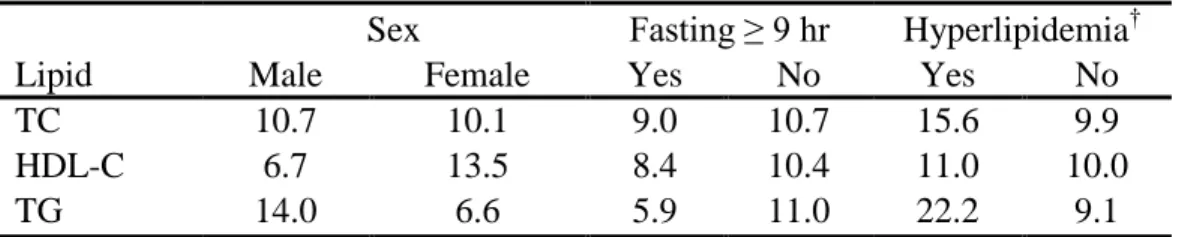
Three plasma pools, together representing low, medium, and high concentrations of TC, HDL-C and TG were obtained from the Lipid Standardization Program, Centers for Disease Control and Prevention (CDC, Atlanta, GA) and mixed with washed erythrocytes. The plasma-erythrocyte mixture from each pool was used to spot twenty capillary whole blood collection cards. One card per pool was submitted to the laboratory twice per week over a ten-week period for assay of TC, HDL-C and TG by laboratory staff masked to origin of the cards. Mean laboratory – CDC differences in TC, HDL-C and TG concentrations were large: -6, 15, and 30 mg/dl. However, corresponding Pearson correlation coefficients were high: 0.66, 0.73, and 0.85. Moreover, in the Add Health population as a whole, expected among-group differences were observed in HDL-C (male << female), TG (fasting << non-fasting), and in TC and TG (normal << hyperlipidemic respondents) (Table 1).
Table 1. Percent* of respondents in the highest lipid decile, by select attributes
Sex Fasting ≥ 9 hr Hyperlipidemia†
Lipid Male Female Yes No Yes No
TC 10.7 10.1 9.0 10.7 15.6 9.9
HDL-C 6.7 13.5 8.4 10.4 11.0 10.0
TG 14.0 6.6 5.9 11.0 22.2 9.1
18
6. Constructed Measures
6.1 Lipid Deciles
Variables: TC, HDL and TG
After de-trending, and when necessary, inter-converting assay results, total cholesterol (TC), high-density lipoprotein cholesterol (HDL), and triglyceride (TG) concentrations (mg/dl) were ordered and assigned decile ranks which are reported here. Absolute concentrations (in mg/dl) will remain unavailable given their distinctive reliance on dried capillary whole blood, nascent assay technologies, de-trending, inter-conversion of fluorimetric to colorimetric concentrations, and attendant potential for bias.
6.2 Flags
Variables: TC_FLG, HDL_FLG and TG_FLG
Flags were constructed to identify the method of measuring total cholesterol (TC_FLG), high-density lipoprotein cholesterol (HDL_FLG), and triglycerides (TG_FLG). Flags took the value “Assayed” (2) when colorimetrically assayed; “Imputed” (1) when converted from fluorimetric assay results; “Missing” (.) when blood spots were unavailable, and “No result” (9) when assay failed.
6.3 Low-Density Lipoprotein Cholesterol Decile
Variable: LDL
When the triglyceride concentration was < 400 mg/dL, a low-density lipoprotein cholesterol concentration (mg/dl) was indirectly calculated from the concentrations (mg/dl) of total cholesterol, high-density lipoprotein cholesterol and triglycerides, as follows: LDL-C = TC – HDL-C – [TG 5] (Friedewald et al. 1972). Concentrations were then ordered and assigned decile ranks.
6.4 Non-High-Density Lipoprotein Cholesterol Decile
Variable: NON_HDL
19
6.5 Total to High-Density Lipoprotein Cholesterol Ratio Decile
Variable: TC_HDL
Although the ratio of total to high-density lipoprotein cholesterol concentrations (mg/dl) is neither a primary nor secondary target of antihyperlipidemic therapy (National Cholesterol Education Panel, 2002), the ratio has been described as a simple and powerful predictor of cardiovascular disease risk (Castelli et al. 1992; Criqui and Golomb 1998; Hong et al. 1991; Kinosian et al. 1995). It was therefore calculated, as follows: TC:HDL-C = TC / HDL-C, then ordered and assigned decile ranks.
6.6 Fasting Duration (hr)
Variable: FASTTIME
In Interview Section 4: General Health and Diet, field interviewers asked respondents the following question: “At what time did you last eat or drink anything other than water, including sugar-containing candy or gum?” The response to the question was recorded in hours and minutes and designated AM or PM. On-screen instructions of “12 MIDNIGHT IS AM. 12 NOON IS PM” were provided to the field interviewer for clarification. To calculate fasting times, responses to the above question were subtracted from the laptop time stamp at the start of the interview. Since laptop clocks were set to Eastern Time for field work processing, the CPC Spatial Analysis Unit corrected interview start times using geocoded respondent locations, the time zones in which they were located, and the U.S. Daylight Savings Time schedule. In a final step, fasting times also were adjusted for interviews that stopped prematurely, but resumed later. Data on fasting times (range: 0-23.9 hr) were missing for 141 respondents, the result of recoding implausible values (> 24 hr), missing time zone data, breakoff interviews that resumed before 24 hours elapsed such that the question was not repeated, unrealistic computer timestamps, and answers of “don’t know” or “refused” to the question.
6.7 Fasted for Nine Hours or More
Variable: FAST_LIP
20
6.8 Antihyperlipidemic Medication Use
Variable: C_MED2
Use of antihyperlipidemic medications as captured by the Wave IV medication inventory (Tabor et al, 2010) may confound lipid-based estimates of cardiovascular disease risk. Respondents using an antihyperlipidemic medications in the past four weeks with one of the following therapeutic classification codes were therefore assigned a value of 1:
358-019-173 HMG-CoA reductase inhibitors
358-019-174 Miscellaneous antihyperlipidemic agents 358-019-241 Fibric acid derivatives
358-019-252 Bile acid sequestrants
358-019-316 Cholesterol absorption inhibitors 358-019-317 Antihyperlipidemic combinations
Respondents not using an anithyperlipidemic were assigned a value of 0. The (1,0) classification should be used cautiously in the investigation or control of potential confounding because selection biases often threaten the study of non-randomized medication exposures.
6.9 Joint Classification of Self-Reported History of Hyperlipidemia and Antihyperlipidemic Medication Use
Variable: C_JOINT2
21
7. References
Bui TL, Warner CN, Ildefonso J, Pirucki TL, Dewey LM, Maggiore JA. Development of a dried blood collection, transport and testing system for HDL-Cholesterol. Clin Chem 2002a; 48(S): A97.
Bui TL, Warner CN, Ildefonso J, Pirucki TL, Dewey LM, Maggiore JA. Development of a dried blood collection, transport and testing system for total cholesterol. Clin Chem 2002b; 48(S): A98.
Castelli WP, Anderson K, Wilson PWF, Levy D. Lipids and risk of coronary heart disease: the Framingham Study. Ann Epidemiol 1992;2:23-28.
Cornbleet PJ, Gochman N. Incorrect least-squares regression coefficients in method-comparison analysis. Clin Chem 1979;25(3):432-8.
Criqui MH, Golomb BA. Epidemiologic aspects of lipid abnormalities. Am J Med 1998;105:48S-57S.
Cui Y, Blumenthal RS, Flaws JA, Whiteman MK, Langenberg P, Bachorik PS, Bush TL. Non-high-density lipoprotein cholesterol level as a predictor of cardiovascular disease mortality. Arch Intern Med 2001;161(11):1413-1419.
Deal AM, Pate VW, El Rouby S. Paper CC-014. A SAS® Macro for Deming regression, 2011. Available at http://analytics.ncsu.edu/sesug/2009/CC014.Deal.pdf.
Entzel P, Whitsel EA, Richardson A, Tabor J, Hallquist S, Hussey J, Halpern CT, Harris KM. Add Health Wave IV documentation: Cardiovascular and anthropometric measures. UNC Chapel Hill: Carolina Population Center, 2009. Available at
http://www.cpc.unc.edu/projects/addhealth/data/guides/Wave%20IV%20cardiovascular%20and
%20anthropometric%20documentation%20110209.pdf.
Friedewald WT, Levy RI, Fredrickson DS. Estimation of the concentration of low-density lipoprotein cholesterol in plasma, without use of the preparative ultracentrifuge. Clin Chem 1972;18(6):499-502.
22 Grzeda BR, Bui TL, Warner CN, Pirucki TL, Dewey LM, Maggiore JA. Development of a dried blood collection, transport and testing system for triglycerides. Clin Chem 2002; 48(S):A106.
Harris KM. Design features of Add Health. UNC Chapel Hill: Carolina Population Center, 2012. Available at http://www.cpc.unc.edu/projects/addhealth/data/guides/design%20paper%20WI-IV.pdf
Harris KM, Halpern CT, Whitsel EA, Hussey JM, Killeya-Jones LA, Tabor J, Dean SC. Cohort Profile: The National Longitudinal Study of Adolescent Health (Add Health). Int J Epidemiol; In press
Hong MK, Romm PA, Reagan K, Green CE, Rackley CE. Usefulness of the total cholesterol to high-density lipoprotein cholesterol ratio in predicting angiographic coronary artery disease in women. Am J Cardiol 1991;68:1646-50.
Kinosian B, Glick H, Preiss L, Puder KL. Cholesterol and coronary heart disease: predicting risks in men by changes in levels and ratios. J Investig Med 1995;43:443-50.
Klag MJ, Ford DE, Mead LA, He J, Whelton PK, Liang KY, Levine DM. Serum cholesterol in young men and subsequent cardiovascular disease. N Engl J Med 1993;328(5):313-318.
Maggiore JA. BIOSAFE Safe At Home Cholesterol Profile Blood Collection and Transport System. US Food and Drug Administration, 510(k) Over-the-Counter Approval, 4/3/02: K012221, 2002.
National Cholesterol Education Program (NCEP) Expert Panel on Detection, Evaluation, and Treatment of High Blood Cholesterol in Adults (Adult Treatment Panel III). Third Report of the National Cholesterol Education Program (NCEP) Expert Panel on Detection, Evaluation, and Treatment of High Blood Cholesterol in Adults (Adult Treatment Panel III) final report. Circulation 2002;106(25):3143-3421.
Smolen A, Whitsel EA, Tabor J, Killeya-Jones LA, Cuthbertson CC, Hussey J, Halpern CT, Harris KM. Add Health Wave IV Documentation: Candidate Genes. UNC Chapel Hill: Carolina Population Center, 2013. Available at
http://www.cpc.unc.edu/projects/addhealth/data/guides/DNA_documentation.pdf
Srinivasan SR, Frontini MG, Xu J, Berenson GS. Utility of childhood non-high-density
23 Stamler J, Daviglus ML, Garside DB, Dyer AR, Greenland P, Neaton JD. Relationship of
baseline serum cholesterol levels in 3 large cohorts of younger men to long-term coronary, cardiovascular, and all-cause mortality and to longevity. JAMA 2000;284(3):311-318.
Tabor J, Whitsel EA. Add Health Wave IV Documentation: Prescription Medication Use. UNC Chapel Hill: Carolina Population Center, 2010. Available at
http://www.cpc.unc.edu/projects/addhealth/data/guides/medication_documentation.pdf.
Tyrrell SP. BIOSAFE Safe At Home Test Kit for Monitoring Hemoglobin A1c. US Food and Drug Administration, 510(k) Over-the-Counter Approval; 11/26/99: K991850.
Whitsel EA, Tabor JW, Nguyen QC, Cuthbertson CC, Wener MH, Potter AJ, Killeya-Jones LA, Harris KM. Add Health Wave IV Documentation: Measures of Glucose Homeostasis. UNC Chapel Hill: Carolina Population Center, 2012a. Available at
http://www.cpc.unc.edu/projects/addhealth/data/guides/Glucose_HbA1c.pdf.
Whitsel EA, Cuthbertson CC, Tabor JW, Potter AJ, Wener MH, Killeya-Jones LA, Harris KM. Add Health Wave IV Documentation: Measures of Inflammation and Immune Function. UNC Chapel Hill: Carolina Population Center, 2012b. Available at