Xinyi Liu. Design and Development of a Web-based Platform to Manage Information Resources Security in Higher Education. A Master’s Paper for the M.S. in IS degree. April, 2018. 54 pages. Advisor: Arcot Rajasekar
This paper describes the design and development of a web-based platform to assess, analyze, and manage information resources security in higher education. The paper studies the types of assets, threats, and vulnerabilities that are used and faced by higher education and how-to categorize them into different security levels. The platform manages information resources by creating and operating independent security projects. It takes the user’s input of asset, threat, and vulnerability information of each project as attributes and saves the data to a back-end database, then follows risk assessment metrics to calculate and determine risk value and level. Additionally, the visualization module provides the user a cross-view of all existing security projects based on the type and number of the asset, threat, and vulnerability to further assess and analyze them based on visual analytics.
Headings:
Information Resources Security
Web Design and Development
Risk Assessment
DESIGN AND DEVELOPMENT OF A WEB-BASED PLATFORM TO MANAGE INFORMATION RESOURCES SECURITY IN HIGHER EDUCATION
by Xinyi Liu
A Master’s paper submitted to the faculty of the School of Information and Library Science of the University of North Carolina at Chapel Hill
in partial fulfillment of the requirements for the degree of Master of Science in
Information Science.
Chapel Hill, North Carolina April 2018
Approved by
Table of Contents
1 INTRODUCTION ... 2
1.1 MOTIVATION... 2
1.2 OBJECTIVE ... 3
1.3 RESEARCH QUESTIONS ... 4
2 PRIOR WORK ... 6
2.1 INFORMATION RESOURCES IN HIGHER EDUCATION ... 6
2.2 THREAT &CHALLENGES ... 7
2.3 RISK ASSESSMENT ... 9
2.3.1 Asset categorization and value definition ... 9
2.3.2 Risk Management vs. Risk Assessment ... 10
2.3.3 Controls ... 11
2.4 INFORMATION SECURITY VISUALIZATION ... 13
2.4.1 What is Security Data Visualization? ... 13
2.4.2 Type of Security Data Visualization Tools ... 13
3 DESIGN OF THE INFORMATION RESOURCES SECURITY MANAGEMENT PLATFORM IN HIGHER EDUCATION ... 16
3.1 SYSTEM ARCHITECTURE DESIGN ... 17
3.1.1 Module Design ... 17
3.1.2 Use Case View ... 19
3.1.3 Process View... 20
3.1.4 Database Schema Design ... 22
3.2 USER INTERFACE DESIGN ... 23
3.3 RISK ASSESSMENT METRICS ... 26
4 EVALUATION OF THE INFORMATION RESOURCES SECURITY MANAGEMENT PLATFORM IN HIGHER EDUCATION ...30
5 CONCLUSION ...33
APPENDIX A: DEVELOPMENT OF THE INFORMATION RESOURCES SECURITY MANAGEMENT PLATFORM IN HIGHER EDUCATION ...40
I. DEVELOPING AND OPERATING ENVIRONMENT ... 40
II. IMPLEMENTATION OF THE DATABASE ... 40
III. IMPLEMENTATION OF THE PLATFORM ... 42
1. Implementation of Project Management ... 42
2. Implementation of Asset Management ... 43
3. Implementation of Threat Management ... 45
4. Implementation of Vulnerability Management ... 47
5. Implementation of Control Management ... 49
6. Implementation of Risk Assessment ... 50
1
Introduction
1.1
Motivation
Higher education in the U.S is highly digitalized today due to the development of the Internet
and information technology. Various systems are in place to support students’ education,
faculty members’ teaching, and staffs’ working needs. Almost every school has its own website
working as a window or platform to present school information on Academics, Research, and
Programs, which is a useful and must-have channel for the propagation of the school and its
information. There are numerous internal and external access points to all websites and
sub-websites. In both use cases, system and website, different types of data are generated, so
further security needs are raised such as data transaction, data storage, data exchange, and data
access. It is obvious that all the information resources in schools have a great number of users,
if any part of the system gets broken and stops working, it will have great effects on system
performance, users experience, research projects, school reputation, or management of
education, which means the security and integrity of all the information resources in an
education organization are very important.
Because of the huge volume of information resources in higher education, various
types of information security incidents have happened in recent years. Researchers from the
Digital Citizens Alliance (Cortez, 2017) found almost 14 million email addresses and
passwords from faculty, staff, students and alumni at U.S. universities. About 79 percent of
Illegal access to web-based information systems and use of malware software urgently needs
attention.
At the current stage, most higher education facilities have firewalls configured,
anti-virus software installed, and the framework follows certain Information Security
standards. However, the effectiveness of protecting information resources and managing
security risks and controls needs to be improved. Additionally, the metrics and approach to
manage information resource security are relatively isolated and inconsistent, there is lack of a
unified and collaborative platform for all information security officers to manage IT security
related projects. In order to build up a feasible and effective security protection system, risk
assessment is very beneficial to evaluating and offering better controls for the security of all
information resources. Data visualization is another critical technique to further represent,
analyze, and predict based on data.
1.2
Objective
The goal of this project is to research the potential security threats to information resources
in education organizations, study how risk assessment will benefit understanding and
prevention of information security incidents, integrate data visualization to support
Information Security Staff to analyze the risks and controls based on visual presentations, then
design and develop a web-based platform to analyze, assess, and manage information
resources security in education organizations.
Objectives breakdown: 1) information resources in higher education includes all kinds
of data, with this platform users will be able to categorize information based on the resource
type; 2) existing management approaches rely on human being’s cognition and past experience,
record and digitize the information to further support describing assets, threats, and risks; 3)
the management of IT resources and security related projects in higher education are relatively
focused on individual components rather than the overall effect or the relation between
components, instead, each project in this platform will have an overall risk assessment based
on each component’s risk, which can also be easily updated if any changes occur to the project;
4) various types of information and data are generated when using the platform to manage
information resources from a security perspective. It is hard to generate meaning based on a
table representation of the input data. This platform integrates visualization components to
provide the users a clearer and more comprehensive approach to analyze the data and better
understand the risks and controls.
1.3
Research Questions
RQ1: What types of information resources and associated security threats are there in higher
education?
This part of the research will include the overview and knowledge of information
resources in higher education and lists of potential threats to each one of the resources.
RQ2: How to assess the risk of information resources in higher education?
This part of the research will include the definition of general risk assessment and what
it should be in the environment and settings of higher education, which will include model
design, process design, asset categorization, vulnerability categorization, threat categorization,
and the metrics used to compute the value of the level of risk.
RQ3: What types of security visualization technologies are available in higher education?
This part of the research will include currently available security visualization
visualization in this project will be focusing on presenting the data that is manually input by
the users and providing analytic function for the users.
RQ4: How is the web-based platform to analyze, assess, and manage information resources
security in education organizations designed and developed?
This part of the research will focus on the design and development of the platform,
which includes framework, database, interface, and interaction. Last but not least, the
performance of the completed system when performing different tasks will be tested.
The following chapters will provide a detailed introduction and description of what
research has been done and the design & development processes of the project. Chapter 2
introduces previous research and work on information resources security management, what
risk assessment methods are available and what visualization tools are in place. Chapter 3
focuses on the design process and details of the web-based information resources security
management tool. Chapter 4 is about testing and evaluation of the management platform to
see if there is potential enhancement based on the current implementations. Chapter 5 is the
conclusion of the paper which provides answers to the initial research questions, lessons
learned and future improvement of the developed product. In Appendix A, it shows the
2
Prior Work
This Chapter describes and concludes prior research work that is helpful to the design and
development of my work. All the studies in this chapter not only gives me the chance to learn
about the current state of the research areas but provides me ideas and supportive materials
to my own study. It includes all the key concepts: information resources in higher education,
threats, risk assessment, and information security visualization.
2.1
Information Resources in Higher Education
The object of this project is information resources in higher education, which may refer to 1)
A system resource in computer science; any component of limited availability within a
computer system; 2) A web resource; a data source accessible on the World Wide Web; 3)
An electronic resource, information which can be stored in the form of electrical signals.
The Columbia University Information Security Charter (2016) defines information
resources in the scope of Information Security Policies as: 1) All Data regardless of the storage
medium (e.g., paper, fiche, electronic tape, cartridge, disk, CD, DVD, external drive, copier
hard drive, etc.) and regardless of form (e.g., text, graphic, video, audio, etc.); 2) The computing
hardware and software Systems that process, transmit and store Data; 3) The Networks that
transport Data.
Giszczak et al. (2016, August 23)’s report on data privacy and cybersecurity in higher
“From social security and credit card numbers to health care records and intellectual property produced by research departments, colleges and universities house a vast amount of sensitive data.”
The report lists various forms of data that need to be protected in higher education: 1)
personal and financial information; 2) health information; 3) intellectual property; 4)
government data; 5) employment-related records; 6) retail establishments.
The challenge of categorizing information resources in higher education is that
different schools have different types of resources and they organize them in different ways.
How to include them all while not overwhelming the users is a critical problem to be solved
while making design decisions.
2.2
Threat & Challenges
In Universities UK (2013)’s report on cyber security and universities, it introduces two types
of threats in Table 1:
Advanced state and
corporate threats Theft of sensitive corporate data for competitive advantage Theft of sensitive corporate data
Theft or damage to valuable research and data
‘Hacktivist’ and
criminal threats Disruption of infrastructure - e.g. overloading of websites Theft of sensitive personal data for fraud or political purposes
Table 1: Types of threats
In many countries, there are laws, regulations, and policies, governing information
security, such as the Data Protection Act and Computer Misuse Act in the United Kingdom
and the Federal Information Security Management Act in the United States. In Hong Kong, a
set of baseline policies have been established for enforcing information security in government
management have been established. Among these standards, the ISO 27000 Information
Security Management System is the most widely adopted. ISO/IEC 27000 describes the
overview and the vocabulary of information security management systems, referencing the
information security management system family of standards (including ISO/IEC 27003,
ISO/IEC 27004 and ISO/IEC 27005, with related terms and definitions.
The consequences of various security incidents may have a huge impact on:
• Reputation: information theft and integrity issues may severely harm a university’s
reputation in the eyes of students, partners, businesses and governments.
• Legal: theft of information may leave institutions in breach of legislation or contracts
and at risk of prosecution, penalties and withdrawal of existing and future funding.
• Economic: theft of information may directly undermine a university’s or researcher’s
ability to capitalize on potential intellectual property or knowledge transfer.
• Operational: there may be immediate damage to networks and infrastructure that
prevents or hinders an institution’s activities and results in significant remedial costs.
Since most information systems in higher education are web-based, they face similar
threats as web applications, such as 1) cross-site scripting; 2) SQL injection; 3) remote
command execution; 4) directory listing … this leads to data breach, malicious tampering,
system destruction and etc. Web resources such as websites are platforms and interfaces, used
to present and provide information. Thus, their stability and security are also very important.
They’re at risk of threats like 1) insecure website login method; 2) directory listing; 3) SQL
injection; 4) deadlock and phishing … which results in account hijacking and further financial
loss. As for data, it is common to experience Advanced Persistent Threat (APT). APT is an
advanced sustainability attack that is widely used by hackers to conduct long-term, fixed-target,
personnel; 2) improper operation; 3) threat to the physical environment. It is a necessity to
have relevant management strategies in place to minimize potential risk.
2.3
Risk Assessment
2.3.1 Asset categorization and value definition
According to Bishop (2003) and Peltier (2004)’s research, the CIA triad forms the principles
of information security, which include confidentiality, integrity, and availability. In the other
literature of Parker (2002) and Anderson (2003), they argued that the CIA triad should be
extended to six principles. They add authenticity, non-repudiation, and accountability. Figure
1 shows these principles:
Figure 1: Six principles of Information Security
Confidentiality is the ability to protect information from unauthorized access.
Integrity is the ability to protect information from undetected modification or deletion.
Availability is the ability to protect information from attacks by denying or inconveniencing
unauthorized accesses. It ensures that information is readily accessible to the authorized users
at all times. Authenticity is the ability to ensure that transactions or communications of
with proper access control and password protection is adopted. Nonrepudiation refers to
one’s intention to fulfill the accepted obligations. Accountability is the ability to track user
identity and actions applied to the information. Accountability is a useful element for executing
non-repudiation that proves the performance of an action (Cheung, 2014, p. 13).
2.3.2 Risk Management vs. Risk Assessment
“Maslow recognized risk in his famous hierarchy of needs by placing food and shelter, both
essential to survival, on [sic] the first rung of the ladder” (Rao, 2009, p. 87). In his book,
Against the Gods: The Remarkable Story of Risk, Bernstein (1998), an economist and financial
historian, traces the history and evolution of “risk,” explaining that the modern concept of
risk is rooted in the Hindu-Arabic numbering system and games of chance of the Greeks and
Romans, noting that the concept of risk management emerges during the Renaissance with
the inception of probability theory. “Risk management guides us over a vast range of
decision-making, from allocating wealth to safeguarding public health, from waging war to planning a
family, from paying insurance premiums to wearing a seatbelt, from planting corn to marketing
cornflakes” (Bernstein, p. 2).
While risk management is a systematic application of management policies, procedures
and practices to the tasks of establishing the context, identifying, analyzing, evaluating, treating,
monitoring and communicating risk, risk assessment involves evaluating existing security and
controls, and assessing their adequacy relative to the potential threats of the organization.
Instead of managing policies and procedures, risk assessment is a quantitative assessment of
the possible impacts caused by a security incident, which may have already happened, be
currently happening, or will happen. Information security risk assessment is the assessment of
According to Trusted Computer System Evaluation Criteria (TCSEC), risks are
qualitatively expressed as Critical, High, Medium, Low and Minimal. For purposes of this
Policy, Critical, High, Medium, Low and Minimal Risks are defined as in Table 2:
Level of the Risk Description of the Risk
Critical Risk The risk of imminent compromise or loss of Sensitive Data from either external or internal sources or where Sensitive Data has already been exposed. There is no control in place to protect the Data
High Risk The risk of imminent compromise or loss of Sensitive Data from either external or internal sources. There is only a single control, or multiple ineffective controls, in place to protect the Data
Medium Risk The risk of compromise or loss of Sensitive Data is possible from either external or internal sources, although less likely from external sources. Controls are in place that are somewhat effective to protect the Data
Low Risk The risk of compromise or loss of Sensitive Data is possible, but not probable or an Information Resource might be used to obtain access to Sensitive Data on a different Information Resource
Minimal Risk There is no realistic risk of compromise or loss of Sensitive Data
Table 2: Level of Risk. Retrieve from The Trusted Computer System Evaluation Criteria (1983-1999). https://www.cs.clemson.edu/course/cpsc420/material/Evaluation/TCSEC.pdf
2.3.3 Controls
It is necessary for a higher education institution to establish policies and control measures for
ensuring information security (Rezgui & Marks, 2008). It is challenging to apply the principles
of information security to practical use. The ISO 27001 Information Security Management
System provides a thorough coverage of the key control areas of information security as
summarized in Table 3. By making reference to ISO 27001, there are at least eight control
areas for a higher education institution, namely, information asset controls, personnel controls,
physical controls, access controls, communication controls, operation controls, information
system controls, and incident management and business continuity (Cheung, 2014, p. 13).
Control Area The purpose of the policy Action needed for Higher Education
Information
accountability are maintained for
information assets. This should be made in accordance with the sensitivity, criticality and values of information assets.
custodian and users of the information assets should be well defined.
Personnel
Controls Policies should be established to ensure that everyone in an organization clearly understand his or her roles and
responsibilities to reduce the risk of theft, fraud or misuse of information assets.
All staff should be aware of the information security threats and concerns and are equipped to support information security in the course of their normal work and reduce the risk of human errors.
Physical
Controls Policies should be established to ensure that appropriate physical security and control should be maintained to protect against any unauthorized accesses to some defined secure areas such as data centres.
Computer systems and storage of critical and sensitive information shall be housed in data centres with proper physical access controls. Access Controls Policies should be established to ensure
that access control to information systems and information processing facilities, and that access rights are properly authorized, allocated and maintained. Control measures should be implemented to enforce
authorized accesses to information as well as to reduce the risks of unauthorized access, loss or damage to information.
There should be proper access controls for information systems and information processing facilities, where student information and financial information are stored. An access control table should be defined for each information system.
Communication
Controls Policies should be established to define procedures for the management and operation of network and communication facilities. Control measures should be implemented to maintain the
confidentiality, integrity and availability of communication facilities, such as electronic mailing systems and network storage for information exchange.
Electronic communication is very common. Electronic mails containing student information or sensitive information should be handled with care. It is a good practice to use secured electronic mail systems to protect sensitive information from undetected interception, modification or omission.
Operation Controls
Policies should be established to define procedures for the management and operation of computer systems and information processing facilities. Control measures should be implemented to maintain the confidentiality, integrity and availability of the computer systems and information processing facilities.
System fixes and patches, especially those related to information security, should be timely applied. Backup
procedures should be tightly followed, and tapes and disks should be properly stored.
Information System Controls
Policies should be established to ensure proper controls to prevent information systems from any unauthorized
modification and misuse of information. Information security requirements should be clearly identified at the beginning of system development.
Incident Management and Business Continuity
Policies should be established to ensure that information security incidents are communicated in an appropriate manner, allowing timely corrective actions to be taken.
Teaching and learning are critical, and hence, control measures should be enforced to maintain continuity of teaching and learning activities in case of information security incidents.
Table 3: 8 key control areas of information security (Cheung, 2014, p. 14).
2.4
Information Security Visualization
2.4.1 What is Security Data Visualization?
SANS Institute (2015)’s report on Security Data Visualization explains how security data
visualization can be used in many areas of information security. Security metrics, Security
monitoring, anomaly detection, forensics, and malware analysis are examples of where security
data visualization can play a vital role in supporting information security professionals. Security
data visualization is part of data science and requires skills in hacking, statistical knowledge
and domain knowledge (SANS Institute, 2015, p. 3). The paper also introduces the process of
Security Data Visualization: 1) Visualization goals; 2) Data Preparation phase; 3) Exploration
phase; 4) Visualization phase; 5) Feedback and fine-tune.
2.4.2 Type of Security Data Visualization Tools
Shiravi et al. (2012) classify the recent works of network security visualization into five
use-case classes. They are host/server monitoring, internal/external monitoring, port activity,
attack patterns, and routing behavior. Each use case represents a different application area,
were defined and several recent works in each category were thoroughly described.
• Host/Server Monitoring
In this class of visualization, the main display is devoted to the representation of hosts
and servers. The intent is to display the current state of a network by visualizing the number
this class should also be able to correlate communicating processes of a single host or server
with the network traffic. This feature enhances the ability of a user to identify malware as they
often manifest themselves in irregular and often anonymous system processes (Shiravi et al.,
2012, p. 1315).
• Internal/External Monitoring
Visualizations of this class are concerned with the interaction of internal hosts with
respect to external IPs. Similar to the above-mentioned class, this class of visualization also
incorporates a display of internal hosts, but in relation to communicating external IPs. Since
the art of displaying internal hosts in a nonoccluding and meaningful manner is by itself a
delicate act, adding the burden of displaying hundreds and thousands of external IPs is a
nontrivial process for systems of this class (Shiravi et al., 2012, p. 1317).
• Port Activity
Visualizations of this class can aid in the detection of malicious software running inside
a network. Scaling techniques must be incorporated in the design of visualizations of this class,
due to the amount of traffic as well as the large range of possible port numbers and IP
addresses (Shiravi et al., 2012, p. 1318).
• Attack Patterns
Visualizations of this class aid an administrator in not only the detection of attacks but
also the display of multistep attacks. Different types of attacks show different behaviors and
accordingly different visual patterns appear. Many types of attacks are carried out in multiple
phases, generally starting with reconnaissance, followed by scanning, acquiring access,
maintaining access, and finally clearing tracks and installing back doors for future access.
Visualizations of this class should aid in displaying these phases (Shiravi et al., 2012, p. 1319).
Understanding the evolution of Border Gateway Protocol (BGP) routing patterns over
time is the main goal of this visualization class. The distributed nature of BGP and the lack of
verification of the validity of the announcements causes Internet routing to be susceptible to
attacks. The ability to detect and correct disruptions in Internet traffic caused by router
3
Design of the Information Resources Security Management
Platform in Higher Education
Based on the research on prior work in chapter 2, chapter 3 is about the design process of the
proposed platform for managing information resources security in higher education.
The motivation of building a web-based information resources security management
platform is there is no such unified and targeted platform for information resources security
in higher education, while a system is needed to support specific security projects management
instead of an overall and undifferentiated management platform for all types of IT projects
since the features and attributes that are required to evaluate and analyze a security project are
unique and more specific.
Based on the previous study and information gathering, there are major
concepts/aspects that need to be included to make the platform feasible and helpful to security
analysts in higher education, they are 1) asset, 2) threat, and 3) vulnerability. These three
attributes together describe the key components of a security project and they provide support
as well as a base for risk assessment. Moreover, data visualization is integrated into the
platform to provide analysts the ability to analyze and manage the projects from a visual
perspective.
The first step of implementing the proposed platform is designing, so in this chapter, it
uses different models to explain and illustrate the design from different angles with various
focus. Module Design separates functionalities into chunks of with specific modules that
with the platform and what functions are available to certain users with different accesses.
Process View focuses on how users’ action would trigger the read/write operations between
the front-end and the database. Database design shows the detailed schema of the back-end
database and what columns are included in all the tables. Last but not least, the UI design is
presented which includes all the draft digital prototypes of major interfaces.
3.1
System Architecture Design
3.1.1 Module Design
Module Design is used to illustrate the system design from a broader and overall view without
touching on detailed flows and processes. It gives a clear and organized view of what modules
are included and what sub-modules are under them. There is hierarchy organization of the
design since it follows the workflow of the information resources management platform.
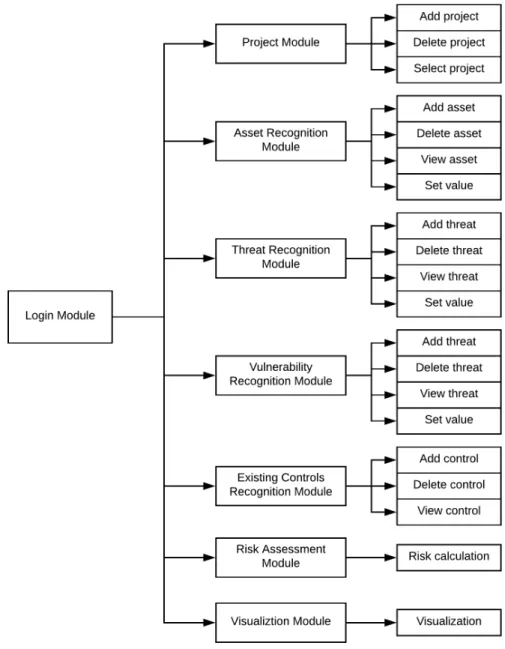
As shown in Figure 2, the web-based information resources security management
platform asks user to input project information; then based on each project, add the associated
asset data; then based on asset, input the corresponding threat it faces; then according to the
threat information, the vulnerability is added that represents how vulnerable and easy to hack
an asset is. After three attributes’ data is input, risk assessment module takes all the data and
calculates associated risk. The visualization module is the module that takes all existing projects’
information and shows a cross-view of the projects on asset types, threat types, and
vulnerability types.
For the sub-modules, the project module includes functions: add a project, delete a
project, and select project (to show the information of selected project for all pages). The asset
module includes add an asset, delete an asset, view asset, and set value for the asset. The threat
vulnerability module includes add vulnerability, delete vulnerability, view vulnerability, and set
value for the vulnerability. The control module allows the user to add control, delete control,
and view control. The risk assessment module handles risk calculation, and the visualization
module generates visualization based on the users' former input for the asset, threat, and
vulnerability modules.
3.1.2 Use Case View
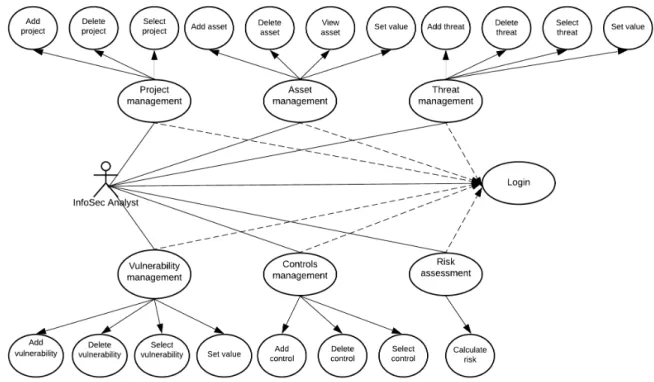
Use Case View is a view of system functions used by system operators. A Use Case View
shows all the interactions between users and the system. The view presents what type of
operation is conducted by the users. The Use Case View of the web-based information
resources security management platform is shown in Figure 3:
Figure 3: Information Resources Security Management Platform - Use case view
In Figure 3, the solid lines between the analyst and cases represent the functions that
the analyst can use; the dotted lines between cases and the login module represent the
operations that can be conducted after logging in. Detailed instruction for each use case is
listed in Table 4:
Case Instruction
Login Analyst uses valid user name and password to log into the platform.
Asset management Analyst can add, delete, view, and set value for asset. Threat management Analyst can add, delete, view, and set value for threat. Vulnerability management Analyst can add, delete, view, and set value for vulnerability.
Control management Analyst can add, delete, and view control. Risk assessment Analyst can calculate the risk.
Table 4: Case Instruction
3.1.3 Process View
Use Case View describes operations that can be conducted by the analyst, which leads to the
detailed process design, while Process View makes it easier to further understand the detailed
processes that happen within every operation.
• Login Operation
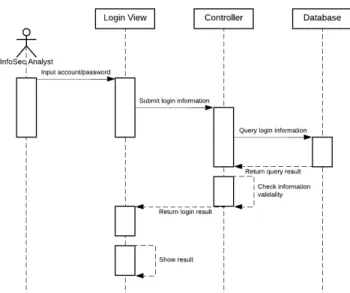
This is an operation that happens when analyst tries to log into the platform, the user
interacts directly with the view. When the user inputs username and password information
and submits it to the back-end, the controller passes the data and queries the database to check
if the data is valid. If it passes the authentication, the platform guarantees the access to further
functionalities. If not, it throws an error message and denies the access request. The process
is shown in Figure 4:
• Add/delete/set value Operation
Add, delete, and set value operations follow a similar process when communicating
with the database. In Figure 5, I use “Asset Management” as an example with “Add New
Asset” operation, the analyst needs to input required fields on the page and click on submit,
which triggers a query of inserting a row to the corresponding table in the database. The flow
is the same for delete as well as set value requests, the difference is the query changes
depending on the “read” and “write” actions.
Figure 5: Add operation process view
• View Operation
When an analyst chooses to view existing instances, as shown in Figure 6, it uses “View
Asset” as an example, the controller sends the query to request all existing assets’ information.
If there is data saved in the database, then it returns all the instances, then the controller
Figure 6: View operation process view
3.1.4 Database Schema Design
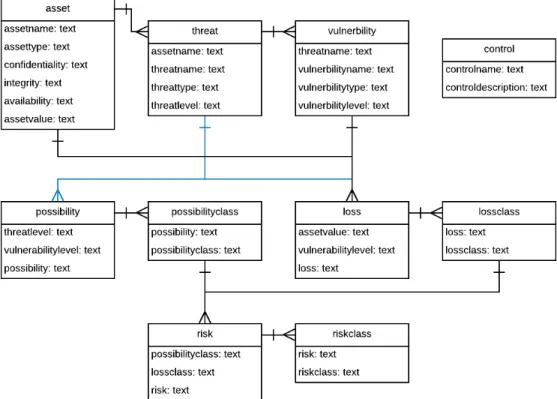
As shown below in Figure 7, this is the database schema design for the system:
System database is the base of implementation of all the operations related to data.
Based on the module and functionality design, three major tables are needed for each project:
asset, threat, and vulnerability. For asset table, it includes attributes (columns): asset name,
asset type, confidentiality, integrity, and availability. For threat table, it includes attributes
(columns): associated asset’s name, threat name, threat type, and threat level. For vulnerability
table, it includes attributes (columns): associated threat’s name, vulnerability name,
vulnerability type, and vulnerability level. As for control table, it has control name and
description columns. Based on vulnerability level and threat level, the Information Resources
Security Management Platform follows the metrics (explained in section 3.3), queries the
pre-implemented “risk assessment” database to generate “possibility value” and “possibility class”,
then writes them into corresponding tables. Similarly, based on vulnerability level and asset
value, the Information Resources Security Management Platform follows the metrics
(explained in section 3.3), queries the pre-implemented “risk assessment” database to generate
“loss value” and “loss class”, then writes them into corresponding tables. Then based on
“possibility class” and “loss class”, it queries again to check “risk value” and “risk class”, then
writes it into “risk” and “riskclass” tables.
3.2
User Interface Design
This section focuses on presenting the digital prototyping and designing the user interface.
Based on the module design introduced in section 3.1.1, the user interface follows the flow of
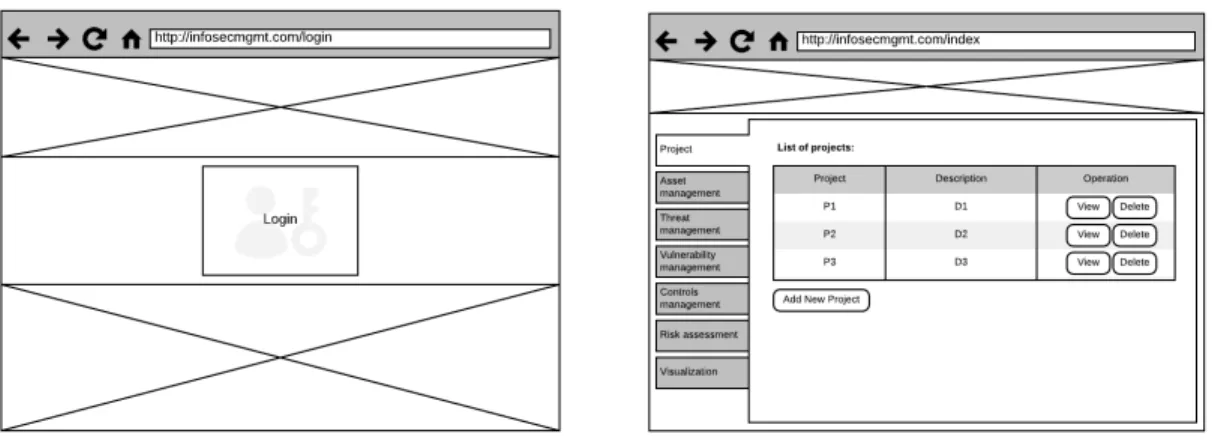
the modules. As shown on the left in Figure 8, analyst is asked to log in first. Then the main
page on the right in Figure 8, it shows an overall project information on the homepage of the
Information Resources Security Management Platform so the analyst can add, delete, or select
Figure 8: User login interface (left) and project management interface (right)
Then it jumps to “Asset Management” page as shown on the left in Figure 9, it lists
all existing assets and corresponding type, confidentiality, integrity, and availability values. The
analyst can “Add New Asset” which jumps to another page to input information for a new
asset. The next tab on the navigation bar is “Threat Management” as shown on the right in
Figure 9, it has the same layout as “Asset Management” which lists all threats with the
associated asset, threat type, and its level. For both asset and threat management pages, for
each row in the list, the analyst can choose to delete certain asset and threat.
Figure 9: Asset management interface (left) and threat management interface (right)
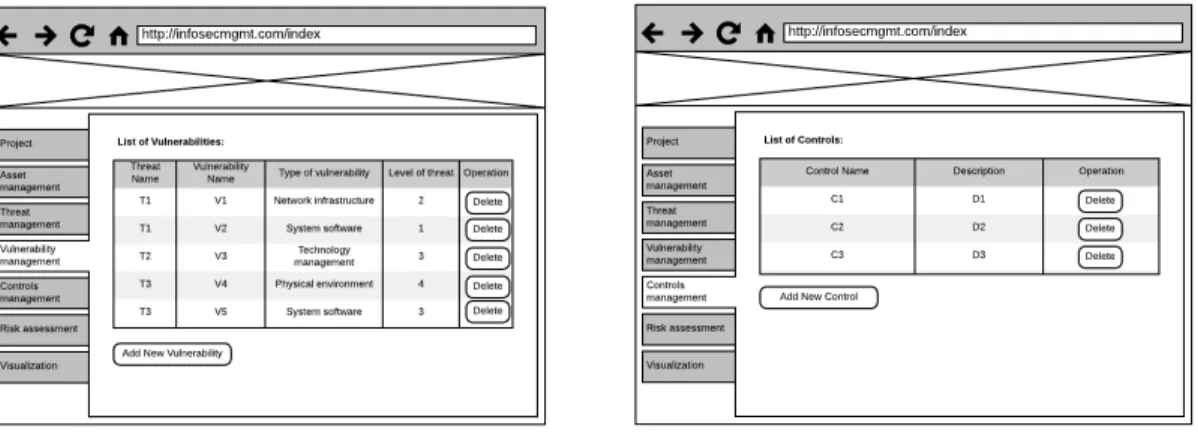
Similar to “Asset Management” and “Threat Management” interfaces, as shown in
are the same, they list all existing instances and show the detailed type and level information.
Additionally, the analyst has the option to add new instance or delete existing ones.
Figure 10: Vulnerability management interface (left) and control management interface (right)
The next tab in the side navigation bar is “Risk Assessment”, when the analyst chooses
this tab, it automatically retrieves needed values of existing assets, threats, and vulnerabilities,
then based on risk assessment metrics (explained in section 3.3), calculates the risk value and
level, and lists them on the interface as shown on the left in Figure 11. On the right in Figure
11, it provides an initial prototyping of visualization. The visual graphs are built to focus on
three attributes: asset, threat, and vulnerability.
3.3
Risk Assessment Metrics
Risk assessment refers to the evaluation work of quantifying possible loss to people’s life,
production, property… when a security accident happens, which also means a quantitative
evaluation of the possibility of a security accident happens and the loss the accident might
bring. For information security risk assessment, it includes the asset value of information asset,
the threats it faces, and its vulnerability level, then considers all three factors to determine and
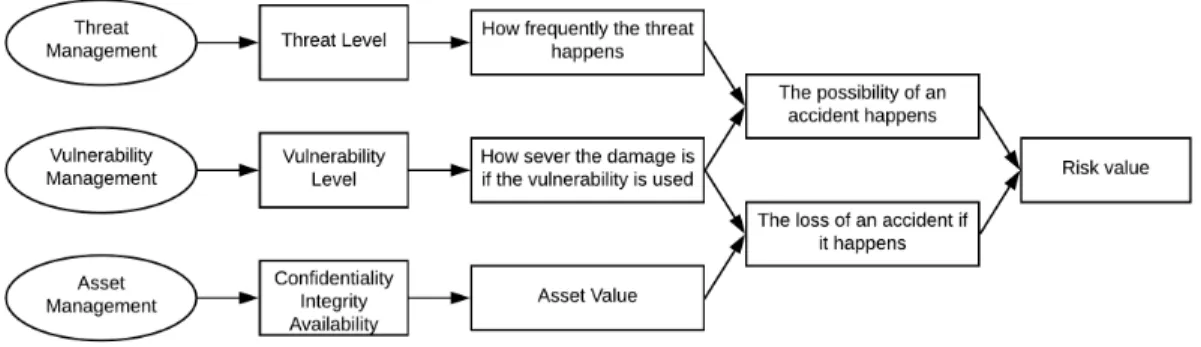
evaluate the risk. To combine the three factors and evaluate the risk, Figure 12 shows the risk
assessment schema:
Figure 12: Risk assessment schema
The risk assessment of Information Resources Security Management Platform follows
the schema in Figure 12, it extracts threat level value from the threat related table which reflects
how frequently the threat happens. It also retrieves the vulnerability level value from
vulnerability related table which reflects how sever the damage is if the vulnerability is used.
The asset value is determined by confidentiality, integrity, and availability values by calculating
the average of these three values. Each asset faces its own threat which has different levels of
vulnerability. Like discussed in formal paragraph, “Risk assessment is a quantitative evaluation
of the possibility of a security accident happens and the loss the accident might bring”, so how
determine the possibility of a security accident happens, in the meanwhile, how sever the
damage is if the vulnerability is used and asset value determine the loss the accident might
bring. Last but not least, the possibility and the loss together decide the risk. The detailed
evaluation metrics of the Information Resources Security Management Platform is explained
as below:
a. Firstly, in calculating the potential for a security accident to happen, a possibility matrix
needs to be conducted, as shown in Table 5:
Vulnerability Level 1 2 3 4 5
Threat
Level 1 2 2 3 4 6 10 7 11 13 14 17
3 5 9 12 16 20
4 7 11 14 18 22
5 8 12 17 20 25
Table 5: Matrix to determine the possibility value of a security accident happen
Based on the threat level and the vulnerability level, then using the possibility
matrix to determine the possibility value.
Since the possibility of a security event happening needs to be included into
the risk assessment calculation, in order to build the risk matrix, possibility value needs
to be categorized into possibility levels, as shown in Table 6:
Possibility Value 1~5 6~11 12~16 17~21 22~25
Possibility Level 1 2 3 4 5
Table 6: Matrix to determine the possibility level of a security accident happen
b. Secondly, in calculating the severity of a security accident, a loss matrix needs to be
Vulnerability Level 1 2 3 4 5 Asset
Value 1 2 2 3 4 6 107 11 13 14 17
3 5 9 12 16 20
4 7 11 14 18 22
5 8 12 17 20 25
Table 7: Matrix to determine the loss value of a security accident
Based on the asset value and the vulnerability level, then using the loss matrix
to determine the loss value.
Since the loss related to a security event happening needs to be included into
risk assessment calculation, in order to build the risk matrix, loss value needs to be
categorized into a loss level, as shown in Table 8:
Loss Value 1~5 6~11 12~16 17~21 22~25
Loss Level 1 2 3 4 5
Table 8: Matrix to determine the loss level of a security accident
c. Finally, in calculating the risk value, a risk matrix needs to be conducted, as shown in
Table 9:
Possibility Level 1 2 3 4 5
Loss
Level 1 2 2 3 4 6 107 11 13 14 17
3 5 9 12 16 20
4 7 11 14 18 22
5 8 12 17 20 25
Table 9: Matrix to determine the risk value of given asset, threat, and vulnerability
Based on the possibility level and the loss level, then using the risk matrix to
determine the risk value, which is then used to determine the risk level, as shown in
Risk Value 1~5 6~11 12~16 17~21 22~25
Risk Level 1 2 3 4 5
Table 10: Matrix to determine the risk level of given asset, threat, and vulnerability
This chapter thoroughly illustrates the design process and outcome of the Information
Resources Security Management Platform. It starts with the overall infrastructure design, then
the database schema description, user interface design, and risk assessment metrics
explanation. They provide support to the development phase of the Information Resources
Security Management Platform. For the outcome and detailed implementation process of the
4
Evaluation of the Information Resources Security
Management Platform in Higher Education
To evaluate the platform, I conducted four short, unstructured, informal, feedback-oriented
interviews with four IT professionals that either works in IT Service in a higher education or
IT department of an enterprise. The reason why I chose to interview these people is 1) they
are the potential users of the platform, so their feedback and feelings are extremely valuable
when assessing the feasibility and functionality of the platform. 2) they either have IT related
experience in an academic setting or working experience in industry with a concentration in
IT Security, so they know what will be practical and helpful to their daily work.
Each interview lasted 10 - 15 minutes. The goal of the interviews was gathering direct
and immediate comments, feelings, and feedback, rather than conducting a user study to
improve user experience. I expected to gain more constructive ideas and advice on the
concepts and functions of the platform. These are the steps that I followed for the interviews:
1) explaining the purpose of the interview. 2) introducing the motivation and objective of the
master project. 3) asking the interviewee to briefly interact with the platform. 4) further adding
more explanations and demonstrations when necessary. 5) asking for their initial thoughts on
what is helpful and practical as well as what can be improved and how I can improve it.
During the interview, I took notes on participants’ comments and feedback. I also
asked the question to the IT specialists: what are potential enhancements for future
development and improvement of the project? I selected some major points from their
Role Comment Potential Enhancement IT staff
(centralized IT Service)
“It is a very useful tool for managing information security. How can you make sure every type of asset is covered by the system?
The staff who are going to use this platform require solid knowledge of
InfoSec to select the correct type, value, etc. How would you expect users who don’t have enough knowledge and experience to use it?”
Before putting the system into use, you would want to conduct more interviews and studies to make sure you have covered every possible scenario.
Necessary training should be offered to staff so that they will gain the knowledge and technique needed to interact with the system.
IT staff (branch IT Service)
“There are already many existing systems in the university. Adding another one would add a lot more work. Is there any way to integrate the platform into the existing systems?
We are a branch of the university IT Service. How would the system work if there are different security projects in different divisions of the university?”
Seek opportunities to integrate the platform into existing workflow, so that adoption can be easier and more cost-efficient. Customization and consideration of how to distribute and manage sub-tasks, and their relation to the overall task will make the platform more practical. IT staff (IT service of another higher education)
“It definitely can be used in my university and for my work, but individual and targeted research would need to be conducted to focus the project on threats the university faces. Also, the university probably would prefer to adopt a more wide-used and mature system. One thing you probably want to consider is that what makes your platform useful and beneficial to IT staffs work?”
To expand and adapt the platform to more universities, more in-depth research needs to be done.
Moreover, making the benefits and uniqueness clearer is essential for the promotion and generalization of the system.
IT Security staff (enterprise IT
department)
“The framework and idea behind this platform can be transferred to an enterprise setting. But there are a lot more things that need to be re-evaluated and re-considered. The enterprise version would be more complicated and would require more features and security implementations.”
Applying the system to enterprise still has a long way to go due to the nature of different settings,
scenarios, environment, requirements, etc.
Table 11: IT specialists’ comment and potential enhancement
The commenters’ views are extremely valuable since they are the potential direct users
of the proposed platform. Their responses to the prompt questions revealed the additional
places for future improvement, as summarized in Table 11. They all shared their ideas from
their unique perspective due to their diverse background and position. The staff working in
under the fact of centralized IT and its branches. Additionally, an IT staff from another
university cares more why they should adopt the system and how they can make it beneficial.
While for the IT security staff in an enterprise, the platform is far from mature enough to be
5
Conclusion
The paper achieves its objective of designing and developing a web-based platform to manage
assets, threats, and vulnerabilities of information resources in higher education. It also
provides the function of risk assessment which includes the metrics it follows and calculation
it conducts. Additionally, based on the users' input, it generates visualizations to provide the
user an approach to analyze and manage security projects from a visual perspective.
To answer RQ1, I conclude 6 types of asset (Data, Software, Hardware, Service,
Personnel, and Others), 9 types of security threat (Software and hardware failures, Physical
environment influence, Inaction or operation error, Lack of management, Malicious code,
Unauthorized or abuse, Network attack, Physical attack, and Denial), and 7 types of
vulnerability (Physical environment, Network infrastructure, System software, System
middleware, Application system, Technical management, and Organization and management).
To answer RQ2, I take the asset, threat, and vulnerability attributes into consideration and
then follows the risk assessment metrics described in section 3.3 to realize the evaluation. To
answer RQ3, research is conducted and there are host/server monitoring, internal/external
monitoring, port activity, attack patterns, and routing behavior security visualization tools
available for higher education to adopt from. To answer RQ4, chapter 3 illustrates the detailed
design process and Appendix A describes how each design is implemented.
I have learned many lessons from this master project experience. These are the major
ones: 1)a feasible goal and detailed plan is half of the success. There were many ideas in
preliminary research and discussing with my proposal class instructor, as well as my master
paper advisor, apparently, not all of the ideas can be realized and implemented for a master
paper. Also, having a well-planned timeline is important in terms of time and process
management. At the beginning of the master paper proposal class, I took my instructor’s
suggestion and narrowed down the scope of the project. During the design cycle of the project,
after communication with my advisor, I expanded and refined the techniques I would use for
the project. Though these steps are made far from the final implementation of the product,
they decide the end point that will be reached and the direction the project will go, which is
half of the overall success. 2)always think about what users need. I first thought I could
design and develop anything based on my imagination since this is a project-based paper, but,
obviously, the output of the project should be a system, platform, or application that can be
put into the practical world, which involves the target audience of the product. This platform
is designed for IT Security staff in higher education, allowing them to manage information
resources security. In order to achieve that, targeted research on each aspect needed to be
conducted. Moreover, gaining perspective and expectations of potential users was essential
since their input helped me decide which functions were included and how they were realized
and implemented. The classes I have taken in SILS such as Research Method Overview and
User Interface Design helped me to conduct more effective research and in-depth analysis. 3)
design and development are circular. Everything starts with simple scratches, then
develops into digital prototypes, and then into a draft product prototype. But designing and
refining the design should not be a one-time action, instead, it will cycle as development
happens. That is how self-reflection and other’s feedback are taken into consideration for
ongoing design and development. My project experience in SILS really helped me a lot during
and understand user’s need. Visual Analytics class provided an opportunity to experience the
full-stack design and development cycle and made me realize that the process is circular and
how I should adjust my goals and actions based on the requirement and current state.
For the further improvement of this platform. These are several possible developments:
1) integration into existing systems. The proposed platform is designed and built
individually. It will be better if every higher education organization can integrate and adopt it
into its own existing systems or workflows. Using multiple systems for IT staff can be
challenging when it comes to consistency and maintenance. Also, the generalization and
transferability of the platform can be challenging since every higher education organization
has its own relatively mature IT infrastructure. Adopting parts or an alternative version of the
proposed platform would be a better option. 2) hierarchical collaboration and
customization. As described in the evaluation section, users from different levels and
branches of the organization may focus on different scopes and operations when using the
platform to manage information resources security. The currently proposed system treats all
levels of staff equally and there is no customization available. However, in the real world,
centralized IT management is as common as its branches, so the need and requirement of
various features and access controls are valid concerns and focuses for the next step of design
and development. 3) interactive visualizations. The visualization module in the current
proposal is not interactive, instead, it simply retrieves users’ input data and displays it. To make
it more dynamic and responsive based on users’ interaction and need in data selection, more
D3 library methods should be added to make it real-time interactive, so that users have the
ability to filter and highlight the population they care about to make assessment and analysis
References
Anderson, J. M. (2003). Why we need a new definition of information security. Computers & Security,
22(4), 308-313.
Bernstein (1998). Against the gods: The remarkable story of risk. New York, NY: John Wiley & Sons.
Bishop, M. (2003). What is computer security? IEEE Security & Privacy, 99(1), 67-69.
Cheung, S. K. (2014). Information Security Management for Higher Education Institutions. In
Intelligent Data analysis and its Applications, Volume I (pp. 11-19). Springer, Cham. Retrieved from:
https://link-springer-com.libproxy.lib.unc.edu/content/pdf/10.1007%2F978-3-319-07776-5_2.pdf
Columbia University Information Security Charter. Retrieved from:
http://policylibrary.columbia.edu/files/policylib/imce_shared/Information_Security_Chart
er.pdf
Cortez, R. B. (September, 2017). Millions of .Edu Email Credentials Are for Sale on the Dark Web.
Retrieved from:
https://edtechmagazine.com/higher/article/2017/09/millions-edu-email-credentials-are-sale-dark-web
Erbacher, R. F., Walker, K. L., & Frincke, D. A. (2002). Intrusion and misuse detection in large-scale
systems. IEEE Computer Graphics and Applications, 22(1), 38-47. Retrieved from:
http://digital.cs.usu.edu/~erbacher/publications/CGAGlyphBasedIntrusionDetection.pdf
Fink, G. A., Muessig, P., & North, C. (2005, October). Visual correlation of host processes and
network traffic. In Visualization for Computer Security, 2005.(VizSEC 05). IEEE Workshop
on (pp. 11-19). IEEE. Retrieved from:
Giszczak, J., Paluzzi, D., Krause, S. (2016, August 23). Pass or fail? Data privacy and cybersecurity
risks in higher education. Retrieved from:
https://www.beazley.com/documents/Insights/201606-data-privacy-and-cybersecurity-in-higher-education.pdf
Harris, C. E., & Hammargren, L. R. (2016, September 6). Higher education’s vulnerability to cyber
attacks. Retrieved from: https://www.universitybusiness.com/article/0816-wisp
Hina, S., & Dominic, D. D. (2017, July). Need for information security policies compliance: A
perspective in Higher Education Institutions. In Research and Innovation in Information Systems
(ICRIIS), 2017 International Conference on (pp. 1-6). IEEE.
Information resource. Retrieved from: https://en.wikipedia.org/wiki/Information_resource
ISO, ISO 27000, Information Security Management System: Family of Standards, Joint Technical
Committee, International Organization for Standardization and International
Electrotechnical Commission (2005).
ISO/IEC 27003, Information technology — Security techniques — Information security
management system implementation guidance
ISO/IEC 27004, Information technology — Security techniques — Information security
management — Measurement
ISO/IEC 27005, Information technology — Security techniques — Information security risk
management
Kenning, M. J. (2001). Security management standard - iso 17799/bs 7799. BT Technology Journal,
19(3), 132-136. Retrieved from: http://www.tarrani.net/AttainingISO17799.pdf
Kvavik, R. B., & Voloudakis, J. (2003). Information technology security: Governance, strategy, and
practice in higher education. Educause.
Lakkaraju, K., Yurcik, W., Bearavolu, R., & Lee, A. J. (2004, October). NVisionIP: an interactive
network flow visualization tool for security. In Systems, Man and Cybernetics, 2004 IEEE
https://s3.amazonaws.com/academia.edu.documents/46443856/NVisionIP_An_interactive
_network_flow_vi20160613-22544-orrcml.pdf?AWSAccessKeyId=AKIAIWOWYYGZ2Y53UL3A&Expires=1506950711&Sig
nature=HMLpyE4BbrZFbiuBFYGDMHNunto%3D&response-content-disposition=inline%3B%20filename%3DNVisionIP_an_interactive_network_flow_vi.pdf
Lundquist, A. E. (2015). Enterprise Risk Management (ERM) at US colleges and universities:
Administration processes regarding the adoption, implementation, and integration of ERM.
Western Michigan University. Retrieved from:
http://scholarworks.wmich.edu/cgi/viewcontent.cgi?article=2183&context=dissertations
Parker, D. B. (2002). Toward a New Framework for Information Security?. Computer Security
Handbook, Sixth Edition, 3-1.
Peltier, T. R. (2004). Information security policies and procedures: a practitioner's reference. CRC
Press.
Rao, A. (2009). Implementation of enterprise risk management (ERM) tools - a case study. Academy of
Accounting and Financial Studies Journal, 13(2).
Rasmussen, R. (2011, April 28). The College Cyber Security Tightrope: Higher Education Institutions
Face Greater Risks. Retrieved from:
http://www.securityweek.com/college-cyber-security-tightrope-higher-education-institutions-face-greater-risks
Rezgui, Y., & Marks, A. (2008). Information security awareness in higher education: An exploratory
study. Computers & Security, 27(7), 241-253. Retrieved from:
https://www.researchgate.net/profile/Yacine_Rezgui/publication/222652086_Information
_security_awareness_in_higher_education_An_exploratory_study/links/565ed8c508ae4988a
7bd80d2.pdf
Roscorla, T. (2016, May 18). 8 Cybersecurity Challenges Facing Higher Education. Retrieved from:
Security Data Visualization. SANS Institute. Retrieved from:
https://www.sans.org/reading-room/whitepapers/metrics/security-data-visualization-36387
Shiravi, H., Shiravi, A., & Ghorbani, A. A. (2012). A survey of visualization systems for network
security. IEEE Transactions on visualization and computer graphics, 18(8), 1313-1329.
Retrieved from: http://ieeexplore.ieee.org/stamp/stamp.jsp?arnumber=6u007132
Systems development life cycle. Retrieved from:
https://en.wikipedia.org/wiki/Systems_development_life_cycle
The CAUSE Current Issues Committee (1997, January 1). Current Issues for Higher Education
Information Resources Management. Retrieved from:
https://library.educause.edu/~/media/files/library/1997/1/cem9712-pdf.pdf
Thomas, L. R. (2013). Information Security in Higher Education: Threats & Response. Retrieved
from:
https://www.giac.org/paper/gsec/2445/information-security-higher-education-threats-response/104246
Trusted Computer System Evaluation Criteria (TCSEC). Retrieved from:
https://www.cs.clemson.edu/course/cpsc420/material/Evaluation/TCSEC.pdf
Universities UK (2013, November), Cyber security and universities: managing the risk. Retrieved
from:
http://www.universitiesuk.ac.uk/policy-and-analysis/reports/Documents/2013/cyber-security-and-universities.pdf
Wolff, J. (2015, October 11). Can Campus Networks Ever Be Secure? Retrieved from:
Appendix A: Development of the Information Resources
Security Management Platform in Higher Education
Appendix A is a supplementary section to give further explanation and illustration on the
development and implementation of the web-based information resources security
management platform. It introduces the development environment, the outcome of database
implementation and all the front-end functionality implementation. This section uses
screenshots of the actual product to show the views and interfaces of the web-based
information resources security management platform. Along with key codes, it explains how
every function is realized and how users are expected to interact with them.
I.
Developing and Operating Environment
PHP version: 5.6
Development environment: PhpStorm
Database server: MySQL
Web server: Apache
Operating system: Mac OS
II.
Implementation of the Database
The web-based platform uses a fixed database to store login information including ‘username’
Figure 13: Login database schema
The ‘userlist’ table is used to store user name and password data, which includes the
‘username’ and ‘userpassword’ columns.
As shown in Figure 14, the ‘risk_assessment’ database stores the matrix that will be
used to calculate risk value and risk level. ‘selectedProject’ is a database that stores the current
database’s name that the user is working on.
Figure 14: Databases implementation
Each project is a database and it is named by the name of the project as shown in
Figure 15. For example, ‘Project1’, ‘Project2’, ‘Project3’ are testing project databases. In a
project database, it contains 10 tables. ‘asset’, ‘threat’, ‘vulnerability’, ‘control’ tables that
includes all the basic attributes of the project. While ‘possibility’ is determined by attributes in
‘threat’ and ‘vulnerability’’ tables and ‘loss’ is determined by attributes in ‘asset’ and
‘vulnerability’’ tables. Then based on possibility value and loss value, deciding the level for
‘possibilityclass’ and ‘lossclass’, which further decide the risk value and level in ‘risk’ and
Figure 15: Project database implementation
III.
Implementation of the Platform
1. Implementation of Project Management
The Project Management interface is implemented as shown in Figure 16:
Figure 16: Project management implementation
If the project is already created and exists, then the database names are retrieved and
shown in the drop-down menu. The code to implement this function is as shown below:
$result = mysqli_query($con, "SHOW DATABASES");
$result = mysqli_query($con, "CREATE TABLE selectedProject".".selected (projectSelected
TEXT)");
The code to delete a project is as shown below:
$result = mysqli_query($con, "DROP DATABASE ".$projectSelected);
If the project does not exist, the user can click on “Add New Project” button and
jump to another page, as shown in Figure 17:
Figure 17: Add new project implementation
When a user clicks on the “Submit” button, the code to add a project is as shown
below:
$result = mysqli_query($con, "CREATE DATABASE" .' '. $_POST['projectName']);
2. Implementation of Asset Management
Figure 18: Asset management implementation
If the asset is already created and exists, then the asset name, type, along with its
confidentiality, integrity, and availability values are retrieved and shown in a table. The code
to implement this function is as shown below:
$result = mysqli_query($con, "SELECT * FROM ".$result0[0].".asset");
The code to delete an asset is as shown below:
$result = mysqli_query($con, "DELETE FROM ".$result0[0].".asset WHERE assetname
='$delete_assetname'");
If the asset does not exist, the user can click on the “Add New Asset” button and
Figure 19: Add new asset implementation
When a user clicks on the “Submit” button, the code to add an asset is as shown below:
$result = mysqli_query($con, "INSERT INTO ".$result0[0].".asset(assetname, assettype,
confidentiality, integrity, availability, assetValue) VALUES ('$assetName', '$assetType', '$confidentiality',
'$integrity', '$availability', '$assetvalue')");
3. Implementation of Threat Management
Figure 20: Threat management implementation
If the threat is already created and exists, then the threat name, type, along with its
level value are retrieved and shown in a table. The code to implement this function is as shown
below:
$result = mysqli_query($con, "SELECT * FROM ".$result0[0].".threat");
The code to delete a threat is as shown below:
$result = mysqli_query($con, "DELETE FROM ".$result0[0].".threat WHERE threatname
='$delete_threatname'");
If the asset does not exist, the user can click on the “Add New Threat” button and
Figure 21: Add new threat implementation
When a user clicks on the “Submit” button, the code to add a threat is as shown below:
$result = mysqli_query($con, "INSERT INTO ".$result0[0].".threat(assetname, threatname,
threattype, threatlevel) VALUES ('$assetName', '$threatName', '$threatType', '$threatLevel')");
4. Implementation of Vulnerability Management
The Vulnerability Management interface is implemented as shown in Figure 22: