Jamie A. Patrick-Burns. History and Genealogy: A Study of the Relationship between Genealogical Research and Interest in History. A Master’s Paper for the M.S. in L.S degree. April, 2015. 50 pages.Advisor: Helen Tibbo
Genealogists make up an important segment of libraries’ and archives’ user population. This study explores the connection between genealogical research and interest in history to better understand user interests and needs. A survey of three North Carolina
genealogical societies was compared to the answers of graduate students at the University of North Carolina – Chapel Hill. The results indicate that genealogists tended to be more interested in history in general than the students and revealed some common motivations for genealogical research between the two groups. Both groups enjoyed learning the context of ancestors’ lives, exploring the continuity of family traits, and building a narrative. Distinct from the students, genealogists also tended to like community, the learning process, and problem-solving. These findings can help information professionals develop more effective resources for and provide better service to their genealogist patrons.
Headings:
Archives users
Genealogists
Genealogy
Family history (Genealogy)
Surveys
HISTORY AND GENEALOGY: A STUDY OF THE RELATIONSHP BETWEEN GENEALOGICAL RESEARCH AND INTEREST IN HISTORY
by
Jamie A. Patrick-Burns
A Master’s paper submitted to the faculty of the School of Information and Library Science of the University of North Carolina at Chapel Hill
in partial fulfillment of the requirements for the degree of Master of Science in
Library Science.
Chapel Hill, North Carolina
April 2015
Approved by
_______________________________________
Table of Contents
Introduction ... 2
Literature Review... 5
Methodology ... 16
Results ... 21
SILS Students... 21
Genealogists ... 25
Discussion ... 31
Summary ... 39
Bibliography ... 41
Introduction
Genealogy has become an important pastime for many Americans; according to a
2005 poll conducted by Market Strategies, Inc., and MyFamily.com, Inc., seventy-three
percent of Americans are interested in “discovering their family history.”1 More than just
an entertaining hobby or an antiquated interest in people and places long gone,
genealogical research meets an affective need to know one’s place in the world, and to
“find a few fixed points in a world of constant change.”2 Knowing one’s family
background gives the genealogist a sense of identity and self-worth, offering him or her a
place in a wider narrative and contributing to psychological well-being.3
As an already large and ever-growing group, genealogists also compose a
significant segment of archives’ patrons. While the proportion obviously varies from
repository to repository based on the institution’s size and collecting focus, studies report
that family historians compose from fifty to ninety percent of users in archives and
1 Ancestry.com, “Americans’ Fascination with Family History Is Rapidly Growing,” Press Releases, June 9, 2005, http://corporate.ancestry.com/press/press-releases/2005/06/americans-fascination-with-family-history-is-rapidly-growing/.
2 Patrick Cadell, “Building on the Past, Investing in the Future through Genealogy and Local History Services,” IFLA Journal 28 (2002): 177.
special collections.4 For example, Aprille McKay reported in the early 2000s that
eighty-five percent of users at the National Archives were searching for genealogical
information.5 In 2010, nearly a quarter of Archives.gov website visitors self-identified as
a “genealogist or family historian.”6
Regardless of who their users are, understanding patrons’ needs and preferences is
a vital step for archives and libraries when planning and evaluating the services that
accomplish their institutional mission and serve their patrons. Beginning in the 1980s,
archivists called for a more robust and systematic study of special collection users and
their research projects and proposing they “begin to think of archives administration as
client-centered, not materials centered.”7 In the past thirty years, libraries and archives
have increasingly oriented their activities to a customer-centered focus.8 Access and use
are a core value of the Society of American Archivists, seeking to “promote and provide
the widest possible accessibility of materials;” thus it is necessary to understand patrons
4 Paul Darby and Paul Clough, “Investigating the Information-Seeking Behavior of Genealogists and Family Historians,” Journal of Information Science 39, no. 1 (2013): 74.
5 Aprille Cooke McKay, “Genealogists and Records: Preservation, Advocacy, and Politics,” Archival
Issues 27, no. 1 (2002): 23.
6 The U.S. National Archives and Records Administration, “About the Archives.gov 2010 Redesign,”
National Archives, accessed January 19, 2015, http://www.archives.gov/open/redesign/about.html.
7 Elsie T. Freeman, “In the Eye of the Beholder: Archives Administration from the User’s Point of View,”
The American Archivist 47, no. 2 (Spring 1984): 112.
and their needs.9 A better knowledge of genealogists’ interests will help archives promote
these values and provide quality service to users.
Given the importance of understanding user needs and interests for effective
services, this study will explore the relationship between family historians’ pursuit of
genealogy and their interest in history more broadly. Increasingly, genealogical research
has become a quest for personal heritage, which “combines the history of one’s ancestors
with the story of where they lived, worked and died, interlaced with the history of events
in the local community.”10 For archivists and instruction librarians in particular, assisting
genealogists can simultaneously encourage them to learn about history. Doing genealogy
is one of the best ways for the public to connect with history, realizing how profoundly
our past impacts who we are in the present. It is also a prime opportunity for information
professionals to provide quality services and to encourage wider use of their collections.
This research paper explores the idea that the pursuit of amateur genealogical research,
defined as researching one’s ancestors online or at repositories, tends to spark interest in
history in general as measured by spending leisure time learning about historical trends or
topics. As family historians spend more time learning about their forbears, do they tend to
also increasingly enjoy studying the world their ancestors inhabited?
9 SAA Council, “SAA Core Values Statement and Code of Ethics,” Society of American Archivists, May 2011, http://www2.archivists.org/statements/saa-core-values-statement-and-code-of-ethics.
Literature Review
While little has been written about the specific relationship between genealogical
research and interest in history as a whole, important work has been done in user studies
and in studies of operationalizing interest. The information and library science literature
contains many relevant user studies of genealogists, while psychology and educational
psychology have developed useful conceptualizations and measurements of interest.
Additionally, interdisciplinary work on leisure and will provide relevant insights.
In the information and library science body of work, the terms “genealogy” and
“family history research” are often used interchangeably, but some scholars indicate a
difference in definitions. Paul Darby and Paul Clough claim that genealogy is “the
systematic tracing of an individual’s ancestors and their key information,” while family
history research “seeks to go further by unearthing supplementary information about
ancestors’ home, educational, working, social and political lives.”11 Combining these two
components of family history, Nick Barratt describes a new genre of historical research
called “personal heritage,” which combines the study of one’s ancestors’ history with
local and social history. 12 It is the second that is of interest to this study, as researchers
transition from simply constructing family trees to exploring of historical context.
Although genealogists are reportedly many archives’ largest user population, they
have often been neglected in the information science literature. Early articles in the 1970s
bemoaned the anecdotal antagonism between librarians and genealogists, as the latter
were perceived to have low competence and little research experience, burdening staff
with their needs.13 This negative attitude began to change when genealogists began to
visit local repositories in increasing numbers, commonly attributed to the publication in
1976 of Alex Haley’s book Roots and the subsequent television series.14 As more
genealogists flocked to libraries, archives, and special collections, more studies emerged
in order to understand the population’s demographics. While these articles do not
primarily address the interests or needs of genealogists, the data are foundational to
understanding this set of patrons. Anecdotal evidence and sample populations indicate a
majority of female genealogists, including a master’s thesis project that found about
seventy-two percent of survey respondents were female, but it is unclear if this finding
can be generalized.15 It seems that family historians tend to be well-educated and
12 Barratt, “From Memory to Digital Record: Personal Heritage and Archive Use in the Twenty-First Century,” 9-10.
13 Craig R. Amason, “Instruction for Genealogists in the Public Library,” The Reference Librarian 9, no. 22 (November 1988): 284.
14 Ibid.; Russell E. Bidlack, “Genealogy Today,” Library Trends 32, no. 1 (June 1983): 7; Hannah Little, “Identifying the Genealogical Self,” Archival Science 11, no. 3–4 (November 2011): 241,
doi:10.1007/s10502-011-9159-9; David G. Null, “Genealogy and Family History in the Academic Library,” Journal of Academic Librarianship 11, no. 1 (1985): 29.
aged or older on average, as this demographic has the leisure time and resources to be
able to research their ancestors.16
Moving from user characteristics to user needs, other scholars have sought to
identify the motivations of genealogists and focus on users themselves rather than on
collections or staff. Patrick Cadell ties the increase in amateur genealogical research to
the rising mobility of recent generations, as people move further and more frequently
than ever before, losing their rootedness in time and space. This lack of historic and
family connection creates an “ever-increasing demand to meet what for many people has
become a psychological need.”17 Many participants in another study said they pursued
genealogy to “learn . . . about one’s roots and identity,” offering a present-oriented reason
to the study of the past. Some self-identified as the custodian of the family’s history,
serving the role of rooting the entire family in its past.18 Yakel also connects family
history with a search for identity, an affective need underlying the factual questions that
genealogists ask.19 Hannah Little explores the archives as part of the “articulation of the
Pamela J. Drake, “Findings from the Fullerton Genealogy Study” (Master’s Thesis, California State University, 2001), http://psych.fullerton.edu/genealogy/; Chrissie Anderson Peters, “Genealogy for Beginners; From Both Sides of the Reference Desk,” Tennessee Libraries 56, no. 1 (2006): 5.
16 Crystal Fulton, “Quid Pro Quo: Information Sharing in Leisure Activities,” Library Trends 57, no. 4 (Spring 2009): 758.
17 Cadell, “Building on the Past, Investing in the Future through Genealogy and Local History Services,” 117.
18 R. D. Lambert, “The Family Historian and Temporal Orientations Towards the Ancestral Past,” Time &
Society 5, no. 2 (June 1, 1996): 121, 125, doi:10.1177/0961463X96005002001.
self” that “connects the self to the other.” Little also discusses the “imaginative and
performative aspects of archives within . . . genealogical storytelling,” touching on a
further development in the concept of genealogy as identity formation: the construction
of narrative.20 Family historians look not just for lists of facts but for orienting
information, historical context, and a narrative of events - a story in which they play a
part.21 Genealogists must mingle “historical time,” the large and impersonal events in
history, with “autobiographical time” of lived and remembered personal experiences.22 It
is this intersection of autobiographical time with historical time that is the focus of the
current study.
Studies of search strategies and preferred sources of genealogists are also
relevant, but largely discuss sources for tracing family lines to the exclusion of relevant
historical sources. Some articles suggest that libraries highlight handbooks, dictionaries
of biography, and record collections that are valuable to genealogists, but the
recommendations do not include any historical background resources.23 Other articles
offer case studies of genealogy workshops offered in particular institutions as examples
for others to follow, although again, these workshops tend to focus on training for tracing
20 Little, “Identifying the Genealogical Self,” 241.
21 Yakel, “Seeking Information, Seeking Connections, Seeking Meaning: Genealogists and Family Historians,” 2; Julia Skinner, “Does Greater Specialization Imply Greater Satisfaction? Amateur
Genealogists and Resource Use at the State Historical Society of Iowa Libraries,” Libri 60 (March 2010): 28; Barratt, “From Memory to Digital Record: Personal Heritage and Archive Use in the Twenty-First Century,” 10.
22 Lambert, “The Family Historian and Temporal Orientations Towards the Ancestral Past,” 135.
family lines rather than conducting historical background research.24 Some of the more
recent articles do acknowledge genealogists’ need for contextual information: Duff and
Johnson’s description of the three research stages includes a final stage of fleshing out
historical context, after collecting names and gathering data about individuals.25 Darby
and Clough’s study proposes an eight-step model of the family history research process
which notes change over time in source use, as family historians dive further into the past
and pursue more difficult research: genealogists’ “information behavior is complex and
changes over time as research experience is gained, researchers’ personal circumstances
change, research focus shifts, and research interests develop.”26
Finally, and most pertinent to the present study, a few scholars in particular have
noted the importance of “orienting information” for family historians as they delve ever
deeper into their family’s past.27 The more they learn and the farther back in time they go,
the more background information they require to interpret sources and to understand their
24 Paul Kaplan, “How Public Librarians Can Provide Basic Genealogy Instruction,” Illinois Libraries 86, no. 4 (Spring 2007): 16–20; Noah Lenstra, “Digital Roots: Community Approaches to Local and Family History,” ILA Reporter, June 2012, 10–13; John Webster, “Genealogy: An Information Need We Can’t Meet?,” Library and Information Update 4, no. 4 (2005): 42–43; Shauna Hicks, “Unlock the Past:
Promoting History, Genealogy and Heritage in Australia and New Zealand,” Aplis 25, no. 2 (Spring 2007): 61–66; John R. Lawton and Heather Block Lawton, “Public-Academic Library Collaboration: A Case Study of an Instructional House and Property History Research Program for the Public,” American Archivist 72, no. 2 (Fall/Winter 2009): 496–514.
25 Wendy M. Duff and Catherine A. Johnson, “Where Is the List with All the Names? Information-Seeking Behavior of Genealogists,” American Archivist 66 (Spring/Summer 2003): 84.
26 Darby and Clough, “Investigating the Information-Seeking Behavior of Genealogists and Family Historians,” 74.
family members’ contexts. Here the interrelated concepts of orienting information and
exploratory search are relevant. Exploratory search involves browsing to learn, rather
than searching for known items.28 Related to exploratory search, orienting information is
that used to understand the basics of a topic and to stay abreast of developments.29
Questions that genealogists seek to answer transition from a search for factual
information (what year did my great-grandparents get married?) to orienting information
(what was life like for them growing up in Colorado in the 1890s?). In fact, both of these
concepts fit into the larger information-seeking model of everyday life information
seeking, or ELIS, which has also been applied to family history research practices.30
Amateur genealogy is unrelated to the work purposes which dominate many other
information-seeking models. Furthermore, the search for identity and belonging which
motivates much genealogical research is related to mastery of life. Seekers are attempting
to situate themselves in the world and understand their family context, past and present.31
It is this transition from fact-finding to the reconstruction of historical context that will
provide the focus for the current research, exploring whether such work encourages
genealogists to study history more broadly.
28 Gary Marchionini, “Exploratory Search: From Finding to Understanding,” Communications of the ACM 49, no. 4 (2006): 41–46.
29 R. Savolainen, “Media Credibility and Cognitive Authority: The Case of Seeking Orienting Information,” Information Research 12, no. 3 (2007): 21.
30 R. Savolainen, “Everyday Life Information Seeking: Approaching Information Seeking in the Context of ‘Way of Life,’” Library and Information Science Research 17, no. 3 (1995): 266.
The library and information science literature about genealogists has come a long
way from laments about librarians’ least favorite patrons, to understanding their
motivations, needs, and strategies. But more work can be done to better serve the largest
constituency of archives and special collections. Drawing from other disciplines, we can
form a more well-rounded understanding of how to measure genealogists’ interests in
order to better meet their needs. The disciplines of psychology and education have both
produced important work on the concept of interest, operationalizing a subjective idea
into something to measure and study. Suzanne Hidi and K. Ann Renninger define interest
as “the psychological state of engaging or the predisposition to reengage with particular
classes of objects, events, or ideas over time.”32 Interest is “a source of intrinsic
motivation for learning,” making it vital for public awareness and education.33 Interest is
formed through a cognitive-emotional regulation system, in which positive cognitive (or
rational) and emotional interactions with a particular object or idea lead to increased
interest.34 Similarly, others locate the emergence of interest when individuals evaluate an
event or item’s novelty, complexity, and comprehensibility.35
32 Suzanne Hidi and K. Ann Renninger, “The Four-Phase Model of Interest Development,” Educational
Psychologist 41, no. 2 (June 2006): 111, doi:10.1207/s15326985ep4102_4.
33 Paul J. Silvia, “Interest: The Curious Emotion,” Current Directions in Psychological Science 17, no. 1 (February 2008): 58.
34 Andreas Krapp, “Basic Needs and the Development of Interest and Intrinsic Motivational Orientations,”
Learning and Instruction 15, no. 5 (October 2005): 382, doi:10.1016/j.learninstruc.2005.07.007.
Furthermore, paralleling the emotional needs met by genealogical research
mentioned above, the basic human needs for competence, autonomy, and relatedness are
motivations for interest development.36 While certainly not the only factors influencing
interest, these three needs can be seen to relate to genealogical research; in particular,
feelings of relatedness are achieved when genealogists find how they are connected to
their ancestors and to broader historical events. Furthermore, scholars have distinguished
between individual interest and situation interest: individual interest is “a psychological
state of interest in reference to a particular content domain or class of activities,” while
situational interest “refers to interest that primarily emerges from and is supported by the
environment,” and may or may not be long-lasting.37 Expanding on these two forms of
interest, others have generated a four-phase model of interest development: triggered
situational interest, maintained situational interest, emerging individual interest, and
well-developed individual interest.38 This process can be useful for understanding the
evolution of genealogists’ interest in history from something incidental to their research
into a genuine personal interest, and for categorizing different levels of engagement
among genealogists.
Relating the psychology of interest to history education, Yarema summarizes ten
years of debates about the content of history classes in American schools. One suggestion
36 Krapp, “Basic Needs and the Development of Interest and Intrinsic Motivational Orientations,” 382.
37 Erika A. Patall, “Constructing Motivation through Choice, Interest, and Interestingness,” Journal of
Education Psychology 105, no. 2 (2013): 523, doi:10.1037/a0030307.
to make history “real, vital, and meaningful to…students” is to personalize history by
encouraging students to talk with older relatives and learn about earlier generations.39
Another educator notes that “genealogical study…reveals the influence of culture on our
family. This gives history meaning. We cannot understand ourselves unless we
understand the circumstances and forces which have molded us.”40 Offering another
approach to generating student interest which utilized the affective/emotional aspect
identified earlier, Berry, et al. used emotional images to engage students in the history
classroom.41 The affective, intellectual connection between interest in family history and
local or national history extends to a wider population than just students; indeed, the
education literature on student interest mirrors the information science literature on
genealogists’ motivations.
Also drawing on psychological understandings of interest, the literature on leisure
and hobbies sheds light on the practices of genealogists. The concept of individual
interest is meaningful in that it explains a person’s interest in a given topic or domain and
a set list of concomitant activities. However, some have challenged this understanding in
favor of emphasizing the “organic nature of persistent engagement,” highlighting the
wide range of factors that influence interest and the diverse levels of engagement of
practitioners. A person’s persistent engagement in a practice is continually shaped by the
39 Allan E. Yarema, “A Decade of Debate: Improving Content and Interest in History Education,” The
History Teacher 35, no. 3 (May 2002): 390.
40 Larry Aaron, “Using Genealogy to Teach History,” OAH Magazine of History 6, no. 3 (1992): 5.
totality of that person’s experiences: the interpersonal and community interactions, the
individual’s preferences, outside constraints and conditions.42 Another component to
leisure activities is the serious leisure framework. Genealogy has been identified as one
of these “serious leisure” pursuits, meaning the “systematic pursuit of an amateur,
hobbyist, or volunteer activity sufficiently substantial, interesting, and fulfilling for the
participant to find a (leisure) career there acquiring and expressing a combination of its
special skills, knowledge, and experience,” as opposed to short-term and less-skilled
casual or project-based leisure activities.43 As a serious leisure activity, genealogy
requires practitioners to develop a high level of information skill as they encounter a wide
variety of sources and technologies over the course of their research, making them more
likely to consult with or interact with information professionals.44
From local historical societies to academic research libraries, repositories of all
kinds receive genealogists searching for factual information about their ancestors,
orienting information to understand the historical background, or both. These researchers
bring a variety of interests developed over time in their serious leisure pursuits, and a
range of motivations such as the need for self-understanding, connectedness, and a place
in the historical narrative of their family. The information science literature pertaining to
42 Flávio S. Azevedo, “Lines of Practice: A Practice-Centered Theory of Interest Relationships,” Cognition
and Instruction 29, no. 2 (April 11, 2011): 151-152, doi:10.1080/07370008.2011.556834.
43 Robert Stebbins, “Serious Leisure and Work,” Sociology Compass 3, no. 5 (September 2009): 764, doi:10.1111/j.1751-9020.2009.00233.x; Fulton, “Quid Pro Quo: Information Sharing in Leisure Activities,” 753-754.
genealogists has evolved from focusing on collections and resources to centering on the
users themselves. More recent work has sought to uncover how genealogists engage in
information seeking behaviors and what genealogy means for them. Meanwhile,
explanations of interest from psychology and education can help practitioners find a
common definition and understand the different sources and stages of interest. Far from
being a simple concept, interest can be generated by individual or situational factors, can
be short- or long-lasting, and can meet deep affective needs. Finally, leisure studies help
to illuminate the information-seeking practices of serious leisure pursuits and the
individual, social, and communal factors that shape leisure activities. Informed by this
interdisciplinary framework, this study will seek to further explore a particular subset of
Methodology
While past studies of genealogists have collected both quantitative and qualitative
data, previous methods have been limited to surveys and interviews. Other related studies
show a wider range of methods. For example, methodologies for studies of leisure
activities include ethnography or field research,45 interviews alone,46 surveys alone,47 and
both surveys and interviews.48 The relevant psychology studies about interest display an
even greater variety; for example, Patall’s study of interest and choice used an
experiment in which interest was operationalized in a Likert scale, while Silvia discussed
several studies that measured physiological changes to compare interest and other
emotions.49 Because this is an exploratory study of genealogists’ interest in history and
not designed to determine direct causation, following the methodologies of previous user
45 Azevedo, “Lines of Practice,” 147.
46 Duff and Johnson, “Where Is the List with All the Names? Information-Seeking Behavior of
Genealogists,” 79; Etherton, “The Role of Archives in the Perception of Self,” 228; Fulton, “Quid Pro Quo: Information Sharing in Leisure Activities," 753.
47 Peggy Tuck Sinko and Scott N. Peters, “A Survey of Genealogists at The Newberry Library,” Library
Trends, Summer 1983, 97–109; Ronald Bishop, “In the Grand Scheme of Things: An Exploration of the Meaning of Genealogical Research,” The Journal of Popular Culture 41, no. 3 (2008): 393–412.
48 Case, “Collection of Family Health Histories: The Link Between Genealogy and Public Health,” 2312; Darby and Clough, “Investigating the Information-Seeking Behavior of Genealogists and Family Historians,” 73.
studies which gathered both qualitative and quantitative data using a survey was deemed
most appropriate. While the survey had too small a sample size for statistical
significance, the results could nonetheless enhance the existing body of literature and
future studies, including discovery of a correlation between genealogy research and
historical interest.
Before proceeding, a note on the use of terms in this study is in order. The precise
meaning of a “genealogist” has been debated in the literature, as noted earlier. Often
“genealogy” and “family history research” are used interchangeably and most scholars
have not provided any specific definition for either; however, Darby and Clough
distinguish between the two. Furthermore, there is also variety in how labels of
“amateur” and “experienced” are applied. Some studies have made no distinction as to
genealogists’ levels of experience, while some studied only amateurs or only
professionals.50 For this study, a “genealogist” is conceptualized as someone who gathers
information about his or her family and its history, or another person’s family;
professional and non-professional are not distinguished. Next, the idea of “interest” in
history is defined as spending free time researching or exploring a historical topic or time
period for personal pleasure. “History” is taken to refer to all past events, trends, or
institutions, whether local, regional or national. This definition is in contrast to “family
history” which is characterized by collecting names, dates, and facts directly related to
one’s forbears. The concept of interest in history was measured by asking respondents
about preferred genres of books and films, preferred school subjects, and museums or
historic sites visited, as well as open-ended questions about interest in history as related
to genealogy. The questions were intended to measure behaviors indicative of underlying
attitudes and provide indicators for interest in history. The survey was developed in
consultation with Dr. Helen Tibbo to ensure clarity and validity. See the Appendix for the
survey questions.
The survey was composed of twenty-seven questions and designed to take five to
ten minutes to complete. The first section asked questions about respondents’
genealogical research habits, such as frequency and duration. The second portion asked
the questions designed to gauge interest in history based on books, films, and historic
institution visits, followed by statements about genealogical research and its relationship
to historical context that respondents were asked to agree or disagree with. Finally, two
open-ended questions and basic demographic questions closed the survey. No personally
identifying information was solicited so that respondents would remain anonymous.
Respondents were offered the chance to enter a drawing for a $50.00 gift card as an
incentive to take the survey, and told to email the author separately so that they would not
be linked to a particular response set.
In order to establish a baseline of interest in history against which to compare
genealogists’ answers, the survey was administered online to a control population of
master’s students from the School of Information and Library Science (SILS) at UNC
Chapel Hill, with the results forming a self-selecting sample. The survey was sent to the
of the survey asked if the respondent was completing the Archives and Records
Management Concentration so I could compare their answers with non-archives students
in case there was a bias towards historical interest. The School of Information and
Library Science currently has 193 masters students enrolled, and twenty-nine responded
(about a 15% response rate). While the SILS population is not representative of the
general US population in age, education, and other demographics, it provided a response
set to compare with genealogists’ answers. The average time for this group to complete
the survey was eight minutes.
The same survey was sent to a convenience sample of three local genealogy
societies, except the question about the archives concentration was replaced with the
question, “Do you research genealogy as a hobby or a profession?” A link to the online
survey was sent to the Durham-Orange County Genealogical Society (D-OGS) email list
on December 16, 2014, the North Carolina Genealogical Society (NCGS) newsletter on
January 5, 2015, and the Wake County Genealogical Society (WCGS) on January 28,
2015. Additionally, I attended a meeting of the Wake County Genealogical Society and
offered a paper version of the same survey, with three results. These were then entered
into the online survey system for ease of analysis. The NCGS has about one thousand
members, including those outside the state of North Carolina; D-OGS, around one
hundred and fifty; and WCGS, about one hundred. The survey achieved a 5.8% response
rate (73 responses out of 1,250 recipients). Because the survey was sent to genealogy
societies in North Carolina, it is not necessarily generalizable to all genealogists.
Additionally, members of a genealogical society may have different characteristics and
results will still provide useful insights about their users with genealogical interests. This
population spent significantly longer to complete the survey, with an average time of 41
minutes. Perhaps the time spent is indicative of the group’s passion for the subject of the
survey, compared with the majority of SILS students.
Once the data were gathered, the responses were aggregated in Qualtrics to
analyze the responses to each question. In particular, the answers to questions indicating
interest in history were compared between the control population and the genealogist
population. The answers to the open-ended questions were iteratively coded to identify
common themes and patterns, beginning with open coding and followed by axial coding
to identify broader, more general concepts. I also ran the results through free textual
Results
SILS Students
From the SILS population, 68% indicated having searched for genealogical
information at some point. Seventy-four percent indicated having searched once or twice,
16% once a year, and 11% once a month. Forty-three percent of respondents had
searched for genealogical information for other people; this figure could be larger than
the general population because as information specialists they are more likely to search
out information for others in a personal or professional capacity. Unsurprisingly given the
demographic makeup of the student population, the number of years doing genealogical
research was low: 38% reported none, 27% less than one year, 31% 1-5 years, and 4%
(one respondent) 6-10 years.
For the questions that indicated interest in history, I compared the answers of
those students completing the Archives and Records Management concentration (32% of
respondents) with those who were not; however, there were too few participants to
discover a significant difference. When asked about preferred book genres and allowed to
check all that applied, literary fiction/poetry was most highly ranked – chosen by 81% -
an unsurprising result for a field that attracts many English majors. Historical fiction was
the second-most commonly listed, at 73%. When asked to choose a single favorite genre,
again literary fiction/poetry was most common at nearly a quarter (23%). When asked to
respondents and closely followed by drama at 85%. However, when choosing a single
favorite genre drama was most common. Eighty-one percent of respondents reported
watching at least documentary in the past three months, with 73% having viewed one on
a historical topic. Slightly over half (54%) reported visiting a history museum in the past
three months, and 65% had visited a historic site.
The questions about attitudes towards genealogy included a set of statements with
which respondents could strongly agree, agree, disagree, and strongly disagree. For the
student population, because not all of them researched genealogy the answers may not
Frequency of research among SILS students who
reported doing genealogy
Once a month (10.53%) Once a year (15.79%) Once or twice (73.68%)
Number of years doing genealogical research
among SILS students
reflect actual practice. The results were roughly the same for the two populations
surveyed except for the statement “researching genealogy sparks my interest in historical
topics and makes me want to know more about history in general,” with which no
genealogists disagreed while 27% of SILS students either disagreed or strongly
disagreed. More students also disagreed with the statements “The most important thing is
to construct a family tree and know names and dates,” and “I enjoy learning the history of
my local area.”
Two open-ended questions allowed respondents to write free-text answers: “What
do you like about genealogy?” and “Has your interest in history grown since you started
genealogy? Please explain.” To analyze these answers, a text analyzer was used to
determine the most frequently used words, excluding very short and common words such
as “I” or “the.” The responses were then given codes based on content analysis of the
answers, assigning labels for themes or contents in the answers. Each response could
have multiple codes. For the SILS student responses to the first question, the word
“family” was the most commonly used (7 times), followed by “like” (5), “knowing” (4),
and “interesting,” “past,” “learning,” and “them” (3 each). The responses from SILS
students to the question most commonly included enjoyment of learning the context or
background of their family. Six answers included this theme. For example, one
respondent noted that genealogy “provides interesting facts about family and background
on ancestors” (SILS Student 5). Similar concepts are the impact of historical events on
individuals and knowing what life was like for ancestors, mentioned by two respondents
each. Three respondents mentioned enjoying stories and narrative: “Fleshing out names
related theme of continuity with the past was also included by three answers. Three
respondents mentioned personal connections, either to famous people or historical events.
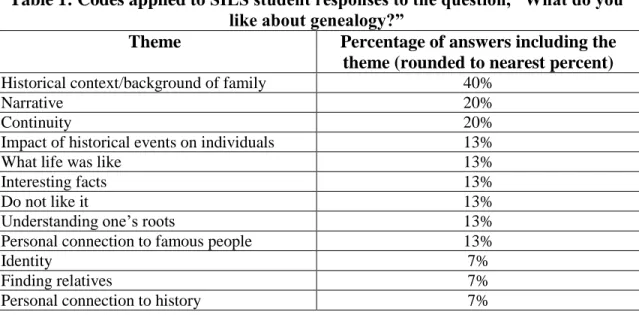
Two explicitly indicated not liking genealogy. See Table 1 for a full list of codes
assigned.
In responses to the second question, “Has your interest in history grown since you
started genealogy?” “history” was most commonly used word at 7 counts, then “interest”
or “interested” at 6. Twelve UNC SILS students answered the question; five said yes, five
said no, and two indicated that they do not do genealogy. Some did not like history,
found no connection, or thought genealogy was subordinate to history. Of those who
answered yes, explanations of how their interest in history grew or changed included
increased interest in particular ethnic groups, time periods, or places; a more personal
connection to history; or more interest in what life was like for people of the past. See
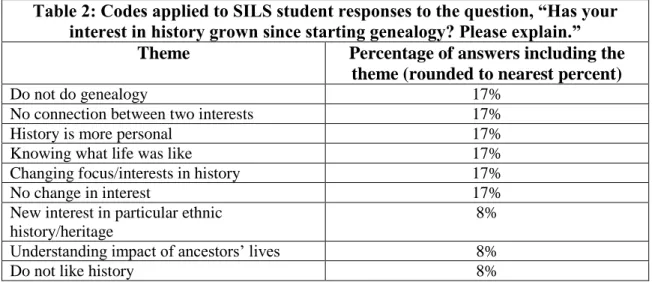
Table 2 for a full list of codes applied.
Table 1: Codes applied to SILS student responses to the question, “What do you like about genealogy?”
Theme Percentage of answers including the
theme (rounded to nearest percent)
Historical context/background of family 40%
Narrative 20%
Continuity 20%
Impact of historical events on individuals 13%
What life was like 13%
Interesting facts 13%
Do not like it 13%
Understanding one’s roots 13%
Personal connection to famous people 13%
Identity 7%
Finding relatives 7%
Table 2: Codes applied to SILS student responses to the question, “Has your interest in history grown since starting genealogy? Please explain.”
Theme Percentage of answers including the
theme (rounded to nearest percent)
Do not do genealogy 17%
No connection between two interests 17%
History is more personal 17%
Knowing what life was like 17%
Changing focus/interests in history 17%
No change in interest 17%
New interest in particular ethnic history/heritage
8%
Understanding impact of ancestors’ lives 8%
Do not like history 8%
Genealogists
For the genealogist population, 95% indicated researching genealogy as a hobby
and 5% as a profession. Sixty-six percent researched once a week, 38% once a month,
5% once a year, and one respondent checked “never.” Eighty-seven percent reported
researching for others. Thirty-nine percent of respondents had been researching
genealogy for over twenty years; 31%, ten to twenty; and 13% five to ten years or one to
five years each. When asked to report all book genres they enjoyed, 72% included
historical nonfiction, followed by historical fiction (65%), mysteries, (65%), and
biographies/autobiographies (63%). When choosing a single favorite genre, historical
non-fiction was first at 31%, followed by mystery at 24%. Historical films were most
popular, included by 80% of respondents; however, drama was the single most
commonly watched. Seventy-nine percent of respondents had viewed at least one
Fifty-four percent had visited a history museum in the past three months, and 66% a
historic site.
The genealogists were also asked the same the open-ended questions. In response
to the first question, “What do you like about genealogy?” their answers used words like
“family” (18), “ancestors” (12), “people,” “where,” and “context” (9 each), “learning,”
“lives,” and “finding” (7). The responses included some of the same themes as those
found among SILS students: enjoying learning about historical context and what life was
like for ancestors (for example, Genealogist 47 wrote “finding information on how my
Frequency of genealogical research among
genealogists surveyed
Once a week (66.67%) Once a month (27.27%) Once a year (4.55%) Never (1.52%)
Number of years doing genealogical research among
genealogists surveyed
ancestors lived, their occupations and achievements, how they migrated”), as well as
feeling a personal connection to ancestors, history, or famous people. A few mentioned
the themes of continuity or narrative, for example, “finding information on . . . the
personal talents that have been passed down through the years” (Genealogist 47). There
was also a shared interest between the two groups in knowing “where I come from,”
labeled as a concern for origins or roots. However two of the major concepts enjoyed by
genealogists were absent from SILS respondents. First, many genealogists indicated their
enjoyment of the research process and learning new information. For example, one
genealogist liked “the search, the surprises, the knowledge learned” (Genealogist 29).
While a couple of SILS students stated they enjoyed learning interesting facts, the
genealogists’ responses indicate a deeper enjoyment of learning that comes with
researching genealogy. A second point of departure is the number of genealogists who
enjoy the problem-solving aspect of genealogy, like fitting together pieces of a puzzle:
one genealogist called it “detective work” (Genealogist 25). None of the SILS students
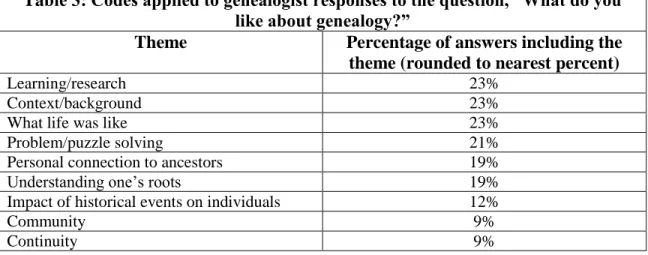
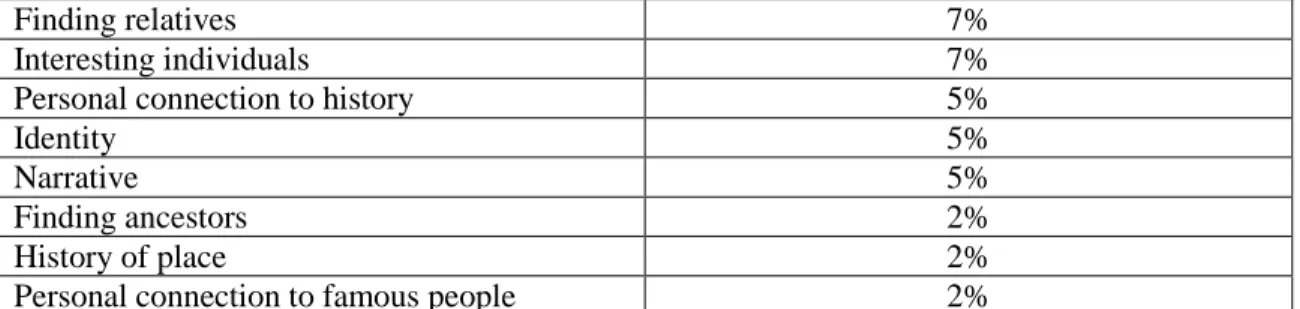
mentioned such an approach, while nine of the genealogists did. See Table 3 for a full list
of codes applied.
Table 3: Codes applied to genealogist responses to the question, “What do you like about genealogy?”
Theme Percentage of answers including the
theme (rounded to nearest percent)
Learning/research 23%
Context/background 23%
What life was like 23%
Problem/puzzle solving 21%
Personal connection to ancestors 19%
Understanding one’s roots 19%
Impact of historical events on individuals 12%
Community 9%
Finding relatives 7%
Interesting individuals 7%
Personal connection to history 5%
Identity 5%
Narrative 5%
Finding ancestors 2%
History of place 2%
Personal connection to famous people 2%
The second open-ended question asked if the respondents’ interest in history had
increased as since beginning genealogical research, and how. Genealogists’ explanations
included words like “history” or “historical” (33), “family,” (17), “interest/ed” (16),
“events” (9), “research” (8) and “ancestor/s” (11). While hardly surprising, this word
frequency analysis shows the importance of family, knowledge or learning, and sustained
Table 4: Codes applied to genealogist responses to the question, “Has your interest in history grown since starting genealogy? Please explain.”
Theme Percentage of answers including the
theme (rounded to nearest percent)
Better understanding of context/background
26%
Impact of historical events on individuals 17%
Changing focus/interests in history 15%
Better understanding ancestors and their choices
13%
Personal connection to historical events 11%
Interest in history of particular places 9%
Desire to know more about interesting facts or individuals
6%
Interest in history came first 6%
Greater sense of identity 4%
Knowing what life was like 4%
interest in a genealogical endeavor. Thirty-three answered yes, eleven said no – five of
which indicated they were interested in history already and their level of interest
remained the same – and three did not answer yes or no. Like SILS students, a few
history of particular places related to their family tree, a personal connection to historical
events, and what life was like. For the genealogist group more than the student group,
some concepts carried over from the first question: many indicated increased interest in
learning the historical context of their ancestors, or the impacts of historical events:
“Understanding the impact of historical events turns a light on the family in a way no
BMDD can do. Watching the effects of WWII on my family as the war progressed has
made me more likely to read a book about London during the war, but that would have
been unlikely had I not began to explore family genealogy” (Genealogist 15). Another
idea absent from the SILS group but important for the genealogists was increased interest
in history for better understanding and insights into their relatives and the choices they
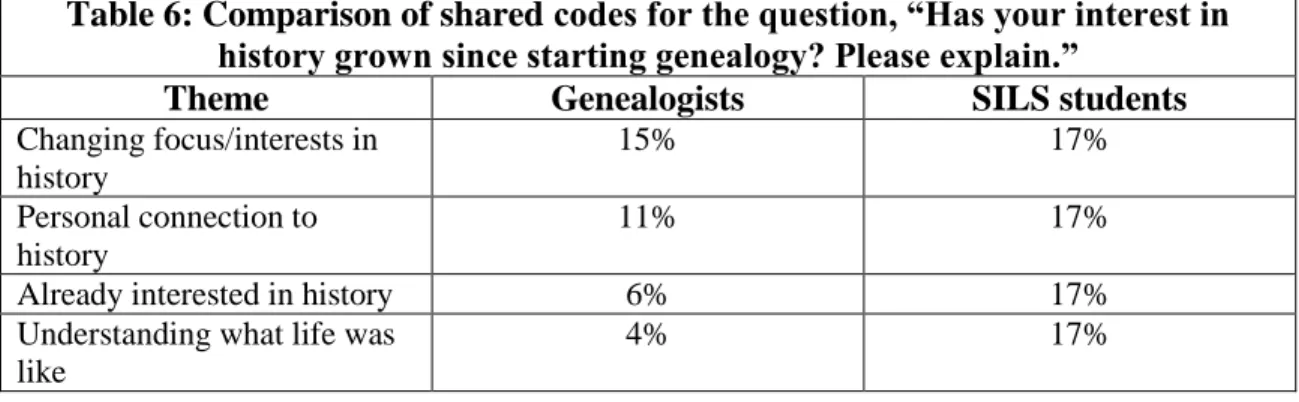
made. See Table 4 for a list of codes assigned. Tables 5, 6, and 7 offer comparisons of the
two groups’ answers.
Table 5: Comparison of shared codes for the question, “What do you like about genealogy?”
Theme Genealogists SILS Students
Family’s historical context/background
23% 40%
What life was like 23% 13%
Understanding one’s roots 19% 13%
Impact of historical events on individuals
12% 13%
Continuity 9% 20%
Finding relatives 7% 7%
Personal connection to history
5% 7%
Narrative 5% 20%
Identity 5% 7%
Personal connection to famous people
Table 6: Comparison of shared codes for the question, “Has your interest in history grown since starting genealogy? Please explain.”
Theme Genealogists SILS students
Changing focus/interests in history
15% 17%
Personal connection to history
11% 17%
Already interested in history 6% 17%
Understanding what life was like
4% 17%
Table 7: Comparison of responses to the question, “Has your interest in history grown since starting genealogy?”
Group Yes No (total) No (interest
remained the same)
Unclear response
N/A (do not do
genealogy)
Genealogists 70% 23% 45% of “no”
responses
6% 0%
SILS students
42% 42% 20% of “no”
responses
Discussion
The survey results show a clear correlation between conducting genealogical
research and some of the indicators of interest in history, such as preferred book and film
genres. The genealogist survey results showed a preference for books and films on
historical topics compared to the SILS student results, although the likelihood of having
visited a museum or a historic site was remarkably similar. In accordance with the
cognitive-emotional dimension of interest, positive results and feelings resulting from
engaging genealogy reinforced and increased interest in continuing family history
research. The open-ended answers of the genealogists also display some interesting
trends when compared to the control population. Not only were some of the most
common concepts found in both answer sets, but they were also discussed in earlier
studies of genealogists’ reasons for their research. A 1994 survey by Ronald Lambert
found that the majority of respondents were motivated by “learning about one’s roots and
identity,” and “getting to know ancestors as people,” which are comparable to some of
the codes applied in this study.51 First, both SILS students and genealogists often listed
learning about the context and background of their families as something they enjoyed
about genealogy and how their interest in history has increased. Ten genealogists liked
learning about historical context as part of genealogy, as did six SILS students; for the
question about increased interest in history, twelve genealogists included learning context
as part of the reason for more interest. Genealogist 26 wrote that s/he liked “putting my
family in the context of its time and place.” SILS student 20 enjoyed “learning about the
historical context and events that led up to the way my family lives now.” Others
expressed interest in knowing where they came from and understanding their heritage,
which was classified as a search for roots. Eight genealogists and two SILS students liked
knowing their family’s origins. “I love finding more on where my family came from,”
wrote Genealogist 61; similarly SILS student 11 likes “learning about where my family
comes from.” Such interests in filling out the historical background of families’ lives and
exploring one’s heritage is similar to Lambert’s “learning about one’s roots.”
The closest categorization to Lambert’s “getting to know ancestors as people”
from the survey results were answers indicating a personal connection to ancestors.
While eight genealogists and no students indicated a personal connection to ancestors as
something they liked about genealogy, more listed a desire to know what life was like for
them, which can be interpreted as a personal connection. Ten genealogists and two SILS
students liked knowing what life was like for their predecessors, and two from each
group included it as part of their increased interest in history. For genealogist 44,
genealogy “provides a snapshot of my ancestors during a period of time and helps to
provide a connection.” SILS student 22 became more interested in history because
“knowing more about individuals in my family paints a more detailed picture of what life
Finally, while the theme of identity or self-perception is not apparent in the
majority of responses, it is still an important topic that deserves consideration. Answering
the question on increased interest in history, one genealogist wrote, “As I’ve researched
the family, [history] has provided a backdrop for understanding myself, my parents, and
all the people preceding us by establishing the time and geographic markers that tell me
more about them” (Genealogist 15). Another noted that as an African American,
researching genealogy has given a history to identify with when it was difficult to
appreciate the exclusive mainstream history (Genealogist 66). One student respondent
explained that genealogy “gives me a sense of my own identity by learning from whom
(and where) I come from” (SILS student 13). As a final example, another genealogist
wrote of enjoying genealogy because of “the sense of being part of something greater
than myself” (Genealogist 59). While these people spoke explicitly of how genealogy
contributed to their understanding, some of the other concepts also relate to
self-perception, such as forming personal connections to ancestors or history, finding their
“roots” or where their people came from, building communities, and weaving a narrative
of which they are a part. These responses all reveal the affective and deeply personal
needs for connection, identity, story, and meaning discussed earlier in the literature, and
reveal that such needs are met not only by researching genealogy but also by the
connection to history that comes with it.52
Other overlapping ideas between the two surveys include building a narrative
(related to identity), shifting focus of interest based on research threads, and
understanding how historic events influenced individuals. As far as different results
between the two surveys, it is difficult to establish causation rather than simply
correlation, but perhaps the kinds of concepts and themes that differ between the two
results are indicative of the time spent on genealogy. Of the SILS students who had
researched genealogy in the past, most had been doing it for less than five years, while
many from the genealogical societies had been researching for over twenty years. Some
themes are common to all levels of genealogy, while some concepts were mentioned only
by the genealogists; this may indicate some interests and insights that only emerge with
time.
First, a few of the genealogists mentioned liking the community that comes with
pursuing genealogy, either meeting new people in the course of research or deeper
connections with family members as a result. One genealogist wrote, “I believe that
having your genealogy and sharing it with your children and family members can give a
family a solid foundation” (Genealogist 64). Yakel explored the concept of genealogists
as “communities of records,” groups who find personal meaning in the records and form
community with other genealogists and with family in the process.53 Perhaps this sense of
community only comes with time, as genealogists exhaust the easy sources of
information and must rely more on the advice and aid of peers.
53 Elizabeth Yakel and Deborah A. Torres, “Genealogists as a ‘Community of Records,’” American
Another prominent theme in the genealogists’ answers was the joy of finding new
information and learning new things. While a few of the SILS students mentioned
learning interesting new facts (“I enjoy knowing the stories of my ancestors' lives. Some
of them have had really interesting existences,” SILS student 19), many genealogists
expressed a deeper sense of satisfaction in their research endeavors. Perhaps this
indicates the feeling of accomplishment from a deeper and longer investment in the
search for genealogical information. Some noted an interest in learning more about
particular places, such as Genealogist 12: “I enjoy doing research and making
connections, following ‘hints’ to find more details, and learning about the areas and
history of places where our ancestors lived.” Others explicitly declared pleasure in the
research process itself: “It’s mostly original research – my ancestors may not have been
researched . . . before” (Genealogist 20). Darby and Clough suggested an eight-step
model of genealogists’ family history research, with continuous learning as an inherent
part of the research process.54 Perhaps the longer genealogists engage in their research,
the more aware they are of this ongoing learning process, particularly when encountering
the more difficult stages of research.
Finally, a third point of departure between the genealogists’ answers and the SILS
student answers to the open ended question was the theme of puzzle or problem solving.
Nine genealogists explicitly elaborated on this aspect when asked what they liked about
genealogy. Genealogist 16 wrote, “I love putting the “puzzle” pieces together about my
heritage.” Another listed “problem solving” (Genealogist 14). Such responses indicate
that beyond the emotional fulfillment of knowing one’s heritage and finding oneself in
history, genealogy brings the satisfaction of completing or at least making headway on a
challenging puzzle. Such an inclination for detective work and problem solving is further
supported by preferences for mystery fiction. When asked to check all book genres of
interest, mystery/thriller tied in second place for most commonly selected. When
choosing a single favorite type of book, 24% of genealogist respondents selected
mystery/thriller, second only to historical non-fiction. These responses indicate a more
cut-and-dried, quantifiable aspect of genealogy – such as tracking down an elusive place
of birth to fill in on the family tree – that complements the more qualitative aspects like
context and heritage that are difficult to operationalize and measure. And the prominence
of both in the responses mean that both sides are essential pieces to family heritage
research. This theme is also a fruitful area for future research.
The results of this study are useful for information professionals whose users
include genealogists, which is most public librarians and archivists as well as those in
academic institutions and especially state archives. Any kind of library or special
collection that receives genealogy requests can benefit from a better understanding of its
users’ interests and needs. Several studies discussed in the literature review have already
identified the importance of historical context for moving out from names and dates to
understanding ancestors’ lives, and for exploring personal heritage which interweaves
individual and societal history. Background information helps with both knowing what
kind of sources to look for at advanced stages of research, and enhances insight into and
Context/background was among the most commonly mentioned themes in the
open-ended questions, indicating the usefulness of resources that provide such data.
Information professionals can direct patrons to history books on the time period they are
studying or direct them to historical collections or other primary sources, in addition to
sources directly involved in family tree construction. This will directly contribute to
increased collection use and patron awareness of the repository’s holdings.
Librarians and archivists can tailor their workshops, brochures, online guides, and
other user services to ensure that they include information about conducting historical
research, which seems from the literature to be a lacuna in current practice. While many
articles give examples of genealogy workshops to develop the skills used in this serious
leisure pursuit as discussed in the literature review, a literature search did not uncover
any workshops about historical context or background information for genealogists.
There is a great opportunity for archivists and librarians to host workshops for
genealogists that discuss local history or that highlight particularly rich historical
collections, enriching their genealogical research. Of course, genealogists will benefit
from these services and from information professionals who are more aware of their
needs. Furthermore, many genealogists indicated shifting areas of historical interest based
on their current line of research. Librarians and archivists must be prepared to keep up
with the ever-changing needs and of these researchers.
One final note for information professionals is the number of SILS students who
had engaged in genealogy research at least once – over half. Although few of them were
currently involved, the responses indicate that even beyond the large numbers of
dabble from time to time and would continue further if given the opportunity. Some
creative engagement with this marginally interested group could lead to increasing
Summary
The impetus to create or continue a family genealogy comes in many forms, from
curiosity to religious reasons to a perceived role as family historian. Less explored are the
results of genealogical research, especially the connection between interest in one’s
family history and in wider historical events and trends. Survey results from members of
three North Carolina genealogical societies and from graduate students at the University
of North Carolina – Chapel Hill indicated a self-reported overall increase in interest in
history resulting from genealogical research. For the majority of genealogists, the deeper
they searched in their family’s past, the more they became interested in the larger
historical forces that shaped their family’s lives. The genealogists also showed more
interest in history in general than the graduate students, as measured by the kinds of
books and films they enjoyed most.
Respondents were asked open-ended questions about what they liked about
genealogy and if their interest in history increased as a result. Some themes found in the
answers were common to both the genealogists and the SILS students who reported doing
genealogy, such as learning the context of ancestors’ lives and what life was like for
them, finding identity in family continuity, and filling out a narrative. Other answers were
found only in the genealogist response set, like enjoyment of the research process,
building community through genealogy, and puzzle solving. Perhaps the shared answers
themes tend to develop after many years of the hobby. Further exploration of these
answers is an area for future research.
A better understanding of genealogists’ interests, motivations, and needs and their
relationship to history can help information professionals provide better services. These
conclusions can aid librarians and archivists in their design of user services such as
brochures, workshops, and reference transactions that will assist patrons not only with
their family trees, but with their historical endeavors as well. Because interest in history
often precedes family history research and is modified or intensified by it, information
professionals can recommend genealogical materials to patrons with an interest in
history. The results of this research project contribute to the body of literature on
genealogists and promote a better understanding of a significant segment of libraries’ and
Bibliography
Aaron, Larry. “Using Genealogy to Teach History.” OAH Magazine of History 6, no. 3 (1992): 5–7.
Amason, Craig R. “Instruction for Genealogists in the Public Library.” The Reference Librarian 9, no. 22 (November 1988): 283–95.
Ancestry.com. “Americans’ Fascination with Family History Is Rapidly Growing.” Press Releases, June 9, 2005.
http://corporate.ancestry.com/press/press-releases/2005/06/americans-fascination-with-family-history-is-rapidly-growing/.
Azevedo, Flávio S. “Lines of Practice: A Practice-Centered Theory of Interest
Relationships.” Cognition and Instruction 29, no. 2 (April 11, 2011): 147–84. doi:10.1080/07370008.2011.556834.
Barratt, Nick. “From Memory to Digital Record: Personal Heritage and Archive Use in the Twenty-First Century.” Records Management Journal 19 (2009): 8–15.
Berry, Chad, Lori A. Schmied, and Josef Chad Schrock. “The Role of Emotion in Teaching and Learning History: A Scholarship of Teaching Exploration.” The History Teacher, 2008, 437–52.
Bidlack, Russell E. “Genealogy Today.” Library Trends 32, no. 1 (June 1983): 7–23.
Bishop, Ronald. “In the Grand Scheme of Things: An Exploration of the Meaning of Genealogical Research.” The Journal of Popular Culture 41, no. 3 (2008): 393– 412.
Cadell, Patrick. “Building on the Past, Investing in the Future through Genealogy and Local History Services.” IFLA Journal 28, no. 4 (2002): 175–80.
doi:10.1177/034003520202800403.
Case, Donald O. “Collection of Family Health Histories: The Link Between Genealogy and Public Health.” Journal of the American Society for Information Science and Technology 59, no. 14 (2008): 2312–19.
Drake, Pamela J. “Findings from the Fullerton Genealogy Study.” Master’s Thesis, California State University, 2001. http://psych.fullerton.edu/genealogy/.
Duff, Wendy M., and Catherine A. Johnson. “Where Is the List with All the Names? Information-Seeking Behavior of Genealogists.” American Archivist 66 (Spring/Summer 2003): 79–95.
Etherton, Judith. “The Role of Archives in the Perception of Self.” Journal of the Society of Archivists 27, no. 2 (2006): 227–46.
Freeman, Elsie T. “In the Eye of the Beholder: Archives Administration from the User’s Point of View.” The American Archivist 47, no. 2 (Spring 1984): 111–23.
Fulton, Crystal. “Quid Pro Quo: Information Sharing in Leisure Activities.” Library Trends 57, no. 4 (Spring 2009): 753–68.
Hedstrom, Margaret. “How Do Archivists Make Electronic Archives Usable and Accessible?” Archives and Manuscripts 26 (1998): 6–22.
Hicks, Shauna. “Unlock the Past: Promoting History, Genealogy and Heritage in Australia and New Zealand.” Aplis 25, no. 2 (Spring 2007): 61–66.
Hidi, Suzanne, and K. Ann Renninger. “The Four-Phase Model of Interest Development.” Educational Psychologist 41, no. 2 (June 2006): 111–27. doi:10.1207/s15326985ep4102_4.
Kaplan, Paul. “How Public Librarians Can Provide Basic Genealogy Instruction.” Illinois Libraries 86, no. 4 (Spring 2007): 16–20.
Krapp, Andreas. “Basic Needs and the Development of Interest and Intrinsic
Motivational Orientations.” Learning and Instruction 15, no. 5 (October 2005): 381–95. doi:10.1016/j.learninstruc.2005.07.007.
Lambert, R. D. “The Family Historian and Temporal Orientations Towards the Ancestral Past.” Time & Society 5, no. 2 (June 1, 1996): 115–43.
doi:10.1177/0961463X96005002001.
Lawton, John R., and Heather Block Lawton. “Public-Academic Library Collaboration: A Case Study of an Instructional House and Property History Research Program for the Public.” American Archivist 72, no. 2 (Fall/Winter 2009): 496–514.
Lenstra, Noah. “Digital Roots: Community Approaches to Local and Family History.”
ILA Reporter, June 2012, 10–13.