COMPETING FOR KIDS: AN EXPLORATION IN MARKETING PEDIATRIC HEALTHCARE
Tyler Powell
An honors thesis submitted to the faculty of the Kenan-Flagler Business School at the
University of North Carolina at Chapel Hill
Chapel Hill 2016
ii ABSTRACT Tyler Powell
Competing for Kids: An Exploration in Marketing Pediatric Healthcare
(Under the direction of Larry Chavis)
Several research studies have analyzed why patients choose one physician over another.
Each of these studies has focused on how consumers choose their own providers,
however. When a parent selects a doctor for their child, do they follow a different
decision-making process? The purpose of my research is to analyze how factors
implicated in prior physician-choice studies influence parents as they choose physicians
for their children.
This study asked employees of the University of North Carolina at Chapel Hill to rate the
degree of influence that four variables- a physician’s proximity, reputation, race, and
gender- had over the selection of their child’s most recent pediatrician and specialist. A
physician’s reputation was found to be the most important variable for both a pediatrician
and specialist. Proximity to a physician’s office was more important for a pediatrician
than for a specialist, while gender and race were considered moderately important and
iii
TABLE OF CONTENTS
ABSTRACT . . . .ii
LIST OF TABLES . . . .v
I. INTRODUCTION. . . 1
II. LITERATURE REVIEW. . . 3
A. Why should we care how people choose?. . . 3
B. What factors influence healthcare decision-making? . . . 4
C. Does physician specialty matter? . . . 7
D. What changes when choosing for someone else? . . . 8
E. Are there any special considerations for the parent child relationship? . . . 9
F. Conclusion . . . 10
III. METHODOLOGY. . . 11
A. Research Design . . . . . . 11
B. Variables. . . 13
C. Population Sample . . . 14
IV. RESULTS. . . 16
A. Demographics . . . .17
B. Selection of Healthcare Provider by Gender . . . 19
C. Importance of Selected Variables for Choosing a Pediatrician . . . 19
D. Importance of Selected Variables for Choosing a Specialist . . . 24
iv
V. DISCUSSION . . . 29
A. Implications of Sample Demographics. . . 29
B. Importance of Selected Variables . . . 30
C. Other Considerations . . . 34
D. Implications for Healthcare Providers . . . 36
E. Limitations . . . .. . . 38
VI. CONCLUSION . . . 40
VII. APPENDIX . . . 42
A. Survey Recruitment Email . . . 42
B. Adult Consent Form. . . 43
C. Survey . . . . . . 45
D. Free Response Data . . . 48
v
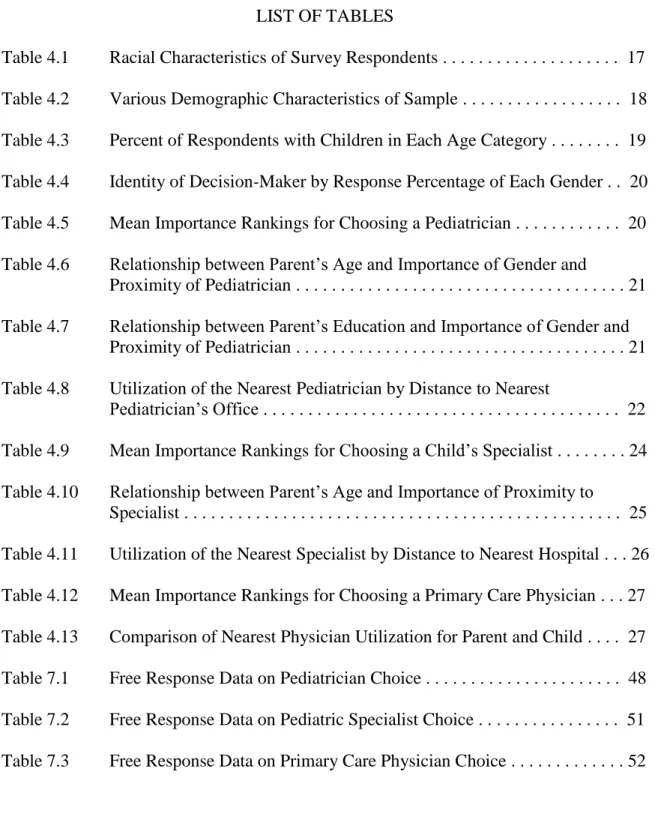
LIST OF TABLES
Table 4.1 Racial Characteristics of Survey Respondents . . . 17
Table 4.2 Various Demographic Characteristics of Sample . . . 18
Table 4.3 Percent of Respondents with Children in Each Age Category . . . 19
Table 4.4 Identity of Decision-Maker by Response Percentage of Each Gender . . 20
Table 4.5 Mean Importance Rankings for Choosing a Pediatrician . . . 20
Table 4.6 Relationship between Parent’s Age and Importance of Gender and
Proximity of Pediatrician . . . 21
Table 4.7 Relationship between Parent’s Education and Importance of Gender and Proximity of Pediatrician . . . 21
Table 4.8 Utilization of the Nearest Pediatrician by Distance to Nearest
Pediatrician’s Office . . . 22
Table 4.9 Mean Importance Rankings for Choosing a Child’s Specialist . . . 24
Table 4.10 Relationship between Parent’s Age and Importance of Proximity to
Specialist . . . 25
Table 4.11 Utilization of the Nearest Specialist by Distance to Nearest Hospital . . . 26
Table 4.12 Mean Importance Rankings for Choosing a Primary Care Physician . . . 27
Table 4.13 Comparison of Nearest Physician Utilization for Parent and Child . . . . 27
Table 7.1 Free Response Data on Pediatrician Choice . . . 48
Table 7.2 Free Response Data on Pediatric Specialist Choice . . . 51
1
INTRODUCTION
Every American will interact with the healthcare industry at some point in their
lives. Whether it is in the role of patient or caregiver, we will all be called upon to
navigate this industry and to make decisions regarding how we seek medical care. One
such decision is our choice between visiting a variety of healthcare providers. Presented
with an assortment of potential candidates, how do we go about choosing just one?
Physician choice decisions are not always made by the patient, however. Until
children are of legal age, this decision is typically made by their parent or guardian. A
parent must therefore draw upon their own experiences and preferences to make a
decision that is in their child’s best interest. While parents frequently make their own
healthcare decisions, we cannot automatically assume that they follow the same process
when making decisions on behalf of their child. Research on healthcare decision-making
indicates that people do not always come to the same conclusions when making choices
for someone else (Zikmund-Fisher, Sarr, Fagerlin, and Ubel, 2006). Understanding
decision-making in the pediatric space will be increasingly important in the coming
years, as the number of yearly pediatrician visits as a percentage of total physician visits
has been growing steadily since 1980 (Centers for Disease Control and Prevention,
2010). Pediatric specialty hospitals are also expected to grow 4.5% annually through
2020, further compounding the need for marketing departments to tailor their campaigns
to capture as much of this growth as possible (Phillips, 2015).
Through a survey of employees with children at the University of North Carolina
2
processes vary in regard to a physician’s proximity, reputation, gender, or race when
choosing their own physicians vs. choosing one for their child. I also hoped to determine
whether or not tendencies to value certain provider characteristics can be predicted based
on a family’s demographic information. Should identifiable patterns arise, careful
analysis of these tendencies may allow marketing departments to make smarter and more
informed decisions on how to attract patients.
Correlations were noted between a parent’s age and the importance they placed on
certain decision-making variables. A relationship was also noted between a parent’s
education and these tendencies as well. Furthermore, a female parent was the family’s
decision-maker in a vast majority of cases, indicating that they should be the primary
3
LITERATURE REVIEW Why should we care how people choose?
According to Dement (2015), specialty healthcare is projected to grow 4%
annually over the next five years. A growing elderly population and increase in chronic
disease prevalence has contributed significantly to this industry’s growth. Between 1980
and 2010, visits to primary care physicians fell from 66.2% to 55.5% of total office visits
(Centers for Disease Control and Prevention, 2010). This increased reliance on specialty
healthcare has led to a rapid increase in specialty practices throughout the United States.
For this reason, an understanding of how and why patients make decisions will be crucial
in this increasingly competitive market.
Pediatric healthcare is one such specialty that is penetrating many communities in
the United States. In recent years, many preexisting hospitals and clinics have expanded
to offer specialized pediatric care. Hospital networks with pediatric divisions are now
numerous, which has resulted in increased competition among neighboring hospitals
vying for a single target market (Phillips, 2015). Many regional pediatric care providers
have launched promotional campaigns in day cares and preschools, indicating parents as
the target audience (Kutscher, 2015). Despite these efforts, competition remains stiff and
hospital marketing departments continue to search for additional ways to attract patients.
Because patients often choose a clinic or hospital because of their desire to see a
particular physician, marketers must increasingly consider the motivations behind
physician-choice.
Several research studies have attempted to analyze why patients choose one
4
Harris, 2003; Hoerger & Howard, 1995). Each of these studies has focused on how
consumers choose their own providers, however. Pediatric healthcare is unique from a
consumer behavior perspective, as the final consumer is not the primary decision maker.
The question therefore remains whether or not this decision-making process differs when
parents select a doctor for their child.
Due to a lack of prior research on pediatric healthcare decision-making, I have
analyzed research on related fields. Specifically, I have narrowed my exploration to four
key questions:
What factors influence healthcare decision-making?
Does physician specialty matter?
What changes when choosing for someone else?
Are there any special considerations for the parent/child relationship?
Taken together, the answers to these questions will help me to establish how my research
will contribute to the field of healthcare consumer behavior.
What factors influence healthcare decision-making?
Current research on factors of influence in healthcare decision-making focuses on
patients choosing their own provider. Despite this limitation, there is evidence to suggest
that parents likely reference their own healthcare preferences when making decisions for
their child (Lipstein, Brinkman, & Britto, 2012). Four factors were most frequently cited
as particularly influential in decision-making: proximity, reputation, gender, and race of
5 Proximity
According to Wun, Lam, Lam, Goldberg, Li, & Yip (2010), the proximity of a
healthcare provider to a patient’s home or workplace is the most important factor for
choosing a physician. Bornstein et al. (2000) also indicated that proximity of provider is
very persuasive in a patient’s decision-making process.
Geographical proximity and perceived convenience are also very influential when
a patient decides whether or not to consult a physician. Probst, Laditka, Wang, and
Johnson (2007) reported that proximity of provider is inversely related to utilization of
healthcare. If a patient considers the location of their provider to be inconvenient, they
are less likely to seek consultation for non-emergent issues. Without a physician close by,
a patient may actually forgo choosing a physician altogether.
Reputation
For the purposes of this paper, I will characterize provider reputation as any and
all information that patients consider regarding provider characteristics, including but not
limited to: regional rankings, educational history of provider, and recommendations from
friends and families. According to Tu and Lauer (2008), half of all consumers rely on
word-of-mouth recommendations from friends and family when selecting a new primary
care physician. Additionally, about a third of all patients sought the advice of other
doctors. The importance of recommendations was also confirmed in several other patient
populations (Wun et al., 2010 & Borstein, 2000). The weight placed on recommendations
varies based on ethnicity, however. Whites consult friends and family for
recommendations most frequently, while Hispanics and blacks do so considerably less
6
Several studies have also indicated the importance of physician credentials in
influencing provider choice (Razzouk, Seitz & Webb, 2004, and Butler & McGlone,
2002). These credentials include but are not limited to: board certification, online
rankings, and the school from which a physician obtained their degree. Despite patients’
interest in provider credentials, research suggests that they rarely use the internet to
obtain this information (Tu & Lauer, 2008). Nearly all information gathering occurs via
word-of-mouth.
Race
Malat and Hamilton (2006) reported that minority populations consider race to be
a very important attribute of a potential physician. Their study suggested that
approximately 20% of black Americans prefer same-race healthcare providers. Chen,
Fryer, Phillips, Wilson, and Pathman (2005) confirmed these findings, estimating that
22% of black Americans exhibit same-race preference for their providers. Latino
respondents in the same study also reported significant racial preference, exhibiting
same-race preference in 1/3 of all cases. These preferences among minority populations
were deeply rooted in suspicions of racism and a subpar quality of care for minority
patients. Having a physician of the same race alleviated these concerns for minority
patients.
Conversely, majority populations consider race to be very insignificant in
influencing healthcare provider decisions. Bornstein et al. (2000) reported that
respondents to a survey on healthcare provider preference exhibited little to no racial
preference. Over 80% of Bornstein’s respondents identified as white (Caucasian).
7
(2005) suggests that majority populations care less about physician race than minority
populations.
Gender
Researchers do not seem to agree on the relative importance of physician gender.
Both Bornstein et al. (2000) and Razzouk et al. (2004) cited physician gender as being
only moderately important to patients. A study conducted by Fennema, Meyer, & Owen
(1990) found that 45% of patients exhibit physician gender preference, however.
Preferences were typically for physicians that shared the same gender as patient. When
asked to elaborate on their preferences, patients reported humane behaviors as being
more characteristic of their gender of preference.
A study performed in a university-based pediatric primary care practice found that
parents were more satisfied by interactions with female pediatricians than similar
interactions with male pediatricians (Bernzweig, Takayama, Phibbs, Lewis, & Pantell,
1997). Although this research focuses on satisfaction rather than physician-choice, it is
extremely relevant to predicting parent’s decision making. Satisfaction is crucial to
retaining patients and is therefore an indicator of long-term doctor-patient relationships.
Does physician specialty matter?
Research suggests that decision-making processes vary slightly depending on the
type (or specialty) of doctor a patient is searching for. Hoerger and Howard’s (1995)
study of pregnant women searching for prenatal care concluded that because pregnancy
and childbirth were considered important events, patients underwent a more extensive
provider search than they would for a primary care physician. Although this study is
8
processes for different types of physicians. Undergoing a lengthier search process for a
specialty physician seems logical, given the level of risk associated with more serious
conditions that require treatment. The more serious an ailment, the more likely a patient
is to consult a specialist. A specialist is defined as “a physician whose practice is limited
to a particular branch of medicine or surgery” (Dement, 2015). The only form of
medicine excluded from this category is primary care, which is also often referred to as
family practice.
What changes when choosing for someone else?
Choosing a pediatric physician is a unique healthcare decision. With the exception
of geriatric care, pediatrics is the only specialty in which personal healthcare decisions
are made by a proxy, rather than the primary patient. This caveat makes it necessary to
consider how decision-making processes may differ when they are made on behalf of
another person. Much of the related literature on this topic concentrates on making
treatment decisions, rather than selecting a particular healthcare provider. Due to this
limitation, I have relied on these studies to guide my approach.
Zikmund-Fisher, Sarr, Fagerlin, and Ubel (2006) conducted a survey that
encouraged participants to place themselves in 1 of 4 roles: patient, physician, parent, or
medical director setting treatment guidelines. Participants were then provided with a
description of a form of cancer and encouraged to make treatment decisions given a list
of potential options. Finally, participants were asked to change roles and reconsider their
answer.
Based on their assumed role, survey participants often changed their mind on
9
explained that what seems “reasonable for yourself may seem less appropriate when
giving advice or acting on behalf of another, even though your personal values are the
same in both cases” (p. 622). Participants reported that their decision to change answers
when choosing for someone else was fueled by an anticipation of eventually needing to
justify that answer to the patient. Their chosen treatment plan was therefore something
that they could easily explain. When choosing for themselves, they often had difficulty
verbalizing their decision-making process, however. The researchers concluded that
people engage in a more complex thought-process when choosing for themselves.
Research conducted by Polman and Emich (2011) on general decision-making
suggests the opposite, however. The researchers conducted three separate studies to
ascertain the level of creativity and imagination used when making a “self-decision” vs. a
“self-other” decision. The results suggested that decisions for others were almost always
more creative than decisions for oneself. The researchers attributed this difference to the
“social distance between deciding for the self and deciding on behalf of someone else.”
Increased social distance fosters “processes of abstraction that facilitate creative
cognition,” therefore resulting in a more sophisticated and nuanced decision (p. 497). It
remains to be seen whether or not this trend applies to the parent-child relationship,
however, as social distance is relatively small in this case.
Are there any special considerations for the parent/child relationship?
In most cases, the parents or guardians of a child make pediatric healthcare
decisions on their behalf. Parents are typically very attentive to the needs of their child
and have a vested interest in maintaining their child’s wellbeing. According to Hagger
10
treatment is a well-established legal principle” (p. 55). In addition to the legal and ethical
implications established by our society, Lipstein et al. (2012) report that parental
involvement in healthcare decisions is driven by familial and emotional factors unique to
the parent/child relationship.
Parents possess detailed knowledge of their child that is unmatched by anyone
else in a child’s life (Hagger, 2009). This level of familiarity encourages parents to
possess deep levels of empathy, as they hold an important stake in the child’s well-being.
Lipstein et al. (2012) indicated that this connection begets the potential for emotions,
beliefs, and values to heavily influence decision making. Depending on the age of the
child, this dynamic may also result in the child having significant influence on their
parents’ decisions. Interestingly, research suggests that parents often consult their
children when making treatment decisions (Lipstein et al., 2012). This research indicates
that children may influence physician choice as well.
Conclusion
I hope to determine how parents’ physician-choice decisions vary when choosing
for themselves vs. choosing for their child. Specifically, I plan to analyze the importance
of a) proximity, b) reputation, c) race, and d) gender of physician in making pediatric
healthcare decisions and to compare these results to research on general physician choice.
Available research on factors of influence in healthcare decision-making contain
areas of agreement and disagreement that I must consider. By analyzing these factors in
the pediatric setting, my research will add to the current discussion on healthcare
consumer behavior. Ideally, I hope that my research will provide insight into how
11
METHODOLOGY
The goal of my thesis is to quantify the extent to which various factors influence
parents as they choose healthcare providers for their children. The following research
methodology will cover the research design, variables, and population sample to be
solicited.
Research Design
My research will be conducted via a survey disseminated through the online
platform Qualtrics. This format was chosen due to the relative ease of survey distribution,
allowing for a large number of respondents. Maximizing the number of responses is
crucial for me to be able to draw any inferences on trends. Several other studies on
patient choice have been conducted using the survey format, which supports its validity
as a method of research in this field (Borstein, 2000, & Wun, 2010).
The recruitment email will include a disclaimer explaining that survey eligibility
is dependent on having a child currently living at home. This limitation ensures that each
response is related to somewhat recent decision-making. Parents whose children have
already reached adulthood may have difficulty remembering their choices, rendering their
responses less representative of their actual decisions. Additionally, this helps to control
for any changes in physician-choice that may have occurred over time and limits the
range to 18 years. Including only recent parents ensures that data is more representative
of current trends. In case respondents fail to read this disclaimer, the first page of the
survey will ask respondents whether or not they have a child that still lives at home. This
12
The survey will begin by collecting each respondent’s basic demographic
information. These demographics will include gender, race, age, and education. This
information will be used to further segment the data collected on each factor of influence
and to determine whether or not demographic characteristics correlate with specific
trends. In addition to their personal characteristics, respondents will be asked about their
children’s ages and whether or not they have multiple children.
A disclaimer will appear within the survey for participants who report to having
more than one child. This disclaimer will encourage participants to draw only upon their
experiences with their youngest child. The youngest child was selected due to the
likelihood that they were the most recent child a parent selected a physician for.
Including these instructions will control for any possible variations resulting from
respondents with multiple children. Failing to include this control could result in
inaccurate data, as respondents might otherwise answer the questions through the lens of
their collective experiences, which may not necessarily be homogenous.
The survey will also ask respondents to specify their marital status. Respondents
that report to being married will then be asked whether or not they or their spouse chose
their child’s most recent physician. Including these questions will provide information on
the gender of the spouse that has the decision-making power in a nuclear family.
After answering these initial questions, respondents will be asked to estimate their
proximity in miles to 1) the nearest hospital and 2) the nearest pediatrician. Respondents
are asked about the nearest hospital due to the assumption that specialists work out of
hospitals more frequently than private practices. Additionally, respondents will be asked
13
Collecting this information will once again be helpful in providing additional
opportunities for segmentation of the data.
Finally, respondents will be asked to rank the degree of influence that four
selected variables have on their choice of pediatrician. This will be provided in a multiple
choice format, allowing for responses that range from 1 (Not Influential) to 5 (Very
Influential). This numerical format was chosen in order to minimize confusion and
maximize survey efficiency, therefore increasing the number of complete responses.
After completing this set of questions, respondents will evaluate the same variables in
terms of selecting a specialist. To avoid confusion, a specialist will be defined as any
physician other than their child’s primary pediatrician. After each ranking, respondents
will have the opportunity to disclose any additional considerations in a free response
format.
In the survey’s final section, respondents will be asked to rank the degree of
influence that the same variables had on their selection of their own primary care
physician. A free response question will again be included to allow respondents to
disclose any other factors of influence. Collecting this information will allow me to
contrast how the importance of these variables change when respondents are deciding for
themselves vs. deciding for someone else.
Variables
The four variables isolated for consideration in this survey are the physician’s
race, physician’s gender, proximity of the clinic, and reputation of the physician. These
factors of influence were selected based on evidence detailed in the literature review
14
influential factors for selecting one’s own physician. In my research, I plan to ascertain
whether or not these specific variables are considered more or less influential when
choosing a child’s physician. While parents may consider additional factors in their
decision-making process, these potential variables are not the primary concern of this
study.
Defining the four selected variables will be necessary in order to ensure that
parents fully understand the questions they are being asked. Proximity of clinic, for
example, will be explicitly defined as “the distance between the doctor’s office and the
patient’s home.” Reputation of physician will also require elaboration. Respondents will
be advised that reputation refers to recommendations, reviews, and independent rankings.
Population Sample
This survey will be distributed to University of North Carolina at Chapel Hill
faculty and staff members using the listserv available through university email. This
population was chosen due to population age and availability of email addresses.
Working adults are more likely to have children than the student population, which is
why the survey will not be distributed campus-wide. Additionally, the email containing
the survey link will ask specifically for participants with children in order limit the
number of employees who open the survey only to realize that they do not qualify to
participate.
While the survey will be able to reach a large number of potential participants, I
must acknowledge the associated limitations of the chosen population. UNC staff
members likely live within the general vicinity of Chapel Hill, which limits the responses
15
likely to have similar economic and demographic backgrounds, although there may be
significant variability between faculty and staff. Additionally, selecting this population
means that only one employer will be represented across all respondents. These
geographical, economic, and demographic homogeneities may result in data that is not
representative of the general population.
Despite these limitations, I am of the opinion that this population is the best
choice for my survey given the resources available to me. As a student, my access to a
large population of working adults is relatively limited. Using the campus listserv allows
me to solicit a large number of my target demographic. Selecting a different population
16 RESULTS
The survey generated 127 unique responses from the University of North Carolina at
Chapel Hill faculty and staff members. Of these 127 responses, 12 were omitted from
analysis for the following reasons:
Four responses were test surveys administered before the final survey version
went live. I knew the identity of these respondents, which violated the condition
of anonymity. For this reason, these responses were removed prior to analysis.
Seven responses were omitted due to incompleteness. If a respondent skipped one
or more demographic questions, I marked their responses as incomplete. If I had
neglected to do this, comparing variables by demographics would have been
difficult due to incomplete data. While there were a few responses that skipped
1-2 questions, I included these in my analysis if the questions skipped were
supplemental questions (i.e. distance from pediatrician, utilization of nearest
pediatrician, etc.).
One response was omitted due to ineligibility. Although my recruitment email
only asked for responses from parents with children currently living at home, I
included a question within the survey to confirm this. If a respondent admitted to
not having a child currently at home, their response was flagged for ineligibility.
After the omission of these responses, 115 eligible responses were included for data
17 Demographics
Of the 115 respondents, 87% identified as white. The other 13% of responses
were somewhat equally spread across several minority categories. Altogether, only 15
survey respondents were not white. Full racial demographics can be seen in Table 4.1.
Table 4.1. Racial Characteristics of Survey Respondents
Race Percent of Total Responses
White 87%
Hispanic or Latino 3%
Black or African American 3%
Asian or Pacific Islander 1%
Mixed 3%
Other 1%
Prefer not to answer 2%
Table 4.2 indicates other sample demographic characteristics. In addition to the
racial homogeneity already mentioned, gender, marital status, and education were rather
one-sided as well. The vast majority of respondents were both married and female, and
over two-thirds of respondents held an advanced degree. Age was rather heterogeneous,
18
Table 4.2. Various Demographic Characteristics of Sample
Characteristic Percent of Total Responses
Gender Female Male 85% 15% Marital status Married Not married 82% 18% Education Some college College graduate Advanced degree 6% 27% 67% Age
20-29 years old 30-39 years old 40-49 years old 50 years or older
5% 35% 39% 21%
Of the parents who were surveyed, there was a significant amount of variation
across their children’s ages. Sixty-three percent of the parents’ surveyed reported having
more than one child. Some responses are therefore accounted for in multiple age brackets
of Table 4.3, which represents the percentage of total respondents who reported having a
child in each of the age categories.
Table 4.3. Percent of Respondents with Children in Each Age Category
Age of Child Percent of Total Responses
0-3 years 32%
3-6 years 25%
6-9 years 20%
9-12 years 21%
12-15 years 23%
19 Selection of Healthcare Provider by Gender
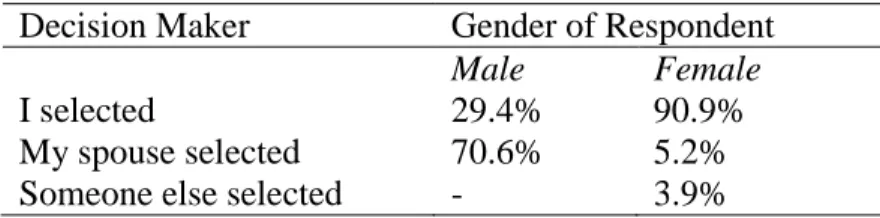
In order to determine the identity of the person who chose each child’s healthcare
provider, it was necessary to ask married respondents if they, their spouse, or someone
else selected their child’s most recent physician. For unmarried respondents, an
assumption was made that they were the primary decision-maker. Of all respondents,
80% reported to choosing their child’s most recent physician themselves. Married
respondents were segmented by the gender of respondent. For parents who answered that
their spouse selected their child’s most physician, 14 of the decision-makers were female,
while only 2 were male. Of the families represented by each of the 115 total responses, a
female was the decision-maker in 84% of cases.
Table 4.4. Identity of Decision-Maker by Response Percentage of Each Gender.
Decision Maker Gender of Respondent
Male Female
I selected 29.4% 90.9%
My spouse selected 70.6% 5.2%
Someone else selected - 3.9%
Importance of Selected Variables for Choosing a Pediatrician
Table 4.5 indicates the mean importance that respondents placed on each of the
selected decision-making variables when choosing a pediatrician for their child.
Reputation of physician was considered the most important variable for consideration,
20
Table 4.5. Mean Importance Rankings for Choosing a Pediatrician
Variable Importance ranking (on a 1-5 scale)
Reputation of pediatrician 4.64 Proximity of pediatrician’s office 3.51
Gender of pediatrician 2.00
Race of pediatrician 1.10
Even though gender of physician was ranked relatively unimportant on average,
the mean ranking of 2.00 had a standard deviation of 1.34, indicating disagreement across
responses. Race, proximity, and reputation had standard deviations of <1, indicating
relative agreement across respondents for those variables.
Variables segmented by age of parent
A positive correlation was noted between a parent’s age and the importance of a
pediatrician’s gender. Although gender was relatively unimportant (1.5) for parents aged
20-29, it was moderately important (2.5) for parents aged 50 and older.
Table 4.6. Relationship between Parent’s Age and Importance of Gender and Proximity
of Pediatrician
Age of Parent Gender of Pediatrician Proximity of pediatrician’s office
20-29 years 1.5 4.5
30-39 years 1.7 3.6
40-49 years 2.1 3.4
50 years or older 2.5 3.3
A parent’s age was negatively correlated to the importance of their proximity to a
pediatrician’s office. While proximity was very important (4.5) to parents between the
21
comparison of age of parent, gender of pediatrician, and proximity of pediatrician can be
seen in Table 4.6.
No statistical trends were noted for the relationship between a parent’s age and
race or reputation of physician.
Variables segmented by education of parent
As seen in Table 4.7, a slightly positive correlation was noted between a parent’s
level of education and the importance they placed on both gender and proximity of
pediatrician. This correlation was not as significant as the correlation noted between age
and these variables, however. The largest deviation was noted in parents with only “some
college.” While importance rankings were relatively similar between college graduates
and advanced degree holders, parents without a formal degree consistently placed less
importance on both gender and proximity of pediatrician.
Table 4.7. Relationship between Parent’s Education and Importance of Gender and
Proximity of Pediatrician
Parent’s Education Gender of Pediatrician Proximity of pediatrician’s office
Some college 1.0 3.0
College graduate 1.9 3.5
Advanced degree 2.1 3.6
While this relationship is particularly interesting, highlighting the number of
respondents with only some college is important for analysis. As previously mentioned,
the educational background of the sample was relatively homogenous, with the majority
of respondents having an advanced degree. The number of parents with only some
22
No statistical trends were noted for the relationship between a parent’s education
and race or reputation of physician.
Proximity to the nearest pediatrician’s office
A slight majority of the sample (n=59) reported living between 1-5 miles from the
nearest pediatrician. Only a very small number (n=9) reported living greater than 10
miles from the nearest pediatrician, implying a high level of pediatrician access for the
majority of respondents. These proximity responses were then compared to responses on
the current pediatrician utilized. Table 4.8 represents the number of parents in each
distance category that reported utilizing the nearest pediatrician to their home.
Table 4.8. Utilization of the Nearest Pediatrician by Distance to Nearest Pediatrician’s
Office
Distance to Nearest Pediatrician Is the nearest pediatrician the one you currently utilize? (number of responses)
Yes No
Under 1 mile 55% 45%
1-5 miles 38% 62%
5-10 miles 11% 89%
Greater than 10 miles 20% 80%
Proximity to the nearest pediatrician did not seem to predict utilization of that
pediatrician in any of the distance categories. Parents who lived farther away from a
pediatrician (5-10 miles or greater than 10 miles) actually utilized the nearest pediatrician
23 Other predictors of pediatrician selection
A little over half of the sample (n=66) responded to an optional prompt asking
about any other factors that influenced their selection of a pediatrician. The responses
were carefully mined for similar words or phrases that might indicate trends. Four distinct
characteristics were mentioned by multiple respondents: accessibility, previous
experience, specialization, and interactions with children.
Accessibility (n=19) was characterized by the ease of making appointments, hours
of availability, and ease of contacting the pediatrician. Several respondents mentioned
weekend appointments and after-hours availability specifically. One such respondent
actually indicated that they selected a pediatrician located farther away specifically
because they offered weekend hours.
Previous experience with the physician (n=9) included both personal experiences
and family experiences. Several respondents mentioned that they chose the same
pediatrician as their sibling, or that they chose to stay with a physician they had seen
previously. Many of these responses indicated choosing a family practice physician rather
than a pediatrician, due to the importance they placed on being a patient of that physician
as well.
Specialization in a particular area was also frequently mentioned (n=8). These
areas included sports medicine, internationally adopted children, research involvement,
and delayed vaccination schedules.
Parental satisfaction with the pediatrician’s interaction with their child (n=5) was
24
said that it was important that their child respond positively to and like their pediatrician.
Others did not mention their child’s opinion specifically, but simply highlighted their
need to feel comfortable with the way the pediatrician spoke to their child.
The full collection of free response data can be seen in Table 7.1, located in the
Appendix.
Importance of Selected Variables for Choosing a Specialist
Table 4.9 indicates the mean importance that respondents placed on each of the
selected decision-making variables when choosing a specialist for their child. Reputation
of physician was considered the most important variable for consideration, followed by
proximity and gender. Race was considered to be unimportant.
Table 4.9. Mean Importance Rankings for Choosing a Child’s Specialist
Variable Importance ranking (on a 1-5 scale)
Reputation of specialist 4.75 Proximity of specialist’s office 2.87
Gender of specialist 1.25
Race of specialist 1.02
With the exception of proximity of specialist (sd= 1.08), the standard deviation
for each variable was <1, indicating relative agreement across the sample.
Variables segmented by age of parent
A negative correlation was noted between the parent’s age and the importance of
the proximity to a specialist’s office. Although proximity was moderately important (3.2)
for parents aged 20-29, it was slightly less so (2.6) for parents aged 50 and older. Mean
25
Table 4.10. Relationship between Parent’s Age and Importance of Proximity to Specialist
Age of Parent Importance of proximity to specialist’s office
20-29 years 3.2
30-39 years 3.0
40-49 years 2.8
50 years or older 2.6
No statistical trends were noted for the relationship between a parent’s age and
the importance of race, gender, or reputation of specialist.
Variables segmented by education of parent
There were no significant trends noted by segmenting the education of parents by
each variable of importance. Once again, it is important to note that the low response rate
of parents with only some college (n=7) makes it difficult for any trend to be discernable,
if it did exist.
Proximity to the nearest specialist
Just below half of the sample (n=55) reported living between 1-5 miles from the
nearest hospital. A minority (n=6) reported living closer than 1 mile to the nearest
hospital, with the rest of the distribution living 5-10 miles or greater than 10 miles away.
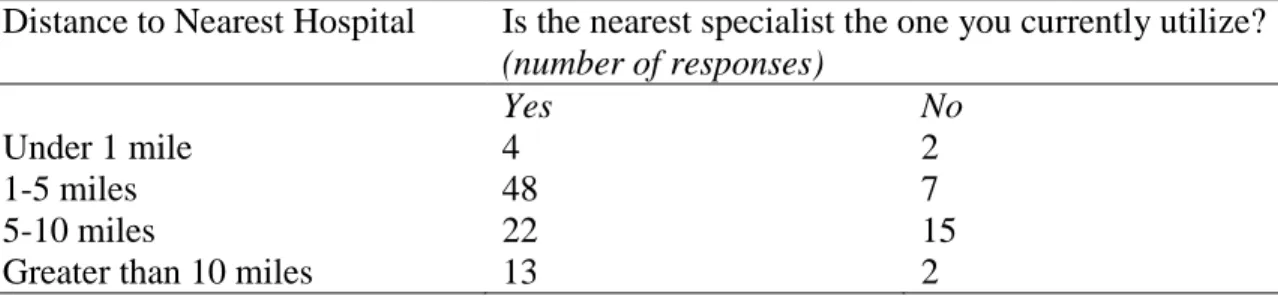
These proximity responses were then compared to responses on the current specialist
utilized. Table 4.11 represents the number of parents in each distance category that
26
Table 4.11. Utilization of the Nearest Specialist by Distance to Nearest Hospital
Distance to Nearest Hospital Is the nearest specialist the one you currently utilize? (number of responses)
Yes No
Under 1 mile 4 2
1-5 miles 48 7
5-10 miles 22 15
Greater than 10 miles 13 2
Respondents who lived greater than 1 mile away from the nearest hospital seemed
more likely to utilize specialists at that hospital for their children. There were not enough
respondents that reported living under 1 mile from a hospital to make any definitive
conclusions about that segment of the sample.
Other predictors of specialist selection
About a third of the sample (n=40) responded to an optional prompt asking about
any other factors that influenced their selection of a specialist. Similar to the prompt for
pediatrician choice, the responses were mined for similar words or phrases. Two distinct
characteristics were mentioned by multiple respondents: referrals and insurance network.
The most frequently mentioned factor in this free-response section was referral by
their pediatrician (n=11). Several respondents expanded upon this characteristic,
specifically mentioning that they valued their pediatrician’s personal opinion of the
specialist in additional to their professional recommendation. Insurance coverage was
also mentioned by several respondents (n=9). The full collection of free response data can
27 Parent’s Personal Physician Choice
Table 4.12 indicates the level of importance that parents placed on each of the
four variables when choosing their own primary care physician. Reputation of PCP was
considered to the most important factor, followed by proximity and gender. Race was
considered to be unimportant.
Table 4.12. Mean Importance Rankings for Choosing a Primary Care Physician
Variable Importance ranking (on a 1-5 scale)
Reputation of PCP 4.45
Proximity of PCP’s office 3.49
Gender of PCP 2.60
Race of PCP 1.05
The standard deviation for gender was 1.49, which indicates variation throughout
the sample. The standard deviations for all other variables were not significant.
Parents were only 6% less likely to choose the nearest primary care physician for
themselves than to choose the nearest pediatrician for their child. A full comparison of
these frequencies can be found in Table 4.13.
Table 4.13. Comparison of Nearest Physician Utilization for Parent and Child
Type of Physician Is the nearest physician the one you currently utilize? (number of responses)
Yes No
Child’s pediatrician 35% 65%
Personal PCP 29% 71%
About half of the respondents (n=60) answered an open-ended question about the
28
extremely similar to the answers given for both pediatrician and specialist selection. Both
insurance compatibility (n=15) and accessibility (n=9) were mentioned with some
frequency. Additionally, effective communication (n=10) was cited as a critical factor.
Respondents claimed that having a good rapport with their PCP was extremely important.
Feeling free to speak about awkward and sensitive topics was highlighted as well, which
respondents attributed to their level of comfort with their PCP. The full collection of free
29 DISCUSSION Implications of Sample Demographics
While my sample was relatively homogenous with respect to race and gender,
comparing it to the demographics of both Chapel Hill and the University of North
Carolina yields important parallels. Fifty-six percent of UNC employees live in either
Chapel Hill or Durham (University of North Carolina at Chapel Hill, Office of
Institutional Research & Assessment, Faculty and Staff Data, 2014). This implies that, of
the employees surveyed, a significant amount of them likely seek medical care for
themselves or their children in the Chapel Hill or Durham area.
The sample demographics were also extremely similar to the overall
demographics of Chapel Hill. Census information from 2010 estimated that Caucasians
made up 72.8% of Chapel Hill’s total population (Town of Chapel Hill, 2010). Although
my sample size was limited (n=115), 87% of all respondents identified as Caucasian.
Coupled with the fact that the majority of UNC employees live in the greater Chapel Hill
area, this large percentage of Caucasian responses implies that my sample was likely
representative of Caucasian healthcare preferences in the greater Chapel Hill area.
Segmented further, the sample provides a great deal of information on the
pediatric healthcare decision-making of Caucasian females working for the University of
North Carolina. Eighty-five percent of my sample was female. Although demographic
information was unavailable for all UNC employees, diversity statistics were available
for UNC faculty members specifically. Seventy-nine percent of female faculty at UNC
identified as Caucasian (University of North Carolina at Chapel Hill, Office of
30
of both female and Caucasian survey response, coupled with the high percentage of
female Caucasian faculty members, allows for the inference that the sample was likely
representative of female Caucasian faculty members at the University of North Carolina.
Educational attainment statistics provide further evidence that the sample was
representative of Chapel Hill. As of 2010, 12% of Chapel Hill residents over the age of
25 had completed some college, 28.9% had a college degree, and 46.5% had a graduate
degree (Town of Chapel Hill, 2010). Although the sample was skewed towards a greater
percentage of graduate degrees (6%, 27%, and 67%, respectively), educational attainment
in both Chapel Hill and the sample followed a similar trend. The large percentages of
both college and graduate degrees imply that the sample was somewhat representative of
the educational background of the general Chapel Hill population.
Importance of Selected Variables Proximity
As expected, proximity was consistently rated as an important variable in a
parent’s decision-making process. This importance varied, however, between selecting a
pediatrician and selecting a specialist. Less importance was placed on the proximity of a
specialist’s office (3.51 for pediatrician, 2.87 for specialist). When considering why this
might be true, it is important to consider the frequency of visits for the two types of
physicians. Pediatricians handle both preventative care and common non-emergent
ailments, while specialists are typically only consulted for more serious and rare
31
frequency of specialist visits. This data suggests that parents care less about the distance
of a specialist’s office because of the infrequency of visits to that office.
Despite ranking the proximity of a specialist as less important than the proximity
of a pediatrician, respondents who lived greater than 1 mile away from the nearest
hospital seemed more likely to utilize specialists at that hospital for their children.
Conversely, proximity to the nearest pediatrician did not seem to predict utilization of
that pediatrician in any of the distance categories. Due to the disparities in reported
importance of proximity, this implies that selection of the nearest hospital was due to
factors other than its location. In this case, it becomes important to consider the sample
population. The University of North Carolina at Chapel Hill has an extensive hospital
network, making it entirely possible that UNC employees choose pediatric specialists at
UNC Hospitals due to their familiarity with the hospital, rather than its proximity. Given
the fact that 56% of university of employees live in either Chapel Hill or Durham, it is
extremely likely that UNC Hospital was their nearest hospital of reference. This would
help to explain the high frequency of utilizing the nearest hospital across the sample
population.
Also of note was the relationship found between a parent’s age and the
importance of proximity to both a specialist’s and pediatrician’s office. For both the
selection of a specialist and the selection of a pediatrician, age of the parent was
negatively correlated to importance of proximity. Older parents therefore placed less
importance on the proximity of both pediatricians and specialists. Although much less
significant than the correlation between age and proximity, a slightly positive correlation
32
proximity. This relationship means that, generally speaking, parents with higher levels of
educational attainment consider proximity to be more important.
Reputation
Reputation of physician was considered to be the most important factor for
consideration when selecting both a pediatrician and specialist. Survey respondents
ranked provider reputation as 4.64 and 4.74, respectively. Reputation was one of the few
variables that did not change between selecting a pediatrician or specialist. This
congruence implies that the reputation of a physician is extremely important to parents,
regardless of the type of physician they are looking for.
In the free response sections of the survey, respondents frequently mentioned that
they sought recommendations in order to verify reputation. For pediatricians,
recommendations from friends or other family members were mentioned by multiple
respondents. This free response data provides further support for the research of Tu and
Lauer (2008), in which they emphasized the importance of word-of-mouth
recommendations for physician selection.
When asked to describe their motivations for selecting a specialist for their child,
respondents once again cited recommendations. The key difference between the
responses for selecting a specialist vs. selecting a pediatrician, however, was that
respondents frequently mentioned physician referrals specifically for the selection of a
specialist. These referrals were typically from their child’s primary pediatrician. This
trend is also in agreement with the research of Tu and Lauer (2008), who described that
33
(and in this case, pediatricians) are typically the first physicians consulted for a
non-emergent ailment, they are likely the person who conveys the need for a child to see a
specialist. After a pediatrician recommends that a child see a specialist, we can therefore
infer that the parent in turn asks for the pediatrician to recommend a specific specialist as
well.
Race
Race was almost unanimously selected as unimportant in selecting both a
pediatrician and specialist. Variations in responses were so small that it was impossible to
segment the importance of race within any other demographic characteristics. These
findings are somewhat unsurprising, however, given the fact that 87% of the survey
sample was Caucasian. Bornstein et al. (2000) reported that Caucasians consider the race
of their physician to be unimportant. The results of my survey therefore support this
finding. Only in minority populations did race appear to be important in the
decision-making process (Chen et al., 2005 and Malat et al., 2006). Without a larger number of
minority responses, it is impossible to confirm the trends noted in minority populations.
Race can also be a somewhat difficult topic for people to speak freely about,
which may have affected the results of the survey. Providing respondents with anonymity
attempted to control for this reluctance, but may not have been sufficient.
Gender
A physician’s gender was considered relatively unimportant to the sample
34
importance of a specialist’s gender was 1.25. None of the respondents elaborated on
gender preferences, or lack thereof, in the free response section.
Despite these relatively unimpressive rankings, a positive correlation was noted
between the parent’s age and the importance of a pediatrician’s gender. Although gender
was relatively unimportant (1.5) for parents aged 20-29, it was moderately important
(2.5) for parents aged 50 and older. A positive correlation was also noted between a
parent’s education and the importance that they placed on gender. Parents with only some
college assigned a pediatrician’s gender an importance of 1.0, while parents with
advanced degrees assigned an importance of 2.1.
Other Considerations
Based on the data collected, I am unable to ascertain whether or not parents
undergo a more extensive search for pediatric specialists than they do for a pediatrician.
Although Hoerger and Howard (1995) provided evidence that pregnant women undergo
an extensive and exhaustive search process for selecting an obstetrician, there is not
enough evidence to make a comparison in this case. The relative importance of the four
tested decision-making variables did not vary significantly between selecting a
pediatrician or a specialist. Furthermore, free response comments gave more insight to
the provider-choice decision itself, rather than the search process.
The free response data implies that the decision-making process for selecting a
specialist may actually be more straightforward than selecting a pediatrician. The factors
that were mentioned by several different respondents- referrals and insurance networks-
35
meaning that they are relatively binary and do not exist on a scale. A prospective
specialist either has a colleague’s referral or not; they either accept a patient’s insurance
or they don’t. The factors frequently mentioned for selecting a pediatrician- accessibility,
previous experience, specialization, and interactions with children- are much more
abstract. Accessibility, for example, can mean many different things depending on a
parent’s personal preferences. These responses imply that parents may actually undergo a
more abstract and creative decision-making process when selecting a pediatrician vs.
selecting a specialist.
Another goal of my research was to contrast decision-making for oneself and for
someone else. In an effort to understand my sample’s personal decision-making
processes, I asked for them to rank the importance of the same four variables for selecting
their own primary care physician. The only variable that differed between their personal
decision-making and decision-making for their child was a physician’s gender. Parents
ranked gender as moderately important (2.60) for their primary care physician, but less
important for their child’s physician (2.00 for pediatrician, and 1.25 for specialist). While
no respondents elaborated on this discrepancy in the free-response section, I would
hypothesize that this difference may be due to the increase of gender-specific health
issues after puberty. Adults may feel more comfortable discussing sexuality and fertility
related issues with a member of their own gender.
In terms of the variety of factors considered, respondents seemed to consider a
narrower range of variables when choosing their own primary care physician. The free
response section for the selection of a pediatrician had several unique factors for
36
antibiotics, and even their personal interests. One respondent actually mentioned that
their pediatrician’s love for dogs influenced their choice, as having a similar interest
helped them to feel more comfortable with their decision. The responses for choosing a
parent’s personal PCP were much less descriptive and imaginative, focusing mostly on
factors such as insurance coverage and hours of operation. This may in fact help to
support the hypothesis that decision-making processes are more creative when the
decision is on behalf of someone else (Polman and Emich , 2011).
Another finding worth mentioning is that parents occasionally mentioned taking
their child’s opinions into account. Although it was relatively infrequent (n=5), several
parents mentioned that it was important for their child to like and feel comfortable with
their doctor. This finding supports the research of Lipstein et al. (2012), as it implies that
the parent-child relationship is a factor of consideration in physician-choice.
Implications for Healthcare Providers
From a demographic standpoint, it appears that women make the majority of
provider-choice decisions for their children. In my sample, a female was the
decision-maker in 84% of cases. This finding will be particularly important when hospitals and
physician practices are tailoring their marketing campaigns. Since mothers choose the
vast majority of their children’s physicians, it would be advisable for marketing
departments to target advertising campaigns towards them directly.
Additionally, parents’ preferences seem to change as they age. Older parents do
not necessarily value certain provider characteristics as much as younger parents, and
37
proximity of their child’s pediatrician and specialists. When providers are making
decisions about building new clinics and hospitals, considering population demographics
will be crucial to choosing an optimal location. If the area’s population has a high density
of young families, they may be particularly sensitive to the distance of their nearest
pediatrician or hospital. In order to maximize the number of potential patients, it would
make sense to choose a location that was as close as possible to a large number of these
young families. A careful clinic placement may not be as important in populations that
have large numbers of older parents, however.
The education levels of parents can also impact the importance they place on
certain variables. In this sample population, higher levels of education were correlated
with placing more importance on both the proximity and gender of a pediatrician. While
a physician’s gender is inflexible, proximity can be mediated through placement of
clinics and hospitals. Keeping a close eye on the demographic makeup of a community
can allow marketing departments to be more efficient in their efforts. In a population with
a large number of professional degrees, target markets may be limited to a smaller
geographic area. If marketers already know that parents are unlikely to travel a large
distance, then they can avoid spending resources on families that are unlikely to become
customers.
The free response data also highlighted the importance of accessibility and
after-hours appointments. Several respondents mentioned after-after-hours appointments
specifically, indicating that pediatricians have the opportunity to differentiate themselves
by providing services outside of normal business hours. Working parents may be more
38
Extending office hours into the evening may be particularly effective in regions that have
low densities of stay-at-home parents, who may be less sensitive to the availability of
appointments.
While it may not be effective to market healthcare services to children directly, it
is important for healthcare providers to realize that maintaining patient satisfaction is still
important for the juvenile patient. Although children do not directly make provider
choice decisions, there is evidence that they have the ability to influence them. Research
does not support the notion that children influence the initial decision to visit a particular
provider, but their assessment of that visit can be predictive of whether or not they
become a long-term patient. For this reason, it is advisable for providers to develop a
rapport with both the parent and child. Since some parents elicit their child’s opinion,
winning over a child may be crucial to retaining a patient.
Limitations
My survey sample was relatively homogenous with regard to both race and
gender. As a result, analyzing the effects of these variables on physician choice was not
possible. Because my sample was comprised of mostly Caucasian women, the results of
the study cannot be generalized outside of that demographic. Future studies should strive
for a larger sample with greater racial and gender diversity. This improvement would
help to provide insight on the provider-choice decisions of both fathers and minorities.
The sample was also limited due to the fact that all respondents were from a
single employer. UNC employees may not represent the general attitudes and
provider-choice preferences of the greater Chapel Hill community. Because these results are not
39
about overarching trends in the United States. A follow-up study should include a sample
with greater geographic and workplace diversity.
In hindsight, several of the study’s questions could have been improved.
Opportunities for elaboration on gender preferences, for example, may have yielded more
data for analysis. It may have been helpful to know whether or not respondents had a
preference for physicians of a particular gender, or if they preferred a physician to be the
same gender as their child. Simply asking about the importance of gender in the
decision-making process does not yield enough data for specific marketing recommendations to be
made.
The survey also failed to control for many life changes that influence the need to
search for a new physician. While the need for a specialist is usually unexpected,
shopping for a new pediatrician typically only occurs when a family moves or is
dissatisfied with their current provider. Additional questions could have been included to
ascertain the reason for the family’s most recent provider choice. This addition would
have allowed for further segmentation the collected data in order to ascertain if particular
40
CONCLUSION
Marketing pediatric healthcare poses many distinct challenges. From a services
marketing perspective, it is relatively unique- few fields market their services to a third
party that decides on behalf of the final consumer. As such, the promotion of pediatric
healthcare services must be performed with both parties- the parent and child- in mind.
While general healthcare marketing guidelines can provide a benchmark, they are by no
means perfectly representative of best practices in the pediatric space. Parents’ general
decision-making tendencies are relatively stable but may be adjusted somewhat where
their child is concerned.
Parents’ thought processes do not deviate significantly with regard to a
physician’s proximity, reputation, gender, or race when choosing their own physicians or
choosing one for their child. Subtle differences arise with regard to their tendency to
consider a broader range of variables, however. Parents seem to consider a greater
number of factors when selecting a physician for their child. While parents’ expectations
for their own physicians may be relatively black and white, this is not entirely true where
their child is concerned. This variability complicates the process of communicating the
attributes of a particular physician. If there are many provider characteristics that are
important to parents, it becomes increasingly hard for marketing departments to tailor
their services and marketing campaigns to touch on each one.
This research also demonstrated the effect that demographic characteristics such
as age and level of education can have on provider preferences. Once marketing
departments have gathered information about what matters to their specific target market,
41
highest potential for return. If a particular characteristic is only moderately important to a
target market, it may be beneficial to focus promotional efforts on a more highly-valued
provider characteristic.
Furthermore, the function of marketing should not end after initially attracting a
customer. Providers and their organizations must focus on customer retention as well.
Retaining customers will be essential for long-term success, especially in the increasingly
competitive pediatric healthcare market. As the number of potential substitutes increases,
families may be more sensitive to the perceived quality of care that they receive.
Appealing to a parent’s preferences may bring a family in, but meeting the expectations
42 APPENDIX
A. Survey Recruitment Email
Subject: Survey on Pediatric Healthcare Decision Making
Dear UNC Faculty and Staff,
I am a senior undergraduate student at Kenan-Flagler Business School completing an honors thesis on healthcare consumer behavior. IF you are a parent of at least one child who currently lives at home, I would appreciate your response to a brief survey. The survey should take less than 10 minutes and will be completely confidential.
The purpose of this research study is to determine how parents choose pediatric healthcare providers on behalf of their children. I hope to determine how parents’ physician-choice decisions vary when choosing for themselves vs. choosing for their child. Specifically, I plan to analyze the importance of a) proximity, b) race, c) gender, and d) reputation of physician in making pediatric healthcare decisions and to compare these results to research on general physician choice.
Follow this link to the Survey: Take the Survey
Or copy and paste the URL below into your internet browser:
https://kenan-flagler.az1.qualtrics.com/SE/?SID=SV_3ye2BjdDPuEeX3L
Thank you for taking the time to complete my survey!
This survey (IRB # 15-3337) is being conducted by Tyler Powell, undergraduate student at Kenan-Flagler Business School at the University of North Carolina at Chapel Hill.
IRB Approval Date: 1/19/2016
Tyler Powell
B.S. Business Administration, Minor in Chemistry
University of North Carolina at Chapel Hill | Class of 2016 Kenan-Flagler Business School