After Swann: Busing, Housing, and the Preservation of Whiteness in Mecklenburg County
By:
Jack Leland Largess
Honors Thesis Department of Geography
University of North Carolina at Chapel Hill 2016
Approved:
________________________________ Altha Cravey, Thesis Advisor
Abstract
Swann v. Charlotte-Mecklenburg Board of Education changed the way the united states thought about segregation. It charged the Charlotte-Mecklenburg Schools system (CMS) with using busing to redistribute students across the district in order to eliminate all vestiges of the segregated, dual-race school system.
The apparent success of CMS’ busing plan helped situate Charlotte as a progressive city of the New South. The end of court-ordered desegregation led to a stark reversion to racially distinct and unequal schools that look very similar to those before Swann.
Table of Contents
Figure 1: Map of Mecklenburg County, North Carolina……….……… 5
Introduction ……….………6
Literature Review A timeline of select desegregation cases……….………7
Literature Review………..………9
The Politics of Public Education in North Carolina, 1839-1956……….………14
Mecklenburg Under Court Order (1969-2001) Swann and the Era of Busing………..………..…27
Geographic Assignment and “de facto” Segregation……..………..…..32
The School Board, Housing, and Development………..………..…35
Preservation of Whiteness Housing Segregation………..……40
Segregation: Schooling, Housing, and Demography………..………….41
Housing Choices………..………….53
The Cotswold Rebellion………..………….55
Conclusion……….………..……….60
Interest Divergence……….………..……….53
Good Schools……….………..………53
Acknowledgements……….………..……….62
A Note on Word Choice……….………..………….62
Introduction
The Charlotte-Mecklenburg Schools (CMS) system gained national recognition and regional prominence for its apparently successful desegregated school system. From 1969 to 2002, the city operated under a program of mandatory busing for racial balance. Know affectionately as the “City that made it work,” Charlotte, and surrounding Mecklenburg County, grew rapidly in the latter third of the 20th century, in no small part due to the public success of its race-based desegregated busing program. After a federal judge
declared the system “unified” and released it from supervision, the district quickly reverted to segregation levels approaching those found in the 1950s. This paper will explain how this happened, why it happened so fast, and what it may mean for CMS.
Literature Review
A timeline of select Supreme Court Desegregation Cases:
The following is of an overview of the school desegregation cases that are most pertinent to this analysis.
• 1954 - Brown v. Board of Education I: segregated schools, even if “equal” in all tangible factors, deprive minority students of equal education, violating the 14th Amendment. Abolished legal school segregation and the separate but equal doctrine (Brown).
• 1955 - Brown v. Board of Education II: directed the states to execute the court’s segregation order with “All deliberate speed” (Brown II)
• 1961 – Morrow v. Mecklenburg County Board of Education: The 1960 pupil assignment plan of geographic assignment with opportunity to petition for transfer was sufficiently desegregated (Morrow)
• 1968 - Green v. New Kent County Commissioners: Legal segregation must be dug out, root and branch. Establishes six “Green factors” by which a desegregation case should be judged: (Green)
o Student assignment, o Faculty assignment, o Staff assignment, o Transportation,
o Extracurricular activities, o Facilities
• 1971 - Swann v Charlotte Mecklenburg Board of Education:
forward with a sufficient plan for dismantling the effects of a state-run dual system (Swann).
• 2000 - Belk v Charlotte Mecklenburg Board of Education
o Belk argued that a new case, Capacchione v CMS, was an assault on Swann, and moved to reopen the Swann case. In 2001 a federal district judge
Literature Review
In contemporary Charlotte-Mecklenburg Schools (CMS), White students have become a statistical minority. However, they still benefit from a school system built to accommodate their needs. As Bell (1980) asserts, Whites will only serve Black and other minority interests if their interests are aligned. Steve Smith’s Boom For Whom evaluates this theorem in the context of CMS and desegregation up until 2004. This paper attempts to refocus that narrative onto the nature by which White actors prioritize their interests, and briefly explores what has happened in CMS since 2004.
ways in which the White population in Mecklenburg County has asserted itself in order to maintain their hold on Whiteness.
As a nationally prominent example of court-ordered desegregative bussing, the Charlotte-Mecklenburg Schools case has received scholarly attention from several different fields and perspectives. In this paper, I will focus on the analysis by Stephen Samuel Smith, relying on Derrick Bell’s interest-convergence dilemma, of the political and economic factors that drove Charlotte’s business elite to support desegregation, and how those same factors now contribute to the resegregation of CMS.
I rely throughout on works from two collections, Yesterday, Today and Tomorrow: School Desegregation and Resegregation in Charlotte (eds Mickelson, Smith, and Nelson, 2015), and School Resegregation: Must the South Turn Back? (eds. Boger & Orfield, 2005) to inform and contextualize the recent history and current realities and challenges facing cities like Charlotte.
The forced desegregation of public schools in the United States in the 20th century is intimately tied to the courts and to public and juridical sentiment and understandings of racism and structural inequality. But both public and judicial opinions on segregation are inextricably tied to the development of the US city in the latter half of the 20th century. An understanding of that development is fundamental to understanding desegregation and resegregation within the US city because of the strong historic linkage between residential segregation and school segregation.
twentieth century and the first decade of the twenty-first, newcomers arriving not only from nearby rural areas but from northern cities and foreign countries.
Ample studies demonstrate the negative impact on students caused by the end to active racial desegregation. Crime rates rose amongst non-White males (Billings, Deming, Rockoff, 2013). All students score lower when assigned to schools with more minority students (Billings, Deming, Rockoff, 2013).
The urban centers of the US, including Charlotte, are becoming minority white, and Charlotte Mecklenburg Schools is now 32% white, compared with 79% white in 1969 (Frey, 2011). However, being a consolidated, countywide district, CMS’ school
administration and assignment does not follow the pattern of many other large
municipalities, (Hanchett; Liebowitz & Page; Billings, Demming, and Rockoff, 2014; Billings Brunner, and Ross, 2014; Tannenbaum, 2015).
Billings, Brunner, & Ross (2014) show, in Charlotte, that in some instances negative school evaluations boost home values in wealthy in-zone enclaves; Billings is able to
suggest that home prices rise because of the significantly increased likelihood that students living within the zone will be able to successfully petition to leave their home district for another, more reputable school.
racially integrated schools and communities without a protracted or intractable political fight over school district boundaries (Liebowitz and Page, 674).
The authors show, however, that CMS’ neighborhood school plan, adopted in 2005 (Liebowitz and Page, 673), created conditions similar to those present in cities with multiple school districts. White families with children enrolled in CMS, they found, were more likely under the neighborhood school scheme to move to predominately White neighborhoods than they had been during the administration of CMS’ race-conscious desegregation plans, from 1971-2002.
Liebowitz and Page argue that, given the litany of factors affecting individual housing choices, differentiating between de jure and de facto segregation is quite difficult. They go so far as to suggest that, in light of their research, the courts might reevaluate their series of decisions in the 1990’s and 2000’s granting many school districts unitary status (699).
Armor, Thernstrom, & Thernstrom (2006) contest that existing research has been able to fully control for the immediate effects of racial segregation, but Mickelson (2008) dismisses their work as dated, drawing on a limited number of studies small in scope, from the 1970’s and 1980’s.
Derrick A. Bell, Jr. writes a commentary on the success and failure of the juridical logics used in Brown v Board of Education and other school desegregation litigation. He writes commentary the ties together judicial and popular opinion. That alone is
relevant work of Steve Smith, and with him, Amy Hawn Nelson and Roslyn Mickelson. Bell’s commentary is very useful in judging how the courts’ opinions evolved from 1954-2002, and why. The interest-convergence theory proposes that the seminal school desegregation decisions from Brown to Swann were not striking stances by the courts that pushed the middle and upper-class Whites in the U.S. to delay their interests for the benefit of Black interests, but rather that the cases demonstrated a narrow window of convergence between White and Black interests. Smith expands on this idea, suggesting, as Bell does, that White economic and political interests of the time supported desegregation, even if the immediate results of such a policy change were personally distasteful. Desegregation benefited the US’ foreign policy, particularly as it competed in the “third world” against the egalitarian ethos of the USSR. It also improved the economic conditions in the US,
particularly in the South, consolidating facilities and making the region more attractive to national and international business and industry.
Bell (1980) suggests that the window of rousing Civil Rights litigation has closed, at least in the realm of school desegregation – and he briefly outlines an alternative. He recommends that energies be focused not on integration but on improving existing schools for all students, including integrated and all-Black schools, in a clear counter-proposal to the ideology of most of the other authors – particularly of Hawn Nelson, Smith, and Mickelson – that integrated schools are a key goal.
Bell argues that the primary goal when discussing desegregation should be
Mickelson (2005) and Nelson (2015) demonstrate, students of color attending desegregated schools do perform better than their peers attending hypersegregated schools of color. Still, evidence (Mickelson, 2005) shows that tracking within schools fosters a still-segregated environment and perpetuates racial achievement gaps. Of these concerns, Bell’s argument raises interesting concerns about the efficacy of Swann’s addressing of segregation. Unfortunately, these concerns fall beyond the scope of this paper.
Davison Douglas’ encyclopedic work, Reading, Writing & Race: The Desegregation of the Charlotte Schools (1995) provides a peerless summary of the political and social
developments that led to and marked the desegregation project in Charlotte-Mecklenburg Schools. In the following section, the prelude to his argument is summarized in depth, not to repeat his scholarship, but to reframe his research in light of Bell’s interest convergence dilemma, emphasizing how White players in North Carolina business and politics have acted to maintain their status as White, and differentiated from non-White.
The Politics of Public Education in North Carolina, 1839-1956
North Carolina has never abandoned its public schools. In 1954, after the Supreme Court handed down their unanimous ruling Brown v Topeka Kansas Board of education ruling, declaring that racially segregated, “separate but equal” facilities and
reputation as a moderate southern state, governed by reasonable, White businessmen willing to, when it came to race, make it work.
In 1868, on the heels of the 14th amendment, (which would later form the backbone of nearly every single lawsuit which challenged segregated schooling) a new constitution for the State of North Carolina promised a free, public education for all students (Douglas, 7). Tucked into that new, post-slavery, post-war framework of government was a non-binding resolution supporting racially separate schools, proposed by a newly elected Black legislator. The following year, Black legislators voted alongside their White peers as the state passed an amendment mandating racial segregated primary and secondary schools. The Black politicians voted for segregation in an effort to secure the establishment and perpetuation of Black schools from the primary to collegiate level.
In the latter part of the 19th century, North Carolina politics were marked by the success of the Fusion Alliance, a coalition of Black and White Republicans and Populists, who dominated state politics, running a modestly progressive government that –generally– supported public education for Black students in North Carolina (Douglas, 14). While Blacks held modest political power in the state legislature, the Black political leadership hoped that by supporting segregated schools they would maintain the general support of White politicians for Black public education and other civic needs (Douglas, 7). This conciliatory tactic, challenged from within and without, became a foundational piece of North Carolina’s attitude towards race and public education.
have to pay more for their children’s superior education than Black families did for their children’s education.
In 1886, a group of White families challenged a law that divided tax revenues for racially segregated schools. Under the statute, taxes on Black citizens would pay for Black schools, while taxes on White citizens paid for taxes on White schools. That year, a group of White taxpayers brought a case against the Gaston County Commissioners, objecting to a planned tax increase to expand funding for White schools. Unhappy about the tax hike, they sued not in support of the underfunded schools for Black students, but in an effort to
challenge their new tax by challenging the law. The resulting decision, Pruitt v.
Commissioners of Gaston County, found that the separate taxation scheme unconstitutional, but upheld segregation so long as it was separate and equal – ten years before the Plessy v. Ferguson case would make separate but equal the law of the land (United States, 1898).
Foreshadowing the extreme reactions that would follow Brown, Kingston and
Goldsboro NC abandoned their public schools rather than fund Black and White institutions from the same tax monies. Kingston and Goldsboro quickly resumed classes after seeing the devastating impact on not just Black, but also White children (Douglas, 11). Pruitt was not an outright victory for Black schools – it enshrined separate but equal as state law ten years before Plessy would do the same in federal courts and while it did determine that Black and White schools should be funded from the same tax base, it left disbursement of that money up to the individual school districts, who tended to spend more on White students than Black (“United States,” 633).
state’s population was about one-third Black, and Black schools were receiving about 28% of state funding – more than in any other southern state, including those with a much larger Black population (Douglas, 14).
The white-supremacist Democrats’ defeat of the Fusion Alliance in the 1898 election brought the days of educational near-parity to a sharp close (Douglas, 12). Governor
Charles B. Aycock, one of the first of North Carolina’s famous “Education Governors,” pushed through education reform including an increased spending, from 1 to 4.7 million dollars. Though an avowed white supremacist, Aycock championed the defeat of an amendment that would have overturned the Pruitt decision, allowing for the racial
collection of taxes for schools. Aycock saw Black education as a vehicle for Whites’ paternal care of Black North Carolinians and an economically important tool, one that would
increase the productivity of the state and stem the tide of Black emigration form Eastern NC. Still, as spending went up for the state, Blacks’ share of the pie fell, from 28% in 1990 to 17% in 1910 to only 13% in 1915 – the state spending an average of $7.40 per White
student, and a $2.30 per pupil pittance on Black students. Some years, Black public schools received more support from northern foundations like the Rosenwald Fund than from the state (Douglas, 14).
and the new General Assembly moved to impeach two of the judges, though the Senate failed to indict (Douglas, 15). Though not an outright rejection of segregation, Hooker did, promisingly, challenge the history of inadequate spending on students of color.
Three years later, a new bench overruled Hooker in the case, Lowery v School
Trustees of Kernersville.The justices found instead that the Constitution required not equal per capita expenditures, but simply “Equal facilities,” terms of the “same length” and a “sufficient number of teachers” (Douglas, 15). The court offered broad, loose definitions for each of these measures, effectively ending any mandate of equal treatment by the state.
The Democratic electoral return came in lockstep with Jim Crow segregation and open violence towards Black North Carolinians. A white electorate and segregationist legislature chose the NC’s jurists, providing few opportunities to challenge discrimination through litigation. Some Black leaders resisted efforts to pursue equity or integration through the courts. Continuing in the vein of those who supported the segregated primary schools of 1869, they operated from an accommodationist platform, working to improve Black schools at the primary, secondary and university level (Douglas, 19).
Improvement in educational parity, when it came, came slowly from both the legislature and the courts. The governor’s 1934 “Commission for the Study of Problems in Negro Education” recommended increased salaries for Black teachers; in 1938 Charlotte 4th Circuit Judge John Parker found that White teachers’ 25-30% higher salaries violated the equal protection clause of the 14th Amendment. By 1945, Black teachers actually made more money than their White counterparts, although this was partly a result of
In the 1940’s North Carolina continued to make small adjustments in an attempt to appease their Black constituency. Around the country, Black interests were being received with greater gravity. Hoping to avoid litigation in Federal Courts, the North Carolina Legislature raised expenditures for Black students, Black teacher Salaries, and expanded graduate programs for Black students. In doing so, ruling Whites in North Carolina appeared to be much more sympathetic to Black lives than were their contemporaries in other states, particularly their Southern neighbors. In 1939, then-Governor Clyde Hoey defended his support of Black graduate education, crystalizing the bigoted, paternal logic of the day by saying “North Carolina does not believe in social equity between the races, and will not tolerate mixed schools for the races, but we do believe in equality of opportunity in their respective fields of service” (Douglas, 23). In 1949, however, the governor’s North Carolina Commission on Interacial Cooperation dissolved, citing disagreements about integration. That same year, Kelly Alexander, president of the North Carolina National Association for the Advancement of Colored People (NC NAACP), defined integrated schools as a final goal of his organization’s work (Douglas, 23). A national consensus was building in support of Black students, and North Carolina was not to be left behind.
Beginning in 1949, with strong support from the NAACP Legal Defense Fund, plaintiffs filed several school desegregation suits, worrying the North Carolina General Assembly (NCGA), who decreased the per-pupil funding gap between White and Black students: in 1940, White students received 79% more funding from the state. By 1952, that gap had been closed to 17% (Douglas, 22). Fighting segregation in primary and secondary schools was challenging. Most of the NAACP’s cases targeted institutions of higher
integrated the UNC Law School (Douglas, 23). Then, in 1954 the Supreme Court released a unanimous 9-0 verdict on a group of cases, including one from Clarendon South Carolina, a few hours to the south of Charlotte. The cases were collectively called Brown v. Topeka Kansas Board of Education. In their opinion the justices concluded “that, in the field of public education, the doctrine of "separate but equal" has no place. Separate educational facilities are inherently unequal (Brown).”
The Brown case was simple, striking in its clarity, and fundamentally changed the United States. Before Brown, the Supreme Court had ruled that segregation of graduate-level institutions was unconstitutional because it hindered students’ “ability to study, to engage in discussion and exchange views with other students, and, in general, to learn his profession” (Swann).
In Brown, the court found that “Such considerations apply with added force to children in grade and high schools. To separate them from others of similar age and
proceed. Published in August of 1954, the authors suggested the state not defy the Courts’ desegregation orders, as many states were preparing to do. Private tuition grants, the report cautioned, for white families hoping to avoid a desegregated learning environment, might be unconstitutional. The authors also panned the idea of a state-sponsored private school system. Desegregation in North Carolina would take a long time. Better, they said, to wait it out and take no drastic action until the court clarified their ruling on Brown
(Douglas, 28).
Shortly after the Brown ruling, the Supreme Court received several “requests for relief” in the task of desegregating their schools – ranging from “how” to “how soon” to “must we at all?”
The NC Attorney General’s office submitted its own amicus (friend of the court) brief. Written in large part by Assistant Attorney General and white supremacist Beverly Lake, it advised the courts that desegregation was simply not possible. Lake supported his argument with a survey of Law Enforcement and school Superintendents, which earnestly reported that desegregation would likely cause unconscionable violence and disruption and, perhaps, the eventual abandonment of public schools (Douglas, 29).
In North Carolina, the Committee found, the Brown decision was hugely unpopular among Whites, and also among Blacks. Across the South, 47% of Black Americans the Brown
decision – in large part due to fears that white students would hurt their children (Douglas, 30). As with the establishment of segregate schools and steps towards funding parity, threats and acts of violence by Whites against Blacks curbed Black enthusiasm for the change.
On the surface, North Carolina appeared to wait to receive notice from the second ruling on Brown. In reality, what would become the state’s strategy towards school
desegregation – external acceptance, internal resistance – was already taking shape. At the state level, on March 30, 1955 the legislature vested local school boards with school
assignment authority (Douglas, 31). These new arbiters were directed to not consider race in their assignment choices; complainants were directed through a labyrinthine appeals process. This action moved the onus of desegregation from the state to municipal
governments, at once relieving the state of any pressure to address school, and stalling the process of compelling integration through the courts: the structure of the new law meant that any case brought against a school system in North Carolina would affect only that system, and not the entire state.
In coordination with Governor Hodges, who in November of 1954 succeeded the late Governor Umstead, the General Assembly did not (as had their colleagues in South Carolina and Virginia) pass a constitutional amendment abolishing public schools,
Instead, in 1956, a second Pearsall Committee, this one composed of seven White men – Black men, Governor Hodges reasoned, being too likely to push for immediate desegregation – reported that “The educational system of North Carolina has been built on the foundation stone of segregation of the races in the schools…The Supreme Court of the United States destroyed the school system which we had developed – a segregated-by-law system…[The Committee is] proposing the building of a new school system on a new foundation – a foundation of no racial segregation by law, but assignment according to natural racial preference and the administrative determination of what is best for the child” (Douglas, 32). The legislature supported the commission’s plan which included, in a
reversal from the 1955 session, constitutional referenda providing private school tuition grants for parents whose children were assigned to a desegregated school, and for a local referenda option which would allow a community to vote to close a desegregated school. While this may seem to be a great departure from the state’s previous position – indeed, as a point of policy, it certainly was – North Carolina, in passing the Pearsall Plan, stayed the course with its business-conscious strategy, taking a “moderate” response to the Brown decision. In situating the White political response to Brown and the growing momentum of the Civil Rights movement, it is important to recognize the level to which, following Brown, White threats and acts of physical violence were accompanied by structural violence of laws and policy enacted not only by citizens and community organizations, but also by local and state governments.
North Carolina did not join South Carolina, Georgia, Louisiana and Virginia in legislating to eliminate funding from schools that chose to follow the Supreme Court’s order and desegregate.
Nor did North Carolina did not join Alabama, Arkansas, Florida, Georgia, Louisiana, Mississippi, South Carolina and Virginia in passing “interposition resolutions,” declaring themselves that all or part of the Brown decisions were unconstitutional (Douglas, 33).
North Carolina did not join Alabama, Arkansas, Florida, Geogria, Louisiana,
Mississippi, South Carolina, Tennessee, Texas and Virginia in passing legislation to limit the NAACP (Douglas, 33).
Unique of all these southern states, North Carolina did not challenge the Court in a strong, public fashion. “Indeed” notes Douglas, “the North Carolina General Assembly enacted fewer statutes and promulgated fewer resolutions in response to Brown during the 1950’s than did any other southern state legislature” (Douglas, 33).
The Pearsall Plan appeased White North Carolinians who opposed desegregation, allowing White segregationists to feel that the state was standing up to the Federal
Government. But, by appearing comparatively moderate alongside the virulent reactions of other southern states, it drew less immediate attention from the Federal Government, giving North Carolina the national reputation of being a reasonable state (Douglas, 34). As open defiance grew, North Carolina stayed the course of quiet, public complicity.
leadership found it an apt response to current politics. The speech derided resistance to Brown, foretelling “Boycotts, economic reprisals, the possibility of abandoning our public schools, incidence of violence, irresponsible statements – these are new factors which will now be given consideration by industry and business when they move to a Southern location” (Douglas, 38).
In November of 1956, 2 months after the Pearsall Plan passed the General Assembly, William Joyner, the vice-president of the committee, addressed the NC State Bar. Calling himself a “man in the middle,” he warned that overt resistance to all desegregation would lead to the end of public education or to court-ordered integration. He found both options unacceptable, saying: “Some mixing in some of our schools in inevitable and must occur…it is a small price to pay for the ability to keep the mixing within the bounds of reasonable control.” (Douglas, 39). Leading the way for North Carolina, this was the course of action Mecklenburg County would take.
Local demography shaped North Carolina’s political response to the end of educational segregation. The state had no sizeable, rural, elite planter political class; the political elite was from the piedmont, wealthy from new growth in business and finance. In many Southern states, powerful White politicians traced their power back to antebellum wealth, and lived in political fear of the Black populations in their districts. In North
Black domination (as did their peers in other states), and so were less concerned by the courts’ orders of desegregation (Douglas, 43).
This demographic supremacy made possible the eventual acceptance and relative embrace of desegregation across North Carolina. Mecklenburg County, the heart of new commerce in NC seemed to embrace the Swann decision after some time. By 2015,
however, whites were no longer a majority in Mecklenburg County. Tremendous growth in non-White population in the Charlotte-Mecklenburg of the twenty-first century would see the rapid retreat of White acquiescence to non-White needs and demands. Whites in North Carolina might, as before, have resigned themselves to adjusting their world to
Mecklenburg Under Court Order (1969-2001)
Swann and the Era of Busing
In July of 1957, Charlotte, Greensboro, and Winston-Salem announced that they had granted transfer requests for 12 Black students. Under state and local law, Black students who wished to attend a White school to which they were not assigned were required to follow a convoluted administrative appeals process. When granting five of the twelve transfer requests, the Charlotte School Board defended its decision as a step to “preserve the public schools of Charlotte” – token desegregation hedging against outright, court-ordered integration.
Then, in July of 1960, what had once been four school districts – Mecklenburg County schools, divided between White and Black, and Charlotte City schools, also divided between White and Black, were consolidated. The merger joined the city and county districts into, ostensibly, one district, serving both Black and White students. Under superintendent Craig Phillips, the new district took advantage of the autonomy recently granted by the state on matters of pupil assignment. Charlotte Mecklenburg Schools (CMS) organized itself around a policy of geographic zoning and “freedom of transfer.” Under this system, students attended schools based on where they lived –so-called neighborhood schools– but, if they preferred to attend another school, either seeking or fleeing
of race perpetuated a “dual system” of segregated White and Black schools. A result of historic access to economic opportunity, federal state and municipal housing regulations, redlining, development, and zoning ordinances, Mecklenburg County was deeply
segregated, with most Black residents clustered in the northwest quadrant of Charlotte, just beyond the city center. As a result, most Black students attended schools that were all Black or nearly, and most White students attended schools that were all White or nearly so.
This was the North Carolina strategy, executed in Mecklenburg County. The school system complied with the court order to desegregate while doing everything in its power to do so slowly.
One of the problems with ‘freedom of choice’ and ‘freedom of transfer’ was that Black families tended to be poor and unable to provide transportation for their children if they requested a transfer from a segregated Black school to a segregated White school or integrated school (Swann, 1969).
While Swann v Charlotte-Mecklenburg Board of Education is often remembered as “the busing case,” in which the federal courts required CMS to eliminate the legacy of segregated schools by busing students within the county so that despite the county’s segregated neighborhoods, the school racial composition approximated the overall
demographics of the school system. However, well before Judge McMillan offered busing as a tool for desegregation, busing was already in use – to maintain segregation in
Mecklenburg County. In Morrow v. Mecklenburg County Board of Education, the families of 8 Black children in Mecklenburg county sued to be allowed to send their children to a nearby White school, instead of busing them “nine to eleven miles” to an all-Black school.
In September of 1957, two Presbyterian missionaries followed the news of the first attempts to integrate the public schools in Charlotte, North Carolina. In one photo from a US newspaper, Darius and Vera Swann, Black themselves, admired the poise with which a young Black woman carried herself through a jeering, spitting crowd of White students on her way to be the first Black student to register for classes at Central High School. Dorothy Counts was her name; she had been the flower girl at the Swann’s wedding. Her father, Herman Swann, had been the pastor of Darius’ childhood congregation in Amelia County, Virginia and had taught the Swanns when they studied at Johnson C. Smith in Charlotte (Douglas, 111).
Nearly ten years later, in 1965, Darius and Vera Swann would also challenge
segregation within CMS. After eleven years in India, they had returned to Charlotte, where the school board assigned their son James not to the nearby, integrated Seversville
Elementary but instead to all-Black Biddleville Elementary. After a personal meeting with Superintendent Phillips proved fruitless, the Swanns, rather than file a transfer appeal under the school board’s new plan (a plan that followed state’s Pearsall Plan’s transfer request policy – an “evil” system, they said) they sued the district (Douglas, 111).
A young lawyer named Julius Chambers filed the suit. Three years removed from law school, Chambers had moved to Charlotte the year before. Empowered by the NAACP’s Legal Defense Fund (for whom, under Thurgood Marshall, Chambers was the first intern), in his first year, Chambers had filed fifty-five desegregation cases against the state of North Carolina, thirty-five challenging school segregation and twenty addressing public
Faced with a lawsuit, the school board allowed James Swann to attend Seversville Elementary school, experiencing the desegregated experience to which, his parents claimed, he had become accustomed in India. The case, however, was dismissed. District Court Judge Braxton Craven ruled that the school district’s desegregation plan was constitutional. Two years later, the Swanns left Charlotte, but the case bearing their son’s name remained (Douglas, 111; Gaillard, 68).
Craven’s decision against Swann and Chambers brought school desegregation litigation in Mecklenburg County to a halt. A growing body of new case law inspired by the Brown decision supported arguments like those that Chambers had made – that
desegregation was not complete if a school district simply drew school assignment borders around black neighborhoods and called it race-neutral geographic assignment. Craven later claimed that, given the lack of clear alternative, his was the only decision possible.
Chambers’ expert witness, Craven said, “was commendably candid in stating that he had not spent enough time to be able to recommend generally a new and better zoning pattern. If [he], competent and experienced in the field of education, does not feel able to
intelligently alter the general zoning pattern, it seems unlikely to me that a District Judge could intelligently do so based on information made available to him in only a day and a half [of testimony]” (Douglas, 117).
Four short years later, Chambers would find a witness –and a judge– willing to do just that.
schools remained racially segregated. In response to the Supreme Court’s desegregation mandate, Virginia had returned school assignment policy to the state. In first and eighth grade, students chose the school they wished to attend, and the state dutifully re-enrolled them in that same school each subsequent year. In the decision, the Court wrote, “During the plan's three years of operation, no white student has chosen to attend the all-Negro school, and although 115 Negro pupils enrolled in the formerly all-white school, 85% of the Negro students in the system still attend the all-Negro school” (Green v New Kent County). The Supreme Court ruled that, in desegregating their schools, school boards should not only remove previous, racially discriminatory policy, but also take an active role in ending the vestiges of segregation in the schools. The school boards had an “affirmative duty to take whatever steps might be necessary to convert to a unitary system in which racial
discrimination would be eliminated root and branch” (Green). The remnants of purposeful
segregation needed to be eliminated in six areas, which later became known as the “Green
Factors:” student assignment, faculty assignment, staff assignment, transportation, extracurricular activities, and facilities (Green).
Revived by the 1969 Green ruling and their belief that the courts should reconsider the Charlotte case, Julius Chambers and his law partners pressed on. They drafted a motion to reopen the case, and prepared their argument for the newly appointed District Court Judge, Jim McMillan.
school districts and make pupil assignments without substantial regard to race. At the same time, may we forever be saved from the folly of the New York authorities who have reportedly gone to the wild extreme of requiring that pupils be transported far away from their natural habitat so that some artificial “average” of racial balance might be maintained” (Douglas, 133). But McMillan had also supported the integration of the North Carolina Bar, and Chambers had a favorable impression of him from their work together with NC Legal Services, helping providing legal representation to those who could not afford it (Stein).
Over days of testimony, education experts presented evidence of the benefits of desegregation to Black students, and the egregious harm caused by ‘separate but equal’ schools. McMillan “became aware of the terribleness” (Stein). The attorneys showed McMillan that while schools in the Charlotte-Mecklenburg system were no longer divided between white and black by legal, ‘de jure’ segregation, they remained segregated by ‘de facto’ segregation. Most all Black students lived in one poor, Black part of the town, while most white students lived in another part of town – the wealthiest of these also clustered together. By 1969 not all CMS schools were strictly segregated. Olympic High School, for example, out past the airport in the southwest corner of the county, was about 1/3 Black and 2/3 White. Sill, thousands of students still attended schools – elementary, middle and high – in which all of the students were of the same race (Swann. For further elaboration, Figure 1, and pertinent discussion in the section on “Schooling, Housing, and Demography,” beginning on page 37).
The new school choice plan did not encourage desegregation, and as it hinged on neighborhood-by-neighborhood “geographic assignment,” it only doubled down on segregated housing patterns. De facto segregation, segregation by individual preference, was not driving the continued school segregation. Housing patterns reflected the legacy of de jure segregation, segregation imposed by law. Housing had been forcibly segregated, Chambers argued, not only by personal taste or animus, but also by federal and state policy that drove urban renewal projects and affordable housing placement, and state laws that upheld racially exclusive homeowner covenants. Not only was the school board not taking enough action to address these historic factors, but their continued existence was causing Black students and the Black community to suffer tremendous consequences; the situation needed to be fixed.
From a file of evidence and exhibits “about two and one-half feet thick,” which “required considerable study,” McMillan found that he was inclined to agree with
Chambers and Stein. “The system of assigning pupils by ‘neighborhoods,’ with ‘freedom of choice’ for both pupils and faculty, superimposed on an urban population pattern where Negro residents have become concentrated almost entirely in one quadrant of a city of 270,000 is racially discriminatory…The neighborhood school concept,” McMillan
continued, “never prevented statutory racial segregation; it may not now be validly used to perpetuate segregation” (Swann, 1969). “All we decide today is that in desegregating a dual system a plan utilizing ‘freedom of choice’ is not an end in itself” (Swann, 1969).
discrimination, but a duty to act positively to fashion affirmatively a school system as free as possible from the lasting effects of such historical apartheid” (Swann).
Chambers and company knew they needed to come up with a plan that did the most to fashion such a system. They contacted education experts from around the country, including a team led by Dr. John Finger of Rhode Island College. Finger drew a new geographic school assignment plan that divided the city center into radial assignment zones – something the school board was trending towards, creating high schools and junior high schools with racial proportions approximating those of the city –and but he also, in order to, as directed, make as many schools as possible as close as possible, racially, to Charlotte’s 71/29% White to Black ratio, bussed pockets of students around the county, far from their homes. In addition, Dr. Finger paired together Black and White elementary schools, busing Black children into white neighborhoods for grades 1-4, and busing the white students back into the Black neighborhoods for grades 5 and 6 (Swann, 1969)
The CMS School Board strongly opposed the Finger Plan and attempted to create their own plan for desegregatin, but McMillan repeatedly rejected their counter proposals, finding them insufficient.
By then, Finger’s busing plan had already begun – on August 7, McMillan had responded in the affirmative to an Appellate Court order that he reexamine the
‘reasonableness’ of his decision. He found his decision to be quite reasonable, and ordered the school board to abide by the Finger Plan unless they were able to produce a suitable substitute.
The school board appealed to the Supreme Court, and requested that Chief Justice Burger stay the implementation of the busing plan until the case was decided, but on August 25, Burger shocked the county, replying that it was the duty of the district to proceed under McMillan’s orders until the higher court released their decision (Gaillard, 97). In February of the following year, the Court ruled with McMillan and Chambers; the Finger plan was there to stay, as Charlotte-Mecklenburg Schools would remain under court order until they achieved unitary status, eliminating all vestiges of the former dual system.
Though Judge McMillan ruled strongly in favor of the plaintiffs, in closing the case he left CMS under court order but not court supervision. This affirmation of good faith in the school board returned some of their autonomy, but restricted the ability of a third party to monitor CMS. In order to challenge any action taken by the school district, a plaintiff would need to either motion to reopen the Swann case, or open a new lawsuit against CMS. Three decades later, both would happen.
The School Board, Housing, and the Politics of Development
Intended to disperse clusters of poor Charlotteans and the Black families who
disproportionately qualified for housing support, the project was a successful complement to the busing plan. Unfortunately, until a 1994 report commissioned by it was the only significant attempt by the city or county to coordinate public housing and development policies with the school district’s desegregation effort (Smith, 217 & 224).
The 1994 report counseled that desegregation of the schools would continue to be an uphill battle until segregated housing patterns were addressed systematically from a policy perspective. Commissioned by then-Board Chair Arthur Griffin, the report
recommended “the use of regulatory techniques and incentive programs such as
inclusionary zoning, linkage ordinances, density bonuses, and low interest loans” (Smith, 224). It earned heavy criticism from the community, and Mayor Richard Vinroot derisively dismissed the report as “social engineering,” calling the suggested Affordable Housing Task Force “unnecessary” (Smith, 224).
Page, 674). Some White families took advantage of a policy allowing integrated
neighborhoods to attend their “neighborhood” (closest) school, and residential segregation rates declined- somewhat. New White arrivals, in particular, abjured the desegregating neighborhoods of the city, and followed developers to the suburbs, testing the limits of the busing system.
Ten years after Chambers’ housing suit Charlotte elected Harvey Gantt mayor. Trained as an urban planner, Gantt was the first Black student to graduate to study at Clemson University, and went on to earn a masters from MIT (Smith, 23). In electing Gantt, Charlotte made history. Twenty-six years after threats and antagonism drove Dorothy Counts to withdraw from Charlotte’s Central High School, Charlotte became the first large, majority White, Southern city to elect a Black mayor. Gantt relied heavily on support from the White business elite, and polled well with Black voters and many White voters,
particularly wealthy Whites (Smith, 43).
In his two terms as mayor, Gantt presided over continued growth – both within and beyond the city limits, as many newcomers settled in new suburban housing developments. The city grew quickly under Gantt. The mayor directed the annexation of many of the new suburbs, even as he attempted, unsuccessfully, to enact policies that would discourage growth so far from the city.
Charlotte’s annexation strategy revealed one key thing about growth in
Mecklenburg County: conservative, white transplants inhabited most of the suburbs Gantt annexed during his time as mayor. Favoring a far more conservative (and White) candidate, the suburbs proved key players in voting Gantt out of office in 1987, despite his
concentration of the new residents compounded the racial isolation within the county as the affluent White population moved further and further to the periphery, expecting the local governments, including CMS, to accommodate their housing choices. However, due to the successful execution of the Finger Plan-style busing plan, schooling quality and student body demographics were relatively even throughout CMS (Liebowitz and Page, 674). Liebowitz and Page (2015) argue that when White families selected housing, proximity to certain public schools, at least, was not a high priority. Still, Whites –who in Mecklenburg County were and are much more able and likely than Blacks to own their home (Smith, 46-55)– flocked to the suburbs. Homeowners and developers alike dismissed or overlooked rising concerns that the concentration of Whites in southeastern, suburban Mecklenburg (Smith, 95). In response to the growth, CMS constructed new, suburban schools.
Desegregation rates began to slip, as CMS was forced to bus Black students further and further from home in an attempt to counteract the nearly homogenous southeastern quadrant of the county. Many of the suburban transplants were used to the fragmented school districts that characterized most other urban areas in the U.S. at the time. They thought that by buying a home in a wealthy, White suburb would ensure their child
attended a Wealthy, white, locally-financed and governed school, not ensure that they were bused into Charlotte to maintain a racial balance. The late 80’s saw a torrent of discontent with the busing policy, leading the Board to hire Jim Murphy as superintendent in 1991 (Smith, 102). Murphy had recently worked as superintendent in Prince George’s county, championing a program of magnet schools as a substitute for “forced” desegregation.
linkage between neighborhood and school, and schools began to be more clearly differentiable racially, and academically. The plan called for a phasing out the pairing elementary schools from White and Black neighborhoods and ended most mandatory busing. The main focus of his plan centered on the creation of magnet schools.
To encourage White, suburban families to continue busing their children back into the increasingly non-White city, Murphy directed CMS to create a series of magnet schools with special themed academic programs, including specialties in the arts, foreign
languages, and STEM. The schools were intended to encourage (most White) parents skeptical of the mandatory busing policies to choose to send their children to desegregated magnet schools (Smith, 112) The magnet schools maintained stringent racial quotas, but the plan included no method for maintaining racial balances in the schools that lost population to the magnet schools.
Interest Divergence and the Preservation of Whiteness
Housing Segregation
Just as the busing plans of 1969 and 1974 did not elicit mass population transfers to the degree that critics prophesied, the housing changes post-2002 have been subtle. For desegregation proponents, the changes, though subtle, have also been insidious. An analysis of these changes will help to characterize the relationship between racial
segregation in housing and in education environments, and provide some perspective on the variety of actions Charlotte and Mecklenburg County and CMS might take looking to the future.
While in the mid 1980’s CMS nearly eliminated all court-identified evidence of segregated schools, by the 1990’s, more and more racially identifiable schools emerged (Mickelson 2005, p. 99). Housing data suggests that Charlotte- area neighborhoods became less racially segregated in the decades under the race-based busing plan (Frankenberg 177).
Current housing data indicates that White families who move within Mecklenburg County are more attentive to the racial composition of their neighborhoods than in the preceding decades, during the era of court-ordered desegregation (Liebowitz and Page, 2014). Contemporary, White movers select for increasingly White neighborhoods. The Convergence of No Child Left Behind1 (NCLB) and the dismantling of CMS’s race-based
pupil assignment program has further effected home values in Charlotte, in ways that are at times predictable and at others surprising (Billings, Brunner, and Ross, 2013).
Little existing research has demonstrated, or focused on emphasizing, a direct connection between home values and school reputation. However, news media reporting on the colloquially-termed “Cotswold Rebellion,” wherein White parents in southern
Charlotte challenged their children’s reassignment to a less-wealthy, less-white middle and high school, points to a strong connection between perception of home value and school quality.
Segregation: Schooling, Housing, and Demography
The geographic assignment policy adopted after CMS’ 1960 consolidation largely maintained the dual school system. Almost all White students went to schools which were attended nearly exclusively by White students and staffed by White teachers and
administrators and almost all Black students attended schools which were attended nearly exclusively by Black students and staffed by Black teachers and administrators (Grundy, 39). Desegregation was a long and difficult journey – a winding path, whose conflicts never quite ended. In Figure one graphs Liebowitz and Page’s 2014 demonstration of the
volatility of segregation in CMS. Those changes, in part, tell the story of desegregation. Figure one demonstrates a segregation index based on dissimilarity. The
Figure 1: Segregation index in Charlotte–Mecklenburg Schools, 1950–2010 (Liebowitz and Page, 676)
Reproduced from Liebowitz and Page, 2014 (page 676). Annotations by author. Original note by Liebowitz and Page as follows:
“1950–2003 reproduced from Clotfelter (2004). 2003–2010 based on authors’ calculations from CMS administrative data. Authors’ calculations are .02 units higher for the 2002–2003 school year than
Clotfelter’s. The increase between 2003 and 2004 is, therefore, likely over- stated by about .02 units.”
Figure one illustrates the great effects court decisions and policy changes have had on the rate of school-level desegregation in CMS. As annotated:
1. Schools in Mecklenburg County are fully segregated. The 1955 Supreme Court order to desegregate with “all deliberate speed” has no immediate effect.
2. In 1957, Dorothy Counts, Delores Huntley, Girvaud Roberts and Gus Roberts, Black students in CMS, attempted to enroll in White schools.
3. The system awaits the outcome of the 1969 Swann case.
4. 1971. McMillan’s ruling is upheld. CMS is obliged to desegregate immediately, following the “Finger Plan”.
6. Dissimilarity levels remain very low, though a steady climb reflects the swell suburban, White population in southeastern Charlotte. Increasing dissimilarity into the 1990’s is attributed to the adoption of Murphy’s magnet school program.
7. CMS is declared unitary and all mandatory busing for racial balance stops. Under the “Family Choice Plan,” students receive first preference to attend the school nearest them. (Liebowitz and Page, 673).
8. Dissimilarity index continues to climb, approaching .4.
A school-level dissimilarity index approaching .4 fits well with Liebowitz and Page’s other finding, that residential segregation was little effected by the unitary status decision and hovered just below .4 (Figure 2). Comparing figures two and one shows that, despite persistent residential segregation, the race-based busing for desegregation created schools that were far less segregated than the communities they served.
Figure 2:
Figure 3 reinforces this observation. 1990 Mecklenburg County exhibited a low rate of segregation – less than .1 on the dissimilarity index, despite a residential rate of
dissimilarity of over 40%. Since 1990, the housing dissimilarity index has diminished somewhat but, as Figure 1 shows, between-school dissimilarity has increased significantly.
Figure 3: Relationship between Residential and Public School White-Black segregation. All Counties in Southern Metropolitan Areas, by Size of County Black Population, 1990
(Reardon and Yun, 2005)
dissimilarity index from kindergarten data. Liebowitz and Page aggregate the data of every school in CMS. Under the feeder organization that has been in place since the Finger Plan, elementary schools zones aggregate into middle school zones, which aggregate into high school zones. Under this system, two elementary schools, one 90% Black and the other 90% White, can feed into the same middle school, creating a middle school with a very low dissimilarity index score. By focusing on elementary schools, Nelson, Mickelson, and Smith show that recent changes have not only blunted the success of desegregation, but also led to the resegregation of many schools in CMS, with levels of dissimilarity approaching those found before Swann. Their research captures the most acute effects of this resegregation: students siloed into racially identifiable schools for the first six years of their education, a phenomena that Mickelson (2001) has showed to have very negative outcomes on short- and long-term education achievement, attainment, and employment.
Figure 4: CMS school dissimilarity index (Nelson, Mickelson, Smith, 2015) Original note:
Mickelson, Nelson, and Smith and Liebowitz and Page both show both that school segregation rapidly increased after CMS was declared a unitary system, but also that the trend began many years earlier.
With the formal end to CMS’ race-based busing policy and a return to geographic assignment, many more schools became racially identifiable. Drawing from Mickelson (2005), Figure 5 tabulates the changes in the percentage of racially identifiable schools over a two-year period spanning Judge Potter’s decision that CMS had reached unity status. For the purposes of the table, schools are considered racially identifiable if, as under
desegregation orders, the ratio of any racial demographic within the school falls beyond +/- 15% of the system wide average. In two years, the end of busing added 22% of the
elementary schools, 7.4% of the middle schools, and 20.6% of the high schools to the ranks of schools which were, based on the logic of the last thirty years, now segregated.
(Mickelson, 2005, p. 100). Figure 5:
Changes in CMS racial demographics (Mickelson, 2005) Percent Change from 2001/2002 – 2003/2004 school years
Demographic Elementary Middle High
Racially Balanced -22.6 -7.4 -20.6
Racially identifiable Black +9.0 +3.0 +16.6
The end of the court orders in 2002 did create some marked, abrupt fissures in the inter-school demographics of CMS, but the change was compounded by an already-begun, steady undoing of the height of racial balance achieved in the 1980’s as well as the rapidly changing demographics within Mecklenburg County. The wild changes in the number of racially imbalanced schools between 2001 and 2004 only added to the thirty percent of the schools in the 126-school system that were already racially imbalanced (Belk).
In 2000, the CMS student population was 47% white. Six percent of non-white students attended schools that were at least 90% non-White (Figure 6). The following decade would see the development of more concentrated-non-White schools. In 2010, CMS was 33% White. Still, an even pupil distribution by race would have left no school more than 82% non-White; more than one third –thirty-six percent– of the schools were more than 90% non-White (Figure 6).
One of the outcomes of the changing racial dispersion within CMS has been the diminishing of the rate at which White and Black students interact with once another in school, often called the “encounterrate.” Encounter rates are measured by an exposure index. In cases relating to school desegregation, this is measured as the percentage of White students composing the class of an average Black student. In the four years from 1968 to 1972, the encounter rate between Black and White students rose by thirteen percent nationally (Rossell and Armor, 1996). After the Belk verdict declared CMS a unitary district, the encounter rate fell by the same margin (Billings, Deming, & Rockoff, 2013).
the percentage of Black students enrolled in majority-minority schools stands out. Resegregation, however, was not the only factor at play.
Figure 6, Black students in minority segregated schools (Ayscue & Woodward, 2014) (annotations by Ayscue & Woodward)
Between 1990 and 2010, the population of Mecklenburg County grew by nearly eighty percent, from five hundred thousand to well over nine hundred thousand
Figure 9. Population Change in Mecklenburg County From: Plaisance, Morrell, McDaniel (2015) (p 121)
1990 2000 2010 % Growth,
1990-2010
Total 511,433 625,454 919,628 79.8%
White 364,651 445,356 456,372 27.1%
% of total 71% 64% 51%
Black 134,468 192,666 278,042 107.7%
% of total 26% 27% 31%
Asian 8,481 20,819 41,991 409.9%
% of total 1.6% 3% 4.7%
Latino 6,693 44,871 111,944 1572.6%
% of total 1.3% 6.4% 12.6%
three times the total 1990 Latinx population of Mecklenburg County. Montclaire Elementary was 78.9% Latinx in 2010.
Figure 10: CMS enrollment by race and ethnicity, 2010-2015 From: Plaisance, Morrell, McDaniel (2015) (p 123)
White Black Latinx Asian American
Indian/Multiracial
2010 % 33 41 16 5 5
2015* % 29.4 39.7 22 6.1 2.9
Source: Charlotte Mecklenburg Schools Enrollment Data:
http://www.cms.k12.nc.us/cmsdepartments/StudentPlacement/PlanningServices/Pages/Enrollmentdata.aspx
From a political perspective, however, the White population in CMS remained a thorny issue. Not only was the relative volume of White students shrinking – the number of White students enrolled in CMS had been in decline since 1987.
Figure 7: 2
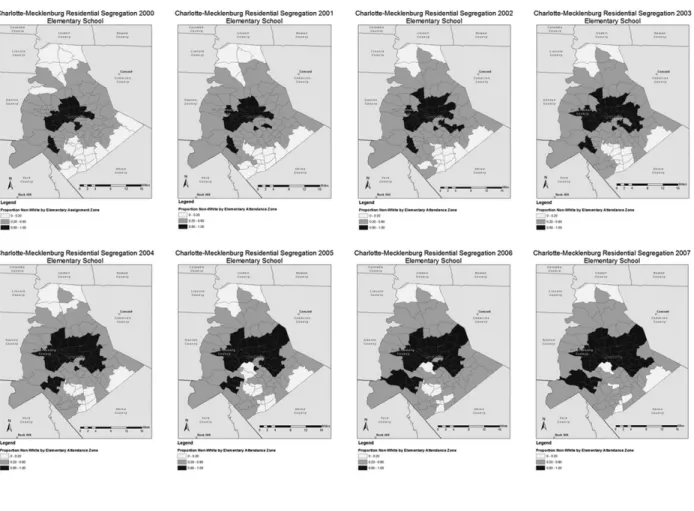
Residential segregation, elementary school pupil assignment zones, 2000-2007
(Liebowitz and Page, 2015)
Authors’ Caption: Patterns of high-concentration White and non-White elementary attendance zones,
using 2001–2002 boundaries.
Figure eight shows how the changes in neighborhood demographics and the
complete end of CMS’ race-based desegregation policy compounded to create high-poverty, high-minority elementary schools. The maps show the impact of both the end of race-based busing, and the momentum of demographic changes in Mecklenburg County and in
2This series of maps also speaks to three demographic trends within Mecklenburg County. One is the return of White residents to the city center and immediate periphery, evidenced by the >80% White
CMS: increases in the number and relative proportion of Black and Hispanic students in CMS.
Figure 8: School Imbalance:
CMS Schools with over 80% students minority and 80% students applied to the federal free or reduced lunch program (Nelson, 2015).
This tremendous demographic change sets up the background for an explanation of why Charlotte schools are resegregating at the expense of non-white students: White families’ school choices in CMS seem to have always been about their own self-interest, above all else.
This may seem natural –school choice does affect the education of parents’ children-– but the very idea of school choice was a phenomenon that was invented to deal with the social challenges of desegregation.
Throughout CMS’ history, decisions have been made with white parents and students in mind. When parents found the conditions to be unsatisfactory to their needs, they took matters into their own hands, by voting, by staging rallies – and by moving. White families in Mecklenburg County, as they have since the very beginnings of school
desegregation, concede to the housing and educational needs of the non-White community only so far as it aligns with their interest. In his interest convergence theorem, Bell (1980) argues that Whites will concede Black interests only so long as those interests align with those of the White community. It is from this frame that I will construct the final piece of my analysis of Mecklenburg’s response to school desegregation.
Housing Choices
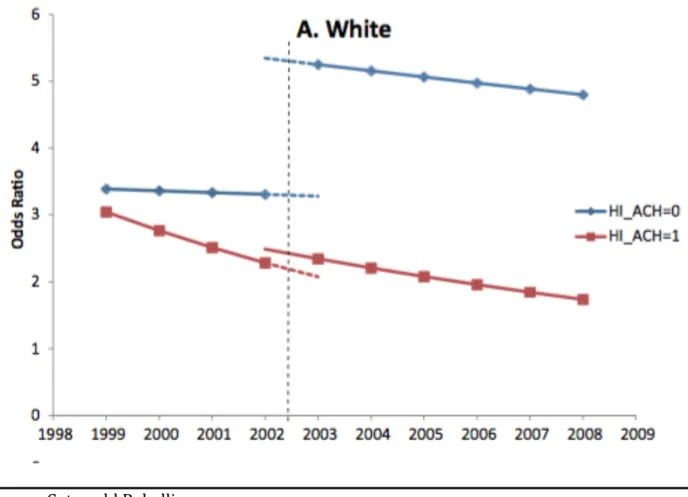
that was more White, and was assigned to a worse performing school than their current neighborhood (Figure 9).
Liebowitz and Page offer competing explanations for this behavior. Perhaps a set of movers prioritized school quality, they say, and the unitary status court decision did not effect their moving. A second group, however, prioritized Whiteness and residential racial isolation and was better able to secure that after the unitary status declaration. This group account for the increase in probability that White families would move into neighborhoods that are more White, but which correspond to a poorer-performing school (Liebowitz and Page, 697).
Their second explanation proposes that there are White families who move in search of White neighborhoods and stronger schools. However, only wealthy families are able to secure both aims, so poorer White families select only for Whiteness and not for school quality (Liebowitz and Page, 697). Both of these explanations, however, suggest that White families, if they move within Mecklenburg County, are more likely to select for
Figure 9:
Liebowitz and Page, 2014 (p. 694)
Fitted odds ratio of moving to an elementary school zone that has a greater proportion of White residents (for White families) that the student’s current zone, by academic
performance of school within zone (1999-2008).
Cotswold Rebellion
assignment areas are made up of multiple elementary school zones, and high schools are formed by joining several middle schools). Instead of attending the very White, very affluent, high performing Alexander Graham and the very White, very affluent, high performing Myers Park, Cotswold Elementary students would attend McClintock Middle and East Mecklenburg High Schools.
That year, hundreds of parents descended on a September School Board meeting to protest a proposed change to their children’s school assignments. Cotswold Elementary School lies midway between very White, very wealthy Alexander Graham Middle School and Myers Park High School. The school board hoped to reassign the feed of the largely White and affluent elementary school so that the students could bring some demographic balance to poor and non-White McClintock Middle School and less-White East Mecklenburg High School. A local news article reported that, “[DC Luchessi] says his objections aren't about his kids going to East Meck, but what the zoning change could undo at Cotswold. "Probably some people would not be okay with the decision to disrupt that chain. [They] would leave Cotswold and would disrupt the 10-year, 12 years worth of work that has gone on for folks to turn that into what should be a model, but has now turned into a target…” (Miller).
investment. The “Cotswold rebellion” exemplifies the lengths to which White parents have been willing to go in order to make certain that their children’s education is shaped as the parents would prefer to have it. As the White population in CMS continues to shrink, social scientists continue to identify new ways that White families exert power to maintain their position of social advantage.
Identifying a pattern that at first glance seems to run counter to Whites’ concern over school assignment and their neighborhoods, Billings, Brunner, and Ross (2014) show a surprising trend: wealthy, White enclaves zoned for CMS schools that fail the No Child Left Behind’s Adequate Yearly Progress Goals (AYP) may see their home values rise.
First introduced in the 1994 Elementary and Secondary Education Act, The 2001 federal No Child Left Behind (NCLB) act reaffirmed the use of a measurement called
lottery boost, and move into neighborhoods assigned to failing schools. Those who make this move are 65% more likely to attend a non-assigned school: attending via the lottery system. The authors note that CMS does allow students to attend their previous school if their family moves, but new residents of the nicest areas within failing school zones are 28% more likely to attend a new school than are others who move within CMS (Billings, Brunner, Ross; 5, 26).
This action could account for a small part of the portion of movers identified by Liebowitz and Page who move to whiter neighborhoods regardless of school quality, but certainly not all of it, given the disparate probabilities and volumes of moves addressed in the studies. The study emphasizes the consolidation of wealth within certain
neighborhoods. It does not detail the racial demography of these moves, and wealth should not be conflated with Whiteness, though in Mecklenburg County, where in 1999 the median income was $72,043 for Whites, $39,479 for Blacks, and $36,416 for Hispanics living in Mecklenburg, the two often cleave along similar lines. As Whites tend to be more wealthy, they tend to be able to be more discerning of their housing choices. (Liebowitz and Page, 680).
Actions like this are be supported by theory about white retreat and consolidation in the face of the browning of cities like Charlotte (Lichter, Parisi, Taquino, 2015).
White parents, concerned less with relative test scores than their neighborhood’s apparent whiteness, buy homes accordingly. Neighborhood schooling confers the
Conclusion
From the beginning of school desegregation, of the dismantling of Jim Crow, even, perhaps, from the end of Slavery, ruling whites in Charlotte supported changes which benefited non-White Charlotteans only insofar as those changes were also beneficial to the interests of ruling White elites. Judge McMillian’s ruling in Swann, along with John Finger’s busing plan and the compromised solution put forward the Citizens Advisory Group were, after a time, palatable changes. Being known as “the city that made busing work,” as a face of the New South, was good for business in Charlotte. As business boomed and the city sprawled, though, one thing remained non-negotiable. Unwillingness, on a personal and political level, to seriously address residential segregation left the post-busing city in a frustrating position. Forced school desegregation had brought Charlotte prestige on a national scale, and Charlotteans had bought into the project. The return to neighborhood schooling has refocused the issue. While in 1969 residential segregation drove school segregation, school resegregation now drives residential segregation, the two remaining in tandem; neither will be solved alone.