Double Bottom Line Investment Funds:
Comparison of Models for Non-Profit Organizations
by
Jordan A. Jones
A Masters Project submitted to the faculty of the University of North Carolina at Chapel Hill
in partial fulfillment of the requirements for the degre of Master of City and Regional Planning
in the Department of City and Regional Planning
Chapel Hill
2014
Approved by:
TABLE OF CONTENTS
INTRODUCTION ... 3
PURPOSE OF STUDY ... 4
METHODOLOGY ... 4
LITERATURE REVIEW ... 6
DOUBLE BOTTOM LINE INVESTMENT FUNDS ... 9
LEGAL STRUCTURES OF OWNERSHIP MODEL ... 13
LEGAL STRUCTURE CASE STUDY:COASTAL ENTERPRISES,INC. OF MAINE ... 15
LEGAL STRUCTURE CASE STUDY:KENTUCKY HIGHLANDS INVESTMENT CORPORATION ... 18
LEGAL STRUCTURE CASE STUDY:NATIONAL DEVELOPMENT COUNCIL ... 21
CONCERNS REGARDING LEGAL STRUCTURE ... 23
Governance ... 24
Unrelated Business Income ... 25
OPERATING STRUCTURE AND REQUIREMENTS ... 28
OPERATING STRUCTURE AND REQUIREMENTS CASE STUDY:THE MASSACHUSETTS LIFE INSURANCE COMMUNITY INVESTMENT INITIATIVE ... 30
COMPENSATION FOR FUND MANAGER AND ITS NON-PROFIT ORGANIZATION ... 32
OVERVIEW OF CONTRACTUAL MODEL ... 34
LEGAL STRUCTURE ... 34
OPERATING STRUCTURE AND REQUIREMENTS ... 35
COMPENSATION FOR FUND MANAGER AND FUND SPONSOR ... 36
CONTRACTUAL MODEL DBLFUND CASE STUDY:NORTHWEST LOUISIANA COMMUNITY DEVELOPMENT FUND ... 36
SIMILARITIES OF CONTRACTUAL AND OWNERSHIP MODELS ... 38
COMPARISON OF CONTRACTUAL AND OWNERSHIP MODELS ... 39
CONTROL OVER INVESTMENTS ... 39
OPERATING REQUIREMENTS ... 41
FINANCIAL RETURN EXPECTATIONS ... 42
OTHER FACTORS TO CONSIDER ... 44
CONCLUSION ... 47
INTRODUCTION
For more than a century in the United States, non-traditional finance institutions have been responding to the need for capital in economically disadvantaged communities, both rural and urban. Historically, traditional capital has not flown easily into these communities, in particular to finance community economic development (“CED”) projects such as affordable housing. In particular, CED projects have difficulty accessing equity capital. Double Bottom Line Private Equity Investment Funds (“DBL Funds”) have emerged across the United States to provide this much needed equity capital. Capitalized with private equity, DBL Funds focus on both financial and mission-related returns to their investors. DBL Funds have a strong track record of investing equity in CED projects in rural and urban communities across the United States. Four operating models for DBL Funds have emerged.
• In the Contractual Model, a non-profit organization initiates a DBL Fund and contracts with a for-profit fund manager to manage the fund.
• The Fund Manager Model involves only the for-profit fund manager that establishes and manages its own fund.
• State legislation is needed to create the Legislative Model. This model has only been used by the insurance industry in Massachusetts.
• In the Ownership Model, the non-profit organization owns the for-profit fund manager.
Purpose of Study
The purpose of this study is to provide information to non-profit organizations
evaluating whether to establish their own Fund Manager as called for in the Ownership Model DBL Fund. These Funds are discussed in the literature, but from a more theoretical perspective. This study researches important components of how these funds have been implemented by various non-profit organizations. These components include the legal and operating structures of Ownership Model DBL Funds, potential operating requirements of the non-profit and its Fund Manager, as well as compensation.
Methodology
The author conducted phone interviews with current leaders of three non-profit organizations that operate at least one Ownership Model DBL Fund. These three non-profit organizations are most often cited in the literature as examples. While not an Ownership Model DBL Fund, author also conducted an interview with a relatively smaller Fund Managerto learn more about the operating requirements of a Fund Manager.
Interviews were conducted with the following: Ms. Ellen Golden of CEI Maine, Inc. that owns two Fund Managers, Ms. Brenda McDaniel of Kentucky Highlands Investment
Corporation that owns two Fund Managers, and Ms. Pat Thomson of National Development Council that owns one Fund Manager. Author also interviewed Ms. Susan Schlesinger of The Massachusetts Life Insurance Community Investment Initiative, a smaller Fund Manager that is a Legislative Model DBL Fund.
hypothetically launched an additional fund. If additional information was needed after each interview, follow-up questions were asked through e-mail correspondence.
Information for the Contractual Model DBL Fund discussed later in paper comes from the author’s “Double Bottom Line Investment Funds: A New Source of Capital for Community Economic Development Projects.” This paper focused primarily on the Contractual Model DBL Fund. The author used a similar methodology and interviewed four non-profit Fund Sponsors: Ms. Elizabeth Ferguson previously with the Bay Area Council, Mr. Tom De Simone of Genesis LA, Mr. Barry Schultz previously with San Diego Capital Collaborative, and Mr. David Aubrey with the Strategic Action Council.
Extensive case studies for the Contractual Model DBL Fund were not developed. The structure for the Contractual Model DBL Funds is less complicated for the non-profit
LITERATURE REVIEW
Since the late 1880s, institutions have been responding to the lack of affordable capital in economically disadvantaged communities. The first institutions were banks primarily owned by African-Americans that targeted black communities (Benjamin et. al., 2004). Later in the 1930s and 1940s, credit units emerged with a similar purpose – provide black communities access to capital (Benjamin et. al., 2004). In the 1960s and 1970s, the federal and state governments began to play a role in capitalizing revolving loan funds to finance small businesses in distressed urban neighborhoods. Also during this time, community development corporations (“CDCs”) emerged to address the housing and small business needs in these economically disadvantaged communities (Benjamin et. al., 2004).
Today, there is a plethora of institutions with the mission of providing capital to disadvantaged communities, in particular to finance community economic development (“CED”) projects. CED does not have a “standard definition,” but can be described as a “strategy” of broad economic activities and programs aimed at “developing low-income
communities” (Clay and Jones, 2009, p. 257). Examples of CED activities include development of affordable housing, local real estate projects, and small businesses (Blaustein, 1970).
CED projects typically cannot access conventional financing such as a loan from a bank (Hamer and LeVeen Farr, 2009). One reason why is because capital does not flow easily into low-income communities, where CED projects are located. Research has identified five market barriers that explain why these communities do not receive as much capital (Hagerman et. al., 2007).
• Insufficient risk pricing, risk pricing, and risk spreading mechanisms that precludes financial intermediaries from providing capital.
• Market prejudice that prevents potential investors from seeing opportunities because of their pre-judgments about the lack of growth and uncertainty.
• Insufficient market competition that leads to
• Market-distorting public policies that can have unintended consequences such as subsidies that increase transaction costs by requiring high reporting burdens.
One of, if not the most, common type of institution providing capital to CED projects is the community development finance institution (“CDFI”), a private sector financial
intermediary that serves communities and individuals that lack access to capital and other financial services from traditional financial institutions. There are four types of CDFIs: Community Development Banks, Credit Unions, Loan Funds, and Venture Capital Funds. Today, there are more than 950 CDFIs certified by the United States Department of Treasury (CDFI Coalition, 2014). According to Opportunity Finance Network, CDFIs have invested more than $30 billion over the last 30 years in Native, rural, and urban communities across the United States (Opportunity Finance Network, 2013). In Fiscal Year 2011 alone, the Opportunity Finance Network reported its CDFI members created or maintained 497,277 jobs, constructed or renovated 940,499 affordable housing units, and financed 9,341 community service
organizations (Opportunity Finance Network, 2013).
The CDFI industry is dependent on subsidies and below-market capital to continue its growth because it cannot offer potential investors market-rate returns (Daniels and Nixon, 2003). The largest financial supporter for the CDFI industry is the U.S. Department of Treasury’s CDFI Fund (“CDFI Fund”) (CDFI Fund, “CDFI Programs,” 2014). Established in 1994, the CDFI Fund has provided more than $1.3 billion in subsidies to CDFIs (CDFI Fund, “CDFI Programs,” 2014). Financial assistance is provided to CDFIs in the form of equity
CDFI Fund awarded more than $146 million in finance assistance to 148 CDFIs (CDFI Fund, “CDFI Program Awards,” 2014).
CED projects are also subsidized through the provision of federal tax credits. Three of the more common federal tax credit programs to support CED projects include:
• Historic Preservation Tax Credits (“HTC”) are administered by the National Park Service, in partnership with the Internal Revenue Service, at the federal level and State Historic Preservation Offices operate similar programs at the state level. HTCs provide equity to rehabilitation projects of certified historic structures. Since the Federal HTCs were enacted in 1976, HTCs have rehabilitated more than 90,000 low- to moderate-income housing units (Comptroller of the Currency, 2008). According to the National Trust for Historic Preservation, 75 percent of all projects that received HTCs since 2002 were located in low-income neighborhoods (National Trust for Historic Preservation, 2014).
• Low-Income Housing Tax Credits (“LIHTC”) are provided to developers to help finance affordable housing. Enacted as part of the Tax Reform Act of 1986, Low-Income Housing Tax Credits have financed more than 2.6 million affordable rental apartments, majority of which are located in low-income communities (Affordable Rental Housing ACTION, 2014). These credits assist community revitalization projects by providing quality housing opportunities for low to moderate-income households (Smith and Williamson, 2008).
• New Markets Tax Credits (“NMTC”) were established in 2000 to spur new or
percent of all NMTC investments are made in low-income communities. Between 2003 and 2011, NMTC investments have generated about 350,000 jobs and financed more than 100 million square feet of manufacturing, retail, and community space in low-income communities (New Markets Tax Credit Coalition, 2014).
As subsidized programs, these three tax credit programs are dependent on the continued re-authorization of their programs, which is not guaranteed.
Double Bottom Line Investment Funds
An emerging source of capital for CED projects that has the potential to access large amounts of capital because it provides market-rate, some sometimes above market-rate returns, and is not dependent on subsidies is the DBL Fund. Total amount of capital invested in DBL Funds in the United States is estimated at $78.2 billion (“Northwest Louisiana Community Development Fund I: Second Bottom Line Report,” 2013). These funds differ from other private equity real estate funds because they target two types of returns (Daniels and La Franchi, 2012). The first type of return called the “First Bottom Line” is market-rates of return for financial investors such as insurance companies and pension funds (Flynn et. al., 2007). DBL Funds commonly target annual financial returns in the mid to upper teens. The second type of return or “Second Bottom Line” includes a variety of measurable economic, social, and environmental returns. Examples of Second Bottom Line returns include job and wealth creation and
preservation of cultural resources (Flynn et. al., 2007).
opportunities that might not have existed without this type of financial capital (Economic Innovation International, 2004).
The literature identifies four models of DFL Funds. Each model differs by its operating structure (Hagerman et. al., 2007).
• In the Contractual Model, a non-profit organization initiates a DBL Fund (“Fund Sponsor”) and contracts with a for-profit Fund Manager to manage the fund. Contractual Model DBL Funds have raised more than $2 billion (Flynn et. al., 2007). Literature identifies the Contractual Model as part of the “second generation” of DBL Funds
because they engage “proven fund managers” and raise “large-scale capital” (Daniels and Nixon, 2003).
An example of the contractual model is the Bay Area Family of Funds that established three funds from 2001 to 2007 with total capitalization at $196.25 million: Bay Area Smart Growth Fund I, Bay Area Equity Fund, and Bay Area Smart Growth Fund II (Ferguson, 2014). The Bay Area Council, a non-profit, sponsored these DBL Funds and contracted with three different Fund Managers: Pacific Coast Capital Partners, JP Morgan H&Q, and Kennedy Wilson (Ferguson, 2014).
• The Fund Manager Model involves only the for-profit fund manager that establishes and manages its own fund. By 2007, the Fund Manager model had five funds in
The Urban Strategy America Fund is an example of the Fund Manager Model.
Capitalized in 2004 at $190 million, this fund targets investments in the amount of $10 million to $70 million located on the East Coast (Flynn et. al., 2007). Types of
investments Urban Strategy America Fund has previously made include multi-family residential, office, warehouse/distribution, and retail properties (Urban Strategy America Fund, 2014).
• State legislation is required to create the Legislative Model. This model has only been implemented in Massachusetts and targeted at life insurance companies. In 1977, the Massachusetts State Legislature created the Massachusetts Capital Resource Company (“MCRC”), a limited partnership funded by Massachusetts life insurance companies. To incentivize life insurance companies to invest in MCRC, life insurance companies received state tax cuts. For more than 35 years, MCRC has invested more than $640 million in more than 300 companies (Massachusetts Capital Resources Company, 2014).
Later in 1998, the Massachusetts State Legislation passed “An Act Insuring Community Investment and the Equitable Taxation of Insurance Companies in Massachusetts” (Flynn et. al., 2007). This act created two additional investment pools: The Life Initiative (“TLI”) and the Property and Casualty Initiative (“PCI”). TLI raised $100 million and PCI raised $85 million (Massachusetts Life Insurance Community Investment Initiative, 2014 and Massachusetts Property and Casualty Initiative, 2014). Similarly, this act provided life insurance companies state tax cuts in exchange for investing in these two new investment pools (Flynn et. al. 2007).
difference is in the Ownership Model, the non-profit organization owns the for-profit Fund Manager. The Ownership Model is an older type of DBL Fund compared to the Contractual Model (Daniels and La Franchi, 2012).
An example of the Ownership Model is the non-profit Community Preservation
Corporation (“CPC”) that owns its for-profit fund manager, CPC Resources. Founded in 1974, CPC provides debt financing for affordable housing and neighborhood
revitalization originally in New York City and now across the State of New York. Over the last 40 years, CPC has preserved or created more than 157,000 units of affordable
housing. In 1992, CPC established its for-profit fund Manager CPC Resources with the purpose of providing consulting services to affordable housing and neighborhood revitalization developers as well as invest equity to purpose troubled residential properties (Community Preservation Corporation, 2014).
LEGAL STRUCTURES OF OWNERSHIP MODEL
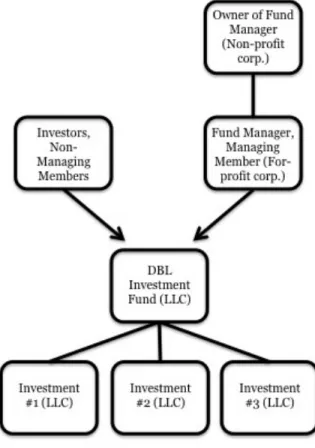
The Ownership Model DBL Fund requires the creation of several legal structures. Three non-profit organizations that operate a for-profit Fund Manager were interviewed to learn about their legal structures: CEI Maine, Inc. (“CEI”), Kentucky Highlands Investment Corporation (“KHIC”), and National Development Council (“NDC”). More information about each of these organizations and their legal structures is provided later.
The first legal structure required is for the non-profit organization’s newly created for-profit fund manager. This new legal entity that houses the fund-manager is wholly owned by the non-profit organization. Non-profit organizations have several legal entities to choose from when forming this new for-profit fund manager including Corporation, Limited Liability Company (“LLC”), and Limited Partnership (“L.P.”). Two of the non-profit organizations interviewed structured their fund managers as L.P.s because they partnered with other organizations to manage these funds. For example, KHIC partners with Tech 20/20 for their two venture capital funds: Meritus Ventures and Southern Appalachian Fund (McDaniel, 2014). The third non-profit organization, CEI, structured its Fund Managers as corporations (Golden, 2014). A potential benefit of structuring the for-profit Fund Manager as a corporation instead of a LLC or L.P. is to prevent the non-profit organization from generating unrelated business taxable income that will be discussed more in depth later.
The next legal structure that needs to be formed is for the specific DBL Fund. This new legal entity, according to the literature, is commonly formed as either a LLC or L.P. (Flynn et. al., 2007). In practice, the LLC structure appears to be more commonly used for these real estate DBL Funds. Ms. Patricia Thomson, Managing Director for NDC, stated the LLC has become the more common legal structure because it provides additional “protection” and “flexibility”
In the LLC structure, the Fund Manager assumes the role of Managing Member and Investors as Non-Managing Members (Flynn et. al., 2007). The LLC structure creates flexibility for the entity to either be manager-managed or member-managed. With the presence of a Managing Member, the LLC is classified as manager-managed. Therefore, the LLC has
centralized management where the Managing Member has the “broad authority” of all “business responsibilities” (Stover and Hamill, 1998-1999, p. 818). While Non-Managing Members do not have any management power, Non-Managing Members can acquire as much ownership of the LLC as wanted (Stover and Hamill, 1998-1999).
Finally, an additional legal structure is created for each individual investment. These single-purpose entities are also commonly created as LLCs (Ferguson, 2014). Interviews
identified two reasons for these additional legal structures. The first is holding an investment in a separate legal structure will isolate potential risk of each project from affecting other
investments. The second reason is to prevent cross collateralization. This also protects the DBL Fund because it prevents additional entities from staking a claim in the investment’s collateral (Ferguson, 2014).
Figure 1 – Legal Structure of Ownership Model DBL Fund
Legal Structure Case Study: Coastal Enterprises, Inc. of Maine
than 5,300 childcare slots (CEI, “Impact and Measurement”). CEI owns two for-profit Fund Managers that provide venture capital: CEI Community Ventures, Inc. and CEI Ventures, Inc.
Some of CEI’s work is completed through its five subsidiaries. CEI wholly owns each of these subsidiaries.
• CEI Capital Management, LLC (“CCML”) is a for-profit subsidiary of CEI established in 2003 to finance CED projects through its allocation of New Markets Tax Credits from the U.S. Department of Treasury’s CDFI Fund. CCML has been certified as a certified Community Development Entity by the U.S. Department of Treasury. Since 2003, CCML has received $858 million in NMTCs (Thorpe, 2013). With a staff of 15, CCML invests its NMTCs across the United States with a focus on rural areas (Golden, 2014).
• CEI Community Ventures, Inc. (“CCVI”) is a for-profit subsidiary of CEI that manages the CEI Community Ventures Fund (“CCVF”), a socially responsible
community development venture capital fund. Established with $1.5 million from the U.S. Small Business Administration’s New Markets Venture Capital, CCVF provides venture capital to qualifying businesses located in low-income communities. CCVI has a small staff of two (Golden, 2014).
• CEI Housing, Inc. (“CHI”) is a non-profit subsidiary of CEI that works to “provide affordable rental, home ownership, supporting housing and related services” (CEI Housing, Inc. 2011 IRS Form 990). CHI does not have any employees, but is staffed through CEI. Formed in 1990, CHI owns several corporations that were established to receive Low-Income Housing Tax Credits (LIHTCs) in support of its creation of affordable rental housing (Golden, 2014).
• CEI Ventures, Inc. (“CVI”) is a for-profit subsidiary of CEI that manages three socially responsible venture capital funds. With a staff of three, CVI also assists its portfolio companies with strategic and exit planning as well as team building and recruiting (CEI Ventures, “Overview,” 2014).
Figure 2 – Coastal Enterprises, Inc.’s Organizational Chart
Legal Structure Case Study: Kentucky Highlands Investment
Corporation
KHIC was one of the first non-profit organizations in the United States to engage in venture capital as a Fund Manager. Founded in 1968, KHIC works to “stimulate growth and create employment opportunities” in an original 9 county and now 20 county region of
To provide capital for emerging businesses and to attract entrepreneurs to the region, KHIC began making “development” venture capital investments in 1972 (Kentucky Highlands Investment Corporation, 2014). By “development” venture capital, KHIC states their
investments differ from traditional venture capital because they play a more active role in the management of their portfolio companies. KHIC’s venture capital investments target returns of 25 percent (McDaniel, 2014).
Through affiliates, KHIC is the General Partner in two for-profit venture capital funds (McDaniel, 2014). KHIC shares the role as General Partner with another non-profit
organization, Tech 20/20. While neither venture capital fund exactly matches KHIC’s geographic targeted region, the funds’ geographies do include KHIC’s 20 targeted counties. Additionally, the funds share similar mission with KHIC of promoting economic development and creating wealth and jobs in low-income communities (McDaniel, 2014). These two venture capital funds are:
• Meritus Ventures, L.P. is a $36.5 million venture capital fund that primarily makes $250,000 to $2,500,000 investments in small companies in 11 states. Formed in 2002, Meritus is a Rural Business Investment Corporation (RBIC) through the U.S.
Department of Agriculture (“USDA”). As an RBIC, Meritus receives some operational assistance from the USDA (Meritus Ventures, “Overview of Meritus Ventures, L.P.”). • Southern Appalachian Fund, L.P. is a $12.5 million venture capital fund that makes
All of KHIC’s for-profit and non-profit affiliates, including the two venture capital funds, do not have any employees. Instead, each affiliate has a management contract with KHIC to provide all necessary services (McDaniel, 2014).
The legal structure of KHIC’s two Ownership Model DBL Funds differs from CEI. KHIC does not directly own either of its for-profit Fund Managers or the DBL Funds. Instead, each Fund Manager is owned by a separate non-profit organization as identified in Figure 3. (The organizational chart provided does not include all of KHIC’s legal entities.) This structure
enables the DBL Funds to be classified as off balance sheet activities of KHIC (McDaniel, 2014).
Legal Structure Case Study: National Development Council
Founded in 1969, the National Development Council (“NDC”) is the oldest national community development organization in the United States (Thomson, 2014). While NDC has expanded and evolved significantly since 1969, it’s mission remains the same – “to increase the flow of capital to distressed urban and rural communities for investment, jobs and community development” (National Development Council, “Mission Statement,” 2014). NDC primarily focuses on lending to small businesses, assisting governments with public-private partnerships, developing and financing affordable housing, building local development finance expertise through professional training, and promoting development in low-income communities through investment of NMTCs (Thomson, 2014). Since 1969, NDC has worked in all 50 states and has loaned more than $160 million to 468 businesses, financed 78 projects with NMTCs, raised more than $450 million in equity for affordable housing and historic preservation projects, and provided training to more than 60,000 professionals (National Development Council, “About Us”). NDC owns a for-profit Fund Manager, the NDC Corporate Equity Fund, L.P. that provides equity for construction and preservation of affordable housing.
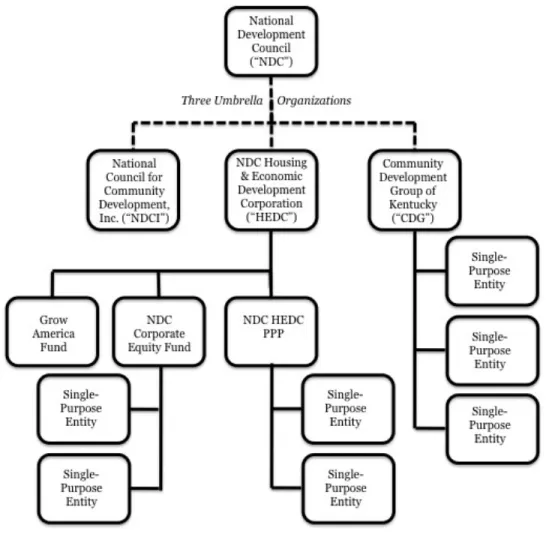
The National Development Council has a complex legal structure that is comprised of three parent companies and more than 100 affiliates (Thomson, 2014). The three parent companies are:
• National Council for Community Development, Inc. (“NDCI”) is the original non-profit organization of NDC. Its primary activities include those of NDC’s core mission such as providing consulting services to development projects and training professionals. This non-profit is the only parent company that has employees and does not have any affiliates (Thomson, 2014).
NMTCs. For each of these projects, HEDC forms a new single-purpose entity for additional legal protection. All of these new affiliates are all non-profits. HEDC is permitted from the IRS to establish new 501(c) (3)s at will because HEDC has a
501(c)(3) group exemption (Thomson, 2014). Two of HEDC’s core affiliates include the NDC Corporate Equity Fund, L.P. and NDC HEDC Public-Private Partnership. Each of these affiliates has formed multiple single-purpose entities (Thomson, 2014).
• Community Development Group of Kentucky (“CDG”) is a for-profit organization incorporated in the State of Kentucky. Any of NDC’s projects that require or are easier to form as a for-profit entity are created under CDG. NDC wholly owns CDG (Thomson, 2014).
NDC’s organizational structure is shown in Figure 4. This depiction does not include all of NDC’s affiliates and single-purse entities.
Figure 4 – National Development Council’s Organizational Chart
Concerns Regarding Legal Structure
Governance
Governing an organization’s affiliates, whether for-profit or non-profit is important. The Organisation for Economic Co-operation and Development (OECD) recommends institutions create a corporate governance structure that “specifies the distribution of rights and
responsibilities among different participants in the corporation and other stakeholders, and spells out the rules and procedures for making decisions on corporate affairs” (Chartier, p.3). CEI, KHIC, and NDC appear to have this type of structure in place:
• Share Mission Statements – All of CEI’s, KHIC’s, and NDC’s affiliates share mission statements. Therefore, each affiliate works towards aligning their programs and services to meet their parent organization’s mission.
• Sit on all Board of Directors - CEI’s CEO and CFO sit on the Board of Directors of each of CEI’s five core subsidiaries. These leaders provide governance and leadership to the subsidiaries to ensure they continue to align with CEI (Golden, 2014). KHIC utilizes a similar strategy where either its President/CEO, Executive Vice President/COO, and CFO sit on all Boards of KHIC’s affiliates (McDaniel, 2014). Similarly, NDC also has its CEO sit on the boards of its three umbrella organizations. Also, NDC’s board has five additional members sit on the HEDC board (Thomson, 2014).
A third strategy CEI uses to ensure governance of its affiliates is that the Managing Director of its three core for-profit affiliates are required to participate in CEI’s Executive Team. Therefore, these Managing Directors participate in the strategic planning and governance of CEI and are expected to ensure continuity between their subsidiary and CEI.
KHIC and NDC also utilize a third strategy, which also involves its staff. Unlike CEI, KHIC’s and NDC’s umbrella organizations and affiliates do not employ any individuals. Instead, all affiliates of these two organizations have management contracts with their parent
they are solely employed and paid through their parent organization. This policy ensures continuity and governance between all of the affiliates and NDC.
Unrelated Business Income
Non-profit organizations that either own the for-profit fund manager or invest in an investment fund could have potential unrelated business taxable income (“UBTI”). Section 512 (a) (1) of the Internal Revenue Code defines UBTI as “gross income derived from any unrelated trade or business regularly carried on” (I.R.C. § 512(a)(1)). In 1950, the U.S. Congress enacted the unrelated business income tax (“UBIT”) primarily to prevent “unfair” competition between non-profits and for-profits that could arise from non-profits having tax-exempt status (Hines, 1999, p.58).
The primary concern of non-profits with UBTI is that the IRS has the authority to remove a non-profit’s tax-exempt status if it earns “excessive unrelated business income” (Hines, 1999, p. 62). The IRS does not treat “passive income” as UBTI (“Accommodating Tax-Exempt Investors,” 2012, p.1). Passive income includes “[d]ividends, interest, royalties, most rents, capital gains and losses, and similar items” (S. Rep. No. 2375, 81st Cong., 2d Sess. 30-31,
reprinted in 1950 U.S.C.C.A.N 3053, 3083). However, the IRS does not recognize an investment in a LLC or L.P. as passive income because the investor is “deemed to receive its share of the income” from the LLC or L.P. (“Accommodating Tax-Exempt Investors,” 2012, p. 1).
CEI owns two for-profit fund managers that generate returns from the operation of multiple venture capital funds. To prevent UBTI, CEI formed each of these fund managers as separate, but wholly owned for-profit corporations (Golden, 2014). These two entities are CVI, Inc. and CCVI, Inc. as shown in Figure 2. In addition to creating for-profit corporations to house these activities, CEI provided these for-profit corporations CEI’s mission statement. The goal of this effort was to add additional protection by showing that the activities conducted by these two for-profit corporations owned by CEI are aligned with CEI Maine’s mission and therefore define them as charitable (Golden, 2014). KHIC and NDC also created their for-profit fund managers with similar mission statements (McDaniel, 2014 and Thomson, 2014).
Non-profit organizations that invest in investment funds also have the concern of generating UBTI through the investment fund. Research identified three scenarios where UBTI can be generated for non-profit organizations that invest directly into the investment fund structured as either a limited liability company or a limited partnership:
• When the fund investments’ are leveraged through debt-financing such as a bridge loan for a capital call or a construction loan;
• When the fund “engages in operational activities that go beyond rental activities” such as holding and managing a hotel property; and
• When a fund invests in a “dealer” property such as condominium projects (Sowell, 2012, p. 7).
corporation is net of taxes, which means the non-profit organization is not required to pay taxes on this income stream. An example of a blocker is shown in Figure 5. This type of blocker is called (and labeled in figure) a “tax-exempt blocker” because tax-exempt investors invest through this blocker (“Addressing UBTI Concerns in Capital Calls,” 2012, p. 2).
Figure 5 – Legal Structure of Investment Fund with “Blocker”
OPERATING STRUCTURE AND REQUIREMENTS
Another important component of the Ownership Model DBL Fund is the operating structure. In this model, the primary entity involved in the management of the DBL Fund is the for-profit Fund Manager. Specifically, the Fund Manager is responsible for the following
primary tasks:
• Designing and structuring the fund • Raising capital for the fund
• Sourcing potential deals • Underwriting potential deals
• Managing day to day activities such as back office functions (accounting, human resources, etc.)
• Providing assistance to strength the first bottom line of the invested projects • Providing assistance to strengthen the second bottom line of the invested projects • Monitoring, evaluating, and reporting fund performance
The Fund Manager is not required to complete any or all of these tasks internally, but is responsible to its investors for their performance. An option of Fund Managers is to contract with another entity to complete some of these tasks. CEI’s two for-profit Fund Managers complete most tasks internally with their own staff. However, both of the Fund Managers contract with CEI to provide the back office support functions.
Ownership Model DBL Funds can also contract with “Fund Builders” (Flynn et. al., 2007, p. 41). Fund Builders primarily assist Fund Sponsors in designing and structuring DBL Funds. Another important role of the Fund Builder is helping raise capital through the relationships the Fund Builder has developed with investors. While Ownership Model DBL Funds do not
commonly appear to use Fund Builders, Contractual Model DBL Funds typically hire a Fund Builder (Flynn et. al., 2007).
The advantage of the Fund Manager contracting with its non-profit owner is efficiency (McDaniel, 2014). The economic theory of economies of scales states that the average cost per unit decreases with increases in scale (Pindyck and Rubinfeld, 2012). This primarily occurs because a firm can spread the economic cost associated with several fixed costs across more units (Pindyck and Rubinfeld, 2012). This theory also applies to some of the management tasks of DBL Funds that involve large fixed costs such as its back office infrastructure.
The operating structure of the Ownership Model should be detailed in the DBL Fund’s Operating Agreement (if an LLC) or Partnership Agreement (if an L.P.) (Flynn et. al., 2007)
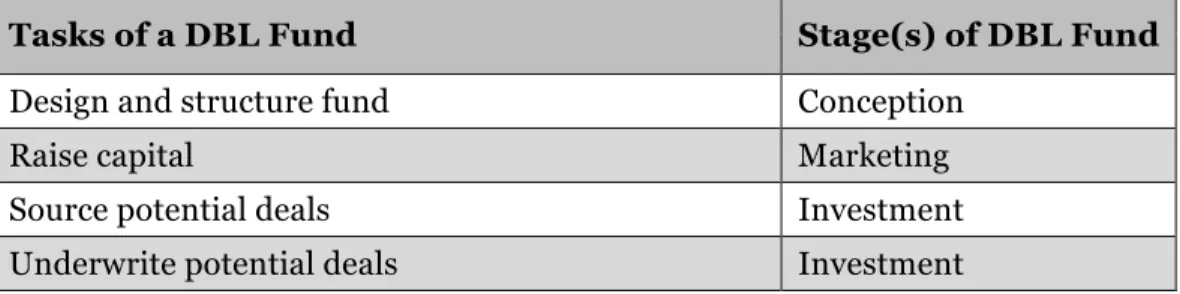
While the operating requirements of a Fund Manager is driven by the role it chooses to manage, other factors also impact the amount of staff time a Fund Manager must dedicate. One significant variable is the stage of the DBL Fund. The four primary stages of a DBL Fund include conception, marketing, investment, and holding. The investment and holding stages are
generally the longest and each can continue for up to five or six years. Figure 6 identifies the stage of each of the eight primary DBL Fund tasks.
Figure 6 – Identification of the Tasks Necessary in the Stages of a DBL Fund
Tasks of a DBL Fund Stage(s) of DBL Fund
Design and structure fund Conception
Raise capital Marketing
Source potential deals Investment
Manage day to day activities Investment/Holding Provide assistance to strengthen first bottom line Holding
Provide assistance to strengthen second bottom line Holding Monitor and evaluate fund performance Holding
As shown in Figure 6, all but one role is limited to a particular stage. Therefore, the operating requirements of a Fund Manager depends on the stage of the Fund and what, if any, roles the Fund Manager manages during that stage. Operating requirements of the Fund Manager can change during each stage of the Fund because some tasks are more time intensive than others.
Operating Structure and Requirements Case Study: The
Massachusetts Life Insurance Community Investment Initiative
Founded in 1999 through state legislation, The Massachusetts Life Insurance
Community Investment Initiative (“TLI”) has invested more than $300 million in CED projects (Schlesinger, 2014). Originally capitalized at $100 million with capital from life insurance companies operating in Massachusetts, TLI invests in projects throughout the state. CED projects TLI commonly invests in include affordable housing, charter schools, childcare centers, commercial developments, health care facilities, and small businesses. TLI makes both debt and equity investments. Since 1999, TLI has made more than 85 investments that have created or preserved more than 7,993 units of affordable housing, 2,995 jobs, 1,590 childcare slots, and 19 community facilities (The Life Initiative, “The Life Initiative Story”). TLI has a goal of deploying about $20 million per year (Schlesinger, 2014). In 2013, TLI exceeded this goal with investing more than $27 million in 13 projects (The Life Initiative, “2013 Investments”).
entire Commonwealth of Massachusetts, operates with a small staff, and was established with a relatively low amount of capital at $100 million.
TLI employs three full-time employees: a President and two Vice Presidents. The President primarily focuses on the operations of TLI, but is responsible for a few investment accounts (Schlesinger, 2014). The two Vice Presidents are responsible for the majority of TLI’s deal flow. Their responsibilities include identifying potential investments and completing due diligence. TLI is successful with a relatively minimal investment team because of its established relationships across Massachusetts. Prior to joining TLI, the two Vice Presidents had extensive experience in community development finance in Massachusetts. Therefore, the Vice Presidents came to TLI with established relationships with developers and community leaders across the state (Schlesinger, 2014).
Despite having a relatively small staff, TLI states it can make investments relatively quickly (Schlesinger, 2014). After receiving all necessary materials, TLI works to present all eligible potential investments to its Investment Committee within one month. TLI also does not require its Investment Committee to meet in person. Instead, the committee primarily discusses potential applications through a conference call. TLI’s Investment Committee Members live throughout the state. Therefore a conference call is quicker to schedule than an in-person meeting.
To provide back office support functions, TLI has an operating agreement with
Figure 7 –The Massachusetts Life Insurance Community Investment Initiative’s Organizational Structure
It is important to note that TLI does not have any asset management capacity. Asset management involves activities that optimize the first and second bottom line returns of
investments. TLI chose not to have an asset management capacity either internally or through a contractual agreement because most of TLI’s investments are short-term. About 75 percent of TLI’s investments have an investment length of three years or less (Schlesinger, 2014). This is not necessarily a best practice, but a decision TLI has supported for more than 14 years.
Compensation for Fund Manager and its Non-Profit
Organization
committed capital that has not been returned to investors (Schwartz and Breslow, 2013). This fee is commonly paid quarterly. The asset management fees the Fund Manager receives is minimal and targeted to reimburse it for operating costs associated with running the DBL Fund. A Fund Managers can also be reimbursed for eligible startup costs (Schwartz and Breslow, 2013).
Income generated through the Ownership Model of the DBL Fund, similar to other private equity funds, is distributed to the Fund Manager and Investors according to a pre-determined policy that involves several “hurdles” or priorities (Schwartz and Breslow, 2013). Initially, all income generated is repaid to investors for their invested capital. Once all invested capital is returned, the first hurdle, Investors receive an annual preferred return that can range from six to 12 percent of their invested capital. With any excess annual income after the
preferred return or second hurdle is met, the remaining revenue called carried interest is commonly allocated 80 percent to Investors and 20 percent to the Fund Manager. The carried interest distributed to Investors is allocated based on their share of invested capital (Schwartz and Breslow, 2013).
OVERVIEW OF CONTRACTUAL MODEL
In the Contractual Model of a DBL Fund, a non-profit initiates a DBL Fund (“Fund Sponsor”) and contracts with a for-profit Fund Manager to manage the Fund. This model shares similar components to the Ownership Model discussed previously.
Legal Structure
The Contractual Model shares similar legal structures to the Ownership Model. When a new Contractual Model Fund is formed, a new legal entity is established between the Fund Manager, Investors, and sometimes the Fund Sponsor. This new legal entity, according to the literature, is commonly formed as a LLC or L.P. (Flynn et. al., 2007). In practice, the LLC structure appears to be more commonly used for these real estate DBL Funds (Jones, 2014).
In this LLC structure, the Fund Manager of the Contractual Model is the Managing Member and Investors are Non-Managing Members. A difference in the Contractual Model is that sometimes the Fund Sponsor is included in the LLC as a Special Member (Flynn et. al., 2007). Of the four Fund Sponsors interviewed, two were included as a Special Member. The San Diego Capital Collaborative was not a Special Member due to concerns from the Fund’s
investors. Mr. Barry Schultz, previous President & CEO of the San Diego Capital Collaborative, explained that investors did not want the financial returns of the San Diego Smart Growth Fund to be “dragged down” by the second bottom line return expectations (Schultz, 2014). According to Mr. Schultz, it is “more acceptable” today to include the Fund Sponsor in the LLC as a Special Member because that is how more recent funds are structured (Schultz, 2014).
Finally, the Contractual Model also creates a new legal entity for each specific investment the DBL Fund makes (Ferguson, 2014). These structures are single-purpose entities.
Operating Structure and Requirements
The Contractual Model operating structure and requirements differs from the Ownership Model. In the Contractual Model, the non-profit Fund Sponsor contracts with an unaffiliated, independent Fund Manager to operate the Fund. The presence of this Fund Manager can decrease the operating requirements of the non-profit organization because the Fund Manager assumes responsibility for multiple of the Fund’s primary tasks. Contractual Model DBL Funds often contract with a Fund Builder as well. Fund Builders can assist the non-profit organization with important roles such as designing the fund and raising capital.
In the Contractual Model, the non-profit organization retains some flexibility in choosing which roles it wants to manage. Figure 8 provides examples of how three Contractual Model Fund Sponsors divided the primary tasks of a DBL Fund between the Fund Sponsor, Fund Builder, and Fund Manager.
Figure 8 – Primary Tasks of a DBL Fund and their Responsible Party in Three Contractual Model Fund Sponsors
Tasks of a
DBL Fund Stage(s) of DBL Fund
Fund Sponsors Interviewed
Bay Area Council NW LA CD Fund San Diego Capital Collaborative
Design and structure fund
Conception Fund Builder Fund Builder Fund Builder
Raise capital Marketing Fund Sponsor/ Fund Builder Fund Builder Fund Sponsor Source
potential deals
Investment Fund Sponsor/ Fund Manager Fund Sponsor/ Fund Manager Fund Sponsor/ Fund Manager Underwrite
potential
deals Investment Fund Manager Fund Manager Fund Manager Manage day
to day activities
Investment/
Provide assistance to strengthen first bottom line
Holding Fund Manager Fund Manager Fund Manager
Provide assistance to strengthen second bottom line Holding Fund Sponsor (through contract with consulting firm)
Fund Sponsor Fund Sponsor
Monitor and evaluate fund
performance
Holding Fund Sponsor Fund Manager/ Fund Builder Fund Sponsor
Compensation for Fund Manager and Fund Sponsor
Similar to the Ownership Model, the Fund Manager in the Contractual Model receives a small asset management fee paid quarterly (Flynn et. al., 2007). The Fund Manager also
receives its profit through participation in the carried interest. Compared to the Ownership Model, the non-profit in the Contractual Model is likely to receive a smaller percent of the DBL Fund’s profit. The non-profit Fund Sponsor commonly received only two percent of the carried interest. In the Ownership Model, the non-profit organization will receive profits passed along from its Fund Manager that it owns. The non-profit organization’s Fund Manager in the
Ownership Model commonly receives 20 percent of the carried interest, which the majority will be transferred to its non-profit parent organization.
Contractual Model DBL Fund Case Study: Northwest Louisiana
Community Development Fund
2007 with the goal of financing CED projects that help revitalize low- to moderate-income communities in a ten-parish region in Northwest Louisiana.
To help design and structure the Fund, SAC hired a Fund Builder Team that included Economic Innovative Institute, SDS Group, and Sustainable Solutions (Aubrey, 2014). After establishing the structure, SAC selected Kennedy Wilson through a competitive process to be the Fund Manager. In March 2010, the NW LA CD Fund had its final close with $15.25 million (Aubrey, 2014). Kennedy Wilson is an international real estate investment and services firm with more than $12 billion of assets under management (Kennedy Wilson, “Our Firm”). The Fund’s investors included JP Morgan Chase, Region’s Bank, Kellogg Foundation, and FB Heron Foundation (Aubrey, 2014). Figure 9 identifies the legal structure of this Fund. As shown, Kennedy Wilson is the Managing Member, Investors are the Non-Managing Members, and SAC is a Special Member.
From 2007 to 2012, the NW LA CD Fund made four equity investments and one loan totaling $10.9 million (Aubrey, 2014). Initial financial returns are not available, but the second bottom line returns include creation of 240 construction jobs, 27 permanent jobs, and 415 rental units of affordable or workforce housing (“Northwest Louisiana Community Development Fund I,” 2013).
Similarities of Contractual and Ownership Models
The Contractual and Ownership Models share similarities in their legal structures, operating requirements, and compensation. In both models, an initial legal structure is required for the DBL Fund. The type of legal structure is most commonly a Corporation, LLC, or L.P. Selection of the legal structure does not depend on the type of DBL Fund model. Instead, the Fund Manager and Investors consider other criteria such as tax considerations and the state where the fund will be located. With both models, an LLC or L.P. is created for each investment. These additional structures are single-purpose entities.
Compensation for the non-profit organization and Fund Manager is also similar in these two models. The Contractual and Ownership Models typically compensate the parties involved in the fund through an asset management fee and carried interest. This form of compensation is similar to other private equity funds
The key difference between the Contractual and Ownership Models is the operating structure. The Contractual Model contracts with an unaffiliated Fund Manager while the Ownership Model contracts with a Fund Manager the non-profit organization owns. This
COMPARISON OF CONTRACTUAL AND
OWNERSHIP MODELS
Non-profit organizations interested in establishing a DBL Fund have two options in the design of the fund: Contractual Model and Ownership Model. This section discusses three key differences between the two models. Non-profit organizations should consider these
distinguishing attributes in their decision-making.
Control Over Investments
An important factor a non-profit organization must consider is the amount of control they want in the decision-making process of approving investments. Non-profit organizations do not appear to solely create these DBL Funds to generate revenues for their organization. Instead, non-profit organizations establish these DBL Funds as another tool to accomplish their missions. Therefore, control over the projects the Fund invests in can be important.
The non-profit organization will have high control over investments made by the Fund Manager in the Ownership Model because the non-profit organization owns the Fund Manager. As a result of this ownership, the non-profit organization will have direct influence over the Fund Manager. One method of this influence is by requiring members of its leadership team to sit on the Fund Manager’s Board of Advisors and/or Investment Committee. Also, the non-profit organization can require the Fund Manager to share the same mission statement therefore tightening the criteria the Fund Manager must follow in making investments. However, the Fund will still need to meet the financial return expectations of the investors.
In the Contractual Model, the Fund Manager has sole authority in the decisions about what investments to make. Fund Sponsors do have some influence though over the investments their Fund Managers make. Two specific methods include:
Fund that the Fund Manager must meet. However, these objectives and strategies cannot be structured too specific because this could prevent any investments from being made. • Required Review of Potential Investments – It is common for Fund Sponsors to
require the Fund Managers to share information about potential investments with the Fund Sponsors prior to approving the investment. In these scenarios, the Fund Sponsors typically provide feedback about the potential investment. Feedback is primarily focused on whether the Fund Sponsor thinks the investment will meet its second bottom line expectations. If not, the Fund Sponsor typically provides the Fund Manager advice about how to strengthen the potential second bottom line returns. However, the Fund Manager is not required to implement the Fund Sponsor’s advice.
In practice, the sole authority Fund Managers have in deciding investments in the Contractual Model can create tension between the Fund Sponsor and Fund Manager. This tension is created from Fund Managers that are trying to meet and possibly exceed the financial return expectations while the non-profit organization is primarily focused on meeting or
exceeding the second bottom line return expectations. The first and second bottom line return expectations can conflict. For example, the Fund Manager might prefer making an investment that will exceed financial return expectations, but slightly miss second bottom line return expectations. Three of four Fund Sponsors interviewed about their Contractual Model DBL Funds identified tension did exist between them and their Fund Managers about the types of investments.
industrial and office space targeted at local small businesses (Flynn et. al., 2014). The three most common types of CED projects supported by Contractual Model DBL Funds are mixed-income housing, office space, and retail centers.
These investments are commonly made in low- to moderate-income communities. For example, the Bay Area Council included language in their investment objectives and strategies that all investments must be made in low- to moderate-income communities defined as Census Tracts with median family income less than 80 percent of area median family income
(Ferguson, 2014).
Operating Requirements
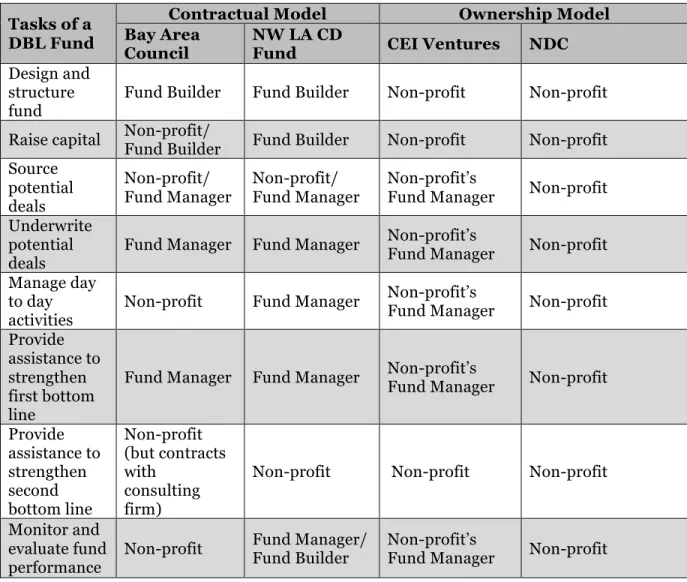
The amount of staff time and resources the non-profit will have to dedicate to a DBL Fund differs between the Contractual Model and Ownership Model. Generally, the Contractual Model will have less operating requirements of the non-profit Fund Sponsor. In this model, the non-profit contracts with a large real estate services firm to perform the majority of the tasks associated with acting as the Fund Manager. The remaining tasks of a DBL Fund such as providing assistance to strengthen second bottom line returns can either be managed by the Fund Manager, Fund Sponsor, or additional consultants.
In the Ownership Model, the non-profit will be responsible for managing the majority of the tasks of a DBL Fund. The non-profit can manage these tasks either with its own internal staff as the National Development Council does or through the staff of the non-profit’s Fund Manager as CEI has it structured.
Figure 10 – Assignment of Tasks in Four DBL Funds
Tasks of a DBL Fund
Contractual Model Ownership Model Bay Area
Council
NW LA CD
Fund CEI Ventures NDC
Design and structure
fund Fund Builder Fund Builder Non-profit Non-profit Raise capital Non-profit/
Fund Builder Fund Builder Non-profit Non-profit Source potential deals Non-profit/ Fund Manager Non-profit/ Fund Manager Non-profit’s
Fund Manager Non-profit Underwrite
potential deals
Fund Manager Fund Manager Non-profit’s Fund Manager Non-profit Manage day
to day activities
Non-profit Fund Manager Non-profit’s Fund Manager Non-profit Provide
assistance to strengthen first bottom line
Fund Manager Fund Manager Non-profit’s Fund Manager Non-profit
Provide assistance to strengthen second bottom line Non-profit (but contracts with consulting firm)
Non-profit Non-profit Non-profit
Monitor and evaluate fund performance
Non-profit Fund Manager/ Fund Builder
Non-profit’s
Fund Manager Non-profit
Financial Return Expectations
Another important distinction between these two models is the financial return expectations. Typically, the Fund Manager and Investors dictate these expectations. In the Contractual Model, best in class Fund Managers will primarily be attracted to DBL Funds with higher return expectations of mid to high teens. These larger real estate firms need higher financial returns to justify their involvement in these DBL Funds and the risk associated with them. Therefore, the Contractual Model offers non-profit organizations less flexibility in
non-profit organization will have more flexibility in setting the DBL Fund’s financial return expectations because it owns the Fund Manager.
Investors will also dictate the financial return expectations. Some investors will only be interested in DBL Funds that will generate higher rates of return due to the associated risk and potential opportunity cost. However, some Investors such as Foundations might be interested in still investing in DBL Funds with lower financial return expectations, but higher second bottom line return expectations.
OTHER FACTORS TO CONSIDER
Non-profit organizations also need to evaluate their expertise and relationships regarding real estate development and financing. These three additional factors are also important for non-profit organizations to contemplate. Non-profit organizations can partner with other organizations to gain this expertise and relationships if needed so therefore these additional factors do not have to be a deal breaker for either the Contractual Model or Ownership Model.
• Expertise in Real Estate Development - An important factor in the successful operation of a DBL Fund is expertise in real estate development. Prior to making
investments, the DBL Fund must complete thorough due diligence to confirm the project has the potential to be successful and that the investment is structured in a way to
optimize first and second bottom line returns. To complete these tasks, the DBL Fund must have access to expertise in real estate development. If a non-profit organization does have access to real estate development expertise in-house, than it is feasible it could have the necessary expertise to establish its own Fund Manager.
An easy way a non-profit organization could add this expertise to its potential DBL Fund is contracting with a Fund Manager through the Contractual Model. It is common for larger real estate development firms to offer fund management as a service.
• Relationships with Potential Institutional Investors – Access to long-term, patient capital is also required for DBL Funds. While these funds commonly have financial returns in mid to high teens, investors do not start to receive returns until four or five years after initial capital is committed. The average length of investment period for a DBL Fund is eight to ten years.
Historically, the two largest sources of capital for investment funds are insurance companies and pension funds (Seidman, 2005, p. 152). These types of investors require investment intermediaries such as DBL Funds to deploy their high levels of capital into smaller projects. Commercial banks, university endowments, foundations, and
corporations are other important sources of institutional capital for DBL Funds (Flynn et. al., 2007). High net worth individuals also invest in DBL Funds.
Non-profit organizations with established relationships with potential institutional investors will help facilitate the process of securing their investment commitments. Non-profit organizations without these established relationships will probably need assistance connecting to these investors. One method is by using the Contractual Model that hires a Fund Manager with established relationships with institutional investors. Non-profit organizations can also hire Fund Builders to assist with raising capital in both
Contractual Model and Ownership Model DBL Funds.
CONCLUSION
DBL Funds are a proven tool non-profit organizations can look to when the communities they serve are in need of equity capital. These funds have emerged across the United States in rural and urban communities. They continue to have success investing their funds in low- to moderate-income communities and into community economic development projects.
Non-profit organizations evaluating whether to establish a DBL Fund have two options for how it will operate. The Ownership Model requires more of non-profit organizations and also creates additional challenges compared to the Contractual Model. In the Ownership Model, the non-profit organization is responsible for the majority of the necessary tasks of the DBL Fund through the for-profit Fund Manager it owns. The non-profit organization needs to create a governance strategy for its Fund Manager and also design the DBL Fund to prevent the non-profit from accumulating unrelated business taxable income. The primary benefit of the
Ownership Model is the non-profit organization has more control over the types of investments the DBL Fund makes. In this model, the Ownership Model could, with support of investors, target lower financial returns and higher economic, social, and environmental returns.
The second option is the Contractual Model. This model calls for the non-profit organization to contract with a proven Fund Manager to serve as the manager of this fund. Advantage of this model is that the non-profit organization does not need to have the necessary real estate and fund management expertise on its staff. The Fund Manager brings this
using the Ownership Model in future DBL Funds, this might not be feasible for these
LITERATURE AND INTERVIEWS CITED
“Accommodating Tax-Exempt Investors: Understanding UBTI.” 2012. Venture Capital & Private Equity Funds Deskbook . Morgan, Lewis & Bockius, LLP. Accessed February 23. https://www.morganlewis.com/documents/VCPEFdeskbook/VCPEFdeskbook_Accom modatingTaxExemptInvestors.pdf.
“Addressing UBTI Concerns in Capital Call Subscription Credit Facilities.” November 2012. Mayer Brown. Accessed February 23. http://www.mayerbrown.com/files/Publication/ 8d5b0f8f-a76f-44b4-9141-6016dd2dddf7/Presentation/PublicationAttachment/ 3f2293fb-e97a-41d0-beea-6221271df252/Addressing_UBTI_Concerns_in_Capital_ Call_Subscription_Credit_Facilities_Moulton_Fi.pdf.
Affordable Rental Housing ACTION. 2014. “ACTION Fact Sheet: Jobs and Small Businesses.” Accessed February 16. http://rentalhousingaction.org/files/ACTION%20Fact%20 Sheet%20-%20Jobs.pdf.
Aubrey, David. 2014. Phone interview with the author. January 22.
Bay Area Family of Funds. 2014. “Overview of the Funds.” Accessed January 20. http://004a1be.netsolhost.com/funds/index.shtml.
Benjamin, Lehn, Julia Sass Rubin, Sean Zielenbach. 2004. “Community Development Financial Institutions: Current Issues and Future Prospects.” Journal of Urban Affairs. Vol. 26, N. 2, p. 177-195.
Blaustein, Arthur. 1970. “What is Community Economic Development?” Urban Affairs Review. 6: 52-70.
CDFI Coalition. 2014. “What are CDFIs?” Accessed February 15. http://www.cdfi.org/about-cdfis/what-are-cdfis/.
CDFI Fund. 2014. “Community Development Financial Institutions Program.” Accessed February 15. http://www.cdfifund.gov/what_we_do/programs_id.asp?programID=7. CDFI Fund. 2014. “CDFI Program Awards, FY 2013 Awards.” Accessed February 15.
http://www.cdfifund.gov/docs/2013/cdfi/CDFIAWARDS_book_92313.pdf. CDFI Fund. 2014. “New Markets Tax Credit Program.” Accessed February 16.
http://www.cdfifund.gov/what_we_do/programs_id.asp?programID=5. CEI Housing Inc. 2011 IRS Form 990. Accessed February 4, 2014 through Guidestar.
http://www.guidestar.org/FinDocuments/2012/223/080/2012-223080013-0940869b-9.pdf.
CEI Maine. 2014. “About: Mission, Vision and Values.” Accessed February 2. http://www.ceimaine.org/about/.
CEI Ventures, 2014. “Overview.” Accessed February 2. http://www.ceiventures.com/ overview.html.
Chartier, Brian J. “The Case for Subsidiary Corporate Governance.” Accessed February 23. http://cgs.computershare.com/news2/Subsidiary%20Governance%20Article%20V2.pdf Clay, Roger A. and Susan R. Jones. 2009. “A Brief History of Community Economic
Development.” Journal of Affordable Housing & Community Development Law. 18 (3): 257-267.
Comptroller of the Currency. 2008. “Historic Tax Credits: Bringing New Life to Older
Communities.” Community Development Insights. November. Accessed February 16, 2014.
http://www.ots.treas.gov/topics/community-affairs/publications/insights/insights-historic-tax-credits.pdf.
Community Preservation Corporation. 2014. “Who We Are.” Accessed February 17. http://www.communityp.com/about/about-us.
Daniels, Belden Hull. 2014. Phone interview with the author. January 15.
Daniels, Belden Hull and Deborah La Franchi. 2012. “Social Impact Private Equity Investing: Doing Well While Doing Good.” Unpublished article Belden Daniels e-mailed to author. Daniels, Belden Hull and James Hurd Nixon. 2003. “Making Markets Work for Inner City
Revitalization.” Paper presented at the Inner City Economic Forum, New York City, October 16.
DeSimone, Tom. 2014. Phone interview with the author. January 10.
Economic Innovation International, Inc. and Sustainable Systems, Inc. 2004. Market Assessment and Investment Strategy for a Northwest Louisiana Community
Development Fund. Boston, MA. http://www.strategicactioncouncil.org/assets/DOC-NWLA-Comprenhensive-CDC-And-Fund-Final-Report.doc.
Ferguson, Elizabeth. 2014. Phone interview with the author. January 27.
Flynn, Erin, James Nixon, Joe Gross, Belden Hull Daniels, and Deborah La Franchi. 2007. The Double Bottom Line Handbook: A Practioner’s Guide to Regional Double Bottom Line Investment Initiatives and Funds.
Golden, Ellen. CEI Maine. Interview with author. January 31.
Hagerman, Clark and Tessa Hebb. 2007. Investment Intermediaries in Economic Development. Oxford University Centre for the Environment, WP 07-09. Oxford, UK.
http://urban.ouce.ox.ac.uk/wpg07-09.pdf.
Hines, James R., Jr. 1999. “Non-Profit Business Activity and the Unrelated Business Income Tax.” In Tax Policy and the Economy, edited by James M. Poterba. Vol. 13, 57-84. Cambridge, Massachusetts: MIT Press.
Jones, Jordan. 2014. “Double Bottom Line Investment Funds: A New Source of Capital for Community Economic Development Projects.” Master’s thesis, University of North Carolina at Chapel Hill.
Kennedy Wilson. 2014. “Our Firm.” Accessed February 9. http://www.kennedywilson.com/our-firm.
Kentucky Highlands Investment Corporation, “About KHIC.” February 13. http://www.khic. org/about-khic.
La Franchi, Deborah. 2008. “Bridging the Financial Gap.” Economic Development Journal. 7 (4): 4-11.
La Franchi, Deborah. 2014. E-mail message with author. January 27.
Massachusetts Capital Resource Company. 2014. Accessed January 30. http://www.mass capital.com/.
Massachusetts Life Insurance Community Investment Initiative. 2014. “About Us.” Accessed February 4. http://www.lifeinitiative.com/about/.
Massachusetts Property and Casualty Initiative. 2014. “About PCI.” Accessed February 4. http://pcifund.com/content/about.html.
McDaniel. Brenda. Kentucky Highlands Investment Corporation. 2014. Interview with author. February 26.
Meritus Ventures, LP. “Overview of Meritus Ventures, L.P.” Accessed February 20. http://www.meritusventures.com/about/.
National Development Council. 2014. “Mission Statement.” Accessed February 8. http://nationaldevelopmentcouncil.org/index.php/mission_statement. National Development Council. 2014. “About NDC.” Accessed February 8.
http://www.nationaldevelopmentcouncil.org/index.php/site/overview/category/about_ us/.
National Trust for Historic Preservation. 2014. “2013 Rutger’s Report Highlights about
Economic Impact of the Federal Historic Tax Credit for FY 2012.” Accessed February 16.
http://www.preservationnation.org/take-action/advocacy-center/additional-resources/2013_Rutgers_Report_Highlights.pdf.
“Northwest Louisiana Community Development Fund I: Second Bottom Line Report.” August 9, 2013. Document emailed to author from Belden Daniels on January 17, 2014.
Opportunity Finance Network. 2013. “CDFIs: Investing in Opportunity.” Accessed February 15. http://www.opportunityfinance.net/public/files/ABOUTCDFIs_Factsheet_051613.pdf. Pindyck, Robert and Daniel Rubinfeld. 2012. Microeconomics. The Pearson Sears in Economics,
Eight Edition. Upper Saddle River, NJ: Prentice Hall.
Schlesinger, Susan. Massachusetts Life Insurance Community Investment Initiative. 2014. Interview with author. January 31.
Schultz, Barry. 2014. Phone interview with the author. February 3.
Schwartz, Phyllis A. and Stephanie R. Breslow. 2013. Private Equity Funds: Formation and Operation. New York, NY: Practising Law Institute.
Seidman, Karl. 2005. Economic Development Finance. Thousand Oaks, CA: Sage Publications, Inc.
Smith, Marc T. and Anne R. Williamson. 2008. “The Low Income Housing Tax Credit and Inner-City Revitalization.” Housing and Society. Vol. 35. No. 1. Pg. 129-142.
Southern Appalachian Fund, L.P. “Overview of the Southern Appalachian Fund.” Accessed February 20. http://www.southappfund.com/overview.html.
Sowell, James, Jim G. Tod, and Ossie Borosh. 2012. “Investment Structures for Real Estate Investment Funds.” KPMG. Accessed February 24. http://www.kpmg.com/US/ en/industry/building-construction-real-estate/Documents/investment-structures-for-real-estate-investment-funds.pdf.
Stover, Fallany O. and Susan Pace Hamill. 1998. “The LLC Versus LLP Conundrum: Advice for Businesses Contemplating the Choice.” Alabama Law Review. Vol. 50. No. 3. p. 813-847.
The Life Initiative. 2014. “The Life Initiative Story.” Accessed March 4, 2014. http://www. lifeinitiative.com/about/.
The Life Initiative. 2014. “The Life Initiative 2013 Investments.” Accessed February 4, 2014. http://67.222.27.169/2013-investments/.
Thomson, Patricia. National Development Council. 2014. Phone interview with the author. February 10.
Thorpe, Devin. 2013. “Tax Credits Drive Triple Bottom Line Investments for Coastal Enterprises, Inc.” Forbes. Accessed February 5, 2014. http://www.forbes.com
/sites/devinthorpe/2013/10/18/tax-credits-drive-triple-bottom-line-investments-for-coastal-enterprises-inc/.