The Fate of the Couple in Modern Cinema
By
Dylan Caskie
Senior Honors Thesis
Department of English & Comparative Literature
University of North Carolina at Chapel Hill
03/27/2018
I would like to thank my advisor, Dr. Rick Warner, for his undying commitment to my thesis and for pushing me to work harder than I ever have before; this thesis would not be possible without him. Thanks also to Dr. Gregory Flaxman and Dr. Shayne
Introduction: A Couple Ahead of Its Time.….….………….….….…….…01
Chapter 1: Couples Lost in Time
..
……….…….……….….……07
INTRODUCTION
A Couple Ahead of Its Time
It would be misleading to consider classical Hollywood cinema without some reference to the romantic couple, a thematic and narrative staple embodied in the genres of romantic melodrama and romantic comedy. David Bordwell and Kristin Thompson famously conducted a quantitative analysis of the kinds of films made in classical Hollywood and found that “Of the one hundred films in the US, ninety-five involved romance in at least one line of action, while eighty-five made that the principle line of action” (Classical Hollywood Cinema, 16). Romance (always heterosexual in classical Hollywood cinema) is not simply a component of most films made in this cultural moment, but the central hub of action and narrative – the couple guides the construction of the rest of the film.
This couple-oriented construction guides classical Hollywood cinema
thematically, but also visually. Bordwell comments that, in classical Hollywood cinema, “The important subjects should be in the same general area of the frame for each of the two shots which are to be cut together” (50). Further, he writes that “Surroundings become significant partly for their ability to dramatize individuality” (54). Framing, graphic vectors, and editing are based around depicting members of the romantic couple, who stand in as symbols for narrative structure and balance at large. The films of
Classical Hollywood are both narratively and aesthetically constructed by depiction of the couple.
Hollywood cinema is both complex and nuanced, but Bordwell outlines some of its hallmarks as “causality, consequence, psychological motivations, the drive toward overcoming obstacles and achieving goals” (13). Time is important in classical Hollywood cinema, but only because it is charged with causal significance. Classical Hollywood is an efficient storyteller where no shot is wasted and “the time span we experience seem[s] a complete unit” (47). Both time and space exist for the purpose of producing a narrative. In the case of the classical romance film, time and space exist to produce a romantic union.
Certainly, no classical Hollywood film checks off all the boxes that Bordwell mentions, but one trait that nearly all romances of the classical Hollywood mode have is the fabled “happy ending.” James MacDowell writes at length about misconceptions behind the concept of a happy ending, arguing that a major flaw of the term is its
proposed finality (112). Often, the happy ending of classical romance narratives comes in the form of marriage between the two central lovers, but this does not actually signify the end of their relationship, merely a significant moment in it. The happy ending suggests the film as a snapshot, one that freezes the couple in time. A commentary on this practice comes in Buster Keaton’s College (1927), which sees the main romantic couple get married near the end of the film. Just following this, however, comes a narrative montage of the couple as they age and eventually die. The ending of College conveys a sense of finality untouched upon by most classical Hollywood romances which seem incomplete and fragmented by comparison.
diversity of classical Hollywood romances. In the film, wealthy heiress Tracy Lord (Katharine Hepburn) divorces her husband C. K. Dexter Haven (Cary Grant) for
alcoholism and sets out to marry the wealthy George Kittredge (John Howard). Dexter, as well as the tabloid reporter Mike Connor (James Stewart) who sets out to cover the wedding, vie for the love of Tracy before the wedding commences. Tracy becomes intoxicated the night before her wedding, which leads Kittredge to break off the wedding engagement with her. Tracy, realizing that she, too, is flawed, forgives and remarries Dexter, for whom she reveals an unaltered affection.
The Philadelphia Story doesn’t have all the hallmarks of classical Hollywood cinema (for instance, it doesn’t end with a final kiss to end the film). Despite this, the film is marked by a causally-driven temporality throughout. The film uses relatively rapid shot-countershot editing and each shot in a given conversation conveys something about the characters or the narrative. Furthermore, the film ends with a wedding between the two central lovers of the film (Tracy and Dexter). This ending comes about as an effect – it is a particular series of events in the film that leads up to a change in Tracy’s
psychology, ultimately permitting her to accept Dexter’s alcoholism as part of his being and not as an unamendable flaw.
Classical Hollywood cinema has had wide-reaching influence in its articulations of time and space, and many contemporary films (like Star Trek Beyond (2016) and
conventions of classical Hollywood cinema comes after the end of World War II in 1945. The philosopher and film theorist, Gilles Deleuze, describes a transition from the
conventions of classical Hollywood cinema to something he calls “modern cinema,” a cinema which foregrounds the role of time over narrative.
In chapter 1, I explore the ways in which this new relationship between time and narrative mutates the highly-stereotyped romance narrative in the work of two directors pivotal to Deleuze’s conception of “modern cinema.” In Alain Resnais’ Hiroshima, mon amour (1959), the dissolution of the teleological time that guided classical Hollywood cinema dissolves the boundary between past and present as well. This destabilization prevents the lovers in this film from determining their partners apart from their memories and the lovers eventually leave one another. In Michelangelo Antonioni’s L’Eclisse (1962), character-object hierarchies are reevaluated to the extent that causal relationships are traded in favor of accidental and coincidental ones. The couple of this film, denied the predictive power afforded by classical temporality, perceives and reacts in the present, but is unable to remember. The couple may fall in love, but they forget about it soon after, entranced as they are instead with momentary attraction.
In chapter 2, my focus turns to a filmmaker not directly cited in Deleuze’s writing but whose work exhibits a strong influence by these aforementioned directors of modern cinema, Wong Kar-Wai. Wong’s work, a blend of genre and arthouse, foregrounds the experience of time’s passing and the relationship between the past and the present. Nostalgic repetition figures prominently in his romantic melodrama In the Mood for Love
nostalgia further with recreations of events and cinematic motifs which call the past into the present. Because these recreations are inevitably imperfect, they highlight the
impossibility of returning to the past in the face of an ever-changing present. The couple, unable to resist the ongoing flow of change, is ultimately forced to split apart despite their best attempts to the contrary.
In chapter 3, I discuss the work of an American filmmaker contemporary to Wong, Richard Linklater. Linklater, although much more grounded in the realm of mainstream cinema than any of these other three directors, is nevertheless also known for his experiments with time. His films often deal with different registers of time with a focus on comparing “clock time” to experiential time. His Before Trilogy (Before Sunrise
(1995), Before Sunset (2004), and Before Midnight (2013)), presents a dialogical view of time in which two lovers must fight against the constrictions of clock time in order to stay together. Linklater treats time in similar ways to Resnais, Antonioni, and Wong, but he extends an experience of time into the viewer’s experience by idiosyncratic methods of film production. The diegetic time in-between the events in each Before film aligns with the time in-between each film’s release date. This creates an experience of the forces of time—both creative and destructive—which reaches beyond the borders of the film’s diegesis.
CHAPTER 1
Couples Lost in Time
Hiroshima, mon amour
(1959) and
L’Eclisse
(1962)
To demarcate between “Classical” and “Modern” is as contentious in film history as in any other history, but in this thesis it points to a distinction proposed by the film theorist and philosopher, Gilles Deleuze (1925-1995). Through his two books on cinema,
Cinema 1: The Movement-Image (1983) and Cinema 2: The Time-Image (1985), Deleuze defines two main types of filmic images. The movement-image refers to classical cinema and, though complex, can be generally thought of as narrative-driven cinema. In the movement-image, time functions as a structure, or as David Bordwell puts it, “time in the classical film is a vehicle for causality, not a process to be investigated on its own” (Classical Hollywood Cinema, 47). Time carries the narrative from beginning to middle to end; it is a tool used to present events in narratively-meaningful sequences. In the movement-image, movement subjugates time
In the time-image, “it is no longer time which is subordinate to movement; it is movement which subordinates itself to time” (Cinema 2, 260). Time becomes the locus of cinema – no longer is it simply a means towards an end, but an end in itself. As Deleuze writes, “the relation, sensory-motor situationindirect image of time is replaced by a non-localizable relation, pure optical and sound situationdirect time-image” (Ibid, 39). The time-image is not a total departure from narrative, but is a
of narrative time becomes difficult as the linearity of time is questioned and the delineations of past, present, and future become muddled.
Modern cinema arises after the end of World War II because of the introduction of new ideas that could not be represented by the movement-image. Specifically, Deleuze attributes the failure of the movement-image to “the rise of situations to which one can no longer react, of environments with which there are now only chance relations, of empty or disconnected any-space-whatevers replacing qualified extended space” (Cinema 2, 261). According to Deleuze, the time-image was created because the horrors of the war had rendered the structured narratives of the movement-image implausible. A new system of images had to evolve to replace this now defunct one. Deleuze cites Yasujiro Ozu as the forefather of the time-image (Ibid, 13), but the style develops in a wide variety of environments including Neo-Realist Italian cinema, French New Wave cinema, and American underground cinema. Modern cinema seeks out replacements for classical cinema’s lost powers of conviction; it must find new ways to reconnect humans with their world (Ibid, 261).
science fiction films such as Frankenstein (1931) and suspense films such as Shadow of a Doubt (1943) end in the couplings of the main characters. In this narrative mode, couples are an easy and effective way to establish parameters and goals for a narrative. Love provides character motivation and couples provide narrative resolution.
The romantic couple shows up again in modern cinema, but in a new form. Herein appears the theme of the estranged couple. In films like À bout de souffle (Breathless, 1960), Sommaren med Monika (Summer with Monika, 1953), and 8 ½ (1963), couples play central narrative roles. Though the romantic couple remains, classical romance’s linear narrative discontinues in modern cinema. Communication fails between the lovers of modern cinema and they fail to reach romantic conclusion. Character intentions and emotions are no longer knowable because the previous mode of heavily-structured relationships has fallen apart. The estranged couples of modern cinema grapple with the role of memory and desire in their relationships and, inevitably, must split apart.
Harry works). Rather, the characters find love only during the brief interlude that the two spend on the archipelago. These scenes are idyllic, but the film constantly reminds its audience that it can be only temporary (done by intercutting shots of clocks). Modern cinema recognizes that love must be found in new outlets outside the routine of romantic fulfillment followed in classical cinema. The love in Sommaren med Monika exists as moments of respite in nature which stand free from the cultural control of the classical romance narrative.
One of the most salient running themes in modern cinema is that of disconnection. Individuals in modern cinema are disconnected from other people, their environments, and from history. The estranged couple can be thought of as an attempt to rediscover connection – by representing disconnected people, cinema can seek a way to reconnect them. Often then, the characters of modern cinema have complicated relationships not only with their partners, but also with their environments, histories, and memories. In Jean-Luc Godard’s Le Mépris (Contempt, 1963), a fighting couple serves as the main plot of the film, but this couple is frequently decentered both visually and narratively.
Particularly during the apartment scene midway through the film, Godard uses elements of the landscape to draw barriers between the two lovers (see Figure 1).
Figure 1: Camille Javal
(Brigitte Bardot) and Paul Javal
(Michel Piccoli) separated by a
Le Mépris refuses to let its narratives exist apart from the rest of the world – the environment frequently plays as important a role as the lovers themselves. The film inhabits a melodramatic romance narrative, but only in order to explore new connections between lovers and their environment.
The theme of disconnection and also that of ambiguity figures prominently in the two case studies of this chapter: Hiroshima, mon amour (1959) and L’Eclisse (Eclipse, 1962). Both of these films center on romance: in Hiroshima, mon amour, it is between Elle (Emmanuelle Riva) and Lui (Eiji Okada); and in L’Eclisse, it is first between Vittoria (Monica Vitti) and Riccardo (Francisco Rabal) and then between Vittoria and Piero (Alain Delon). In each of these romances, the lovers are unable to communicate their intentions or emotions to the other, and they eventually go their separate ways. These films contrast estranged couples with their classical romance narrative counterparts in order to depict disruptions in this narrative mode. The lovers in these films appear disconnected and lost by comparison to those within the narrative structure of the movement-image.
Hiroshima mon amour and L’Eclisse represent important poles for this study, particularly with how they conceptualize time in its relation to narrative structure. In
a lack of shared history – they encounter each other and have moments of tenuous connection, but they meet moment-to-moment as strangers without the memory of the past to direct their next course of action. Where the couple in Hiroshima, mon amour is tangled with memory and without spatiotemporal direction, the couples in L’Eclisse are distant and locked in the ever-recurring present. The collapse of the couple is the collapse of a central narrative guiding force, freeing time from the constraints of classical
narrative structure
Time without Borders in Hiroshima mon amour
Alain Resnais (1922-2014), now a well-regarded arthouse filmmaker, first rose to fame for his contributions to the Left Bank movement, a group of filmmakers, including Agnès Varda and Chris Marker, who worked concurrently with the more famous “Young Turks” of the French New Wave like Jean-Luc Godard and Francois Truffaut. Films from the Left Bank tended to focus on relationships between documentary and fiction; politics and its artistic representation; and cinema in comparison to other art forms (Neupert 299). Most of Resnais’ early work deals with attempting to understand traumatic historical events: Nuit et Brouillard (Night and Fog, 1956) investigates the remains of
Cinema II particularly because of the way time takes on a new importance, often
controlling the other elements of the film and thereby, for Deleuze, providing one of the strongest examples of the time-image in modern cinema (Cinema 2, 112-121).
In Hiroshima mon Amour, a Japanese man (credited as Lui) and a French woman (credited as Elle) begin a romantic relationship after meeting at a café in post-war
Hiroshima. They each tell stories from their past in an attempt to understand one another as they walk around New Hiroshima, the city rebuilt after Hiroshima’s destruction in 1945. Elle claims that she has learned about the horrors of the Hiroshima bombing from documentaries and museums, but Lui, a native of Hiroshima, denies that this is possible. Elle, then, tells a story about her romance with a German officer in her hometown of Nevers, France during World War II. When the war ended, her head was shaved and she was locked in a cellar. Both characters are haunted by their pasts and seemingly fail to understand the other’s story. The film ends as Elle decides to return to Paris and leave Lui behind in Hiroshima, despite his attempts to get her to stay.
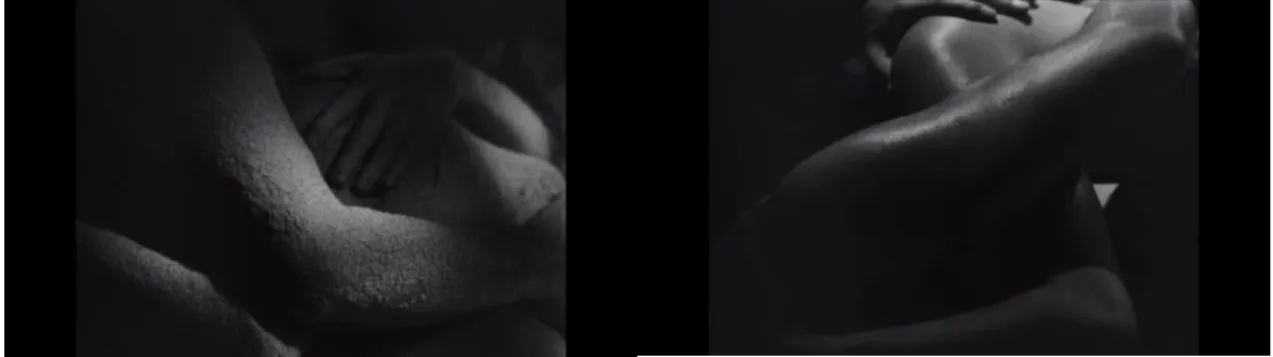
The first shot of Hiroshima, mon amour depicts two bodies intermingled in an embrace. These same two bodies (or what appear to be) are then shown in different positions, all intertwined, over the following series of shots. The framing of these shots omits the faces of the characters, which effectively renders these two bodies
indecipherable from one another. By classical film logic, longer shots should be
does not provide spatial or narrative context until nearly fifteen minutes into the film, when it finally zooms out to show the faces of these characters as they lie together in a bed.
This opening prevents us from approaching the film with any “sense of mastery” (Craig 114). It intentionally disorients us by excluding narrative context and denying any sense of a clear spatiotemporal focal point. It is unclear how the different audial and visual components of this opening scene relate to each other because no apparent narrative structure has emerged. The film imitates the structure of a flashback opening where Elle and Lui talk in voiceover while images meant to signify Elle’s past appear on screen, but the demarcation between what exists in the past and what exists in the present is ambiguous. As Deleuze remarks about Resnais’ cinema, “there is a disappearance of the centre or fixed point” (Cinema 2, 113). By classical film logic, flashbacks should be clearly set apart from the present course of narrative action (often by use of a visual or audial signifier, like a sound to signal the transition), but Resnais depicts the past
alongside the present to the point that it becomes impossible to construct a spatiotemporal foothold by which to comprehend the course of narrative events. The film even conflates past and present within the same shot. This opening shot shows the two bodies
Figure 2: Elle and Lui wrapped in embrace covered with sand-like material (left) and covered with sweat
(right) in Hiroshima mon amour.
This concept of indistinguishable bodies extends from human bodies in this first scene to that of cities in a later one. The scene starts with Elle walking down the streets of Hiroshima as Lui follows her from a distance. As Elle walks through the city, the camera focuses on different parts of the street (signs, storefronts, pedestrians, etc.), and thereby represents Elle’s point-of-view during her walk. Then, without demarcation, the film starts to intercut shots of Nevers streets with the shots of Hiroshima streets, as if these two cities were contiguous. Because the shots of Hiroshima’s streets represent Elle’s point-of-view, the intercutting of Nevers’ streets has temporal significance. The streets of Nevers represent the past while the streets of Hiroshima represent the present. Again, past and present are muddled. Elle’s experiences in Hiroshima are mediated and limited by her experiences in Nevers – her ability to perceive the present is overcome by her memories.
literally replayed in the present), but the past simultaneously remains in the past. When past and present coexist like so, their delineation is lost and “Linear causality is ruptured: any conventions or assumptions governing temporal or causal relationships – the very existence of the categories of past and present – collapse” (Craig 111-112). The blurring of the boundary between past and present defeats the classical use of time as narrative structure. Hiroshima, mon amour depicts time as something absolved of dramatic association. The film’s dissolution of temporal categories creates a time-image, one where time is no longer subjugated to movement.
The deconstruction of the classical romance narrative in Hiroshima, mon amour
continues through its denial of specific, identifiable characters. Neither lover in the film has an actual name – they are referred to by the pronouns Elle and Lui (which translate to
she and he respectively). Bordwell and Thompson write that “classical Hollywood cinema often constructs a narrative around characters with definite traits who want to achieve specific goals” (Film Art, 385). The characters of Hiroshima mon amour lack even the most fundamental specifier – that of a name. These lovers try to understand each other via stories in an attempt to transform one another from persons of ambiguous or missing identity into specific, identifiable individuals. In order for this couple to last, the two lovers must be able to identify each other apart from other people. The lovers spend the course of the film searching for something to function as an identifier – something that will distinguish their relationship apart from others.
In Hiroshima mon amour, these identifiers prove difficult to come by.
in Resnais’ cinema, “events do not just succeed each other or simply follow a
chronological course; they are constantly being rearranged according to whether they belong to a particular sheet of past, a particular continuum of age, all of which coexist” (Cinema 2, 116). If experiences construct an identity, then the free exchange between past and present, or experiences and perceptions, distorts this construction. Because the past and present freely interchange, identity based on a stable backstory becomes difficult to parse. The protagonists of Hiroshima, mon amour cannot be defined by their
backstories because these backstories are in constant fluctuation.
The search for identifiers culminates in the final scene when they name each other: Lui names Elle “Nevers” and Elle names Lui “Hiroshima.” Their attempts to understand one another through their respective pasts all boils down to two words. The great task of identifying their relationship seems to fail completely at this moment – all the knowledge that each has gained about the other is reduced to a place name. Siobhan Craig writes that these names “represent the rupture of any stable identity, the collapse of models of subjectivity. The self is fragmented and scattered, reduced metaphorically to ash and rubble containing the disheveled, randomly scattered elements of what once existed” (125). The lovers seek identification through the past, but this results in an oversimplification that ultimately denies the romantic connection that each seek. After all, Elle eventually decides to return to Paris, leaving “Hiroshima” behind with the rest of New Hiroshima.
places, which may ultimately become our places of memory” (2) and furthermore that “places of memory are thereby our anchors in time and space, the points of reference from which we can shape our personality, establish our identity and counteract the alienation resulting from contemporary processes of globalization” (3). Elle and Lui adapt each other, like cities, into places of memory. Each “visits” the other and learns a story, but exchange ends here. Even while they interact in the present, each lover has come to represent the past. The time of the time-image has subordinated each character into a memory which cannot drive the narrative of the film, ultimately denying the couple any romantic resolution.
It is not the couple, but time which plays the center role in Hiroshima, mon amour. The memories of Elle and Lui bridge the present with the past, allowing for a free exchange of time. This results in the loss of demarcation between past and present and thereby, the linear progression of time that informs the classical romance narrative ruptures. The romance of Elle and Lui cannot continue in the time-image because of the resultant loss of specific space-time coordinates and character identities. They exchange stories, but each lover simply becomes another memory for the other, memorialized in the symbolic naming gesture at the end of the film. Without the narrative cohesion
afforded by classical cinema, these lovers are overwhelmed by their pasts to the point that their interactions are subsumed into memory.
Momentary Love in L’Eclisse
film career working as part of the post-World War II movement called Italian
Neorealism. This movement stressed realistic depictions of lower-class individuals in their day-to-day lives, but Antonioni’s work, including early films like Cronaca di un amore (Story of a Love Affair, 1950) broke from this with a tendency to focus on the day-to-day lives of middle-class individuals instead. Antonioni’s breakthrough success came with the premiere of his film, L’Avventura (The Adventure) at the 1960 Cannes Film Festival. L’Avventura begun an informal trilogy with his later films La Notte (The Night, 1961) and L’Eclisse (1962) which became famous for their depiction of the alienation effects of late capitalism. Antonioni’s films make use of couples as narrative
centerpieces, but these couples experience communication failures and eventually split up. Antonioni presents romance narratives, but experiments with film form in a way that deconstructs narrative time, leaving the lovers isolated from history.
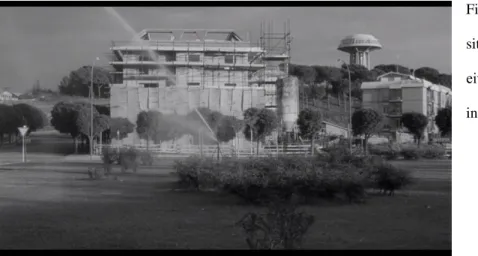
of the construction site without either lover present, indicating that they had failed to keep their promise that evening.
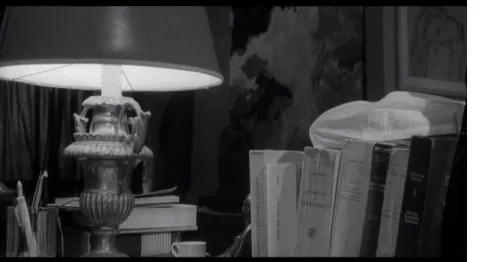
This failure to meet stems from a reconfiguration of dramatic hierarchies established in the first shot of the film. The shot shows a table of objects, including a lamp and a row of books. Suddenly, one of the objects resting on the row of books moves and is revealed to be a human arm (see Figure 3). In the very first shot of the film, the human form has been confused for an anonymous object. Something that is intimately related to the human experience has already been misrecognized. As Gilberto Perez writes, “an Antonioni film designedly disorients us, not to promote confusion but in the recognition that our accustomed ways of making sense are no longer reliable, our
received assumptions about the world no longer adequate, and in the attempt to find new bearings amid uncertainty, new ways of apprehending and ordering our experience” (369). The human form does not occupy the central dramatic role in this opening shot, the objects do. This shot conceals the difference between a human and an object and plasters over the traditional dramatic hierarchy of humans over objects. Just in this first shot, the film has reworked the relationship between humans and their environment, doing so in the context of a couple on the brink of separating.
Figure 3: Riccardo’s arm
framed as an anonymous
This opening shot introduces Vittoria and Riccardo, whose interactions in Riccardo’s apartment cover the first fourteen minutes of the film. Vittoria and Riccardo have one last conversation after what appears to have been a long night of discussion resulting in a breakup. Vittoria moves around the apartment investigating different objects, opening windows, and occasionally speaking with Riccardo. The film constantly frames the characters from a distance, allowing the human bodies to exist in conjunction with their non-human surroundings. Furthermore, non-narrative contents of the apartment are given dramatic weight in this scene – particularly, an electric fan. The sound of the fan plays in the background of this entire scene, sometimes quite loudly to the effect of drawing attention away from Riccardo and Vittoria’s conversations. The wind produced from the fan also appears in many of the shots in this scene, noticeably moving
Riccardo’s tie and Vittoria’s hair. In this opening scene, an arbitrary part of Riccardo’s apartment (it has no relation to the film’s narrative) rises to dramatic significance,
sometimes over the human characters. This scene extends the reconfiguration of dramatic hierarchies investigated in the opening shot – previous modes of interpreting narratives are rendered inadequate.
The film explores new concepts of the romance narrative through visual
– the characters of L’Eclisse do not have backstories. They instead seem confined to encounter the events of the present – time in L’Eclisse is a “time of the moment” (Perez 370). The film does not refer to extra-narrative existence – rather, the narrative picks up in the present and carries forward. L’Eclisse does not structure itself in relation to the histories of its environments or the memories of its characters. Instead, it presents a time-image disconnected from the narrative valuation of history. The world of L’Eclisse exists on a new timescale, one of the present cut off from the past.
Already, the film has constructed a new narrative sensibility – the traditional structure of the romance narrative has been lost. Alvarez argues that, in Antonioni’s films, “the narrative structure has been deprived of what we previously understood as beginning and end to focus instead on the middle, from which we have to deduce everything” (44). L’Eclisse is not directed from a clear beginning to a clear end. The classical narrative direction which subjugates time to movement in the movement-image is absent and thereby, the film refuses to fall into any previous patterns of narrative. Because of this, it quickly becomes difficult to predict what kinds of interactions the characters will have. By denying classical narrative structure and thereby denying
viewers the knowledge of character psychologies, the film denies narrative predictability. No longer can events be placed along a time continuum from past to future; events in
L’Eclisse must simply be perceived as they occur.
This reorganized time continuum culminates in the film’s famous non-ending. Vittoria and Piero agree to meet up by a construction site in the evening to show
present. Then, over the course of seven minutes, the camera observes a series of objects around the construction site in close-up. Often in classical cinema, “a temporal goal is wedded to a causal one, and the time becomes charged with cause-effect significance” (Film Art, 386). This type of thinking drives the fabled “happy endings” of classical cinema where the viewer is certain that the end of the film (temporal goal) will bring about happiness, often in the form of a couple united (causal goal). When Piero and Vittoria plan to meet on the street corner near the end of the film, they wed the temporal goal to a causal goal – the film is primed for a happy ending.
Piero and Vittoria do not, of course, meet at their appointed time; this cause-and-effect priming falls flat. Seymour Chatman points out that “Audiences must expect Vittoria and Piero to meet again if their not doing so is to have any shock” (80). Antonioni’s film plays on viewer expectations. The film is aware of the effect of this causal priming and uses it so that when Piero and Vittoria do not meet, the cause-and-effect relationship is rejected. During this seven minute protagonist-less ending, narrative time stops despite cinematic time continuing. The ending of the film achieves a time-image free from narrative and it is the specific expectations of the structurally-rigorous genre of classical romance that allows for this to happen.
narrative symbolism. The couple has made an insignificant place into a significant one by association with memory – the building becomes important because of the events that take place near it. The final scene, then, acts to erase this association. No longer can the construction site represent the memory of Vittoria and Piero’s relationship – the lasting effect of the final scene is to erase this couple and their relationship from our memories. Time in L’Eclisse refuses narrative subjugation by the memorialization in a place of memory and these memories are forgotten just like the appointed meeting of Vittoria and Piero.
Figure 4: The construction
site meeting place without
either protagonist’s presence
in L’Eclisse.
Forgetting and cutting the present off from the past reprises continually in this film, but does not mean the film is entirely ahistorical. With a 1962 release date, the film was made just after the Cuban Missile Crisis in the height of the Cold War. The most explicit reference to this comes in a shot in the film’s final sequence in which an
denies its characters the ability to ground their experiences in a historical timeline. The protagonists of a film made partly in response to an afilmic historical event are excluded from this history and subsequently denied the narrative configuration of events that this would provide.
L’Eclisse constructs a world fueled with reinterpretation of classical film logic. With use of editing, framing, and camera movement, the film determines anew classical dramatic hierarchies – the human form does not hold overpowering dramatic weight over its environment. The film rejects the clear causal relations of the movement-image and furthermore denies viewer access to character psychologies, specifically the mental states relating to memory and desire. Rather, the world and narrative are alien, something to be perceived and interpreted, but impossible to predict. It abstracts narrative structure, ultimately rendering narrative time inferior to cinematic time, generating a time-image. Time in L’Eclisse can no longer be subordinated to narrative memory, which ultimately denies its couple from existing anywhere except for the present. The couple exists outside of history, experiencing the present, but unable to remember.
Conclusions
The time-image represents a distinct structural departure from the narrative rigor of classical cinema. Where narrative subjugates time in classical cinema, time takes on a more central role in modern cinema, often completely abstracted from narrative. In
L’Eclisse, on the other hand, refuses to fall in line with previous patterns of narration, creating a romance narrative that stands apart from the past, forcing its characters to encounter the world moment-to-moment. Time, freed from the constraints of causality, intercepts the progression of events in the romance narrative, ultimately denying the formation of the couple for romantic resolution.
Both Hiroshima mon amour and L’Eclisse figure prominently in the creation of the estranged couple, a theme which demonstrates a new relationship between time and narrative brought about by theorization of the time-image. The romance narrative, because of its intrinsic tie to structured time, provides a powerful tool through which the observation of new cinematic trends becomes possible. Romances are both incredibly pervasive narratives (throughout both time and space) and undergo constant
CHAPTER 2
Navigating Replayed Time
In the Mood for Love
(2000) and
2046
(2004)
In modern cinema, the relationship between time and narrative undergoes a major reconfiguration. Time overcomes its subjugation as an underlying structure by which narrative elements find clarity and becomes cinema’s central subject. The time-image, as Deleuze terms it, inhabits a distinctly different mode of filmmaking from classical cinema, which Deleuze terms the movement-image. As discussed in chapter 1, this reconfiguration of hierarchy generally involves the adaptation and rethinking of traditional narrative cinema. Films of the time-image still rely on narrative and, often, generic convention, but these films have a distinctly new focus on the relationship
between cinema and time. The highly stereotyped narrative mode of romantic melodrama thus provides a useful substrate by which to understand the new system of the time-image.
In the theorization of his time-image, Deleuze draws heavily on the work of the philosopher, Henri Bergson, whom he writes about at length in a book titled Bergsonism
(1988). Deleuze’s Bergson-inspired time rejects traditional notions of causal time,
arguing that “the present is not; rather, it is pure becoming, always outside itself. It is not, but it acts” (Bergsonism, 55) and that “The past, on the other hand, has ceased to act or to
Deleuze’s past does not lead to the present in the way of causal time, but conditions a modification of the present.
The experience of the coexistence of past and present comes in the form of memory. Because time functions as the fundamental building block of cinema, memory interacts intimately with cinema as well. Lynda Chapple writes that cinema’s
representations “exist simultaneously in both the present and past tense: present, in that each screening is an immediate experience of a given moment; past, in that the object represented by the image has long vanished” (209). Cinema is a memory itself. Just as we bring the past into the present when remembering something, cinema brings recorded images of the past into the present for viewer perception. The desire to watch cinema, then, necessitates a discussion of nostalgia.
Oxford Dictionary defines nostalgia as “a sentimental longing or wistful affection for a period in the past.” Nostalgia comes from the Greek words nostos and algos which mean “homecoming” and “pain” respectively. Taken literally then, nostalgia means “the pain of homecoming” or “homesickness.” It seems peculiar that “nostalgia” comes from a word meaning “pain” considering how it is often classified as a “positive” emotion. Though nostalgia is a reminiscence of (usually) positive moments in the past, it also thereby declares a fundamental difference between the object of nostalgia and the present. Nostalgia reimagines something positive, but the inherent separation from the actual event brings pain, algos.
past into the present, but this is never a perfect replication. Nostalgia is a re-visitation of the past which, through modification, deconstructs the nostalgic object itself. Once nostalgia recreates an event, the subjective treatment of it modifies it, influencing future recollection. Deleuze writes that “The image...does not actualize this recollection without adapting it to the requirements of the present; it makes it into something of the present” (Bergsonism, 58). Memory cannot conjure up a perfect replication of the past, and so, all nostalgic encounters are necessarily mediated by the subjectivities of an individual or collective. Thus, when nostalgia recreates something, it produces something new and distinct no matter how similar it may seem.
Because of its simultaneous presentation of past and present, cinema serves as a valuable resource by which to understand this nostalgic desire. Cinema is, in a way, subjectified images of the past. Cinema cannot simply reproduce the past, it necessarily modifies it, producing something new. Deleuze’s theory of cinematic time breaches the driving force behind classical romance cinema, a philosophy of determinism which “presumes an action already completed, a sequence of already past moments that make up a whole whose necessity is retroactively constructed” (Bogue 25). Rather than a deterministic cinema, Deleuze’s time leads to a cinema where “the future is genuinely new and undetermined” (Bogue 25). Deleuze’s time-image is a cinema where the
of experience through an experience of temporality” (7). By destabilizing the course of events in classical narratives, the time-image encourages a focus on ephemerality of interaction – no longer is the “happy ending” guaranteed. When this teleological explanation of events disappears, the momentary interactions which build up these narratives are emphasized instead.
Cinema of the time-image, then, constantly affirms how adept time is at
separating events. This has particular portent with the concept of nostalgia, which seems to preserve a past which would otherwise be forgotten. Cinema provides an experience of nostalgia which brings the past into the present while simultaneously refuting its
accuracy. Because attempts to bring the past into the present via cinema are clearly futile, the past becomes even less accessible. Cinema, whether deliberately or not, constantly emphasizes how unreachable the past actually is.
Despite the inherent links between cinema and nostalgia, a number of critics have described a mode of film called the “nostalgia film.” This mode mostly refers to films which involve wide-scale reconstruction of the (often distant) past. Films such as George Lucas’s American Graffiti (1973), which reconstructs 1962 American “rock ‘n’ roll” culture, and Stephen Frears’ Dangerous Liaisons (1988), which reconstructs 18th century French royal court culture, can both be considered in this category of filmmaking. These films pursue accurate reconstructions of the past through culturally-specific costuming, settings, dialogue, and music.
memory and time. Wong’s films, like those of Resnais and Antonioni, emphasize time over narrative and attempt to “capture the ephemerality of time and therefore the past” (Christina Lee 128). Wong’s films do this often through the pattern of the romance narrative. Wong’s romances exist in momentary interaction before an endless wave of change forces them to drift apart. As Carla Marcantonio writes, “Love is the vehicle through which his [Wong’s] investigation of historical change gets grafted onto stories of love found and lost. The romantic stories are metaphors for the experience of time, making temporality an organic, felt experience” (60). Because romantic narratives are classically so infused with linear temporality, the disruption of their pattern in Wong’s films makes this mutation of time more directly observable.
Perhaps the most prominent “historical change” influencing Wong’s temporality is the Sino-British Joint Declaration, which took effect on July 1st, 1997. The deal, a transfer of sovereignty from Great Britain to the People’s Republic of China, stipulates that Hong Kong should retain its capitalistic economic policies for a period of 50 years, ending in the year 2046. Wong’s films make a number of explicit references to this – most notably is the hotel room number 2046 in In the Mood for Love (2000) and later as the basis for an entire film, 2046 (2004). Wong’s films often feature nostalgic
reconstructions of the past, most notably 1960s Hong Kong, but they always highlight the inevitability of change. Just as Hong Kong is bound by inevitable change in
governmental and economic policy, Wong’s characters are unable to maintain stable relationships as their worlds morph with the inevitable progression of time.
change can be evaluated. These films, both set in 1960s Hong Kong, focus on a romantic relationship between Chow Wo-Man (Tony Leung) and Su Li-Zhen (Maggie Cheung) which ultimately fails and leaves Chow unable to form new relationships. Wong uses repetition, both within each film and between the two films, as a reflection on nostalgic reconstruction. Because of the imperfection of the repetitions, the films stress the ephemerality of moment and the impossibility of revisiting the past. The fleeting past, despite attempts to recover it, denies Wong’s couple the stability required to maintain their relationship, which inevitably falls apart.
Looking Backwards is Looking Forwards
Wong Kar-Wai, after working under Patrick Tam for a number of years, made his directorial debut with the 1988 feature, As Tears Go By. After the success of his second film, Days of Being Wild (1990), Wong was able to establish himself as financially independent and went on to direct and produce films such as Chungking Express (1994),
The film that has garnered Wong the most praise, In the Mood for Love, takes place in 1962 Hong Kong. Su Li-Zhen (Maggie Cheung) and her husband rent out a room in an apartment next door to where Chow Wo-Man (Tony Leung) and his wife rent out a room. After a number of chance encounters, Su and Chow start to suspect their respective spouses are having an affair with one another and, in an attempt to recreate the interaction which would have led to such an affair, accidentally fall in love themselves. At the end of 1962, Chow takes a job in Singapore and asks Su if she will leave with him. She fails to make the appointment in time and Chow travels to Singapore alone. Chow and Su return to their Hong Kong apartments to visit their old landlords in 1966. Though they are there at roughly the same time, Chow and Su do not meet. The last scene depicts Chow visiting Angkor Wat and whispering into a hole as part of a ritual for those with secrets they cannot share.
Ultimately, Chow is unable to, or otherwise refuses to, pursue a serious relationship with any of them, and the film ends with him alone.
These films do follow a general plot structure, but the presentation of narrative in these two films is often obfuscatory and elaborate. In Mood, spatiotemporally disparate scenes are often spliced together without any marker and traditionally-important plot points are left out of the film (e.g. we are never shown what happens to either character’s marriage). 2046 shows its narrative out of chronological order (e.g. part of Chow’s romance with Mimi/Lulu is shown at the end of the film while her death is shown at the beginning of the film). 2046 does not encourage the piecing together of a puzzle (like, for instance, Memento (2001) does), but deliberately stages a mosaic plotline to obscure its narrative trajectories. Wong’s films, instead, emphasize non-narrative elements of filmmaking – in particular, mood. Wong’s films make heavy use of overexposed
photography, saturated colors, and slow-motion to create visually-striking scenes that are effective despite what is often narratively incomprehensible. Wong’s films use narrative, but de-emphasize it in favor of constructing sensuous, romantic, and nostalgic moods.
Charles de Gaulle’s visitation to Cambodia in 1966 near the end of Mood and the 1966 Hong Kong riots in 2046.
The films can, then, be classified as “nostalgia films.” The two films inhabit a particular cultural moment without necessarily interacting with that moment. Rather than forming a commentary on these Shanghainese communities around 1960s Hong Kong,
Mood and 2046 use this setting as a kind of backdrop. Vivian Lee proposes to read Wong’s films “less as ‘nostalgia films’ than as ‘films about nostalgia’” (23) and argues that Mood “creates a stylized image as a specimen of a cultural nostalgia that is intimately personal and collectively shared at the same time” (36). Perhaps Wong’s films do
willfully inhabit the uncritical nostalgia film mode, but they also reflect upon the nature of nostalgia itself. It is this reflection that powers Wong’s thematic treatment of the relationship between cinema and memory and which separates his films from the narrative-driven world of classical cinema.
Though 1960s Hong Kong features prominently throughout 2046 as well, it is more difficult to consider this film as a straightforward “nostalgia film.” A number of scenes, meant to be filmic projections of Chow’s in-film sci-fi story, take place in a future world called “2046.” 2046 is the name of the location in which this story takes place, but it also refers to the year 2046 in which the sci-fi story takes place. The diegetic world of 2046 is pictured through a series of CGI animations and live-action sets aboard a train. Characters in these sci-fi scenes are played by actors with roles in the 1960s Hong Kong segments such as Wang Sum, Faye Wong, and Carina Lau.
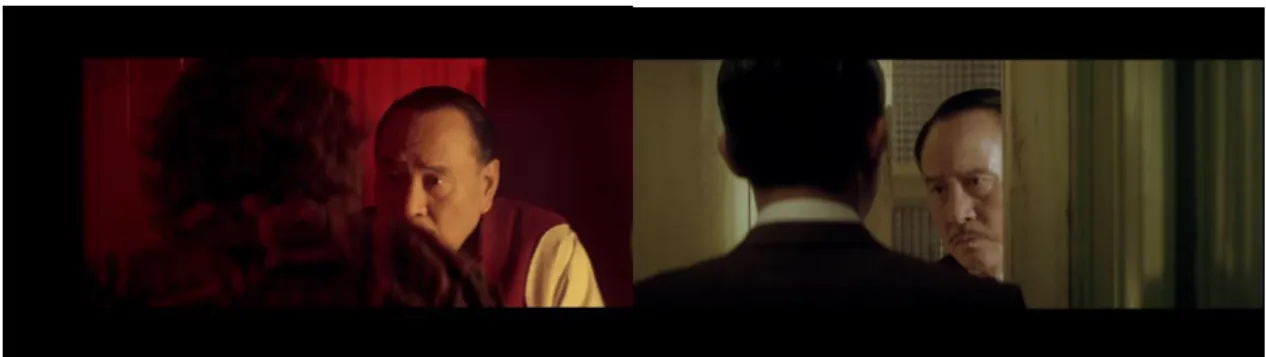
greets Tak and asks him about his reasons for leaving 2046 parallels the shot later in the film where Mr. Wang (Wang Sum) greets Chow and informs him about room 2046. In both scenes, Wang Sum’s head is mid-frame, pictured over the right shoulder of Tak/Chow. Tak and Chow are shown nearly in silhouette and Wang Sum is framed by walls that appear to close in towards his head (see Figure 5).
Figure 5: Tak discusses 2046 with Wang Sum’s character (Left) and Chow discusses room 2046 with Wang Sum’s character (right) in 2046
This kind of visual repetition happens throughout the film, establishing a sense of great similarity between the sci-fi sequences and the 1960s sequences.
The main distinction between the future and the past comes through the film’s use of costuming: in the sci-fi sequences, the characters wear a distinct mode of dress which contrasts considerably from the traditional 1960s clothing elsewhere in the film. This dress often consists of highly complex clothing made up of patches to give the semblance of “future clothing” (see Figure 6).
This, along with the fact that the CGI used is skeletal and incomplete, marks the fact that Wong makes little effort to actually flesh out the world of 2046. The film imagines a future that is only superficially different from the past. Just as the sci-fi film, as a genre, superficially redresses old ideas, the nostalgia film tells a contemporary story hidden behind the thin veil of historical markers. The fact of past or future (history or sci-fi) does not matter in Wong’s film. The parallelism of past and future rejects the notion of linear temporal progression, instead creating a temporality where the past and present coexist.
Time in these two films, especially in 2046, refuses to be restricted to a
straightforward temporality. The nostalgic past is not so definitely in the past, but rather, as Marcantonio writes, “The films…present us with a kind of no-time: a temporality constructed from echoes and repetitions” (56). Past, present, and future are aligned in
2046 to a point that negates the viewer’s ability to establish a clear time continuum. Scenes, along with audial and visual markers which might indicate time or narrative, are repeated to a point where their space-time coordinates lose significance. The same events and markers continually repeat, but each repetition is imperfect – different in some way from the previous iteration. Wong’s films depict a world where, despite attempts to re-experience the past, things can never be the same. The world changes so quickly and frequently that connections, especially romantic ones, can only exist momentarily.
Repeating is Like Remembering
Mood and 2046. Music, events, and actions all repeat, but fail at some level to recreate the original. This imperfect repetition creates a world of constant change and instability. Because of this incessant newness of time, the films are prevented from aligning into a classical narrative course. Neither Mood nor 2046 progresses towards a happy ending.
Repetition appears in Wong’s films in a number of different forms. One of Wong’s most prominent markers of repetition is his use of music – Shigeru
Umebayashi’s "Yumeji’s Theme” plays at various points throughout the film. The more this song is repeated, the more it seems to refer to its previous iterations in the film. Similarly, a number of visual motifs repeat throughout the film – one of which is Wong’s use of mirrors and other reflective surfaces. The mirror motif shows up repeatedly
throughout the film and proposes a thematic multiplicity through the presentation of objects and their replications. For example, midway through Mood while Chow and Su are writing their martial arts serial, the camera moves horizontally behind Su as she sits at a desk with a trifold mirror. As the camera moves, the trifold mirror reflects Su from a progression of different angles. In this shot, the camera moves to show an infinitude of replicated Su’s, all posed at slightly different angles. Wong’s frames are also marked by repetition of another visual motif: step-printed cinematography. Step-printing runs a segment of filmed material through an optical printer, omitting some frames and repeating other frames. The motif is used throughout both Mood and 2046 to signify contemplation and the actual structure of the motif involves a series of micro-repetitions.
and usually make use of the same visual effects (slow-motion) and soundtrack (“Yumeji’s Theme”). In one instance of this scenario, Su is shown descending the staircase into the shop and, after Su retrieves her food and leaves the shop, we see Chow descending the staircase into the shop in a nearly identical manner. After a shot of Chow eating his food, the camera shifts again to the top of the stairs, where Chow and Su (Chow descending, Su ascending) meet and exchange a “Hello.” At first, it seems like a mistake that Chow should be shown entering the shop after finishing his meal until it is realized that Su is wearing a different cheongsam. Through this, Wong suggests that these two encounters actually take place on different days. Encompassed in a short series of shots, Wong expresses the repetition of Chow and Su’s interactions where despite inhabiting the same physical location, time passes. Despite extreme similarity between days, change is still inevitable.
Somewhat ironically, both Mood and 2046 are interspersed with formal elements that indicate specific points in time. In both films, intertitles appear throughout denoting place and time such as “Hong Kong, 1962” in Mood and “24 December, 1968” in 2046.
which matters is that which is experienced by the viewer. Cinematic time, as it is experienced, follows a disjunctive nonlinear trajectory which, in Mood and 2046, overcomes the structure inherent to calendars and clocks.
The irrelevance of structured time in Wong’s films is well-exemplified by the use of intertitles in a scene late in 2046. In this scene, a shot of Chow writing cuts to an intertitle that reads “1 hour later,” which cuts back to a shot of Chow writing in nearly the same position. This repeats with an intertitle which reads “10 hours later” and then one which reads “100 hours later.” This series of intertitles undermines the structural power which intertitles typically claim. These structured leaps in time are irrelevant to the course of the film and an unknown number of events is swallowed up in the ellipses grounding these intertitles. The fact of “1 hour later” or “100 hours later” does not suggest anything about the film’s narrative. Rather, this series of shots is a direct image of time’s passage as time moves forward around Chow.
If these clocks and calendars are what delineate the past from the present, then its circumvention seems to bring the past back into the same plane as the present. The desire to bridge the gap formed between past and present by spatialized time is a kind of
Sequels are Nostalgic Too
Nostalgia also emerges with the consideration of 2046 as a sequel to In the Mood for Love. A large part of 2046’s narrative revolves around Chow attempting to
reconstruct the relationship he had with Su Li-Zhen in Mood. The shy lover of Mood
turns into a playboy in 2046 and he romances several women throughout the film, each of which approximate some part of Mood’s Su Li-Zhen. For instance, Chow’s final lover of
the film is Black Spider, a professional gambler whose real name turns out to be Su Li-Zhen as well. This Su Li-Li-Zhen has no relation to the one in Mood, but the reveal of her name triggers a cut to images of Mood’s Su framed as one of Chow’s memories. Chow
even voices this and reflects upon when he “fell in love with another man’s wife.” The film is largely about Chow’s nostalgia for the events of Mood, but the repeated references to the look and feel of Mood also encourage nostalgia in the viewer. 2046 is a film about Wong’s nostalgia for 1960s Hong Kong, Chow’s nostalgia for Mood’s Su Li-Zhen, and
the viewer’s nostalgia for In the Mood for Love.
The cinematography of 2046 underscores this nostalgia by constructing parallel scenes to ones in Mood. Near the end of Chow and Black Spider’s romance, there is a
scene where they are saying goodbye while framed against a nondescript gray wall. The blocking, framing, and lighting are extremely reminiscent of the various wall scenes in
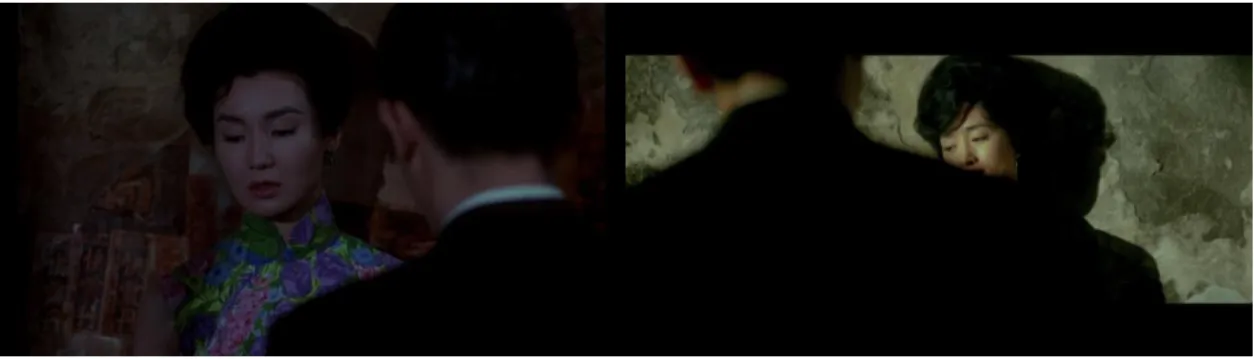
Figure 7: Maggie Cheung’s Su Li-Zhen framed against a nondescript wall with Chow in In the Mood for Love (left) and Gong Li’s Su Li-Zhen framed against a nondescript gray wall with Chow in 2046 (right).
This scene especially evokes the final farewell scene in Mood as Chow prepares to leave another Su Li-Zhen behind. The scene in 2046 takes a slightly different direction than the one in Mood, however, as Chow does not declare his love for this new Su, but does kiss her. The scene plays as a kind of re-visitation of the scene in Mood, as if Chow entered into the same scenario able to make a different choice. Even though the past seems to arise again to allow Chow to relive a scenario previously contained to a moment in time, events cannot play out the way he (or we) wants them to. Events must necessarily play out at least somewhat differently because the previous scenario has already happened. The scene reflects upon the impossibility of perfectly reliving the past.
Similarly, Chow and Wang Jing-Wen replay the martial arts serial writing scene that occurs midway through Mood. In the 2046 edition, Chow dictates to Wang a similar part of the serial to that which appears in Mood. Chow, forgetting that his character “Iron
is constructed in a way so as to be reminiscent of the Mood scene, but is marked as an incomplete reconstruction. Where the characters in Mood are framed in a single shot, the characters in 2046 are framed in two separate shots (see Figures 8 and 9). Despite the attempt to replicate Chow and Su’s romance by replicating their romance scenarios, the new lovers are unable to create the same connection.
Figure 8: Su and Chow writing a martial arts serial in In the Mood for Love.
Figure 9: Chow (left) dictating a martial arts serial to Wang Jing-Wen (right) in 2046.
Chow in 2046 enters into many of the same scenarios as he does in Mood, perhaps with the attempt to bring them from the past into the present. Christina Lee writes that, in
2046, “It is almost as if by being in the same space, something that was lost in time will
and events of previous narratives” (135). 2046 uses the same stylistic motifs that Mood
does in the creation of its atmosphere and it is this replication of environment that draws the viewer’s attention to a nostalgic wish towards recreating Mood. The film structures its viewers to feel nostalgia for the preceding film just as Chow feels nostalgia for his
previous relationship.
Both films then, are constructed primarily out of enactment scenes. The re-enactments of 2046, however, can be distinguished from the re-enactments of Mood. In
Mood, Chow and Su re-enact events that they have never witnessed directly (the beginning of their spouses’ affair) and rehearse events that have not happened yet (and may ultimately never happen – we don’t see them). The re-enactments of 2046, however, are re-enactments of the events in Mood – that is, events that have already happened (and that the audience has already seen). Thus, whereas Mood attempts re-enactments to simulate a time and space outside of the diegesis, 2046 reaches backwards in a reflection upon the failure to do so. Mood is hopeful to change the course and repetition of time, but
2046 affirms the impossibility of doing so.
However, perhaps the whole point of repeating, rehearsing, and re-enacting so frequently is that the original event comes to not actually matter. The romances in 2046
seem like a rerun of the romance in Mood, but we cannot forget that the romance in Mood
well. Chow and Su’s repetition (though not formed of nostalgia) of their spouses’ affair later, in 2046, becomes a source of nostalgia itself. Nostalgia begets repetition which, in turn, deconstructs nostalgia.
The failure of the nostalgic recreations of Mood in 2046 exemplifies this
deconstruction of nostalgia. In Mood, Chow whispers a secret into a hole in Angkor Wat and then fills it with mud, which he claims is a tradition of the “old days.” This
whispering ritual reprises in the sci-fi segment of 2046 as an interaction between Tak and Faye Wong’s gynoid. After Tak relates the structure of the ritual (when one has a secret, they must carve out a hole in a tree, whisper their secret into it, and then fill it with mud), the gynoid forms her fingers into a circle mimicking a hole in a tree. Tak attempts to whisper his secret into it, but the gynoid keeps moving her hand, preventing Tak from confessing his secret and ultimately leading him to kiss her. The ritual, which indicates an attempt to bring the past onto the present, is denied. Because of the imperfection of the recreation (literalized through the replacement of a tree with an android’s hand), this ritual highlights the inaccessibility of the past.
Conclusions
In the Mood for Love and 2046 provide a critical perspective on nostalgia, especially as it pertains to cinema. Characters in these films are nostalgic, the films are nostalgic recreations, and the viewer experience is rendered nostalgic. These nostalgia provide uncritical pleasure to the viewer, but also comment on the relationship between cinema, time, and memory. Viewer experience is especially important considering that
temporal gap can be felt between the narratives, which can be used to attune viewer experience to character experience. Just as 2046 depicts a character’s nostalgia for the events of the previous film, it encourages its spectators to experience a nostalgic attachment to the events of Mood as well.
Wong’s films repeatedly incite nostalgia, but also repeatedly argue that nostalgia, both generally and for specific events, is unsuccessful at actually recreating the past. Nostalgia brings the past into the present, but only superficially. Each recreation and repetition invariably creates something new and different, ultimately destabilizing the concept of an original event which nostalgia draws from. Because of the constant
CHAPTER 3
The Ticking Clock and Passing Moment
Before Sunrise
(1995),
Before Sunset
(2004), and
Before Midnight
(2013)
Modern cinema which, according to Deleuze, arose in part as a response to the horrors of World War II, has impacted filmmaking and film criticism even incontemporary filmmakers like Wong Kar-Wai. Despite a robust presence of classical narrative cinema in the contemporary films of Hollywood, Bollywood, and other large film production industries, the influence of the time-image has led to a cinema which foregrounds the role of time over movement and narrative. Because time can be
expressed in many different ways, the time-image appears in a plenitude of forms, as has been seen in chapters 1 and 2. In the romantic melodrama, this new focus on time has led to the destabilization of narrative and the ultimate undoing of romantic couples. The work of “modern cinema” directors like Resnais and Antonioni elucidates the relationship between romance, narrative, and time and has influenced contemporary filmmakers, including the subject of this chapter, Richard Linklater.
Richard Linklater (1960-present) is known for his role in the American
Independent New Wave, directing, producing, writing, and acting in his first two films
It’s Impossible to Learn to Plow by Reading Books (1988) and Slacker (1990). Though Linklater has dabbled in making classical narrative cinema (with films like School of Rock (2003) and Bad News Bears (2005)), he is most famous for his sprawling multi-protagonist narratives driven by dialogue-based interactions in films such as Slacker
slacker” (Walk, Don’t Run, 1) figures prominently throughout Linklater’s work and is characterized by a desire to actively discuss politics and philosophy, but ultimately avoid involvement in the labor system of the American military-industrial complex. The characters of Linklater’s films are often counterculture youth who move through a city-space and interact with the various persons and places within.
The “committed slacker” of Linklater’s films is marked as a political effort to resist the cult of productivity prominent in mainstream American culture. Rob Stone relates this character to the time-image by arguing that, “the time-image is revolutionary, but by its refusal to act, rather than by its action. The time-image is a slacker!” (Ibid, 96) and that “the time-image allows for imagination, reflection and collaboration to occur as a rebuttal to the conventions of a hurrying mainstream narrative cinema. The time-image, like the slacker, deliberately ignores all pressures to conform, compete, or consume” (Ibid, 96). Stone’s argument hits on an interesting parallel: just as the time-image is a defiant response to the structured determinacy of the movement-image, the slacker is a defiant response to the structure of mainstream American corporate culture. The slacker is a character who attempts to bring time back from the format of deadlines and schedules towards a fluid series of interactions and spontaneity.
The slacker proposes an attempt, then, to de-spatialize time. Deleuze writes about the distinction (originally raised by Henri Bergson) between spatialized time and a de-spatialized time, which he calls durée (duration). He defines spatialized time as “a numerical multiplicity, discontinuous and actual” (Bergsonism, 38) and durée as “a
that we measure) thematically guides a number of Linklater’s films. Ronald Bogue provides a somewhat more explicative definition:
We tend to think of time as an abstract, homogenous element, which we measure by the ticks of the clock. But the sixty marks on the clock face are merely
interchangeable, static points, and the passage of time is more than a mere succession of states marked into discrete and even intervals. Our basic
psychological experience of time is that of durée, of a dynamic continuation of a past into a present and toward a future (14).
Where clock time structures and schedules, defining the present as it teleologically relates to the past and future, Deleuze’s experienced time (durée) allows for freedom and
creativity. Linklater’s cinema contrasts these two registers of time in a preoccupation with the importance of experience in the present. This contrast between durée and clock time suggests that “if one thinks of the present as a prologue or an epilogue, one can only experience frustration or loss” (“About Time,” 71). In its application to Linklater’s cinema, the time-image is the ever-recurring present and the movement-image is that which expands the vision of time to the past and the future. Where the movement-image is concerned with structure, tradition, and foresight, the time-image is concerned with the ever-recurrent new and the plurality of moment.
and Céline takes the train back to Paris. The two fall in love and plan to meet each other again in six months at the Vienna rail station. In Before Sunset, Jesse and Céline meet each other in Paris nine years later while Jesse is on a book tour. It’s revealed that Céline couldn’t make the originally planned meeting in Vienna because her grandmother’s funeral had been the same day. They walk and talk around Paris and reveal that they are both in romantic relationships with other people, but by the end of the film, they appear to fall in love again. In Before Midnight, Céline and Jesse are long-term partners with two daughters on a vacation in the Southern Peloponnese in Greece. Over the course of the film, an argument over the fate of Jesse’s son, Hank (Seamus Davey-Fitzpatrick), drives them to a serious fight which is only partially reconciled by the end of the film.
Linklater’s trilogy is a collection of some of the ideas about time investigated in the work of Resnais, Antonioni, and Wong, but in a more accessible format. The films of this thesis tend to fall into the romantic melodrama genre, but it is in Linklater’s work that this is most clear and recognizable. The films rely on dialogue heavily, use standard editing patterns like shot-countershot, and follow a more or less linear narrative. Despite this, the films explore time in a variety of incarnations like deadlines, nostalgia, aging, and death. David Johnson writes that “Linklater’s work...is very much interested in the experience of temporality, for both characters and spectator, and in particular in what it means to inhabit the present, whether beneficial or destructive, elusive or inevitable” (“Richard Linklater,” 8). The trilogy contrasts different interpretations of time and calls attention to the importance of a momentary lifestyle (“living in the now”) especially in the face of the ever-destructive forces of time. Clock time in Linklater’s trilogy