Access to Care Barriers for Neuro-oncology Patients in Western Kenya:
A Study Proposal
By
Stephen Parker
A Master's Paper submitted to the faculty of
the University of North Carolina at Chapel Hill
in partial fulfillment of the requirements for
the degree of Master of Public Health in
the Public Health Leadership Program.
Abstract
Sub-Saharan Africa contains over ten percent of the world's population, almost
one-fourth of the global disease burden, but only three percent of global healthcare workers. These
problems are exemplified in Kenya. Moi Teaching and Referral Hospital is a national hospital in
Western Kenya. The catchment area for the sole neurosurgeon at Moi University is estimated
to contain approximately 20 million people. No research has been published regarding how
patients reach tertiary care centers in Kenya or how long they have had symptoms prior to
presentation. Compared with acute disease treated by neurosurgeons, patients with a
neuro-oncologic diagnosis' most often present in clinic. Further, there appears to be no published data
on access to neuro-oncology care in Kenya, delays in diagnosis possibly lead to more advanced
stages at the time of diagnosis and potentially worse outcomes. We propose to describe the
barriers to access of care for patients within this group. We hypothesize that differences will be
found by age, gender, education level, financial resources, and location of a patient's residence
in the ability for a patient to have timely access to neurosurgical oncology care in Western
Kenya. We aim to determine what types of health care providers, if any, patients have seen
prior to presenting to the neurosurgeon. Assessing the barriers experienced by neuro-oncology
patients in reaching the only national hospital in Western Kenya will help us design programs to
Background and Significance
Introduction
Sub-Saharan Africa contains over ten percent of the world's population, almost
one-fourth of the global disease burden, but only three percent of global healthcare workers.1 The
low number of healthcare professionals and the variable geographical terrain compromises the
healthcare services available in this region.2 Most people of sub-Saharan Africa live in an
extreme rural community with fewer resources and further distances to hospitals/clinics than
rural areas of developed countries, leading to these areas being severely disadvantaged for
health and survival indicators.3 Those with limited financial resources are even more vulnerable
as deteriorating infrastructure in addition to unavailable or unaffordable transportation
decreases the chances for the poor to reach adequate medical facilities.
Medical care and access to medical care have become headline grabbing topics in the
national media of the United States. No better example of the type of medical care possible in
the United States is that of former Senator Kennedy's treatment for a malignant brain tumor.4 Neuro-oncology care is one of the most highly sophisticated areas of modern medicine.
Senator Kennedy had the means to search out what he felt was the most advanced care
available at the Robert Preston Tisch Brain Tumor Center at Duke University Medical Center in
Durham, NC which is over 700 miles away from Boston and the hospital where he obtained his
original diagnosis.s Senator Kennedy assembled a team of leading brain tumor experts from all
over the country, including representatives from Massachusetts General Hospital, the University
of California- San Francisco, and Duke University to discuss treatment options, in order to
make the decision to travel from his home in Massachusetts to North Carolina to seek personal
medical treatment. 5
Senator Kennedy is an example of an individual with close to unlimited access to the
best medical care in a developed nation such as the United States of America. But what about
the barriers to care for individuals living in poverty or in rural areas in the United States? Are
the barriers to care different in developing nations such as in sub-Saharan Africa compared with
nations such as the United States? What are the barriers to care for such complicated medical
illnesses such as brain tumors? Barriers to care present varying challenges to countries and
healthcare workers in attempting to provide care to patients while decreasing healthcare
inequalities. In this paper I will discuss general barriers pertaining to the issue of access to
health care both within developed and developing countries. This will be followed by a
discussion of access issues for neuro-oncology care, and will conclude with a proposal for a
future study to be carried out in Western Kenya to assess the barriers experienced by
neuro-oncology patients there. This proposed study will hopefully help us understand the difficulties
neuro-oncology patients face in accessing medical care Western Kenya and develop
interventions and policies to help reduce or remove some of these barriers and increase the
number of patients able to be treated.
Access to Care
The Institute of Medicine defines access to health care as" ... the timely use of personal
health services to achieve the best possible outcomes"6 Access deals with an individuals' ability to find and receive care from a health care system.7 The barriers to medical care access have become a very large topic for research and within the medical literature. A PubMed keyword
search using "barriers to healthcare" or "barriers to medical care" as terms, returns over 16,500
articles addressing the topic.
One of the most respected frameworks for assessing access to health care is the
Anderson Behavior Model. The Anderson Model was developed in the late 1960s as an attempt
to explain an individual's use of health services8 The initial model was termed the behavioral model and has gone through multiple revisions over the years. The initial behavioral model
(age, gender), social structure (education, ethnicity, occupation), and health beliefs (attitude,
values, and knowledge about health and health services). These predisposing characteristics,
taken with enabling resources- both personal (financial, means of transportation, travel
distance) and community (health services and healthcare worker availability) - along with health
need - individuals perceived health care need as well as evaluated need (professional
judgment) leads to an individuals use of health services. (Figure 1)
FIGURE 1 (Adapted from ref. 8 [pg. 8])
Predisposing
1----
Enabling
1----
Need
-
Use of
Characteristic
Resources
Health Services
I
I
I
Demographic Personal! Perceived
Family
I
I
I
Social Community (Eval11ated)
Structure
I
Health Beliefs
The first revision added the health care system as a distinct and major component that
influences access.9 Further revisions added the concept of health status outcome measures, and the most recent model utilizes four major categories 1) the environment, 2) population
characteristics, 3) health behaviors, 4) outcomes, and the importance of reciprocal feedback
loops which highlight the influence of each of the components on each other8• 10 Each major
category has its own subcategories. The environment is measured as an aggregate that utilizes
provider related issues, and the external environment, or the community composition.
Population characteristics primarily use the initial behavior model components of predisposing
characteristics, enabling resources, and need. The outcome component uses an aggregate of
perceived health outcome, evaluated health outcome, and customer satisfaction. (Figure 2)
Figure
2
(Adapted fmm ref. 8[p.8])Environment Population Characteristics Health Behavior j-
I
OutcomesThe model has been developed for use to assess health care access in the United States and to
look at overall health; however, it also can be extrapolated and used as a framework in
assessing access to care for specific diseases and for various populations. I will use the
Anderson Model framework concentrating on the environment and population characteristics in
The Environment
Community composition such as the overall educational level, ethnic composition,
religion, and employment level can be very important in determining what type of access to care
an individual will have. For example, in Israel, significant correlations between healthcare
access with religion, father's ethnicity (Arabic children had shorter lag times than children of
Jewish parents), and location of residence have been shown.11
Delivery of healthcare services, such as the presence of hospitals or clinics, the number
of trained healthcare workers, and the availability of medications can be classified as supply
barriers. Most supply barriers vary according to the country being evaluated as well as national
and local governmental priorities. Most health policy is aimed at reducing supply barriers.12
However, barriers on the demand-side can be just as important in preventing patients from
accessing medical care. Demand can be influenced from the overall community make-up as
well as on an individual level and is most appropriately discussed under population
characteristics.
Population Characteristics
Demand barriers have the potential to be even more important than supply barriers for
poor and underserved groups. This can be due cultural barriers and lack of information can
prevent them from benefitting from policy changes and public spending.12 Demographic and
social structure factors such as race, gender, and age are unable to be controlled. Much of the
literature devoted to assessing individual factors is attempting to identify and remedy disparities
between groups of individuals such as by race and/or gender. One example is from The Voices
ofthe Poor cross-country study in Tanzania, which found general agreement that men were
invariably given preferential access to health care over women.13 Many poor women have little time, money or incentive to access health care.3 A lot of the literature devoted to evaluating
health care. Living in a rural environment often times limits the supply side by having fewer
healthcare workers and hospitals but living in a rural area has also been shown to reduce the
demand.12 The decrease in demand can increase the delay in accessing health care which can
lead to increased morbidity and mortality. One study in Vietnam found that rural living (distance
to facilities) is a principle determinant of how long patients delay before seeking care.14
Whether it is through supply or demand barriers to medical care, both decrease the likelihood of
obtaining an evaluation of an illness. Without an evaluation and diagnosis, it is difficult to
prevent or treat a disease.15 Much research has been done to evaluate how the location of where an individual lives affects how healthcare is received. Individuals in rural areas many
times have fewer medical resources, have to travel long distances to reach healthcare facilities,
and are more socially isolated. These factors have been found to positively correlate with who
will not start treatment and/or will drop out of treatment.16 A study in the US evaluating patients after a myocardial infarctions showed that individuals living more than 20 miles away from a
hospital are much less likely to visit ambulatory services for follow up-care.17 However, it is not
only rural patients who can have difficulty accessing medical care based on where they live.
Medical services are frequently inadequate or unavailable within the inner cities in the United
States.18
Many authors are interested in how finances affect the type of access to healthcare that
an individual will have.2 It seems logical to think that individuals with low economic means will have less access to medical care compared with individuals such as Senator Kennedy, but that
is not the only barrier to accessing and receiving healthcare.
Not only the ill are affected. Many families drift into poverty precipitated by the cost for
the medical care of the sick, the loss of the family's breadwinner, or the extra expenses incurred
to take care of a disabled family member. It has been estimated that if medical costs exceeded
5 per cent of a household's non-food expenditures, families would not be willing, and, in
means from other potential barriers to care, as economics dictate many factors that have the
potential to limit access to medical care. There is interest in trying to determine at what
monetary level finances stop being a barrier to healthcare access. However, it can be difficult to
indentify accurately who are the indigent and study mechanisms to improve access to health
care for the indigent.2
Overview of Health and Healthcare in Sub-Saharan Africa
The World Health Organization (WHO) has recommended that there should be at least
10 physicians per 100,000 people; however, many countries in sub-Saharan Africa have most
districts with less than 2 physicians per 100,000 people.20 Barriers to medical care access as
well as the inequalities in the burden of disease have recently become prominent concerns for
many countries in sub-Saharan Africa.7 Countries have begun to institute creative programs in attempting to address some of these issues. For instance, in Rwanda the government has
developed policies and laws for the health system to coordinate donors and external aid,
monitor the effectiveness of the aid, develop a country-wide independent community health
insurance program, and begin performance-based pay initiatives.20 However, these programs
mostly act on the supply side for barriers to healthcare. Demand barriers have the potential to
vary drastically both within countries and between countries in Sub-Saharan Africa given the
heterogeneous compositions of the countries, and the fact that demand is influenced by both
the individual characteristics and health behaviors as delineated in the Anderson Model.8•12 It
is difficult to apply much of the work that has been done in developed countries to developing
nations because of the different challenges faced in the developing world. It is important that
demand barriers within sub-Saharan Africa are assessed to help develop programs aimed at
reducing these access issues.
It is estimated that approximately 12 million people die yearly due to causes that go
have survived had fewer barriers to medical access been present. Most of the current data from
the developing world come from the WHO; however, given the difficulty of obtaining quality data
in the developing world and the problem of under-reporting, it is likely that the total number
people experiencing certain diseases, DAL Ys (Disability Adjusted Life Years) lost, and the cost
burden to developing countries are higher than reported. Effective planning, interventions, and
decision-making in an attempt to reduce barriers to medical care access should be based on
evidence, not on guesswork. However, currently no good evidence exists to help policy makers
make these difficult decisions. Along with policy makers, clinicians become advocates for the
implementation of barrier reduction strategies as there is no better group to advocate for the
health of the people than those charged with caring for them.
Kenya
These problems are exemplified in the developing sub-Saharan country of Kenya which
has a population of over 39 million people, over half of whom are between the ages of 15-64.'1
Kenya is a vast country of over 580 thousand square kilometers from the snows of Mt. Kenya in
the central region, the semi-dessert terrain in the north, the Indian Ocean to the east, Lake
Victoria in the west, and the Masai Mara in the south, containing total roadways covering
177,765 kilometers, 85% of which are unpaved.21 There are 7 provinces and over 60 districts. The challenge to reduce healthcare barriers and increase access to medical care is important
for the population and economy of the country. Improved access to healthcare of adults aged
15-64 in Kenya is vital to the future economic health of the country, as this age group contains
the majority of the 16.94 million Kenyan workforce21 If all of the barriers to healthcare access
were fully understood the obstacles faced in Kenya would continue to be bountiful and include
both large and small impediments including limited financial resources, the need for public
education and development with implementation of programs, and skill development for
countries which only add further obstructions to overcome.22 However, we still do not fully understand the current barriers that patients face in an attempt to access healthcare and to
what extent these barriers cause decreased access to medical care.
Currently, there are two national referral hospitals within Kenya. Kenyatta National
Hospital primarily serves the capital city of Nairobi and its surrounding area. The second
hospital is Moi Teaching and Referral Hospital located in the city of Eldoret in the Rift Valley
Provence23 The hospital serves all of Western Kenya which is more rural and not as developed as Nairobi; thus the hospital serves many patients over a larger land area. The poverty
estimate in the Rift Valley Provence in 2000 was at 47.9%.24
Neurosurgery and Neuro-oncology in Africa
Neurosurgery throughout Africa has been improving over the past two decades. It is
estimated that the continent now has 565 neurosurgeons currently practicing; however, most of
these surgeons are practicing in the northern countries bordering the Mediterranean Ocean
such as Morocco and Egypt or in South Africa. This group of countries has over 480 (85%) of
the continents' neurosurgeons.25 This leaves most of the countries in sub-Saharan Africa with less than two or three neurosurgeons to treat their citizens.
In Kenya, there are a few neurosurgeons practicing within Nairobi; however, only one
neurosurgeon, Dr. Florentius Koech, serves Western Kenya while working at Moi University
Teaching and Referral Hospital. Evaluating and addressing barriers to neurosurgical care is
an important step in improving healthcare quality in Western Kenya as well as aiding in the
retention of the only neurosurgeon in Western Kenya. Dr. Keech estimates that approximately
one-third of his clinic patients have presented to him over the past few years with a
A PubMed keyword search combining the terms "neuro-oncology" or "brain neoplasm"
and "Kenya" returned 7 articles; however, 3 of these were written before 1980, 1 primarily
concerns testicular cancer, 1 primarily concerns cerebral malaria, and the other 2 articles
evaluated the number of brain tumors treated in Nairobi. There appears to be no published data
on access to neuro-oncology care in Kenya and more specifically the less developed Western
Kenya. Since the 1993 World Bank report "Investing in Health" was published there have been
multiple programs and plans initiated in sub-Saharan African countries; however, no research
has been done to learn how patients reach tertiary care centers and how long they have had
symptoms prior to presentation?· 20
Study Proposal
I propose a three phase study to be carried out in Western Kenya to assess the barriers
experienced by neuro-oncology patients being treated by the sole neurosurgeon at Moi
University Teaching and Referral Hospital. There is extreme interest of the hospital in
determining referral patterns for neuro-oncology patients, who they are, and if many patients are
not finding their way to Moi Teaching and Referral Hospital. The catchment area for the sole
neurosurgeon within the public health system in Western Kenya is estimated to contain
approximately 20 million people.26 Based on conversations I have had with Dr. Koech the number of patients he sees with advanced neuro-oncologic diagnoses because of the extreme
length of time it has taken the patient to arrive in his clinic appears to be increasing. It is unclear
whether the patients have seen a healthcare provider prior to presenting to the tertiary care
center, and if so, what type of provider or how many providers were seen prior to presenting to
the neurosurgeon. The time from initial symptoms until presentation to the neurosurgeon is
greater allowing more potential routes for a patient to navigate within the referral network.
potentially worse outcome, and a possible increase in therapy27 Through understanding reasons for the delay in reaching the tertiary care center interventions may be developed.
We will base our study on the Anderson Model discussed earlier. We will also be able to describe characteristics of the patients who present to the tertiary care center and whether there are groups of people who have even less access than those who were able to navigate the barriers and arrive at Moi Teaching and Referral Hospital for care. The study will attempt to address the following questions:
1. What are the perceived barriers to neuro-oncologic access in Western Kenya? (Individual Characteristics, Health Needs}
2. How long does it take for a patient experiencing symptoms related to a neuro-oncologic diagnosis to present to a tertiary care facility? (Individual Characteristics)
3. How many healthcare practitioners have patients seen and what treatments have been prescribed prior to presenting to a neuro-surgeon in Western Kenya? (Environment, Individual Characteristics)
5. What is the income level for patients presenting to a neuro-surgeon with a neuro-oncologic diagnosis in Western Kenya? (Individual Characteristics)
6. What is the average amount of money spent on doctors and tests prior to a diagnosis of a neuro-oncologic illness? (Environment, Individual Characteristics)
7. How far from a tertiary care center do patients live who present to a neuro-surgeon with a neuro-oncologic diagnosis in Western Kenya? (Individual Characteristics)
8. What is the financial cost to travel to the tertiary care center? (Individual Characteristics)
9. What is the sex distribution of patients presenting to a tertiary care center with a neuro-oncologic diagnosis? (Individual Characteristics)
10. What is the education level of patients presenting to a tertiary care center with a neuro-oncologic diagnosis? (Individual Characteristics, Health Needs)
Materials and Methods
well as new questions designed by the research team. We will use qualitative methods to
revise the initial survey. The survey will initially be developed in English and subsequently
translated into Kiswahili (than official language of Kenya). The survey will then be given to 1-2
focus groups consisting of 5-6 individuals who speak Swahili as their primary language.
Questions will be revised and reordered as necessary based on focus group feedback. The
revised survey will be field tested with 10 non neuro-oncology neurosurgery patients. The
survey will be further revised if necessary.
The second phase of the study will take place in Kenya. Over a two month period we
will visit villages in the catchment area for Moi University Teaching and Referral Hospital. In
these villages focus groups will be held discussing the perceptions and perceived regional
variations dealing with barriers to access for neurosurgical oncology care as well as allowing us
to understand the cultural backgrounds for our patients. These focus groups will be recorded
and analyzed to determine whether there are themes present which are not adequately
captured in the official personal interview questionnaire. The survey will be revised one last
time and prepared for administration.
The final phase of the study will occur over the next 7 months as the questionnaire will
be offered to every neuro-oncology patient presenting to the neurosurgery clinic at Moi
University Teaching and Referral Hospital. There will be no incentive offered to the patients
who participate. The data will be collected during a clinic visit or within 3 months if the patient is
unable to complete the interview on the initial visit. All neuro-oncologic diagnoses will be
confirmed by either CT or MRI imaging. All radiographic imaging and neurologic physical
examinations will be reviewed by the study investigators. The demographic, anthropomorphic,
and historical data will be used to address the questions surrounding how patients present for
neuro-oncologic care; however, all of the data, including imaging characteristics, will be used to
help create a database for use in future epidemiology and outcome based studies. Only the
interview questionnaire which will be completed by the participant in a separate interview room
at their convenience.
Sample Size and Population
The target population for the analysis of patients with neuro-oncologic disease includes
patients in the Neurosurgery clinic at Eldoret. Inclusion criteria: Age at least18 years and a
confirmed or presumed neuro-oncologic diagnosis. Kenyan patients younger than 18 years are
more likely to be dependants and thus have the potential to rely more heavily on guardians to
reach a tertiary care referral center. Enrollment Estimate: It has been estimated that
approximately 3-5 patients with a new neuro-oncologic diagnosis present to the neurosurgery
clinic at Moi University Teaching and Referral Hospital per week. Over the course of seven
months, we expect to enroll at least 75 neuro-oncologic disease patients.
Recruitment and Consent Process
Eligible patients will be identified by clinical officers seeing patients in clinic. Patients will
be referred to the research assistant after check in at the neurosurgery clinic. The research
assistant will contact the patient in order to obtain consent to participate in the study. Informed
consent is obtained in Kiswahili using forms at the appropriate reading level. The research
assistant will be primarily responsible for patient enrollment and consent thereby limiting the
need for translation. When translation is required, we will utilize Moi University translators and
nurses who are not part of the patient's primary care team. We will avoid using clinicians who
have direct responsibility of each person's care to translate in an effort to limit bias and
Analysis Plan
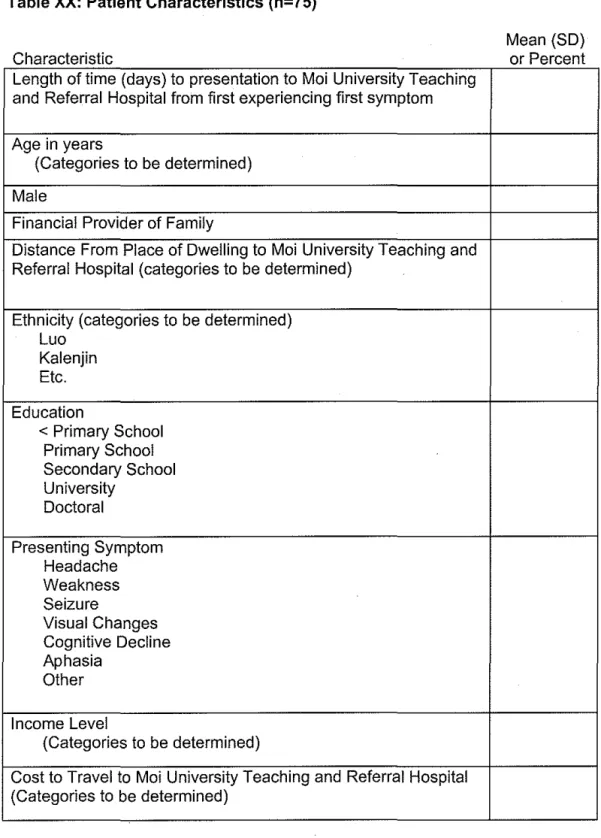
The baseline characteristics of the patient population will be evaluated in a univariate
analysis and displayed as means and standard deviations for continuous variables and
prevalence (percentages) for categorical variables. Length of time in days until presentation to
the neurosurgery clinic at Moi University Teaching and Referral Hospital will be treated as a
continuous variable. Categorical variables will be the initial healthcare provider seen
(Traditional Healer, Non-professional Trained Healthcare Worker, Nurse, Physician); number of
healthcare providers seen prior to presentation to the neurosurgery clinic (0-1, 2-4, >5); age in
years (18-30, 31-50, >50); gender (male/female); income level (categories will be determined
after focus groups); education level (did not finish primary school, primary school graduate,
secondary school graduate, university graduate, doctoral program graduate); distance in
kilometers from place of residence to Moi University Teaching and Referral Hospital (will
determine categories after focus groups); cost to travel to Moi University Teaching and Referral
Hospital (will determine categories after focus groups); primary financial provider for family
(Yes/No); and the initial presenting symptom is headache (Yes/No), weakness (Yes/No),
seizure (Yes/No), visual changes (Yes/No), cognitive decline (Yes/No), aphasia (Yes/No), other
(Yes/No). Bivariate analysis will then be performed comparing length of time to neurosurgical
oncology care with categorical variables using a student's t-test or AN OVA and using simple
linear regression for continuous variables. Finally multivariate regression will then be
performed.
Limitations and Challenges
This study is designed to attempt to describe barriers to access for neurosurgical
oncologic care in Western Kenya. As it is a survey it has inherent limitations related to its
design. We will only be able to capture a fraction of the patients in Western Kenya who actually
neuro-oncologic illness but are never diagnosed either because they never have symptoms or they die
prior to presentation. There will also be other patients that are never referred or choose not to
come to the tertiary care center in Western Kenya even if a diagnosis has been established.
Translating a survey from English to Kiswahili may make some of the questions unclear. We
are attempting to reduce this risk by having the survey interview guide undergo multiple
revisions using native Kiswahili speakers as part of the research team.
Recall bias is inherent when using a questionnaire to obtain data. There is also the
possibility that the research personnel administering the interview questionnaire can influence
the answers given by the patients which would influence our results. We will train with our
research personnel prior to the beginning of the study to make them aware of this potential for
biasing the answers given. This study is not designed to be able to determine the prevalence of
neuro-oncologic disease in Western Kenya, but rather is an initial foray into determining the
characteristics of the patients who are able to maneuver through the healthcare system and
reach the tertiary care referral hospital as well as the barriers to neuro-oncologic care faced by
patients in Western Kenya.
Future Research
Along with helping to evaluate barriers to access of care for neurosurgical oncology
patients in Western Kenya, this study will help to develop an initial database of patients. This
patient database will be used in the future to obtain epidemiologic data for neurosurgical
oncology patients presenting to Moi University Teaching and Referral Hospital as well as for
design of further studies to evaluate surgical outcomes for various neuro-oncologic diagnoses.
This survey will begin a multi-year effort, with this study serving as a foundation, to analyze and
improve the care neuro-oncologic patients receive in Western Kenya. We hope to develop
more sophisticated studies evaluating potential genetic or biochemical differences in the
other regions. We are excited to see where the future will take us both in improving the care
neuro-oncologic patients receive in Western Kenya and taking what we learn from these
patients to help patients throughout the world.
Appendix 1: Possible Sample Questions for Questionnaire (in English)
Open Ended Questions: (will be coded by investigators by themes)
1. What are sorne things you can think of that make it hard for people in your community to get health care?
2. What would make it difficult for people in your community to get to a neurosurgery clinic? What made it difficult for you to get seen here at the neurosurgery clinic?
3. How rnany days ago did you experience your first symptom?
4. What treatments have been prescribed for your symptom(s)?
Multiple Choice Questions
1. Approximately, how long did you wait before seeing a healthcare provider for your symptom? (will determine choices after focus groups)
2. What type of healthcare provider did you first see after you developed your first symptom?
a. Traditional Healer
b. Non-professional Trained Healthcare Worker c. Nurse
d. Physician
3. How many healthcare practitioners have you seen since you developed your first symptom(s)?
a.
0-1 b. 2-4c.
>54. What was your first symptom that you noticed? a. Headache
b. Weakness c. Seizure
d. Visual Changes e. Cognitive Decline f. Aphasia
5. Have you experienced any of the following symptoms in addition to your initial symptom?
a. Headache (Yes/No) b. Weakness (Yes/No) c. Seizure (Yes/No)
d. Visual Changes (Yes/No)
e. Cognitive Decline [will reword] (Yes/No) f. Aphasia (Yes/No)
g. Other (Yes/No)
6. How would you classify your financial status? (will determine choices after focus groups)
7. How much money have you spent on doctors and tests after you first developed your symptom? (will determine choices after focus groups)
8. How far do you live from Moi University Teaching and Referral Hospital? (will determine choices after focus groups)
9. How much money did you spend to travel to Moi University Teaching and Referral Hospital? (will determine choices after focus groups)
1 0.
What is your sex? a. Male b. Female11.
How old are you? a. 18-30 years old b. 31-50 years old c. >50 years old12.
What school level did you complete? a. Did Not Finish Primary School b. Primary School Graduate c. Secondary School Graduate d. University Graduatee. Doctoral Program Graduate
13. Are you the primary financial provider for your family? a. Yes
b. No
14. What is your ethnicity? (categories will be determined after focus groups)
Appendix 2: Mock Tables
Table XX: Patient Characteristics (n=75)
Characteristic
Length oftime (days) to presentation to Moi University Teaching and Referral Hospital from first experiencing first symptom
Age in years
(Categories to be determined)
Male
Financial Provider of Family
Distance From Place of Dwelling to Moi University Teaching and Referral Hospital (categories to be determined)
Ethnicity (categories to be determined) Luo
Kalenjin Etc.
Education
< Primary School Primary School Secondary School University
Doctoral
Presenting Symptom Headache Weakness Seizure
Visual Changes Cognitive Decline Aphasia
Other
Income Level
(Categories to be determined)
Cost to Travel to Moi University Teaching and Referral Hospital (Categories to be determined)
Initial Provider Patients Presented To Traditional Healer
Non-professionally Trained Provider Nurse
Physician
Table XX: Bivariate Associations Between Patient Characteristics and Days to Presentation to Moi University Teaching and Referral Hospital Neurosurgery Clinic Characteristic AQe Patient gender Male Female
Patient Ethnicity (categories to be determined)
Luo Kalenjin
Financial provider for family Yes
No
Distance From Place of Dwelling to Moi University Teaching and Referral Hospital (categories to be determined)
Education
< Primary School Primary School Secondary School University Doctoral Presenting Symptom Headache Weakness Seizure Visual Changes Cognitive Decline Aphasia Other Income Level
(Categories to be determined)
Cost to Travel to Moi University Teaching and Referral Hospital
(CateQories to be determined) Initial Provider Patients Presented To
Traditional Healer
Non-professionally Trained Provider Nurse
Physician
* Means and p values based on 2-sample !-tests or one-way analysis of variance for variables with more than two categories; Correlations and p values based on Pearson's correlation
Appendix 3: Critical Appraisal on Neurosurgery Workforce in the United States and the European Union
As alluded to earlier in this paper the ratio for neurosurgeons to people in Sub-Saharan
Africa is somewhere between 1:3.6 million and 1 :46 million depending on which country is
evaluated.25 It is an understatement to state that this ratio is likely too great to provide adequate
neurosurgical care to the patients living in these areas; however, what is the optimal ratio of
neurosurgeons to people in a population? This is a difficult question to answer as many factors
can influence what an appropriate ratio would be. In Japan the ratio is approximately 1:17,000,
although many would argue that this ratio is artificially inflated as many neurosurgeons in Japan
are not in clinical practice. Regardless Japan retains the highest ratio of neurosurgeons to
people in the world.28• 29 Determining what the appropriate neurosurgeon to population ratio
should be, has been of intense interest over the years both in the United States and the
European Union; however, most of the literature devoted to this topic is based on expert
opinion. The United States of America and countries of the European Union represent some of
the most developed countries in the world and have the potential to be a more homogenous
sample to help determine what a theoretically appropriate neurosurgeon to population ratio
should be. A keyword PubMed search using "European Union" or "United States" with MeSH
search terms "Neurosurgery" and "manpower" returns 42 articles published since 2000. Most of
these articles address neurosurgical subspecialties (#20), how many neurosurgical residents
should be trained yearly (#3), are historical reviews of neurosurgery (#6), address gender equity
in neurosurgical training (#3), legal issues involving neurosurgery (#2), or articles with no
relevance to the topic (#6). Only 2 articles attempt to address the appropriate neurosurgery
workforce in the United States of America or the European Union.30• 31 Both of these articles will
Neurosurgical Workforce in the United States
In the article Neurosurgical workforce trends in the United States by Gottfried et al in
2005,
an analysis of the US neurosurgery workforce is presented by using recruitmentadvertisements published over
10
years as a proxy for determining whether the US has anappropriate neurosurgeon to population ratio.30 A critical analysis of their work is presented in Table 1. It currently is estimated that in the US there is a neurosurgeon to patient ratio of
1:62,000.
31 The authors conclude in this paper that there has been an increase over the past10
years in the number of neurosurgeon recruitment advertisements which argues that thecurrent ratio of neurosurgeons to patients is too high based on demand for neurosurgical care in
the United States and more neurosurgeons are needed.
Gottfried 0, Rovit R, Popp A, et al. Neurosurgical Workforce Trends in the United States. J. Neurosurg.
2005; 102: 202-208
Study Question: What has the demand been for the clinical neurosurgery workforce over the past
10
years?Study Secondary Questions: What is the demand for general neurosurgery positions compared with neurosurgery
subspecialty positions? What is the demand for academic neurosurgery positions compared with private sector positions?
Research Design: Retrospective Review of Recruitment
Advertisements in the 2 US Journals
Source Population:
240
issues of the Journal ofNeurosurgery and Neurosurgery from
1994-2003
Initial Comparab.ilityoJ ••... ·.···· groups (ie, randqmi:;;:ation · or grol!ppom~o§Jt(on; , concealmenFotallocation Drop ol.lts([\g~l}dpoint \ data),
adp~f.~llC:~.<
<,· ;
cros~overs (~t!((W~n. lo~l)tcii;.
f.ollow.u · ·· ·· · · ·· ·
Measl.lreme!Jfoi expo~~re.;''
interv~n(iqll;·~~ie2t,i8,LycT
.confou[lp~rs}and
iKct
!\. ···.
ou.tcomes:r~.li~biljty,<l(ld.••··· ..
validity.Ofll)~a§ur~f11~nt;·••
h.ow · erformed,blindin ·
Study Population:
2120
recruitment advertisements within the240
issues of the Journal of Neurosurgery andNeurosurgery from
1994-2003.
Advertised positions were listed as academic or private sector with academic positions being defined as one advertised by an institution with an Accreditation Council for Graduate Medical Education approved neurosurgical residency program. Advertisements were also listed as subspecialty positions or general positions. Subspecialty positions (pediatrics, spine, vascular,endovascular, oncology, stereotactic, functional, epilepsy, pain, stereotactic radiosurgery, skull base, trauma) were defines as advertisements that specified fellowship training, subspecialty ex ertise, or subs ecialt ex erience re uired for em lo men!. Non-Randomized
Not Applicable
+++
Recruitment Advertisements in the two major neurosurgical journals only represents a subset of the job positions available.
Not all positions available are advertised as many positions are privately recruited for, use recruitment firms, use recruitment mailings, or rely on word of mouth. This would be especially true in evaluating the potential for selection bias of the secondary questions as it is unknown whether there is a difference in the use of these recruitment methods for academic compared with private positions or general versus subspecialty positions. However, the authors do cite previous studies to show the reliability and validity of using recruitment advertisements as an index for evaluatin the workforce. Equal Measurements of the two journals used.
Each recruitment advertisement was assigned to the initial month and journal it appeared.
Advertisements that specified two or more positions were recorded individually
Potentialform~.a~l.lrernen\":t ++ bias (+.to~+~) •·· ··· ·
The authors tell us there was no change to journal policy; however, they do not mention whether there was a change in the cost for listing an advertisement or how much space was
I
The authors do not tell us how they controlled for advertisement cost
Means and Standard Deviations were obtained for the yearly advertisement totals .
. ··-'''"''·' Comparisons were rnade between the first 5 years and the
in recruitment advertisements frorn
-120
in1994
to297
in
2003
Academic versus Private Sector Position Advertisements -private sector advertisements increased from - 80 in
1994
positions to-160
in2003,
and academic positions increased from-45
positions in1994
to-90
positions in2003;
thus both private and academic positions approximately doubled during the time frarne studied. General versus Subspecialty PositionAdvertisements-increase in recruitment of general neurosurgery position advertisements from
113
in1994
to247
in2003,
and subspecialty position recruitment advertisementnumber neurosurgeons to treat the US population is important to reduce the morbidity and mortality caused by diseases treated by neurosurgeons. Many neurosurgical illnesses are life threatening if left untreated. This study suggests that the increase in neurosurgery position advertisements reflects a shortage in the supply of
'"'"·-' .1 neurosurgeons needed; however, this study does not attempt to address whether the positions advertised become filled or remain unfilled. If a large number of positions remain unfilled this could have detrimental effects for patients suffering frorn
I
comiT!Ei~ts~Wov~rau
: < .· conclul:>Ion&lil)terpretation·'' · (ipc;l~de'c()ns.istenqy)lifth'ii'
9tller stud.iel>; •.
bi.o.lc;>~iq,;)
;i'
plausibility; •contu,c.t~ 9f;~!
'i'
interest; seleqtive er;i~ppint,}f~pc;>itiryg)
••••• ...•..•..•.•.•. :.: .•.. ··.·• '1i~J.
,-,'-~':0; ,
;-z::~-:~~;~_::~ri,~;;N~t'1;1;:i}--Neurosurgeon to patient ratio is an important ratio to help determine timely and necessary neurosurgical treatment for patients suffering from illnesses seen by neurosurgeons. This study raises the question as to whether the current
neurosurgeon to patient ratio is appropriate as the number of neurosurgical positions advertised for has increased over the past 10 years. Further work needs to be done to evaluate the length to neurosurgical intervention and outcome for
neurosurgical patients in various regions with different neurosurgeon to patient ratios.
I am concerned that this paper does not adequately address this issue alone. Using advertisements is one method for potentially evaluating the appropriate neurosurgical workforce, but using multiple methods all showing similar results would be more convincing and useful in attempting to determine how lar e the neurosur ical workforce in the US should be.
Neurosurgical Workforce in the European Union
In the article A Report on Neurosurgical Workforce in the Countries of the EU and
Associated States by Reulen et al in 2009, a report from the European Union of Medical
Specialists Section of Neurosurgery is presented in an effort to help guide what the appropriate
ratio for neurosurgeons to patients in the European Union should be. A critical analysis of the
report is presented in Table 2. The authors of this paper concluded that an appropriate range
ratio of neurosurgeons to patients should be between 1:60,000- 1 :85,000 to provide adequate
neurosurgical care to patients in the European Union.
population ratio in the countries of the European Union?
Study Population
( descriptiyEl: demographics, eli gibi(.ity c;rite~~) and ~OV{
chOl>!'Jrt()lpl,~ptEl•El.Fl>·••··'·<····
).•·' rec;ruitfr1e?t•·t§.l'ti~:fYe~re '; , ce .. ltic.nics,pp[l0l~ti/)I]-.:
.•.
P
.•..
fl~~f!Oc,i':
.;,-o '''" '"' ; ,./"F5c":'\>-'; '.- -:;". '"-Initial GO[T)parabilityot·•.··· · groups ·(ie, .ra[tdqllli:z:~tion
or
9,f9HH>C:9JRP.().si~iq.n,i
/ ..i ·
conce~lrijent(jfaiJqc;;Jtiqn) .·
DropoiJts(RO.erldp?iht•••.• ••.. ·.·.···•·.··· data), adhElrence, .·· .... · · ... , ...••...• crossovers (attritioQ, loss to . follow up)
Study Population: 27 country EUMS Section of Neurosurgery Delegates
There is no mention as to who the EUMS Section of
Neurosurgery Delegates are or how they became Delegates. There is no mention as to whether there is any eligibility criteria for becomin a dele ate
The European Union is a heterogeneous group of countries with different political and medical systems in Europe. There is no discussion of the group composition which completed the surve .
No mention whether a country/delegate in the European Union or Associated States declined to participate or did not return the survey.
Portugal and Greece did not provide information regarding number of neurosurgical procedures performed per million population or number of neurosurgical procedures each
erforms er ear.
There is no discussion as to the make up of the respondents of •••...•. ·.·•. r the survey or how the delegates were chosen from each
country. Within the Evaluation of Data section in the paper it ·· .•. ·• ... • •••• r states the after the initial data was obtained the report was
amended and re-sent to the national delegates for a second check of the data. This gives the national delegate a chance to
:·•·•'•><.·::·<'··<'1
change there reported statistics if they do not like where theyMeasurem.E:lntof .. exposure. :
inteivention,potenti~lii ; .. confoundElrs, ancJ.·· ....
'.< . ·,·
o~tcomes;
..rel.i~.bility.'.~ll<:l<.
'''·• validityofmE:l~~tJre[T)et1!;
• : • · ho"'' perfqrmed; oii[ttUf]g . , ... ·PotentiaTfor.J'l'leasureJ'l'lent bias (+to++-t,)·'.
Potential .. confdullders i (nameanddesc;ribe
h()~i
each was contrpiiE(d for)·fall in com arisen with other Euro ean Union Member Nations. Number of Neurosurgeons to Population
Number of Neurosurgery Operations per million population Average Number of Neurosurgical procedures each
Neurosurgeon performs per year
Average number on yearly new neurosurgical trainees
There is no mention as to how the reported numbers returned on the survey are obtained from the various countries. As the European Union Member States and Associated States are a heterogeneous group, there may be variations in the quality of the medical workforce monitorin s stems.
++
Political Motivations Cultural Motivations
Numbers are on the survey with Univariate
Minimum Ratio for Neurosurgeon to Population: 1:39,800 (Greece)
Maximum Ratio for Neurosurgeon to Population: 1 :294,000 (UK)
Median Ratio for Neurosurgeon to Population: 1:84,000 Mean Ratio for Neurosurgeon to Population: 1 :99,152
-standard deviation of 50,698
Minimum Number of Neurosurgical Procedures per Million Population/Year: 770 (Poland)
Maximum Number of Neurosurgical Procedures per Million Population/Year: 3,600 (Luxemburg)
Median Number of Neurosurgical Procedures per Million Population/Year: 1,500
Mean Number of Neurosurgical Procedures per Million
i 1 neurosurgeons to
the European Union population is important to reduce the morbidity and mortality caused by diseases treated by neurosurgeons. Many neurosurgical illnesses are life
,,, , threatening if left untreated. This study suggests that there is large variability in the European Union for the neurosurgical workforce. However, they conclude that an "optimal" ratio of neurosurgeons to population is between 1 :60,000 and 1 :85,000 with an average workload of 150 operations per neurosurgeon
I for
Co[)lll"l~ntsand overall
x .. •.
conclus.ions/i.nterpretatio~·
•(include consiSteJlfY»'i.\Q other stu (lie~; !.)iolggif' .·. • plausibility; ~ghfl.ift!l··of···· interest; selecti)/e E!r!dpoint . reporting}
> .;;{
, Ji>-_ -:--_-<: {:::-'::_·;~Er,: .:-:-;
Neurosurgeon to patient ratio is an important ratio to help determine timely and necessary neurosurgical treatment for patients suffering from illnesses seen by neurosurgeons. This study also raises the question as to what neurosurgical
workload is appropriate per neurosurgeon for appropriate neurosurgical care of the population. Further work needs to be done to evaluate the length to neurosurgical intervention and outcome for neurosurgical patients in various regions with different neurosurgeon to patient ratios and different neurosurgeon workload.
Conclusion
It has been almost 50 years since Kerr White presented community illness prevalence
and the role of physicians and hospitals using nested squares.32 (Figure 3)
Figure 3 (Adapted from ref. 32 [p. 889])
Adult Population At Risk
Adult Reports~ I illness or
injury per month
Adult Consulting a Physician~ I
time per month
Adult Patients Admitted to a Hospital per month
Adult Patients Referred to Another Physician per month
Adult Patients Referred to a University Referral Hospital per month
Neurosurgeons typically do not see patient's until they are referred to the tertiary care center
(e.g., University Medical Center), which represents a very small number of the total population
at risk. Although the United States of America and the countries of the European Union tend to
be highly developed nations the neurosurgical needs of patients in these countries have the
potential to vary. One area this seems to be the most evident would be in spine surgery. In the
US, neurosurgeons are trained during residency to perform spinal decompression and fusion
surgeries; where as in most European Union countries, spinal surgeries are performed by
orthopedic surgeons as opposed to neurosurgeons. Peripheral nerve surgery is another area
where significant overlap could occur with other surgical subspecialties as some orthopedic and
an argument could be made that in developed countries a goal ratio of neurosurgeons to
patients could be somewhere in the range of 1:60,000. It is much more difficult to determine
what an appropriate ratio goal for neurosurgeon to patient ratio should be in developing
countries as it is difficult to determine what the neurosurgical care need truly is. It is likely not to
be as low as 1:60,000, but it also is not in the current range of 1:3,600,000-46,000,000. A
study modeled after Kerr White's nested squares specifically addressing neurosurgical care in
Appendix 4: Proposed Grant Application
(Based on the official Fogarty Clinical Research Fellowship Grant Application)
FICRS-F
Fogarty International Clinical
Res~arch Scholars & Fellows Support Center@ Vanderbilt
International Clinical Research Fellowship
APPLICATION- Due 5
Dec.
2009
Full Name: _,_P_,a,_,rk,e::_r _ _ _ _ _ _ _ _ _ _ _,S~t,_e"'p'-'"he,n"---'-R'-- Date: 10/25/2009
Last First M.l.
Address:
Street Address Apartment/Unit #
City State ZIP Code
Phone: E-mail:
US Citizen/Perm SSN
Completed Degree (s)
or D Not Applicable Resident? 1:81 yes Dno (if no) Citizenship
Applicant is:
Current Program
MD
1:81 current resident D current fellow D current post-doc Dother
Professional Title (ex: ID Fellow)
Neurosurgery/Global Health Resident
Department/Division
Surgery/Neurosurgery & Hubert Yeargan Center for
Global Health
Institution
Duke Universityr
Partnering US Institution (please write N.A. if not applicable)
Hubert Yeargan Center for Global Health Duke University
Department/Division Institution
Name of Responsible Administrator: Name of Responsible Faculty (if different):
Address:
Street Address Aparlment!Unit #
City State
Phone:
Overseas
I
Institution
Department/Division Institution
! • ·'me of Responsible Administrator:
[ . "me of Responsible Faculty (if different):
Phone
Street Address A artment!Unit #
State ZIP Code
E-mail Address:
' Name
I am proposing to work at a Non-Pre-Approved ICRF site and have included a site application*
*Only US citizens and permanent residents can propose to work at a non-pre-approved ICRF
site. Others MUST apply with a pre-approved ICRF site.
Proiect Title & Abstract
DO NOT EXCEED 81 letters and spaces for title and 250 WORDS for abstract. Access to Care Barriers for N euro-oncology Patients in Western Kenya
Sub-Saharan Africa contains over ten percent of the world's population, almost one-fourth of the global disease burden, but only three percent of global healthcare workers. These problems are exemplified in Kenya. Moi Teaching and Referral Hospital is a national hospital in Western Kenya. The catchment area for the sole neurosurgeon at Moi University is estimated to contain approximately 20 million people. No research has been published regarding how patients reach tertiary care centers in Kenya or how long they have had symptoms prior to presentation. Compared with acute disease treated by neurosurgeons, patients with a neuro-oncologic
Institution: Duke
Overseas Site- based Mentor (may or may not be the same as the overseas faculty member on previous page)
Name: Florentius MD Moi Co-Mentor
Phone:
Other Mentor(s)
Name:
Health
Name:
Applicant Name
Stephen Parker
RESEARCH PLAN
DO NOT EXCEED 2,500 WORDS (Longer proposals will be truncated at 2500 words and reviewed as such)
Background and Significance
Access to Care in Kenya
Page 4
Most of sub-Saharan Africa patients live in an extreme rural community with fewer resources
and further distances to hospitals/clinics than rural areas of developed countries, leading to these
areas being severely disadvantaged for health and survival indicators.? Those with limited
financial resources are even more vulnerable as deteriorating infrastructure in addition to
unavailable or unaffordable transport decreases the chances for the poor to reach adequate
medical facilities. The WHO has recommended that there should be at least 10 physicians per
I 00,000 people; however, many countries in sub-Saharan Africa have most districts with less
than 2 physicians per 100,000 people.4 Barriers to medical care access as well as the inequalities
in the burden of disease have recently become a prominent concern for many countries in
sub-Saharan Africa.3
Itis difficult to apply much of the work that has been done in developed
countries into developing nations because of the different challenges faced in the developing
world. Effective planning, interventions, and decision-making in an attempt to reduce barriers to
medical care access should be based on evidence, not on guesswork. However, currently no
good evidence exists to help policy makers make these difficult decisions. Kenya is
representative of many countries within sub-Saharan Africa. Kenya is a vast country of over 580
thousand square kilometers with a population of over 39 million people, over half of whom are
between the ages of 15-64.8 We do not fully know what the current barriers that patients face in
an attempt to access healthcare in Kenya and to what extent these barriers cause decreased access
to medical care. Currently, there are two national referral hospitals within Kenya. Kenyatta
National Hospital primarily serves the capital city of Nairobi and its surrounding area. The
second hospital is Moi Teaching and Referral Hospital located in the city ofEldoret in the
RiftValley Provence.2 The hospital serves all of Western Kenya which is more rural and not as
developed as Nairobi, thus the hospital serves many patients over a larger land area.
Neurosurgery and Neuro-oncology Care in Kenya
access to neuro-oncology care in Kenya and more specifically the less developed Western
Kenya. There is extreme interest at Moi University Hospital in determining where
neuro-oncology patients are coming from, who they are, and if many patients are not finding their way
to Moi Teaching and Referral Hospital.
Research Environment at Moi University
Indiana University School of Medicine and Moi University School of Medicine agreed to
partner for the development of health care leaders for both the U.S. and Africa in 1989. This
partnership helped provide outstanding training to future generations of health care providers. IU
and Moi created one of Africa's first, largest, and effective HIV
I
AIDS control systems. The
Indiana-Kenya Partnership provided a base to grow clinical care and research which led to the
creation of the American/Sub-Saharan African Network of Training and Education (ASANTE)
Consortium. The consortium is in a great position to assess and provide understanding of issues
facing access to healthcare for patients of Western Kenya and share the information among
network participants in order to reduce the burden of health disparities and implement programs
aimed to remove barriers to health care and improve the current and future lives of East Africans.
Duke University's Commitment to Global Health
In 2004 the creation of the Rubert-Yeargan Center for Global Health signaled the value
placed on formal bilateral international experiential education by Duke University. The
Rubert-Yeargan Center works with its international colleagues in human and infrastructure development
to help reduce the burden of disease and health disparities around the globe. One of my
co-mentors for the project, G. Ralph Corey, MD, is Professor of Medicine and Infectious Diseases,
Director of the Hubert Yeargan Center for Global Health, Gary Hock Distinguished Professor of
Global Health and Director oflnfectious Diseases Research at DCRI. He previously served as
the Program Director of the Internal Medicine Residency Training Program at Duke. He has
supervised close to one thousand medical residents over the past twenty years and is instrumental
in helping to establish research objectives for the Duke Global Health Residents.
Another of my co-mentors for the project, Michael M. Haglund, MD, PhD, is Professor of
Surgery and Neurobiology, Director of Surgical Epilepsy, and Program Director for the
Neurosurgery Residency Training Program at Duke. He has been instrumental in developing the
Duke Global Health Placement of Life-Changing Usable Surplus (PLUS) program. He also has
been the driving force behind the creation of a Neurosurgery Residency Training Program in
affiliation with Mulago University in Kampala, Uganda. He has a strong clinical and research
interest for the intersection of neurosurgery, neurosurgery capacity building, and global health.
The ASANTE research effort will be able to share that expertise with colleagues at Moi
University with an onsite investigator from Duke, weekly conference calls, and clinical
workshops.
Specific Aim #I
To identify and describe barriers to access for neurosurgical oncology care in Western Kenya.
Differences will be found by age, gender, education level, financial resources, and location of a
patient's residence in the ability for a patient to access neurosurgical oncology care in Western
Kenya.
Specific Aim #2
To identity and describe how neuro-oncology patients are referred and how long they take to
reach a tertiary care referral center in Western Kenya.
Hypothesis #2
Time to neurosurgical care will be longer for patients who first present to traditional healers or
non-professional healthcare workers compared with those who present initially to nurses or
physicians.
Specific Aim #3
To describe specific characteristics and presenting symptoms for neuro-oncologic patients and
create a database of the patients presenting to a tertiary care center in Western Kenya.
Design and Outcomes
Sample population: All patients ages >
18 years and older being seen in the Eldoret Neurosurgery
clinic with a presumed neuro-oncologic diagnosis will be eligible for participation.
Prior to July 2011, the principle investigator, Dr. Stephen Parker (SP) and a Kenyan research
assistant will develop a personal interview questiounaire in English then will be subsequently
translated into Kiswahili (the most common language spoken in Kenya). Beginning in August
2011 Dr. Parker will spend one year at Moi University performing this two phase protocol. To
assure appropriate translation, Dr. Parker and a research assistant will first give the interview
questionnaire to 1-2 focus groups consisting of 5-6 individuals who speak Swahili as their
primary language within Eldoret, Kenya. Questions will be revised and reordered as necessary
based on focus group feedback. Over the next 2 months we will visit villages in the catchment
area for Moi University Teaching and Referral Hospital and hold focus groups discussing the
perceptions of neuro-oncologic illnesses and issues regarding regional variations for access to
neurosurgical care. These focus groups will be recorded and analyzed to identity any other
themes which should be addressed in the personal interview questiounaire. Fallowing
completion of the focus groups, the personal interview questionnaire will be finalized and
prepared for administration.
examinations. Nurses, residents and medical students will be trained in performing neurologic physical examinations via weekly didactic and practical experiences. Only the native Kiswahili speaking research nurse and research assistants will administer the personal interview
questionnaire which will be completed by the participant in a separate interview room at their convemence.
Interventions and Duration
The survey will be developed in an iterative manner over the first 3 months of the project. The next phase will initiate the data collection and will allow us to obtain quantitative data.
Participants will spend, on average, two more hours in the clinic on the day they are enrolled in this pilot. Enrollment will continue for 7 months or until an adequate sample size have been achieved.
Sample Size and Population
The target population for the analysis of patients with neuro-oncologic disease includes patients in the Neurosurgery clinic at Eldoret. Inclusion criteria: Age >= 18 years and a diagnosis or presumed neuro-oncologic diagnosis. Kenyan patients younger than 18 years are more likely to be dependants and thus have the potential to rely more heavily on guardians to reach a tertiary care referral center. Sample Size Estimate: It has been estimated that approximately 3-5 patients with a new neuro-oncologic diagnosis present to the neurosurgery clinic at Moi University Teaching and Referral Hospital per week. Over the course of seven months, we expect to enroll over 75 neuro-oncologic disease patients.
Recruitment and Consent Process
Eligible patients will be identified by clinical officers seeing patients in clinic. Patients will be referred to the research assistant at the discretion of their clinician. The research assistant will contact the patient in order to obtain consent to participate in the study. Informed consent is obtained in Kiswahili using forms at the appropriate reading level. The research assistant will be primarily responsible for patient enrollment and consent thereby limiting the need for translation. When translation is required, we will utilize Moi translators and nurses who are not part of the patient's primary care team. We will avoid using clinicians who have direct responsibility of each person's care to translate in an effort to limit bias and coercion.
Statistical Methodology