EUROPEAN JOURNAL OF PURE AND APPLIED MATHEMATICS Vol. 13, No. 1, 2020, 84-95
ISSN 1307-5543 – www.ejpam.com Published by New York Business Global
A Systematic Approach to Group Properties Using its
Geometric Structure
Muhammed Bello1,2,∗, Nor Muhainiah Mohd Ali2, Nurfarah Zulkifli2 1 Department of Mathematics and Computer Science, Federal University of Kashere,
P.M.B 0182 Gombe, Gombe State Nigeria,
2 Department of Mathematical Sciences, Faculty of Science Universiti Teknologi Malaysia
81310 UTM Johor Bahru, Johor
Abstract. The algebraic properties of a group can be explored through the relationship among its elements. In this paper, we define the graph that establishes a systematic relationship among the group elements. Let Gbe a finite group, the order product prime graph of a group G, is a graph having the elements of G as its vertices and two vertices are adjacent if and only if the product of their order is a prime power. We give the general presentation for the graph on dihedral groups and cyclic groups and classify finite dihedral groups and cyclic groups in terms of the order product prime graph as one of connected, complete, regular and planar. We also obtained some invariants of the graph such as its diameter, girth, independent number and the clique number. Furthermore, we used the vertex-cut of the graph in determining the nilpotency status of dihedral group. The graph on dihedral group is proven to be regular and complete only if the degree of the corresponding group is even prime power and connected for all prime power degree. It is also proven on cyclic group to be both regular, complete and connected if the group has prime power order. Additionally, the result turn out to show that any dihedral group whose order product prime graph’s vertex-cut is greater than one is nilpotent. We also show that the order product prime graph is planar only when the degree of the group is three for dihedral group and less than five for cyclic group. Our final result shows that the order product prime graphs of any two isomorphic groups are isomophic.
2020 Mathematics Subject Classifications: 05C25, 20F65
Key Words and Phrases: Order product prime graph, Vertex adjacency, Graph invariant, Nilpotency of a group
1. Introduction
Various techniques have been used by researchers in investigating the properties of a group as well as classifying it according to its properties, which happen to be one of the
∗
Corresponding author.
DOI: https://doi.org/10.29020/nybg.ejpam.v13i1.3587
Email addresses: [email protected](M. Bello),
[email protected](N. M. M. Ali),[email protected](N. Zulkifli)
great achievements of modern mathematics. One of the techniques found to be useful is by defining graph to the groups and investigate its properties using the corresponding geometric structure. According to Selva and Subajini [8] in order to get a better under-standing of a given algebraic structure A, one can associate to it a graph Γ and study the interplay of the algebraic properties of A and the combinatorial properties of Γ. This study gained the attention of many researchers, for instance, Cayley graph was defined by Arthur in [2] and this graph has been used by Kelarevet al.in [7] to classify data which can be recorded as set of strings or sequences of letters over a finite alphabet. Ganesan [4] used this graph to obtain the structural description of the automorphism group of the modified bubble-sort graph. Several researches has also been conducted on the commuting graph and non-commuting graph, for instance, Sharafdini and Darbandi [10] computed the energy of commuting graph for groups whose centralizers are abelian, and in [11] Vahidi and Talebi obtained some invariants of non-commuting graphs on dihedral groups and generalized quaternion groups, which include its independent number, clique number and minimum size of the vertex cover of the graph, in their paper, they did not find the chromatic number of this graph, which has been obtained a year later by Tamizhet al. [9]. Akbari and Reza [3] used the non-commuting graph to determined up to isomophism the structure of finite non-abelian groups in which the vertex of the graph can be partitioned into two sets such that the induced subgraph on one of them is a complete graph and the induced subgraph on the other is an independent set. Ghobani and Alkhansari [5] used the geometric properties of a group to prove that for a group G, G/Z(G) ∼= Zn×Zn if
and only if the non-commuting graphΓ(G) is a regular(p+ 1)-partite graph and consider the isomorphism of the non-commuting graph with some special graphs. The generaliza-tion of non-commuting graph of a group was given by Kakeri et al. in [6], where they investigated the connectivity, regularity and planarity of the graph and concurrently, give the numerical invariants of the graph which happen to be the improvement of the result given for non-commuting graphs. Abd Rani et al. [1] defined the relative coprime graph of a group with respect to its subgroups and dertermined some invariants of the graph which include the domination number, independence number and give the situation when the graph is regular. In this paper, we defined order product prime graph of finite groups, classify groups in terms of the properties of the graph as one of connected, complete, regu-lar, planar and obtained some of its invariants such as independent number, clique number, girth and diameter. Moreover, we investigate the nilpotency status of dihedral group using the connectivity for the order product prime graphs on the dihedral group.
2. Notations and preliminaries
In this section, we give some basic concepts, notations and preliminaries useful to this paper.
All groups considered in this paper are finite and the investigation covered all dihedral groups Dn = {a, b|an = b2 = (ab)2 = e} and cyclic groups Zn =< g > 3 g ∈ Zn . We
On the other hand, we consider simple undirected graphs without loop or multiple edges. The sets of vertices and edges of a graph Γ are denoted by V(Γ) and E(Γ) respectively. We denote the adjacency of vertices x, y by x ∼ y, number of vertices of the graph Γ
by |V(Γ)|, the degree of the vertex v by deg(v). A graph Γ is regular if all the ver-tices of the graph have the same degree, that is if for all verver-tices v1, v2, ..., vn of Γ, deg(v1) = deg(v2) = ... = deg(vn) and a graph Γ is r-regular if deg(vi) = r, i ∈ N.
A graph Γ is connected if there is a path between every pair of its vertices, and a graph is complete if there is an edge between every pair of its vertices. A graph is planar if it can be drawn in a plane without edge crossing. A clique is a subset U of vertices of
Γ such that the induced subgraph of U is a complete graph, the size of the maximum such clique is refered to as the clique number of Γand denoted by ω(Γ). An independent set of vertices of a graph is the set of vertices such that no two vertices are adjacent, and the independent number of a graph Γ, is the cardinality of the largest independent set, which is denoted by α(Γ). The girth of a graph Γ, is the length of the shortest cy-cle contained in the graph, which is ∞ if Γ has no cycle. The diameter of a graph is the maximum distance between the pair of its vertices, which is∞if the graph is disconnected.
Throughout this paper p denotes prime number, andα∈N.
3. Results and Discussions
In this section, we give the formal definition of the order product prime graph and the general presentation for its connectivity, completeness, regularity and planarity on dihedral group and cyclic group, which help in obtaining its diameter, girth, independent number, and the clique number. We also use the graph properties to obtain the corresponding group properties.
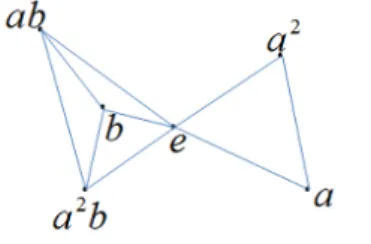
The formal definition of the order product prime graph is given in Definition 1 below, followed by an example which demonstrate the definition.
Definition 1. Let G be a finite group, the order product prime graph of G, Γopp(G) is a graph whose vertices are the elements of G and two vertices x, y are adjacent if and only if |x||y|=pα, α∈
N, for some prime p .
Figure 1: Order product prime graph ofD3
The general presentation for the order product prime graph on dihedral group and cyclic group are given in Theorem 1 to Theorem 3.
Theorem 1. Let Gbe the dihedral group, Dn, where n=pα, α∈N, then
Γopp(G) =
(
K2n if p= 2,
K1+ (Kn−1∪Kn) if p6= 2.
Proof: Ifp= 2, then|G|= 2α+1, pick arbitraryxi, yj ∈G, i6=j, then|x|
2α+1,|y| 2α+1, that is |x||y|= 2t, 1≤t≤α. Since any element of G is of order2t, it follows that all the elements ofGform single clique. Therefore Γopp(G) =K2α+1 =K2n.
If p 6= 2, then |G| = 2pα. Let A and B are the sets of non-trivial rotations and the reflections of G respectively. pick x ∈A, y ∈B, then xpt = e= y2. Now by the vertex adjacency, A and B are distinct cliques in Γopp(G) and |(A)| =pα−1, |(B)|=pα, then
Γopp(A) =Kpα−1, Γopp(B) =Kpα are subgraphs of Γopp(G). So by the vertex adjacency,
a∼e∼b, therefore
Γopp(G) = Γopp(e) + Γopp(A)∪Γopp(B)
=K1+ (Kpα−1∪Kpα) =k1+ (Kn−1∪Kn)
Theorem 2. Let G be a dihedral group, Dn, where n=Qdi=1pαii, then
Γopp(G) =
K1+ Sdi=2K(pαii −1)
S
Kn+pα1
1 −1)
S
Kn+d−(1+Pd
i=1pαii ) where p1 = 2,
K1+ Sdi=1K(pαi
i −1)∪Kn
S
Kn+d−(1+Pd
i=1pαii ) if n is odd,
wheredis the number of prime divisors of nandα∈N.
Proof LetRandR0 be the sets of non-trivial rotations and the reflections ofGrespectively, since n=Qd
i=1p
αi
i , then each element of orderpαi, where α is the greatest prime power,
generates cyclic subgroup of orderpαi −1. Recall that we have ddistinct primes, so there exist total of d complete non-trivial cliques whose each vertex is adjacent toe. Let I be the set of the isolated vertices ofΓopp(G), thenI ⊂R and
|I|=|R| −
d X
i=1
(pαi i −1)
= (n−1)−pα1
1 −p
α2
2 −...−p
αi i +d
=n+d−
1 + d
X
i=1 pαi
i
.
If p1 = 2, then there exist an element a ∈R 3 a2
α1
=e, let X be the set of these a0s, then{X, R0} is a clique of size n+ 2α1 −1. We can now see thatΓopp(G) is the union of
the non-trivial complete cliques and set I, that is,
Γopp(G) =K1+
d−1 [
i=1 K(pαi
i −1)
[
Kn+2α1−1)
[
I
=K1+
d−1 [
i=1 K(pαi
i −1)
[
Kn+2α1−1)
[
Kn+d−(1+Pd i=1pαii )
Ifn is odd, thenZ(G) is trivial and therefore each prime generate distinct clique. So
Γopp(G) =K1+
d [
i=1 K(pαi
i −1)
∪Kn
[
I
=K1+
d [
i=1 K(pαi
i −1)∪Kn
[
Kn+d−(1+Pd i=1pαii )
Theorem 3. Let G be a cyclic group, Zn, then
Γopp(G) =
Kpα if n=pα,
K1+Sdi=1K(pαii −1)
S
Kn+d−(1+Pd
i=1pαii ) if n= Qd
i=1p
αi i ,
wheredis the number of prime divisors of nandα∈N.
Proof: Ifn=pα, thenGis a p-group, and so for eachx∈G,|x|=pt,1≤t≤α, hence all the elements ofGform a single clique in Γopp(G) and |G|=pα, thereforeΓopp(G) =Kpα
Suppose n=Qd
i=1p
αi
i , observe that for alln, Zn ∼=R, where R is the set of rotations of
dihedral groups. So by Theorem 2,
Γopp(G)∼= Γopp(R)
=K1+
d
[
i=1 K(pαi
i −1)
[
Kn+d−(1+Pd i=1pαii )
Theorem 4. Let G be a dihedral group, Dn, then Γopp(G) is regular and complete only if n= 2α and connected only if n=pα, ∀ p.
Proof: We prove the theorem by considering the degree of the group in two cases below. Case 1: If n = 2α, then |G| = 2α+1 and so all the elements of G are powers of 2, they therefore form single clique in Γopp(G). Therefore Γopp(G) is complete since for each pair
(xi, xj)∈G, xi ∼xj, i6=j, hence the graph is also connected and regular by the vertex
adjacency.
If n = pα, p 6= 2, then |G| = 2pα so we only have the elements of order 2 and pα but not 2pα since G is not cyclic. Let R and R0 be the sets of non-trivial rotations and the
reflections of G respectively, then R and R0 are distinct cliques and |R| = n−1 while |R0|=n, hencedeg(xi)< deg(yi) ∀ xi∈R, yi ∈R
0
since n−1< n, therefore Γopp(G) is not regular and also not complete since xi yi ∀i. But xi ∼e∼yi, that is each element
of R is reachable from any element ofR0 through e, therefore Γopp(G) is connected. Case 2: Suppose n=Qd
i=1p
αi
i , then we have total number of ddistinct primes and each
prime generate a subgroup which is non-trivial complete clique of order pαi
i . Also there
exist some elements of orderQd
i=1p
αi
i which are the isolated vertices of the graph by
defi-nition. Letgi, gj ∈G 3 g pαii
i =e=g
Qd i=1pαii
i , then
gi gj, therefore Γopp(G) is not complete and hence not regular. The fact that gi are
isolated vertices shows that the graph is not connected.
Theorem 5. Let G be a cyclic group, Zn, thenΓopp(G) is regular, complete and connected only if n=pα.
Proof: Suppose n=pα, then by Theorem 3, Γopp(G) is complete and hence regular and connected. On the other hand, if n=Qd
i=1p
αi
i , then there existx ∈G 3 x
Qd i=1pαii
i =e,
x is therefore an isolated vertex, hence Γopp(G) is not connected, not complete and not regular by definition since there is another element y ∈ G 3 ypiαi = e, then deg(y) <
deg(x)
The planarity of the order product prime graph on dihedral group and cyclic group is given in Proposition 1 and Proposition 2 below;
Proposition 1. Let G be a dihedral group, Dn, then Γopp(G) is planar only if n= 3
Proof: By Theorem 1, the size of the maximum clique isn+ 1, so the result follows since, the maximum complete subgraph is less than K5
Proposition 2. Let G be a cyclic group, Zn, then Γopp(G) is planar if
n= (
pα<5,
Qd
i=1p
αi i , p
Proof: Observe from Theorem 3 and the above hypothesis that, ifn=pα, then the max-imum complete component is less than K5 and soΓopp(G) is planar, since the size of the maximum clique is |G|=pα.
Suppose n=Qd
i=1p
αi
i , then still by Theorem 3, the maximum complete component≯K3 since pαi
i <5and therefore planar.
We start the investigation of the invariants for the order product prime graph. The investigation begins with the diameter of the graph on dihedral group which is given in Propositions 3.
Proposition 3. Let G be a dihedral group, Dn, then
diam(Γopp(G)) =
1 if n= 2α,
2 if n=pα, p6= 2,
∞ if n=Qd
i=1p
αi i , ∀ p.
Proof: If n = 2α, then by Theorem 4, Γopp(G) is complete, and therefore each of its vertices is central, hence diam(Γopp(G)) = 1.
Suppose n=pα, p6= 2, then recall that by definition, the vertices of Γopp(G) are the ele-ments ofG, and|G|= 2pα. So pickx, y∈G, 3xpα =e=y2, then the maximum distance between pair of vertices of Γopp(G) occur between the vertices x and y, but x ∼ e ∼ y,
that is the distance to reach x fromy is 2, hence diam(Γopp(G)) = 2. Ifn=Qd
i=1p
αi
i , then by Theorem 4, Γopp(G) is disconnected and hence
diam(Γopp(G)) =∞
The diameter of the order product prime graph for cyclic groups are given in Proposition 4.
Proposition 4. Let G be a cyclic group, Zn, then
diam(Γopp(G)) = (
1 if n=pα, ∞ if n=Qd
i=1p
αi i .
Proof: If n=pα, then by Theorem 5, Γopp(G) is complete and so each vertex is central, thereforediam(Γopp(G)) = 1.
Ifn=Qd
i=1p
αi
i , then still by Theorem 5,Γopp(G)is disconnected and so
diam(Γopp(G)) =∞
The girth of the order product prime graph of the dihedral group and the cyclic group is given in Proposition 5 and Proposition 6.
Proof: Ifn=pα, then|G|= 2pα. Pick any two elementsx, y ∈G,
3 xpα =e=y2, thenx∼e∼y is a triangle in Γopp(G), hence girth(Γopp(G)) = 3.
If n =Qd
i=1p
αi
i , then|G|= 2n = 2
Qd
i=1p
αi
i . Let l, m ∈ G, 3 lp αi
i =e =m2, then also
l∼e∼m is a triangle in Γopp(G), therefore girth(Γopp(G)) = 3
Proposition 6. Let G be a cyclic group, Zn, n=pα, then
girth(Γopp(G)) = (
3 if p >2,
∞ if p= 2, α= 1.
Proof: Since|G|=pα, then allg1, g2, ..., gpα form single clique inΓopp(G)sinceΓopp(G)is
complete by Theorem 5. That is Γopp(G) contains triangle and hencegirth(Γopp(G)) = 3. If p = 2, α = 1, then |G| = 2, hence Γopp(G) is triangle free, infact has no any cycle,
thereforegirth(Γopp(G)) =∞
The clique number for the order product prime graph on dihedral group and cyclic groups is given in Proposition 7 and Proposition 8.
Proposition 7. Let G be a dihedral group, Dn, then
ω(Γopp(G)) =
2n if n= 2α,
(n+ 1) if n=pα or n=Qd
i=1p
αi
i , where n is odd in each case, (n+ 2α) if n=Qd
i=1pαi, where n is even.
Proof: Ifn= 2α, then by Theorem 1,Γopp(G) =K2n and is complete by Theorem 4 with 2nvertices, hence ω(Γopp(G)) = 2n.
Suppose n=pα or Qd
i=1p
αi
i , n odd, then by Theorem 2, the size of the maximum clique
isn+ 1. Therefore ω(Γopp(G)) =n+ 1. Ifn=Qd
i=1pαi, neven, then by Theorem 2, the size of the maximum clique is
(n+ 2α), so ω(Γopp(G)) = (n+ 2α)
Proposition 8. Let G be a cyclic group, Zn, then
ω(Γopp(G)) = (
n if n=pα,
maxpαi
i if n=
Qd
i=1p
αi i .
Proof: If n = pα, then Γopp(G) is complete by Theorem 5, hence all the elements of
Γopp(G) form a single clique and therefore ω(Γopp(G)) =|G|=n. Suppose n=Qd
i=1p
αi
i . Pickx, y∈Γopp(G) 3xp t
1 =e=ypt2 andh
Qd
thenh is an isolated vertex and the maximum clique size is the biggest amongpαi
i ,
there-foreω(Γopp(G)) = maxpαi
i .
In Proposition 9 and Proposition 10, we give the independent number of the order product prime graphs for dihedral group and cyclic group.
Proposition 9. Let G be a dihedral group, Dn, then
α(Γopp(G)) =
1 if n= 2α,
2 if n=pα p6= 2 , n+ 2d−(1 +Pd
i=1p
αi
i ) if n=
Qd
i=1p
αi
i is even, n+ 2d+Pd
i=1p
αi
i if n=
Qd
i=1p
αi
i is odd.
Proof: Ifn= 2α, then by Theorem 4,Γopp(G) is complete and so α(Γopp(G)) = 1.
If n=pα, p 6= 2, then by Theorem 1, there are only two non-trivial independent cliques whose each member is adjacent toe. Thereforeα(Γopp(G)) = 2.
Ifn=Qd
i=1p
αi
i , then by Theorem 2, the maximum independent set is n+ 2d−(1 +Pd
i=1p
αi
i ) =α(Γopp(G)) if nis even and n+ 2d+
Pd
i=1p
αi
i if n if nis odd.
Proposition 10. Let G be a cyclic group, Zn, then
α(Γopp(G)) = (
1 if n=pα, n+ 2d−(1 +Pd
i=1p
αi
i ) if n=
Qd
i=1p
αi i .
Proof: If n = pα, then by Theorem 5, Γopp(G) is complete and so all the vertices are central, therefore α(Γopp(G)) = 1.
Ifn=Qd
i=1p
αi
i , then by Theorem 3, the size of the maximum independent set isn+ 2d− (1 +Pd
i=1p
αi
i ) =α(Γopp(G))
The strength for the connectivity of the order product prime graph of dihedral and cyclic groups is determined in Theorem 6 to Theorem 8. This strength has been deter-mined by the vertex-cut of the graphs.
Theorem 6. Let G be a dihedral group,Dnor cyclic group,Zn, thenΓopp(G)is 0-connected if n=Qd
i=1p
αi i
Proof: By Theorem 4 and Theorem 5, Γopp(G) is disconnected, therefore Γopp(G) is
Theorem 7. Let G be a dihedral group, Dpα, then Γopp(G) is (n−1)-connected if n is even and 1-connected if n is odd
Proof: Ifnis even, then by Theorem 4,Γopp(G)is complete, so we haven−1cut-vertices, thereforeΓopp(G) is (n−1)-connected.
If n is odd, then still by the Theorem, Γopp(G) has one vertex -cut which is K1 and so
Γopp(G) is 1-connected
Theorem 8. Let G be a cyclic group, Zn, n = pα, α ∈ N, then Γopp(G) is (n−1) -connected.
Proof: The result follows, since by Theorem 5, Γopp(G) is complete
The nilpotency of dihedral groups is investigated in Theorem 9 using the vertex-cut of the graph.
Theorem 9. Let G be a dihedral group, Dn, then G is nilpotent if k ≥ 2, where k is vertex-cut ofΓopp(G).
Proof: We need to show that if there exist more than 1 vertices of the graph whose all the non-isolated vertices of the graph are adjacent to them then the group is nilpotent. Suppose k ≥ 2, then the central vertices of Γopp(G) are greater or equals to 2. This is only possible ifZ(G)is non-trivial and the non-isolated vertices of the graph are adjacent to Z(G) and e since G is a group. In this case, we can say that G has even degree and so n = 2α or Qd
i=12
αi
i . If n =
Qd
i=12
αi
i , then Γopp(G) has one cut-vertex which is e by
Theorem 1. Suppose n = 2α then still by Theorem 1, k = 2 and |G| = 2α+1, so G is a
p-group, thereforeG is nilpotent
In Theorem 10, we give the result that shows that the order product prime graph of any two groups are isormorphic if the two groups are isomorphic.
Theorem 10. Let Gand H be any two groups, such thatG∼=H, then Γopp(G)∼= Γopp(H)
Proof: Let φbe a map between Gand H,3 φ:V(G)−→V(H), define by
φ(ui) ∼ φ(uj) in H if ui ∼ uj in G, where ui, vj,1 ≤ i, j ≤ |G| are the sets of vertices
of G respectively. We need to show that φ is a bijection and preserves vertex adjacency. Pick u1, u2 ∈ Γopp(G), 3 u1 ∼ u2, then u1u2 ∈ E(Γopp(G)) and since G ∼= H, then φ(u1)∼φ(u2) inH, that is
φ(u1)φ(u2) =v1v2 ∈E(Γopp(H)), therefore φ preserves vertex adjacency. φis a bijection since
φ(u1) =φ(u2) ⇐⇒ u1 =u2
and also the verticesui ∈G 3φ(ui) =vi∈H, with the condition thatv1v2 ∈E(Γopp(H)) if u1u2∈E(Γopp(G)) sinceG∼=H
Example 2. Consider the dihedral group of degree six and symmetric group of degree three. Let G=D6 and H =S3, then G∼=H, it can be easily seen that Γopp(G)∼= Γopp(H) since
the isomorphism preserves the order of the elements in the groups. Observe that the cycles of length two in S3 correspond to the reflections of D6 while the cycles of length three
corresponds to the rotations. ThereforeΓopp(G)∼= Γopp(H).
4. Conclusion
In this paper, new graph that relates the order of the group elements by prime power is defined and some properties of the graph which include some of its invariants, its regularity, planarity, connectivity and the strength of the connectivity have been investigated and the nilpotency of the graph is checked using the vertex-cut of the graph.
Acknowledgements
The first author would like to thank Federal University of Kashere (FUK) for their total support. He also like to appreciate Universiti Teknologi Malaysia (UTM) for the financial support of International Doctoral Fellowship (IDF). The second and third authors would like to thank Universiti Teknologi Malaysia (UTM) for its support.
References
[1] Abd Rhani, N., Muhainiah, N. M. A., Sarmin, N. H. and Erfanian, A. On the Domination Number and Regularity of the Relative Coprime Graph of a Group
Malaysian Journal of Fundamental and Applied Sciences, 13 (2):(2017), 72–74. doi:10.2307/2369306 2017
[2] Arthur, C. Desiderata and suggestions: No. 2. The Theory of groups: graphical repre-sentationAmerican Journal of Mathematics, 1 (2):(1878), 174–6. doi:10.2307/2369306 1878
[3] Akbari, A. and Eza, M. A. Groups for which the Non-Commuting Graph is a Split Graph International Journal of Group Theory 6(1): 29-35 2017
[4] Ganesan, A. On the Automorphism Group of Cayley Graphs Generated by Transpo-sition Australasian Journal of Combinatorics, 64(3): 432-436 2016
[5] Ghorbani, M. and Alkhansari, G. Spectral Properties of NC-graphKragujevac Journal of Mathematics, 43(4): 523-534 2019
[7] Kelarev, A., Ryan, j and Yearwood, J. Cayley graphs as classifiers for data mining: The influence of asymmetries. :Discrete Mathematics 2009 309:(2009) 5360-5369.
[8] Selvakumar, K. and Subajini, M. Classification of groups with toroidal coprime graphs. India: Australasian Journal of Combinatorics. 2017. 69(2):(2017), 174–183
[9] Tamizh, T. C., Selvakumar, K. and Raja, S. Commuting Graphs on Dihedral groups
The Journal of Mathematics and Computer Science 2011 2(2011):402-406
[10] Sharafdini, R. and Darbandi, r. Energy of Commuting Graphs of finite groups whose Centralizers are abelian arXiv:1704.06464v1[math.co] 2017