Path Finding and Collision Avoidance
in Crowd Simulation
Cherif Foudil
1, Djedi Noureddine
1, Cedric Sanza
2and Yves Duthen
21LESIA, Department of Computer Science, University of Biskra, Algeria 2VORTEX, IRIT, Toulouse, France
Motion planning for multiple entities or a crowd is a challenging problem in today’s virtual environments. We describe in this paper a system designed to simulate pedestrian behaviour in crowds in real time, concentrat-ing particularly on collision avoidance. On-line plannconcentrat-ing is also referred to as the navigation problem. Additional difficulties in approaching navigation problem are that some environments are dynamic. In our model we adopted a popular methodology in computer games, namely A∗ algorithm to find the first itinerary of each entity. The idea behind A∗ is to look for the shortest possible routes to the destination, not through exploring exhaustively all possible combinations, but utilizing all possible directions at any given point. In order to deal with collision avoidance problems, priority rules are given to some entities as well as some social behaviour. These rules solved the problem of disorder in the crowd movement.
Keywords: path finding, collision avoidance, behavioural animation, crowd simulation
1. Introduction
The autonomy of a virtual human is defined by its capacity to perceive, act and decide about its actions. The behaviour is usually described through several simple skills that can be mixed to generate a more complex and credible be-haviour. One of the most important skills is the ability to navigate inside a virtual environment as it is part of a large number of behaviours. Re-producing this fundamental behaviour requires to address different topics such as the topolog-ical model of the environment, path planning and collision avoidance techniques.
In order to animate a crowd of pedestrians in real-time, each of these techniques should be
optimized without leaving out behavioral stud-ies. A crowd is not only a group of many in-dividuals: crowd modelling involves problems arising only when we focus on crowds. For in-stance, collision avoidance among a large num-ber of individuals in the same area requires dif-ferent resolving strategies in comparison with the methods used to avoid collisions between just two individuals. Also, motion planning for a group walking together requires more in-formation than needed to implement individual motion planning. An important guideline for our work is that, as in real life, each virtual pedestrian should be an autonomous, intelligent individual. More explicitly, each pedestrian should be able to control itself across percep-tual, behavioural and cognitive levels, just like real people, it should be an autonomous agent that does not require any external, global coor-dination whatsoever, including control by any real human animators in order to cope with its highly dynamic environment.
In this article, we propose a general model, in-spired by studies on human behaviour, to sim-ulate the navigation process in dynamic envi-ronments. We focus our work on the meth-ods of collision avoidance between pedestrians. We will demonstrate that the use of these rules solved the problem of disorder in the pedestrian movement.
2. Related Works
behaviour, with birds a popular choice, but re-cently there has been a lot of work on human behaviour. Techniques for simulating a crowd as a single entity have been proposed, as well as those which consider each person in the crowd separately. In the virtual environments commu-nity, the most common approach to simulating group movement is to use flocking. The con-cept of flocking was introduced by Reynolds [15]. His boids-model described behaviour of the units in a group using only local rules for the individual units. Later, Reynolds extended the technique to include autonomous reactive be-haviour[16]. The idea is that units steer them-selves in such a way that they avoid collisions with other units in the environment, while at the same moment, they try to align themselves with other units and try to stay close to them. In open areas this leads to rather natural group behaviour as can be observed in flocks of birds or schools of fish. When we also give the units a goal, they will move toward the goal together. The big drawback of this approach is that the units act based on local information which eas-ily gets them stuck in cluttered environments. Also, the combined steering behaviour can eas-ily lead to the group breaking up.
Another widely used technique is grid search-ing in which the environment is divided into a grid that can be searched for a free path using A* like approaches[17]. Different units try to find a path through the grid while avoiding colli-sions with each other. This easily leads to units getting stuck in ways that can only be resolved by rather unnatural motions (or cheating, like penetrating the walls).
The social potential field technique[14]defines potential force fields between units of the group. Desired behaviour is then created by defining the correct force fields. However, the same problem as in flocking arises because only local information is taken into account.
Kamphuis and Overmars[9]developed a method for planning the motion of a coherent group of units using a multiphase algorithm. First, a path is planned for a deformable rectangle, represent-ing the group shape. Second, the internal mo-tion of the units inside this deformable rectangle is calculated using social potential fields. Third, the global and local paths are combined to give the total motion of the units. Although the tech-nique guarantees coherence, it lacks
complete-ness. The approach also generates unnatural behaviour when a group enters or leaves a nar-row passage.
Bayazit, Lien and Amato [4] have combined the probabilistic roadmap approach(PRM) ap-proach with flocking techniques. The units use the roadmap created by PRM to guide their mo-tion toward the goal while they use flocking to act as a group and avoid local collisions. While this indeed leads to better goal finding abilities, groups still split up easily.
Li and Chou [12] developed an approach that allows dynamic structuring of the units such that the centralized planning of the motions is greatly improved. Again, this approach lacks the ability of guaranteeing coherence.
Crowd simulation also investigates the move-ment of large numbers of units in a virtual en-vironment. This research area has received vast amounts of attention over the last few years, such as [13],[20]. Although related to our re-search, the area has a different goal. The global idea behind crowd simulation is to have virtual units behave in a natural way, interacting with each other, based on (social)rules. The emer-gent behaviour of the units is then studied.
Other work in this area is by Feurtey [6], who uses a space-time approach to predict collisions with other actors, Helbing and Molnar[8], who use a social force model to simulate move-ment based on motivations, Blue and Adler [5], who use a cellular automata model, Gillies and Dodgson[7], who concentrated on obstacle avoidance and the simulation of attention, and Lamarche and Donikian[10], whose work on path finding also includes ideas on behaviour simulation.
Other recent work is done by Rymill and Dodg-son[18]simulating human behaviour in crowds in real-time, concentrating particularly on colli-sion avoidance. The algorithms used are based heavily on psychology research and their ap-proach gives better results than conventional methods.
perceptual, behavioral, and cognitive compo-nents within a model of pedestrians as individu-als. They represent the environment using hier-archical data structures, which efficiently sup-port the perceptual queries of the autonomous pedestrians that drive their behavioral responses and sustain their ability to plan their actions on local and global scales.
3. The Problem of Path Finding
Path planning consists of finding an optimal path (generally the shortest one) between a starting point and a destination point in a virtual environment, avoiding obstacles. Traditionally, path planning has been solved using a heuristic search algorithm such as A*[1],[3]directly cou-pled with the low-level animation of the agent. The use of A* for path planning is based on a two step process. The virtual environment is first discretised to produce a grid of cells. This grid is formally equivalent to a connectivity tree of branching factor eight, as each cell in the discretised environment has eight neighbours. Searching this connectivity tree with A* using a distance-based heuristic(Euclidean distance or Manhattan distance)produces the shortest path to the destination point. This path is calculated offline, as A* is not a real-time algorithm, and the agent is subsequently animated along this path. As a consequence, this method cannot be applied to dynamic environments. This di-rect integration of A* with low-level animation primitives is faced with a number of limitations. In order to let an object or character move inside a scene from one location to another, a path has to be planned that guarantees a collision-free translation from the start to the goal position. Hence, the whole task of path planning is usu-ally broken down into three sub-problems:
• First, one has to find a suitable discretiza-tion of the ground on which one can build a graph. This can be done offline in a pre-processing step. The resulting graph should be as lean as possible to allow a fast search. If the graph is too large, the search will be significantly slowed down. One the other hand, the discretization should be as fine as possible so that the areas corresponding to graph nodes are not too large. This would
lead to an approximation error which ends up in suboptimal paths.
• Then, the graph has to be searched for a so-lution which connects the found nodes. For static environments, as expected, the A* al-gorithm is commonly used.
• Afterwards, the resulting sequence of graph nodes needs to be transferred back to the original environment.
4. A∗ Algorithm
The standard search algorithm for the shortest path problem in a graph is A*. It is a directed breadth-first search and combines the advan-tages of uniform-cost and greedy searches using a fitness function:
f(n) =g(n) +h(n);
where g(n)denotes the accumulated cost from the start node to node n and h(n) is a heuris-tic estimation of the remaining cost to get from nodento the goal node.
During the search the A* algorithm maintains two lists of nodes: The open list contains the nodes that have to be considered next and the
closed listwhich contains the nodes already vis-ited. The algorithm itself consists of expanding the one node from the open list, whose fitness function is minimal. Expanding a node means putting it into the closed list and inserting the neighbours into the open list and evaluating the fitness function. The algorithm stops, when the goal node gets expanded.
5. System Overview
This section discusses various aspects of our solution. First, we present how to create the virtual environment and how to discretizate the scene into cells in order to form a graph. Sec-ond, we present our modified algorithm of A∗in order to be used in dynamic environment. This algorithm is used by every individual inside its visible region. Then we focus our discussion on collision avoidance types and situations. The individuals must avoid collisions with the envi-ronment and with each other.
Given a pedestrian’s current location and a tar-get destination, it exploits the topological map at the top level of the environment model. By applying path search algorithms within the path maps associated with each region, the pedes-trian can plan a path from the current location to the boundary or portal between the current region and the next. The process is repeated in the next region, and so on, until it terminates at the target location.
5.1. Scene Modelisation
In our problem setting we are given a virtual environment in which individuals must move from a given start point to a given goal position. The information to be given are:
• The number and position of the obstacles in order to form the desired environment.
• The number of agents, the position and the goal point for each agent. More than one agent could have the same goal position.
5.2. Discretization
Our approach is a cell decomposition approach which uses a modified A∗ to find paths for a set of agents. The first task is to discretize the scene into obstacle-free regions. Each agent occupied one cell, but an obstacle can occupy several cells in the environment.
5.3. Path Finding
Autonomous pedestrians are capable of auto-matically planning paths around static and
dy-namic obstacles in the virtual environment. Af-ter the discretization of the scene, each agent computes its path by applying the A∗algorithm in its visible region. The boundary or portal be-tween the current region and the next becomes the intermediate target location. At this stage the algorithm takes into account only the static obstacles.
The next stage of the simulation is the pedes-trian’s movement. So, for each frame of the behavioural animation and before getting to the next position, each agent must process the colli-sion prediction to avoid collicolli-sion with the other agents in the environment.
5.4. Collision Prediction
In each frame of the simulation, every agent needs to check for future collisions with all other agents in the scene. If a collision has been pre-dicted, the type of collision must be determined. Every pedestrian has its itinerary saved in the data structure. This itinerary was computed by the path finding module using the A* algorithm. This algorithm produces for each agent a list of nodes which formed its initial itinerary. These itineraries are free of static obstacles.
A vector represents the mapping from a present agent position to a desired moving direction. The agents determine their moving direction by referring to this vector at the present location. This strategy is well suited to design a com-plex flow pathway. The moving direction is determined according to the positional relation among the agents.
The trajectory of each pedestrian will be used in the collision avoiding process. The pedestri-ans have to deal with two situations of collision prediction: the first situation when two agents reach the same cell and the second one, when the agents reach the cell of each other(Figure 1).
If a collision has been predicted, then the type of collision must be determined. There are three possible types of collision, which will be called Toward, Away and Glancing.
The behaviour in the next frame of each agent depends on the type of collision prediction and the type of collision avoidance. The detail will be described in Figure 3.
In real life, there are three possible types of col-lision, called Toward, Away and Glancing; they are shown in Figure 2.
• Toward collision: or face-to-face, occurs if the agents are walking toward each other;
• Away collision: or rear, when the agent is behind the collidee(another agent or an ob-stacle);
• Glancing collision: is a side-on collision between two agents walking in roughly the same direction;
a)Two agents reach the same cell.
b)The agents reach the cell of each other.
Figure 1.Collision prediction types.
5.5. Collision Avoidance
Collision avoidance between agents can involve some problems that only appear when we deal with many agents. A method to avoid col-lision between individuals can be inefficient when we have several ones. There are more
constraints and variables when a complex en-vironment(with fixed obstacles, mobile obsta-cles, and small regions to walk)includes many virtual human agents. Yet, if the structure of the group has to be preserved, this adds another parameter in the complexity of crowd collision avoidance.
First, consider how we avoid collisions in our human life for collision avoidance. It is very complex, but it can be defined by some sim-ple rules. In general, one is reluctant to be far away from one’s path. Therefore, one just goes ahead if the other goes out of the way to avoid ahead-on collision. In case of overtaking, one prefers a wide side or follows the other if obsta-cles(or other characters)exist somewhere near. In case a collision occurs while proceeding in a different direction, people pass on the back-side or speed up; otherwise speed down or wait generally[2].
Figure 2.The three collision types.
5.5.1. Toward Collisions
The first stage is to determine whether the col-lidee is to the left or right of the agent. People will prefer to pass on the side with least devi-ation from their path. Observdevi-ations show that the agent has three different ways of avoiding the collision:
• Changing direction only;
• Changing speed only;
• Changing direction and speed;
will allow the other agent involved in the colli-sion to avoid the subject, who can then resume walking.
5.5.2. Away Collisions
An away collision is one where the collidee is in front of the agent, but the agent is walking faster than the collidee, so it will bump into the rear of the collidee. To deal with this situation, the agent has two choices:
• Slow down to the same speed as the collidee and walk behind it.
• Walk faster and overtake the collidee by choosing the appropriate side.
5.5.3. Glancing Collisions
This type of collision is dealt with in a similar way as with toward collisions.
Each agent has a goal trying to reach it by fol-lowing its initial path. After avoiding collision, the agent should return to its path smoothly in order to look natural, or change the path com-pletely.
6. System Avoidance Behaviours
As we have seen before, each collision avoid-ance needs different behaviour and different treatment. The list of behaviours that can be used in collision avoidance are:
• moving forward,
• changing directions(left or right)
• waiting
• speeding up
• slowing down
• moving back.
Each agent has a priority and several ones could have the same priority. These priorities are taken from the sociology and psychology of the human society(the priority is given to old humans, the handicapped, pregnant women, etc. . .) [21].
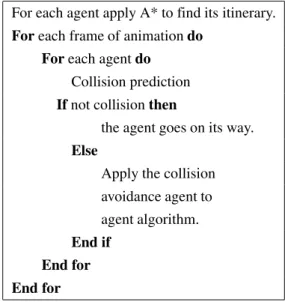
For each agent apply A* to find its itinerary. Foreach frame of animationdo
Foreach agentdo Collision prediction Ifnot collisionthen
the agent goes on its way. Else
Apply the collision avoidance agent to agent algorithm. End if
End for End for
Figure 3.Overview of the system.
A second level of priority is given to the haviours. These are complex phenomena be-cause they depend on the type of collision and the avoidance collision situations: (two indi-viduals, crossing groups, queuing in an exit, queuing in two directions, crowded environ-ment, etc. . .). In order to validate our system, we have chosen these situations. Some of them have been described by Winnie and Serge[22].
The process of collision avoidance is similar for all these situations by applying the above algo-rithm for each pair of agents in collisions. The process is described in Figure 4. The overview of the system is described in Figure 3.
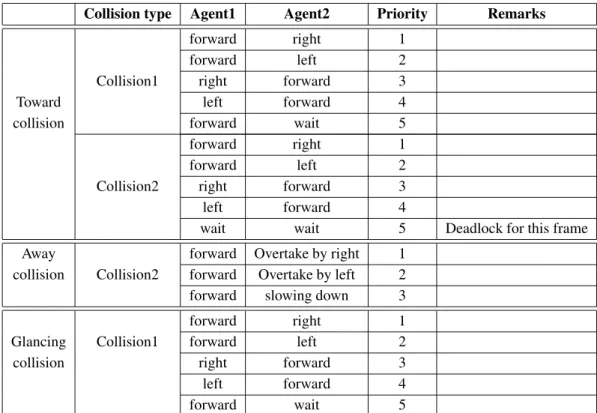
We can summarize the treatment of collision avoidance by using the priority rules in the Ta-ble 1. For example, if we are in a toward col-lision, the two agents reach the same cell, the first agent goes forward and the second agent moves to the right. The priority one is given to this situation.
We pass to the priority two if there is no space for the second agent to move, and so on.
Foreach pair of agentsdo Iftoward collisions,then
Ifagents have the same priorities,thenchoose one agent in random way If collision 1, then(two agents reach same cell Figure 1)
- Agent 1 moves forward, agent 2 changes direction to the right if there is space to move else changes direction to the left
- Agent 1 changes direction to the right, agent 2 moves forward - Agent 1 changes direction to the left, agent 2 moves forward - Agent 1 moves forward, agent 2 waits.
Else (collision 2agents reach the cell of each other Figure 1)
- Agent 1 moves forward, agent 2 change direction to the right if there is space to move, else changes direction to the left
- Agent 1 changes direction to the right, agent 2 moves forward - Agent 1 changes direction to the left, agent 2 moves forward - Agent 1 waits, agent 2 waits(these agents are blocked) End if
Elsebegin with the agent which has the higher priority and process the treatment as in the same priorities.
End if
Else ifaway collisionsthen(agent 2 behind agent 1)
- agent 1 moves forward, agent 2 changes directions right, left to overtake, or slows down else(glancing collisions)
- Agent 1 moves forward, agent 2 changes direction to the right if there is space to move else changes direction to the left
- Agent 1 changes direction to the right, agent 2 moves forward - Agent 1 changes direction to the left, agent 2 moves forward - Agent 1 moves forward, agent 2 waits.
End if End if End for
Figure 4.Agent to agent collision avoidance algorithm.
6.1. Crossing Groups
This situation is found in a crowded environ-ment, when two groups of agents moving in opposite directions try to avoid each other. In real life, they form opposite lines consisting of pedestrians with the same direction. (Figure 5.1)
In case of collision, the agent-to-agent colli-sion avoidance algorithm is applied. The col-lision avoidance behaviours used are: moving forward, changing directions, waiting and
mov-ing back. The last behaviour is used in the case of blocking when there is no space to move for-ward.
6.2. Bottlenecks (Queuing in an Exit)
Collision type Agent1 Agent2 Priority Remarks
forward right 1
forward left 2
Collision1 right forward 3
Toward left forward 4
collision forward wait 5
forward right 1
forward left 2
Collision2 right forward 3
left forward 4
wait wait 5 Deadlock for this frame Away forward Overtake by right 1
collision Collision2 forward Overtake by left 2 forward slowing down 3
forward right 1
Glancing Collision1 forward left 2
collision right forward 3
left forward 4
forward wait 5
Table 1.Priority rules in collision avoidance.
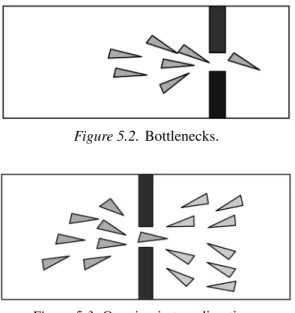
collision the agent-to-agent collision avoidance algorithm is applied. The collision avoidance behaviours used are: moving forward, chang-ing directions, and waitchang-ing(Figure 5.2).
6.3. Queuing in Two Directions
Pedestrians form queues in front of exits or doors of vehicles. When a vehicle arrives, pedestrians wait for the inside passengers to get off the vehicle and then get on it. This type of movement can be seen in elevator halls, on platforms of railway stations, at bus stops, and so on(Figure 5.3).
There will be two types of situations: pedes-trians gather in front of the entrance without leaving the way for inside passengers to get off the vehicle and pedestrians leave the way for inside passengers to get off the vehicle.
In our system a priority is given to the agents of one direction, the others wait until there is a free space to move. In case of collision the agent-to-agent collision avoidance algorithm is applied. The collision avoidance behaviours used are: moving forward, changing directions, waiting
and moving back. The last behaviour is used when the passage is blocked; there is no space to move. The agents of less priority have to choose between two possibilities: moving back to leave passage to the other agents or applying the A* to find a new path if it is possible.
6.4. Narrow Passage
This situation is observed inside corridors, in pavements, or pedestrian’s passages. Gener-ally, the pedestrians form line segregation, each group takes a direction and the choice of the direction is taken from the sociological be-haviours of the pedestrian. In almost all so-cieties the pedestrians take their right(right or left). We have given the priority one to this
Figure 5.2.Bottlenecks.
Figure 5.3.Queuing in two directions.
Figure 5.4. Narrow passage.
uation. The agent will first check on its right. The A* algorithm provides the path to be fol-lowed by just changing direction to overtake, in case of away collision. (Figure 5.4)
7. System Results and Discussion
The behavioural algorithms described above have been implemented in C++ using the OpenGL library. The system is a 3D software designed to be used in real time, so different ideas and situations can be simulated. A crowd of about 640 agents can be simulated at an ac-ceptable time on a Pentium IV, 3 GHz with 256 Mo of main memory.
The user interface has been designed to allow easy testing: the simulation can be paused at any time, and replayed at any speed, or frame by frame, meaning that a collision can be viewed from a variety of angles. The user can create his virtual scene in different ways, by placing the obstacles and the agents wherever he wants; He can also choose the destination of each agent. The system can simulate any type of collision situations.
An environment with agents and obstacles or without obstacles, a populated environment, a narrow space to produce a large number of po-tential collisions, agents acting as bottleneck, crossing groups, queuing in two directions, etc. . .
Figure 5 shows some results of our system. The colored cells are the goals of the agents.
Our algorithm is used for all the collision avoid-ance situations, with minor changes in the pri-orities of the agents and the behaviors. We have separated them in order to better understand and to compare the results of the system with the real life Figure 6.
The combination of A∗ with the application of the behaviors of collision avoidance gave good results, similar to the everyday life. The agents moving back could use the A∗ to compute the new optimum path from the actual position to the destination target. After avoiding colli-sion, the agent has two choices: to return to its itinerary or compute a new path to its goal from that position.
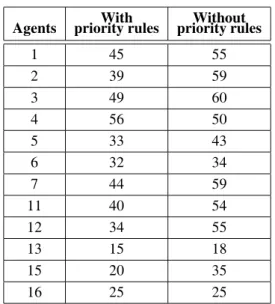
The use of priority rules solved the problem of disorder in the crowd movement. The traversed time depends on several parameters, amongst
Agents priority rulesWith priority rulesWithout
1 39 39
2 51 54
3 27 47
. . .
10 49 47
11 37 44
. . .
21 23 24
22 34 36
23 24 28
. . .
30 24 38
31 27 31
. . .
48 15 20
49 26 30
50 34 34
Agents priority rulesWith priority rulesWithout
1 45 55
2 39 59
3 49 60
4 56 50
5 33 43
6 32 34
7 44 59
11 40 54
12 34 55
13 15 18
15 20 35
16 25 25
Table 3.Traversed time in seconds in queuing in two directions.
other things, the density of crowd and the meth-ods of collision avoidance. We have tested the system with these priority rules and without them. And in almost all situations the traversed time is better with the use of these rules. Table 2 and Table 3 show this difference in two situa-tions, for example narrow passage and queuing in two directions. We used in the first simu-lation about 50 individuals and in the second simulation about 15 individuals.
The traversed time depends on many parame-ters of the environment: such as density of the crowd, initial position, obstacles, collision situ-ations and finally the process of collision avoid-ance. We can see in the simulation tables that some individuals have the same traversed time (2%)and sometimes have better time without priority rules(1%). But in most situations the traversed time is better with the use of these rules(97%).
To validate the performance of our system we must consider the realism of simulation but not the traversed time.
8. Conclusion and Future Works
This paper has presented useful ideas toward a system that can simulate human behavior based on theories from sociology and psychology[21] of a human being. We concentrate our dis-cussion on techniques for collision avoidance
as well as the path finding in dynamic envi-ronment. These two techniques add realism to the simulation. The system can simulate a large number of agents in real time(about 640 agents).
The use of priority rules solved the problem of disorder in the crowd movement and in most situations the traversed time is better with the use of these rules.
Our model could be used as a framework to sim-ulate real situations such as: the rise and descent of a subway or a bus, the walk in pavement, the entry or the exit of a supermarket. . .
A similar work has been done by Feurtey [6 ] using an agent-to-agent algorithm. He has used a critical density to differentiate the high and the low density of the crowd. The reaction of the agent depends on the distance ranges; close, near, and far. So the agent’s reaction is not the same according to this range. The second prob-lem is in the way that his virtual environment has been represented.
Our agent-to agent model can be used in differ-ent types of crowd; high or low density, just by applying a small set of rules depending on the collision types and the priority rules. A second advantage of our model resides in the way that we have calculated the path of each agent free of obstacles.
The system implements a number of features that make it more realistic than existing sim-ulations [6],[18]: we have included almost all the behaviours of avoiding collisions, concen-trating our research on the real life behaviours. We have translated these behaviours to simple collision avoidance rules.
There are many ideas for future work to improve the realism of the simulation:
• Improve the individual modelisation and move-ment by using professional 3D animation software such as 3DMAX or others.
• Actually, all agents move through the scene on their own, further work would allow agents to move in small groups.
• The notion of groups should improve the re-alism of the simulation by performing group avoidance rather than individual avoidance and it will allow modelling both group and individual behaviours.
• More time would have enabled work on
Figure 6a.Open area with obstacles.
Figure 6b.Narrow passage; the path is shown by lines.
Figure 6c. Queuing in two directions before starting animation.
Figure 6d. Queuing in two directions: during the animation.
some other aspects of natural human inter-action. We are interested actually in inte-grating sociological and psychological rules to improve the realism of the simulation.
References
[1] N. BADLER, C. PHILLIPS, B. WEBBER, Simulating
Humans: Computer Graphics Animation and Con-trol.Oxford University Press, New York, NY, 1993. [2] S. BAEK, I. K. J. INHO, Lee Motion Generation Using Motion Mining System. International Conference on Artificial Reality and Telexistence ICAT2003, Japan, 2003.
[3] S. BANDI, D. THALMANN, Space Discretization for
Efficient Human Navigation. Computer Graphics Forum, 17(3), pp. 195–206, 1998.
[4] O. B. BAYAZIT, J. M. LIEN, N. M. AMATO, Better
flocking behaviors using rule-based roadmaps. In
Algorithmic Foundations of Robotics V, Springer Tracts in Advanced Robotics 7, Springer-Verlag Berlin Heidelberg, pp. 95–111, 2004.
[5] V. BLUE, J. ADLER, Cellular automata model of
emergent collective bi-directional pedestrian dy-namics. InArtificial Life VI, the Seventh Interna-tional Conference on the Simulation and Synthesis of Living Systems, 2000.
[6] F. FEURTEY, Simulating the Collision Avoidance
Be-havior of Pedestrians. Master’s thesis, Department of Electronic Engineering, University of Tokyo, 2000.
[7] M. F. P.GILLIES, N. A. DODGSON, Attention based obstacle avoidance for animated characters. In Vir-tual Reality. To appear.
[8] D. HELBING, P. MOLNR, Social force model for
[9] A. KAMPHUIS, M. H. OVERMARS, Motion planning for coherent groups of entities. InIEEE Int. Conf. on Robotics and Automation. IEEE Press, San Diego, CA, 2004.
[10] F. LAMARCHE, S. DONIKIAN, Crowd of virtual
hu-mans: a new approach for real time navigation in complex and structured environments. InComputer Graphics Forum, vol. 23, pp. 509–518, 2004.
[11] C. NIEDERBERGER, D. RADOVIC, M. GROSS,
Generic Path Planning for Real-Time Applications,
Computer Graphics International (CGI’04), pp. 299–306, 2004.
[12] T. Y. LI, H. C. CHOU, Motion planning for a crowd of robots. InInternational Conference on Robotics and Automation (ICRA). IEEE Press, San Diego, CA, 2003.
[13] S. R. MUSSE, D. THALMANN, Hierarchical model
for real time simulation of virtual human crowds.
IEEE Transactions on Visualization and Computer Graphics, 7(2), pp. 152–164, 2001.
[14] J. REIF, H. WANG, Social potential fields: A
dis-tributed behavioral control for autonomous robots. InK. Goldberg, D. Halperin, J. C. Latombe, and R. Wilson, editors, International Workshop on Al-gorithmic Foundations of Robotics (WAFR), A. K. Peters, Wellesley, MA, pp. 431–459, 1995.
[15] C. W. REYNOLDS, Flocks, herds, and schools: A
distributed behavioral model.Computer Graphics, 21(4), pp. 25–34, 1987.
[16] C. W. REYNOLDS, Steering behaviors for
au-tonomous characters. In Game Developers Con-ference, 1999.
[17] S. RUSSELL, P. NORVIG, Artificial Intelligence: A
Modern Approach.Prentice Hall, 1994.
[18] S. J. RYMILL, N. A. DODGSON, A Psychological-based Simulation of Human Behaviour. Theory and Practice of Computer Graphics. EG UK, pp. 229–236, 2005.
[19] W. SHAO, D. TERZOPOULOS, Autonomous Pedestri-ans.Eurographics / ACM SIGGRAPH Symposium on Computer Animation. USA. pp. 19–28, 2005.
[20] B. ULICNY, D. THALMANN, Crowd simulation for
interactive virtual environments and vr training sys-tems.
[21] M. WOLFF, Crowd Notes on the behaviour of
pedes-trians. In People in Places: The Sociology of the Familiar, Birenbaum A., Sagar E., New York: Praeger, pp. 35–48, 1973.
[22] W. DAAMEN, SP. HOOGENDOORN, Experimental
re-search on pedestrian walking behavior. In Trans-portation Research Board annual meeting 2003. Washington DC: National Academy Press, pp. 1–16, 2003.
Received:May, 2006
Revised:May, 2009
Accepted:June, 2009
Contact addresses:
Cherif Foudil LESIA Laboratory Biskra University BP 145, RP Biskra Algeria
e-mail:foud [email protected]
Djedi Nouredddine LESIA Laboratory Biskra University BP 145, RP Biskra Algeria
e-mail:djedi [email protected]
C´edric Sanza VORTEX, IRIT Toulouse France
e-mail:[email protected]
Yves Duthen VORTEX, IRIT Toulouse France
e-mail:[email protected]
DR. CHERIFFOUDILis currently working as an Associate Professor of computer science at Computer Science Department, Biskra University, Algeria. Dr. Cherif holds PhD degree in computer science. The topic of his doctoral dissertation was Behavioral Animation: simulation of a crowd of virtual humans. He also possesses B. Sc.(engineer)in computer science from Constantine University 1985, M. Sc. in com-puter science from Bristol University, UK 1989. He is currently the head of “animation and artificial life” team in LESIA laboratory. His current research interest is in artificial intelligence, artificial life, crowd simulation, behavioural animation.
DR. DJEDINOUREDDINEis currently working as a Professor of computer
science at Computer Science Department, Biskra University, Algeria. Dr. Djedi holds Ph. D. degree in computer science. He also possesses B. Sc.(engineer)in computer science from USTHB University 1986. He is currently the head of LESIA laboratory. His current research interest is in artificial intelligence, artificial life, crowd simulation, behavioural animation.
DR. C´EDRICSANZAhas been an Assistant Professor in computer graph-ics at the University of Toulouse since 2002. He works in the Vortex team at the IRIT laboratory. His current research interests include learning classifier systems, behavioural simulation of characters and animation of crowds.