Lucrări ştiinŃifice Zootehnie şi Biotehnologii, vol. 41 (2) (2008), Timişoara
STUDIES REGARDING THE PRESENCE OF THE
PATHOGENS BACTERIA INTO A RECIRCULATING
SYSTEM OF BELUGA STURGEON INTENSIVE REARING
STUDII PRIVIND PREZENTA BACTERIILOR PATOGENE
INTR-UN SISTEM RECIRCULANT DE CRESTERE
INTENSIVA A MORUNULUI
DOCAN ANGELICA, GRECU IULIA, SFETCU LORENA, VASILEAN I., CRISTEA V.
Food Science and Engineering Faculty, Galati, Romania
Recirculating aquaculture offers good potential for successful fish farming since is often independent of environmental conditions. Maintaining healthy fish in a recirculating system involves establishing adequate dissolved oxygen levels, removal of solid wastes, and sufficient ammonia nitrification to assure optimal rearing conditions. Neglecting these, the fish immune system will depress, the facultative pathogen germs will be able to provoke important disease outbreaks into cultured biomass, as was happened in our recirculating pilot system. In this study are presented the pathological aspects registered to the beluga sturgeon of 1 year, reared into our recirculating pilot system, pathological aspects generated by a haemorrhagic bacterial septicaemia which was manifested in the conditions of low concentrations of DO. The disease was diagnosed to the affected fish through anatomo-pathological and clinical exam, haematological exam and microbiological exam.
Key words: bacterial haemorrhagic septicaemia, Aeromonas hydrophila,
beluga sturgeon, recirculating system.
Introduction
pathologies, the bacterial infections are frequently because the water in recirculating systems is an ideal environment for the growth of bacteria and other micro-organisms, which adversely affect fish health. In 90 % of cases, infections are determined by facultative pathogen germs, in this case suboptimal levels of water quality and nutritional factors having an important role in fish immune system depression (Schlotfeldt & al., 1995; Propas, A. & al., 2000) which challenge a massive pressure on the systems’ pathogen germs. Into an advanced phase of the infectious process the intern organs are infected and, as results, an acute mortality in fish populations is manifested with serious economic loses.
The aim of our study was to identify the pathogens agents of an outbreak episode affecting beluga fingerlings reared into our recirculating aquaculture system.
Materials and Methods
Researches have been done in spring of 2007 on beluga sturgeons of 353 ±91,8 g weight and 44,05±2,47 cm length with clear signs of infection. The beluga sturgeons were resulted from the artificial reproduction performed in Isaccea sturgeon farms in April 2006 and reared over a year into the recirculating pilot system of Aquaculture, Environmental Science and Cadastre Department/University of Galati.
For establishing the diagnosis and the disease’s causes, following investigations have been performed:
the analyse of the water’s chemical parameters from the recirculating system (pH, ammonia, nitrites) with Spectroquant “Nova 400” Merck;
clinical exam was performed every day by following the general state of fish, his behaviour and feeding, the appearance of some body lesions;
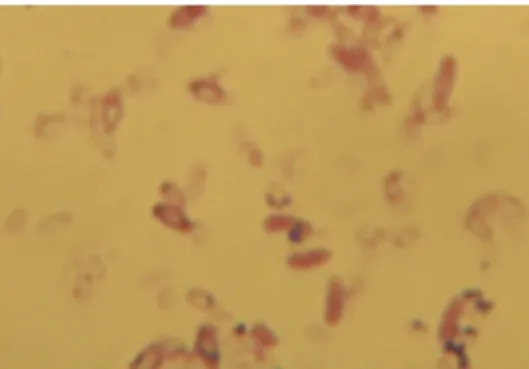
the analyse of the haematological parameters was performed on the Burker-Turk and Thomas chambers for counting the erythrocytes; for haemoglobin determination was used haemoglobinometer Sahli; for haematocrit was used microhaematocrit tubes and a centrifuge; the qualitative modifications of the blood cell morphology were establishing by microscopic exam of the blood smears stained by the panoptic method - May-Grunwald-Giemsa (MGG) staining - from the affected fish in comparison with the healthy fish ;
Results and Discussions
All the investigations performed on the beluga sturgeons reared into the recirculating system, which presented pathological processes led us to the following results:
Some physico-chemical parameters of the water were maintained in normal limits (t water = 18-20
o
C; pH = 7,5-8, [N-NH3] < 0,01 mg/l), an exception was the DO levels, which varies into a suboptimal range from 4,8 to 5,4 mg/l.
The first symptoms was characterised by a chaotic swim (around the body axe, with the head upward) (fig.1), bleedings at the fins base and ventral part (fig. 2);
The disease evolution was chronically, with the appearance of necrosis processes on the tegument followed by the occurrence of some profound ulcerations into the muscle filled with a sanguineous liquid (fig.3,4);
Besides the external lesions, the anatomo-pathological exam pointed out alterations of the pale gills with beginning of necrosis process (fig. 5), the anus was congested and prolapsed, the liver was pale or marbled;
The blood analysis point out an accentuated anaemia, with qualitative and quantitative modifications; haemoglobin and haematocrit presented lower values than the healthy fish. On examined blood smears the higher number of neutrophils (90%), lymphoblasts and other intermediary cells from the lymphocytary line suggested a rapid defence reaction to the infectious process. Also, the higher number of erythroblasts confirmed the existence of an hypoxia into the system’s aquariums considering this the most favourable factor of bacteriosis installation;
In the microbiological exam of the different tissues drawn from the affected fish, after isolation on nutritive media, were developed round colonies, white-grey, smooth, with a diameter of 3-5 mm;
Anatomo-pathological features of the affected beluga sturgeons (Huso huso Linnaeus, 1758) from the recirculating system
Fig 1. Beluga sturgeon with chaotic swimm .
Fig 2. Beluga sturgeon with bleedings at the fins base and ventral part of body
Fig 3. Beluga sturgeon with profound abscess into the muscle
Fig 4. Beluga sturgeon with haemorrhagic ulceration on the tegument
Conclusions
Our researches regarding the pathological features appeared to the beluga sturgeons reared into the recirculating system led us to the following conclusions:
in the conditions of the intensive rearing, the stress induced by the technological factors (high densities, small spaces) or chemical parameters (oxygen) has produced a perturbation of the fish’s normal physiological state, making them more sensible to the pathogen agents’ action;
the captivity stress of the beluga sturgeons which length exceed over 40 cm into the small tanks of 300 l, made them vulnerable to the water’s germs attack, potential pathogen ;
the pathology manifested to the beluga sturgeons reared into the recirculating system was diagnosed as haemorrhagic bacterial septicaemia, pathology that conducted to the death of the affected fish;
Specialised literature offers just few data about the pathology of the sturgeons cultured into the recirculating systems and that is why we consider as necessary to continue this study in a complex and sustained manner to clear up more aspects.
Bibliography
1. Ghittino, P. (1985) – Tecnologia e patologia in acquacultura. Emiloo Bono – Torino, p. 1- 399
2. Munteanu, G., D. Bogatu (2003) – Tratat de Ihtiopatologie. Editura Excelsior Art Timisoara, p. 160 – 168
3. Propas, A., G. Savidis, F. Athanassopoulon, P. Hristofiloianis (2000) – Practicos Odogas Ihtiopatologia EAFP. Editura KORIFI, Atena. P. 25- 122
4. Photis, G., P. Florou – Paneri, I. Gavrulidou (1998) – Eel growth performance in a grow – out recirculating aquaculture system. 1st Balkan Aquaculture Conference Salonic. Book of abstracts, p. 9
5. Roberts, R.J. (1989) – Fish Pathology Second Edition, Edit. Bailliere Tindall, Londra, p. 300 – 307.
6. Schaperclaus, W. (1979) – Fischkrankheiten. Akademie Verbag – Berlin. Vol. 1,2. p. 412 – 430.