The Asian Journal of Technology Management Vol. 12 No. 1 (2019): 70-85
*Corresponding author. Email: [email protected]
Factors Affecting Knowledge Sharing Intention of Expert in Group of
Faculty Member Telkom Corporate University
Rezka Andria Tirana* and Jann Hidajat Tjakraatmadja
School of Business and Management, Institut Teknologi Bandung, Indonesia
Abstract. Telkom CorpU has expert who have been recognized as employees with particular skill and experience. But based on data, some expert feel knowledge sharing is not already become culture among them. Indeed, knowledge sharing is a vital part from knowledge management processes and the key success in KM implementation. The low level of knowledge sharing and the fact of that most senior experts will retire in two years make the management feel anxious. For this reason, management tries to find ways to improve expert knowledge sharing behavior so in the future there will be no such anxiety. Theory of Planned Behavior is a theory about factors that influence individual intention toward particular behavior. The theory states that there are three factors that influence individual intention to particular behavior, namely attitude, subjective norm and perceived behavioral control. But for intention of expert in conducting knowledge sharing, the factors that influence significantly are perceived behavioral control only. Other factors such as attitude and subjective norms only potentially affecting expert intentions in carrying out knowledge sharing.
Keywords: Attitude, intention, knowledge sharing, subjective norm, perceived behavioral control
1. Introduction
Knowledge is a competitive advantage that each company must have. A company can compete with other companies to face the business challenges with competitive advantage. Knowledge within the organization must be managed properly by the company. Employee’s experience is key knowledge and the primary competitive resource for the company (Maponya, 2005). At Telkom CorpU, employees who have qualified experience are appointed as experts. Experts known as employee who have particular expertise. These employee are the people who have been develop with large investment in the fields of education, training and the implementation of benchmarking programs between companies either both inside and outside the country. Expert who have been considered to have
more experience and knowledge should be expected to be a source of knowledge for other employees. Telkom CorpU has a unit that is responsible for providing expert or instructor called Group of Faculty Member (GOFM).
25 people from 69 experts share their knowledge on Kampiun website in 2018. This amount only reach 36% of the total available expert. But some expert has carried out knowledge sharing with their own awareness. Based on in-depth interviews, the expert acknowledges that their intention to do knowledge sharing is still low. It indicate that knowledge is no longer becoming their culture.
Knowledge sharing should be committed by every employee for successing the implementation of knowledge management. Telkom CorpU management who are aware of this situation, still trying to find out what to do to increase the level of knowledge sharing in GOFM so knowledge sharing will become a habit for the experts.
To achieve that objective, it is necessary to conduct a study to find out what factors that affects knowledge sharing intention in GOFM working environment, so Telkom CorpU management can make a right strategies or decisions to increase their knowledge sharing level. Based on the problem statement above, the research question will be:
What factors that affect Knowledge Sharing Intention of expert in Group of Faculty Member?
What recommendations about people, process, and technology can we conclude from the factors to improve Knowledge Sharing Intention?
2. Literature Review
Knowledge sharing defined as an exchange of knowledge between and among the individuals, teams, organizational units, or company as the big organization. Some
researcher define knowledge sharing further not only exchanging knowledge but it have to be an interaction that one people who communicates their knowledge and others assimilates it. The important term is that there is an process assimilation.
Knowledge sharing is one of the hardest processes of Knowledge Management, because a lot of barriers for someone to share their knowledge such the assumption about knowledge is an asset for their self or they didn’t have time to share (Chikoore & Rasgdell, 2013). Knowledge sharing only occurs when people are naturally interested in helping others to build new competencies and capacities to act (Elizabeth, 2014). Knowledge sharing is a naturally action that affected by intention to do the action. The action is shown as a behavior. In knowledge sharing, there are two popular theories about behavior intention, there are Theory Reasoned of Action (TRA) and Theory of Planned Behavior (TPB). The theory of reasoned action (TRA) and the theory of planned behavior (TPB) are two key theories that have tried to explain individual knowledge-sharing intention and actual Knowledge Sharing Behavior within an organizational context (Ajzen, 1991; Fishbein & Ajzen, 1975).
Theory of Reasoned Action
Figure 1.
Theory of Reasoned Action Source: Madden et al. (1992)
According to Razak, Pangil, Zin, Yunus, & Asnawi (2016), attitude and subjective norms are main factor that contributes to the intention of individual to share their knowledge and experience with the others. Attitude defined as disposition respond favorably or unfavorably to the self, other people and environment (Ajzen, 1985). Meanwhile Social Norm defined as the way individuals think and expect from others towards individual actions (Razak et al., 2016).
Theory of Planned Behavior
Different with TRA, Theory of Planned Behavior (TPB) see behavioral intention caused by three variables. The three variables are Attitude, Subjective Norm, and Perceived Behavioral Control. Perceived Behavioral Control is beliefs of individual skill and opportunities affect behavior, it means the level of confidence of an individual to perform the behavior. According to Ajzen (1991), Perceived behavioral control can influence the individual willingness and unwillingness to choose the activities, prepare them to participate, and influence their effort to the performance (Razak, et al., 2015).
Figure 2.
Theory of Planned Behavior
Another difference in TPB theory with TRA is because there’s a variable that has a direct influence on the behavior. Perceived behavioral control is considered as a variable that is able to make up to two influences on the intention in behaving and directly towards
Intention (INT)
Intention define the willingness of the individuals to engage in particular behavior. The terms of willingness is the key to define the intention. In intention towards knowledge sharing, it is not enough to define an intention as willingness only but it must defined as readiness of an individual to share their knowledge. The relation between intention and behavior usually is a linear function. It means if an individual tend to do a particular behavior, it means that they have positive intention towards the behavior. Base on TPB, intention affected by three main factors, there are attitude towards the behavior, subjective norm, and perceived behavioral control.
Attitude (ATT)
Attitude defines as the degree of individual feelings towards to a positive or negative consequence from doing a particular behavior. Meanwhile, attitude towards knowledge sharing defined the knowledge sharing as the degree of individual respond towards a particular behavior Bock, Zmud, Kim, & Lee (2005). Attitude encouraged by believing about the result and evaluation of behavior (behavior belief) Machrus, & Purwono (2012). To measure the behavior belief, it depends on personal belief or belief that is associated with the feelings. Basically, the theory of the influence of attitude toward behavior intention is positive (Ajzen, 1985). Several studies that have been done previously by Abbas (2018); Bock et al. (2005); and Jolaee, Md Nor, Khani, & Yusoff (2014) shown that attitude has positive effect on intention of knowledge sharing.
Subjective Norm (SN)
Subjective Norm define as people’s perception about behavior that is acceptable or not acceptable that can be perceived by their environment. Subjective norm affected by normative belief, it similarity from behavior belief but as reflection from social perception. Subjective Norm affect the intention as a
perception about acceptance, encourage or implementation some behavior. Several studies that have been done previously by Abbas (2018); Bock et al. (2005); and Jolaee et al. (2014) show that subjective norms has positive affect on knowledge sharing intention.
Perceived Behavioral Control (PBC)
Perceived behavioral control can be defined as a benchmark for the people to perform the behavior with their internal or external capabilities. Several studies that have been done previously by Abbas (2018); and Bock et al. (2005), shown that perceived behavioral control has positive effect on knowledge sharing intention.
3. Methodology
Author use TPB that focused on the intention of knowledge sharing behavior expert in a group of faculty members. This selection is due to the fact that the subject research are experts who have the ability to think, sufficient educational background and experience to share knowledge. Because they already past the fit and proper test as an expert. Fit and proper test is an exclusive tests that are specifically used for the employees who have sufficient ability and the will to become a practitioner in the field of education.
Figure 3.
Research Framework
Personal Belief
To measure the attitude, personal belief must be included as the dimension that affects attitude (Machrus & Purwono, 2012). The power of belief and evaluation of the results for the behavior for measuring personal belief, is substantive information about attitudes, which guide decisions to take action, or do not take certain actions, as a reflection of attitude. Ajzen in his description of beliefs related to attitudes, states that attitudes towards behavior are determined by believing about behavioral consequences, results (outcome), and burden (cost) in relation to the object attitude (Ajzen, 1991). Strength of belief and evaluation of results / cognitively estimated. Personal belief in attitude toward knowledge sharing is the perception about knowledge sharing consequence for someone. The hypothesis proposed in this study regarding personal belief is a personal belief that has a positive effect on the attitude toward intention to share the knowledge in GOFM’s expert.
Expecting Rewards
Expecting rewards means that attitude toward behavior affected by rewards. Rewards that determine in this variable can be monetary reward or achievement feeling. It strengthened by Abbas (2018) and Lumbantobing (2011) that said rewards will motivate people to share their knowledge. The hypothesis proposed in this study regarding expecting rewards is when they expect a
rewards then it has a positive effect on the attitude toward intention to sharing knowledge in GOFM’s expert.
Professional Environment
According to Bock et al. (2005) and Abbas (2018), professional environment has a positive impact toward subjective norm. According to Abbas (2018), higher opportunities to sharing knowledge among employee will achieve if management or environment can create friendly relationship and mutual trust. The hypothesis proposed in this study related to professional environment is professional environment has a positive effect on the subjective norm toward knowledge sharing in GOFM’s expert.
Method
related to the method is the method has a positive effect on the perceived behavioral control toward the intention of knowledge sharing in GOFM employees.
Technology
In this research, author tried to connect the technology as variable that affect to GOFM’s experts as employee in Telkom Indonesia that always proclaim to transform into digital behavior. As the company that has vision to be the king of digital company in this region,
GOFM’s experts should shown technology in their perceived behavior control as an culture. In previous studies, technology is considered to be one of the variables equated with methods. The hypothesis proposed in this study related to technology is technology has a positive effect on the perceived behavioral control toward intention of knowledge sharing in GOFM employee. Based on the literature review and research framework, there are 9 hypothesis that will author use.
Figure 4.
Research Hypothesis Model
4. Findings and Discussion
The subject of this study is Telkom employees who have job position as an expert in Telkom CorpU. The object of this study is to find out the factors that influence the intention of the experts in carrying out knowledge sharing. The case study was carried out GOFM Telkom CorpU as the unit of experts at Telkom Indonesia. This research conducted in January 2019 with a total of 69 experts. Population is generalization area of objects / subjects, which have certain qualities and characteristics set by the researcher to be studied and examined in order to draw conclusions (Sugiyono, 2008). The population of this study is 69 experts in GOFM Telkom CorpU. According to Sugiyono (2008), sample is part of the number of characteristics
possessed by the population. A good sample can truly represent the characteristics of the population (Sugiyono, 2008). This study is a quantitative research that tests a theory. In determining the minimum sample size, according Sugiyono (2008), for the number population less than 100, include them all.
Data Collection Techniques
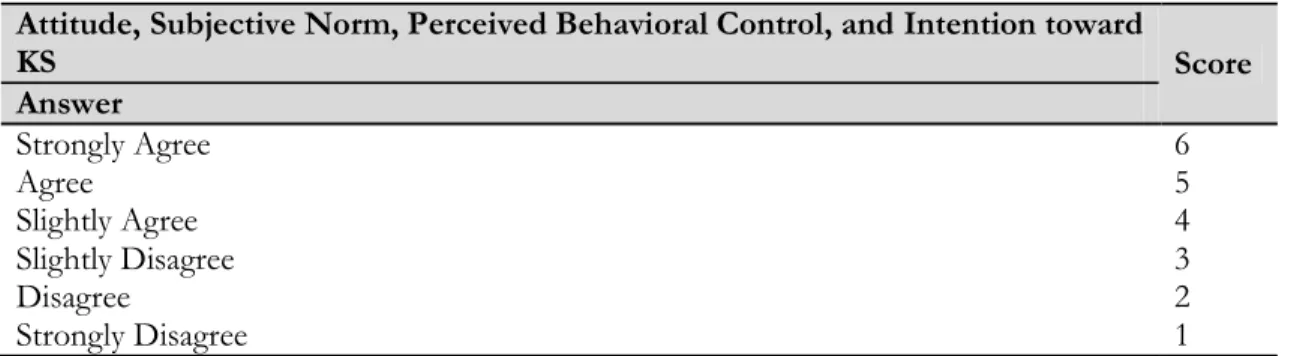
Table 1.
Likert Scale
Attitude, Subjective Norm, Perceived Behavioral Control, and Intention toward
KS Score
Answer
Strongly Agree 6
Agree 5
Slightly Agree 4
Slightly Disagree 3
Disagree 2
Strongly Disagree 1
Respondent Overview
After the questionnaire distributed, the number of questionnaire that returned to the author are 56 respondent. The questionnaire distribution time is one week by online google form. The results of data collection obtained through questionnaires that have been administered unanalyzed make conclusions according to the characteristics of each respondent based on demographic data. The characteristics are describing gender, education, age, the length of work as an expert, the length of work as an employee, and band position. The characteristics are expected to provide an overview and information related to the existing variables.
The quantitative method was carried out to test the hypotheses that have been proposed to determine the effect of each variable on the intention for knowledge sharing. The quantitative method used in this study is Partial Least Square. In this study, there are two types of variables, named as independent and dependent variables. Independent variables are variables that affect other variables. Whereas dependent variables are variables that are influenced by other variables. Partial Least Square is a statistical technique that involves more than one variance. This technique is assessed to be used for models with many independent variables even though multi collinearity occurs between these variables. Another advantage of this technique is that assessment indicators can use
data scales in both the category, ordinal scale, ratio scale, and interval scale also can be used in this questionnaire. Another consideration of the use of PLS in this study is because the study population is small and it will affect the size of sample too. It has all the advantages because this technique is strong enough even for relatively small sample sizes. There are two main steps in PLS Analysis, named as The Outer Analysis Model, Partial Hypothesis Testing and Simultaneous Hypothesis Testing.
1) The Outer Analysis Model
a. Validity
Convergent Validity
Convergent validity of the measurement model with reflexive indicators is based on the correlation between item scores components that estimated by Smart PLS. Convergent validity value is the value of loading factors on the latent variable with the indicators. The required value is 0.7 to be considered highly
satisfactory, but according to Hair, Black, Babin, Anderson, & Tatham (2014), loadings 0.50 or greater are considered practically significant. In this study, author use 0.50 as the minimum value for loading factors. Based on the calculation with SmartPLS and twice iteration the valid items to be used in processing as follow in Table 2.
Table 2.
Valid Item
Numb. Variable Dimension Item Number
1 Attitude Personal Belief (PB) ATT1, ATT2, ATT3 Expecting Reward (ER) ATT5
2 Subjective Norm Professional Environment (PE) SN1, SN2, SN3, SN4 3 Perceived Behavioral
Control Method (ME) Technology (TE) PBC1, PBC2, PBC3 PBC4, PBC5, PBC6
The other way to see the convergent validity, we can use Average Variance Extracted (Hussein, 2015). The expected value for AVE
is > 0.5 for all constructs. For AVE value, all constructs already get the expectations of above 0.5.
Table 3.
Average Variance Extracted
Latent Variable Code Average Variance Extracted
Attitude ATT 0.511
Subjective Norm SN 0,508
Perceived Behavioral Control PBC 0.502
Intention INT 0.809
Discriminant Validity
Discriminant validity of the measurement model with reflexive indicators is generally accepted prerequisite for analyzing relationship between latent variables. Discriminant validity may use some criteria like the Fornell-Larcker criterion, cross-loadings and the HTMT criterion results. Each method has their criteria, there are (Ab Hamid, Sami, & Sidek, 2017):
Fornell-Larcker criterion, it can conclude as valid if the the square root of each construct’s AVE should have a greater value than the correlations with other latent constructs
Cross loadings criterion, it can conclude as valid if the factor loading indicators on the assigned construct have to be higher than all loading of other constructs.
HTMT criterion, it can conclude as valid if the value of HTMT is below than 0.90.
Unidimensional / Reliability Test
repeatedly produces the same data (consistent). Several criterion from the results of reliability testing, are:
If Cronbach alpha is 0.8 to 1.0 = Good Reliability
If Cronbach's alpha is from 0.6 to 0.799 = Reliability Accepted
If Cronbach alpha reliability is less than 0.6 = Unreliable
The other way criteria to test the reliability is Composite reliability, according to Hussein (2015) the acceptable value for composite reliability is more than 0.699.
Table 4.
Cronbach Alpha & Composite Reliability
Latent Variable Code Composite Reliability Cronbach Alpha
Attitude ATT 0.911 0.890
Subjective Norm SN 0.876 0.833
Perceived Behavioral Control PBC 0.900 0.873
Intention INT 0.894 0.764
Table 4 shows that all variable are reliable. This is indicated by Cronbach Alpha and Composite Reliability values above 0.7.
2) Partial Hypothesis Testing
The test was performed to determine whether the indicator had significant influence to the independent variable or the independent variable partially had significant influence to the dependent variable. The partial hypothesis testing used statistical hypothesis base on hypothesis model in previous chapter. The partial hypothesis test by t-statistics using SmartPLS application calculation. The results of the t-statistic coefficient obtained referred
to as the t-test was compared with t-table where the test criteria were:
H0 is rejected if sig <α or | t | ≥ t table with a level of significance of 5%, there is no significant effect of X1 and X2 to the dependent variable Y. H0 If Sig> α or | t | <T table at a
significance level of 5%, there is no significant effect of X1 and X2 to the dependent variable Y.
Author use the level of significance = 10% (0.1) The value of t – table that author use in this study with 56 sample and confidence level 90% is 1.6730.
Table 5
Bootstrapping Result
No. Structure Original Sample (O)
Sample Mean (M)
Std Deviation (STDEV)
T Statistics
(IO/ STDEV) P Values
1 ATT INT -> 0.085 0.131 0.165 0.518 0.518
2 SN -> INT 0.243 0.240 0.159 1.533 0.126
3 PBC ->INT 0.443 0.412 0.153 2.886 0.004
4 PB -> ATT 0.388 0.380 0.107 3.614 0.000
5 ER -> ATT 0.093 0.088 0.049 1.907 0.057
6 PE -> SN 0.621 0.624 0.052 11.928 0.000
7 ME -> PBC 0.449 0.448 0.041 11.028 0.000
1. Sub-Structure-1: Effect of Attitude to Intention of Knowledge Sharing
Based on the results of the analysis test shown in Table 5, the path coefficient value for this sub structure is 0.085 with t value of 0.518. This value was smaller than t table (1.6730), which means that H0 was accepted. This indicated that Attitude and intention toward knowledge sharing has no significant influence on expert Telkom CorpU. From the results of data processing it can be seen that attitude has positive insignificant effect to intention toward knowledge sharing. It means positive attitude does not guarantee can increase the intention of the experts toward knowledge sharing. If there is an effect, attitude can influence to increase or decrease the expert's intention to do knowledge sharing only at 8.5%.
Based on literature review, attitude has been defined as someone feeling or perception regarding a behavior. When we look from the statistics results, the perception or positive feeling of an expert on knowledge sharing does not always make the expert want to do knowledge sharing. Attitude is not a major factor or factor that will definitely make someone to do knowledge sharing. Otherwise, if an expert has a negative attitude towards knowledge sharing, it does not indicate that the expert have no intention to do knowledge sharing. This discovery is different from the theory that found by Ajzen (1985), and the other results of studies that have been conducted by other researcher that state that attitude has a significant positive influence on people’s behavior toward knowledge sharing (Abbas, 2018; Jolaee et al., 2014).
2. Sub-Structure-2: Effect of Subjective Norm to Intention of Knowledge Sharing
Based on the results of the analysis test shown in Table 5, the path coefficient value for this sub structure is 0.243 with t value of 1.533. This value was smaller than t table (1.6730), which means that H0 was accepted. This indicated that subjective norm and intention toward knowledge sharing has no significant
influence on expert Telkom CorpU. This means that the expert’s subjective norm only affected 24,3% of their intention toward knowledge sharing.
Just same with attitude, subjective norms have a positive influence but not significant relationship to the expert of Telkom CorpU intention toward knowledge sharing. This is different from result research conducted by other researchers who stated that subjective norms have a significant positive influence on intention toward knowledge sharing (Abbas, 2018). But from other research (Jolaee et al., 2014) found that subjective norm has no significant effect to intention toward knowledge sharing. In the experts of Telkom CorpU’s case, subjective norms could influence the increase or decrease of intentions toward knowledge sharing in about 24.3%.
3. Sub-Structure-3 : Effect of Perceived Behavioral Control to Intention of Knowledge Sharing
Based on the results of the analysis test shown in Table 5, the path coefficient value for this sub structure is 0.443 with t value of 2.886. This value was greater than t table (1.6730), which means that H0 was rejected and H1 was accepted. This indicated that perceived behavioral control to intention toward knowledge sharing has significant influence on expert Telkom CorpU. This means that the expert perceived behavioral control affected 44,3% of their intention toward knowledge sharing. This indicates that if expert Telkom Corpu had high perceived behavioral control, their intention toward knowledge sharing was also high. Likewise, if the perceived behavioral control is low, the intention toward knowledge sharing will also be low.
be encouraged by control belief and perception of facilitation. Control Belief is influenced by the presence of opportunities and resources both externally and internally, while facilities are interpreted as the existence of methods and technology that support the knowledge sharing process. The influence of each PBC indicators and their implications will be discussed in the analysis of sub-structures per indicator. In terms of the independent variables in this model, only perceived behavioral control has a significant positive effect. It can be a consideration for management to focus at the positive significant factors when developing policies about knowledge sharing for expert Telkom CorpU.
4. Sub-Structure-4: Effect of Personal Belief to Attitude toward knowledge sharing.
Based on the results of the analysis test shown in Table 5, the path coefficient value for this sub structure is 0.388 with t value of 3.614. This value was greater than t table (1.6730), which means that H0 was rejected and H2 was accepted. This indicated that personal belief and attitude toward knowledge sharing has significant influence on expert Telkom CorpU. But, this means that the expert personal belief affected 33,8% of their attitude toward knowledge sharing. This indicates that if expert Telkom Corpu had high personal belief, their attitude toward knowledge sharing was also high. Likewise, if the personal belief is low, the attitude toward knowledge sharing will also be low.
Personal belief of the experts related to knowledge sharing that they do will be useful for others is still low. Knowledge sharing is still considered as additional activity that is not more important than getting teaching hours. In other hand, because of number participant in knowledge sharing activity is low, the experts of Telkom CorpU are not confidence to conduct their own knowledge sharing activity. They don’t think their knowledge can give something valuable to other persons. They also think people who have an opportunity to do knowledge sharing should
be people who is smart and have higher knowledge than people who attend the knowledge sharing.
5. Sub-Structure-5: Effect of Expecting Reward to Attitude toward knowledge sharing.
Based on the results of the analysis test shown in Table 5, the path coefficient value for this sub structure is 0.093 with t value of 1.907. This value was greater than t table (1.6730), which means that H0 was rejected. This indicated that expecting reward and attitude toward knowledge sharing has significant influence on expert Telkom CorpU. This means that the expecting reward control affected 9,3% of their attitude toward knowledge sharing. This indicates that if expert Telkom Corpu had high expecting reward, their attitude toward knowledge sharing was also high. Likewise, if the expecting rewards is low, the attitude toward knowledge sharing will also be low. At the beginning, reward defined as two type, there are extrinsic reward such as monetary rewards and other physical gifts and intrinsic rewards such as promotional points. However, when the validity test is done by looking at the loading factor, the questions related to the extrinsic reward are issued because it is invalid.
From the results of data processing, intrinsic reward has significant positive effect on attitude but not able to encourage the attitude to change into intention for knowledge sharing. The finding in line with the fact that number of documents uploaded in Kampiun by the experts are low even though there are point competency as reward to anyone who conducts knowledge sharing in Kampiun. Point competency as reward are considered as a good thing to give some pressure on knowledge sharing activities, but attends to be ineffective and low quality of document that uploaded in Kampiun.
6. Sub-Structure-6: Effect of Professional Environment to Subjective Norm toward knowledge sharing.
sub structure is 0.621 with t value of 11.928. This value was greater than t table (1.6730), which means that H0 was rejected. This indicated that professional environment and subjective norm toward knowledge sharing has significant influence on expert Telkom CorpU. This means that the expert professional environment affected 62.1% of their subjective norm toward knowledge sharing. This indicates that if expert Telkom Corpu had high professional environment, their subjective norm toward knowledge sharing was also high. Likewise, if the professional environment is low, the subjective norm toward knowledge sharing will also be low. Base on Lin (2011), professional environment is become potential issue when they deliver efficiency and effectiveness of knowledge sharing behavior. Professional environment can build learning environment to increase knowledge sharing activity.
7. Sub-Structure-7: Effect of Method to Perceived Behavioral Control toward knowledge sharing.
Based on the results of the analysis test shown in Table 5, the path coefficient value for this sub structure is 0.449 with t value of 11.028. This value was greater than t table (1.6730), which means that H0 was rejected. This indicated that method and perceived behavioral control toward knowledge sharing has significant influence on expert Telkom CorpU. This means that the method affected 44.9% of their perceived behavioral control toward knowledge sharing. This indicates that if expert Telkom Corpu had good method to do knowledge sharing, their perceived behavioral control toward knowledge sharing was also high. Likewise, if the method is bad, the perceived behavioral control toward knowledge sharing will also be low.
Method is the degree of belief that the way to knowledge sharing is an easy thing. According to in-depth interview, a positive attitude and positive subjective norms toward knowledge sharing does not affect intention of experts
toward knowledge sharing if management could not conducted a method to facilitate them. In this study, method is a factor that has positive influence on the perceived behavioral control so management needs to pay attention to these findings to go to the next step.
8. Sub-Structure-8: Effect of Technology to Perceived Behavioral Control toward knowledge sharing.
Based on the results of the analysis test shown in Table 5, the path coefficient value for this sub structure is 0.315 with t value of 6.879. This value was greater than t table (1.6730), which means that H0 was rejected. This indicated that technology and perceived behavioral control toward knowledge sharing has significant influence on expert Telkom CorpU. This means that the technology expert affected 38.6% of their perceived behavioral control toward knowledge sharing. This indicates that if expert Telkom Corpu had good technology, their perceived behavioral control toward knowledge sharing was also high. Likewise, if the technology is bad, the perceived behavioral control toward knowledge sharing will also be low.
Figure 5.
Partial Hypothesis Testing Result
3) Simultaneous Hypothesis Testing
This simultaneous hypothesis used in this study was that attitude, subjective norm and perceived behavioral control had a significant influence on intention toward knowledge sharing. Based on the results of the analysis
test, the R-square value was 0.450, which means that the attitude, subjective norm and perceived behavioral control had a significant effect on intention toward knowledge sharing of 45%. Based on Guilford and Fruchter (1973), correlation coefficient categorized as:
Table 6.
Guildford Empirical Rule
Interval Classification
0.00 ≤ R2 < 0.20 Very Weak
0.20 ≤ R2 < 0.40 Weak
0.40 ≤ R2 < 0.70 Moderate
0.70 ≤ R2 < 0.90 Strong
0.90 ≤ R2 < 1.00 Very Strong
From Table 6, it was stated that the attitude, subjective norm and perceived behavioral control simultaneous has an influence but the impact categorized is in the moderate category. The remaining 55% was influenced by other variables not examined in this study
5. Conclusions
By all findings above, therefore the author has come to the conclusion from the research question. The findings are.
1) Factors that affect expert Telkom CorpU of intention knowledge sharing is
perceived behavioral control. Perceived behavioral control give positive significant affect to intention toward knowledge sharing as much 44.3%. It mean if we increase expert perceived behavioral control, the expert intention toward knowledge sharing will increase as much the increasing of perceived behavioral control. To increasing expert Telkom CorpU perceived behavioral control it can be done with increasing expert professional environment, determine the right method to do knowledge sharing, and increasing quality of Kampiun. Therefore, from the simultaneous test, there are other H0 accepted, no significant
factors that influence 55% expert’s intention toward knowledge sharing.
2) Recommendation that can author give from this study from people, process and technology are:
a) People
Expert Telkom CorpU still need encouragement from management to increasing their intention toward knowledge sharing. Expert Telkom CorpU still have low attitude and low subjective norm, because of that, management need specific strategic to increasing attitude and subjective norm level from expert Telkom CorpU regarding to forming awareness to do knowledge sharing. Because if management only rely on expert perceived behavioral control to do knowledge sharing, their intention to do knowledge sharing will not long last. With increasing attitude and subjective norm level from expert, it will increasing the engagement of knowledge sharing in expert environment.
b) Proses
The knowledge sharing activities in Telkom for experts Telkom CorpU still need further development. Management needs to provide a new method for conducting knowledge sharing so that the expert feels facilitated. The method that must be developed by management is a method that is able to improve the learning environment. The thing to note is that the method must have clear goals and participants.
c) Technology
Not only as the easy tool to do knowledge sharing, but the technology must be able to increase the utility of users. One of the things that we have discussed in the previous sub-section, the principal to develop technology for knowledge sharing is same with the method. Technology must make it easier for users to use it and the technology must facilitate user want and need so the number of active user in Kampiun can be improved.
References
Ab Hamid, M. R., Sami, W., & Sidek, M. M. (2017, September). Discriminant validity assessment: Use of Fornell & Larcker criterion versus HTMT criterion. In Journal of Physics: Conference
Series (Vol. 890, No. 1, p. 012163). IOP
Publishing.
Abbas, K. M. (2018). Knowledge-sharing behaviour
intentions of academics and their
determinants (Doctoral dissertation,
Liverpool John Moores University). Ajzen, I. (1985). From intentions to actions: A
theory of planned behavior. In Action
control (pp. 11-39). Springer, Berlin,
Heidelberg.
Ajzen, I. (1991). The theory of planned behavior. Organizational behavior and
human decision processes, 50(2), 179-211.
Bock, G. W., Zmud, R. W., Kim, Y. G., & Lee, J. N. (2005). Behavioral intention formation in knowledge sharing: Examining the roles of extrinsic motivators, social-psychological factors, and organizational climate. MIS
quarterly, 29(1), 87-111.
Chikoore, L., & Ragsdell, G. (2013). Knowledge sharing in higher education: a study of students preparing assessed group work. Journal of Knowledge
Management Practice, 14(1).
Elizabeth, T. (2014). Analisis Knowledge Sharing pada Mahasiswa Program Studi Teknik Informatika STMIK GI MDP. Creative Information Technology Journal, 1(4), 296-305.
Fishbein, M., & Ajzen, I. (1975). Belief, Attitude, Intention, and Behavior: An Introduction to
Theory and Research. Reading, MA:
Addison-Wesley.
Ghozali, I. (2012). Aplikasi Analisis Multivariate dengan Program IBM SPSS 19, Edisi 5, Badan Penerbit Universitas Diponegoro, Semarang. Terhadap Penghindaran Pajak Di Perusahaan Manufaktur, Skripsi, Fakultas Ekonomi
Guilford, J. P., & Fruchter, B. (1973).
Fundamentals statistics in psychology and
education (No. HA29 G8 1973).
Hair, J. F., Black, W. C., Babin, B. J., Anderson, R. E., & Tatham, R. (2014). Multivariate Data Analysis , Edinburgh Gate Harlow.
Hussein, A. S. (2015). Penelitian bisnis dan manajemen menggunakan partial least squares (pls) dengan smartPLS 3.0.
Universitas Brawijaya.
Jolaee, A., Md Nor, K., Khani, N., & Md Yusoff, R. (2014). Factors affecting knowledge sharing intention among academic staff. International Journal of
Educational Management, 28(4), 413-431.
Lumbantobing, P. (2011). Manajemen knowledge sharing berbasis komunitas.
Bandung: Knowledge Management Society
Indonesia.
Machrus, H., & Purwono, U. (2012). Pengukuran Perilaku Berdasarkan
Theory of Planned Behavior. Jurnal
Insan Media Psikologi, 12(1).
Madden, T. J., Ellen, P. S., & Ajzen, I. (1992). A comparison of the theory of planned behavior and the theory of reasoned action. Personality and social psychology
Bulletin, 18(1), 3-9.
Maponya, P. M. (2005). Fostering the culture of knowledge sharing in higher education. South African journal of higher
education, 19(5), 900-911.
Razak, N. A., Pangil, F., Zin, M. L. M., Yunus, N. A. M., & Asnawi, N. H. (2016). Theories of knowledge sharing behavior in business strategy. Procedia Economics
and Finance, 37, 545-553.
Sugiyono. (2008). Metode penelitian
pendidikan:(pendekatan kuantitatif,
kualitatif dan R & D). Alfabeta.
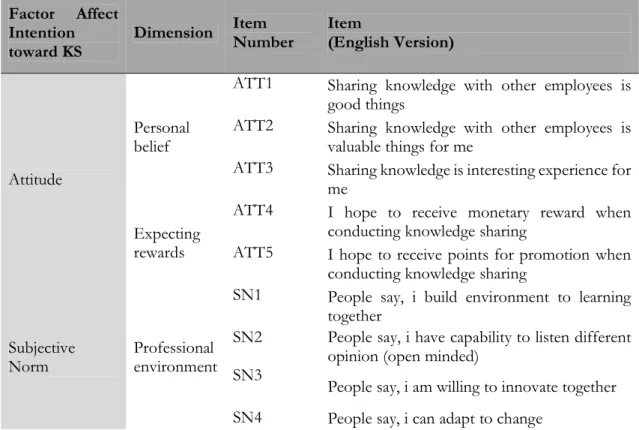
Table 7 Questionnaire
Factor Affect Intention
toward KS Dimension
Item
Number Item (English Version)
Attitude
Personal belief
ATT1 Sharing knowledge with other employees is good things
ATT2 Sharing knowledge with other employees is valuable things for me
ATT3 Sharing knowledge is interesting experience for me
Expecting rewards
ATT4 I hope to receive monetary reward when conducting knowledge sharing
ATT5 I hope to receive points for promotion when conducting knowledge sharing
Subjective
Norm Professional environment
SN1 People say, i build environment to learning together
SN2 People say, i have capability to listen different opinion (open minded)
SN3
Factor Affect Intention
toward KS Dimension Item Number
Item
(English Version)
Perceived Behavioral Control
Method
PBC1 Knowledge sharing method in my company can be done easily
PBC2 I am satisfied with knowledge sharing method in my company
PBC3 Knowledge sharing method in my company can be customized to fit individual needs
Technology
PBC4 I am satisfied with the quality of Kampiun PBC5 Kampiun is an effective platform for
conducting knowledge sharing PBC6 Kampiun is easy to access Intention
towards knowledge sharing
INT1 I have intention to do knowledge sharing