http://www.sciencepublishinggroup.com/j/ajnc doi: 10.11648/j.ajnc.20170605.11
ISSN: 2326-893X (Print); ISSN: 2326-8964 (Online)
Roadmap and Challenges to the Deployment of 4g Lte
Network: The Nigerian Experience
Okene Ese David
*, Emmanuel Ighodalo Okhueleigbe
Department of Electrical and Electronics Engineering, Federal University of Petroleum Resources Effurun, Effurun, Nigeria
Email address:
[email protected] (O. E. David) *
Corresponding author
To cite this article:
Okene Ese David, Emmanuel Ighodalo Okhueleigbe. Roadmap and Challenges to the Deployment of 4g Lte Network: The Nigerian Experience. American Journal of Networks and Communications. Vol. 6, No. 5, 2017, pp. 74-78. doi: 10.11648/j.ajnc.20170605.11
Received: September 26, 2017; Accepted: October 24, 2017; Published: December 8, 2017
Abstract:
Nokia, a leading equipment vendor, named Nigeria as a "priority country" in March 2014, when it announced it was expanding its presence with the opening of a new office in the country's largest city Lagos, and an overhaul of its existing office in capital city Abuja. [1]. Nigeria, therefore, present a huge market potential in the telecoms world. However, this potential has not been fully tapped as broadband penetration is abysmally low. Also, next generation technology is needed to drive the Internet of Things (IoT), Artificial Intelligence, Smart Cities and various smart innovations technology can avail. [2]. This research looked at how these problems could be tackled through the deployment of 4G LTE. It was found that for the 4G LTE network to be successfully deployed across the whole of Nigeria, certain factors had to be addressed. Some of these factors include, spectrum challenge, challenges in the implementation of hard handover, inability to acquire 4G LTE enabled devices due to low-income base of users, inadequate number of base stations and problem integrating 4G equipment with existing legacy networks.Keywords:
LTE, 4G, Handover, OFDMA, MIMO, SAE, Refarming, Nigeria1. Introduction
Nigerian is currently making efforts to increase its broadband penetration from its current level of 8% to 30% by 2018. This attempt is still far behind International Telecommunications Union (ITU’s) target of 40% by 2015 for developing countries. The situation is further compounded by the fact that 90% of telecom services in Nigeria are deployed through wireless means since there is near total absence of an active fixed telephone infrastructure [3]. Broadband is to the 21st century information age what electricity was to the industrial age. It has significant transformative effect on how people live and work [4].
Another area of concern is that the small population of subscribers of 8% that currently have access to broadband cellular services in Nigeria, are currently experiencing poor services and the situation could worsen due to increasing number of mobile users and limited spectrum. In addition to this, the functionalities of mobile phone are becoming more
complex and the usage patterns of mobile subscribers is changing rapidly. For example, an average length You Tube Video can generate the same amount of traffic to the network as 500,000 SMS (Raeke, 2010). According to [5], Forty hours of high-definition video generate as much traffic as a million email messages. Higher data rates are required to support such usage patterns. To the operators, the most challenging aspect of this trend is that as demand for higher data increases, mobile users are also demanding for lower prices! How can operators overcome this?
The solution is Long Term Evolution (LTE) also referred to as 4G. LTE is a radio access technology developed by the 3rd generation partnership project (3GPP). The benefits of 4G LTE
Table 1. User Experience.
Types of Service 3G 4GLTE
Web Surfing 8 Seconds Instantly
Download of 5MB Music 3 Minutes 1 Second
Download of 750 MB Movie 6.5 Hours 2.5 Minutes
Download of HD Video 2 to 3 Days 15 Minutes
Mobile Tv Available Available
On Demand Tv Not Available Available
Table 2. Service Providers’ Experience.
Types of Service 3G 4GLTE
Network Architecture
Contains circuit switched network
With circuit switching, once a call is established, the circuit stays in place whether someone is talking or not. IP networks are far more dynamic and share resources more efficiently. Spectrum Efficient Spectrum Higher spectrum efficiency means higher network capacity, improved cost efficiency
Reliability Few network outages Network outages are rare and, if they do occur, they are immediately identified and acted upon.
[6] [7].
Nigeria currently has four (4) active mobile network operators (MTOs) with national coverage namely; Airtel, Globacom, MTN and 9Mobile. Out of the four mobile network operators only MTN and Globacom have made substantial progress in the roll out of 4G LTE network across major cities of Abuja, Lagos, Port-Harcourt and others. However, internet service providers (ISPs) like Smile and Ntel have also rolled out 4G LTE services but with limited coverage and mostly for data rather than voice services. Generally speaking, the level of penetration of 4G services into the Nigerian mobile market is still at its all-time low due to some challenges, which this research hopes to highlight in section 4.0.
2. Materials and Methods
The benefits of 4G LTE are so important in the economic, infrastructural and technological development of a developing country like Nigeria. According to [8], the LTE is not a ‘YES’ or ‘NO’ but a ‘WHEN’ thing since current 3G Networks are facing the tremendous challenge to manage Smartphones data requirements. It was stated in [9] that voice was the driving force of 2G mobile communication, video and data were for 3G and in the case of 4G low-cost and high-speed data are the dominant driving force. He went ahead to describe the benefits of 4G over 3G such as higher data rates, increased capacity among others. He, however, identified one of the challenges to the successful deployment of 4G as its inability to meet up with content based interactive videos. [9], did not address core challenges to the roll-out of 4G LTE services such as complexity in LTE handover process or the problem of support for voice quality in an all-IP network like LTE.
[10], carried out a comparative study on the performance of 3G and 4G LTE networks. Based on his findings, he stated that 4G LTE network performed better than 3G network in the areas of interoperability, latency, scalability, convergence, data rate, among others. He identified some of the challenges to LTE deployment to include: interference cancellation at the user terminal and VoIP. He, however, did not address challenges in the area of spectrum allocation and acquisition
of 4G enabled terminals.
This researched is aimed addressing the huge gap in literature identified as it relates to the roll-out and operation of 4G LTE network with a look at the Nigerian experience considering the huge untapped potentials Nigeria offers as reported in [1].
3. Roadmap to the Deployment of 4g Lte
Network in Nigeria
of the air interface as the network no longer has to assign fixed levels of resource to each user but can allocate air interface resources according to real-time demand. LTE will
co-exist with the WCDMA and HSPA networks that will also continue to evolve within 3GPP.
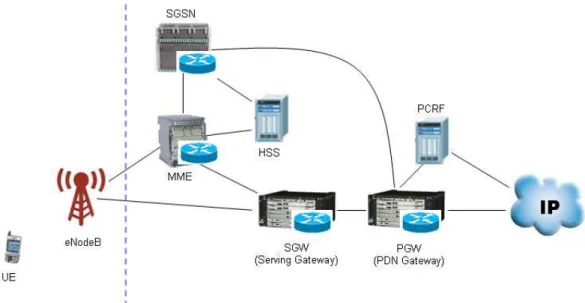
Figure 1. 4G LTE Network Architecture.
Soon after 3G, fourth generation mobile
telecommunication networks are technologies that are built to achieve the ITU’s set of standards specified by the IMT-Advanced specifications. These networks are to achieve speeds of 100Mbps at high mobility and up to 1Gbps at low mobility. This is to enable wireless systems to achieve present day wireline systems capabilities and trigger a mobile broadband revolution. Also, the 4G network is to be an ‘open wireless’ system which means it should be a network with a unified core which is accessible from different wireless (access) technologies, this is aimed at harmonizing and further standardizing all the available wireless technologies. 4G networks are also ‘all IP’ and fully packet switched networks. Services such as live TV, voice, radio, broadband etc will be replaced by IPTV, VOIP, internet radio and the likes. There is yet to be a tested and proven truly 4G network but 4G technologies so far seen are Long Term Evolution (LTE) and IEEE's WiMAX based on the 802.16x specifications. Both technologies use orthogonal frequency-divisional multiplexing (OFDM) and also MIMO antenna technology which stands for Multiple-Input Multiple-Output to achieve the high data rate required.
Key Features of 4G LTE include
(i) OFDM (Orthogonal Frequency Division Multiplex). OFDM technology has been incorporated into LTE because it enables high data bandwidths to be transmitted efficiently while still providing a high degree of resilience to reflections and interference. The access schemes differ between the uplink and downlink: OFDMA (Orthogonal Frequency Division Multiple Access is used in the downlink; while SC-FDMA (Single Carrier - Frequency Division Multiple Access) is used in the uplink. OFDMA is meant to cancel multipath fading. Multipath fading arises when more than one signal arrive at the receiver [12]. This is caused by
buildings or mountains that are too close or from the receiver. SC-FDMA is used in view of the fact that its peak to average power ratio is small and the more constant power enables high RF power amplifier efficiency in the mobile handsets - an important factor for battery power equipment.
(ii) MIMO (Multiple Input Multiple Output). One of the main problems that previous telecommunications systems have encountered is that of multiple signals arising from the many reflections that are encountered. By using MIMO, these additional signal paths can be used to advantage and are able to be used to increase the throughput. When using MIMO, it is necessary to use multiple antennas to enable the different paths to be distinguished. Accordingly schemes using 2 x 2, 4 x 2, or 4 x 4 antenna matrices can be used. While it is relatively easy to add further antennas to a base station, the same is not true of mobile handsets, where the dimensions of the user equipment limit the number of antennas which should be place at least a half wavelength apart.
(iii) SAE (System Architecture Evolution). With the very high data rate and low latency requirements for 3G LTE, it is necessary to evolve the system architecture to enable the improved performance to be achieved. One change is that a number of the functions previously handled by the core network have been transferred out to the periphery. Essentially this provides a much "flatter" form of network architecture. In this way latency times can be reduced and data can be routed more directly to its destination.
Drawbacks:
Areas of Application:
In densely populated urban areas to cater for the problem of capacity, deploying 4G in villages could be considered as wasteful because of the high cost involved. This is the reason why 2G, 3G would continue to exist side by side with 4G, thereby, giving rise to handover whenever you are moving from an area under the coverage of 4G to that of 2G or 3G. Also, since 4G is all-packet switch, voice calls or SMS on 4G LTE is impossible unless through VOIP and Internet protocol Multimedia Subsystem (IMS). Therefore, 2G and 3G will always be needed to do voice calls and SMS even with the deployment of 4G.
4. Challenges to 4g Lte Deployment in
Nigeria
Handover is a key feature in GSM (wireless Mobile) communication that ensures that mobile users remained connected to the best quality of service as they move from one cell to another. In currently deployed 4G LTE networks, operators tend to manually set parameters to default values whether optimum performance is met or not. This method is time consuming and does not effectively address the problems of hand over failure and ping-pong.
Also, despite rapid evolution in radio access technologies leading to the introduction of 4G and possibly 5G networks in the nearest future, 2G and 3G networks would still remain in use owing to the fact that it is not economical wise to deploy 4G LTE in rural areas or sparsely populated areas and they are useful in carrying voice traffic even in areas were 4G LTE is operational. Therefore, there is going to be a handover from 3G circuit switched network and 4G LTE packet switched network. This kind of handover involving circuit switched fallback (CSFB) or single radio voice call continuity (SRVCC) is generally regarded in the telecoms industry here in Nigeria as problematic.
The beauty of cellular mobile communication is that a user may travel across different cells while on a voice call or a data session without interruption. The user’s connection is handed over from one cell to another through a process called handover or handoff. Another reason why handover is also attracting a lot of attention is that is generally agreed that handover calls should have more priority than new calls [13]. A call drop caused occasioned by handover failure might be misconstrued by a mobile user as a deliberate move by the other user to end the conversation.
LTE (4G) is based on OFDMA, which is fundamentally a frequency division method. This means that a UE has to actually retune to a different set of frequency subcarriers when it hands over between cells, removing the possibility for soft handover. In fact, when a handover is beginning, an LTE UE has to go into a 'compressed mode' where it listens to its current cell for part of the time and searches for a new cell the rest of the time. With modern radio technology, this retuning can happen fast enough to make the inter-frequency retuning much more seamless than it was in older
technologies like GSM, obviating the need for soft handover. That's because LTE has flat architecture which means there's no central node controller like the BSC or RNC. Therefore, there's no need to sum up multiple active signals like you would say for in CDMA. the next sub-section.
Another challenge confronting the LTE market in Nigeria is low-income base of the majority of its customer base which has deprived them from acquiring 4G LTE enabled devices. According to [1], most people in Nigeria still exist on a daily wage of $1 (€0.89) or less, making it hard to sell the investment case for LTE rollouts to operators.
MNOs and ISPs, which currently offer 4G/LTE services have about 7,500 base transceiver stations (BTS), which recently grew from 1,500 previously. This is a far cry from the requirement of about 40,000 BTS needed for nationwide initial roll-out [2]. The implications of fewer 4G/LTE BTS are poor service delivery and limited areas of coverage.
Of course, by its standard, LTE is seen as critical in advancing broadband services, which makes it a must venture for any country that wants to improve on its broadband delivery.
The international telecommunication Union (ITU) has specified that the frequency spectrum of 700 MHz for sparse rural settlement and 2.6 GHz are the most suitable frequencies for LTE deployment. Unfortunately, the Nigerian Broadcasting Corporation (NBC) has not fully made available these frequencies for LTE services.
LTE is an all-IP technology and offers only packet-switching services. The challenge of rendering voice services which are circuit-switched in nature becomes a daunting problem. This now gives rise to voice over IP (VoIP) calls which are erratic in nature.
5. Conclusion
To accelerate the telecommunications growth in Nigeria, there is need to address the challenge of spectrum shortage. The Nigerian Communication Commission (NCC) which is the regulatory body in the Nigerian telecoms sector needs to liase with the Nigerian Broadcasting Commission (NBC) to speed track the digital migration in order to free up the spectrum being used by broadcast stations for deployment for 4G LTE services. They also need to work out an appropriate pricing model that would encourage MNOs and ISPs to speed roll-out.
The uniqueness of the Nigerian mobile market is that, subscribers are ready and willing to pay more for reliability, efficiency and faster data rates. This may serve as a guarantee that MNOs and ISPs would get returns for their investments. This assurance is vital because of the capital investment needed to roll-out of the over 40,000 BTSs needed to ensure national coverage.
References
[1] M. Carroll, "Nokia Networks Nigeria manager details LTE challenges," 15 September 2017. [Online]. Available: http://www.fiercewireless.com/europe/nokia-networks-nigeria-manager-details-lte-challenges.
[2] Admin, "http://nationaldailyng.com/nigeria-needs-40000-bts-to-strengthen-4g-services/," 15 September 2017. [Online]. Available: http://nationaldailyng.com/nigeria-needs-40000-bts-to-strengthen-4g-services/.
[3] O. Olabisi, 30 11 2015. [Online]. Available:
http://sunnewsonline.com/new/reasons-nigeria-needs-adequate-spectrum-to-deploy-broadband-services-lte/.
[4] Broadband, "Nigeria’s National Broadband Plan 2013-2018," Ngeria Government, Abuja, 2013.
[5] UMTS Forum, "Mobile Broadband Evolution the roadmap from HSPA to LTE," UMTS Forum, London, 2009.
[6] Altusuc, "Understanding the Benefits of 4G/LTE," 20 September 2017. [Online]. Available:
https://altusuc.com/understanding-benefits-4glte/.
[7] A. Lund, "The IoT Showdown and the Opportunity for 4G LTE," 15 September 2017. [Online]. Available: http://www.telecomengine.com/the-iot-showdown-and-the-opportunity-for-4g-lte/.
[8] IT Edge News, "Tough Road To LTE Deployment In Africa," 15 September 2017. [Online]. Available: https://itedgenews.ng/2013/12/01/itedgenews-com-analysis-17/.
[9] A. Rathore, R. Chaurasia, R. Mishra and H. Kumar, "Road Map and Challenges in 4G Wireless System," Journal of Electrical & Electronic Systems, pp. 1-4, 2012.
[10] A. Abioye and H. Ferreira, "Comparative Study of 3G and 4G LTE Network," Journal of Advances in Computer Networks,
pp. 247-250, 2015.
[11] 30 11 2015. [Online]. Available:
http://www.ncc.gov.ng/index.php?option=com_content&view =article&id=84&Itemid=98.
[12] D. Okene, "Global System for Mobile Communication (GSM) Transmission Process and Challenges," International Journal of Engineering Science, p. 56, 2011.
[13] A. Bhuvaneswari and R. George, "Survey on Hand Off Techniques," Journal of Global Research in Computer Science, vol. 2, no. 6, pp. 140-144, 2011.
[14] M. Weiser, "The computer of the 21st century," Scientific American, pp. 256 (3): 66-75, September. (1991),.
[15] A. Kay, "Computers, Networks, and Education," Scientific American, pp. pp. 138-148., September 1991.
[16] Gunther Gridling, Bettina Weiss, "Introduction to Microcontrollers," in Vienna University of Technology, 2007.
[17] P. Richard C. Hanley, "Development of a Personal Digital Assistant," June 2005.
[18] M. Satyanarayanan, "Pervasive Computing: Vision and Challenges," in Carnegie Mellon University (School of Computer Science).
[19] Jan Beutel et al, "Wireless Local Network for Palmtop Computers," 6th February 1998.
[20] Ladyada, "Adafruit Industries http://learn.adafruit.com/pir-passive-infrared-proximity-motion-sensor," 28 10 2014. [Online]. Available: http://learn.adafruit.com/pir-passive-infrared-proximity-motion-sensor. [Accessed 9 december 2015].
[21] R. R, "Design of New Micro Reception System," in
International Journal of Emerging Technology and Advanced Engineering, 2014.
[22] B. A. L. Steels, "The emergence of embodied Communication in artificial agents and humans", 2008, pp. pp. 229-256..