VOLUME 16 ISSUE 1 (2018), Page 130 - 143
AGEING IN PLACE FRAMEWORK AS REFERENCE GUIDE
FOR HOUSING IN MALAYSIA: LANDED PROPERTY
Siti Uzairiah Mohd Tobi1, Mohamad Syazli Fathi2 & Dilanthi Amaratunga3
1, 2
UTM Razak School of Engineering and Advanced Technology
UNIVERSITI TEKNOLOGI MALAYSIA, KUALA LUMPUR 3
School of Art, design and Architecture
UNIVERSITY OF HUDDERSFIELD, UNITED KINGDOM
Abstract
The increasing ageing population due to improved quality of life from better healthcare services and lifestyle as well as development in technology calls for better support in the ageing process. Even though the aged population dramatically increases globally, surprisingly the construction sector and the housing system seem slow in adapting to the changing needs of the ageing population. Increasing evidence show that population ageing is a pervasive and unparalleled global phenomenon which presents many challenges towards social and economic growth. Therefore, this research focuses on the provision of better support services and facilities of landed property, as well as the creation of sustainable environment that is age-friendly and safe. Data were collected using semi-structured interviews, focus group discussion and document reviews. Findings from cross sectional content analysis and cognitive mapping could enhance the standard of living for senior citizens in Malaysia in the context of ageing in place. A foundation for developing a comprehensive guideline for elderly, particularly in the urban areas, is proposed to improve the health and welfare of senior citizens in Malaysia through the provision of better services, facilities and development in landed properties.
INTRODUCTION
The ageing population is an effect from declining fertility rates as well longer life expectancy compared to previous decades (Lutz, Sanderson, & Scherbov, 2008). This is due to improved quality of life from better healthcare services and lifestyle as well as development in technology that support the ageing process. Finally, the ageing of “baby boomers”, which means the large number of children born after World War II in the United States and paralleled by similar booms in different places of the world have also lead to an increase in the number of seniors (Bloom, Boersch-Supan, McGee, & Seike, 2011). Although it is deemed as a great achievement for mankind, population ageing also brings forward some of the greatest challenges faced by our current society due to its many consequences towards the economic, social and political wellbeing of nations.
Some of these challenges include a decline in economic growth due to a shrinking work force, issues in healthcare and pension systems, increase in dependency ratio, policy changes and a changing sector more focused towards the needs of the elderly (Bloom et al., 2011; Arshad & Ahmad Bhat, 2013). Furthermore, the old age group is increasing due to a very low population growth and a growing average life span of 71.7 years for males and 75 years for females (Samad & Mansor, 2013).
Consequently, there is a necessity to increase public awareness, construct the required infrastructure, and deliver various facilities along with accomplishment-oriented research in order to look after the aged population of Malaysia (Tey et al., 2016). Since the essentials of the aged population in Malaysia for housing strategies have not been well considered, this has caused major problems concerning the delivery of suitable shelters for the aged (Sulaiman, Baldry, & Ruddock, 2006).
LITERATURE REVIEW
Definition of an Elderly Person
Ageing can be defined as a biological, sociological, economic and chronological phenomenon (Karim, 1997). In this research, the chronological definition will be used, which is in line with the United Nations’ and Ministry of Health's recommendations. Meanwhile, "the elderly or ageing population" means people aged 60 years or older. Although at the moment there is no United Nations standard numerical criterion, but the cut off age of 60 years refers to the elderly population has been adopted by many developing countries (Juni, 2015). Similarly, in Malaysia, elderly people are described as people aged 60 years and over (Ministry of Health, Labour and Welfare, 2013; Mohammad & Abbas, 2012).
On the other hand, ageing can be described as an extensive concept which comprises mental capabilities and physical alterations, social characteristics, and psychological modifications to one’s mind. Additionally, it takes into account the elderly person capability for his situation, self-care and position within family along with the social networks. These are related to their aptitude and capability to deliver on their behalf a suitable and pleasant life (Abdullah, Abdullah, & Al-Merbaw, 2013).
An ageing population is a domain that affects both developed and developing countries. Every month, one million people turn 60. Furthermore, the projected growth of elderly group will increase exponentially, and the need for resources to care for older individuals will, therefore, rise proportionately. This growth will also result in an increased incidence of degenerative diseases and disabilities. This will lead to the needs of generating knowledge how to care for this population (Abdullah et al., 2013). Accordingly, as the number and percentage of older population continue to increase, the need for extensive and current information regarding elderly persons are becoming increasingly important to be discussed (Wan-Ibrahim & Zainab, 2014).
Elderly Physical Environment
alone, and are isolated from friends and family in their homes. Thus, in order to make it safer for elderly persons to age in place, it is important to first create a safe physical environment for them to live in.
Todd and Skelton (2004) interpret the physical environment as a general definition which encompasses the home and community environment for an elderly person. This includes the housing options (own house, assisted living facility, nursing home and so on), public spaces (hospitals, supermarkets, parks and recreational spaces and more) and the spaces that connect these places together (public transport stations, pavements and walkways and so on). The National Council on Aging (2015) and Centre for Disease Control and Prevention (2016) report that one of the major risks from the physical environment for the elderly population is related to injuries from falls, which can result in lower self-esteem, reduced mobility, and serious injuries which require hospitalization. Furthermore, the barriers in the physical environment can cause mobility issues that will hamper active and healthy lifestyle habits and prevent access to much needed services and facilities within the community. Hence, it is important to develop physical environment that is suited for all community members regardless of their age and ability levels, as it will play a vital role in maintaining their quality of life.
Thus, the most recognized definition for the concept of ageing in place which has been extensively used in current studies is as follows:
“(Ageing in place is) the ability to live in one’s own home and community safely, independently, and comfortably, regardless of age, income, or ability level”. (Centre for Disease Control and Prevention, 2009).
METHODOLOGY
Accordingly, the research techniques used for main data collection process involved three approaches as follows:
Semi-Structured Interviews (Stakeholder 1 – Local Government)
The identified respondents were the Head of Departments who were involved with the welfare of elderly people and who were responsible to endorse the permission to renovate houses (landed property).
Focus group discussion (Stakeholder 2 – Community Group)
The identified respondents were the Residents Association Committee Members that comprised all three generations of family members; the parent – the children – the grandchildren. The justifications of ageing population are referred to the ‘Generation X and Baby Boomers’ age group type as below:
• Ageing people (Generation X – age group between 37-54 years old).
Document Reviews
During the case study phase, document review was also used as a supplementary technique of data collection to triangulate the data collected. Relevant government documents on elderly policy and welfare were reviewed. However, this is not be discussed in this article.
Data Analysis
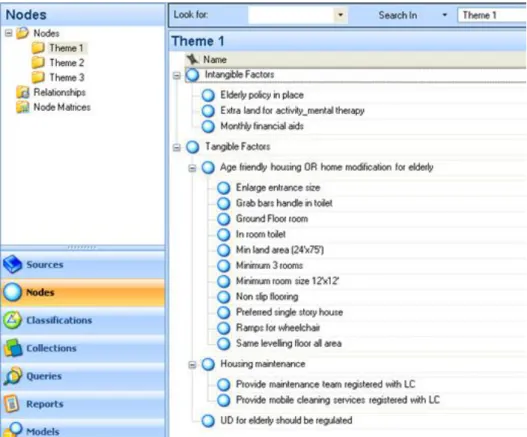
Figure 1: Summary of analysis done using NVivo11 – Theme 1
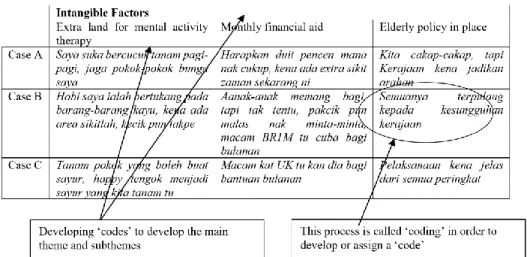
Figure 2: Example of the content analysis process – Theme 1
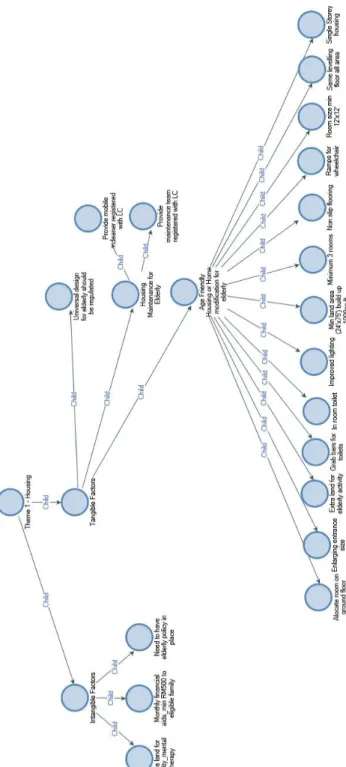
Cognitive Mapping using NVivo11
FINDINGS
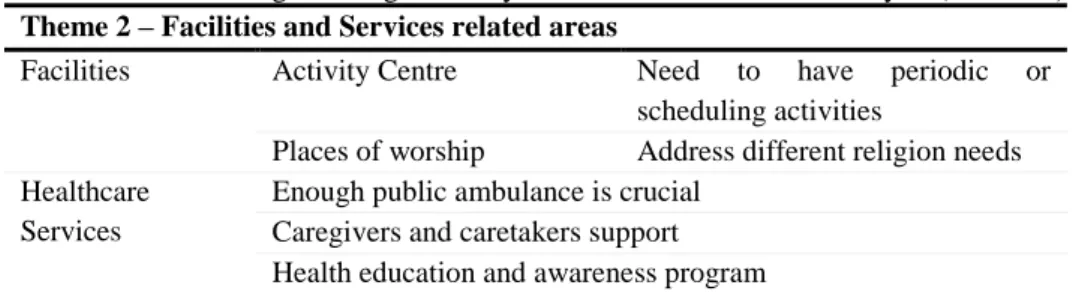
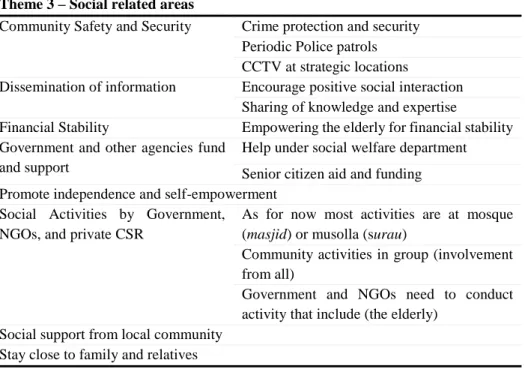
At the final stage of analysis, it was appropriate to summarize the results from the cross sectional content analysis from all cases. This process helped to accomplish both literal replication and theoretical replication and the results would stand more robustly. The summary of the results is presented in Table 1 to Table 3, grouped under the related themes.
Table 1: A matrix for generating summary of cross sectional content analysis (Theme 1)
Theme 1 – Housing related area
Intangible Factors
Extra land for activity (mental therapy)
Monthly financial aids (min RM500 to eligible families) The need to have an elderly policy in place
Tangible Factors
Age friendly housing or home modification for elderly
Allocate rooms on ground floor Enlarge entrance size
Allocate extra land Grab bars for toilet Attached toilet Install Good lighting
Minimum land area (24’x75’) Minimum three rooms Minimum room size (12’x12’) Non slip flooring
Ramps for wheelchair Same levelling floor all area Single storey housing are preferred Housing Maintenance for
elderly
Provide mobile cleaning services registered with LC
Provide maintenance team registered with LC
Universal Design (UD) for elderly should be regulated
Table 2: A matrix for generating summary of cross sectional content analysis (Theme 2)
Theme 2 – Facilities and Services related areas
Facilities Activity Centre Need to have periodic or
scheduling activities
Places of worship Address different religion needs Healthcare
Services
Mobile clinic and mobile Doctor Nearest public clinic is essential
Visit or routine medical check-up from the nearest hospital
Transportation and mobility
Increase the frequency of buses and local commuter trains Provide local transport to the community (for self-manage) Smaller transport such as mini buses, vans, and cars
Various pick up points for public transport (that cover the inside area)
Table 3: A matrix for generating summary of cross sectional content analysis (Theme 3)
Theme 3 – Social related areas
Community Safety and Security Crime protection and security Periodic Police patrols CCTV at strategic locations
Dissemination of information Encourage positive social interaction Sharing of knowledge and expertise
Financial Stability Empowering the elderly for financial stability Government and other agencies fund
and support
Help under social welfare department
Senior citizen aid and funding Promote independence and self-empowerment
Social Activities by Government, NGOs, and private CSR
As for now most activities are at mosque (masjid) or musolla (surau)
Community activities in group (involvement from all)
Government and NGOs need to conduct activity that include (the elderly)
Social support from local community Stay close to family and relatives
RECOMMENDATIONS
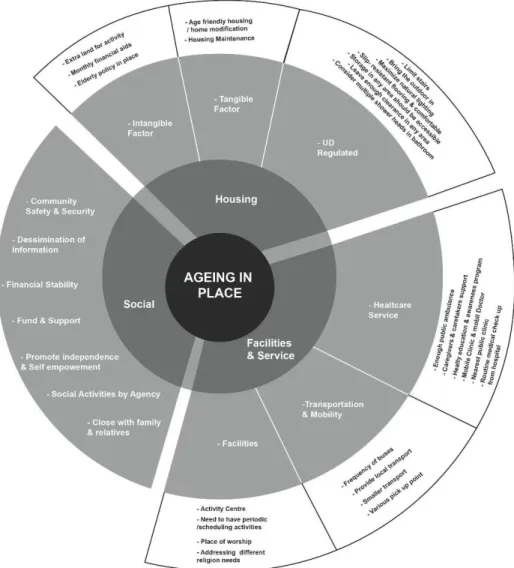
The Proposed Framework for Ageing in Place Guideline
Figure 4: Framework for ageing in place guideline
CONCLUSION
This study has followed a rigorous research process by using multiple embedded case studies to gain an in-depth explanation through various measures, which have been done by using multiple data collection methods. However, there were limitations which were associated with limited stakeholders’ involvement, towards seeking factors that contribute towards developing the proposed framework. The identified stakeholders came from two target groups, namely the community and representatives from local councils. Therefore, at this stage, the researchers were only seeking opinions and in depth understanding on the related area of focus in this study.
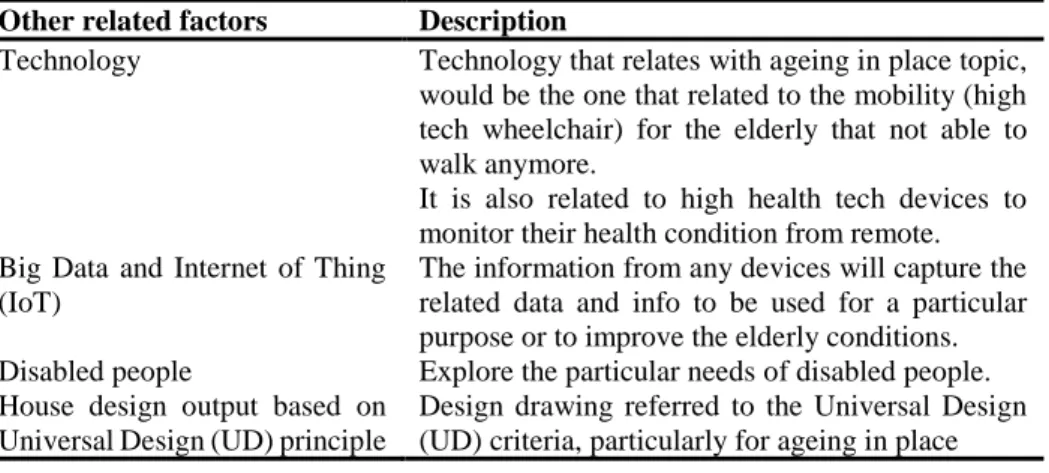
Further investigation needs to be done in order to improve and refine the findings before the final guideline can be developed. Future research can also examine other factors that can further refine the guidelines for ageing in place in Malaysia as shown in Table 4.
Table 4: Other related factors in developing the ageing in place guideline
Other related factors Description
Technology Technology that relates with ageing in place topic, would be the one that related to the mobility (high tech wheelchair) for the elderly that not able to walk anymore.
It is also related to high health tech devices to monitor their health condition from remote. Big Data and Internet of Thing
(IoT)
The information from any devices will capture the related data and info to be used for a particular purpose or to improve the elderly conditions. Disabled people Explore the particular needs of disabled people. House design output based on
Universal Design (UD) principle
Design drawing referred to the Universal Design (UD) criteria, particularly for ageing in place
ACKNOWLEDGEMENT
REFERENCES
Abdullah, O. C., Abdullah, M. S. Y., & Al-Merbaw, A. (2013). Ageing population in developed countries: A study of process and phenomena. Middle-East Journal of Scientific Research, 17(2), 219-225.
Arshad, M., & Ahmad Bhat, S. (2013). Global ageing trends: A sociological perspective.
International Journal of Current Research and Academic Review, 1(4), 55-64. Bloom, D. E., Boersch-Supan, A., McGee, P., & Seike, A. (2011). Population aging:
Facts, challenges, and responses. PGDA Working Paper No. 71.
Carter, S. E., Campbell, E. M., Sanson-Fisher, R. W., Redman, S., & Gillespie, W.J. (1997). Environmental hazards in the homes of older people. Journal of Age and Ageing, 26, 195-202.
Centre for Disease Control and Prevention. (2009). Healthy places terminology. National Center for Environmental Health.
Centre for Disease Control and Prevention (2016). Important facts about falls: Home and
recreational safety. Retrieved 10 October 2016 from
http://www.cdc.gov/homeandrecreationalsafety/falls/adultfalls.html
Joseph, A. (2006). The role of the physical and social environment in promoting health, safety, and effectiveness in the healthcare workplace. The Center for Health Design, Issue Paper 3 November 2006.
Juni, M. H. (2015). Ageing population: A public health implications. International Journal of Public Health and Clinical Sciences, 2(3).
Karim, H. (1997). The elderly in Malaysia: Demographic trends. Medical Journal of Malaysia, 52(3), 206-212.
Kirby, S. D. (2004). A housing safety checklist for older people. North Carolina Cooperative Extension Service.
Lavin, T., Higgins, C., Metcalfe, O., & Jordan, A. (2006). Health impacts of the built
environment: A review. Retrieved from
https://www.publichealth.ie/publications/healthimpactsofthebuiltenvironmentarevi ew.
Lutz, W., Sanderson, W., & Scherbov, S. (2008). The coming acceleration of global population ageing. Nature,451, 716-719.
Ministry of Health, Labour and Welfare (2013). Country Report Malaysia. Retrieved
October 3, 2016, from
http://www.mhlw.go.jp/bunya/kokusaigyomu/asean/2013/dl/Malaysia_CountryRe port.pdf.
Mohammad, N. M. N., & Abbas, M. Y. (2012). Elderly environment in Malaysia: Impact of multiple built environment characteristics. Procedia - Social and Behavioral Sciences, 49, 120-126.
National Council on Aging (2015). There's no place like home - for growing old. U.S. Department of Health and Human Services.
Netherlands Board for Healthcare Institutions. (2008). Quality of the physical health care environment. Status of research on environmental variables and the effects on (sick) people (Report number 617).
Samad, S. A., & Mansor, N. (2013). Population ageing and social protection in Malaysia.
Stevens, M., Holman, C.D., & Bennett, N. (2001). Preventing falls in older people: Impact of an intervention to reduce environmental hazards in the home. Journal of the American Geriatrics Society, 49(11), 1442-1447.
Sulaiman, N., Baldry, D., & Ruddock, L. (2006, April). Issues concerning housing for the elderly in Malaysia. 6th International Postgraduate Research Conference, April 6-7, 2006, Delft University of Technology, the Netherlands.
Syed Abdul Rashid, S. N., Mohd Yusuff, R., Hamid, T. A., Goh, S. C., & Hussain, M. R. (2006). Ageing-in-place: Towards an ergonomically designed home environment for older Malaysians. Gerontechnology, 5(2), 92-98.
Tey, N. P., Siraj, S. B., Kamaruzzaman, S. B. B., Chin, A. V., Tan, M. P., Sinnappan, G. S., & Muller, A. M. (2016). Aging in multi-ethnic Malaysia. Gerontologist, 56(4), 603-609.
Todd, C., & Skelton, D. (2004). What are the main risk factors for falls among older people and what are the most effective interventions to prevent these falls? Health evidence network report. Copenhagen, WHO Regional Office for Europe.
Wan-Ibrahim, W., & Zainab, I. (2014). Some demographic aspects of population aging in Malaysia. World Applied Sciences Journal, 30(7), 891-894.