VOLUME 17 ISSUE 1 (2019), Page 250 – 266
SUPPLY OVERHANG OF AFFORDABLE HOMES: A SURVIVAL ANALYSIS ON HOUSING LOANS APPLICATION
Rosylin Mohd Yusof1, Sirajo Aliyu2, Shazida Jan Mohd Khan3, & Nurul
Huda Abdul Majid4
1Othman Yeop Abdullah Graduate School of Business (OYAGSB) 2Islamic Business School
3School of Economics, Finance and Banking
UNIVERSITI UTARA MALAYSIA
4UNIVERSITI UTARA MALAYSIA, KUALA LUMPUR CAMPUS
Abstract
This study aims to investigate the issue of supply overhang of affordable homes and financial exclusion in the Malaysian housing market. It seeks to decipher the issue of unaffordability of homeownership from the financing perspective as offered by the financial institutions in Malaysia. By employing survival analysis via Kaplan-Meier survival estimates for the period covering Q1:2009 to Q4:2014, our findings suggest that higher inflation rate and lower house price volatility may reduce the likelihood for home loans exclusion and thus allow banks to allocate higher loan disbursements. Meanwhile, higher interest rate excludes clients from having access to finance where the compounding effects of interest shows increased hazards of exclusion among the home loans clients. Understanding the determinants of financial exclusion is, therefore, a pertinent issue to be addressed for potential house buyers to be aware of in order to increase the probability of access to financial services. To the financial institutions, identifying the determinants of financial inclusion will assist them to design products that are more marketable. For the policymakers, the findings of the study will shed some light on the policy ramifications towards promoting affordable homeownership in achieving sustainable development goals as outlined by the United Nation.
INTRODUCTION
It was reported that there is supply overhang of affordable homes developed by PRIMAi. As of November 15, 2017, PRIMA managed to sell only 12,640 units of affordable homes out of 25,132 units open for sale. In Kuala Lumpur (the capital, with the going price greater than RM400, 000, the number of units sold constitutes only 42 percent of units open for sale. BNM also noted that house prices are indeed beyond the mean of the majority of buyers who qualify for affordable homes. There were a lot of rejections for applying for loans because houses are above RM 250,000. These potential buyers are generally excluded from getting access to financing in order to buy homes.
Access to finance is one of the major determinants considered for homeownership. Therefore, homeownership financial inclusion is nested within the ability and capability of an individual to have access to funding. In Malaysia, getting access to funds for a home buyer is a pressing issue. With the spikes of property market prices in the past fifteen years together with vulnerabilities of the economic fundamentals and increasing cost of living relative to the increase in income, the adverse effects on the financing affordability to own homes seems to be more profound. In some scenarios, access to particular financial services is denied even though potential borrowers have established financial relations with a particular lending institution. Understanding the determinants of financial exclusion is, therefore, a pertinent issue to be addressed for potential house buyers to be aware of, in order to increase the probability of access to financial services. To the financial institutions, identifying the determinants of financial inclusion will assist them to design products that are more marketable. For the policymakers, the findings of the study will shed some light on the policy ramifications towards promoting affordable homeownership in achieving sustainable development goals as outlined by the United Nation.
This present paper employs survival analysis on the number of loans application by potential home buyers and approval time of loans by the financial institutions. The financial institutions covered in this study include Islamic Banks, Conventional Banks, Investment Banks and Merchant Banks operating in Malaysia from the year 2006 until 2014. This study also focuses on analysing the increasing gap between loans applied and approved housing loans during the period of Q1: 2006 to Q4:2014 to unravel the link between loans applied and loans approved for potential house buyers.
LITERATURE REVIEW
plans.The objective of the policies is to provide affordable and adequate housing to the low-income and middle-income groups. According to Hawtrey (2009) the term “affordable housing” relates to those who are housed but are in housing stress. However, in Malaysia the affordable house may refer to houses with ‘appropriate prices’ that may be affordable to be owned by those considered as low income and middle -income groups. As depicted in Figure 1, the housing loan was increasing in up to 2013 but went on a sharp drop in the first quarter of 2014. The following quarters shows the some increment in the number of applied loan but at a slower phase. The above scenario illustrates the exclusion gap of the aggregate home finance in the Malaysian banking sector. Nonetheless, the factors responsible for the exclusion cannot be easily determined from the descriptive trend analysis. Therefore, further inferential analysis is used to assess the major macroeconomic that can predict home financing exclusion in Malaysia.
Figure 1: Home financing gap in Malaysia 2006-2014
Source: Bank Negara Malaysia Annual Report (2014)
Based on the current economic condition in Malaysia and the increasing uncertainties in the banking sector, developments in the housing market can have an important impact on financial stability. Rigorous changes in house prices may impact the demand for credit by the households and balance sheets of banking institutions. The uncertain developments in the property sector may lead to excessive lending debt accumulation by both household and developers. Yet, in the event of sharp downward adjustments in house prices, the impact on the balance sheets of banking institutions could be severe, with significant risks to financial instability (BNM, 2012).
determinants of housing affordability (Panagiotidis & Printzis, 2015; Wong, Hui, & Seabrook, 2003; McGibany & Nourzad 2004). Debelle (2004) described household borrowing had increased considerably in a number of developed countries over the past two decades, both in absolute terms as well as relative to household incomes. Accordingly, with current Malaysian economic condition, the same impact may now be exerting its pressure for developing countries. In addition, most households having multiple mortgages were found to be very sensitive to small changes in interest rates because of the impact on their incomes and asset prices and this therefore reinforces the income constraints faced by households in Malaysia (Debelle, 2004; Osman, Khalid, & Yusop, 2017). It is interesting to note that no specific past study has looked into the Malaysian scenario in terms of financial exclusion in particular. Yet, this issue relates to the existing complexity of getting mortgage loans among applicants and therefore seeks to answer the question of why the gap between loans applied and loan approved is widening through the years.
DATA
Banks as intermediaries provide home finance based on mortgage principles. Although, rate of interest, lower income of the client, employment status, banks’ financial preference among others are some of those factors that lead to home financing exclusion.
The present study also uses a proxy to represent income status based on per capita income as measured by gross domestic product divided by the number of population. The indicator stands as a yardstick to approximate the income level of the productive members of the society. During the period of analysis, the average income per capita stands at RM6, 162.01. However, banks normally consider other factors apart from income and employability of an applicant in granting loans. These factors include interest rate and the purpose of the loans among others. For instance, bankers set a benchmark on the return for home finance based the interest margin in relation to house price changes. As such, the interest rate is also considered a major determinant to loans approval in the conventional system, whereas Islamic banks set house price index as the benchmark in determining the rental index to diminishing partnership of home finance. Thus, as evidenced in The value of our data for house price index was 7.80 percent while interest rate was at 2.89. Despite the lower variation of the interest rate, it will not conclude any inferential power on the parametric analysis at this stage.
which is close to its average of 104.2. The survival analysis adopted in this study was generated based on time and failure (which in this case, we regard it as exclusion) as explained in the following methodology section. Therefore, in this context, since there is a gap (as illustrated in Figure 1 above) between loans applied, loans approved and disbursed home financing, we apportioned a limit for each of the identified case of financial exclusion. For Case 1, we assumed at least 70% of the number of loans applied as a percentage of the aggregate home financing was approved by the Islamic, commercial and investment banks. Thereafter, we realized that in most cases the 70% was not feasible except in the case of the investment bank, and then we reduced to 60% and even 50% (i.e. half of the amount applied). In this case, for each bank type (Islamic, commercial or investment) that was able to approve the amount applied to 60% scored zero, and otherwise one, to form the exclusion as a dependent variable against time variant. Similarly, we did the same calculation when 50% of the loans applied to get approved by the selected financial institutions.
METHODOLOGY
Survival analysis is commonly used in the banks survival literature, although it is earlier applied in other disciplines such as medical science, biology, engineering, economics, and social sciences. The early application to banking study began with the work of Lane, Looney and Wansley (1986) using non-parametric and parametric of Cox proportionate hazard model. Thereafter, the Cox (1972) model became established to the subsequent banks on time to failure (Whalen, 1991; Wheelock & Wilson, 2000; Pappas, Ongena, Izzeldin, & Fuertes, 2016). The probability application of survival analysis considering the work of Royston and Lambert (2011), the prime three relationships in survival analysis are transformational of survival to hazard function and the cumulative of the hazard function. Furthermore, the loan period to approval time is randomly denoted as and the application period begins at time In a nutshell, their relationship can be expressed as follows:
(1) Equation (1) represents survival function (meaning the home loan application and its approval) of the client to own a home without experiencing a rejection by the banks. Therefore, an application can be considered as failed if the bank denied the application due to insufficiency of documentation requirement and/or illiquidity of the financial institution to settle the funding request on demand. Therefore, the period in which client makes the application and the conditional period that can lead to the subsequent approval can be expressed as follows:
( );
S t h t( );
( )
H t
T t=0.
( ) Pr( )
(2)
Equation (2) is derived from the termed conditional exclusion (failure) rate due to limit interval of time and the possibilities of the loan application to be approved from the application period at an interval time (Cleves, Gutierrez, Gould, & Marchenko, 2010; Rabe-Hesketh & Skrondal, 2012). Likewise, equation (3) expresses the accumulated client’s risk of exclusion from the application period to an event (i.e. approval or rejection).
(3)
Importantly, can be expressed as the inverse of in this form: (4) (5) (6) However, is the hazard cumulative distribution function, and the probability density function is expressed as: An extensive picture of examining the inclusion case begins with the non-parametric survival analysis based on the Kaplan-Meier (Kaplan & Meier, 1958). The Kaplan-Meier non-parametric hazard proportionate analysis is derived as:
(7) The Kaplan-Meier survival probability at a time is , i, referred to
individual customer event experiences or right censoring at a time
, is the client’s censor or inclusiveness times, which is less
than t. The notation begins with the client observation at and is the disapproval count. Therefore, the proportionate percentage of client exclusion is utilized at the time of the event (exclusion) in the event where it is below fifty percent or sixty percent for the second analysis. Conversely, the cumulative hazard function is originated from the work of Nelson-Aalen which is expressed as follows:
(8) 0
Pr( | )
( ) lim t T t t T t
h t t
→ + =log ( )
d S t dt
= −
0
( ) ( )
t
H t =
h u du( )
S t H t( )
( ) exp{ ( )}
S t = −H t
( ) ln{ ( )}
H t = − S t
( ) ( ) / ( )
h t = f t S t
1−S t( )
( ).
f t
( )
i
i i
t t i
n
d
S t
n
−
=
t S t( )
(i=1, 2, 3,... )n
t
ii
n
t
id
i0
( ) ( )
t
The cumulative hazard function is determined by the integration of the exclusion (failure) in a multiplicative term. Furthermore, extending the analysis to parameterization using the macroeconomic covariates is estimated with the aid of Cox model. The Cox model examined the case of financing inclusion in the form survival analysis where the vector of a covariate influencing inclusiveness of the clients. This covariate includes house price index, interest rate, consumer price index, and GDP per capita. Therefore, the functional equation can be extended with the insertion of other assumptions that will give the real picture of the scenario. With this, let’s consider clients and the survival dataset with time to event and have a tri-variate
response . The is the bank’s establishment period while is
last observation period for the bank and is the failure indicator which
is representing or right censoring of; . Similarly, adding unobserved random effects to the panel is assumed to satisfy the properties of independent and identically distributed (iid)
(9) Following Royston & Lambert (2011), the study extends to investigate the hazard of home finance exclusion using piecewise exponential model: (10)
Banking institutions provide an intermediary role between the economic agents in the society. The surplus and deficit agents of the society meet indirectly through banks to solve their immediate financial needs. Nonetheless, banks have other criteria in which the client must fulfil before loans disbursement. Thus, the disparity between home loans applied and home loans approved is the gap in which can be expressed as funding gap in the literature. Following DeYoung and Jang (2016), home financing gap = loan applied – loan approved > 0.
Positive financing gaps require banks to extend their funding through inclusiveness to reduce homeownership exclusion. Meanwhile, balanced finance between loans applied and loans approved is expected as long as clients fulfil all the requirements for the loans to be approved. Notwithstanding, banks exclusion becomes necessary in the event where loans requirements are insufficient for the banks to approve financing. Similarly, banks decline access to funds due to short of liquidity at their disposal which can be settled through short-term funds mobilization such selling of liquid assets. Therefore, this study creates a benchmark for the net home financing gap at fifty and sixty percent respectively. In a situation where fifty percent of the home loans applied is approved in a particular month, the dummy was coded zero and was coded one if less than fifty percent of home loans applied get approved. Similar coding procedure was
( )
H t
X
1,...,
i= n
t
0
( , , )
t t d
t0 (t0 0), t0
(tt ) d
1
d = d =0
is2
(0, ).
N
( )ij exp( ij i)
h t = X +
( / ) exp( )
ij i j i
applied in the case where sixty percent of the home loans applied get to be approved. Thereafter, survival method of analysis procedure is employed to estimate financial inclusion which represents the proportion of the survived, while the excluded portion is regarded as those facing hazard.
Figure 2: The Benchmark of fifty percent
RESULTS AND DISCUSSION
Our results begin with the non-parametric survival estimates of Kaplan-Meier product limit analysis as depicted in Figure 2. The first proportion of the fifty percent benchmark indicates that Islamic banks failed to provide at least fifty percent those loans applications from the period of January-May 2007. However, more than half of the amount applied through Islamic banks in Malaysia was settled between July and November 2007. As a result, the initial period of Islamic banks exclusion to home financing indicates downward sloping due to their failure to approved at least fifty percent benchmark (i.e. period 1-5). Thereafter, the survival curve becomes horizontally flat between period 6 and 11, and steeps down immediately when the Islamic banks exclude more than half the home finance loans at period 12. The situation continues in the same pattern to all types of banks as when they exclude their clients from financing the curve is declining, while staying horizontally at the time of inclusion.
home finance applications between January 2007 and February 2010 which covered 38 periods. Nonetheless, the commercial banks exclude half of their applied home finance within the range of periods 60-65 (i.e., December 2011-May 2012), 78-83 (i.e., June 2013-November 2013), and 86-90 (i.e., February 2014-June2014). However, the commercial banks in the country were able to approve more than half of the applied home finance from July 2014-December 2014 (i.e., 91-96). However, Malaysian investment banks are often approving more than half of the loans applied due to their business structure and characteristic of their customers which are mostly investment companies. As a result, the survival curve of the investment banks is above all other banks and their customers have a high rate of inclusiveness compared to other banks. In sum, the survival curves illustrate that investment banks are more prompt to approve at least half of the housing loan applied. Consequently, commercial banks perform comparatively better than Islamic banks up to period 85 (January 2014) and since the survival curve of the latter is lower compared to the former. However, an Islamic bank performs much better than commercial banks in terms of inclusiveness between February 2014 and December 2014 (i.e., period 86-96). The performance of Islamic banks at this juncture indicates some improvement in the industry which further necessitate the study to adjust the benchmark to sixty percent in order to explore more information concerning three banking performance (Islamic, commercial and investment banks).
Further analysis investigates the situation on the benchmark of least sixty percent which has excluded investment banks from deeper analysis. Although the trend of the analysis in Figure 3 seems to mimic that of fifty percent, but it serves as a guide in terms of identifying the types of banks that have grant customers more access to home loans. In essence, investment banks have higher inclusiveness of home financing compared to Islamic and commercial banks. Although, the Islamic banks have lower home financial inclusion up to a point where it intersected commercial and aggregate banks around period 81 (i.e., October 2013). After that, Islamic banks perform better than commercial and aggregate of the banks respectively. Consistently with the prior benchmark of the fifty percent, the behaviour of financial inclusion offered by the aggregate banks is similar to that of commercial banks in the later benchmark (sixty percent). Besides, the study extends to investigate the comparison of inclusiveness using survival rate table.
Figure 3: The Benchmark of sixty percent
Table 2 highlights ten outcomes of the inclusive rate per bank based on the allocated benchmark. For instance, the first two months of 2007 indicate that commercial, investment and aggregate banks approved at least fifty percent of home finance applied, that is, it indicates 100 percent, whereas Islamic banks fails approve at least fifty percent of the loans applied.
Table 2: Comparison of the survival estimates Fifty percent approved
Time Comm. Islamic Invest Aggregate
2007M01 1.0000 0.9896 1.0000 1.0000
2007M12 1.0000 0.9368 1.0000 1.0000
2008M11 1.0000 0.8548 0.9865 1.0000
2009M10 1.0000 0.8182 0.9865 0.9841
2010M09 0.9464 0.6989 0.9512 0.8971
2011M08 0.9047 0.6016 0.9098 0.8208
2012M07 0.7580 0.4604 0.9098 0.7068
2013M06 0.5385 0.3781 0.8311 0.5069
2014M05 0.2475 0.3004 0.7333 0.4119
2014M12 0.2121 0.3004 0.7333 0.4119
2007M01 0.9896 0.9896 1.0000 0.9896
2007M12 0.9575 0.9154 0.9890 0.9472
2008M11 0.8860 0.8054 0.9756 0.8765
2009M10 0.7645 0.7056 0.9756 0.7562
2010M09 0.6288 0.5804 0.9407 0.6221
2011M08 0.4932 0.4552 0.8998 0.4879
2012M07 0.3576 0.3300 0.8998 0.3537
2013M06 0.2219 0.2049 0.7846 0.2196
2014M05 0.0863 0.1526 0.6923 0.0854
2014M12 0.0000 0.1526 0.6923 0.0000
In the same period, only investment banks are able to maintain sixty percent benchmark whereas the remaining banks experience a shortfall at that moment. However, all the banks under review experience exclusions before September 2010, where none of them are able to approve 100 percent loans at the identified benchmarks of sixty and fifty percent. Consequently, as observed earlier, investment banks performed comparatively better in terms of inclusiveness due to the nature of their businesses and customers’ strength. Despite that, the aggregate data of the banks explains the close association with commercial banks behaviour at sixty percent benchmark compared to the fifty percent especially around 2013 to 2014. Islamic banks’ inclusion appears lower than that of commercial banks during the month of July 2012, while the bank performed better in the month of May 2014 and December 2014 respectively since it crossed both commercial and aggregate banks values some time in 2013. In sum, despite the performance of the commercial banks in the early stage of the analysis toward inclusiveness, Islamic banks adjusted to better home finance inclusiveness in the most recent period which is closer to their maqasid shariah objective (Aliyu, Hassan, Mohd Yusof, & Naiimi, 2017).
also affect the aggregate of banks to have higher percentage after adding with commercial banks.
In the third quarter of 2013, the performance of the Islamic banks recorded more than sixty percent of the home finance is approved whereas the commercial banks exhibit consistent hazard exclusion between 2009q2 and 2014q4. Consequently, Islamic banks illustrate inclusiveness at the last three observation periods (2014q2-2014q4). The probability of not having the exclusion recurrence is increasing throughout the trend of our results. For instance, at period 2009q1 the inclusion rate is 85 percent exp (-0.167 x 1), while the exclusion hazard values are continuously reducing at time variation up to period 2013q2 which accounted for 96 percent exp (-0.0455 x 1). Meanwhile, commercial banks maintained the inclusion probability at 96 percent at 2013q3, whereas Islamic banks were able to approve more than sixty percent of the applied housing loans.
Table 3: Hazard of exclusion by time
Time Islamic
Bank
Commercial Banks
Aggregate Banks
2008Q1 1.000 6.02E-08 1.96E-08
2008Q2 0.500 0.500 0.500
2008Q3 0.333 6.02E-08 0.333
2008Q4 0.250 0.250 0.250
2009Q1 0.200 0.200 0.200
2009Q2 0.167* 0.167* 0.167*
2009Q3 0.000 0.143* 1.96E-08
2009Q4 0.125** 0.125** 0.125**
2010Q1 0.111** 0.111** 0.111**
2010Q2 0.1000** 0.1000** 0.100**
2010Q3 0.0909** 0.0909** 0.0909**
2010Q4 0.0833** 0.0833** 0.0833**
2011Q1 0.0769** 0.0769** 0.0769**
2011Q2 0.0714*** 0.0714*** 0.0714***
2011Q3 0.0667*** 0.0667*** 0.0667***
2011Q4 0.0625*** 0.0625*** 0.0625***
2012Q1 0.0588*** 0.0588*** 0.0588***
2012Q2 0.0556*** 0.0555*** 0.0556***
2012Q3 0.0526*** 0.0526*** 0.0526***
2013Q1 0.0476*** 0.0476*** 0.0476***
2013Q2 0.0455*** 0.0454*** 0.0455***
2013Q3 0.000 0.0435*** 0.0435***
2013Q4 0.0417*** 0.0417*** 0.0417***
2014Q1 0.0400*** 0.0400*** 0.0400***
2014Q2 0.000 0.0385*** 0.0385***
2014Q3 0.000 0.0370*** 0.0370***
2014Q4 0.000 0.0357*** 0.0357***
Obs. 28 28 28
***p<0.01, **p<0.05, *p<0.1
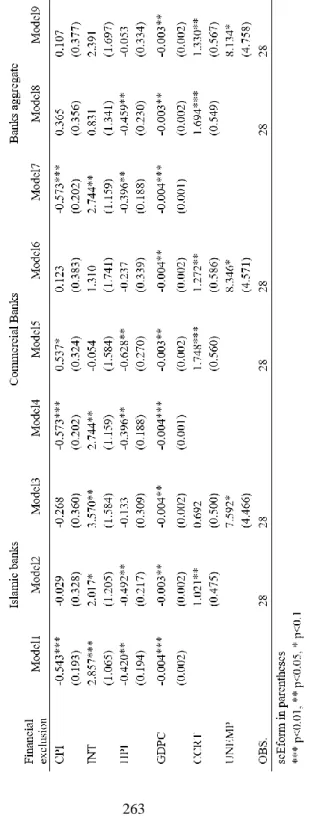
It is worth noted that, in the most recent time, Islamic banks are consistently trying to abide with the inclusiveness that reaches at least sixty percent of the applied amount, which constitutes part of their maqasid shariah objective compliance of their establishment in the last three-quarters of our sample. In contrast, though inclusiveness to sixty percent of housing loan approved was increasing at the side of commercial banks, but efforts are required to fill up the 4 percent hazard of exclusion during the last three periods of our sample. Nonetheless, apart from time-dummy of exponential analysis, the study extends parameterisation of macroeconomic covariates.
CONCLUSION
For the past few years, affordable home ownership has been considered a challenge for policy makers in Malaysia. Despite many programmes launched by the Malaysian Government, few have succeeded in providing solutions to this complex issue. The government has announced the need for banking institutions to play a more active role in providing more flexibility in mortgage loans. This study proved that banks are able to provide inclusions to home buyers but at the same time uncertainties in the economy may result in downward trend of loan approval. A financial system normally provides loans to society based on societal needs. However, the challenges in the economy certainly have contributed towards the expansion in the gap between the applied and approved housing loan. There are a few important points provided by the above analysis.
1. It describes how inflation reduces the likelihood of home loans exclusion since banks increase loan disbursement during inflation with an expectation to gain more return from customers. Therefore, banking institution allocates higher financing to their client during inflation with a substantial increase of interest rate.
2. Interestingly the Islamic banks, commercial banks, aggregate banks, and the pool banks models confirm that high-interest rate excludes clients from having access to finance. The compounding effect of the interest shows increase hazards of exclusion among the home loans clients.
3. The analysis also describes a lower volatility house price index encourages banks to distribute loans to clients especially in an economically stable environment. Stability of house price index reduces the hazard of client exclusion to loans and increase chances for the client to be inclusive and have access to home ownership.
4. The findings conclude that income as an integral component of home ownership and are also a requirement considered for loans to be approved. The applicant’s income is determined based on the employability status and is used to gauge the amount to be loaned out.
ACKNOWLEDGEMENT
The authors wish to express sincere appreciation to the Ministry of Higher Education (MoHE) for funding this study under the Transdisciplinary Research Grant Scheme (TRGS) (SO Code: 13166).
REFERENCES
Aliyu, S., Hassan, M. K., Mohd Yusof, R., & Naiimi, N. (2017). Islamic banking
sustainability: A review of literature and directions for future research. Emerging
Markets Finance & Trade,53, 440-470.
Bank Negara Malaysia, B. N. M. (2014). Annual Report 2009.. Retrieved from http://www.bnm.gov.my/files/publication/fsps/en/2016/cp01_001_box.pdf Cleves, M., Gutierrez, R. G., Gould, W., & Marchenko, Y. (2010). An introduction to
survival analysis using stata. College Station: Stata Press.
Connolly, C., Georgeouras, M., Hems, L., & Wolfson, L. (2011). Measuring financial
exclusion in Australia. (n.p.): Centre for Social Impact for National Australia Bank.
Cox, D. R., (1972). Regression models and life tables (with discussion). Journal of the
Royal Statistical Society,34, 187-220.
Debelle, G. (2004, March 8). Household debt and the macroeconomy. BIS Quarterly
Review.
DeYoung, R. & Jang, Y. K. (2016). Do banks actively manage their liquidity? Journal of
Banking & Finance, 66, 143-161.
Hawtrey, K., (2009). Affordable housing finance. Basingstoke: Palgrave Macmillan.
Kaplan, E. L., & Meier, P. (1958). Nonparametric estimation from incomplete
observations. Journal of the American Statistical Association, 53, 457-481.
Khazanah Research Institute (2015). Making housing affordable. Retrieved from
http://www.krinstitute.org/assets/contentMS/img/template/editor/_FINAL_Full
_Draft__KRI_-_Making_Housing_Affordable__with_hyperlink__220815%20(1).pdf
Kumar, C., & Mishra, S. (2011, February). Banking outreach and household level access:
Analyzing financial inclusion in India. 13th Annual Conference on Money and
Finance in the Indian Economy. February 25-26, 2011, Mumbai, India. Lane, W. R., Looney, S. W., & Wansley, J. W. (1986). An application of the Cox
proportional hazards model to bank failure. Journal of Banking and Finance, 10,
511-531.
Lee, E. T. & Wang, J. W. (2003) Statistical methods for survival data analysis. Oklahoma: Wiley-Interscience.
Liu, X. (2012). Survival analysis: Models and applications (1st Edition). Chichester: Wiley.
McGibany, J., & Nourzad, F. (2004). Do lower mortgage rates mean higher housing
prices? Applied Economics, 36(4), 305-313.
Osman, M. M., Khalid, N., & Yusop, S. W. M. (2017). Housing affordability in the state
of Selangor, Malaysia. Advanced Science Letters, 23(7), 6118-6122.
Panagiotidis, T., & Printzis, P. (2015). On the macroeconomic determinants of the
housing market in Greece: A VECM approach. GreeSE- Hellenic Observatory
Papers on Greece and Southeast Europe. Hellenic Observatory, LSE, Paper No.88
Pappas, V., Ongena, S., Izzeldin, M., & Fuertes, A.M. (2016). Do Islamic banks “Live
free and die harder”? Available at SSRN 2070957.
http://ssrn.com/abstract=2070957
Rabe-Hesketh, S., & Skrondal, A. (2012). Multilevel and longitudinal modeling using stata, volumes I and II (Third Edition). College Station: Stata Press.
Royston, P., & Lambert, P. C. (2011). Flexible parametric survival analysis using stata:
Sain, M. R. M., Rahman, M. M., & Khanam, R. (2016). Financial exclusion in Australia:
Can Islamic finance minimise the problem? Australasian Accounting, Business
and Finance Journal, 10(3), 89-104.
Scenario of Malaysian Housing Loan (2016). Rehda Bulletin 8 August 2016. Retrieved
from
http://rehda.com/wp-content/uploads/2016/11/REHDA-Bulletin-08-August-2016.37.pdf
Shen, N. M. (2017,July 24). Commercial banks are giving out affordable housing loans.
The Malaysian Reserve. Retrieved from
https://themalaysianreserve.com/2017/07/24/commercial-banks-giving-affordable-housing-loans/
Whalen, G. (1991). A proportional hazards model of bank failure: An examination of its
usefulness as an early warning tool. Economic Review, 27(1), 21-30.
Wheelock, D. ., & Wilson, P. W. (2000). Why do banks disappear? The determinants of
US bank failures and acquisitions. Review of Economics and Statistics, 82(1),
127-138.
Wong, T. Y., Hui, C. M., & Seabrook, W. (2003). The impact of interest rates upon
housing prices: An empirical study of Hong Kong’s market. Journal of Property
Management, 21(2), 153-170.
___________________________________
i Perbadanan PR1MA Malaysia was established under the PR1MA Act 2012 to plan, develop, construct and
maintain high-quality housing with lifestyle concepts for middle-income households in key urban centres.