12 SAJCH February 2012 Vol. 6 No. 1
S
S
A
J
ou
rna
l of Child H
ea
lth
S
A
J
ou
rna
l of Child H
ea
lth
ARTICLE
Objectives. To describe the noise levels of popular hand-held, tabletop, crib and close-to-the-ear toys for children between the ages of birth
and 3 years in South Africa.
Design. A quantitative, non-experimental, descriptive research design was employed for this study.
Subjects. Twenty toys, 5 from each of 4 categories, were chosen from a popular toy store in South Africa. The noise levels of these toys
were measured using a sound level meter in a quiet room. The frequency spectra of the noise were analysed and compared with current international standards relating to toy safety.
Results. The majority of toys adhere to the current American Society for Testing and Materials (ASTM) International standards for toy
noise. Frequency spectra analysis revealed that the loudest continuous noise levels for all toys were recorded at the frequencies that are the most important for hearing speech.
Conclusions. There is a need to develop standards for the maximum sound output of toys, and compulsory introduction of warnings about
the noise levels of toys on the packaging and adherence to ASTM International standards for toy manufacturers are recommended.
Noise levels of toys for children between the ages
of birth and 3 years in South Africa
Karin Joubert, PhD
Megan Ellis, BA Speech and Hearing Therapy
Department of Speech Pathology and Audiology, University of the Witwatersrand, Johannesburg
Corresponding author: K Joubert ([email protected])
Noise-induced hearing loss (NIHL) in children is a growing area of concern for audiologists, who have an important role to play in the
prevention of hearing loss in children.1 One aspect of prevention is
the education of adults and children about the potentially harmful
effects on the auditory system of exposure to loud noise.2 NIHL
may negatively affect not only a young child’s ability to communicate effectively, but also their social, emotional, cognitive and behavioural
development and academic achievement.3
The mechanism of NIHL involves damage to the delicate hair cells lining the basilar membrane of the cochlea. Stereocilia, the mechano-sensing organelles of these hair cells, are deflected in a shearing motion and transform the mechanical energy of sound waves into electrical impulses for the hair cells. This results in an excitation of
the auditory nerve.4,5 Excessively loud sounds can damage or destroy
the stereocilia. The hearing damage can transpire in two ways. Brief exposure to extremely loud sounds can cause permanent damage, while continuous exposure to loud sounds wears out the hair cells and weakens their ability to recover, resulting in permanent hearing loss.
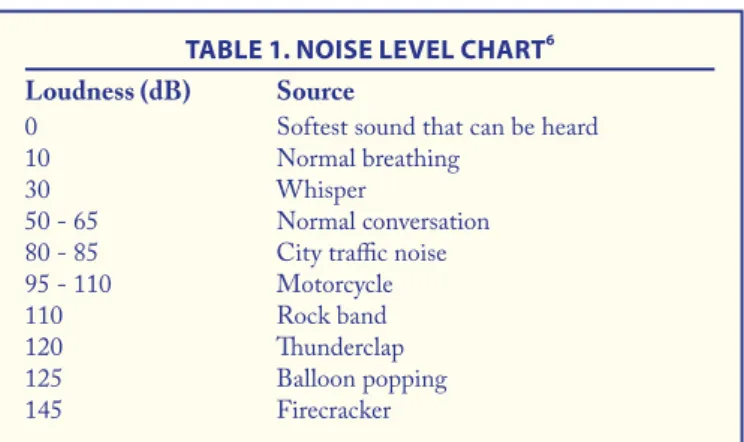
Sound intensity or loudness, measured as sound pressure level (SPL) in a logarithmic decibel (dB) scale, is used to indicate how we hear a specific sound. The point at which a person starts to hear sound is referred to as a dB of 0, while a whisper is equal to 30 dB. An average rock band performance can measure up to 110 dB and a firecracker up
to 145 dB (Table 1).6 Continuous exposure to noise of 85 dB or more
over a typical 8-hour workday can cause permanent hearing loss.5
NIHL as a result of exposure to noise from toys is common among
children.7 Of children between the ages of 6 and 19 years in the USA,
12.5% have NIHL.8 NIHL is more common in boys than in girls
between the ages of 6 and 19 years, which may be because boys are more
likely to play with noisy toys and to be involved in noisy activities.9
In Finland and Germany, 8% and 7% respectively of schoolchildren between the ages of 6 and 7 had a hearing loss of 20 dB or more at one
frequency or more.10 Interestingly, toy guns and fireworks were found
to be a major cause of hearing loss in children.11 Tympanic membrane
perforations were reported in 7 out of 53 children, while 39 out of 53 children were diagnosed with a unilateral hearing loss. Exposure to these toys was further reported to be the cause of bilateral hearing loss in 14 of the 53 children.
The current toy standards from the American Society for Testing and Materials (ASTM) International are based on product standard information that was obtained by the National Bureau of Standards in 1976. These standards are based on the Occupational Safety and Health Administration standards for adult noise exposure in an
industrial setting.12
TAbLE 1. NoISE LEVEL CHART6
Loudness (dB) Source
0 Softest sound that can be heard
10 Normal breathing
30 Whisper
50 - 65 Normal conversation
80 - 85 City traffic noise
95 - 110 Motorcycle
110 Rock band
120 Thunderclap
125 Balloon popping
The noise standards for children’s toys (hand-held, tabletop, floor and crib toys) indicate that a toy should not emit a continuous sound
greater than 90 dBSPL when measured from a distance of 25 cm.12 The
standards for close-to-the-ear toys are that they should not produce
a sound greater than 70 dBSPL when measured from 2.5 cm12 and
should not produce a sound greater than 90 dBSPL when measured from 25 cm, which is regarded as how close to the ear children are
likely to hold these toys.2 The International Standards Organization
suggests that close-to-the-ear toys should not be louder than 65 dB when measured in free-field conditions, and all other toys should not be louder than 85 dB. The Canadian Association of Speech-Language Pathologists and Audiologists advises that these standards need to be changed, as these levels are not safe enough to protect children’s
hearing.13
Research has found that a number of toys produce sounds that exceed
the ASTM International standards.7,14 It has been reported that 17
out of 25 toy cell phones and walkie-talkies produced sounds that
were either equal to or greater than 115 dBA.14 Squeaky toys and
some rattles have been found to emit sound at a level of 110 dB, while toy guns emit sound at a level of 150 dB. Musical toys have been found to emit sound at a level of 120 dB, and toy telephones at a level
of 125 dB.7 Other toys that have been found to emit sound levels
above 90 dBA include toy trumpets and whistles.15
There are currently no noise level standards specific to children’s toys in South Africa. Describing the noise levels of children’s toys is important, as this will enable audiologists to educate health care professionals and caregivers about the effects that exposure to noise from toys may have on children’s hearing. The purpose of this study was to determine the noise levels of popular hand-held, tabletop, crib and close-to-the-ear toys for children between the ages of birth and 3 years in South Africa.
Methodology
Aims
The main aim of the study was to measure the noise levels of popular hand-held, tabletop, crib and close-to-the-ear toys for children between the ages of birth and 3 years in South Africa. The sub-aims of the study were:
• to measure the frequency spectra of the noise produced by the children’s toys
• to compare the sound pressure level measurements obtained with the ASTM International standards for toy noise.
Research design
A quantitative, non-experimental, descriptive research design was employed to describe the relationship between noise levels of different types of toys measured at different distances, and the relationship between noise and different frequencies.
Materials
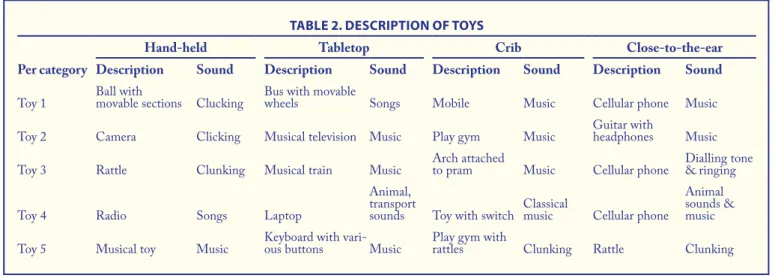
A total of 20 toys, 5 from each of the categories of hand-held, tabletop, crib and close-to-the-ear, were donated for testing by a well-known South African toy store. The most popular toys, labelled as appropriate for children aged birth to 3 years, were informally assessed and only included in the study if they created loud or continuous sounds. Seventeen of the toys were manufactured in China and 3 in Hong Kong. All the toys featured choking hazard warnings, but for only 2 (close-to-the-ear toys 3 and 4) was it stated on the packaging that as a safety precaution the sound volume of the telephones would be lower once the toy was removed from the packaging. A description of the toys is presented in Table 2.
Equipment
A recently calibrated Quest Technologies 1900 Precision Integrated/ Logging Type I sound level meter with a 1/1 - 1/3 octave filter set was used to collect data. The equipment adhered to current American National Standards Institute (ANSI) standards.
Testing environment and parameters
The sound level meter readings were recorded in a quiet, carpeted room. The environmental noise levels during testing ranged from 20 dBA to 36 dBA. The environmental noise during testing is similar
to the World Health Organization guidelines for community noise.16
The range on the sound level meter was different for each toy, to ensure that the sound produced by the toy was not out of the range of the sound level meter and to ensure accurate results. Sound level meter measurements were A-weighted and set on the fast setting, as per the standards set by the ASTM International standard for measuring toys.
Sound level meter readings were taken at distances of 25 and 2.5 cm from the toy. The toy was set to its highest volume setting if it had varying levels of noise output. The toy and the sound level meter were at least 1 cm away from any walls, floor or ceiling. Toys were placed on hard surfaces if that was how they were meant to be used, for example the tabletop and crib toys.
The sound level output and frequency spectral analysis of the noise from each toy was measured three times, and an average was taken for each.
Ethical approval was obtained from the University of the Witwatersrand’s non-medical research ethics committee. Anonymity of the brands and name of toys used in this study was maintained.
Results
The results of the frequency (the pitch of sound) spectra analysis, maximum sound-field and continuous sound measurements of the noise produced by the toys are presented. The ASTM International
TAbLE 2. DESCRIpTIoN oF ToyS
Per category
Hand-held Tabletop Crib Close-to-the-ear
Description Sound Description Sound Description Sound Description Sound
Toy 1 Ball with movable sections Clucking Bus with movable wheels Songs Mobile Music Cellular phone Music
Toy 2 Camera Clicking Musical television Music Play gym Music Guitar with headphones Music
Toy 3 Rattle Clunking Musical train Music Arch attached to pram Music Cellular phone Dialling tone & ringing
Toy 4 Radio Songs Laptop
Animal, transport
sounds Toy with switch Classical music Cellular phone
Animal sounds & music
14 SAJCH February 2012 Vol. 6 No. 1 TA b LE 3 . Su MM AR y o F RES u LT S To y categ or y Distance Cont
inuous sound le
vel measur
ements (in dBA) per fr
equenc
y
125 Hz
250 Hz
500 Hz
1 000 Hz
2 000 Hz
4 000 Hz
8 000 Hz
16 000 Hz
Handheld to ys 2.5 cm R ang e
35.97 - 48.87
50 - 59
59.77 - 76.20
64.40 - 84.07
76.13 - 81.97
66.80 - 86.17
47.77 - 83.37
33.50 - 74.87
A ver ag e 41.87 53.45 64.84 73.05 79.39 76.65 69.24 56.59 SD 5.68 3.39 7.04 7.27 2.18 7.91 14.24 20.62 25 cm R ang e 25.67- 41.60
32.57 - 51.47
49.60 - 68.47
59.40 - 69.77
64.10 - 73.23
43.40 - 76.13
38.07 - 76.97
21.70 - 69.20
A ver ag e 32.47 42.81 57.70 63.15 68.68 64.10 56.79 47.33 SD 5.68 6.78 7.20 4.31 4.37 14.06 19.02 23.60 Tabletop to ys 2.5 cm R ang e
32.50 - 46.87
41.80 - 61.70
53.20 - 80.07
70.53 - 78.73
69.93 - 79.97
60.67 - 77.90
50.80 - 69
37.23 - 55.67
A ver ag e 37.75 50.83 70.43 76.89 75.59 67.43 60.41 46.77 SD 6.25 8.02 11.25 3.57 4.53 7.24 7.35 7.73 25 cm R ang e
22.43 - 41.70
32.13 - 52.27
41.10 - 72.47
58.37 - 74.43
61.03 - 63.17
49.10 - 66.70
35.50 - 58.57
20.30 - 48.47
A ver ag e 27.89 42.08 59.79 65.39 62.20 56.67 50.21 38.49 SD 7.96 7.17 12.23 5.81 0.99 8.66 9.30 10.66 Cr ib to ys 2.5 cm R ang e
26.53 - 42.83
31.83 - 64.43
50.80 - 86.67
54.17 - 83.33
50.60 - 76
52.50 - 75.27
34.27 - 85.17
11.60 - 77.07
A ver ag e 34.50 43.43 63.08 69.06 66.11 63.69 54.39 42.87 SD 7.48 13.02 14.80 12.73 10.34 10.21 18.94 23.22 25 cm R ang e
24.83 - 34.83
27.17 - 52.53
40.40 - 73.70
39.73 - 69.43
37.13 - 61.40
38.43 - 70.50
21 - 81.17
11.60 - 71.37
A ver ag e 28.39 35.69 51.03 55.83 53.65 53.37 45.75 36.66 SD 4.22 11.17 14.08 11.85 9.90 14.43 22.16 21.89
Close-to- the-ear to
ys
2.5 cm
R
ang
e
3.77 - 38.33
28.20 - 43.27
47.50 - 59.87
53.80 - 71.07*
45.97 - 74.47*
53.20 - 67.83
36.73 - 77.77*
16.53 - 72.70*
A ver ag e 28.21 36.53 53.38 59.42 56.71 57.30 47.91 33.23 SD 6.38 6.28 5.64 6.91 11.03 6.07 16.84 22.76 25 cm R ang e
23.77 - 31.20
27.50 - 41.93
40.17 - 70
45.93 - 70.43
37.03 - 60.60
37.27 - 61.67
27.47 - 72.90
11.93 - 67.67
A ver ag e 26.10 33.15 51.03 54.17 46.99 48.03 41.31 29.19 SD 3.25 5.72 11.42 9.43 9.56 10.14 18.76 23.93 *Ex ceeded AST M Inter natio
nal limit of 70 dB
A.
Hz = Her
tz (unit of measur
e f
or fr
equenc
y);
SD = standar
d de
viatio
SAJCH February 2012 Vol. 6 No. 1 15
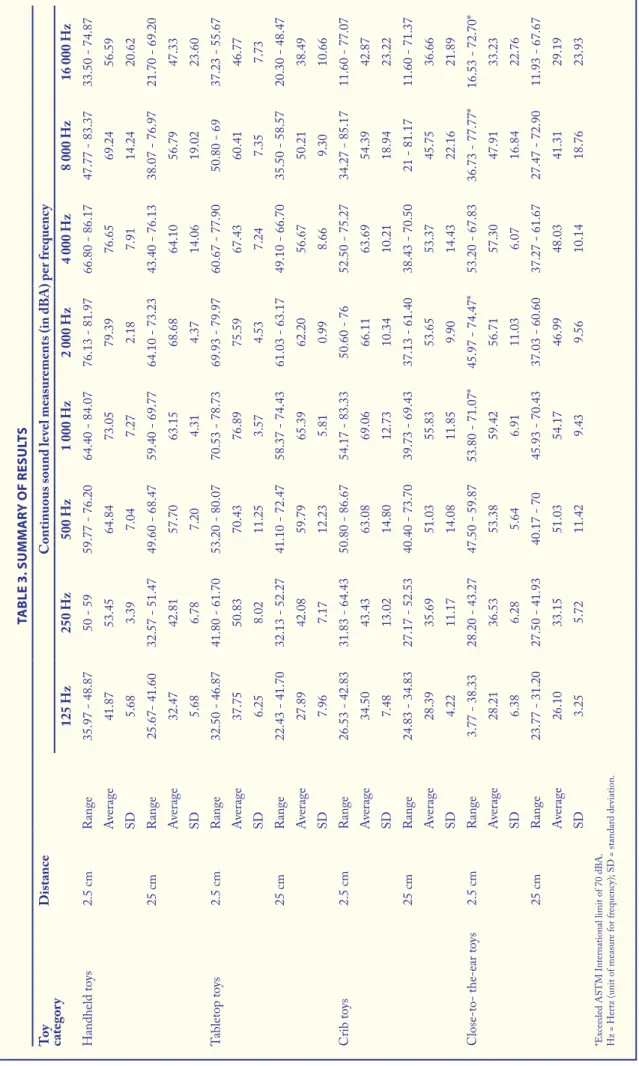
standards state that hand-held, tabletop and crib toys should not exceed 90 dBA when measured from a distance of 2.5 cm and 25 cm. Close-to-the-ear toys should not exceed 70 dBA when measured from a distance of 2.5 cm and 90 dBA for a distance of 25 cm. A summary of the results of the continuous noise measured per frequency is presented in Table 3.
Hand-held toys
Frequency spectra analysis• The greatest amount of continuous acoustic energy was recorded between 500 Hz and 16 000 Hz for the hand-held group of toys. • Maximum sound-field measurements were also recorded for each
of the toys despite the fact that current toy noise standards are based on continuous noise and not the maximum output of the toy. The maximum sound recorded for the hand-held toys ranged from 36.23 dBA to 92.97 dBA when measured from a distance of 2.5 cm. The maximum sound recorded for the hand-held toys when measured from a distance of 25 cm ranged from 24.50 dBA to 81.83 dBA.
• Continuous sound for the hand-held toys ranged from 33.50 dBA to 86.17 dBA when measured from a distance of 2.5 cm. When measured from a distance of 25 cm, the continuous sound ranged from 21.70 dBA to 76.97 dBA. None of these toys exceeded the ASTM International 90 dBA limit.
Tabletop toys
Frequency spectra analysis
• The greatest amount of continuous acoustic energy was recorded between 500 Hz and 4 000 Hz for the tabletop group of toys. • The maximum sound-field measurements recorded ranged from
41.47 dBA to 89.60 dBA when measured from a distance of 2.5 cm. Measurements taken at a distance of 25 cm ranged from 24.83 dBA to 78.47 dBA.
• The continuous sound for the tabletop toys ranged from 32.50 dBA to 80.07 dBA when measured from a distance of 2.5 cm, and from 20.30 dBA to 74.43 dBA when measured from a distance of 25 cm. None of the tabletop toys exceeded the ASTM International 90 dBA limit.
Crib toys
Frequency spectra analysis
• The greatest amount of continuous acoustic energy was recorded between 500 Hz and 4 000 Hz for the crib group of toys. • The maximum sound-field measurements recorded for the crib
toys when measured from a distance of 2.5 cm ranged from 11.73 dBA to 89.73 dBA, while at 25 cm the measurements ranged from 11.60 dBA to 84.83 dBA.
• The crib toys’ continuous sound ranged from 11.60 dBA to 86.67 dBA when measured from a distance of 2.5 cm, and from 11.60 dBA to 73.70 dBA when measured from 25 cm. None of the crib toys exceeded the ASTM International 90 dBA limit.
Close-to-the-ear toys
Frequency spectra analysis• The greatest amount of continuous acoustic energy was recorded between 500 Hz and 4 000 Hz for the close-to-the-ear group of toys.
• These toys’ maximum sound recorded ranged from 22.17 dBA to 82.30 dBA when measured from a distance of 2.5 cm, while measurements recorded at a distance of 25 cm ranged from 15.23 dBA to 76.30 dBA.
• When measured from a distance of 2.5 cm, the continuous sound for the close-to-the-ear toys ranged from 16.53 dBA to 77.77 dBA. None of these toys exceeded the ASTM International 90 dBA limit when measured from 25 cm. When measured at a distance of 2.5 cm, the continuous sound for the close-to-the-ear toys ranged from 11.93 dBA to 72.90 dBA. Two of these toys exceeded the ASTM international 70 dBA limit for continuous sound.
• The two close-to-the-ear toys that exceeded the recommended toy noise standards were a guitar with earphones and a rattle. The sound output of the guitar was measured through the earphones while on the loudest setting. The loudest continuous sound output for this toy was 72.90 dBA, which occurred at 8 000 Hz. The loudest maximum sound output when measured from the same distance was 76.30 dBA at 1 000 Hz.
• The loudest continuous sound output for the rattle was 70.43 dBA, which was recorded at 1 000 Hz. The loudest maximum sound output was 74.87 dBA at 8 000 Hz. Both of these toys may put children between the ages of birth to 3 years at risk for developing an NIHL.
Discussion
The findings of frequency spectra analysis from this study suggest that the majority of toys measured produced the largest amount of continuous noise outside of the natural frequency range for young children. The natural frequencies for children younger than 2 years of age are between 6 000 and 8 000 Hz, which means that the sound
pressure levels of toys are the most acute in this frequency range.14 This
suggests that the toys measured in this study do not place children between the ages of birth and 3 years at high risk of developing an NIHL.
For all four groups of toys, the greatest amount of continuous acoustic energy was recorded between 500 Hz and 4 000 Hz, with 8 000 Hz and 16 000 Hz also included for the hand-held group of toys. These results indicate that the greatest amount of acoustic energy was emitted by all of the toys at the frequencies that are important for hearing speech. The most important frequencies for hearing speech
are 500 Hz, 1 000 Hz and 2 000 Hz.17
Only two of the toys measured exceeded the recommended standard of 70 dBA (for close-to-the-ear toys) for continuous noise, which occurred at 1 000 Hz and 8 000 Hz. These toys were a guitar with headphones and a rattle.
The results of this study suggest that the majority of the toys for children between the ages of birth and 3 years measured in this study adhere to the current ASTM International standards for toy noise. Only 2 out of the 20 toys investigated exceeded the recommended standards. This is in contrast to research conducted in the USA, where it was found that 13 out of 20 toys in the hand-held, tabletop and crib groups exceeded the 90 dBA limit for continuous sound, and all 4 toys in the close-to-the-ear group exceeded the 70 dBA limit for
continuous sound. 12 The study, however, did not measure the sound
output of toys within a specific age range, and included toy guns. In another study, the sound levels of toy weapons, toy appliances, musical toys, bicycle horns and whistles for children between the ages of 6
months and 6 years were measured.14 Sound levels of between 80 to
126 dBA were recorded for these toys.
The ASTM International standards are the same for hand-held, tabletop, and crib toys when measured at a distance of 2.5 cm and
S
A
J
ou
rna
l of Child H
ea
lth
S
A
J
ou
rna
l of Child H
ea
lth
ou
rna
l of Child H
ea
Toy manufacturing
companies should be
encouraged to place
warnings about noise
16 SAJCH February 2012 Vol. 6 No. 1
25 cm. It is argued that this standard needs to be lowered for sound output at a distance of 2.5 cm, as most of these toys can be placed at ear level. This is important, as children often play with toys closer to their ears than the distances recommended in safety regulations
suggest.18
The ASTM International standards are voluntary for toy
manufacturers.19 Comparing the results of the current study with
previous research, it seems likely that toys manufactured in China and Hong Kong for children between the ages of birth and 3 years adhere closely to the current ASTM International standards for
continuous noise.12 However, adhering to toy noise standards needs
to become compulsory for toy manufacturers, to reduce the risk of children developing NIHL.
Conclusions
The results of this study indicate that all but 2 of toys for children between the ages of birth and 3 years measured in this study adhere to the current ASTM International standards. Analysis revealed that all the toys emitted the greatest amount of acoustic energy in the frequency range that is the most important for hearing speech. The majority of the toys produced the largest amount of continuous noise outside the natural frequency range for children younger than 2 years of age.
Implications
Although most of the noise levels of the toys included in this research project were not higher than the recommended standards, the public needs to be made aware that children are still at risk for developing NIHL if they play with noisy toys close to their ears and for longer than 1.5 hours a day. Focus needs to be placed on increasing parents’ awareness of NIHL in young children.
Practical implications of this research project include creating guidelines for maximum and continuous sound output of toys measured from a distance of 2.5 cm to add to the ASTM International standards. This is important in order to prevent exposure to loud sounds and NIHL in young children. Toy manufacturing companies should be encouraged to place warnings about the noise levels of toys on the packaging. In addition, steps need to be taken to make adherence to ASTM International standards compulsory for all toy manufacturers.
Recommendations for future research
Future research needs to focus on the length of time that children play with noisy toys per day, as well as the distance between the child’s ears and the toy during play. It would also be important to investigate the effect of maximum sound output compared with continuous sound output, in order to determine whether standards need to be developed for the maximum sound output of children’s toys. Toys that produce explosive and impact noise, such as toy guns, could also be measured and compared with the ASTM International standards.
References
1. DeConde Johnson C. Educational audiology. In: Katz J, Medwetsky LR, Burkard R, Hood L, eds. Handbook of Clinical Audiology. 6th ed. Philadelphia: Lippincott Williams & Wilkins, 2009:564-583.
2. Haller AK, Montgomery JK. Noise-induced hearing loss in children: What educators need to know. Teaching Exceptional Children 2004;36(4):22-27. http:// www.speechandlanguage.com/PDF/june20042.pdf (accessed 9 February 2010). 3. Goines L, Hagler L. Noise pollution: A modern plague. South Med J
2007;100:287-294.
4. Northern JL, Downs MP. Hearing in Children. 5th ed. Baltimore: Lippincott Williams & Wilkins, 2002
5. Rabinowitz PM. Noise-induced hearing loss. Am Fam Physician 2000;61(9):2749-2756.
6. Daniel E. Noise and hearing loss: A review. J School Health 2007:77:225-231. 7. Noise level chart. http://www.noisehelp.com/noise-level-chart.html (accessed
12 December 2011).
8. Cooley Hidecker MJ. Noise-induced hearing loss in school-age children: What do we know? Semin Hear 2008:29:19-28.
9. Niskar AS, Kiesak SM, Holmes AE, Esteban E, Rubin C, Brody DJ. Estimated prevalence of noise-induced hearing threshold shifts among children 6 to 19 years of age: The third national health and nutrition examination survey, 1988-1994, United States. Pediatrics 2001;108:40-43.
10. Smith RJH, Bale JF, White KR. Sensorineural hearing loss in children. Lancet 2005;365:879-890.
11. Segal S, Eviatar E, Lapinsky J, Shlamkovitch N, Kessler A. Inner ear damage in children due to noise exposure from toy cap pistols and firecrackers: A retrospective review of 53 cases. Noise Health 2003;5(18):13-18.
12. Bittel SN, Freeman BA, Kemker BE. Investigation of toy-noise exposure in children. Semin Hear 2008;29:10-18.
13. Canadian Association of Speech-Language Pathologists and Audiologists. Revising the Current Hazardous Products Act: Noisy Toys. http://www. speechandhearing.ca/core/files/edited%20Final%20Issue%20paper%20 english%20Noisy%20Toys.pdf (accessed 11 October 2009).
14. Yaremchuk K, Dickson L, Burk K, Shivapuja BG. Noise level analysis of commercially available toys. Int J Pediatr Otorhinolaryngol 1997;41:187-197. 15. Maassen M, Babisch W, Bachmann KD, et al. Ear damage caused by leisure
noise [Shortened translation of the review Gehorschaden durch Friezeitlarm, HNO 1999;47:236-248]. Noise Health 2001;4(14):1-16.
16. World Health Organization. Noise: facts and figures. http://www.euro.who.int/ en/what-we-do/health-topics/environmental-health/noise/facts-and-figures (accessed 28 June 2010).
17. Bess FH, Humes LE. Audiology: The Fundamentals. 3rd ed. Baltimore: Lippincott Williams & Wilkins, 2003.
18. Altman T. Critical Review: In preschool aged children (0-3 years), is there evidence of noise induced hearing loss related to the use of battery-operated age-appropriate toys? http://publish.uwo.ca/~larchiba/2007pdfs/Altman.pdf (accessed 16 August 2009).