www.ijte.net
Critical Thinking Skills in Asynchronous
Discussion Forums: A Case Study
Naima Ahmad Al-Husban Arab Open University, Jordan
To cite this article:
Al-Husban, N.A. (2020). Critical thinking skills in asynchronous discussion forums: A case
study.
International Journal of Technology in Education (IJTE), 3
(2), 82-91.
International Journal of Technology in Education
Volume 3, Issue 2, Fall 2020
Critical Thinking Skills in Asynchronous Discussion Forums: A Case Study
Naima Ahmad Al-Husban
Article Info
Abstract
Article History
Received: 14 December 2019
This study investigated critical thinking indicators of students‘ postings on the asynchronous online discussion forums on the learning management system (LMS) at Arab Open University (AOU), Jordan. The models used to diagnose nineteen students‘ postings were Garrisons‘ (2001) thinking skills and Newman (1995). Results revealed that participants‘ postings reflected the critical thinking indicators proposed by Newman like relevance and importance, but students need to enhance skills like justification, and critical assessment. According to Garrisons‘ model, participants could identify, and explore problems, but they need support to evaluate the problem and integrate solutions into their existing knowledge. The findings reveal that participants acquire essential critical thinking skills, but they need to focus on higher order skills. Further research should be conducted using different courses issues to impart the critical thinking indicators that students need in higher institutions. In addition, instructors should be trained on how to formulate online tasks that stimulate high level of thinking.
Accepted: 09 February 2020
Keywords
Critical thinking Online discussions Asynchronous forum e-learning
Introduction
In the last few decades, developments in information technology have introduced a new mode of learning that is called e-learning in general (Blanchette, 2012; Dinc, 2017; Serhan, 2019). Many educational settings have been affected by these innovations (Hull & Saxon, 2009). Therefore, most universities, colleges, and schools now seek to employ e-learning technologies in technology-based environments as a new mode of instruction in their educational system (Delahunty, 2012; Mohamad et al., 2016; Sahin, 2007; Syaimar & Sutiarso, 2018). In comparison with conventional teaching contexts, many researchers claim that online learning improves students‘ quality of learning as it gives them flexibility both in content and methodology (Lai, 2016; Perdana, Jumadi, & Rosana, 2019; Sahin & Shelley, 2008; Soliman, 2014; Zanjani, 2015). E-learning also gives students the opportunity to work and discuss the class material with their peers. It encourages learners to interact with each other which lead into sustaining their learning. In addition, e-learning allows the use of various learning resources such as documents, presentations, and activities that can meet learners‘ different learning styles. To investigate the abovementioned features, most universities and higher education institutions are racing to advance their education systems to either online or blended (Demirer & Sahin, 2013; Mancilla, Polat, & Akcay, 2015; Palmer & Holt, 2012).
Arab Open University (AOU) is a pioneer in establishing e-learning educational system in the Middle East. It facilitates learning through a university-wide electronic learning management system (LMS). Tutorial sessions are designed to provide a forum for interaction between tutors and students. The LMS is a moodle-based program which provides access to all electronic resources. It has many tools, like forums, which encourage students to interact and learn from each other (Farmer, 2004). Students in the higher education diploma program faced challenges in the course of English language teaching methodology. They need more time to focus on the educational concepts related to curriculum, to differentiate between current and traditional approaches to English language teaching, and to know how to teach English language skills in online settings communicatively. Developing these skills takes significant time, and the literature reveals that a discussion forum could be the best way to engage students in these topics critically as they could communicate with the tutor and their colleagues freely and comfortably at any time and in any place. Therefore, the study analyzed the participants‘ postings on Asynchronous Discussion Forums (ADF) to identify if their responses revealed critical thinking skills according to the criteria of the selected models in the study.
value in developing different stages of critical thinking in the process of teaching and learning in higher education. However, tutors should follow certain procedures and strategies such as giving clear instructions and learning how to ask open-ended questions. Instructors should also make sure that students have a clear idea about what to do, especially if instructors provide continuous feedback to students‘ activities on the forums (Hunter, 2018). It is also good to provide threaded discussions for each topic to help students find the information that they are searching for and return to the thread when needed. Mokoena (2013) stated that ADF helps students create their own posts and keep summaries of what they have read and written; this might enhance their memory and enable them to think of the post critically. This tool also may allow tutors to post different types of questions that motivate students to participate based on their own circumstances and schedules.
Arab Open University has provided online services such as the learning management system (LMS), which provides tutors and students with discussion forums where they can participate by writing and interacting with tutors and their peers. This capability is especially important to the students at Arab Open University who do not have time for doing homework, as most of them have various responsibilities, and face to face lectures are limited to one session in a week. Therefore, this technique is very suitable for them as a means of developing their educational background and deepening their critical thinking. On the other hand, critical thinking specifically has become an important skill for students‘ success in the world. Analysis and reasoning are keys to develop critical thinking. Cheong and Cheong (2008) stated that, according to the literature review, critical thinking could be taught through asynchronous or synchronous discussion forums, as they give students chances to read, discuss, and observe contributions of others. This, in turn, plays a major role in developing students‘ critical thinking. Zulkifli et al. (2016) shed light on the importance of discussion forums. Lang (2010) showed the extent to which asynchronous discussion forums could identify whether students think critically or not by analyzing their responses and postings. Rovai (2007), in his turn, revealed that taking part in discussion forums is a collaborative activity which could play a role in developing critical thinking.
Review of Relevant Literature
Discussion Forums
The use of asynchronous discussion forums (ADF) in higher education has grown dramatically in the past few decades, as it is an effective means of extending knowledge construction from the classroom and providing students with the time and space to work with, explore, and discuss topics posted by instructors (Gerosa, Filippo, Pimentel, Fuks, & Lucena, 2010; Loncar, Barrett, & Liu., 2014). Gerosa et al. (2010) define ADFs as textual communication tools, largely used to delvep deeper into a course subject. This technique, according to Loncar et al. (2014), could be framed by using the theory of social constructivism. That is, this promising tool aims to connect students with each other and with their instructors and to extend classroom activities using ADF, thereby encouraging cooperative and collaborative learning. In addition, higher educational institutions have started adopting blended models of learning that combine classrooms and ADF (Loncar et al., 2014). This trend has become one of the key approaches to developing higher education (Hunter, 2018). Arab Open University started this trend from the early days of its establishment by implementing LMS that provides online learning services to students; one of the features of this service was the discussion forum. According to Richardson and Ice (2010), the discussion forum is an extension of traditional learning that promotes dialogue, knowledge construction, and critical thinking. This last point leads to an argument about how discussion forums could improve students‘ critical thinking. Murphy (2004) claimed that ADF encourages students to engage in cognitive processes, especially critical thinking.
Different models such as the Community of Inquiry Model by Garrison et al. (2001) were emerged to investigate the nature and the quality of the learning scripts produced by students while participating in ADF. This model is derived from Deweys‘ concepts of practical inquiry. Richardson and Ice (2010) and Junus et al (2019) highlighted the importance of this model as a tool to assess thinking and reflection. Garrison et al. (2001) stated that this model is good at identifying the critical thinking skills that scripts may reflect. The four phases of this cognitive model encompasses several important skills that determine the development of students‘ critical thinking was developing dramatically. The skills are analysis (the first phase); knowledge transfer, questioning assumptions, and brainstorming (the second phase); analysis, synthesis, inductive and deductive reasoning (the third phase); and evaluation, informed judgment, and hypothetical reasoning (the fourth phase).
84 Al-Husban
deep and surface learning approaches; for example, in the exploration phase, positive indicators would be linking facts, ideas, or concepts, whereas the negative indicators would be repeating information without making inferences. They found that there were significant differences in critical thinking between computer conferences and face to face seminars, with computer conferences being preferable because students brought in outside material and linked ideas to solutions. In this vein, Beckmann and Weber (2016) conducted a study to analyze discussion forums to identify students‘ critical thinking using the model of Newman et al. (1996), which has ten categories, including 40 indicators. Results revealed that students‘ postings reflected a strong use of outside knowledge, intensive justification, and critical assessment. However, there were weak points in their critical thinking, like manifold repetition. It is also worth mentioning that Schellens et al. (2007) conducted a study analyzing scripts of structure university students‘ discourse in asynchronous discussion groups using Garrisons‘ model of content analysis. Results revealed that the evidence of critical thinking appeared during the stages of problem identification and problem integration. They shed light on the importance of scaffolding strategies for online discussion and guidance on how to pose good questions in order to foster critical thinking in this environment. Similarly, Zulkifli et al. (2016) conducted a study to explore whether students‘ critical thinking could be enhanced using text-based, asynchronous online discussion. Using content analysis to identify students‘ critical thinking, the authors investigated several models of analyzing online discussion, and they showed that most of the analysis models had the same theoretical framework for assessing critical thinking skills. They also presented Garrisons‘ model as one of the most prominent in identifying students‘ critical thinking.
Similarly, Sun and Bin (2018) investigated students‘ cognitive skills when interacting with each other on the discussion forums. The authors found that those students who used the discussion forums showed higher levels of comprehension and analysis skills than those used the traditional way of learning. Tan (2017) examined how university students used discussion forums to develop their cognitive skills like paraphrasing and analysis. The author analyzed the students‘ postings on the discussion forum and found that students showed cognitive skills like paraphrasing, analysis, and evaluation, and these skills reflect some of the dimensions of critical thinking. Moreover, McLoughlin and Mynard (2009) investigated if ADF postings reflected students‘ critical thinking; data were collected over a 20-week semester and then analyzed according to Garrison et al.‘s 2001 model of content analysis. Transcripts were sorted into one of the models‘ categories of triggering, exploration, integration, or resolution. The researchers found evidence of higher-order thinking processes. The results revealed that most of the transcripts were either categorized as exploration or integration. They also highlighted the importance of presenting the correct conditions to encourage the appearance of critical thinking. Based on these results, the authors recommended that instructors should focus on their questions and the type of information presented in the posting, as these factors play a significant role in encouraging students‘ critical thinking. In their study, Richardson and Ice (2010) revealed students‘ critical thinking levels while using different instructional strategies. For fifteen weeks, the postings of nineteen to twenty-nine students per section were analyzed. Results revealed that 81% of students were at the integration and resolution levels.
In another study, Tan and Ng (2014) conducted a study to investigate the critical thinking abilities of postgraduate students in threaded discussions. Four threaded discussion transcripts were collected and used as the source of data, and the researchers assessed the transcripts based on Newman et al. (1995) model. Results showed that the participants‘ postings mainly reflected their critical thinking ability in terms of their ability to include relevant information, clear statements, and novel ideas; justify their or others‘ contributions; and bring outside knowledge. However, the participants showed that they lacked the ability to assess critically their own or others‘ contributions. Beckmann and Weber (2016) found that students reflected outside knowledge and intensive justification, whereas Tan and Ng (2014) showed that students were good at relevance, importance, and bringing outside knowledge. These trends reveal the importance of the roles of instructors who employed asynchronous discussion forums. The instructors‘ use of scaffolding strategies and effective feedback to students were critical factors in revealing differences between the groups of students. Additionally, the characteristics of students such as attitudes, motivation, and intelligence played a major role in the different results. The content of the courses and their nature could also be another factor that motivates students to post in the asynchronous forums. For example, if the course is difficult, students‘ participation in asynchronous ADF will be limited.
high level of thinking. This is due to the tutors‘ skills, training, following up with students‘ participation on the DF, students‘ motivation, and attitudes. The review of literature also shows that convincing students to stay involved in online discussion forums could be a challenge for tutors, and there are many articles revealed that students are not necessary to show critical thinking in online discussion like Lim, Cheungand Hew (2011). In addition, ADF is a tool whose effectiveness depends on the user. If the user be active, reads from different resources, presents his\her idea on the discussion forums and discusses them with his/her colleagues, this tool will play a key role in developing his/her critical thinking. Likewise, the opposite is true: a student who is not active will not benefit from the LMS. In this regard, the body of literature revealed that measuring critical thinking in online discussions would be helpful for course designers, teachers, and students (Lim, Cheung& Hew, 2011). Researchers, such as Maurino (2007) and Garrison et al. (2001), recommended more research in this area, as it will be a dominant means of teaching in the future. Therefore, this study investigated this issue by analyzing the content that students posted on the DF in the LMS.
Research Questions
Based on the abovementioned statements the following research questions have been raised in the current study:
- What critical thinking skills do students' postings in asynchronous course forums reveal in the light of the indicators of critical thinking model proposed by the Newman et al. model (1995)?
- What stage of critical thinking do scripts of students in asynchronous course forums show in the light of Garrison‘s model of successive critical thinking stages?
Method
Study Design
The purpose of this study is to analyze participants' postings in the asynchronous discussion forums at the higher education program at Arab Open University during the second semester of the academic year 2018/2019, then investigate the postings of the participants to identify which critical thinking indicator proposed by Newman et al. (1995) each posting reflected. Therefore, this study was designed using a content analysis approach based on two models of critical thinking found in the literature review: Garrisons‘ successive thinking skills stages (1991) and then the model of Newman et al. (1995). The analysis was conducted in an integrated way, not separately. The integration is logical because Garrisons‘ stages gave an overall perspective about critical thinking, whereas the model of Newman et al. (1995) gives a deep perception about students‘ critical thinking skills. Therefore, the model Newman and his colleagues explained that of Garrison. Knowing the level of students‘ critical thinking in higher education is an international goal, and the literature review revealed that theories of learning, such as social constructivism, could reinforce critical thinking and researchers presented several frameworks and models for assessing critical thinking. Indicators were found within these model that reflected the theory of social constructivism, such as analyzing Newman et al.‘s (1995) indicators of critical thinking for content analysis and the stages model of Garrison‘s stages (Hunter, 2018).
Participants
The study sample consisted of 19 students as a case study, they were chosen purposefully as they were the only students registered the course ―methodology of teaching English language‖ as part of a higher education diploma at AOU during the second semester of the academic year 2018/2019. It is a program the in-service teachers enrolled in. All the 19 students were female, aged between 27 and 35, and they were EFL teachers whose experience ranged from 3 to 7 years. Students provided their approval to participate in the study, and they were informed that their participation in the discussion forum was voluntary. Then, students‘ postings in the discussion forum were analyzed for seven weeks. Each week, the tutor presented a question or thought-provoking issue related to the topic of the units that were discussed in the face-to-face meetings. Four of the questions were as follows:
1. As an EFL teacher, how do you reflect on your teaching? (2 weeks)
2. What does effective teaching mean? Do you think you are teaching English language effectively? (1 week)
3. What does an eclectic teaching approach mean? How do you employ this idea? (2 weeks)
86 Al-Husban
Procedures
One intact class of AOU was selected as the participants of the study. Students voluntarily took part in the asynchronous discussion forums for 7 weeks, each week, there was a topic students were encouraged to participate in the ADF, for example, in the first week, the instructor posted the first issue ―reflective teaching‖, and asked participants as an EFL teachers, how do you reflect on your teaching? This issue lasted for two weeks, then participants were asked to participate in the second issue which was about ―effective teaching‖, they were asked the following questions: What does effective teaching mean? Do you think you are teaching English language effectively? and this issue lasted for a week. In the third and fourth weeks, the instructor presented the issue of electric teaching, and the instructor asked the participants to answer the following question: What does an eclectic teaching approach mean? How could you adopt this idea? In the sixth and seventh weeks, another issue was raised, it was teaching English language skills, and teachers were asked: What do you think the most effective way of teaching different English language skills is? The instructor drew students' attention that there is no one right answer and all the questions were derived from the topics that were discussed during the face-to-face tutorials.
In addition, the instructor drew the participants' attention that their participation was not related to a grade, so the number of participants in the discussion forum on each topic varied and depended on the participants‘ free time. They were free to participate in the forum at any time and place; the instructor in every face-to-face meeting encouraged students to post at least one message every week, and the instructor read some of the postings, and provided the necessary feedback to motivate participants to participate and engage in the DFs. Each posting was analyzed separately by the researcher and a co-rater after they were familiarized with the model of critical thinking of Garrison et al. (2001) and the content analysis scheme based on the work of Newman et al. (1995), who expanded the five stages of critical thinking into ten critical thinking categories: relevance, importance, novelty, outside knowledge, ambiguities, linking ideas, justification, critical assessment, practical utility, and breadth of the discussion. It is worthwhile to mention that Newman et al. (1995) stated that critical thinking was a link between surface learning and deep thinking, so they developed a content analysis method to assess expressions of critical thinking in transcripts of discussions in asynchronous course forums. The model rates comments that participants posted in the forum against a series of indicators of critical thinking in a way that each of the indicators has a pair of opposites, one for in-depth processing and one for surface learning. It also presents their relationship with the stages of Garrisons (2001), the indicators are relevance, importance, novelty, bringing outside knowledge, justification, and critical assessment, linking ideas, resolving ambiguity, practical utility and focus of the discussion (Newman, Webb & Cochrane, 1995).
In this study, content analysis was performed at the posting level; that is, each posting was considered a unit of analysis. This level of analysis helped in decreasing the subjectivity of the raters in spite of some probable challenges. One such challenge was that some postings did not have the necessary information for the rater to infer the student‘s cognitive skill. Another problem was that some postings included evidence of more than one of the categories according to the Garrison et al. (2001) model; in these cases, the raters decided on the best category that the posting described. The decision was based on the discussion between the author and the rater and benefited from the literature review. The author was interested in making the content analysis scientific, resistant to bias and any subjective manipulations by having a rigorous rater.
Data Analysis
The content analysis method of critical thinking skills as defined by Newman et al. (1995) was implemented to assess and investigate the quality of group learning, not just the performance of students. Using this analytical method, each student‘s post was considered to be a unit of meaning and to show at least one of the indicators of the model. Then the posts were marked and counted to avoid subjective decisions. Below is an example of a students‘ response to the question concerning the best and most effective method of teaching English language skills. As an example, the analysis of this posting according to Newman et al.‘s 1995 model is as follows:
Script one, student 1 ―I think there is no one best method for teaching English language skills, as each method focused on a specific skill, I will use grammar translation approach for literary texts in which students translate it from one language to another, using the direct method to improve the speaking skill, and communicative method is used to teach listening and speaking through games.‖
whereas there is no reference to critical assessment. It is important to mention that in analysis (+) was given for critical thinking and (-) for non-critical thinking. Therefore, the ratio could be inferred using the following formula: the critical thinking counts – the noncritical thinking counts / the total, for example, in the above excerpt, 5-4/9= 0.11 out of 1, this showed that students' level of critical thinking is not up to the mark.
Inter-Rater Reliability
Two procedures have been taken into consideration to guarantee reliability. The first was Holsti‘s (1969) coefficient of reliability, a percent of agreement measure that shows the number of agreements between co-raters out of the total number of coding decisions. The second method was Cohens‘ Kappa (K), which measures reliability after identifying agreement between co-raters. The coefficient reliability for the total posting was 0.75, which is an acceptable value for the purpose of this study.
Results and Discussion
To show which critical thinking indicators were demonstrated by the postings of the sample studying ―English language methodology‖, ratios were calculated in light of the indicators of critical thinking proposed by Newman et al. (1995); the ratio was between minus one 1- (uncritical thinking) to one +1 (critical thinking). Results were as follows:
What Critical Thinking Skills Do Students' Postings in Asynchronous Course Forums Reveal in the Light of the Indicators of Critical Thinking Model Proposed by the Newman et al. Model (1995)?
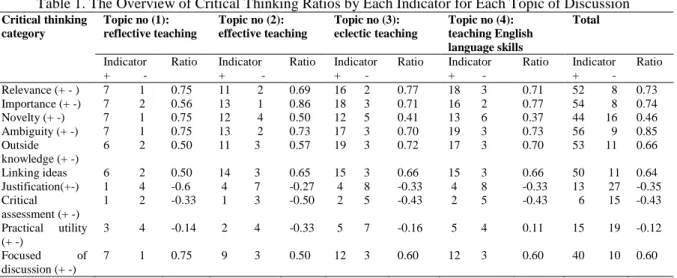
Newman et al (1995) stated that (-1) indicates uncritical or surface thinking while (+1) shows critical thinking and deep postings. The results in Table 1 reveal the ratio of critical thinking indicators for every topic of the course. The major finding is that for relevance .73, importance.74, ambiguity, outside knowledge .66, linking ideas, and focus of discussion, the total ratios of the four discussion topics ranged from (0.85 to 0.46). According to Newman et al. (1995), these results reflect that students‘ statements had evidence of critical thinking as their ration were near +1, and participants were engaged in critical thinking skills for the four discussion topics. However, the ratios of the indicators of practical utility, critical assessment, and justification were negative, because their ratios were near -1, meaning that students showed non-critical thinking; the range of the ratios was from (-0.12 to -0.43). Positive scores were obtained for seven of the ten critical areas, demonstrating critical thinking in these areas study; the development of critical thinking was maintained over the four topics of discussion for seven weeks.
Table 1. The Overview of Critical Thinking Ratios by Each Indicator for Each Topic of Discussion Critical thinking
category
Topic no (1): reflective teaching
Topic no (2): effective teaching
Topic no (3): eclectic teaching
Topic no (4): teaching English language skills
Total
Indicator + -
Ratio Indicator + -
Ratio Indicator + -
Ratio Indicator + -
Ratio Indicator + -
Ratio
Relevance (+ - ) 7 1 0.75 11 2 0.69 16 2 0.77 18 3 0.71 52 8 0.73 Importance (+ -) 7 2 0.56 13 1 0.86 18 3 0.71 16 2 0.77 54 8 0.74 Novelty (+ -) 7 1 0.75 12 4 0.50 12 5 0.41 13 6 0.37 44 16 0.46 Ambiguity (+ -) 7 1 0.75 13 2 0.73 17 3 0.70 19 3 0.73 56 9 0.85 Outside
knowledge (+ -)
6 2 0.50 11 3 0.57 19 3 0.72 17 3 0.70 53 11 0.66
Linking ideas 6 2 0.50 14 3 0.65 15 3 0.66 15 3 0.66 50 11 0.64 Justification(+-) 1 4 -0.6 4 7 -0.27 4 8 -0.33 4 8 -0.33 13 27 -0.35 Critical
assessment (+ -)
1 2 -0.33 1 3 -0.50 2 5 -0.43 2 5 -0.43 6 15 -0.43
Practical utility (+ -)
3 4 -0.14 2 4 -0.33 5 7 -0.16 5 4 0.11 15 19 -0.12
Focused of discussion (+ -)
7 1 0.75 9 3 0.50 12 3 0.60 12 3 0.60 40 10 0.60
88 Al-Husban
―The best teaching method is communication between the students within the group, that will give them the opportunity to discuss and negotiate the exercises and the tasks such as problems need to be solved, and by discussing and negotiating students could understand the problem and propose a solution, and they will acquire new structures and words. The best method is a combination of approaches depending on students’ needs, interests, level and the aims of the lesson.‖
It is clear that the ideas of the student were related to the topics studied in the face-to-face classroom, and that important ideas were chosen from the textbook, but the student was far from providing an innovative way of teaching English language skills. The student said that EFL teachers should be eclectic, but in critical assessment indicators or in practical utility, the student did not show their ability to provide a comprehensive overview about how to be eclectic and how to critically assess this approach. Another post said that:
―I believe that a successful class management is the guarantee for effective learning, so it is important to establish ground rules, and the teacher should have knowledge in curricula”.
This posting revealed unimportant and irrelevant information, as the question was about the effectiveness of teaching not about classroom management, and the student focused only on knowledge rather than skills, values, and attitudes. Another posting stated about the third topic ―eclectic teaching‖:
―A teacher should focus on the idea that there is no one best strategy, and she or he should choose what is suitable for students, for example, with young students a teacher should use songs and games, with upper primary stage, should use stories, cooperative learning, or mind maps”.
This posting indicates that students had novelty by showing new ideas have not discussed before, applying outside knowledge in a convincing way and linking ideas and generating new ones from those they have acquired previously. A posting about the fourth topic (how do you teach English language skills?) is presented here:
“While teaching English, I focused on grammar, and structures that all what students need, and I sometimes asked students to read aloud, listening could not be taught because there is no recorders, students could not speak”.
This posting reveals that the level of thinking of the participant is very low, as it is irrelevant, unimportant, unreasoned rejection of teaching English language skills, it also shows narrow discussion. Another post in the same topic:
―I like integrating skills, while I am teaching reading, I ask students to listen, speak, write, and I apply several strategies like working in groups, jigsaw, and playing language games”.
This posting reveals relevance, importance, novelty, clear and unambiguous statements, and justified her opinion.
In sum, personal experience, previous knowledge, and additional course material were introduced frequently by the students. Furthermore, they were able to link facts and ideas, but they continuously repeated information they read in the textbook. Justification, practical utility, and critical assessment were rarely presented by the participants due to their need to justify, assess, and apply information in new contexts. According to Blooms‘ Taxonomy of the cognitive domain, application, justification, and assessment are on the top of the taxonomy, and students need to use these higher- level thinking skills. These results reveal that discussion forums are considered an effective tool to stimulate students‘ thinking skills. However, the results also revealed that students lack some high-level indicators of critical thinking that are necessary in higher education like justification, practical utility, and assessment. This deficiency could also be due to students‘ familiarity with the content. That is, if the tasks presented in the DF are new, students will focus on repeating what they studied in the classroom.
These results are consistent with related studies like Tan and Ng (2014), and Schellens et al. (2007). That is, both the current study and previous studies revealed that students focused on relevance, importance, and bringing in outside knowledge while using ADF, but students had problems in other skills that focused on analysis and assessment. The results show the importance of strategic instruction to make sure students‘ critical thinking skills will be developed—i.e. giving clear instructions while using DF, engaging with students‘ discussion, and giving constructive feedback (Hunter, 2018).
What Stage of Critical Thinking Do Scripts of Students in Asynchronous Course Forums Show in the Light of Garrison’s Model of Successive Critical Thinking Stages?
shows the ratios of critical thinking indicators; comparing the findings with Garrisons‘ stages of critical thinking shows students could define the problem clearly, present important points, and make relevant statements (stage one which is identifying the problem). There were also indicators for which students showed high ratios like drawing on personal experience, referring to course material, and using relevant outside material. All of these indicators reflected the second stage, which is problem definition. Moreover, students were rated highly in indicators like providing examples; focused contribution to the problem; linking facts, notions, and ideas together; and generating new information from data posted by students. All of these indicators reflected stage three ―problem exploration‖. However, students in this study rarely showed critical thinking indicators of the fourth or fifth stages, problem evaluation and problem integration, such as justifying solutions, offering judgments with explanation, critical assessment of other contributions, discussing practical utility of new ideas, and using previous knowledge with evidence. Students have basic essential critical thinking skills as suggested by the models of Newman et al. (1995) and Garrison (2001), but they still need to develop their skills to acquire the higher level of thinking.
The results of this study are somewhat in line with studies like those of Schellens et al. (2007) Cheong and Cheung (2008), Mcloughlin and Mynard (2009), Lang (2010), Richardson and Ice (2010), Tan and Ng (2014), Zulkifli et al. (2016), Beckmann and Weber (2016), and Sun and Bin (2018). All of these studies focused on the importance of the models of Garrison et al. (2001) and Newman et al. (1995) in identifying and developing students‘ critical thinking skills. For example, Tan and Ng (2014), Beckmann and Weber (2016), and the current study identified similar critical thinking indicators that participants revealed in their postings, such as importance, relevance, ambiguity, and bringing outside knowledge. Additionally, participants in both studies revealed an inability to critically assess the postings of other participants. In addition, the results of this study highlight the importance of the skills at the top of Bloom‘s Taxonomy, including applying, analyzing, evaluating or justifying, and creating. This does not mean the rest of the critical thinking skills are not important; on the contrary, if students want to develop these higher skills, they should first acquire the basic ones of identifying, defining, and exploring a problem. Therefore, the results of this study open the field for further research on how to employ discussion forums to develop the higher-level skills necessary for thinking critically. This study is different from those in the literature review in that it investigated the general or surface thinking and the deep thinking of the participants using two models, so the current level of students‘ critical thinking is clearly identified. Therefore, these results are a good resource for future researchers in Jordan or in the region. This study revealed how policy makers should think when establishing their academic programs and what skills they should focus on. This study can also help to design special training programs for instructors to be familiar with employing ADF, particularly in order to motivate students to enroll in online academic programs, as students often have negative attitudes towards distance learning.
Conclusions
This study investigated critical thinking indicators of students‘ postings on the asynchronous online discussion forums on the LMS at AOU. The models used to diagnose nineteen students‘ postings were Garrisons‘ thinking skills and Newman. Content analysis is a promising potential method of research, as it can provide significant insight into why students think in a certain way and if the type of interaction is positive or negative. To this end, postings in the discussion forum were assessed by calculating the critical thinking ratios for all the categories proposed by Newman et al. (1995) and the stages of Garrisons et al. (2001). The particular results of the current study revealed that participants‘ postings reflected the critical thinking indicators proposed by Newman et al. (1995) like relevance and importance, but students needed to enhance skills like justification, and critical assessment. According to Garrisons‘ model, participants could identify, and explore problems, but they needed support to evaluate the problem and integrate solutions into their existing knowledge. This reveals that participants acquire essential critical thinking skills, but they need to focus on higher order skills. Based on these results, further research should be conducted using different courses issues to impart the critical thinking indicators that students need in their higher institutions.
90 Al-Husban
how to deal with the asynchronous discussion forums especially in online programs and distance learning, provide them with continuous feedback, motivate students when they participate in a new way, and most importantly pose high level thinking questions like why, who, what if, and so what. Through these means, students can produce knowledge based on the information they already know.
This study investigated the efficacy of ADF in revealing students‘ critical thinking, provide indicators for the decision makers at universities and give professors insights on how to present topics and tasks using ADF to motivate active participation on the part of students. This study also provides an international perspective; that is, the results of the study consolidate the international assumptions of the effectiveness of this tool in developing students‘ critical thinking. The findings of the study could also be a resource for international research projects that aim to compare the level of critical thinking among international students in higher education, which would be particularly important for international agencies interested in education like UNESCO. The present research is one of few studies that employ two models in an integrated way to produce a comprehensive perspective on the current level of students‘ critical thinking, encouraging professors to use this tool to assist students pursuing their studies online. Furthermore, the results of the study can lead policy makers to formulate a future strategy that makes use of this tool and to prepare academic programs that focus on developing students‘ cognitive skills, particularly critical thinking. It is a case study and the sample size involved in the study was limited, as it was to diagnose the critical thinking indicators students could show while engaging in asynchronous discussion forums. Therefore, further research should be conducted using a large sample and different courses to identify the critical thinking indicators that students could show in higher education institutions.
References
Beckmann, J., & Weber, P. (2016). Cognitive presence in virtual collaborative learning: Assessing and improving critical thinking in online discussion forums. Interactive Technology & Smart Education, 13(1), 52-70.
Blanchette, J. (2012). Participant interaction in asynchronous learning environments: Evaluating interaction analysis methods. Linguistics & Education, 23(1), 77–87. http://dx.doi.org/10.1016/j.linged.2011.02.007 Cheong, C., & Cheung, W. (2008). Online discussion and critical thinking skills: A case study in a Singapore
secondary school. Australasian Journal of Educational Technology, 24(5), 556-573.
Cohen, L. Manion, L., & Morrison, K. (2018). Research methods in education (8th ed.). London: Routledge. Delahunty, J. (2012). ‗Who am I?‘: Exploring identity in online discussion forums. International Journal of
Educational Research, 53, 407–420. http://dx.doi.org/10.1016/j.ijer.2012.05.005
Demirer, V., & Sahin, I. (2013). Effect of blended learning environment on transfer of learning: An experimental study. Journal of Computer Assisted Learning, 29(6), 518-529.
Dinc, E. (2017). Web-based Education and Accessibility. International Journal of Technology in Education and Science, 1(1), 29-35.
Farmer, J. (2004). Communication dynamics: Discussion boards, weblogs and the development of communities of inquiry in online learning environments. In Beyond the comfort zone: Proceedings of 21st ASCILITE conference, 274-283.
Hull, D. M., & Saxon, T. F. (2009). Negotiation of meaning and co-construction of knowledge: An experimental analysis of asynchronous online instruction. Computers & Education, 52, 624-639.
Hunter, W. (2018). Critical Thinking in Asynchronous Online Discussions: A Systematic Review. Canadian Journal of Learning & Technology, 43(2), 34-56.
Garrison, D. R. Anderson, T., & Archer, W. (2001). Critical thinking and computer conferencing: A model and tool to assess cognitive presence. American Journal of Distance Education, 15(1), 7-23.
Gerosa, M. A., Filippo, D., Pimentel, M., Fuks, H., & Lucena, C. J. (2010). Is the unfolding of the group discussion off-pattern? Improving coordination support in educational forums using mobile devices. Computers & Education, 54, 528-544.
Junus, K., Suhartanto, H., R-Suradijono, S., Santoso, H., & Sadita, L. (2019). The Community of Inquiry Model Training Using the Cognitive Apprenticeship Approach to Improve Students' Learning Strategy in the Asynchronous Discussion Forum. Journal of Educators Online, 16(1). 1-17.
Lai, C. (2016). Third graders‘ understanding of air concepts facilitated by the iPod inquiry teaching method. International Journal of Research in Education and Science (IJRES), 2(1), 1-9.
Lang, Q. (2010). Analyzing high school students‘ participation and interaction in an asynchronous online project-based learning environment. Australasian Journal of Educational Technology, 26(3), 327–340. Lim, S. C. R., Cheung, W. S., & Hew, K. F. (2011). Critical thinking in asynchronous online discussion: An
Loncar, M, Barrett, N., & Liu, G. (2014). Towards the refinement of forum and asynchronous online discussion in educational contexts worldwide: Trends and investigative approaches within a dominant research. Computers & Education, 73(1), 93-110.
Maurino, P. S. M. (2007). Looking for critical thinking in online threaded discussions. Journal of Educational Technology Systems. 35(3), 241-260.
McLoughlin, D., & Mynard, J. (2009). An analysis of higher order thinking in online discussions. Innovations in Education & Teaching international, 46(2), 147-160.
Mohamad, M., Omar, A., & Mansor, A. Z. (2013). Asynchronous forum as a discussion tool in a preparatory reading course for first year distance learners. Asian Social Science, 9(13), 53-62
Mokoena, S. (2013). Engagement with and participation in online discussion forums. The Turkish Online Journal of Educational Technology, 12(2), 97-105.
Murphy, E. (2004). An instrument to support thinking critically about critical thinking in online asynchronous discussions. Australasian Journal of Educational Technology, 20(3), 295-315.
Neal, D., & Akin, L. (2007). CRESTmodel: Writing effective online questions. Journal of Online Learning & Teaching, 3(2), 191-202.
Newman, D. R. (1996). An experiment in group learning technology: Evaluating critical thinking in face-to-face and computer-supported seminars. Interpersonal Computing & Technology Journal, 4(1), 57-74
Newman, D.R., Webb, B., & Cochrane, C. (1995). A content analysis method to measure critical thinking in face to face and computer supported group learning. Interpersonal Computing & Technology, 3(2), 56-77.
Palmer, S., & Holt, D. (2012). Trajectories of engagement: A repeated cross-sectional investigation of student perceptions of an online learning environment. Research in Learning Technology, 20(3), 253–265. Perdana, R., Jumadi, J., & Rosana, D. (2019). Relationship between analytical thinking skill and scientific
argumentation using PBL with interactive CK 12 simulation. International Journal on Social and Education Sciences, 1(1), 16-23.
Richardson, J., & Ice, P. (2010). Investigating students‘ level of critical thinking across instructional strategies in online discussions. Internet & Higher Education, 13(1), 52-59.
Rovai, A. P. (2007). Facilitating online discussions effectively. Internet & Higher Education, 10, 77-88. Sahin, I. (2007). Predicting student satisfaction in distance education and learning environments. Turkish Online
Journal of Distance Education, 8(2), 113-119.
Sahin, I., & Shelley, M. (2008). Considering students' perceptions: The distance education student satisfaction model. Journal of Educational Technology & Society, 11(3), 216-223.
Schellens, T., Keer, H., Wever, B., & Valcke, M. (2007). The effects of two computer-supported collaborative learning (CSCL) scripts on university students' critical thinking. Psicologia Escolare Educacional, 11, 83-92.
Serhan, D. (2019). Web-Based Homework Systems: Students‘ Perceptions of Course Interaction and Learning in Mathematics. International Journal on Social and Education Sciences, 1(2), 57-62.
Soliman, N. A. (2014). Using E-Learning to Develop EFL Students‘ Language Skills and Activate Their Independent Learning. Creative Education, 5(1), 752-757.
Sun, G., & Bin, S. (2018). Topic Interaction Model Based on Local Community Detection in MOOC Discussion Forums and its Teaching Application. Educational Sciences: Theory & Practice, 18(6), 2922-2931. Syaimar, C.P. & Sutiarso, S. (2018). Study anywhere and anytime, not necessarily in class. International
Journal of Technology in Education and Science (IJTES), 2(1), 35-39.
Tan, C. L., & Ng. L. L. (2014). Assessing critical thinking performance of postgraduate students in threaded discussions. International Association for Development of The Information Society. Retrieved from https://files.eric.ed.gov/fulltext/ED557315.pdf
Zanjani, N. (2015). Success factors of engaging higher education students and staff with e-learning tools within Learning Management Systems (Unpublished Doctoral dissertation) Queensland University of Technology, Brisbane, Australia.
Zulkifli, N. N., Halim, N. D. & Yahya, N. (2016). Measuring critical thinking in online Discussion: Analysis model. RCEE Conf. Proc, 1(1), 56-6.
Author Information
Naima Ahmad Al-HusbanArab Open University Jordan