Anusak Yiengpruksawan, M.D., FACS, FRCST (Hon.)*, Thawatchai Akaraviputh, M.D.**, Asada Methasate, M.D., Ph.D.**, Vitoon Chinswangwatanakul, M.D., Ph.D.**
*Valley Hospital, Ridgewood, NJ 07450, USA, **Siriraj Robotic Surgery Center, Minimally Invasive Surgery Unit, Department of Surgery, Faculty of Medicine Siriraj Hospital, Mahidol University, Bangkok 10700, Thailand.
Robotic Surgery in Thailand: Current Status and
Future Development
Correspondence to: Anusak Yiengpruksawan E-mail: [email protected]
Received 23 April 2018 Revised 25 April 2018 Accepted 27 April 2018 doi:10.14456/smj.2018.74
ABSTRACT
Robotic surgery, currently monopolized by the intuitive “daVinci Surgical System” (dVSS), has now established its strong foothold in the USA and a few other countries in Europe and Asia. However, because of its high cost and lack of evidence to support its superiority over the traditional laparoscopic technique, its utility especially in less affluent countries remains controversial. In this article, we studied the adoption and development of robotic programs in Thailand, a middle income country, that had its head started relatively early with the acquisition of the first generation daVinci system by the private international hospital. The systems have since been installed in 5 other institutions, 4 of which are academic centers. We analyzed and discussed the causes of success of the urological program and failure of the others. In the end, we concluded that instead of resisting the trend, it should be selectively and rationally embraced. We then suggested steps to help with the program development that are best suited to Thailand’s financial and health care conditions.
Keywords: Robotic surgery; da Vinci Surgical System; Thailand (Siriraj Med J 2018;70: 466-470)
INTRODUCTION
Since its approval by the US FDA in 2000, the da Vinci Surgical System (dVSS) has so dominated the field of robotic surgery that its name is effectively synonymous with robotic surgery. Despite the exorbitant price tag and high annual maintenance fee, it is now installed in almost all major hospitals and medical centers in the USA. Although initial acceptance was tepid, the dVSS rapidly gained momentum as urologists began to deploy it. Compared to the laparoscopic approach, urologists found the dVSS—with its high definition 3D imaging, wristed instruments with 7-degree freedom of movement, and intuitive hand-eye coordination—to be effective on the one hand and to make minimally invasive prostatectomy possible on the other hand, and with much greater ease.1
Adoption of the dVSS by general surgeons occurred at a much slower pace and initially was greeted with less enthusiasm and more skepticism. It has continued
to be a controversial and contentious issue in general surgery because of the high cost, but similar outcomes, compared to the laparoscopic approach.2 The dVSS has
also prompted a heated debate over its role in the rising cost of national health care.3 Despite sharp adversarial
opinion, however, the dVSS has regained popularity in recent years due to its newfound potential roles and benefits in complex hernia repair surgery.4 Hospitals are
increasingly rushing to acquire the system and promote its use. For the moment, there seems to be no way to stop or reverse the trend, which has also begun to emerge elsewhere, including Thailand.
The development of robotic surgery in Thailand The first dVSS - “The original da Vinci”
time. Bangkok Hospital, a premier international hospital with a nationwide network facilities, was the first to purchase the system for cardiac surgery. The first robotic symposium and live demonstration was organized and held at the same hospital in 2004 with an audience from all around the country. However, enthusiasm soon waned. Indeed the da Vinci was so infrequently used that it was eventually placed in a storage room at the hospital. During the same period in the USA, there was a surge in the popularity of the dVSS because of a report showing its benefits in prostatectomy in a large cohort study.5 That
and subsequent studies with similar outcomes helped to renew the interest in the dVSS among Thai urologists. Meanwhile, the dVSS distributor for Thailand changed and is now in the hands of Berli Jucker (BJC), a Thai firm.
Siriraj Hospital Robotic Surgery Program
In 2007 Siriraj Hospital—the oldest and largest hospital in Thailand—purchased the second generation da Vinci S from Berli Jucker Public Company Limited (BJC), then a new distributor in Thailand, and established a urological robotic surgery center. Their early experience of robotic prostatectomy showed outcomes similar to those in the US: less blood loss, less pain, shorter catheter indwelling time, shorter length of stay (but much higher cost), and no significant difference in erectile dysfunction.6 Although
with less enthusiasm, general surgeons also began to get involved and held their first robotic symposium on December 25, 2008, with participation by a US-based expert in the dVSS. The following year a deal was struck with a robotic surgery program in New Jersey, USA, and a number of junior attending surgeons from Siriraj Hospital went there for short-term training. On December 16, 2010, at the inaugural combined minimally invasive and robotic surgery conference held in Siriraj Hospital, the first live pancreatic surgery was performed. In the same year, the success of robot-assisted complete excision of choledochal cyst type I and hepaticojejunostomy was published in international journal by the minimally invasive surgical team.7 Because of the success of the urological
program and increased interest among general surgeons, the hospital, in 2012, invested in the third generation da Vinci Si. Since then surgeons at the Department of Surgery, Faculty of Medicine Siriraj Hospital have performed more than 1,500 procedures. The urology department,8 which performed the majority of cases,
has become the leading center for robotic prostatectomy in Asia. The success of the urology robotic program was due to a high volume of prostatectomy patients, most of whom were either self-paying or covered by
insurance. In contrast the general surgical cases tended to be charity cases supported by a limited grant or charity fund allotted annually. Once the fund was depleted in any given year, surgeons were no longer able to schedule a case unless special provision was made to cover the cost. However, in 2016, the gynecological team join the robotic program and successfully performed the first total robotic hysterectomy of Thailand.9
King Chulalongkorn Memorial Hospital (KCMH)
In 2011 KCMH, another major university hospital in Bangkok, acquired its first da Vinci Si system with a strong push from the Department of Urology, Faculty of Medicine, Chulalongkorn University. Similar to Siriraj’s experience, urologists quickly embraced the technology and have since been the main users of the robotics. In 2015 they published a landmark article looking at cost-utility aspects comparing laparoscopic prostatectomy and robotic prostatectomy (RP). They showed that RP was not cost-effective at 100 cases per year but could potentially be improved if the number were higher.10
In essence, the more cases, the quicker the recoup of investment cost, and the higher the profitability margin.
On October 22, 2011, at the second minimally invasive and robotic surgery conference in Thailand, this time under the auspices of KCMUH, history was made with the world’s first robotic surgery in soft cadaver.11 The
procedure was a pancreatoduodenectomy successfully performed by a local surgeon and proctored on a second console by an expert surgeon from the USA.
Other Institutions
Maharaj Nakorn Chiang Mai Hospital (2011), Ramathibodi Hospital (2012), and most recently Bumrungrad International Hospital (2016) also own the da Vinci
Si system but use it primarily for urological procedures.
Justifications for Previous dVSS Procurements
public hospitals which consistently have a long line of waiting patients. Rising health care costs associated with population growth and new technology will undoubtedly further squeeze limited universal healthcare resources resulting in widening of the inequality gap. With such a background, it is reasonable to question the rationale for acquiring the dVSS, which is priced at twice the cost of that in the USA, and so far has not been shown to be superior to the current conventional approaches. To date the main justifications for acquiring the dVSS can be summarized as follows:
1. Marketing tool – this motive was obvious with the first dVSS acquired by the private-sector Bangkok Hospital. The business plan had a marketing focus and did not rely on evidence- based data. The goal was primarily to attract patients, in particular, high-paying cardiac patients. There were no experienced personnel to use the system. As a result, the dVSS ended up nothing more than an expensive marketing tool. 2. Keeping up with medical technology and its trends – this has been the common theme employed by teaching institutions, such as Siriraj and other university hospitals, to acquire advanced technology. Although the technology might not be practical for the larger community, it is believed to be the role of the higher institute to understand, teach, and prepare the next generation of surgeons to be ready for technology used in the more advanced and affluent countries.
3. Necessary technology for a private international hospital to compete in the era of medical tourism – in contrast to the first justification as above, Bumrungrad International Hospital’s recent acquisition of the dVSS was in line with its business plan while also boasting experienced personnel ready to use the system. The dVSS also helped to reinforce the institute’s progressive vision and commitment to state-of-the-art health care technology.
4. Higher reimbursement for a surgeon – this can be a powerful incentive for surgeons in the US or for Thai urologists who operate mostly on affluent patients. For the majority of Thai general surgeons, this rationale does not apply, since most of their procedures can be done laparoscopically and are neither high-end nor well-compensated.
Future Development of Robotic Surgery in Thailand
The technology is in and it is here to stay – that is the fact with which we must now live. The issues
then are how to utilize and control the technology to benefit patients, surgeons, and society as a whole without bankrupting the healthcare system. The process must begin at the individual institutional level where a robotic surgery program is launched, its objectives defined, and guidelines established. A national robotic surgery association can then be formed through collaboration from all institutional programs to create a national consensus on issues related to robotic surgery.
How to Build a Robotic Surgery Program
Establishing a successful robotic surgery program whether in a public or private setting requires similar principles. These include defining the robotic program and setting achievable or realistic goals, formation of a surgical committee and robotic team, establishing a data collection and analysis center, and other relevant factors as outlined below.
Goals – a successful robotic surgery program which
provides not only quality and diverse robotic procedures performed by highly skilled surgeons but also a center for education, training, and clinical research.
Surgical Committee
Led by a program director, the committee should consist of active robotic surgeons, a robotic nursing coordinator, and an OR administrator. The committee duties are to 1) establish credentialing, granting, and maintenance of robotic privileges; 2) perform critical evaluation and analysis of problem cases; 3) assess OR utilization, efficiency, and safety; and 4) collect and analyze data.
Administrative Office and Staff
In addition to the robotic program director, a program or office manager should be separately appointed to coordinate work and act as a liaison between surgeons and the hospital administrative staff in areas such as web design and management, marketing, public relations, patient education, and other non-clinical functions.
Surgical Team
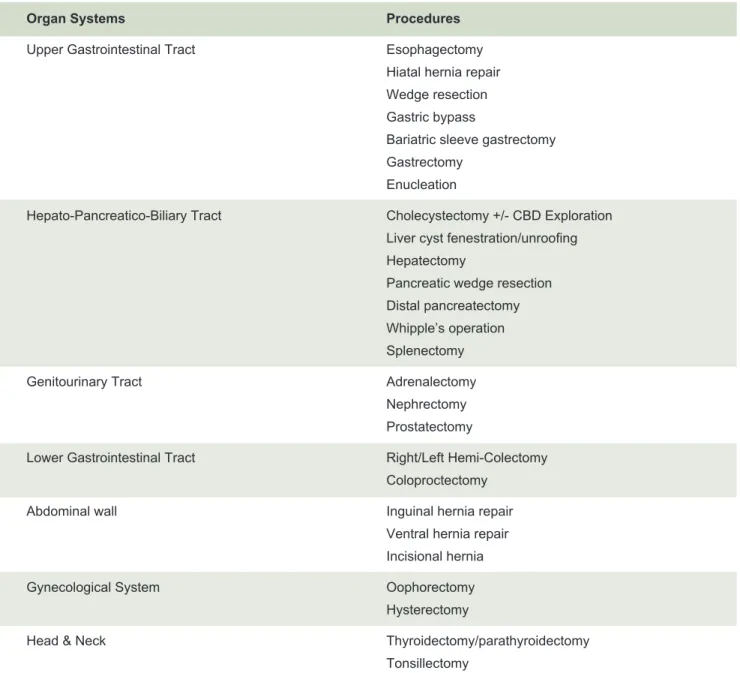
specialties is not a cost-effective way of exploiting this expensive technology. All procedures holding potential for robotic surgery, regardless of specialty, should be explored. Table 1 shows a list of robotic surgical procedures performed worldwide. Of those, only procedures that can realistically be performed at the facility should be considered.
A multispecialty approach helps to increase volume, patient flow, and efficient usage of the system and operating room.12 It reduces the cost of capital investment and
maintenance per case, leading to early profitability. Furthermore, public awareness of a multispecialty robotic program can affect patient flow to other non-robotic programs, with the potential of greater market share through an increase in overall patient volume.
An Actual Robotic Surgery Center
While it is possible to promote a robotic surgery program “virtually”, the importance of a physical facilities infrastructure cannot be overstated. An actual robotic surgery center is essential to familiarizing patients and families with robotic surgery. This is the place where a patient first encounters the surgeon who will counsel and explain in detail what robotic surgery entails. There should be a waiting room where patients and family can peruse robotic articles, brochures, or view multimedia materials. Facilities should also include a command center where a surgical director and program manager reside, as well as a data collection and audiovisual station for clinical research.
TABLE 1. Commonly performed robotic procedures.
Organ Systems Procedures
Upper Gastrointestinal Tract Esophagectomy
Hiatal hernia repair Wedge resection Gastric bypass
Bariatric sleeve gastrectomy Gastrectomy
Enucleation
Hepato-Pancreatico-Biliary Tract Cholecystectomy +/- CBD Exploration Liver cyst fenestration/unroofing Hepatectomy
Pancreatic wedge resection Distal pancreatectomy Whipple’s operation Splenectomy
Genitourinary Tract Adrenalectomy
Nephrectomy Prostatectomy
Lower Gastrointestinal Tract Right/Left Hemi-Colectomy
Coloproctectomy
Abdominal wall Inguinal hernia repair
Ventral hernia repair Incisional hernia
Gynecological System Oophorectomy
Hysterectomy
Head & Neck Thyroidectomy/parathyroidectomy
Program Promotion and “Marketing”
Although the notion of marketing inevitably prompts complaints of conflict-of-interest in the academic sector, it is nonetheless an important factor in growing a robotic surgery program. The goal of program promotion in this case should be to expand the catchment territory and referral base while also distributing educational information to patients and physicians. Program promotion should begin within the institution through town-hall style lectures by the director and the team introducing the “robot” and “what it can do” so that news can spread in a factual fashion. The next step is to utilize various media outlets for the same purpose, such as newspapers or local TV networks. These strategies will help form public awareness of the existence of a robotic surgery program at any given institution. Equally important is the maintenance of a dedicated website providing information about the program, public outreach, and dedicated patient online interaction.
Program Growth and Maintenance
Clinical and financial data collection is essential to growing a program and making it economically sustainable and profitable.13 On the clinical side, the
collection and analysis of data provides insight into cost-effectiveness and outcomes and offers keys to further improvement. All procedures should be video-recorded for review and critique, self-improvement, and ongoing education of surgical staff and residents. Video-records are equally an important resource for clinical research and publication. On the financial side, data should be collected and analyzed with respect to the cost structure of the program, including average direct and total costs per case for hospital expenses (room, operating room services and supplies), as well as surgeons’ fees. Targeted improvements, such as in operating time, number of instruments used, or length of hospital stay, can then be strategized based on analyzed data.14
CONCLUSION
Any robotic surgery program in Thailand is a luxury – that is an undeniable fact. It is not, by any evidence-based information we have to date, superior to the existing technology. However, the reality is that there is now no turning back on this technology on the local and international level. Moreover, it is no longer beyond the means of an increasingly affluent and internationalizing Thai medical community. But whatever goals we may set for robotic surgery in Thailand, the most important priority must be the safety of the patient and a good
surgical outcome. These goals are definitely attainable through careful and realistic program design, selection of an exemplary surgical team, ongoing self-evaluation and analysis through prospectively collected data and videos, teaching and training of a new generation of robotic surgeons, and last but not least, a smart business plan.
REFERENCES
1. Patel VR, Palmer KJ, Coughlin G, Samavedi S. Robot‐assisted laparoscopic radical prostatectomy: perioperative outcomes of 1500 cases. J Endourol. 2008;22(10): 2299‐305.
2. Tewari AK, Jhaveri JK, Surasi K, Patel N, Tan GY. Benefit of robotic assistance in comparing outcomes of minimally invasive versus open radical prostatectomy. J Clin Oncol. 2008;26:4999- 5000.
3. Tsuda S, Oleynikov D, Gould J, Azagury D, Sandler B, Hutter M, et al. SAGES TAVAC Safety and effectiveness analysis: da Vinci Surgical System (Intuitive Surgical, Sunnyvale, CA). Surg Endosc. 2015;29(10):2873-84.
4. Walker PA, May AC, Mo J, Cherla DV, Santillan MR, Kim S, et al. Multicenter review of robotic versus laparoscopic ventral hernia repair: is there a role for robotics? Surg Endosc. 2018;32(4):1901-5.
5. Heemskerk J, Bouvy ND, Baeten CGMI. The end of robot-assisted laparoscopy? A critical appraisal of scientific evidence on the use of robot-assisted laparoscopic surgery. Surg Endosc. 2014;28:1388-98.
6. Srinualnad S. Early experience of robotic assisted laparoscopic radical prostatectomy. J Med Assoc Thai. 2008;91:377-82.
7. Akaraviputh T, Trakarnsanga A, Suksamanapun N. Robot-assisted complete excision of choledochal cyst type I, hepaticojejunostomy and extracorporeal Roux-en-y anastomosis: a case report and review literature. World J Surg Oncol. 2010;8:87.
8. Nithisathiian C, Nualyong C, Leewansantong S, Srinualnad S, Taweemonkongsap T, Chaiyaprasithi B, et al. Incidence of urinary incontinence and erectile dysfunction post robotic- assisted laparoscopic radical prostatectomy: the first 318 cases in Siriraj Hospital, Thailand. Thai J Urol 2012;33:1-8. (in Thai).
9. Sirimai K, Inthasorn P, Sutchritpongsa P, Tanmahasamut P. Total robotic hysterectomy: Thailand’s first case report of gynecologic robotic surgery. Siriraj Med J. 2016;68:42-46.
10. Ratchanon S, Apiwattanasawee P, Prasopsanti K. A cost-utility analysis of laparoscopic radical prostatectomy and robotic- assisted laparoscopic radical prostatectomy in men with localized prostate cancer in Thailand. J Med Assoc Thai. 2015;98 Suppl 1:S14-20.
11. Laparobotic Whipple operation in soft cadaver. Available from: http://pr.md.chula.ac.th/spotlight/year3/03-50.pdf
12. Tuvayanon W, Chinswangwatanakul V, Akaraviputh T, Yiengpruksawan A. How to manage the operating theater and the surgical system for robotic surgery? Siriraj Med J. 2016;68:395- 400.
13. Palmer KJ, Orvieto MA, Rocco BM, Patel VR. Launching a successful robotic program. In: Patel VR, ed. Robotic Urologic Surgery. Springer-Verlag, London Limited, 2012.p.11-17.