Refereed papers
The CONTENT project: a problem-oriented,
episode-based electronic patient record in
primary care
Gunter Laux MCS PhD
Scientific OfficerThorsten Koerner MD MA MPH
Scientific Project ManagerThomas Rosemann MD
Research AssociateDepartment of General Practice and Health Services Research, University of Heidelberg, Heidelberg, Germany
Martin Beyer MSocSc
Research AssociateKatja Gilbert MD
Research AssociateDepartment of General Practice, University of Frankfurt, Frankfurt, Germany
Joachim Szecsenyi MD MSocSc
Professor of General Practice, Department of General Practice and Health Services Research, University of Heidelberg, Heidelberg, Germany
ABSTRACT
In order to obtain a proper knowledge base in primary care, a form of electronic patient record is needed that takes into account the specific characteristics of the doctor–patient encounter, the patient population, the presentation of diseases and the associated prevalences. However, in real life this has not happened for several reasons. For the most part, existing patient records are determined by invoicing requirements rather than by endeav-ours to meet the intrinsic needs of primary care. CONTENT (CONTinuous morbidity registration Epidemiologic NeTwork) is an ambitious scientific project in Germany to establish a system for ad-equate record keeping and analysis in primary care. Based on a classification system designed for the special situation of primary care, a scientific net-work is being established consisting of participating
surgeries, general practitioners, computer scientists and statisticians. The project is supported by the German Federal Ministry of Education and Re-search.
The aims are strictly scientific and the underlying hypothesis is that the knowledge-gaining process can be accelerated by combining the experience of many, especially with respect to complex interac-tions of factors and the analysis of rare events. Aside from maintaining a morbidity registry, within the CONTENT framework various prospective and retrospective studies on particular epidemiological and health economic research topics will be con-ducted.
Introduction
There is a general consensus that computerised pri-mary care records are fundamental components for any national health information system.1 However, reliable research in primary care is only possible if the specific characteristics of the population as well as the presentation and prevalence of illness and disease are taken into account.2Therefore, among other import-ant factors, an appropriate coding structure is indis-pensable. In general practice, several kinds of coding structure are in use. However, only one system was especially designed to meet the needs in this field: the
International Classification of Primary Care (ICPC) published by the World Organisation of National Col-leges and Academics (WONCA) in 1987 allows the healthcare provider to classify three important ele-ments in the context of a doctor–patient encounter using the same classification:3
. reasons for encounter from the patient’s perspective . problems and diagnoses in the healthcare provider’s
view
. decisions, actions and plans elaborated between patients and healthcare provider.
Table 1 shows the biaxial structure of ICPC. The first axis consists of 17 chapters with an alpha code. Each
Table 1 ICPC structure: 17 chapters, 7 components
Components
1
(01–29) Symptoms and complaints
2
(30–49) Diagnostic, screening, preventive
3
(50–59) Medication, treatment, procedures
4
(60–61) Test results
5
(62) Adminis-trative
6
(63–69) Referrals and other reasons for encounter
7
(70–99) Diagnoses and diseases
AGeneral and unspecified
A01–29 A30–49 A50–59 A60–61 A62 A63–69 A70–99
BBlood, blood-forming organs and immune mechanism
B01–29 B30–49 B50–59 B60–61 B62 B63–69 B70–99
DDigestive D01–29 D30–49 D50–59 D60–61 D62 D63–69 D70–99
FEye F01–29 F30–49 F50–59 F60–61 F62 F63–69 F70–99
HEar H01–29 H30–49 H50–59 H60–61 H62 H63–69 H70–99
KCirculatory K01–29 K30–49 K50–59 K60–61 K62 K63–69 K70–99
L Musculo-skeletal
L01–29 L30–49 L50–59 L60–61 L62 L63–69 L70–99
NNeurological N01–29 N30–49 N50–59 N60–61 N62 N63–69 N70–99
PPsychological P01–29 P30–49 P50–59 P60–61 P62 P63–69 P70–99
RRespiratory R01–29 R30–49 R50–59 R60–61 R62 R63–69 R70–99
SSkin S01–29 S30–49 S50–59 S60–61 S62 S63–69 S70–99
TEndocrine, metabolic, nutritional
T01–29 T30–49 T50–59 T60–61 T62 T63–69 T70–99
UUrological U01–29 U30–49 U50–59 U60–61 U62 U63–69 U70–99
WPregnancy, child-bearing, family planning
W01–29 W30–49 W50–59 W60–61 W62 W63–69 W70–99
XFemale genital
X01–29 X30–49 X50–59 X60–61 X62 X63–69 X70–99
YMale genital Y01–29 Y30–49 Y50–59 Y60–61 Y62 Y63–69 Y70–99
ZSocial problems
Z01–29 Z30–49 Z50–59 Z60–61 Z62 Z63–69 Z70–99 C
chapter corresponds to a body system or a problem area. The second axis is formed by seven components. Each component contains several two-digit numeric codes describing the doctor–patient encounter ele-ments in more detail. An ICPC code consists of the character for the chapter followed by the numeric code for the subcomponent. ICPC reflects the essential elements of each doctor–patient encounter and the linkage of elements, beginning with the reason for encounter and ending with decisions, actions and plans, and the dynamic arrangement of encounters into episodes allows documentation in an ‘episode of care’ structure over time.4,5
ICPC was accepted by the World Health Organ-ization (WHO) as a related classification to be used for health information recording in primary care. The electronic version of the second ICPC edition (ICPC-2-E) is available for use in electronic medical records.6 Moreover, this electronic version includes well-defined conversion tables to map ICPC codes to the widely recognised and used International Classification of Diseases (ICD-10) published by the WHO.7
Generally, there is a broad consensus that ICPC exactly meets the needs in primary care both in research as well as in practice and will add knowledge about morbidity patterns in this field. However, the structure of existing electronic patient records is mostly determined by specific national provisions for routine documentation and invoicing. Moreover, conflicting interests of national and international organ-isations work against a broadly based implementation of ICPC-based electronic records in primary care.
In Germany, primary care documentation is based on ICD-10 since the medical billing system is based on ICD-10. However, ICD was developed as a coding system for detailed mortality statistics and does not focus on the special context in primary care.7 The CONTENT project is an effort to establish a system for adequate documentation and analysis in primary care based on ICPC. An electronic patient record (EPR) designed for the special conditions in primary care had already been developed in Heidelberg, Germany. Existing primary care software is about to be upgraded to meet the needs of the new EPR.
The basic objects of the
CONTENT EPR
The CONTENT EPR consists of several fundamental objects which are described below. To a large extent the objects’ semantics are similar to those defined by Okkes and Lamberts:4
Doctor: The essential healthcare provider in primary care.
Patient: Individual with health problems contacting the healthcare provider.
Contact: Contact between patient and doctor or other members of the healthcare team. The contact can be direct (face to face) or indirect (telephone call, letter, and so on). One or more episodes may be dealt with during one contact, therefore one contact may consist of several ‘sub-contacts’.
Episode of care: A health problem from its first pre-sentation by a patient to a doctor until the completion of the last contact for it or presumably death, if the focal problem still exists. An episode of care contains all contact or sub-contact elements related to that health problem. At a particular time an episode can be active, inactive or concluded.
Health problem: Health concern of a patient as deter-mined by the healthcare provider. These problems should be recorded as specifically as possible. The first presentation of a problem leads to an entry of anew problemand a previously assessedcontinuing problem requires ongoing care (follow-up).
Procedure: Decisions, actions and plans elaborated between patients and their healthcare providers. A procedure may be a prescription, a therapeutic or diagnostic method, a referral or a hospitalisation.
ICPC assignment: For every contact there must be an assignment according to ICPC within the EPR. This assignment may specify a reason for encounter in the patient’s view, a problem/diagnosis in the healthcare provider’s view or a procedure.
ICD diagnosis: In addition to diagnoses according to ICPC, more detailed diagnoses according to ICD-10 can be assigned.
Notification: At regular intervals, the participating surgeries will send CONTENT-specific data concern-ing a particular observation period to the study centre. This event is documented with a notification object containing the observation period and other meta-information. For each notification, patients’ episodes, problems and encounters are linked to a notification object and the consideration of subsequent notifica-tion objects with their related objects allows the dynamic documentation in an episode of care struc-ture over time.
contact are acquired by the doctor. Moreover, the doctor decides if this contact corresponds to an exist-ing episode or if the reasons for encounter correspond to one or more new episodes. Finally, new problems can be acquired and a mapping of episodes to prob-lems can be performed. Basically, contacts, episodes, problems, procedures as well as ICPC- and ICD-assignments and the performed mappings between them can be updated at any time according to new insights concerning the patient.
Software, data transfer and
security
A German medical software company with more than 1000 installations in primary care surgeries has ex-tended existing software components to meet the needs of the above-described form of data entry. The close collaboration between the software developer and the Department of General Practice and Health Services Research at the University of Heidelberg has been quite successful so far. The first version of the modified software was evaluated by the German Federal Ministry of Education and Research in the context of a feasibility study and met the strict requirements. The second version has been approved for implementation within surgeries. Moreover, it is planned to gain at least two more medical software companies for the CONTENT project by means of open competitive tendering. After the test stage which started this sum-mer with ten participating surgeries, in 2006 a further 20 surgeries will be recruited. The recruitment of more
than 100 surgeries is the ambitious aim in order to obtain a sound and representative database for scien-tific analyses.
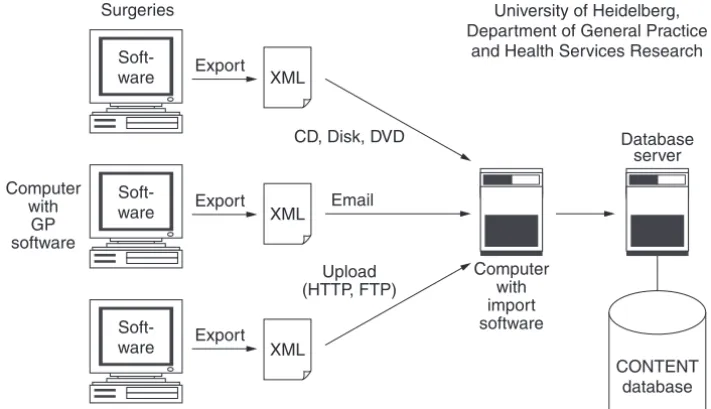
As mentioned above, the participating surgeries will send CONTENT-specific data concerning a particular observation period to the study centre at regular inter-vals. Figure 1 illustrates the data transfer architecture. The extended medical software features a special func-tion for data export based on eXtensible Mark-up Language (XML).8The result of an export is an XML data file corresponding to a well-defined XML schema that defines the structure of the XML data accurately.9 The XML schema file is independent from any medical software used in the context of CONTENT. Thus, it is guaranteed that XML data files can be processed with the same import software in order to be integrated in the CONTENT database. Besides the actual patient data the files contain metadata with information about the observation period and the surgery. The data may be sent using electronic data media (floppy disk, CD, DVD) or may be attached to an email. Furthermore, an upload option will be established in order to enable an upload of data files onto a dedicated file server via file transfer protocol (FTP) or HyperText Transfer Protocol (HTTP).
By means of a customised import program based on Java and XML Path Language (XPath), the XML data will be validated and imported into the relational CONTENT database.10,11 The CONTENT database server, which houses the resulting aggregated database and is located at the University of Heidelberg, is not accessible from external networks.
As a basic principle, only anonymised data will be transmitted. For each patient, the CONTENT EPR contains a case number, the year of birth and the gender
Computer with import software
Soft-ware Export XML
Soft-ware Computer
with GP software
XML Export
Soft-ware Export XML
CD, Disk, DVD
Upload (HTTP, FTP)
University of Heidelberg, Department of General Practice
and Health Services Research
CONTENT database Database server Surgeries
but not name or address. Thus, it is not possible to determine a patient’s identity and the implementation of extensive data security mechanisms is not needed. Moreover, the German Data Protection Act allows the transmission of anonymised patient data for scientific purposes without the explicit permission of patients.
Web-based analysis
The scientific aim is to conduct various analyses con-cerning particular epidemiological and health economics research topics in primary care within the CONTENT network. Therefore a framework for web-based analysis is about to be established in order to answer scientific questions from authorised researchers from all over the world.
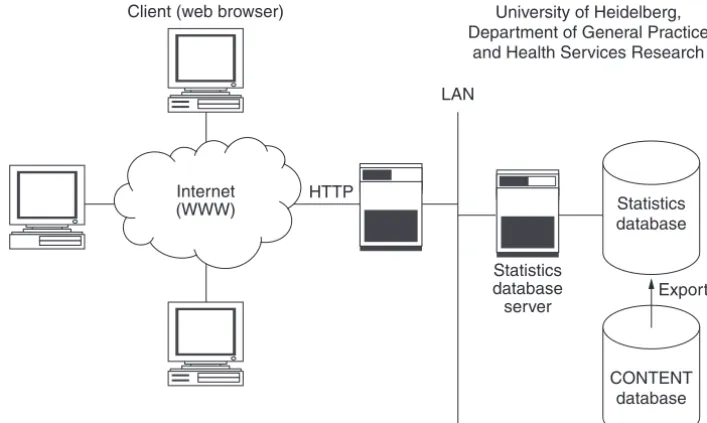
Figure 2 schematically shows the architecture for web-based analysis. At regular intervals data relevant for statistical analyses will be transferred from the CONTENT database server to a statistics database server. A dedicated computer hosts both a logical web server and a logical application server. The web server receives HTTP requests from client browsers and initiates the application server to receive the needed data from the statistics database server and then to perform the corresponding calculations. Finally, the result is for-matted and the response is sent back via the web server to the client browser. In this way reliable components and technologies (such as Jakarta Tomcat and Java Server Pages) will be applied.
Some analyses are of general value and will be freely available to any person who wishes to access them. More detailed analyses will be available only to speci-fied authorised users (for instance, comparisons be-tween a certain subpopulation and the registered overall population). An initial set of detailed mor-bidity analyses will provide cross-tabulation of, for example, incidence and prevalence of specific diseases and disease groups, tabulated by age and gender. Moreover, from the very first, analyses concerning drug prescriptions and relative expenditure will be available. The analysis framework will be extended continuously, particularly following evaluation of user requests.
Related research
In recent years many researchers in several European countries have established morbidity registers based on data from EPRs. The UK General Practice Research Database (GPRD) as well as the UK QRESEARCH database are among the world’s largest aggregated databases of longitudinal medical records.12,13 Cur-rently, both databases contain over three million active patient records from more than 400 primary care practices throughout the UK and support public health research internationally.
In contrast to the UK, researchers in the Nether-lands and Belgium established EPRs in primary care based on episodes of care and/or ICPC. On the basis of the Belgian network ‘INTEGO’ (INTEGrated com-puterized netwOrk), new perceptions to determine
Statistics database server
University of Heidelberg, Department of General Practice
and Health Services Research
CONTENT database Statistics database Client (web browser)
Export HTTP
Internet (WWW)
LAN
the denominator or the ‘population at risk’, a problem which has long been encountered in general practice-based epidemiological research, were obtained.14
In the Netherlands several problem-oriented mor-bidity registers exist. Within the framework of the Integrated Primary Care Information (IPCI) project, electronic data from participating GPs are downloaded on a monthly basis and aggregated at the study centre (Erasmus University Medical Centre, Rotterdam). Data accumulated in the IPCI database have proven to be of high quality and suitable for epidemiological and pharmaco-epidemiological research.15The cen-tral goal of the ‘transition project’ (Amsterdam Centre for Health and Health Research) is to formally charac-terise and describe the domain of family practice, based on episode-oriented epidemiology, in order to develop guidelines for the comparison of national and international data from family medicine.16 At the University of Maastricht, the RNH (RegistratieNet Huisartspraktijken [Registration Network Family Prac-tices]) network was established in 1988.17The RNH database has initially been set up primarily as a sam-pling frame allowing researchers to identify patients with particular health problems. Meanwhile the data-base is also used in education. In healthcare research especially, the prevalence and incidence of multi-morbidity in a general practice setting and factors related to the occurrence of multimorbidity are focused.18 The RNH group is very experienced in this field of research and there is a close collaboration between the Department of General Practice at the Maastricht University and the Department of General Practice and Health Services Research at the University of Heidelberg in order to begin work on first inter-national comparisons.
Conclusions
Based on sound and representative data with an appropriate classification system, the establishment of a morbidity registry is a promising challenge. The German CONTENT EPR with its logical mappings between patients’ contacts, episodes, problems and procedures as well as ICPC- and ICD-assignments will represent a knowledge base with the potential to approach scientific questions that could not yet be addressed in primary care. Qualitatively and quanti-tatively sound data about the frequency distribution of reasons for encounter and associated diagnoses appear to be especially interesting in order to deter-mine prior and posterior probabilities for important diseases when patients present a specific complaint or symptom.
Appropriate education for GPs on how to use this sophisticated approach to documentation is an essen-tial premise for good results, as well as encouraging acceptance of the extra time and effort it requires. The increased work may be considered to be justified by a better understanding of the patient’s condition by both doctor and patient.
Finally, the increasing application of ICPC-based EPRs all over the world will allow challenging inter-national comparisons in order to see inter-national differ-ences and regional distinctions and to discover what is generic in family practice and independent from local or national conditions.
REFERENCES
1 De Lusignan S, Teasdale S, Little Det al. Comprehensive computerised primary care records are an essential component of any national health information strategy: report from an international consensus conference. Informatics in Primary Care2004;12(4):255–64. 2 De Maeseneer JM, van Driel ML, Green LA and van
Weel C. The need for research in primary care. The Lancet2003;362:1314–19.
3 Lamberts H and Wood M (eds).ICPC. International Classification of Primary Care. Oxford: Oxford Univer-sity Press, 1987.
4 Okkes IM and Lamberts H. Classification and the domain of family practice. In: Jones R, Britten R, Culpepper L et al. (eds)Oxford Textbook of Primary Medical Care, Vol. 1. Oxford: Oxford University Press, 2004:139–53. 5 Okkes IM, Veldhuis M and Lamberts H. Severity of
episodes of care assessed by family physicians and patients. The DUSOI/WONCA as an extension of the International Classification of Primary Care (ICPC). Family Practice2002;19:350–6.
6 Okkes IM, Jamoulle M, Lamberts H and Bentzen N. ICPC-2-E. The electronic version of ICPC-2: differences with the printed version and the consequences.Family Practice2000;17:101–6.
7 World Health Organization.Manual of the International Classification of Diseases, Injuries, and Causes of Death. Tenth revision, ICD-10. Geneva: World Health Organ-ization, 1993.
8 Extensible Markup Language (XML) 1.0 (Third Edition). W3C Recommendation, 04 February 2004. www.w3. org/TR/2004/REC-xml-20040204
9 XML Schema Part 0: Primer Second Edition. W3C Recommendation, 28 October 2004. www.w3.org/TR/ xmlschema-0
10 XML Path Language (XPath)Version 1.0. W3C Rec-ommendation, 16 November 1999. www.w3.org/TR/ xpath
11 XML Path Language (XPath) Version 2.0. W3C Working Draft, 04 April 2005. www.w3.org/TR/xpath20 12 Walley T and Mantgani A. The UK General Practice
Research Database.The Lancet1997;350:1097–9. 13 Hippisley-Cox J, Stables D and Pringle M. QRESEARCH:
14 Bartholomeeusen S, Kim CY, Mertens R, Faes C and Buntinx F. The denominator in general practice: a new approach from the Intego database. Family Practice 2005;22(4):442–7.
15 Vlug AE, van der Lei J, Mosseveld BM et al. Post-marketing surveillance based on electronic patient records: the IPCI project. Methods of Information in Medicine 1999;38(4–5):339–44.
16 Okkes IM, Groen A, Oskam SK and Lamberts H. Advantages of long observation in episode-oriented electronic patient records in family practice.Methods of Information in Medicine2001;40(3):229–35. 17 Metsemakers JFM, Ho¨ppener P, Knottnerus JA, Kocken RJ
and Limonard CBG. Computerized health information in the Netherlands: a registration network of family practices. British Journal of General Practice 1992;42: 102–6.
18 Van den Akker M, Buntinx F, Roos S and Knottnerus JA. Problems in determining occurrence rates of multi-morbidity.Journal of Clinical Epidemiology2001;54(7): 675–9.
CONFLICTS OF INTEREST
None.
ADDRESS FOR CORRESPONDENCE
Gunter Laux
Department of General Practice and Health Services Research
Voss-Strasse 2 D-69115 Heidelberg Germany
Tel: +49 (0)6221 566207 Fax: +49 (0)6221 561972
Email: [email protected]