o r i g i n a l a r t i c l e
Detection of Acute Infections during HIV
Testing in North Carolina
Christopher D. Pilcher, M.D., Susan A. Fiscus, Ph.D., Trang Q. Nguyen, M.P.H., Evelyn Foust, M.P.H., Leslie Wolf, Ph.D., Del Williams, Ph.D., Rhonda Ashby, B.S.,
Judy Owen O’Dowd, B.S., J. Todd McPherson, M.S., Brandt Stalzer, B.S., Lisa Hightow, M.D., William C. Miller, M.D., Ph.D., Joseph J. Eron, Jr., M.D.,
Myron S. Cohen, M.D., and Peter A. Leone, M.D.
From the Departments of Medicine (C.D.P., B.S., L.H., W.C.M., J.J.E., M.S.C., P.A.L.), Mi-crobiology and Immunology (S.A.F.), and Epidemiology (T.Q.N., W.C.M., M.S.C.), Uni-versity of North Carolina at Chapel Hill, Chapel Hill; and the North Carolina Depart-ment of Health and Human Services HIV/ STD Prevention and Care Branch, Raleigh (E.F., L.W., D.W., R.A., J.O.O., J.T.M., P.A.L.). Address reprint requests to Dr. Pilcher at C.B. 7215, University of North Carolina at Chapel Hill, 211A W. Cameron Ave., Chapel Hill, NC 27599-7215, or at cpilcher@med. unc.edu.
N Engl J Med 2005;352:1873-83. Copyright © 2005 Massachusetts Medical Society.
b a c k g r o u n d
North Carolina has added nucleic acid amplification testing for the human immunode-ficiency virus (HIV) to standard HIV antibody tests to detect persons with acute HIV in-fection who are viremic but antibody-negative.
m e t h o d s
To determine the effect of nucleic acid amplification testing on the yield and accuracy of HIV detection in public health practice, we conducted a 12-month observational study of methods for state-funded HIV testing. We compared the diagnostic performance of standard HIV antibody tests (i.e., enzyme immunoassay and Western blot analysis) with an algorithm whereby serum samples that yielded negative results on standard antibody tests were tested again with the use of nucleic acid amplification. A surveillance algorithm with repeated sensitive–less-sensitive enzyme immunoassay tests was also evaluated. HIV infection was defined as a confirmed positive result on a nucleic acid am-plification test or as HIV antibody seroconversion.
r e s u l t s
Between November 1, 2002, and October 31, 2003, 109,250 persons at risk for HIV in-fection who had consented to HIV testing presented at state-funded sites. There were 606 HIV-positive results. Established infection, as identified by standard enzyme immu-noassay or Western blot analysis, appeared in 583 participants; of these, 107 were iden-tified, with the use of sensitive–less-sensitive enzyme immunoassay tests, as recent in-fections. A total of 23 acutely infected persons were identified only with the use of the nucleic acid amplification algorithm. With all detectable infections taken into account, the sensitivity of standard antibody testing was 0.962 (95 percent confidence interval, 0.944 to 0.976). There were two false positive results on nucleic acid amplification tests. The specificity and positive predictive value of the algorithm that included nucleic acid amplification testing were greater than 0.999 (95 percent confidence interval, 0.999 to >0.999) and 0.997 (95 percent confidence interval, 0.988 to >0.999), respectively. Of the 23 acute HIV infections, 16 were detected at sexually transmitted disease clinics. Emer-gency measures for HIV prevention protected 48 sex partners and one fetus from high-risk exposure to HIV.
c o n c l u s i o n s
The addition of nucleic acid amplification testing to an HIV testing algorithm signifi-cantly increases the identification of cases of infection without impairing the perfor-mance of diagnostic testing. The detection of highly contagious, acutely infected persons creates new opportunities for HIV surveillance and prevention.
cute infection with the human
immunodeficiency virus (HIV) is rarely rec-ognized. It is associated with a high prob-ability of secondary HIV transmission,1-5
probably because of the magnitude of viremia and genital shedding of virus. Since routine HIV antibody tests yield negative results during the first four to five weeks of HIV infection,6
acute infections can be di-agnosed during this period only with the use of tests for viral antigens, nucleic acids, or both.
Sensitive nucleic acid amplification tests are routinely used by blood banks to protect the blood supply.7
However, concerns about cost and speci-ficity have precluded the use of these tests for clini-cal testing for HIV, except in the evaluation of sus-pected acute retroviral syndromes.8
Results from several small studies,9-15
including one conducted in North Carolina,14
have suggested that acute (an-tibody-negative) infections that can be detected by nucleic acid amplification testing may be identified regularly in some clinical testing settings. Most re-cently, the use of algorithms12-15
involving the test-ing of pooled specimens has been proposed as a way to make nucleic acid amplification testing ac-curate and cost effective.14
We designed a system based on the concomi-tant use of nucleic acid amplification and antibody testing for the identification and public health man-agement of patients with acute HIV infection who received voluntary counseling and testing in North Carolina. We report the results of the first year of this program.
s t u d y d e s i g n
A 12-month observational study was conducted to evaluate a new strategy for HIV testing in North Carolina. The primary objective was to compare the performance and yield of standard HIV antibody tests with an algorithm that included both standard antibody tests and nucleic acid amplification tests. Additional objectives were to assess the feasibility of timely intervention in networks of social and sex-ual contact and to compare nucleic acid amplifica-tion tests with sensitive–less-sensitive enzyme im-munoassay tests with respect to estimation of the incidence of HIV infection.16-18
s t u d y s u b j e c t s
All consenting persons who presented for HIV counseling and testing at 110 publicly funded sites
in North Carolina participated in this study between November 1, 2002, and October 31, 2003. All test-ing was confidential and was linked to patient in-formation with the use of a system of unique iden-tifiers, according to state public health statutes. Anonymous, unlinked HIV testing is not available in North Carolina.
s t u d y p r o c e d u r e s
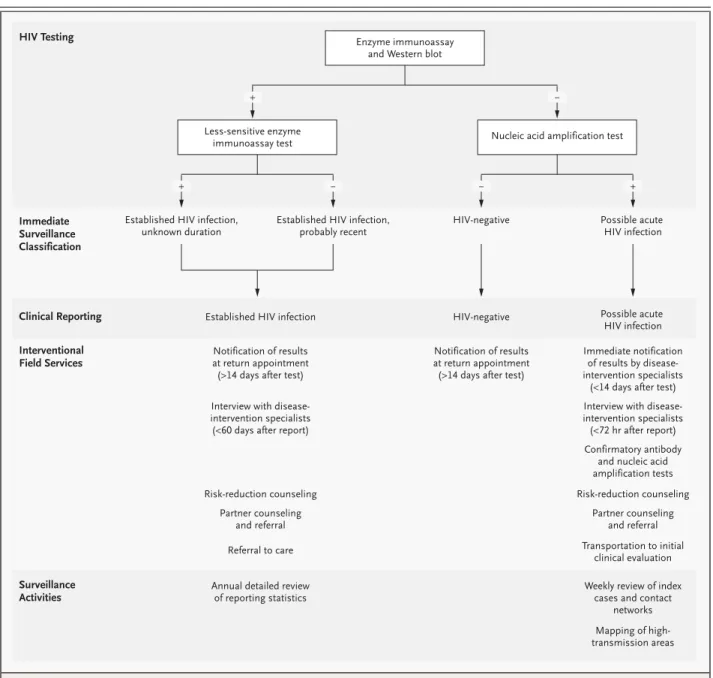
Figure 1 depicts the procedures of the North Caro-lina Department of Health and Human Services for HIV testing, field services (e.g., notification of test results and partner counseling), and surveillance, which provided the framework for this study. In-formation about characteristics of the testing sites, demographics, reasons for testing, HIV-testing his-tory, and lifetime risk factors was taken from test-ing forms and entered into a secure database. Sup-plemental, detailed information about symptoms, risk behavior, and partnerships was collected at follow-up interviews from subjects with HIV tests positive for acute infection by specialists in HIV and sexually transmitted disease intervention. Written informed consent for all HIV testing and for the use of personal information in evaluation research was obtained during pretest counseling and at ini-tial interviews with disease-intervention specialists. All testing and evaluation procedures were ap-proved by institutional review boards of the state of North Carolina and the University of North Caroli-na School of Medicine.
Standard HIV Antibody Testing
Serum samples submitted for HIV testing were pro-cessed centrally at the North Carolina State Labora-tory of Public Health and maintained at ¡70° C. Standard Vironostika HIV type 1 (HIV-1) enzyme immunoassay (bioMérieux) and Western blot analy-sis (Bio-Rad Laboratories) kits were used for anti-body screening.
Sensitive–Less-Sensitive Antibody Testing
Antibodies that appear during the early stages of HIV infection are typically associated with a low ti-ter. Janssen et al.16
developed a detuned antibody test (the “less sensitive” HIV antibody enzyme im-munoassay) that continues to yield a negative result for 170 days, on average, after a standard (“sensi-tive”) antibody enzyme immunoassay test becomes positive,17
thereby allowing the identification of re-cent infections. For this study, serum samples that had positive results on the standard antibody
en-a
zyme immunoassay or Western blot analysis were made anonymous (unique identifiers were recoded) and then tested again at a laboratory certified by the Centers for Disease Control and Prevention (CDC) with the use of a less-sensitive HIV antibody enzyme immunoassay test based on the Vironostika kit.17
Nucleic Acid Amplification Testing
Serum samples that were antibody-negative or for which there was an indeterminate result were
pooled, as previously described,14
with the use of an automated liquid-handling robot (Biomek FX, Beck-man Coulter). The pooling algorithm allowed spec-imens to be screened by nucleic acid amplification in large groups, an approach that reduced testing costs and the potential for false positive results (which are expected to be approximately propor-tional to the number of tests performed). Pools of 10 samples were first created by combining aliquots from consecutive individual specimens; pools of 90
Figure 1. Algorithm of the Procedures of the North Carolina Department of Health and Human Services for HIV Testing, Notification, and Surveillance.
Enzyme immunoassay and Western blot
Less-sensitive enzyme immunoassay test
Established HIV infection, unknown duration
Established HIV infection, probably recent
Established HIV infection
HIV-negative
HIV-negative
Possible acute HIV infection
Possible acute HIV infection
Notification of results at return appointment (>14 days after test)
Notification of results at return appointment (>14 days after test)
Immediate notification of results by disease-intervention specialists
(<14 days after test)
Interview with disease-intervention specialists (<60 days after report)
Interview with disease-intervention specialists (<72 hr after report)
Confirmatory antibody and nucleic acid amplification tests
Risk-reduction counseling
Partner counseling and referral
Transportation to initial clinical evaluation
Weekly review of index cases and contact
networks Annual detailed review
of reporting statistics
Mapping of high-transmission areas Risk-reduction counseling
Partner counseling and referral
Referral to care
Nucleic acid amplification test HIV Testing
Immediate Surveillance Classification
Clinical Reporting
Interventional Field Services
Surveillance Activities
+ ¡
were created by combining aliquots from 9 of these pools of 10. The pools of 90 were then screened by nucleic acid amplification for HIV-1 RNA with the use of the NucliSens HIV-1 QL assay (bioMérieux), a qualitative assay that can reliably detect concen-trations exceeding 75 copies of HIV-1 RNA per mil-liliter. A pool of 90 specimens, therefore, would be likely to be positive on nucleic acid amplifica-tion testing if the pool included at least 1 specimen with more than 6750 copies of HIV-1 RNA per mil-liliter. Nucleic acid amplification can occasionally detect even lower concentrations, depending on the efficiency of nucleic acid amplification in a test-ing run.19
Only pools of 90 specimens that were positive on nucleic acid amplification tests were broken down for further testing by this method — first by the examination of pools of 10 and finally by tests of individual specimens. Individual specimens that were positive on nucleic acid amplification under-went repeated enzyme immunoassay testing and quantitative HIV-1 RNA testing (Roche Amplicor 1.5, Roche Molecular Systems; lower detection limit, 500 copies per milliliter). Confirmatory se-rum samples obtained subsequently from subjects with possible acute HIV infection and their recent sexual contacts were tested individually for HIV an-tibodies and, if the results were negative, by nucleic acid amplification.
Field Protocols
North Carolina public health statutes mandate that the following functions be fulfilled by specialists in HIV and sexually transmitted disease intervention for all newly identified HIV-positive persons: name-based reporting, notification of HIV-positive per-sons of their test results, provision of risk-reduction counseling, and provision of partner counseling and referral services (Fig. 1). Cases of possible acute HIV infection, as determined by a positive re-sult on a nucleic acid amplification test, and cases of documented seroconversion found during the routine evaluation of HIV reports were assigned to a team of 12 specifically trained disease-interven-tion specialists, who performed initial interviews, confirmatory tests, and referrals to care within 72 hours after receiving a report. For persons with pos-sible acute HIV infection, initial counseling focused on the indeterminate nature of HIV test results and the urgent need for additional evaluation and con-firmatory testing; repeated testing was recommend-ed at 2 weeks (and, if necessary, at 4 and 12 weeks).
Sexual partners or those who had shared needles and hence had possibly been exposed to acute HIV infection within eight weeks before the initial in-terview were rapidly notified and offered testing. Partners who were exposed outside the eight-week window were notified only after confirmation of seroconversion in the index case.
a n a l y s e s
The population at risk for HIV infection was de-fined as the population of persons who did not re-port a previous positive HIV test. HIV infection was defined as a positive result on enzyme immunoas-say and Western blot analysis at either the initial or follow-up test or as a positive result on nucleic acid amplification at both the initial and follow-up tests (Fig. 1). Persons for whom the HIV antibody status was negative or indeterminate but positive on ini-tial nucleic acid amplification testing were defined as having acute HIV infection; those whose anti-body status was positive on initial testing were de-fined as having established HIV infection. The per-formance of testing algorithms during screening of the routine testing population was evaluated on the basis of all detectable HIV infections according to the above-mentioned reference standard. The sensitivity of the combined algorithm and the spec-ificity of the standard algorithm were assumed to be 100 percent. For surveillance purposes, after sensitive–less-sensitive enzyme immunoassay test-ing, subjects who had positive results on a sensitive enzyme immunoassay but negative results on a less-sensitive enzyme immunoassay were classified as probably having recent infection16,17
; the remain-ing subjects, with positive results on a less-sensi-tive enzyme immunoassay, were classified as having infection of unknown duration, as recommended because of concerns about misclassification.20
Estimation of Incidence
Incidence rates were estimated from observational data on acute and recent HIV infections, according to the Serologic Testing Algorithm for Recent HIV Seroconversion.18
In this algorithm, the number of people in a population that are detected as having incident infection by an assay or assays (Ninc) can
be divided by the window period in days (w) to give the number who have incident infection per day (Ninc/w); w was assumed to be 170 days with the
less-sensitive enzyme immunoassay17
and 28 days with nucleic acid amplification,6
The annual number was determined by multiplica-tion of the observed number of incident infecmultiplica-tions per day by 365 (365¬Ninc/w). We divided this figure
by the number at risk for infection in the popula-tion to obtain an estimate of the annual incidence rate ([365¬Ninc/w]/[number at risk¬1 year]).
HIV-seronegative subjects and those with acute or re-cent HIV infections were included in this denomi-nator. The 95 percent confidence interval for each estimate of incidence was calculated with the use of a Poisson distribution.18
t e s t i n g p o p u l a t i o n
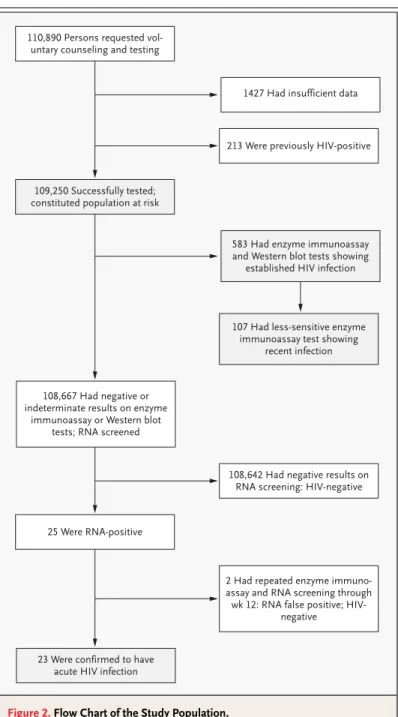
Between November 2002 and October 2003, 110,890 persons sought publicly funded, volun-tary HIV counseling and testing in North Carolina. The study population consisted of 109,250 subjects for whom there were complete testing data and who were classified as being at risk for HIV infec-tion (Fig. 2). Forty-five percent of the subjects at risk were self-identified as black, 37 percent as white, and 15 percent as Hispanic. Most subjects under-went HIV testing at sexually transmitted disease clinics (41 percent); other testing sites included prenatal–obstetrical clinics (17 percent), family-planning clinics (16 percent), freestanding HIV test-ing sites (11 percent), or jails (3 percent). Only 3 per-cent of subjects identified themselves as men who have sex with men, and 2 percent reported hetero-sexual contact and the use of injection drugs; 33 per-cent of the testing population self-identified as het-erosexual, with no other risk factors.
c a s e i d e n t i f i c a t i o n
As detailed in Table 1, 606 new HIV infections were identified with the use of the enhanced algorithm (prevalence, 5.5 cases per 1000 persons at risk). Of those, 583 subjects had antibody-positive estab-lished infection (prevalence, 5.3 per 1000). On the basis of the results of sensitive–less-sensitive en-zyme immunoassay tests suggesting low antibody titer, the surveillance algorithm defined 107 of the antibody-positive persons as probably having re-cent infection (prevalence, 1.0 per 1000).16,17
An ad-ditional 23 persons were antibody-negative and had positive nucleic acid amplification test results and thus met the study definition of acute HIV infection (prevalence, 0.2 per 1000).
Overall, the use of nucleic acid amplification tests increased the rate of HIV case identification
by 3.9 percent over that with standard antibody test-ing. Differences in the frequency of acute HIV infec-tion were significant (P<0.001) across all types of confidential HIV testing sites, as illustrated in Fig-ure 3. Most of the persons with acute infections (16 of 23, or 70 percent) were identified at sexually transmitted disease clinics. The remainder of the acute infections were detected at freestanding HIV testing sites and at jails.
r e s u l t s
Figure 2. Flow Chart of the Study Population.
The study samples are indicated in the shaded areas.
110,890 Persons requested vol-untary counseling and testing
109,250 Successfully tested; constituted population at risk
108,667 Had negative or indeterminate results on enzyme
immunoassay or Western blot tests; RNA screened
1427 Had insufficient data
213 Were previously HIV-positive
583 Had enzyme immunoassay and Western blot tests showing
established HIV infection
107 Had less-sensitive enzyme immunoassay test showing
recent infection
108,642 Had negative results on RNA screening: HIV-negative
25 Were RNA-positive
23 Were confirmed to have acute HIV infection
2 Had repeated enzyme immuno-assay and RNA screening through wk 12: RNA false positive;
As shown in Table 1, acute and recent HIV infec-tions were generally more prevalent among men, black persons, and persons older than 24 years than among other demographic groups. There was also a significantly increased prevalence of both acute and recent HIV infections among men who have sex with men and among persons tested for HIV in-fection as a result of having another sexually trans-mitted disease.
Signs and Symptoms of Acute Infection
No subjects were believed, on clinical grounds, to have acute HIV infection at the time of testing, al-though it was determined retrospectively that 7 of the 23 subjects who met the study definition of acute infection (30 percent) had presented with symp-toms of acute retroviral illness.21
Symptoms de-veloped in an additional six subjects (26 percent) during the seroconversion period. Eight subjects
* Categories that were included contained at least 1000 subjects; data were not available for all subjects in every category. Acute denotes acute HIV infection as determined by a positive result on a nucleic acid amplification test, recent Ab+ the likelihood that a patient has recent HIV in-fection as determined by a positive result on a sensitive enzyme immunoassay and a negative result on a less-sensitive enzyme immunoassay, all Ab+ an HIV antibody-positive result on an enzyme immunoassay and Western blot analysis, and CI confidence interval.
† Differences in the prevalence of acute infection and in the prevalence of acute or recent infection were significant (P<0.05). ‡ Differences in the prevalence of acute or recent infection were significant (P<0.05).
§ Race and ethnic background were self-reported. Differences in the prevalence of acute or recent infection were significant (P<0.05).
Table 1. Frequency and Prevalence of HIV Infections in the General Testing Population in North Carolina, According to Disease Stage and Demographic Characteristics and Risk Factors (November 1, 2002, through October 31, 2003).*
Variable
No.
at Risk No. of HIV-Positive Cases Prevalence of HIV-Positive Cases
Acute Recent Ab+ All Ab+ Acute Recent Ab+ All Ab+
no./1000 (95% CI)
All subjects 109,250 23 107 583 0.2 (0.1–0.3) 1.0 (0.8–1.2) 5.3 (4.9–5.8)
Sex†
Male 36,925 15 69 378 0.4 (0.2–0.7) 1.9 (1.4–2.3) 10.2 (9.2–11.3)
Female 70,900 8 38 200 0.1 (0.05–0.2) 0.5 (0.4–0.7) 2.8 (2.4–3.2)
Age‡
>24 yr 54,534 16 74 454 0.3 (0.2–0.5) 1.4 (1.1–1.7) 8.3 (7.6–9.1)
≤24 yr 53,318 7 31 122 0.1 (0.05–0.3) 0.6 (0.4–0.8) 2.3 (1.9–2.7)
Race or ethnic background§
White 40,472 5 29 106 0.1 (0.04–0.3) 0.7 (0.5–1.0) 2.6 (2.1–3.1)
Black 48,796 16 64 410 0.3 (0.2–0.5) 1.3 (1.0–1.7) 8.4 (7.6–9.2)
Hispanic 16,627 1 14 53 0.1 (0.002–0.3) 0.8 (0.5–1.4) 3.2 (2.4–4.1)
Native American 1,137 1 0 4 0.9 (0.02–4.9) 0 (0–3.2) 3.5 (1.0–8.9)
Risk category†
Heterosexual contact 35,647 1 18 102 0.03 (0.001–0.2) 0.5 (0.3–0.8) 2.9 (2.3–3.5) Presence of sexually transmitted
disease
21,968 7 11 72 0.3 (0.1–0.7) 0.5 (0.3–0.9) 3.3 (2.6–4.1)
Has a sex partner at risk 19,975 2 23 141 0.1 (0.01–0.4) 1.2 (0.7–1.7) 7.1 (5.9–8.3) Does not have an acknowledged
sex partner
12,715 0 5 20 0 (0–0.3) 0.4 (0.1–0.9) 1.6 (1.0–2.4)
Has a sex partner and uses non-injection drugs
6,077 2 2 17 0.3 (0.04–1.2) 0.3 (0.04–1.2) 2.8 (1.6–4.5)
reported symptoms related to a sexually transmit-ted disease, and one was pregnant. The median HIV-1 viral load on initial testing was 258,000 cop-ies of HIV-1 RNA per milliliter, with a range of 2609 to 4,998,000 copies per milliliter.
p e r f o r m a n c e o f d i a g n o s t i c t e s t s
Follow-up testing demonstrated antibody sero-conversion in 20 of 25 persons who had tested pos-itive on nucleic acid amplification. Two persons were again positive on nucleic acid amplification and antibody negative on initial follow-up testing, but they refused further testing. In one person who was followed up for 12 months, Pneumocystis carinii
pneumonia and the acquired immunodeficiency syndrome developed, but HIV antibodies were not detected. Two patients had negative results on both nucleic acid amplification and antibody testing at follow-up and were classified as having false pos-itive results.
The estimate of sensitivity for the standard an-tibody-testing algorithm was 0.962 (95 percent confidence interval, 0.944 to 0.976). The positive predictive value of the algorithm that combined
standard antibody testing and nucleic acid ampli-fication testing with pooling was 0.997 (95 percent confidence interval, 0.988 to >0.999). The positive predictive value of nucleic acid amplification with pooling alone was 0.920 (95 percent confidence interval, 0.740 to 0.990). The specificity of nucleic acid amplification testing with pooling was greater than 0.999 (95 percent confidence interval, 0.999 to >0.999).
i n t e r v e n t i o n s t a r g e t i n g a c u t e i n f e c t i o n
All subjects with acute infection were notified of their infection, 17 of the 23 (74 percent) within 72 hours after the test result became available. No ad-verse events (e.g., psychological trauma, violence against or from partners, violation of confidentiali-ty, or inappropriate HIV therapy) were reported dur-ing follow-up. Twenty-one subjects with acute in-fection successfully began specialty medical care, and 20 of them, including 1 pregnant woman, re-ceived antiretroviral drug therapy from their person-al physicians. The offspring of the pregnant wom-an was HIV-negative.
Forty-eight sexual partners of subjects with acute
Figure 3. Frequency of Newly Diagnosed HIV Infections in North Carolina, November 1, 2002, through October 31, 2003, According to Type of Testing Site and Stage of Disease.
All sites were publicly funded and provided confidential HIV testing. The numbers in parentheses are the population at risk. Data regarding type of site were missing for 705 persons.
250
Frequency (no. of cases)
150 200
100
50
0 Sexually
trans-mitted disease clinic
Prenatal– obstet-rical clinic
Family-planning
clinic Free-standing
HIV testing
clinic Other type of clinic
Prison or jail
Field visit
Drug- treat-ment clinic
General medicine
clinic Tuber-culosis clinic
Hospital clinic
Type of Site
(44,386) (18,754) (17,252) (11,700) (6893) (3078) (2664) (1812) (1233) (759) (14) Acute infection Probable recent infection
HIV infection received counseling for risk reduc-tion. Eighteen of these partners (38 percent) had HIV infection — in 13 cases (27 percent) previously recognized and in 5 (10 percent) newly detected. Eleven of the partners were probably the source of the acute HIV infections. Ten of these possible trans-mitters were aware of their HIV infection, but only three had disclosed their status to their partners. Three of the possible transmitters had been named in surveillance records as a potential source of in-fection in at least three other cases, suggesting a possible role as “core transmitters.”22
s o c i a l n e t w o r k s a n d r i s k a s s o c i a t i o n s
Disease-intervention specialists collected data on the social networks of acutely infected subjects through depth interviews. Eleven of 15 acutely in-fected men named male sexual partners at the time of the interview, whereas only 7 had reported on their testing form that they had sex with men. So-cial factors that were identified as possibly con-tributing to the risk of transmission in the 23 in-dex cases of acute infection included recent prison release (5 subjects), sex work (5), multiple anony-mous sexual partnerships (4), and heavy drug or al-cohol use (10).
Four subjects with acute HIV infection were col-lege students; two in one town were identified with-in one month of each other. Surveillance records were examined with the use of traditional outbreak-investigation techniques for evidence of increased rates of HIV infection among college students and noncollege students; this review revealed a new HIV outbreak in both student groups that had begun across North Carolina in mid-2001 among young black men who have sex with men.23
e s t i m a t i o n o f i n c i d e n c e o n t h e b a s i s
o f a c u t e a n d r e c e n t i n f e c t i o n s
When used in conjunction with an algorithm based on sensitive–less-sensitive enzyme immunoassays, nucleic acid amplification testing increased the number of incident cases available for the estima-tion of incidence of HIV infecestima-tion by 21 percent. In-cidence rates that were calculated only on the basis of acute HIV infections (as detected on nucleic acid amplification tests) correlated strongly with inci-dence rates that were calculated only on the basis of recent HIV infections (as detected by sensitive– less-sensitive enzyme immunoassays) across both demographic categories (r2=0.95) and risk
cate-gories (r2=0.95) with sufficient sample size. The
inclusion of data from nucleic acid amplification testing did not change the estimated incidence rate by more than 5 percent in either direction for large patient categories that included men, women, men who have sex with men, black persons, and white persons.
With the use of the combined data from nucle-ic acid amplifnucle-ication testing and sensitive–less-sensitive enzyme immunoassays, the overall inci-dence in the study population was estimated at 2.2 HIV infections per 1000 person-years (95 percent confidence interval, 1.8 to 2.6). The measured in-cidence was higher among blacks (3.0 infections per 1000 person-years; 95 percent confidence in-terval, 2.4 to 3.8) than among whites (1.6 infections per 1000 person-years; 95 percent confidence in-terval, 1.0 to 2.1) and higher among persons old-er than 24 years (3.0 infections pold-er 1000 pold-erson- person-years; 95 percent confidence interval, 2.4 to 3.7) than among those 24 years of age or younger (1.3 infections per 1000 person-years; 95 percent con-fidence interval, 0.9 to 1.8). A higher estimated in-cidence of HIV among men (4.3 infections per 1000 person-years; 95 percent confidence interval, 3.3 to 5.2) than among women (1.2 infections per 1000 person-years; 95 percent confidence interval, 0.8 to 1.6) was driven by the much higher incidence rate among the small number of men who report-ed having sex with men (21.4 infections per 1000 person-years; 95 percent confidence interval, 15.6 to 28.8).
c o s t s
In this study, we found that antibody tests alone de-tected only 96 percent of HIV infections, as com-pared with an algorithm that included nucleic acid amplification tests to detect acute HIV infections. There are three principal reasons why the detection of such infections is especially important. First, the recognition of acute HIV infection allows appropri-ate clinical management. For the infected person, a prompt diagnosis can prevent the administration of inappropriate tests and therapies often used to evaluate and treat the symptoms of acute retroviral infection.24
When indicated, antiretroviral therapy can be provided. The hypothesis that even short-term antiretroviral therapy that is initiated in pa-tients with acute HIV infection may delay the pro-gression of disease25
is currently being evaluated in clinical trials.
Second, the identification of persons with acute HIV infection can help prevent further transmis-sion of the virus. The probability of transmistransmis-sion is high during the first few months after acute HIV in-fection,1-5,26
during which time patients have a high viral burden in the blood and genital tract1
and are likely to engage in risky sexual behavior.27
Stan-dard voluntary counseling and testing practices for HIV identify many patients as HIV-positive with ad-vanced disease,28,29
after most sexual transmis-sion is likely to have occurred already.3
The present study demonstrated that notification of results, ac-cess to antiretroviral therapy, and partner counsel-ing and referral services can be instituted for acute-ly infected persons within days after testing.
Third, the identification of acute infections can improve HIV surveillance. Standard antibody tests limit surveillance to the monitoring of populations living with latent or advanced HIV disease. Since 1998, the CDC has attempted to develop tests to distinguish recent from established antibody-posi-tive HIV infections. To date, antibody-based assays that are used to determine incidence have not proved accurate enough to guide clinical manage-ment or epidemiologic investigation,20
and these tests miss all acute infections. The most widely used of these antibody assays is now the CDC’s sensi-tive–less-sensitive enzyme immunoassay, which demonstrates reduced antibody titers among pa-tients within 170 days after seroconversion.16,17
This test allows efficient estimation of HIV-infec-tion incidence rates from cross-secHIV-infec-tional sampling of populations, as described above.16-18
For
pas-sive surveillance based on clinical testing, estimates of incidence are most appropriately used to moni-tor trends in incidence prospectively within testing populations defined by demographic factors or risk factors.18,20,30
In this study, we demonstrated that nucleic acid amplification testing and the sensitive– less-sensitive assay were complementary. In our patient population, the addition of nucleic acid am-plification testing increased the number of detected incident cases by 21 percent over sensitive–less-sensitive enzyme immunoassay testing alone, there-by increasing the precision of estimates of incident cases for ongoing monitoring, without adding mis-classification error. These findings demonstrate the potential of nucleic acid amplification testing to in-crease the accuracy and precision of data for both passive and active surveillance of HIV incidence.
The identification of acute cases also created the opportunity for public health officials to investigate HIV-transmission events systematically. Data from these investigations provided new details about the populations that were acquiring and transmitting HIV in North Carolina. The early detection of an ongoing outbreak of HIV infection across the state among young black men who have sex with men23
exemplified the sensitivity of this approach in the identification of epidemiologic trends and hidden populations at risk for HIV infection.
This study had several additional, unexpected findings. More than two thirds of the acute cases were detected among the one third of the study par-ticipants who were tested at sexually transmitted dis-ease clinics. This indicates that the use of nucleic acid amplification testing in sexually transmitted disease clinics can readily identify persons with both acute HIV infection and acute cases of other sexually transmitted diseases, possibly representing cotrans-mission of HIV and classic sexually transmitted pathogens. This dually infected population may be very likely to transmit HIV as a result of extreme HIV shedding in genital secretions.1,31
We also noted that only 30 percent of patients had symptoms of acute retroviral infection at the time they tested pos-itive on nucleic acid amplification, indicating that limitation of this type of testing to patients with symptoms would be counterproductive.
Finally, we noted that an automated, high-throughput approach to specimen pooling result-ed in excellent performance and cost-effectiveness with nucleic acid amplification tests. The total add-ed testing cost of $3.63 per specimen (inclusive of all costs for equipment, kits, labor, and
tration) increased the overall costs of HIV testing and surveillance in North Carolina by only about 3 percent. Costs were lower than would be expected for any alternative methods used to diagnose acute HIV infection, including individual nucleic acid am-plification tests, p24-antigen tests, or fourth-gener-ation antigen–antibody enzyme immunoassay tests. Formal cost-effectiveness studies of nucleic acid am-plification testing should be conducted. We noted substantial variation in the recognition of acute HIV infection among the types of testing sites and the categories of risk and demographic characteristics in this study; additional studies are needed to ex-plore whether such criteria might help guide the use of supplemental nucleic acid amplification testing. The inclusion of all state-funded testing per-formed during an entire year ensured that the present study would accurately reflect testing per-formance in public health practice. The generaliz-ability of our findings to other states or to private medical-practice settings is less clear, although oth-er preliminary data strongly suggest that many othoth-er testing populations (e.g., persons presenting at ur-gent care and emergency departments or at high-risk clinics)9-13
are expected to harbor a greater number and proportion of acute HIV infections that are missed by current antibody testing than North Carolina’s general testing population. We be-lieve that the work that has been done to date with nucleic acid amplification testing for HIV is now sufficient to allow us to conclude that this form of testing should be a standard tool for the prevention and surveillance of HIV infection and for the care of infected persons.
Supported in part by grants from the National Institutes of Health (NIMH-R01 068686, NIAID-K23 001781, and NIDDK-R01 049381), from the University of North Carolina Center for AIDS Research
(NICHD/NIAID 9-P30-AI50410), and from the General Clinical Re-search Center (RR-00046); and by an Association of Schools of Pub-lic Health–Centers for Disease Control and Prevention–Agency for Toxic Substances and Disease Registry Cooperative Agreement.
Dr. Pilcher reports having received grant support from Gen-Probe, Gilead, and Bristol-Myers Squibb; Dr. Fiscus, consultation or lecture fees from Scynexis and Becton Dickinson; Mr. McPherson, consul-tation or lecture fees from bioMérieux; Dr. Hightow, consulconsul-tation or lecture fees from Gilead; Dr. Eron, consultation or lecture fees from Roche, Virco, GlaxoSmithKline, Abbott Laboratories, Bris-tol-Myers Squibb, and ViroLogic and grant support from Pana-cos Pharmaceuticals, Abbott Laboratories, and GlaxoSmithKline; and Dr. Leone, consultation or lecture fees from Gen-Probe and GlaxoSmithKline and grant support from GlaxoSmithKline.
We are indebted to the staff of the North Carolina State Laborato-ry of Public Health Serology/Virology LaboratoLaborato-ry (Ini Ikpe for pool-ing and Regina Lee and Juanita Harris for assistance with protocol development, data collection, and management) for all antibody testing and nucleic acid amplification testing for the North Carolina Department of Health and Human Services Screening and Tracing Active Transmission program; to Ada Cachafeiro of the University of North Carolina Center for AIDS Research Retrovirology Core Labo-ratory for performing the less-sensitive enzyme immunoassay test-ing; to Mark Turner, Amy James, Paul Alabanza, and Priya Joshi for assistance with the handling of specimens and data and with train-ing in nucleic acid amplification testtrain-ing for the staff of the state lab-oratory; to Melissa Kerkau for performing quantitative viral load testing at the University of North Carolina; and, especially, to Bill Petz and Todd Vanhoy, the Disease Intervention Specialists of the HIV/STD Prevention and Care Branch of the North Carolina Depart-ment of Health and Human Services, for protocol developDepart-ment, training, and supervision of the STAT DIS team, which included Ramsay Hoke, Steve Beagle, Patrick McBride, Kristen Hancock, Kari Whisnant, Bernard Davis, Antonio Jones, Melissa Peoples, Leigh Cutler, Lateacha Hodge, and Vonetta Bethea — all showed extraor-dinary dedication and were responsible for all interviews and pri-mary data collection; to Dr. Pia MacDonald for valuable technical as-sistance and John Peebles for asas-sistance with the assembly of budget information; to Dr. Steve Cline for leadership within the health department; to Drs. Robert Ryder and Ron Swanstrom for leadership and funding for project development; to Drs. Frederick Sparling, Bernard Branson, and Sonia Napravnik for critical review of the manuscript; to bioMérieux and Mike Cronin, in particular, for in-kind support during the pilot phase of program implementation that included the nucleic acid testing kits for Screening and Tracing Active Transmission testing; and to Judith Finlay and Beckman Coulter for providing the Biomek FX robot and technical assistance during the initial pilot phase of the program.
r e f e r e n c e s
1. Pilcher CD, Tien HC, Eron JJ Jr, et al. Brief but efficient: acute HIV infection and the sexual transmission of HIV. J Infect Dis 2004;189:1785-92.
2. Leynaert B, Downs AM, de Vincenzi I. Heterosexual transmission of human immu-nodeficiency virus: variability of infectivity throughout the course of infection. Am J Epi-demiol 1998;148:88-96.
3. Wawer MJ, Gray RH, Sewankambo D, et al. HIV-1 transmission per coital act by stage of HIV-1 infection, Rakai, Uganda. J Infect Dis (in press).
4. Peterman TA, Stoneburner RL, Allen JR, Jaffe HW, Curran JW. Risk of human immu-nodeficiency virus transmission from
hetero-sexual adults with transfusion-associated infections. JAMA 1988;259:55-8. [Erratum, JAMA 1989;262:502.]
5. Jacquez JA, Koopman JS, Simon CP, Longini IM Jr. Role of the primary infection in epidemics of HIV infection in gay cohorts. J Acquir Immune Defic Syndr 1994;7:1169-84.
6. Fiebig EW, Wright DJ, Rawal BD, et al. Dynamics of HIV viremia and antibody sero-conversion in plasma donors: implications for diagnosis and staging of primary HIV infection. AIDS 2003;17:1871-9. 7. Schreiber GB, Busch MP, Kleinman SH, Korelitz JJ. The risk of transfusion-transmit-ted viral infections: the Retrovirus
Epidemi-ology Donor Study. N Engl J Med 1996;334: 1685-90.
8. Daar ES, Little S, Pitt J, et al. Diagnosis of primary HIV-1 infection. Ann Intern Med 2001;134:25-9.
9. Rosenberg ES, Caliendo AM, Walker BD. Acute HIV infection among patients tested for mononucleosis. N Engl J Med 1999;340:969.
immunodefi-ciency virus type 1 infection in seronegative emergency department patients. J Infect Dis 1994;170:194-7.
12.Morandi PA, Schockmel GA, Yerly S, et al. Detection of human immunodeficiency virus type 1 (HIV-1) RNA in pools of sera negative for antibodies to HIV-1 and HIV-2. J Clin Microbiol 1998;36:1534-8. 13.Quinn TC, Brookmeyer R, Kline R, et al. Feasibility of pooling sera for HIV-1 viral RNA to diagnose acute primary HIV-1 infec-tion and estimate HIV incidence. AIDS 2000; 14:2751-7.
14.Pilcher CD, McPherson JT, Leone PA, et al. Real-time, universal screening for acute HIV infection in a routine HIV counseling and testing population. JAMA 2002;288:216-21.
15.Pilcher CD, Price MA, Hoffman IF, et al. Frequent detection of acute primary HIV infection in men in Malawi. AIDS 2004;18: 517-24.
16.Janssen RS, Satten GA, Stramer SL, et al. New testing strategy to detect early HIV-1 infection for use in incidence estimates and for clinical and prevention purposes. JAMA 1998;280:42-8. [Erratum, JAMA 1999;281: 1893.]
17.Kothe D, Byers RH, Caudill SP, et al. Per-formance characteristics of a new less sen-sitive HIV-1 enzyme immunoassay for use in estimating HIV seroincidence. J Acquir Immune Defic Syndr 2003;33:625-34.
18.McDougal JS, Pilcher CD, Parekh B, et al. Surveillance for HIV-1 incidence using tests for recent infection. AIDS Suppl (in press).
19.Brambilla DJ, Jennings C, Morack R, Granger S, Bremer JW. Comparison of the sensitivities of the version 1.5 and version 1.0 ultrasensitive Roche Amplicor HIV-1 Moni-tor kits at low concentrations of human immunodeficiency virus RNA. J Clin Micro-biol 2004;42:2819-20.
20.Reed C, Branson B, Janssen R. Inter-preting STARHS results for individuals vs. estimation of HIV incidence. Presented at the 11th Conference on Retroviruses and Oppor-tunistic Infections, San Francisco, February 8–11, 2004. abstract.
21.Bollinger RC, Brookmeyer RS, Mehen-dale SM, et al. Risk factors and clinical pre-sentation of acute primary HIV infection in India. JAMA 1997;278:2085-9.
22.Thomas JC, Tucker MJ. The development and use of the concept of a sexually trans-mitted disease core. J Infect Dis 1996;174: Suppl 2:S134-S143.
23.Hightow LB, MacDonald P, Pilcher CD, et al. The unexpected movement of the HIV epidemic in the Southeastern United States: transmission among college stu-dents, J Acquir Immune Defic Syndr. 2005; 38:531-7.
24.Weintrob AC, Giner J, Menezes P, et al. Infrequent diagnosis of primary human
immunodeficiency virus infection: missed opportunities in acute care settings. Arch Intern Med 2003;163:2097-100.
25.Rosenberg ES, Altfeld M, Poon SH, et al. Immune control of HIV-1 after early treat-ment of acute infection. Nature 2000;407: 523-6.
26.Pilcher CD, Eron JJ Jr, Vernazza PL, et al. Sexual transmission during the incubation period of primary HIV-1 infection. JAMA 2001;286:1713-4.
27.Colfax GN, Buchbinder SP, Cornelisse PG, Vittinghoff E, Mayer K, Celum C. Sexual risk behaviors and implications for second-ary HIV transmission during and after HIV seroconversion. AIDS 2002;16:1529-35. 28.Valdiserri RO, Holtgrave DO, West GR. Promoting early HIV diagnosis and entry into care. AIDS 1999;13:2317-30. 29.Dybul M, Bolan R, Condoluci D, et al. Evaluation of initial CD4+ T cell counts in individuals with newly diagnosed human immunodeficiency virus infection, by sex and race, in urban settings. J Infect Dis 2002; 185:1818-21.
30.Schoenbach VJ, Poole C, Miller WC. Invited commentary: should we estimate incidence for undefined populations? Am J Epidemiol 2001;153:935-7.
31.Galvin SR, Cohen MS. The role of sexu-ally transmitted diseases in HIV transmis-sion. Nat Rev Microbiol 2004;2:33-42. Copyright © 2005 Massachusetts Medical Society.
physician-journalist
The Journal is seeking a physician with substantial reporting experience to write occasional articles on timely topics in medicine and society for the Perspective
section. Send curriculum vitae and writing samples to Perspective Editor,