TECHNICAL UNIVERSITY OF CLUJ-NAPOCA
ACTA TECHNICA NAPOCENSIS
Series: Applied Mathematics, Mechanics, and Engineering Vol. 61, Issue IV, November, 2018
THE IMPORTANCE OF AMBIANCE IN ROMANIAN UNIVERSITY
EDUCATIONAL SPACES
Laura Andrada BACALI, Andreea BOTOS, Simina Elena LAKATOS, Laura BACALI
Abstract: This paper presents the coordinates of a study targeting students from the universities in Cluj-Napoca regarding the assessment of the study environment and its elements as a communication element, but especially as a possible influence on their professional performances. The applied research methodology shows, starting from the preliminary investigation and the speculative hypotheses, the sample size of 100 subjects, chosen non-aleatory, the survey method, the study instrument and the results of exploratory research.
Key words: Ambiance, educational spaces, space management, higher education
1. INTRODUCTION
This study aims to analyze how the issues of the location of educational spaces is somewhat akin to the iceberg issue, because the educational site is of overwhelming importance, although in the past and even today, in some situations, due attention has not been paid to it, its role being invisible to many decision-makers, the largest part of the iceberg cannot be predicted or deduced according to reality.
A sustainable city is influence by the progress of the educational system. It can be talked about a sustainable urban development only when the higher education is developing too. The education system is a tool for enhancing the sustainability of urban areas.
In a changing world, the educational environment, rapid technological change and the increasing number of students, flexibility and sustainability in the design of learning spaces has become an essential element. Technologies that are, as much as possible, eco-friendly will support a wider variety of pedagogical approaches and will contribute to the creation of more easily reconstituted spaces. But with regard to the flexibility of open spaces in which both learning and teaching take place - it is still challenging in managing students' sound, warmth and activity.
2. THE CONCEPT OF AMBIANCE IN EDUCATIONAL SPACES
Most educational buildings are encountered in a more or less developed urban context, but if the institution is more complex or much larger, campus organizations are preferred and usually located outside cities due to the large area of land needed. In these situations, achieving a high degree of site accessibility is often a challenge, but the requirements remain as high and necessary.
In the traditional forms of education buildings, we find them to be clearly separated from the community they are part of, mainly for student security reasons, but also because school institutions are seen as an entity that needs to work after laws and principles.
and civic values. For a school to function in conjunction with the community it belongs to, it must have an open character, both at the architectural and the theoretical level. [1] Schools also have the ability to revitalize a particular area or neighborhood, especially if they involve residents of that area. Just as civic spaces or public markets have the ability to awaken a person's sense of belonging to a city, so we can say that the same effect may have a single building, if it can satisfy the human needs of socialization, the existence of a significant green space, or its capacity to reflect local culture. [1]
The benefits of trainees' involvement in the design process are numerous. On the one hand, this is a good example of applied learning, being able to see how their knowledge can be applied in a practical and tangible way in the real world. Moreover, they have an active role in shaping the space and environment in which they carry out their daily activities. Children thus become active citizens of society, perpetuating, in turn, these types of democratic processes. By involving young people and adults in the design process, a well-informed mass of people is gained on how buildings work and why they have a certain form or architectural solution. [2] The human need to be directly related to the natural setting is a basic one and it is most felt among young people. The landscape and green space must become an extension of a modern school building and its quality is large enough to wake up the interest in spending as much time as possible in this setting. The outer space of an educational building has the ability to enhance both the educational experience and the institution's connection with the community in which it is located.
A quality educational building is bound to use the available land in the most appropriate and efficient way to provide new learning and development opportunities in general. More attention is paid to the outer space, with the school's courtyard containing stimulating staff, ecological diversity, and closely linked to the topography of the site and its natural elements. The ambiance in educational spaces it is given by the following factors [3]: the quality of the environment; the reported interactions with either material or social features of that
environment; the personal strategies of adapting to the environment; the self-monitoring reflections on study activity. The quality of the environment is determined mostly by the social features rather than the physical comfort or other more material resourcing. Therefore, the educational space is not seen as a good place that offers study opportunities, because usually there are a lot of distractions, and the most disturbing element that exists in a learning space is the social noise.
In the process of designing a better institutional space, there should be considered the ideas of flexibility, collaboration and new technologies. In the process of sustainable development of a city, the development of the higher education takes place at the same time. In this sense, several new concepts have developed “sustainable city university”, “sustainable urbanism university” and “Eco-city University”. These concepts refer to [4]: new and innovative approaches to urban development, the energy use, low carbon societies, self-repairing cities, the transporting system issues, the social justice, citizenship and sustainable urban mobility planning.
The main dimensions of the eco-city are [6]: green economy, climate leadership, green buildings, green transport, zero waste, access to nature, lighter footprint, clean water, clean air, and local food.
Green architecture is focusing on water, energy and atmosphere efficiency; green building materials, sustainable site; indoor environmental quality. A green building is energy efficient, economic and environment-friendly. [6]
The sustainable development of a city is like a coin, having 2 aspects that are in contradiction. On the one hand, the urban development imply an economic growth that have influence on many public services, such as education, healthcare and transportation; but on another face of the coin it is associated with environmental degradation, congestion, economic and social exclusion. [5]
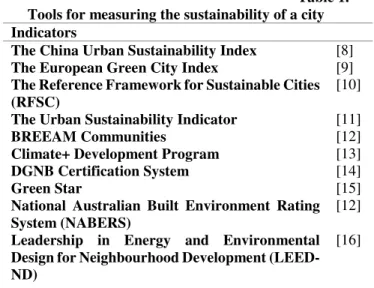
Table 1. Tools for measuring the sustainability of a city Indicators
The China Urban Sustainability Index [8]
The European Green City Index [9]
The Reference Framework for Sustainable Cities (RFSC)
[10]
The Urban Sustainability Indicator [11]
BREEAM Communities [12]
Climate+ Development Program [13]
DGNB Certification System [14]
Green Star [15]
National Australian Built Environment Rating System (NABERS)
[12]
Leadership in Energy and Environmental Design for Neighbourhood Development (LEED-ND)
[16]
As a practical example, Portland, Oregon is considered to be the ‘greenest’ US cities and has a legacy of innovation in urban sustainability. In a recent study, it was found that the most effective way to implement the sustainable urban development is at the neighborhood level. The study take place in five districts, in which were involved the local organizations and the community groups. The most successful was the South-of-Market (SoMa) EcoDistrict, where the involvement of the Portland State University, through its substantial sustainability research base, together with over a dozen other major property owners in the area helped and improved the district through green streets and public transit. In this way, the district becomes an attractive place for business to locate. [6]
When the planning for a sustainable urban development project starts the most relevant factors to look at are the transport systems, water, sanitation, waste management, disaster risk reduction, access to information, education and capacity-building [17]. In this domains will be the biggest problems, if it will not work out. For a successful implementation, it appears the need of an effective engagement and participation of the local people, public institutions and businesses.
A proper solution for the academic environment regarding the sustainable urban development is the green campuses. This implies a concrete solution of sustainability on universities campus buildings. These green campuses have solar panel installation, bike sharing, and recycle shop, to name a few. In this
way the sustainability is integrated through both passive and active learning. [17]
A green campus is basically efficient in terms of using the resources and it has to be economic. It focuses on reducing the consumption of energy and water, the waste generation and the pollution [18].
The school institutions are encouraged to inform its staff and students about the energy issues, water consumption, and the environmental impacts.
An important step in all green or sustainable projects is promoting them and to inform the large public. This can be through websites, onsite signs, and brochures. For more interactive ways to promote in which the community can be engaged is by facilitating activities and public events, organizing family days, sports events, festivals, guided walks, local champions.
3. METHODOLOGY
To analyze the ambiance of educational spaces in Romanian universities we used the survey method, and as a working tool, the questionnaire, which was afterwards pretested and modified. The survey was conducted between May and June 2018. The data were collected on the basis of a questionnaire. Each questionnaire contained 25 questions, of which 19 questions were related to the learning environment, components of space management and educational time, and the remaining 6 questions are for identifying the respondents.
The poll consisted of interviewing a total of 100 students, selected with a non-aleatory sampling method based on accessibility. The research population consists of students of the following universities: Technical University; Babeş-Bolyai University; University of Medicine and Pharmacy "Iuliu Haţieganu"; both based in Cluj-Napoca. In the universities there were included 2 study programs respectively: Bachelor and Master.
posted on the networks (e.g. Facebook) and their online groups.
3.1 The objectives and the assumptions of the research
The most significant objectives of this applied research were:
O1. Identifying the portfolio of complaints and suggestions for improving student learning environments.
O2. Developing more effective ways to improve learning outcomes, professional performances from the perspective of the academic environment, to a more significant extent. O3. Creating flexible and dynamic learning spaces.
O4. Increase the number of people interested in using the library by at least 20% by providing up-to-date teaching materials.
The speculative hypotheses that led to the research and generated the structure of the student questionnaire were:
H1. "At least one-third of the investigated subjects appreciate the ambiance within the faculty being enjoyable and appealing."
H2. "At the minimum one quarter of the investigated subjects believe that there is an appropriate environment for university study." H3. "Most investigated subjects appreciate the university's concern about enhancing the environment to improve the results as being very good."
H4. "At least a quarter of the investigated subjects want the design the extra-curricular activities as an effective way to improve professional performance from the perspective of the learning space."
H5. "At least half agree with the statement:" The ambience of the faculty is appropriate to the working environment."
H6. "Most investigated subjects attach medium importance to the flexibility of the educational space"
H7. "Not more than a quarter of those surveyed appreciate the fact that the provision of education facilities is very poor."
H8. "Most of the investigated subjects are influenced to a slight extent by the library environment."
H9. "Most of the investigators would certainly spend more time in the library if the atmosphere was to improve, or the provision of teaching materials would be easier."
H10. "At the minimum one-third of the subjects consider study visits as a social activity in the university."
H11. "No more than half of the respondents appreciate the integration building in the context very poorly."
H12. "Most investigated subjects appreciate that the university is implementing sustainable strategies and develop environmentally programs."
H13. "Most investigated subjects consider that the school institution has a distinct, unique and distinctive identity."
H14. "At least a quarter of the investigated subjects moderately appreciate a building on the flexibility and dynamics of the structure.” H15. "At least one-third of respondents believe that at the building level is created spaces for distinct communities, so socio-communicative skills will be more developed."
H16. "No more than a quarter of the respondents know about the link between the building and the natural environment."
H17. "No more than half of the respondents can make a comparison with other universities in the country/abroad about educational spaces." H18. "At least a quarter of the investigated subjects propose modern equipment to improve educational spaces."
4. PRELIMINARY RESULTS
In the following, the outcomes achieved from the research will be presented, comparing the result obtained in each question with the hypothesis underlying the question.
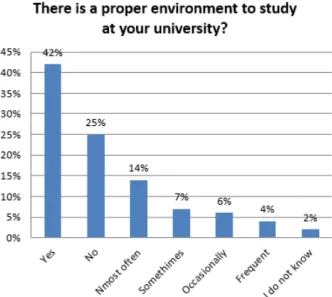
Fig. 1. The chart about student opinion about the learning environment
H2 shows the view of the subjects on the learning environment in the university. This assumption is confirmed because more than a quarter of the students consider that the universities offer an appropriate environment for studying.
H3 on students’ opinion on the university's concern in improving the environment and the learning outcomes is invalid, as only 15% of respondents have responded that their university is very concerned about this issue.
H4 shows the review on the most effective ways to improve performance from a learning space perspective. It is confirmed, because more than a quarter of the responders (38%) consider that the design of extra-curricular activities represents an effective way to improve professional performance from the perspective of the learning space.
H5 regarding the acceptance of the statement "The ambience within the faculty is an appropriate learning environment". It is confirmed, because the majority (56%) of the respondents said that they agreed with the statement.
H6 shows the opinion of the subjects on the importance of the flexibility of the educational space. The assumption is denied, because only 15% of the respondents give an average importance to the flexibility of the educational space.
Fig. 2. The chart regarding universities concern in improving the learning environment
H7 about the provision of materials in the educational areas is confirmed, because a quarter (16%) of the respondents appreciates that the provision of the educational spaces has a poorly delivery of facilities. The 16% of respondents are cumulated as follows: 1% for the courses, 7% for the laboratories, 2% for the seminars, 4% for practices and 2% for the projects.
Fig. 3. The chart about the provision in the educational spaces
H8 is about the influence of the library environment. It is denied, because the percentage is not representing the majority, as only 7% of respondents said that the library environment has little influence to them.
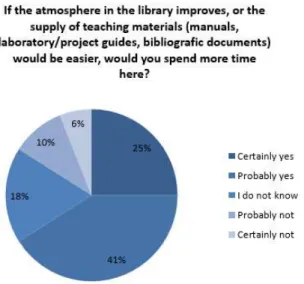
H9 shows the opinion on spending time in the library. It is infirmed, because only 25% of the subjects would spend more time in the library, if the atmosphere were improved, or the provision of teaching materials would be easier.
assumption is confirmed, as 42% of the investigated subjects consider that study visits are social activities carried out in the university. H11 is about the context integration of the building. It is confirmed, because only 3% of the respondents said that they appreciate very poorly the building as integration into the context. H12 on the implementation of strategies and programs for sustainable and ecological development in the universities is invalid. As only 34% of the investigated subjects have some knowledge about such programs and projects. Only these students think that their universities implements sustainable and environmentally sustainable development strategies and programs.
Fig. 4. The chart for spending more time in the library if there would be improvements in the learning
environment
H13 is about the students’ opinion on the identity of the school institution. It is confirmed, because the majority (80%) of the respondents answered affirmatively and consider that their university has a distinct, unique and distinctive identity.
H14 regarding the flexibility and dynamics of the structure of universities buildings is confirm. As 30% of the investigated subjects responded that they appreciate moderately the building's flexibility and dynamics of the structure.
H15 on designing spaces for distinct communities at the building level is neglected, because only 12% of those investigated believed that, at the building level of their universities there can be created spaces for distinct
communities, even as an important advantage will be the development of the socio-communicative skills.
H16 shows the knowledge regarding the connection between the building and the natural environment. It is denied, because 53% of the investigated subjects do not have any information about the link between the buildings and the natural environment setting.
H17 shows if the respondents can make a comparison between their university and other universities from Romania or from abroad regarding the educational environment. This hypothesis is confirmed because more than half of the students were able to compare their learning areas with other from other universities.
Fig. 5. The chart regarding the flexibility and dynamics of the structure of a university building
In the following tables there are the identification data related to the investigated sample.
Table 2: Table with the Universities at which the investigated subjects are studying
University No. of
people
Technical University of Cluj-Napoca 72 Babes-Bolyai University of Cluj-Napoca 18 University of Medicine and Pharmacy "Iuliu Hatieganu" of Cluj-Napoca
10
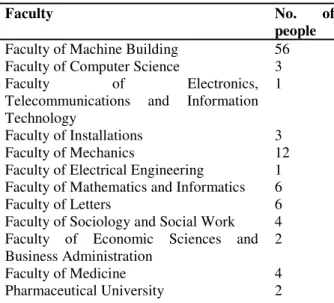
Table 3: The subjects' answers to what faculty they are studying
Faculty No. of
people
Faculty of Machine Building 56 Faculty of Computer Science 3 Faculty of Electronics, Telecommunications and Information Technology
1
Faculty of Installations 3
Faculty of Mechanics 12
Faculty of Electrical Engineering 1 Faculty of Mathematics and Informatics 6
Faculty of Letters 6
Faculty of Sociology and Social Work 4 Faculty of Economic Sciences and Business Administration
2
Faculty of Medicine 4
Pharmaceutical University 2
Looking at the study year of the investigated subjects, the following results are observed: in the first year of the Bachelor’s program, there were six persons, in the second year 29 people, in the third 26 people and in the fourth 36 individuals; in the first year of the Master’s program was one person and in the second year were two people.
Only 16% of subjects have the school grades over nine. One quarter (33%) of the participants have the school grades of the previous year of study among eight and nine, another quarter (33%) with school grades between seven and eight, leaving the rest of 18% of the subjects with school grades under seven. In the population surveyed there were 46 women and 54 men.
About 80% of the subjects have a stable residence in the urban area and only 20% have their domicile in rural zones.
5. CONCLUSIONS AND FOLLOWING RESEARCH DIRECTION
Educational marketing can become one of the solutions that can save the education system in Romania. Between May and June 2018 the quantitative research was carried out, which implied the analysis of the influence of the learning environment, namely the knowledge of some aspects regarding the components of the space and the informative time.
An extremely significant conclusion focuses on considering the needs and demands of the students. The interests and priorities of the students are necessary to analyze, as well as identifying their thoughts, attitudes and behaviours towards the services provided in the academic area for improving their educational performances.
Another resolute opinion is that most of the respondents, both at universities and at high schools in Cluj-Napoca, claim that the environment is pleasant and appealing. The distribution of frequencies indicates a strong concentration of the answers on the positive side of the scale (the percentage being 74% in the universities).
A remarkable conclusion of this research is the students’ opinion on the development of educational areas and environments, as well as on site as a usage necessity. It can be concluded that students want modern equipped rooms and the use of appropriate information communication methods. All these techniques should be correlated and updated according to the educational places to a great extent.
A suggestion for universities in Cluj-Napoca is to create a more comfortable, flexible and dynamic space, as it actively maintains their interest in studying and promoting "learning by pleasure" to increase their performance.
The attitude of students regarding the ambiance in the Romanian educational spaces can be achieved only through the change of the focus of the education. Teaching green skills to students it should be a priority.
6. REFERENCES
University of New Mexico Press, Albuquerque, pg. 247, 2008.
2. Rigolon, A., A space with Meaning: Children’s Involvement in Participatory Design Processes, Research Paper, University of Bologna, 2009. 3. Crook, C., Mitchell, G., Ambience in social
learning: student engagement with new designs for learning spaces, Cambridge Journal of
Education, 42:2, 121-139, 2012, DOI:
10.1080/0305764X.2012.676627.
4. Joss, S., Eco-cities and Sustainable Urbanism, University of Westminster, London, UK, 2015, Elsevier, doi : 10.1016/B978-0-08-097086-8.74010-4.
5. Kennedy, C., Cuddihy, J. & Engel-Yan, J. The changing metabolism of cities [online]. Journal of Industrial Ecology. 11 (2), pp. 43–59, 2007. 6. Tamiami, H., et al., Green design application on
campus to enhance student’s quality of life, IOP Conf. Series: Materials Science and Engineering,
309, 2018, doi: 10.1088
/1757-899X/309/1/012022.
7. Indicators for Sustainable Cities, Science for Environment Policy, European Commision, November 2015 (revised March 2018), Issue 12, DOI: 10.2779/121865.
8. Li, X., Li, X., Woetzel, J., Zhang, G. & Zhang, Y. 2014 The China Urban Sustainability Index 2013. 9. Watson, J. (ed.) European Green City Index,
2009.
10. Van Dijken, K., Dorenbos, R. & Kamphof, R. The Reference Framework for Sustainable Cities (RFSC): Testing results and recommendations, 2012.
11. Mega, V. & Pedersen, J. Urban Sustainability Indicators Luxembourg: Office for Official Publications of the European Communities, 1998. 12. Joss, S. (ed.) Tommorow’s City Today: Eco-city Indicators, Standards & Frameworks. Bellagio Conference Report. In: Simon Joss (ed.). Bellagio Conference. 2012 London: University of Westminster. p. 21, 2012.
13. Clinton Foundation, 2011, Climate+
Development Program: Framework for Climate Positive Communities. [online]. Available from: http://climatepositivedevelopment.org/, accessed on 11.06.2018.
14. DGNB, 2018, German Sustainable Building
Council, [online]. Available from:
http://www.dgnb.de/en/, accessed on 11.06.2018. 15. Roderick, Y., McEwan, D., Wheatley, C. & Alonso, C. Comparison of energy performance assessment between LEED, BREEAM and Green Star. In: Eleventh International IBPSA Conference, Glasgow, Scotland, 27-30 July 2009. pp. 1167–1176, 2009.
16. Welch, A., Benfield, K. & Raimi, M. A Citizen’s Guide to LEED for Neighborhood Development : How to Tell if Development is Smart and Green, 2010.
17. UNESCO roadmap for implementing the Global Action Programme on Education for Sustainable Development, 2014.
18. Ravindran, G., & Nagendran, R. Study on need for sustainable development in educational institutions, an ecological perspective–a case study of College of Engineering–Guindy, Chennai. Journal of Urban and Environmental Engineering, 4(1), 29-36, 2010.
Importanta ambiantei in spatiile educationale din mediul universitar romanesc
Rezumat: Această lucrare prezintă coordonatele unui studiu care vizează studenții de la universitățile din Cluj-Napoca privind evaluarea mediului de studiu și a elementelor sale ca element de comunicare, dar mai ales ca o posibilă influență asupra performanțelor lor profesionale. Metodologia cercetării aplicate arată, pornind de la ancheta preliminară și ipotezele speculative, mărimea eșantionului de 100 de subiecți, aleși non-aleator, metoda sondajului, instrumentul de studiu și rezultatele cercetărilor exploratorii.
Laura Andrada BACALI, Faculty of Machine Building, Technical University of Cluj-Napoca, 400641, Cluj-Napoca, Romania
Andreea BOTOS, Faculty of Machine Building, Technical University of Napoca, 400641, Cluj-Napoca, Romania
Simina Elena LAKATOS, Institute for Circular Economy and Environment “Ernest Lupan” – IRCEM, 400609, Cluj-Napoca, Romania