IC, 2016 – 12(2): 733-754 – Online ISSN: 1697-9818 – Print ISSN: 2014-3214 http://dx.doi.org/10.3926/ic.626
Sources, availability and uses of knowledge in
enterprises in Bogotá, Colombia
César Bernal-Torres , Ulf Thoene , Josefernando Giraldo
Universidad de La Sabana (Colombia)
[email protected], [email protected], [email protected]
Received March, 2015 Accepted March, 2016
Abstract
Purpose: The present article analyses the main sources, availability and uses of knowledge relating to enterprise performance according to the type of economic activity in Bogotá, Colombia.
Design/methodology: This descriptive study used a survey of 919 executives and non-executives of 59 enterprises from different economic sectors. Information was gathered via a questionnaire consisting of closed multiple-choice questions.
Findings: Results indicate that in the enterprises surveyed knowledge management activities do not have any emphasis either on the use of technologies or on activities relating to individuals’ behaviour as sources of competitive advantage, as occurs in North American enterprises (emphasising the intensive and effective use of technologies in their different activities) and in Japanese enterprises (emphasising the development of individuals’ potential as their competitive advantage).
Practical implications: Contributes to the empirical knowledge of business reality and also to the need for designing strategies that allow for a better use of knowledge management to improve enterprise competitive capacities.
Social implications: Highlights the importance of the essential differentiating characteristics that provide sustainable competitive advantages to nations, organisations and individuals over prolonged periods of time. Understands knowledge as the strategic resource of contemporary society. Developing countries require best practices in the identification, transfer, spread and use of knowledge management.
Originality/value: Compares the theory of knowledge management with the empirical evidence found in enterprises from different economic sectors with respect to knowledge management activities as a competitive strategy.
Keywords: Knowledge sources, Knowledge availability, Knowledge uses, Competitive advantage, Knowledge management, Economic sector, Colombia
Jel Codes: M10, M19
1. Introduction
Business management research on the importance of knowledge in organisational performance in developing countries has become increasingly important gaining broad recognition among academics and practitioners (Bernal, Henao, Aguilera & Frost, 2016). Knowledge proves to be the main strategic resource driving the sustainable competitive capacity of organisations independently of the context or environment in which they are located and function (Luo & Bu, 2016). Efforts to evaluate the influence of knowledge activities on organisational performance are on the rise. However, they have not yet translated into clear practical recommendations, which is mostly due to the difficulty of operationalising that evaluation (Donate & Guadamillas, 2010).
responds to the particular needs of organisations in national and global contexts, there are few studies that have sought to identify the effects of KM on organisational performance.
According to Wen Chong, Holden, Wilhemij and Schmidt (2000), the benefits of KM in enterprises are improved client service, improved communication and reduced problem resolution times as well as increased sales. This concurs with Andreu, Baiget, Almansa and Salvaj (2004), who found that KM improves service and product quality, client satisfaction, the capacity to respond to change, and employee satisfaction. Nevertheless, Andreu et al. (2004) also point out the low impact of KM on sales and on production times.
Against this background this descriptive study seeks to identify the knowledge aspects that Bogotá-based organisations possess and use, as well as the changes or improvements that those aspects generate in organisational performance. What is more, KM theory builds on the premise that enterprises differ due to the synergy that originates from the way organisations combine their internal capacities and resources rather than from the characteristics of the business sector the enterprises operate in. This research analyses whether business sectors share similarities in their organisational KM approach (technocratic or behavioural) on which the studied organisations emphasise. Thus, this research highlights the necessity to thoroughly analyse why enterprises in Bogotá do not tend to value the sources, the availability and the uses of knowledge to gain a competitive advantage, whilst the opposite tends to be the case in firms located in developed countries.
2. Theoretical Framework
In this new society the main source of the wealth of nations is derived from the creation of intellectual capital, which is superior to the sources related to countries’ endowments of natural resources, and even to the existence of physical capital (Drucker, 1998). In a similar vein, Quinn et al. (1996) consider that a modern organisation’s economic and productive power is based more on its intellectual capacities, personal creativity, innovation, and the services it offers than on the remainder of its assets. For Drucker (1998), the capacity to manage knowledge is the most important executive ability of the contemporary era.
Furthermore, Teece (1986) states that such factors as globalisation and the rapid, complex changes of different aspects of social life have led to a new economic development era that calls for novel sources of competitiveness and concepts of wealth creation based on the development and intelligent employment of intangible assets, among which knowledge, intellectual property and capacities feature as the most important.
Given the relevance of knowledge in the new society, KM theory builds on the principle of knowledge representing the key strategic resource for business competitiveness. Therefore, the organisational capacity to manage knowledge is relevant to the participation in the market and to gaining a sustainable competitive advantage (Kogut & Zander, 1992; Grant, 1996; Teece, Pisano & Shuen, 1997; Obeso, Sarabia & Sarabia, 2013; Chourides, Hadjiphanis & Evripidou, 2015). KM theory stems from the theory of resources and capacities (Wernerfelt, 1984; Barney, 1991; Grant, 1991; Hall, 1992; Amit & Shoemaker, 1993; Peteraf, 1993), which argues that a business’ competitive advantage depends on the firm’s capacities and resources that are found within the very enterprise. For the purposes of this paper the focus lies on the theory of KM rather than on the theory of resources and capacities.
According to Wernerfelt and Montgomery (1988), the variable focused on the external environment of an enterprise does not explain organisational performance and competitive capacity as classical strategic analysis would claim. To the contrary, in this ever-increasingly globalised, competitive and uncertain business environment, the crucial factor is mainly how organisations, which rely on individuals and, particularly, on their knowledge, coordinate their resources based on their capacities. Hence, organisations are heterogeneous with each one having a distinct combination of resources and capacities explaining the different results of some organisations versus others in the marketplace.
combination of its resources and capacities. Instead of imitating its competitors, the most important function of an organisation is exploiting factors that differentiate it from the competition. In other words, competitive organisations detect those strategic actions enabling them to establish a sustainable competitive advantage (Barney, 1991; Nonaka & Takeuchi, 1998; Grant & Daden-Fuller, 2004).
In order to build competitive advantage through the synergy created by the combination of its knowledge-based resources and capacities, an organisation usually chooses a specific emphasis (Muñoz & Montero, 2007). Some emphasise the use of Information and Communications Technologies (ICT) to store, analyse, and distribute information (referred to as technocratic emphasis). Others emphasise the interactions among individuals based on their roles as knowledge creators and possessors as well as their capacity to share and use knowledge (referred to as behavioural emphasis).
Although empirical studies show evidence in favour of each emphasis (better results for North American enterprises focusing on the technocratic approach and for Asian enterprises on the behavioural approach), research on global, heterogeneous contexts suggest that an equilibrium between the two emphases allows organisations to enhance synergy to define the best sustainable competitive strategy (Muñoz & Montero, 2007).
Moreover, organisations need to undertake KM initiatives that reconcile technologies, systems and structured procedures with those referring to social and cultural aspects directed towards the behaviour of the individuals making up the organisations (Prieto, 2005). The former characteristics are needed in the processing, filing and flow of information implied in an effective development of organisational execution. The latter are those that invigorate the synergy of resources and capacities to create value and competitive advantage. Although the competitive capacity of each enterprise is unique according to the synergy derived from the combination of resources and capacities, the enterprises with the best results are those that carry out active KM integrating techno-structural and socio-cultural elements (Prieto, 2005).
On the other hand, Obeidat, Masadeh and Abdallah (2014) claim that they did not find a relationship between human resources management (HRM) and KM, while Jiménez and Sanz (2013) did indeed detect such a positive relationship in Spanish enterprises. Jiménez and Sanz (2013) suggest that a human resources system oriented towards knowledge improves KM. For the abovementioned authors the link between human resources and KM is evidenced by the fact that the capacity of an enterprise to create new knowledge lies in the employees’ abilities to learn and share knowledge with colleagues.
Generally speaking, adequate KM implies organisations know how to effectively identify, record, socialise, create, protect and use relevant knowledge to sustainably boost their competitive capacity adding value for each stakeholder (Wiig, 1999; Quintanilla, 2003; Prieto & Revilla, 2004; Del Moral, Pazos, Rodríguez, Rodríguez & Suárez, 2007). To achieve this purpose, KM stresses the need for organisations to possess accurate self-knowledge and knowledge of their external (local, regional, national, global) environment (Ventura & Ordóñez, 2007).
Organisational self-knowledge is produced when the organisation and its members are aware of the knowledge availability and needs underpinning the achievement of its vision as a function of the market’s requirements and expectations, whilst also identifying, acquiring, sharing, generating and applying knowledge to boost competitive capacity. Internal learning allows the organisation to know its potential, limitations and to develop competencies. Indeed, enterprises must strive for a solid and permanent internal learning environment fostering self-knowledge and an awareness of their surroundings, as well as be capable of impacting the external environment through the creation of value (Chesbrough & Teece, 1996).
Additionally, Grant (1996) argues that in a world in permanent flux, knowledge of the external environment makes organisations more flexible and adaptable. Thus, external knowledge means the incorporation of knowledge from external sources (market, clients, suppliers, competition, government, community, academic institutions) into the organisation.
In this context Drucker (2003) considers that in the current economic world order organisations need to be increasingly aware of the fact that qualified individuals are and will always be the most important resource. However, the value of this resource also depreciates the fastest if it is not trained requiring the investment of time, money and effort.
long-term success and survival because knowledge could be unique and difficult to imitate (Kogut & Zander, 1992; Grant, 1996).
Furthermore, strategy formulation based on personal and organisational knowledge and its effects on business performance constitute a line of research that up to now has not generated notable findings (McEvily & Chakravarthy, 2002; Choi & Lee, 2003; Donate & Guadamillas, 2010). Yet, authors such as Jiménez and Sanz (2013) assert that a positive relationship exists between KM and enterprise performance. Studies that have sought to analyse the influence of KM initiatives on organisational performance (Bierly & Chakrabarti, 1996; Choi & Lee, 2003; Bierly & Daly, 2007; Donate & Guadamillas, 2010) come to diverse conclusions and recommendations in the practical terrain.
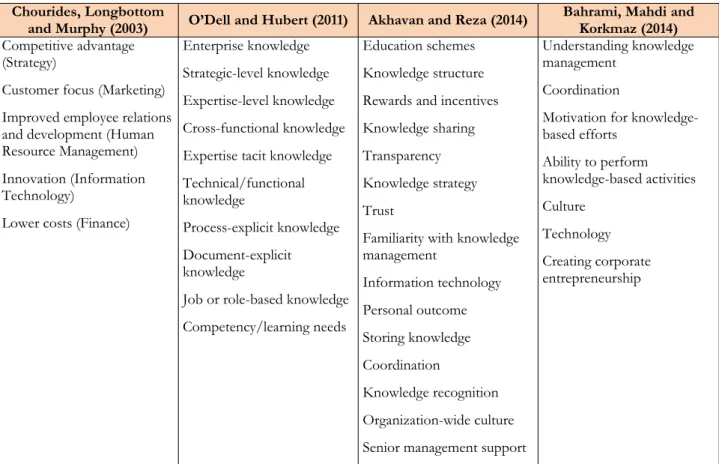
Within the research field of KM there are numerous studies identifying different factors that organizations need to focus on in order to implement KM programmes and which have to be known beforehand by the individuals responsible for leading such processes. Table 1 shows the key factors of KM in organisations.
Chourides, Longbottom
and Murphy (2003) O’Dell and Hubert (2011) Akhavan and Reza (2014) Bahrami, Mahdi andKorkmaz (2014) Competitive advantage
(Strategy)
Customer focus (Marketing) Improved employee relations and development (Human Resource Management) Innovation (Information Technology)
Lower costs (Finance)
Enterprise knowledge Strategic-level knowledge Expertise-level knowledge Cross-functional knowledge Expertise tacit knowledge Technical/functional knowledge
Process-explicit knowledge Document-explicit knowledge
Job or role-based knowledge Competency/learning needs
Education schemes Knowledge structure Rewards and incentives Knowledge sharing Transparency Knowledge strategy Trust
Familiarity with knowledge management Information technology Personal outcome Storing knowledge Coordination Knowledge recognition Organization-wide culture Senior management support
Understanding knowledge management
Coordination
Motivation for knowledge-based efforts
Ability to perform knowledge-based activities Culture
Technology Creating corporate entrepreneurship
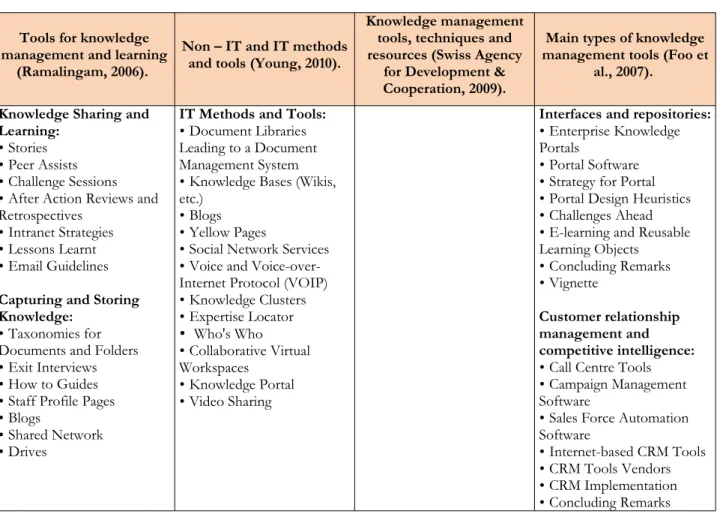
Furthermore, in order to round up this survey of the literature it is important to mention that one of the areas of major development and interest for enterprises is related to the design and use of KM tools (Foo, Sharma & Chua, 2007; Young, 2010). Against this background, Table 1 illustrates the diverse tools that are at hand for individuals and organisations in order to implement KM. Such tools can be classified in different forms and according to various criteria (Ramalingam, 2006; Foo et al., 2007; Swiss Agency for Development and Cooperation, 2009; Young, 2010). These classifications evidence that each tool is designed for specific purposes and concrete aspects of KM processes. Therefore, the necessity arises to identify one or more pertinent and specific tools for each aspect of KM. For instance, according to Ramalingam (2006), the tools for knowledge capture differ from those of knowledge sharing.
Tools for knowledge management and learning
(Ramalingam, 2006).
Non – IT and IT methods and tools (Young, 2010).
Knowledge management tools, techniques and resources (Swiss Agency
for Development & Cooperation, 2009).
Main types of knowledge management tools (Foo et
al., 2007).
Strategy Development:
• Knowledge Audits
• Social Network Analysis
• Outcome Mapping
• Scenario Testing and Visioning
Management Techniques:
• The SECI Approach
• Blame vs Gain Behaviours
• Force Field Analysis
• Activity-based Knowledge Mapping
• Structured Innovation
• Reframing Matrix
Collaboration Mechanisms:
• Teams: Virtual and Face-to-Face
• Communities of Practice
• Action Learning Sets
• Six Thinking Hats
• Mind Maps
• Social Technologies
Non–IT Methods and Tools:
• Brainstorming
• Learning and Idea
• Peer Assist
• Learning Reviews
• After Action Review
• Storytelling
• Collaborative Physical Workspace
• Knowledge Café
• Lessons Learnt
• Communities of Practice
• Taxonomy
• Knowledge Worker Competency Plan
• Knowledge Mapping
• KM Maturity Model
Connecting people to information and knowledge:
• Case study
• Rapid evidence review (RER)
• Knowledge banks
• Yellow Pages
• IDeA knowledge
Connecting people to people:
• Communities of practice (CoP)
• Peer assist
• Lessons Learnt
• Knowledge café
• Knowledge marketplace
Organization improvement:
• Gone well/not gone well
• After action review (AAR)
• Retrospective review
• Knowledge exchange
Knowledge transfer and sharing:
• Mind Maps
• Idea Processors
• Concept-mapping, Mind-mapping and Other Creative and Idea
• Generation Software
• Social Network Analysis
• Vignette
Discovery services:
• Introduction
• Intelligent Agents
• Search Engines
• Data Mining
• Text Mining
Tools for knowledge management and learning
(Ramalingam, 2006).
Non – IT and IT methods and tools (Young, 2010).
Knowledge management tools, techniques and resources (Swiss Agency
for Development & Cooperation, 2009).
Main types of knowledge management tools (Foo et
al., 2007).
Knowledge Sharing and Learning:
• Stories
• Peer Assists
• Challenge Sessions
• After Action Reviews and Retrospectives
• Intranet Strategies
• Lessons Learnt
• Email Guidelines
Capturing and Storing Knowledge:
• Taxonomies for Documents and Folders
• Exit Interviews
• How to Guides
• Staff Profile Pages
• Blogs
• Shared Network
• Drives
IT Methods and Tools:
• Document Libraries Leading to a Document Management System
• Knowledge Bases (Wikis, etc.)
• Blogs
• Yellow Pages
• Social Network Services
• Voice and Voice-over-Internet Protocol (VOIP)
• Knowledge Clusters
• Expertise Locator
• Who's Who
• Collaborative Virtual Workspaces
• Knowledge Portal
• Video Sharing
Interfaces and repositories:
• Enterprise Knowledge Portals
• Portal Software
• Strategy for Portal
• Portal Design Heuristics
• Challenges Ahead
• E-learning and Reusable Learning Objects
• Concluding Remarks
• Vignette
Customer relationship management and competitive intelligence:
• Call Centre Tools
• Campaign Management Software
• Sales Force Automation Software
• Internet-based CRM Tools
• CRM Tools Vendors
• CRM Implementation
• Concluding Remarks Table 2. Main tools for KM classified according to different criteria
3. Methodological Strategies
This descriptive study was conducted in the city of Bogotá, Colombia, using a survey with a sample of 919 executives and non-executives of 59 enterprises from different economic activity sectors (see Table 3).
Sector of economic activity Number of interviewees
Agricultural 150 Commercial 172 Communications 132 Construction 146 Financial 65 Industrial 91 Services 163 Total 919
Data collection was carried out applying an adapted version of the questionnaire used by Bernal et al. (2014), the information of Table 1 (key factors in KM) and Table 2 (main tools for KM classified according to different criteria) of the theoretical framework. This is how the different aspects related to the availability, the use and also the sources of knowledge were identified. The questionnaire consisted of closed multiple-choice questions in which the persons that answered indicated with an x the three or five most important aspects or impacts of knowledge in the organisation where they work. The application of the survey was conducted in person with the collaboration of undergraduate and postgraduate students from the International School of Economics and Administrative Sciences of the Universidad de La Sabana who were trained to that effect.
The data obtained was processed using Excel quantifying the answers for the source, availability and use of knowledge and their impact factor. Subsequently, those totals where converted into percentages in order to facilitate comparisons.
4. Findings
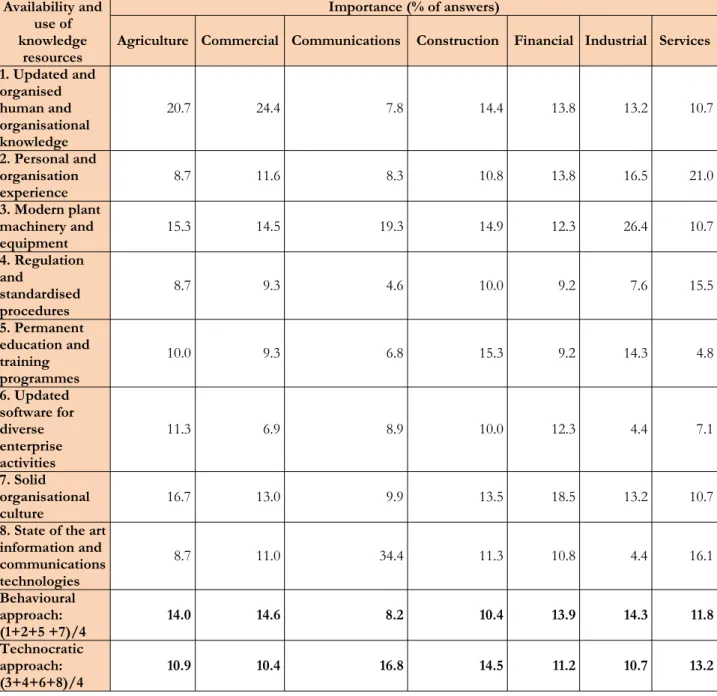
Table 4 (Importance of the availability and use of knowledge in enterprises by economic sector) illustrates that the enterprises from the commercial sector place greater importance (24.4%) on updated and organised personal and organisational knowledge than those of the communications sector (7.8%). This difference is very noticeable when taking into account that the other five sectors present percentages equal to or greater than 10.7%.
It appears curious that in the enterprises from the services sector greater importance is placed on the level of personal experience and the organisational experience (21.0%) while in the other six sectors the percentages vary between 8.3% and 16.5%.
When considering the importance of the availability and use of knowledge referring to the machinery and equipment used in a modern plant, it can be seen that the percentages for all the enterprise groups (sectors) are higher than 10.7%. The case of the least importance can be found in the services sector. This reaches 26.4% in the industrial sector, which is not a spectacular outcome considering that it is a highly technicalised sector and that it faces very intense global competition.
sector (15.5%). The rest of the percentages are below this amount reaching even a response level of as low as 4.6% in the communications sector.
It is also noteworthy that generally speaking the percentage of answers over the total of surveyed enterprises in the seven sectors show the little importance that is placed on permanent education and training programmes. In fact, their scores range from 4.8% in the services sector to 15.3% in the construction sector, which is a situation that is also comparable to the results obtained when evaluating the importance of the availability and use of knowledge generated by the updated software in each enterprise (response range from 4.4% in the industrial sector to 11.3% in the agricultural sector).
It is crucial to note that the percentage of responses that recognise the organisational culture of an enterprise as “solid” has a high identification especially in the financial sector (18.5%) and even in the communications sector (9.9%), which displays the lowest percentage.
A point worth highlighting pertains to the importance placed on the state of the art of ICT across the economic activity sectors. The result of 34.4% of the communications sector can be said to be “expected” insofar as it is a very dynamic sector and in view of its performance it must be up-to-date with the latest technological advances on the subject. Yet, this contrasts with the percentage of 4.4% obtained by the industrial sector. The rest of the percentages range between those two values.
Thus, it is possible for the results of the groups of enterprises to show an emphasis on technologies that characterises their performance, as in the case of the communications sector. Consequently, when the group of enterprises are analysed from the perspective of the approach they take on knowledge activities (technocratic or behavioural), the following can be said. In general terms, no predominance exists between one and the other. Neither can a difference be observed when analysing each approach by enterprise group. The behavioural approach can be obtained by averaging the results of items 1, 2, 5, and 7 of Table 4. The communications sector scores lowest (8.2%), with the rest of the sectors between 11.8% (services) and 14.6% (commercial).
Availability and use of knowledge
resources
Importance (% of answers)
Agriculture Commercial Communications Construction Financial Industrial Services
1. Updated and organised human and organisational knowledge
20.7 24.4 7.8 14.4 13.8 13.2 10.7
2. Personal and organisation
experience 8.7 11.6 8.3 10.8 13.8 16.5 21.0
3. Modern plant machinery and
equipment 15.3 14.5 19.3 14.9 12.3 26.4 10.7
4. Regulation and
standardised procedures
8.7 9.3 4.6 10.0 9.2 7.6 15.5
5. Permanent education and training programmes
10.0 9.3 6.8 15.3 9.2 14.3 4.8
6. Updated software for diverse enterprise activities
11.3 6.9 8.9 10.0 12.3 4.4 7.1
7. Solid organisational
culture 16.7 13.0 9.9 13.5 18.5 13.2 10.7
8. State of the art information and communications technologies
8.7 11.0 34.4 11.3 10.8 4.4 16.1
Behavioural approach:
(1+2+5 +7)/4 14.0 14.6 8.2 10.4 13.9 14.3 11.8
Technocratic approach:
(3+4+6+8)/4 10.9 10.4 16.8 14.5 11.2 10.7 13.2
Table 4. Importance of the availability and use of knowledge in enterprises by economic sector (authors’ calculations)
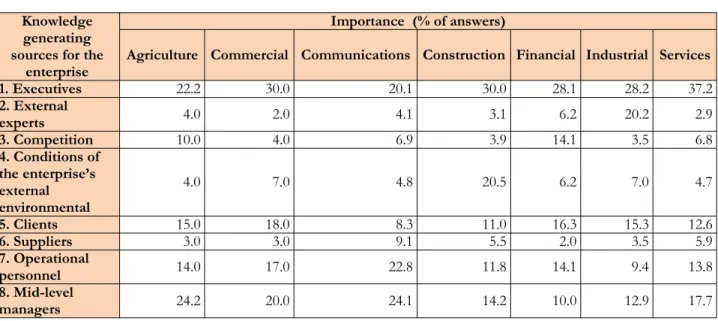
With regard to Table 5 (Knowledge generating sources and importance for enterprises by economic sector) it can be said that there are great numerical differences between the different sectors and even within each one of them with respect to their executives, operational personnel, clients, suppliers and competitors.
which means that the executive is the greatest generator and possessor of knowledge for the respective enterprise.
The above data contrasts with the percentage of answers obtained by experts external to the enterprises as a knowledge generating source since the highest percentage corresponds to the industrial sector (20.0%) and the other six sectors fluctuate between 2.0% in the commercial sector and 6.2% in the financial sector.
Competitors as knowledge generating sources are important to two sectors (agricultural 10.0% and financial 14.1%), but they are not as important to the rest of the sectors whose percentages are between 3.5% (industrial sector) and 6.9% (communications sector).
It is somewhat curious that the answers given by the employees of the enterprises of the construction sector are the ones that attribute a high importance (20.5%) to the external environment of their respective enterprise as the knowledge generating source. The other six sectors analysed stand in contrast with values between 4.0% for the agricultural sector and 7.0% for the commercial and industrial sectors.
When observing the role that is played by clients as a knowledge-generating source for the enterprises it can be seen that in general the factor is accepted as pertinent (all the percentages are greater than 11.0%) with the exception of the communications sector whose value stands at 8.3%.
Regarding the role played by suppliers as a knowledge-generating source for the enterprises it can be said that it appears low in four sectors (agricultural, commercial, financial, and services) and relatively high in the rest (communications, construction, and services), although its highest percentage value only reaches 9.1%.
Knowledge generating sources for the
enterprise
Importance (% of answers)
Agriculture Commercial Communications Construction Financial Industrial Services
1. Executives 22.2 30.0 20.1 30.0 28.1 28.2 37.2
2. External
experts 4.0 2.0 4.1 3.1 6.2 20.2 2.9
3. Competition 10.0 4.0 6.9 3.9 14.1 3.5 6.8
4. Conditions of the enterprise’s external environmental
4.0 7.0 4.8 20.5 6.2 7.0 4.7
5. Clients 15.0 18.0 8.3 11.0 16.3 15.3 12.6
6. Suppliers 3.0 3.0 9.1 5.5 2.0 3.5 5.9
7. Operational
personnel 14.0 17.0 22.8 11.8 14.1 9.4 13.8
8. Mid-level
managers 24.2 20.0 24.1 14.2 10.0 12.9 17.7
Table 5. Knowledge generating sources and importance for enterprises by economic sector (authors’ calculations)
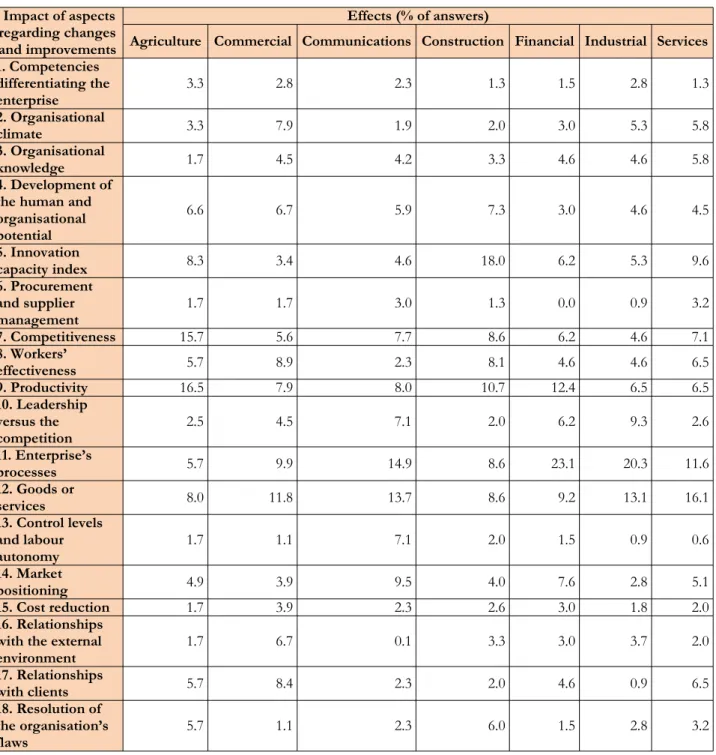
In order to measure the effects of the availability and use of knowledge in the enterprises by economic sector (Table 6), 18 items labelled “impact aspects corresponding to changes and improvements” were considered. Very dissimilar results were obtained by item and even by sector.
The competencies that differentiate the enterprise did not obtain high percentages in any of the studied sectors (such as availability and use of knowledge) because their values range between 1.3% (construction and services sectors) and 3.3% (agricultural sector).
The effect on changes and improvements in organisational climate is better reflected in the commercial sector (7.9%) and to a lesser degree in the communications sector (1.9%). Said effect on the organisational knowledge is observed to be higher in the enterprises of the services sector (5.8%) and lower in the agricultural sector (1.7%). Although these two aspects may be very much linked to each other, the development of the human and organisational potential in general reaches higher values ranging from 3.0% in the financial sector to 7.3% in the construction sector. Nevertheless, the results do not evidence a direct dependency between the availability and use of knowledge on the one hand, and the development of the human and organisational potential on the other hand.
Competitiveness obtained a high score in the agricultural sector (15.7%). In the other six sectors that were studied percentages range between 4.6% (industrial sector) and 8.6% (construction sector).
There appears to be a sharp contrast between the workers’ effectiveness and productivity. In the first aspect, the percentages range between 2.3% (communications sector) and 8.9% (commercial sector). Conversely, in the second aspect the values increase, ranging between 6.5% (industrial and services sectors) and 16.5% (agricultural sector). If these two aspects are compared with each enterprise’s leadership versus the competition, the values are found to decrease. They range between 2.0% in the construction sector and 9.3% in the industrial sector.
Each enterprise’s internal processes and goods produced or services offered score relatively high percentages. With respect to the former, the values are between 5.7% for the agricultural sector and 23.1% for the financial sector. For the goods and services sectors the values tend to decrease somewhat ranging from 8.0% for the agricultural sector to 16.1% for the services sector.
As an effect of the availability and use of knowledge it could be expected that the values obtained for control levels and labour autonomy would be high, but their result is actually not. The range spreads from 0.6% in the services sector to 2.0% in the construction sector, with the exception of the communications sector that obtained 7.1%.
The positioning of each enterprise in the market obtains values between 2.8% in the case of the industrial sector and 9.5% for the communications sector. Cost reduction as an aspect subject to changes and improvements shows low percentages ranging from 1.7% in the agricultural sector to 3.9% in the commercial sector.
The relationships with the external environment and the relationships with the clients also show low percentage values. Regarding the relationships with the external environment they range from 0.1% for the communications sector to 6.7% for the commercial sector. Pertaining to the relationships with clients the values are between 0.9% for the industrial sector and 8.4% for the commercial sector.
Impact of aspects regarding changes and improvements
Effects (% of answers)
Agriculture Commercial Communications Construction Financial Industrial Services 1. Competencies
differentiating the
enterprise 3.3 2.8 2.3 1.3 1.5 2.8 1.3
2. Organisational
climate 3.3 7.9 1.9 2.0 3.0 5.3 5.8
3. Organisational
knowledge 1.7 4.5 4.2 3.3 4.6 4.6 5.8
4. Development of the human and organisational potential
6.6 6.7 5.9 7.3 3.0 4.6 4.5
5. Innovation
capacity index 8.3 3.4 4.6 18.0 6.2 5.3 9.6
6. Procurement and supplier
management 1.7 1.7 3.0 1.3 0.0 0.9 3.2
7. Competitiveness 15.7 5.6 7.7 8.6 6.2 4.6 7.1
8. Workers’
effectiveness 5.7 8.9 2.3 8.1 4.6 4.6 6.5
9. Productivity 16.5 7.9 8.0 10.7 12.4 6.5 6.5
10. Leadership versus the
competition 2.5 4.5 7.1 2.0 6.2 9.3 2.6
11. Enterprise’s
processes 5.7 9.9 14.9 8.6 23.1 20.3 11.6
12. Goods or
services 8.0 11.8 13.7 8.6 9.2 13.1 16.1
13. Control levels and labour
autonomy 1.7 1.1 7.1 2.0 1.5 0.9 0.6
14. Market
positioning 4.9 3.9 9.5 4.0 7.6 2.8 5.1
15. Cost reduction 1.7 3.9 2.3 2.6 3.0 1.8 2.0
16. Relationships with the external
environment 1.7 6.7 0.1 3.3 3.0 3.7 2.0
17. Relationships
with clients 5.7 8.4 2.3 2.0 4.6 0.9 6.5
18. Resolution of the organisation’s
flaws 5.7 1.1 2.3 6.0 1.5 2.8 3.2
5. Conclusions
In general terms, KM has a low impact on the performance of the enterprises regardless of their economic activity. This is evidenced by low levels of improvements in productive processes, in produced goods or in services rendered, in productivity, and in some cases having nearly zero impact on activities such as cost reduction, improvements in the relationships with the external environment, and improvements in the relationships with clients.
The above is due to the fact that there is evidence of low impact of the importance of having access to knowledge and of using knowledge adequately within the enterprises without discriminating for the economic sector to which each of the analysed enterprises belongs. These results contrast with those found by Wen Chong et al. (2000) in multinational enterprises in Europe, with those found by Andreu et al. (2004) and Jiménez and Sanz (2013) in Spanish enterprises. However, the results confirm the diversity of outcomes (some favourable, others not so much) that are obtained when trying to evaluate KM impacts on business performance.
On the other hand, the results of this study indicate that in the case of the Bogotá-based enterprises the activities related to KM do not evidence any technocratic or behavioural emphasis as is frequently identified in the case of North American enterprises (emphasis on availability and use of ICT) and Japanese enterprises (emphasis on social relationships). This can be interpreted as an interest of the enterprises in Bogotá to maintain an equilibrium between the two approaches, similar to the one that may be presenting itself as a trend in the KM programmes in European enterprises (Muñoz & Montero, 2007).
The fact that enterprises of different economic sectors value their executives far more than their operators and mid-level managers as knowledge possessors and generators is also noteworthy. Actually, this valuation practically displaces what other stakeholders may contribute and is especially evident in the services sector given its relative lack of technicalisation. This contrasts with the claims of Chesbrough and Teece (1996), Nonaka and Takeuchi (1998), and Drucker (2003) who point out how greatly important it is for all the individuals of an organisation to learn, share and contribute knowledge to organisational performance. This situation differs from Obeidat et al. (2014) who assert that there is no relationship between HRM and KM in organisational performance.
indicator inferior even to that obtained by the agricultural and services sectors, which was not to be expected at the outset of the study. By and large these results evidence the premises of KM theory claiming that the result of enterprise performance are a function of the synergy produced by the relationships between the resources and capacities of the enterprise rather than of the characteristics of the economic sector to which it belongs (Wenerfelt & Montgomery, 1988; Barney, 1991; Nonaka & Takeuchi, 1998; Grant & Daden-Fuller, 2004).
Given the descriptive nature of this study it is not pertinent to make generalisations of the previously described results about the whole group of Bogotá-based enterprises. On the contrary, such findings spur the development of new studies on the role of KM activities in enterprise performance in order to contribute to the design of strategies that allow a more appropriate use of KM as a strategy to improve the competitive capacity of local enterprises in the national and international realms.
References
Akhavan, P., & Reza, M. (2014). Critical success factors in knowledge management among project-based organizations – a multi-case analysis. The IUP Journal of Knowledge Management, 12(1), 20-38.
Amit, R., & Shoemaker, P. (1993). Strategic assets and organizational rent. Strategic Management Journal, 14(1), 33-46. http://dx.doi.org/10.1002/smj.4250140105
Andreu, R., Baiget, J., Almansa, A., & Salvaj, E. (2004). Gestión del conocimiento y competitividad en la empresa española. Cap Gemini-IESE.
Bahrami, M., Mahdi, S., & Korkmaz, S. (2014). A study of the driving forces of knowledge management and corporate entrepreneurship in Iran. The IUP Journal of Knowledge Management, 12(1), 7-19.
Baker, M., Barker, M., Thorne, J., & Dutnell, M. (1997). Leveraging human capital. Journal of Knowledge Management, 1(1), 63-74. http://dx.doi.org/10.1108/EUM0000000004581
Barney, J. (1991). Firm resources and sustained competitive advantage. Journal of Management, 17(1), 99-120. http://dx.doi.org/10.1177/014920639101700108
Bernal, C., Fracica, G., & Frost, S. (2012). Análisis de la relación entre la innovación y la gestión del conocimiento con la competitividad empresarial en una muestra de empresas en la ciudad de Bogotá. Estudios Gerenciales, 28, 303-317.
Bernal, C., Frost, S., & Sierra, H. (2014). Importancia de la gerencia del conocimiento: Contrastes entre la teoría y la evidencia empírica. Estudios Gerenciales, 30, 65-72.
http://dx.doi.org/10.1016/j.estger.2014.01.011
Bernal, C., Henao, M., Aguilera, C., & Frost, S. (2016). Gestión del conocimiento y actividad empresarial en Colombia. Manuscript submitted for publication.
Bierly, P., & Daly, P. (2007). Alternative konwledge strategies, competitive environment and organisational performance in small manufacturing firms. Entreperneurship Theory and Practice, 31(4): 493-516. http://dx.doi.org/10.1111/j.1540-6520.2007.00185.x
Bierly, P., & Chakrabarti, A. (1996). Generic knowledge strategies in the U.S. pharmaceutical industry.
Strategic Management Journal, 17(S2), 123-135. http://dx.doi.org/10.1002/smj.4250171111
Bojica, A., Ruiz, M., & Fuentes, M. (2012). La adquisición de conocimiento a través de las relaciones interorganisativas y la orientación emprendedora: El papel mediador del capital social de segundo orden. Cuadernos de Economia y Dirección de la Empresa, 15, 141-153.
http://dx.doi.org/10.1016/j.cede.2012.01.003
Briceño, M., & Bernal, C. (2010). Estudios de caso sobre la gestión del conocimiento en cuatro organisaciones colombianas líderes en penetración de mercado. Estudios Gerenciales, 26, 173-193.
http://dx.doi.org/10.1016/S0123-5923(10)70140-6
Castells, M. (2000). La era de la información. (1), La sociedad en red. Madrid: Alianza editorial.
Chang, T., & Chuang, S. (2011). Performance implications of knowledge management process – examining the roles of infrastructure capability and business strategy. Expert Systems with Applications, 38(5), 6170-6178. http://dx.doi.org/10.1016/j.eswa.2010.11.053
Chesbrough, H., & Teece, D. (1996). Organising for innovation – when is virtual virtuous?. Harvard Business Review, January-February, 65-73.
Choi, B., & Lee, H. (2003). An empirical investigation of knowledge management styles and their effect on corporate performance. Information and Management, 40, 403-417.
Chourides, P., Hadjiphanis, L., & Evripidou, L. (2015). The art of managing organizational knowledge and performance – a blank or colorful canvas?. Proceedings of the 16th European Conference on Knowledge Management, 196-204.
Chourides, P., Longbottom, D., & Murphy, W. (2003). Excellence in knowledge management – an empirical study to identify critical factors and performance measures. Measuring Business Excellence, 7(2), 29-45. http://dx.doi.org/10.1108/13683040310477977
Del Moral, A., Pazos, J., Rodríguez, E., Rodríguez, A., & Suárez, S. (2006). Gestión del conocimiento. Madrid: Thomson.
Donate, M., & Guadamillas, F. (2010). Estrategia de gestión del conocimiento y actitud innovadora en empresas de Castilla-La Mancha. Investigaciones Europeas de Dirección y Economía de las Empresas, 16(1), 31-54. http://dx.doi.org/10.1016/S1135-2523(12)60002-1
Drucker, P. (1998). La sociedad postcapitalista. Bogotá: Grupo Editorial Norma.
Drucker, P. (2003). La empresa de la sociedad que viene. Madrid: Ediciones Urano.
Foo, S., Sharma, R., & Chua, A. (2007). Knowledge management – tools and techniques. Singapore: Prentice Hall.
Grant, R. (1991). The resource-based theory of competitive advantage – implications for strategy formulation. California Management Review, Spring, 114-135. http://dx.doi.org/10.2307/41166664
Grant, R. (1996). Dirección estratégica: Conceptos, técnicas y aplicaciones. Madrid: Civitas.
Grant, R., & Baden-Fuller, C. (2004). A Knowledge acessing theory of strategic alliances. Journal of Management Studies, 41(1), 61-84. http://dx.doi.org/10.1111/j.1467-6486.2004.00421.x
Hall, R. (1992). The strategic analysis of intangible resources. Strategic Management Journal, 13, 135-144.
http://dx.doi.org/10.1002/smj.4250130205
Jiménez, D., & Sanz, R. (2013). Studying the effect of HRM practices on the knowledge management process. Personnel Review, 42(1), 28-49. http://dx.doi.org/10.1108/00483481311285219
Kogut, B., & Zander, U. (1992). Knowledge of the firm, combinative capabilities and replication of technology. Organisation Science, 3(3), 383-397. http://dx.doi.org/10.1287/orsc.3.3.383
Luo, Y., & Bu, J. (2016). How valuable is information and communication technology? A study of emerging economy enterprises. Journal of World Business, 51(2), 200-211.
Mcadam, R., & Reid, R. (2001). SME and large organisation perceptions of knowledge management – comparisons and contrasts. Journal of Knowledge Management, 5(3), 213-247.
http://dx.doi.org/10.1108/13673270110400870
Mcevily, S., & Chakravarthy, B. (2002). The persistence of knowledge-based advantage – an empirical test for product performance and technological knowledge. Strategic Management Journal, 23(4), 285-305. http://dx.doi.org/10.1002/smj.223
Muñoz, J., & Montero, M. (2007). Enfoques teóricos para el estudio de la cooperación empresarial.
Cuadernos de Estudios Empresariales, 17, 141-163.
Navas, J., & Nieto, M. (2003). Estrategias de innovación y creación de conocimiento tecnológico en las empresas industriales españolas. Madrid: Civitas.
Nonaka, I., & Takeuchi, H. (1998). La organización creadora de conocimiento: Cómo las compañias japonesas crean la dinámica de la innovación. México: Oxford University Press.
Obeidat, B., Masadeh, R., & Abdallah, A. (2014). The relationships among human resource management practices, organisational commitment, and knowledge management processes - a structural equation modelling approach. International Journal of Business and Management, 9(3), 9-26.
http://dx.doi.org/10.5539/ijbm.v9n3p9
Obeso, M., Sarabia, M., & Sarabia, J. (2013). Gestionando conocimiento en las organisaciones: Pasado, presente y futuro. Intangible Capital, 9(4), 1042-1067.
O’dell, C., & Hubert, C. (2011). The new edge in knowledge – how knowledge management is changing the way we do business. Oxford: Wiley.
Peteraf, M. (1993). The cornerstones of competitive advantage – a resource-based view. Strategic Management Journal, 3, 179-191. http://dx.doi.org/10.1002/smj.4250140303
Prieto, I. (2005). Gestión del conocimiento para el desarrollo de la capacidad de aprendizaje en las organisaciones. Universidad de Valladolid Secretariado de Publicaciones e Intercambio.
Prieto, I., & Revilla, E. (2004). La naturaleza dual de la gestión del conocimiento. Academia Revista Latinoamericana de Administración, 32, 47-76.
Quinn, J., Anderson, P., & Finkelstein, S. (1996). La gestión del intelecto profesional: Sacar el máximo de los mejores. Harvard Deusto Business Review, 75, 4-17.
Ramalingam, R. (2006). Tools for knowledge and learning – a guide for development and humanitarian organisations. London: Research and Policy in Development Programme and Overseas Development Institute.
Sharma, R., Noorjahan, M., Igbal, A., & Victoriano, M. (2013). On the use of benchmarking and good practices for knowledge management for development. Knowledge Management Research and Practice, 11, 346-360. http://dx.doi.org/10.1057/kmrp.2012.27
Swiss Agency For Development And Cooperation (SDC). (2009). Knowledge management toolkit. Berne: Swiss Agency for Development and Cooperation (SDC) and Federal Ministry of Foreign Affairs (FFA).
Teece, D. (1986). Profiting from technological innovation – implications for integration, collaboration, licensing and public policy. Research Policy, 15(6), 285-305. http://dx.doi.org/10.1016/0048-7333(86)90027-2
Teece, D., Pisano, G., & Shuen, A. (1997). Dynamic capabilities and strategic management. Strategic Management Journal, 18(7), 509-533.
http://dx.doi.org/10.1002/(SICI)1097-0266(199708)18:7<509::AID-SMJ882>3.0.CO;2-Z
Ventura, J., & Ordóñez, P. (2007). Análisis de estrategias de conocimiento en la industria manufacturera española: Evidencias empíricas. Tribuna Económica, Mayo-Junio, 141-161.
Wen Chong, C., Holden, T., Wilhelmij, P. & Schmidt, R. (2000). Where does knowledge management add value?. Journal of Intellectual Capital, 1(4), 366-380. http://dx.doi.org/10.1108/14691930010359261
Wernerfelt, B. (1984). A resource-based view of the firm. Strategic Management Journal, 5, 171-180.
http://dx.doi.org/10.1002/smj.4250050207
Wernerfelt, B., & Montgomery, C. (1988). Tobin´s Q and the importance of focus in firm perfomance.
American Economic Review, 78(1), 246-250.
Wiig, K. (1999). What future knowledge management users may expect. Journal of Knowledge Management, 3(2), 155-165. http://dx.doi.org/10.1108/13673279910275611
Young, R. (2010). Knowledge management tools and techniques manual. Tokyo: Asian Productivity Organization.
Intangible Capital, 2016 (www.intangiblecapital.org)
Article's contents are provided on an Attribution-Non Commercial 3.0 Creative commons license. Readers are allowed to copy, distribute and communicate article's contents, provided the author's and Intangible Capital's names are included. It must not be used for