Yuliasti Eka Purnamaningrum et al IJSRE Volume 06 Issue 02 February 2018 Page 7812
Volume||6||Issue||02||February-2018||Pages-7812-7819||ISSN(e):2321-7545 Website: http://jsae.in Index Copernicus Value- 76.10 DOI: http://dx.doi.org/10.18535/ijsre/v6i2.02
Young age pregnancy and postpartum blues incidences
Authors
Yuliasti Eka Purnamaningrum1,Yuni Kusmiyati2, Herlina Tri Nugraheni3,Waryana 1,2,3,4
HealthPolytechnic of Health Ministry Yogyakarta Correspondence : [email protected] ABSTRACT
The rate of postpartum blues incidence in Indonesia is between 50-70%. Young age pregnancy becomes a major risk trigger for mothers and children to experience physical and psychological impact resulting from postpartum blues. The aim of this research is to elaborate the correlation between postpartum blues and young age pregnancy. This research uses cross-sectional design, and the subjects are 90 respondents who experience 6-14 days postpartum blues. In addition, this research use data with Edinburgh Postnatal Depression Scale (EPDS), and standard social support questionnaire from the Postpartum Depression Predictors Inventory (PDPI). Data analysis uses logistic regression. Result: young age pregnancy is associated with postpartum blues incidences with p-value 0.042 (PR: 4.0, 95% CI: 1,0-15,2) and the related external variable is labor induction with p-value 0.004 (PR: 5.1; 95% CI: 1,6-15,7) and type of labor p 0,003 (PR: 5,1; 95% CI 1.7-15, 3). Interventions are needed for pregnant mothers with young age pregnancy andincreasing the participation of health workers, especially midwives in providing postpartum counseling on postpartum and infant care. With these intervention, it is expected that postpartum blues can be detected as early as possible and well-managed.
Keywords : Postpartum blues, young age pregnancy, psychological
INTRODUCTION
Pregnancy and delivery are two stages in life prone to stressful potential.1A woman in the period of pregnancy and postpartum tends to experience considerable stress due to the limitations of physical conditions. As a result, she has to limit activities in the process of psychological adaptation.1
Postpartum blues refers to a transient mood depression which new mothers experience resulting from hormonal changes, responsibility of having a new baby and parenting duty. Postpartum blues is characterized by sadness and anxiety which can occur everyday following the childbirth process. These symptoms normally occur on the third or fourth day, and onset may typically peak on the fifth and fourteenth day after delivery (postpartum).2 If the symptoms of postpartum blues persist for longer than two weeks, the woman can develop more significant symptoms of postpartum depression and post partum psychosi.3 Postpartum blues has negative impact on children's development. Children with postpartum mothers have lower cognitive abilities than those without postpartum mothers. More over, their ability to interact with other children will also be affected.4
Yuliasti Eka Purnamaningrum et al IJSRE Volume 06 Issue 02 February 2018 Page 7813 Results of research conducted in Jakarta showed that 120 out of 580 (25%) of mothers had postpartum blues syndrome. Research in Jakarta, Yogyakarta, and Surabaya found that the postpartum blues incidence rate was 11-30% 8. Based on preliminary study conducted by researchers at RSUD Wonosari, the case of postpartum blues was 15%.
While the exact cause of postpartum blues is still unclear, it is believed that postpartum blues results from external factors including, socio economic status, and low economic conditions.9. Internal factors are also believed to contribute on the episodes of postpartum blues which may include hormonal changes and age.3 Young age pregnancy increases the physical and psychological risks for mothers and children during pregnancy and childbirth.10 Based on the results of a study which analyzes risk factors affecting postpartum blues, postpartum blues is greatly associated with mothers’ age (P 0,000 , PR = 3.41) .11
According to the Riskesdes Report on 2013, it was suggested that 2.6% of women between the ages of 10-54 years were married at the age of less than 15 years. Women who get married at the age under 15 years are 23.95% and those who get marrted at age of 15-19 years are 23.9%. Early marriage serves the main factor leading to reproductive health problem. The high rate of pregnancy at early age indicates that young women are prone to pregnancy problems and other problems associated with pregnancy at a young age.1
METHOD
Wonosari General Hospital which is located in Gunungkidul Regency serves as a government hospital, Wonosari Hospital also serves as a referral hospital in the district of Gunungkidul and the area around Central Java becausethe geographical site can be reached.
The research was conducted in Wonosari General Hospital Gunungkidul Regency from April to May 2017. This research uses cross sectional. The population of this research include women who experience postpartum on the 6th and 14th day after delivery, primipara, babies, and mother who are willing to be respondents. The exclusion criteria in this research is women with mood disorder. Sample size was calculated by using different formula two proportions from Lemeshow (1997), and the eligible respondents were 90 respondents.
The independent variable in this study is early pregnancy. Young age pregnancy usually occurs on women under 20 years old. Data are collected from secondary data and dependent variable is postpartum blues. Postpartum blues is mood disorder which happens at any time after delivery women and measured by using the Edinburgh Postnatal Depression Scale (EPDS) questionnaire. Data are analyzed by using Chi square and logistic regression.
RESULT
Respondents in this study consist of 90 postpartum mothers in Wonosari General Hospital, Gunungkidul District. Characteristics of respondents in this study are presented in the form of frequency distribution based on the variables in the study.
Table 1. The characteristic subjectpostpartum blues in Wonosari General Hospital in 2017
Variables Frequency %
Young age Pregnancy
Age< 20 y.o 19 21,1
Age ≥ 20 y.o 71 78,9
Education Level
Low 55 61,1
High 35 38,9
Employment
Yuliasti Eka Purnamaningrum et al IJSRE Volume 06 Issue 02 February 2018 Page 7814
Not Working Mother 62 68,9
Social Support
No 1 1,1
Yes 89 98,9
Premature rupture of the membranes
Yes 40 44,4
No 50 55,6
Episiotomy
Yes 25 27,8
No 65 72,2
Labor Induction
Yes 39 43,3
No 51 56,7
Labor Type
Seksio Caesaria (SC) 46 51,1
Spontaneous 44 48,9
Postpartum Blues
Yes 50 44,1
No 90 55,6
Table 1 shows the results of the frequency distribution of respondent variables. A total of 19 respondents (21.1%) gave birth at age <20 years, 55 respondents (61.1%) had low education (Elementary School-Junior High School), 28 respondents (31.1%) are working mother, 1 respondent (1.1 %) has no social support, 40 respondents (44.4%) experience premature rupture of membranes, 25 respondents (27.8%) has episiotomy, 39 respondents (43.3%) have performed induction, 46 respondents (51.1 %) gave birth through SC. 50 respondents (55.6%) experience postpartum blues.
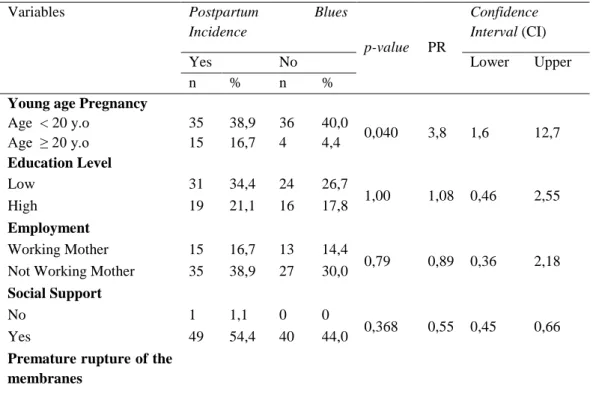
Table 2. The correlation between young agepregnancy and external variables with the incidence of postpartum bluesin Wonosari General Hospital in 2017
Variables Postpartum Blues
Incidence
p-value PR
Confidence Interval (CI)
Yes No Lower Upper
n % n %
Young age Pregnancy
Age < 20 y.o 35 38,9 36 40,0
0,040 3,8 1,6 12,7
Age ≥ 20 y.o 15 16,7 4 4,4
Education Level
Low 31 34,4 24 26,7
1,00 1,08 0,46 2,55
High 19 21,1 16 17,8
Employment
Working Mother 15 16,7 13 14,4
0,79 0,89 0,36 2,18
Not Working Mother 35 38,9 27 30,0
Social Support
No 1 1,1 0 0
0,368 0,55 0,45 0,66
Yes 49 54,4 40 44,0
Yuliasti Eka Purnamaningrum et al IJSRE Volume 06 Issue 02 February 2018 Page 7815
Yes 27 30,0 13 14,4
0,068 2,43 1,02 5,78
No 23 25,6 27 30,0
Episiotomy
Yes 34 37,8 31 34,4
0,445 1,62 0,62 4,19
No 16 17,8 9 10,0
Labor Induction
Yes 27 30,0 12 13,3
0,022 2,7 1,14 6,57
No 23 25,6 28 31,1
Labor Type
Seksio Caesaria (SC) 31 34,4 15 16,7
0,036 2,71 1,153 6,412
Spontaneous 9 21,1 25 27,8
The results of the analysis in Table 2 show that early pregnancy, labor induction, and type of labor become 3 significant variables. . Results of analysis with early pregnancy variable <20 years obtain p value of 0.040, with PR = 3.8. It means that early pregnancy <20 years has a chance of 3.8 times to experience postpartum blues compared to postpartum mothers with age ≥ 20 years . The result of analysis withinduction labor variable obtains p value of 0,022, with PR = 2, It means that womenwho performed induction of labor have chance 2,7 times to experience postpartum blues. The result of analysis on the type of labor in SC obtains p value equal to 0,036 with PR = 2,71 and it means that postpartum blues women with SC have opportunity 2,71 times to experience postpartum blues compared to postpartum women who do spontaneous labor.
The results of the analysis on external variables show that education has p-value of 1.00 (PR 1.08 95% CI 0.46-2.55). Meanwhile, employment status has p-value of 0.79 (PR 0.89 95% CI 0.36-2.18); social support has p-value of 0.36 (PR 0.55; 95% CI 0.45-0.66); premature rupture membrane has a p-value of 0.068 (PR 2, 43, 96% CI 1.02-5.78) and episiotomy has p-value of 0.445 (PR 1.62 95% CI 0.62-4.19). If p value> 0.05 meaning that 5 variables are not statistically significant for postpartum blues incidences.
Table 3. Table results of multivariate analysis onYoung age pregnancy, inductionand labor type with postpartum bluesin Wonosari General Hospital in 2017.
Variables Koef.β P PR 95% CI
Young Age Pregnancy
1,388 0,042 4,008 1,050- 15,298
Induction
1,637 0,004 5,141 1,683- 15,702
Labor Type
1,637 0,003 5,139 1,718-15,369
Constant - 1,514 0,168 0,656
The result of analysis of table 3 shows three most significant risk variables (p <0,05 and p <0,25). The three variables are then tested by multivariate statistical test by using logistic regression test. The statistical test used was logistic regression with significance level of 0.01. Regression test result obtained early pregnancy with p-value 0,042 with PR = 4.0 95% CI: 1,050-15,298, induction of labor with p-value 0,004 PR: 5,1; 95% CI: 1,683-15,702 and type of labor with p-value 0,003 PR: 5,1; 95% CI 1.718-15, 369. Probability of postpartum blues events in postpartum women with risk factors for young age pregnancy, labor induction and type of labor.
y = -1,514 + 1,388 (young age pregnancy) + 1,637 (labor induction) + 1,637 (labor type) y = -1,514 + 1,388 (1) + 1,637 (1) + 1,637 (1)
y = 3,148
thus, the probability of p = 1/ (1+2,7-(-3,148)) is p = 4,2%
Yuliasti Eka Purnamaningrum et al IJSRE Volume 06 Issue 02 February 2018 Page 7816 DISCUSSION
Postpartum bluesis a normal peripartum incidence which women experience after delivery. It commonly occur on the third or fourth day, and onset may typically peak on the fifth and fourteenth day after delivery (postpartum).2 If the symptoms of postpartum blues persist for longer than two weeks, the woman can develop more significant symptoms of postpartum depressionandpostpartumpsychosi.3Postpastum depression is considerable depression which occurs following childbirth which are commonly characterized by such classical symptoms such as sleeping deprivity, loss of appetite, low energy, and suicidal thought for at least two weeks.2
The results of the analysis vividly show the results of the respondents’ characteristics, the relationship between young age pregnancyand postpartum blues and the relationship of young age pregnancy after controlled by external variables. The results of research on 90 postpartum women in Wonosari General Hospital show that almost 50 women (55.6%) had postpartum blues and 40 people (44.4%) did not experience postpartum blues. Bivariate analysis showed that three variables have the highest correlation with postpartum blues incidence namely pregnancy, induction of labor, and labor type. External variables such as education, job status, social support, premature rupture of membranes and episiotomyare the leading factors to postpartum blues, but they are not related to each other. The results of multivariate analysis show that young age pregnancy and labor type are the most related variables.
The results of this study indicate that young age pregnancyand postpartum blues have a significant relationship with p-value 0.033 with PR = 3.80 (95% CI 1.117 - 12.934). In this research, there were 50 women with postpartum (55,6%) and 40 women without postpartum (40,4%). Pregnancy in age <20 years is found in 15 respondents(16,7%) who experienced postpartum blues. Women with young age pregnancy had a 3.80-fold risk of postpartum blues compared to mothers with pregnancy at the age ≥ 20 y o (95% CI 1.117- 12.934).
The results of this study support a study which shed a light on the relationship between age and postpartum blues. The obtained p-value is equal to 0.003 with significance level set at α = 0.05. The value of p <α, so H1 is accepted. Therefore, there is relationship between age and postpartum blues.12 This research also supports previous research which analyzed the maternal age <20 years with multivariate analysis. It showed that maternal age is the most dominant factor which influences postpartum blues with P-value value of 0.000 (p <0.05) and OR 3.41; 95% CI 2,129-5,469. Other studies also suggest that early age tends to cause higher risk for postpartum blues.8,13,14
Related to pregnancy and childbirth, age is often associated with the woman's mental readiness to become a mother. Young age pregnancy accelerates the physical and psychological risks for a woman and her baby during pregnancy and childbirth.10 In addition, young age pregnancyincreases biomedical risks, leads to less optimum behavioral pattern for a mother and her newly-born baby.15
Pregnancy and childbirth at an early age to be one of the leading factors topostpartum blues. It is believed that emotional maturity increases as the mother gets older. As a result, it increases the involvement and satisfaction of parents and shapes the optimum maternal behavioral pattern.
In addition to young age pregnancy factor, labor type has a significant relationship with p-value 0.028. SC type of delivery has a 2.6-fold risk of postpartum blues compared to spontaneous delivery (95% CI 1.111-6.500). 31 respondents have SC type and postpartum blues (34,5%) while 19 respondents (21,1%) have normal delivery process and postpartum blues.
Yuliasti Eka Purnamaningrum et al IJSRE Volume 06 Issue 02 February 2018 Page 7817 effects on the mother. Therefore, these procedures reduces the mother's self-confidence in performing her roles, disrupts natural attachment processes and increases postpartum blues to postpartum depression..16 Ceasereandelivery process is the labor type involving a transabdominal transition to the uterus, whether planned or not.2The lack of experience in giving birth normally impacts the mother's self-concept. The purpose of a cesarean section is to provide the life or health of the mother and fetus due to maternal or fetal stress.2
Labor induction refers to labor contractions before spontaneous onset to speed up labor. Interventions in labor such as induction-induced labor and equipment help may increase postpartum stress, reduce maternal confidence in the smoothness of the delivery process, with an increased postpartum blues.2 These stimulating stressors allow the adrenal cortex to produce excessive cortisol hormone, with increased postpartum blues.17
Bivariate test results obtain p-value 0,035 (p-value <0,05). It means that induction labor has a significant postpartum blues incidence and has PR 2,6. Thus, induction during delivery increases risk of postpartum blues for 2,6 times compared to those do not performinduction with 95% CI 1.07-6.40.
This finding supports with studies showing that induction labor causes an increased risk of postpartum blues incidence of 5.50 times compared to induced labor with a p-value of 0.028 (p <0.05).18
The use of induction in labor will cause uterine hyperstimulation (the mother feels more severe pain than regular uterine contractions), nausea, vomiting, headache and hypotension.2 The use of oxytocin induction has been proven to increase the amount of pain received by the mother and increases the risk of hyperstimulation. Experiencing this severe pain will cause anxiety and fear for the mother. Mothers will also experience anxiety and fear and worry about the success of the intervention. Maternal anxiety and anxiety, the possibility of complications in infants and mothers is one of the contributing factors for the possibility of postpartum blues.16
Another leading factor to postpartum blues is education. The level of education in this study obtained p-value 1.00 (p> 0.05). This shows that educationhas no significant relationship with postpartum blues with PR 1.08; 95% CI; 0.464-2.55. The finding supports previous research which analyzed the risk factors influencing the postpartum blues incidence. Education has p-value of 0.282 (p> 0,05) which indicatesthat education does not give significant effect on postpartum blues.11 A highly educated woman faces social pressure and role conflict between demands to work, to perform activities outside the home and the role of a housewife or parent for her children.19
Employmentvariable doesnot have significant relationship with p-value 0.890 (p> 0.05) with 95% CI; 0.363-2.18. This finding is also consistent with a study which analyzed the risk factors affecting postpartum blues. The employment status variable has a p-value of 0.282 (p> 0.05).Another study explained that there was no significant difference in postpartum blues based on demographic characteristics such as education, employment, economic status, and marital status.11,20
Analysis on social support also shows that there is no significant correlation with p-value 1.00 (p>0,05) with 95% CI; 0.456-0.664. It strengthens the result of previous researchwhich obtained data based on social support from the majority of respondents who experienced postpartum blues.21
Premature rupture of membranes does not show a significant relationship with p-value of 0.68 (p> 0.05) with PR 2.43; 95% CI; 1,027-5,787. It strengthens the result of previous researchwhich proved that labor complication does not affect the possibility of postpartum blues (p-value = 0.148). In the study, the labor involves labor induction with oxytocin and labor trauma such as premature rupture of membranes.17
Yuliasti Eka Purnamaningrum et al IJSRE Volume 06 Issue 02 February 2018 Page 7818 CONCLUTION
There was a significant relationship between young age pregnancy and postpartum blues inidences with p-value 0.042 PR: 4.0; 95% CI: 1,050-15,298, induction of labor with p-p-value 0.004 PR: 5.1; 95% CI: 1,683-15,702 and type of labor with p-value 0,003 PR: 5,1; 95% CI 1.718-15, 369. Young age pregnancy<20 years increases risk 4.0 times compared to women whose pregnancies ≥ 20 years to experience postpartum blues events.
SUGGESTION
Interventions need to be given for women with young age pregnancy, so they get adequate information. Besides, the participation of health workers, especially midwives, must be increased in providing counseling on postpartum and infant care, so postpartum blues can be known early and can be handled.
REFERENCES
1. Sarwono. 2005. Ilmu Kebidanan. Jakarta : Yayasan Bina Pustaka
2. Bobak I.M., Lowdermilk, D.L., & Jensen, M.D., Perry, S.E. 2005. Buku Ajar Keperawatan Maternitas. Edisi 4. Alih Bahasa : Maria & Peter. Jakarta : EGC
3. Gale, S., & Harlow, B. L. 2003. Postpartum Mood Disorders : a review of clinical and epidemiological factors. Journal of Psychosomatic Obstetrics and Gynecology.
4. Latifah dan Hartati. 2006. Efektifitas Skala Edinburgh dan Skala beck dalam mendeteksi risiko depresi Postpartum Di RSUD Prof. Dr Margono Soekarjo Purwokerto. Universitas Soedirman : Purwokerto.
5. Perry, S.E., Hockenberry, M.J., Lowdermilk, D.L, & Wilson, D. (2010). Maternal and Child Nursing Care. Vol 1. 4th ed. Missouri : Mosby Elsevier.
6. Gonidakis, F., Rabavilas, A.D., Varson, E., Kreatsas, G., & Christodoulou,G.N. 2007. Maternity Blues in Athens, Greec; A Study The First 3 days After Delivery. Journal of Affective Disorders, 99, 107-115.
7. Iskandar, S. S. 2005. Depresipasca kehamilan (postpartum blues). Diperoleh tanggal 29 November 2016.
8. Irawati dan Yuliani. 2014. Pengaruh faktor Psikososial dan Cara Persalinan terhadap terjadinya Postpartum Blues Pada Ibu Nifas. Hospital Majapahit (6) 1-7 vol 6 No. 1 Februari 2014.
9. Ibrahim, F., Rahma & Ikhsan, M. 2012. Faktor faktor yang berhubungan dengan depresi postpartum di RSIA Pertiwi Makassar tahun 2012. FKM Unhas.
10.Rusli, R. A., Meiyuntariningsih, T., & Warni., W. E 2011. Perbedaan Depresi Pasca Melahirkan pada Ibu Primipara ditinjau dari usia Ibu Hamil. Jurnal INSAN. Vol 13, No 01: 21-31.
11.Fatmawati, Diah Ayu. 2014. Faktor Risiko yang Berpengaruh Terhadap Kejadian Postpartum Blues. Jurnal EDU Health. Vol 5.No 2, hal 82 93.September 2015.
12.Khotimah, Hosnol. 2014. Usia dan Paritas dengan Postpartum Blues di RSUD Bangil Pasuruan 2014. Jurnal. Sumenep Madura.
13.Jardri, R., Pelta, J., Maron, M., Thomas, P., Delion, P., Codaccioni, X., Gourdemand, M. (2006). Predictive Validation Study of The Edinburg Postnatal Depression Scale in The First Week after Delivery and Risk Analysis for Postnatal Depression. Journal of Affective Disorders, 93: 69 176. 14.Deal, L & Holt, V. (1998). Young maternal Age and Depressive Symptoms: Results from the 1988
National maternal and Infant Health Survey, Bureau of Maternal and Child Health, Am J Public Health, 88(2): 266-270.
Yuliasti Eka Purnamaningrum et al IJSRE Volume 06 Issue 02 February 2018 Page 7819 16.Handerson C. dan Jones, (2006). Buku Ajar Konsep Kebidanan. Jakarta. : EGC.
17.Machmudah, T. 2010. Pengaruh Persalinan dengan Komplikasi terhadap kemungkinan terjadinya Postpartum Blues di Kota Semarang. Tesis. Universitas Indonesia.
18.Kurniawan, Hendro. 2013. Hubungan kadar hormone kortisol dengan kejadian postpartum blues pada persalinan dengan induksi. Tesis. Universitas Sebelas Maret.
19.Barnett, R.C & Marshall, N.L. (1992). Worker ang Mother Roles, Spillover Effects ang Psychological Distress. Women and Health, 18 (2) : 9 40
20.Kennerley H, Gath D. Maternity Blues. I. detection ang Measurement by questionnaire. Br J Psychiatry, 1989; 155: 365-362 (PubMed)