COMBINED EFFECTS OF ACUTE PROLONGED SITTING AND MENTAL STRESS ON AORTIC STIFFNESS IN MIDDLE-AGED ADULTS: A RANDOMIZED CROSSOVER TRIAL
Jake Christopher Diana
A thesis submitted to the faculty at the University of North Carolina at Chapel Hill in partial fulfillment of the requirements for the degree of Masters of Arts in the
Department of Exercise and Sports Science (Exercise Physiology).
Chapel Hill 2020
Approved by:
Lee Stoner
Erik Hanson
© 2020
ABSTRACT
Jake Christopher Diana: Combined Effects of Acute Prolonged Sitting and Mental Stress on Aortic Stiffness in Middle-Aged Adults: A Randomized Crossover Trial
(Under the direction of Lee Stoner)
Prolonged sitting significantly disrupts central and peripheral cardiovascular function.
However, physiological mechanisms explaining these changes are understood in isolation. Overall, our understanding of the body’s response to behavioral and environmental stressors is
poorly defined. It is hypothesized that the combined exposure to prolonged sitting before mental
stress will lead to greater disruptions in arterial stiffness.
Six individuals participated in two experimental conditions: two hours of prolonged sitting
(LONG) and 20 minutes of sitting (SHORT) upright. After sitting in each session, a mental
stressor was administered. Measures of pulse wave velocity (PWV) and cardiovascular function
were taken during and after the sitting periods and mental stressor. Brachial-femoral PWV was
greater (worse) in the SHORT condition (p<0.001, ES=-1.81). Femoral-ankle PWV was greater
in the LONG condition (p=0.025, ES=0.59).
Prolonged sitting and mental stress in combination acutely worsen peripheral arterial
stiffness. Precursory changes in cardiovascular function may explain these changes in
ACKNOWLEDGEMENTS
Thank you to my parents, who taught me organization, understanding, and
perseverance. Your guidance has led me to believe I am capable of achieving anything with the right mindset. Thank you to my advisor Lee Stoner for contributing to my growth as a
researcher. Thank you to the faculty of the Exercise and Sport Science department for your wisdom and guidance. I came to North Carolina unsure of my directives for a career in research,
but you certainly have helped. Thank you, Jade, DJ, Amanda, Gabby, Lauren, Jess, and Moe
for an amazing two years as a cohort. You’ll be friends for life in all certainty, and I love you all
TABLE OF CONTENTS
LIST OF TABLES ... xi
LIST OF FIGURES ... xii
LIST OF ABBREVIATIONS ... xiii
CHAPTER I: INTRODUCTION ... 1
ASSUMPTIONS, DELIMITATIONS & LIMITATIONS ... 3
Assumptions ... 3
Delimitations ... 3
Limitations ... 3
CHAPTER II - REVIEW OF LITERATURE ... 4
INTRODUCTION TO TOPIC ... 4
IMPORTANT DEFINITIONS ... 4
Sedentary Behaviors (SB) ... 4
Mental Stress (MS) ... 5
NATIONAL RISKS: MENTAL STRESS AND PROLONGED SITTING ... 6
ASSOCIATIONS BETWEEN CHRONIC SEDENTARY BEHAVIOR AND CVD ... 7
Gaps in Knowledge ... 9
ACUTE MENTAL STRESS IMPAIRS CARDIOVASCULAR FUNCTION ... 9
Gaps in Knowledge ... 10
PROPOSED COMBINATION EFFECT ... 11
METHODOLOGICAL CONSIDERATIONS ... 12
Study Design Considerations ... 12
EXPERIMENTAL MEASURES ... 13
Population Considerations ... 14
Statistical Considerations ... 15
OTHER CONSIDERATIONS ... 16
Pre-Assessment Guidelines ... 16
Internal Validity ... 16
Population/Sampling ... 17
Sex as a Biological Factor ... 18
Ethnicity/Race ... 18
Generalizability ... 18
POTENTIAL CHALLENGES & ALTERNATIVE STRATEGIES ... 18
Unmet Recruitment Targets ... 19
TIMELINE ... 19
SUMMARY ... 19
What is Known ... 20
What is Not Known ... 20
Critical Need ... 20
CHAPTER III: METHODOLOGY ... 21
PARTICIPANTS ... 21
EXPERIMENTAL DESIGN ... 21
Visit 1: Familiarization ... 22
Visits 2 & 3: Experimental Visits ... 23
Mental Stress – Mental Arithmetic Test (MAT) ... 24
EXPERIMENTAL MEASURES ... 25
Primary Outcome: Brachial-Femoral Pulse Wave Velocity (bfPWV) ... 25
Secondary Outcomes: Additional Measures of Central and Peripheral Cardiovascular Health ... 26
Mechanistic Outcomes: Autonomic Function ... 27
Mechanistic Outcomes: Calf Circumference ... 27
Mechanistic Outcomes: Free-Living Activity ... 27
RANDOMIZATION ... 28
SAMPLE SIZE ... 28
QUALITY CONTROL ... 29
DATA MANAGEMENT AND STATISTICAL ANALYSIS ... 29
BASELINE DATA ... 31
Control Data: Accelerometry ... 31
RESPONSE TO PROLONGED UNINTERRUPTED SITTING ... 32
Calf Circumference ... 32
Arterial Stiffness ... 32
Oscillometric Blood Pressure ... 32
Pulse Wave Analysis ... 33
Heart Rate Variability ... 33
RESPONSE TO MENTAL STRESSOR: SHORT vs. LONG CONDITIONS ... 36
Mental Arithmetic Test Response: Visual Analog Scale ... 36
Arterial Stiffness ... 36
Oscillatory Blood Pressure ... 36
Pulse Wave Analysis ... 39
Heart Rate Variability ... 41
CHAPTER V: DISCUSSION ... 43
LIMITATIONS AND STRENGTHS ... 43
COMPARISON TO LITERATURE ... 44
Response to Prolonged Sitting ... 44
Response to Mental Stress ... 45
IMPLICATIONS ... 47
APPENDIX A: MEDICAL HISTORY QUESTIONNAIRE ... 50
APPENDIX B: INFORMED CONSENT ... 52
APPENDIX C: REMINDERS PACKET ... 58
APPENDIX D: MENTAL ARITHMETIC TEST ... 62
APPENDIX E: ETHICAL APPROVAL ... 64
LIST OF TABLES
TABLE 1. Preemptive control considerations. ... 16
TABLE 2. Inclusion criteria ... 17
TABLE 3. Exclusion criteria ... 17
TABLE 4. Project timeline and milestones ... 19
TABLE 5. Participant characteristics (n=6). ... 31
TABLE 6. Reported calf circumferences before and after sitting periods in the SHORT and LONG conditions. ... 32
TABLE 7. Response to two hours of prolonged sitting for measures of oscillatory blood pressure. ... 32
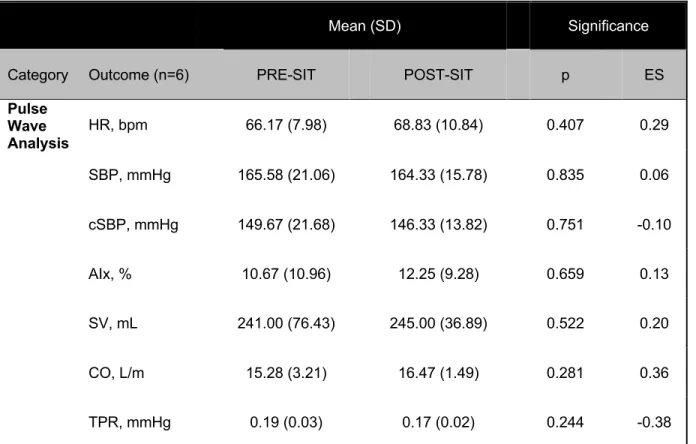
TABLE 8. Response to two hours of prolonged sitting for measures of pulse wave analysis. ... 33
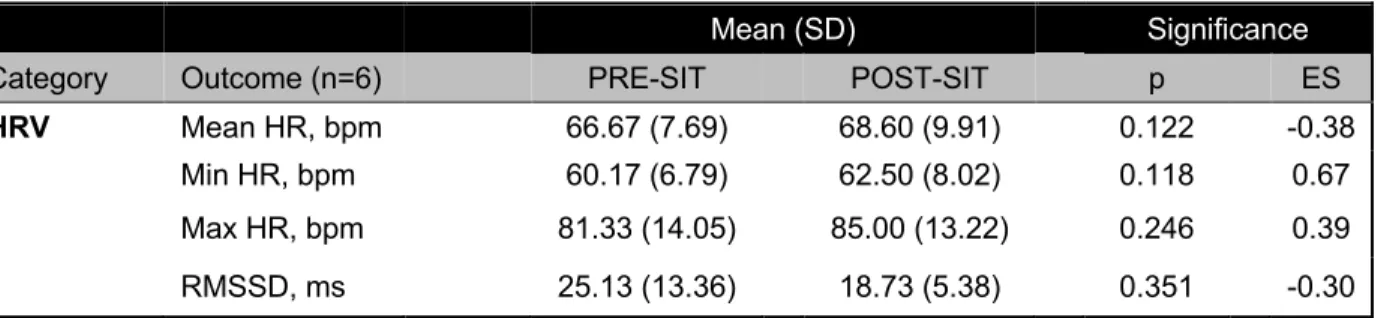
TABLE 9. Response to two hours of uninterrupted prolonged sitting for measures of heart rate variability. ... 34
TABLE 10. Oscillatory blood pressure response to a mental stressor. ... 37
TABLE 11. Response to a mental stressor for measures of pulse wave analysis. ... 40
LIST OF FIGURES
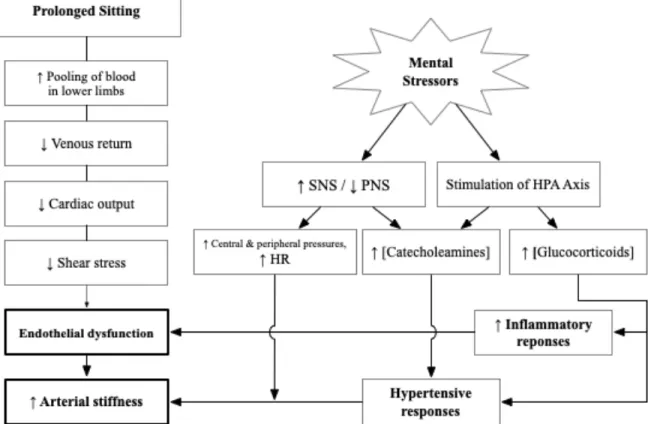
FIGURE 1. A visualization of the pathways prolonged sitting and mental stress (MS) navigate to ultimately impact central
and peripheral cardiovascular health with stiffer large arteries ... 12
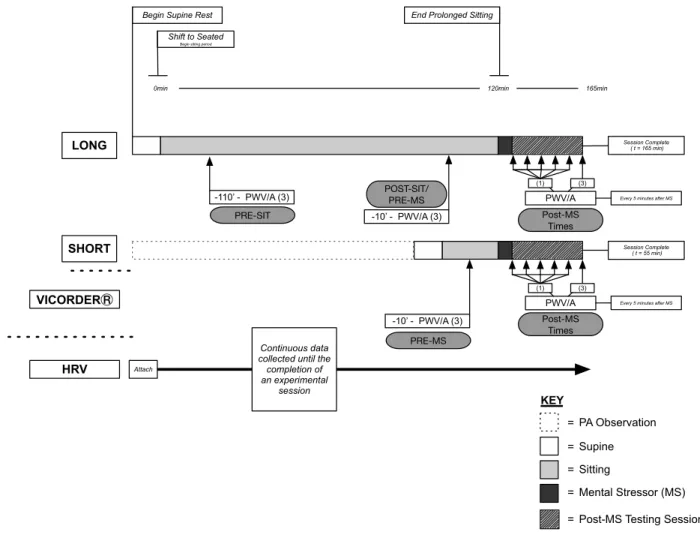
FIGURE 2. Experimental protocol. First experimental condition for all participating subjects are randomized according to
stated randomization procedures. ... 22
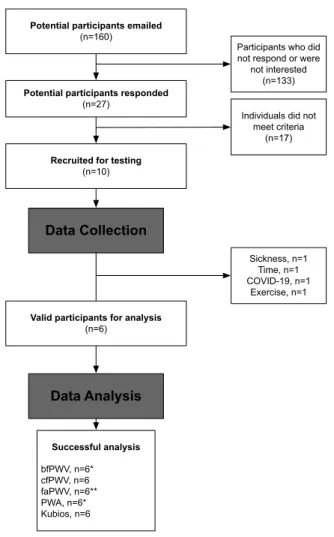
FIGURE 3. CONSORT Diagram ... 30
FIGURE 4. Response to PS for bfPWV (A), cfPWV (B), faPWV (C). Points are marginal means from mixed models. Faded lines and points represent individual data points from
each participant. Bars represent standard error. ... 35
FIGURE 5. bfPWV response to mental stressor. Dots represent marginal means of mixed models with bars representing
standard error. SE, standard error. ... 38
FIGURE 6. Secondary (cfPWV, A; faPWV, B) outcome responses to standardized mental stressor. Colored dots represent marginal
LIST OF ABBREVIATIONS
AIx Augmentation index
AS Arterial stiffness
bfPWV Brachial-femoral pulse wave velocity
cfPWV Carotid-femoral pulse wave velocity
CO Cardiac output
cSBP Central systolic blood pressure
CVD Cardiovascular disease
CVS Cardiovascular system
DBP Diastolic blood pressure
faPWV Femoral-ankle pulse wave velocity
HRV Heart rate variability
MAT Mental arithmetic test
MS Mental stressor/stress
PA Physical activity
PWA Pulse wave analysis
PWV Pulse wave velocity
RMSSD Root mean squared of successive differences
SBP Systolic blood pressure
SV Stroke volume
CHAPTER I: INTRODUCTION
Stress, sedentarism, and cardiovascular diseases (CVDs) in the United States have reached pandemic proportions1–3 and research has recently shown how our actions immediately
impact cardiovascular function. Cardiovascular diseases and adverse cardiovascular events consistently rank as the leading cause of death in the United States 3,4 and worldwide5,6. While a
sizable portion of an individual’s cardiovascular profile is genetically predetermined7,8, specific
health behaviors can significantly affect an individual’s risk for the development of CVD’s9–12.
For example, chronic mental stress (MS) and a lack of physical activity (PA) are known to
negatively impact an individual’s cardiovascular health cutely 13–15 and chronically 16,17 The
pathways in which mental stress impacts the cardiovascular system (CVS) acutely are well
documented16,18,19, and the dangers of chronic stress are well known20,21. Significant, acute
disruptions to the vasodilatory properties of the endothelium have been cited to occur after
bouts of sitting lasting as little as one hour22–24. Responding to the sedentarism epidemic with
research-guided public health will first require a clearer understanding of these acute
physiological changes. Furthering our understanding of how these stimuli impact the CVS and
establishing these recommendations will be beneficial for the maintenance of cardiovascular
health for at-risk populations like the average “white-collar worker.”
Most white-collar workers exist in a high-stress work environment characterized by
extensive desk and screen time. If researchers are to provide strategies to mitigate the negative effects of MS and prolonged sitting to this workforce, further research is necessary on these
sitting. Novel measures like pulse wave velocity (PWV), a measure of arterial stiffness (AS), will
be coupled with other variables collected by non-invasive techniques to obtain the desired
cardiovascular profile of the white-collar participant. The physiological mechanisms connecting
prolonged sitting and MS to changes in the CVS are understood. However, the interactions
between these cardiovascular responses are relatively unknown. Based on a review of the
present literature, it is hypothesized that exposure to prolonged sitting will worsen the
cardiovascular disruptions caused by exposure to a standardized research mental stressor.
Specific Aim 1: To observe the cardiovascular response and changes in arterial stiffness to
prolonged uninterrupted sitting in the “white-collar worker” population: physically inactive
middle-aged adults at heightened risk for cardiovascular diseases.
Specific Aim 2: To observe the cardiovascular response and changes in arterial stiffness to a
mental stressor with or without previous exposure to prolonged uninterrupted sitting. Strategy: A two-condition crossover trial in which participants were exposed to the mental
arithmetic test (MAT) either after two hours of sitting (LONG condition) or 20 minutes of sitting (SHORT condition). Exposure to the MAT will be time-matched to maintain internal validity.
Central and peripheral pulse wave velocity were used as surrogate measures for arterial
stiffness. Data from this lab group and scientific literature supports the usage of brachial-femoral
PWV, carotid-femoral PWV, and femoral-ankle PWV as viable arterial stiffness outcomes. Data
were collected at the beginning of the sitting periods in each experimental condition (PRE-SIT).
In the LONG condition, arterial stiffness will be measured at the end of the sitting period to
address specific aim 1 (POST-SIT). To address specific aim 2, PWV will be measured
immediately after completion of the MAT, every 5 minutes post-MAT for 20 minutes, and 30
minutes post-MAT. Data from these time points were compared to PRE-MS values in both
Hypothesis: The central and peripheral cardiovascular responses to mental stress will be
worsened after exposure to prolonged sitting.
ASSUMPTIONS, DELIMITATIONS & LIMITATIONS Assumptions
1. Participants truthfully answered medical screening questionnaire
2. Participants followed pre-assessment guidelines
3. Placement of VICORDER® cuffs was similar between two visits and recorded similar
arterial segments
4. Mental arithmetic test adequately “stressed” out the individual
Delimitations
1. Researchers encouraged little to no movement by the participant to ensure data is of
high quality
2. All participants had a similar 24-hour dietary intake profile with the usage of a
standardized meal
3. Exposure to the mental stressor was at a similar time of day for both conditions
4. A sitting period of two hours is shown, according to literature, to cause significant
disruptions in the cardiovascular system
Limitations
1. Due to the COVID-19 pandemic, investigators were unable to acquire the number of participants for adequate statistical power.
CHAPTER II - REVIEW OF LITERATURE
INTRODUCTION TO TOPIC
This literature review will begin by explaining the prevalence of prolonged sitting and chronic MS on a national scale and how these factors impact the national wellness and
productivity. Only recently has the general public become aware of the problems prolonged
sitting and excessive MS impose on individual health. Awareness is the first step in attempting
to combat the scourge of prolonged sitting on cardiovascular health, but in order to take action,
continued research on the physiological mechanisms both prolonged sitting and mental stress
take to impact the cardiovascular system is necessary. Without a foundation of knowledge,
organized guidelines for effective action cannot be constructed. Therefore, this review will reveal
what we do and do not understand about behavioral factors and their acute and chronic impacts
on cardiovascular function and structure. A sizable body of literature has shown the acute
impact of these factors on cardiovascular health, but significant gaps in knowledge regarding
more chronic impacts and potential compounding effects show the need for further investigation.
IMPORTANT DEFINITIONS Sedentary Behaviors (SB)
Sedentary behavior defines the lifestyle of sedentarism. In the United States, with the
increasing availability of short-term gratification, reported physical has dropped, and
sedentarism has risen25. For the past two decades, researchers have been contributing to a
body of literature defining and denouncing a sedentary lifestyle and sedentary behaviors like
prolonged sitting11,13,26–28. A review committee under the advisement of the Department of
important actions a person can do to improve their health29. A separate study found that a
lifestyle centered with regular exercise cannot overcome the negative effects of excessive being
sedentary30. Right now, identifying and reducing time spent sedentary is vital for the
maintenance of national public health. The Sedentary Behavior Research Network defines SB
as “waking behavior characterized by an energy expenditure ≤1.5 metabolic equivalents
(METs), while in a sitting, reclining or lying posture”31. While this definition is objective and easily
defined for exercise physiologists, the general public is less knowledgeable on specific
terminology. Relevant to not only this study, but to the middle-aged populous, our target
population, is the fact that consistent sedentarism leads to elevated resting heart rate, blood
pressures, and potentially lipid values like high-density lipoprotein (HDL) levels32,33. Defining SB
in this manner while also adhering to gold standard definitions in literature will more clearly
convey the harm that actions like prolonged sitting and physical inactivity have on the body.
Mental Stress (MS)
Mental stress seemingly defines a way of life for most middle-aged Americans. In a
review of cardiovascular responses to acute and chronic levels of stress, Dimsdale et al. define
“stress” as “the organism’s response to challenge”21. This ability to identify and respond to
environmental challenges or stimuli is an essential tool for survival against perceived “threats.”
However, when “threats” are the mental toll of the daily workday, and stress pathways are
constantly activated, cumulative damage to the CVS occurs. The stress reactivity hypothesis
has allowed us to make this connection between psychological stressors and strain on
cardiovascular function. This theory states individuals with excessive cardiovascular responses
to MS (e.g., large spikes in BP with sustain elevation) are more prone to the development of
CVDs34. Researchers admit, though, that the cardiovascular response to a specific MS is unique
reactivity changes over time, how it is influenced by behavioral factors like exercise or
sedentarism, or how it is affected by other mental stressors. This study will explore how
sedentary behaviors like PS affect the body’s capabilities to interpret and respond to mental
stress.
NATIONAL RISKS: MENTAL STRESS AND PROLONGED SITTING
The economy of the 21st century demands more “white-collar” jobs than any other period
of human progress in history. Unlike our more industrial ancestors, a larger portion of the
workforce must now sit at desks and complete mentally rigorous tasks rather than physically move and actively “work”35. Also, most adults in affluent environments like the United States
spend 70% of their waking hours seated and sedentary36. Prolonged sitting is an example of
sedentary behavior, and its prevalence significantly impacts the national healthcare system.
Sedentarism and physical inactivity have been shown to significantly increase an individual’s
risk for CVDs11,37,38. More seriously, the health benefits garnered from an exercise-centered
lifestyle are lost with significant amounts of prolonged sitting30. Worryingly, with increased
access to smart devices and a new, tech-centered economy, this behavior has seen increased
prevalence and is expected to grow 25,39. The American Heart Association (AHA) estimated that
direct costs in 2017 totaled $300 billion dollars on the American economy with the value
doubling at least by the year of 2035 4. Combatting this burden requires a more focused
research effort to better understand the health behaviors the general public can collectively take
to reduce the prevalence of CVDs.
In addition to physical inactivity, the pursuit for greater strides in business and
technological advancement has also imposed high levels of mental stress and cognitive strain
on the working population. The burden of chronic stress in America has reached critical levels40.
an already strained healthcare system. These health burdens are especially true for
middle-aged Americans, the subpopulation most likely to experience this high-stress environment.
Chronic mental stress puts these individuals at greater risk for the development of cancers and
cardiometabolic conditions16,21,41. In comparison to low-stressed individuals, this group also
report lower quality of life and lower energy21. Instead of slowing the pace of human progress,
more research should be completed to discover techniques that mitigate stress’s harm on the
CVS and maintain physical and mental wellbeing.
ASSOCIATIONS BETWEEN CHRONIC SEDENTARY BEHAVIOR AND CVD
Sedentary behaviors contribute significantly to the development of CVDs. This
connection began with Moris et al. in 1958 with the observation that bus drivers were twice as likely to be diagnosed with CVDs than the more active job of the bus conductor. Since these
preliminary findings, our understanding of the causality between physical inactivity and CVDs
has become stronger and more granular. We’ve learned that a calculated risk for CVDs is far
more complex with factors like genetic predisposition, age, stress, diet, and physical inactivity,
all acting as contributing factors. Before the development of CVDs, changes begin with
progressive changes in bodily characteristics. Those who are less active lose muscle mass,
increased fat mass, and more developed disruptions in cardiovascular function over time42.
These are the long-term physiological changes that are the result of the unfavorable
predisposition for these conditions43. A landmark study found the physical inactivity
independently account for 6-10% of all cases of non-communicable disease of the heart,
metabolic conditions, and even some cancers44.
ACUTE PROLONGED SITTING IMPAIRS CARDIOVASCULAR FUNCTION
legs due to the added effect of gravity and is visualized as the first physiological change in
Figure 1. The pumping action from the lower limb musculature is lost, and the blood fails to
exceed the force preventing circulation back to the heart. A decreased return of deoxygenated
blood to the inferior vena cava will translate to decreases in cardiac output (CO). The heart
manages to compensate by increasing heart rate, but with these changes and an excessively
high work rate, cardiac function in the future may be lost. In addition to acute changes in cardiac
function, the decreased CO and reduced blood blunts shear stress and fails to dilate constricted
vessels, thereby increasing resistance to blood flow 14,45. Prolonged sitting imposes these
significant changes in cardiac function with durations as short as one hour 14,22,23. More novel
measures assessing cardiovascular function and structure like pulse wave velocity (PWV),
pulse wave analysis (PWA), and augmentation index (AIx) have been critical in this relatively
new understanding that a lifestyle of sedentarism leads to higher risks of CVDs, other chronic
diseases, and early mortality 12,46–48.
Prolonged sitting also influences the function of the most minuscule endothelial
mechanisms. These changes are relatively small, but these failures in regulatory mechanisms
are hypothesized to translate to greater risk for CVDs. These macroscopic changes are due to
underlying physiological mechanisms that describe the regulatory efforts the CVS makes to
maintain homeostasis and demands of normal life. A leading hypothesis connects significant changes in blood flow to the most miniscule functions of the inner layers of our peripheral
endothelium 49–52 The connecting force that fulfills this proposed relationship is shear stress,
defined as the force experienced by the endothelium of blood vessel when erythrocyte flow
against the individual cells. Shear stress stimulates endothelial cells to release of nitric oxide (NO), a powerful vasodilator that expands the lumen of a blood vessel when blood pressure due
to heightened blood flow is hypertensive. Blood flow undisturbed by prolonged sitting generates
adequate levels of shear stress and nitric oxide to maintain regular peripheral circulation and
the lower limbs is the first disruption in the cardiovascular system that blunts this shear stress
mechanism and will eventually lead to increased arterial stiffness, visualized as the final steps in
Figure 1.
Gaps in Knowledge
Despite the formation of two distinct physiological mechanisms, specifics of these
changes are still unclear. It is still unknown if there is a “dose-dependent” relationship between prolonged sitting and disruptions in cardiovascular function. For example, does PWV increase
linearly with increasing time in prolonged sitting, or is there a “ceiling” value after a certain amount of exposure? Workers in certain occupations may have to maintain a seated position for
several hours every day of the workweek, potentially accruing detriments to cardiovascular function and accelerating atherosclerosis. Also, there is no one clearly effective intervention to
mitigate the CV effects of prolonged sitting that is also easy and simple to complete. Calf
pumping, “fidgeting,” and standing are examples of previously explored solutions, but success
has been limited23,51,53,54.
ACUTE MENTAL STRESS IMPAIRS CARDIOVASCULAR FUNCTION
Mental stress (MS) is manifested physiologically through two pathways: neural and hormonal. Through these pathways, environmental stressors can influence and disrupt the
continuous input of the autonomic nervous system (ANS) provides to the CVS. The ANS is split into two subbranches: the sympathetic nervous system (SNS) and the parasympathetic nervous
system (PNS). Both branches of the ANS serve the heart and other portions of the central circulatory system continuously for regulatory purposes. A surrogate measure to assess this
function of the ANS is heart rate variability (HRV), defined as the time between RR intervals on
activation or cardiac exertion55. The SNS and PNS also provide the function of vasoconstriction
and vasodilation in response to metabolic demands, respectively. In the event of a mental
stressor, these branches naturally alter the endothelial tone and cardiac function, thus
manipulating measures of HR and BP. These physiological changes are necessary for survival
and adaptation, but excessive activation of these neural pathways will lead to hypertensive
conditions in the CVS and damaged vasculature.
Stress also influences the CVS through the hypothalamic-pituitary-adrenal (HPA) axis.
The presence of a stressor activates this pathway to secrete a variety of catecholamines
(epinephrine, norepinephrine) and glucocorticoids (cytokines, cortisol). Each chemical pathway
maintains a functional purpose to manage the new loads the perceived stressor has on the
body. These pathways are essential to meeting the demands brought on by acute stimuli. From
these pathways come macroscopic alterations in blood pressure, heart rate, and subclinical
measures found from PWA. These changes are natural and essential for an appropriate
response to stressors. Chronic activation, however, of the HPA axis leads to cardiovascular
dysfunction56. Hypercortisolism, for example, leads to hypertensive conditions throughout the
peripheral vasculature10,19. Heightened cytokine levels in the bloodstream also trigger excessive
cardiovascular stress through an immune response that accelerates atherosclerosis57.
Gaps in Knowledge
The perception and reaction to a stressor are unique to each individual. It is still unclear
how MS impacts all portions of the CVS, including cerebrovascular structure and function. A
colloquial understanding of stress and cognitive performance believes that excessive stress will
lead to decreased mental performance. Unfortunately, a more comprehensive, physiological
elucidate these pathways to either assist in maintaining cognitive performance or preventing the
harm to cerebrovascular structure and function due to acute or prolonged mental stress.
PROPOSED COMBINATION EFFECT
Both prolonged sitting and MS operate through separate mechanisms to impair
peripheral and central cardiovascular function. Prolonged sitting, a sedentary behavior chosen
by the individual, will lead to more direct changes in the function of the CVS. Mental stressors, in contrast, will affect cardiovascular function across different pathways and relative in strength
amongst individuals58. Perception of stress is variable amongst individuals, and the introduction
of a light mental stressor will therefore lead to non-uniform changes in the CVS. Regardless, as
discussed, MS operates through neural and hormonal pathways to disrupt cardiovascular function. Using the literature as a guide, the proposed combination effect is visualized in Figure
1. The diagram generalizes the pathways these adverse behaviors and environmental factors
take and hypothesizes that heightened central and peripheral arterial stiffness is the result of
repeated exposure to both prolonged sitting and MS. This study is the first to hypothesize that
the cardiovascular response to MS will be worsened if the individual is first exposed to a bout of
prolonged sitting. If this protocol provides preliminary evidence for this combination effect, a
novel understanding that specific behavioral and environmental stressors may uniquely interact
FIGURE 1.
A visualization of the pathways prolonged sitting and mental stress (MS)
navigate to ultimately impact central and peripheral cardiovascular health with stiffer
large arteries
METHODOLOGICAL CONSIDERATIONS Study Design Considerations
Several study designs have been considered to achieve the goals of this research
project. The selection of the overall structure for this study design was based on considerations
for convenience to the participants, minimization of influence by potential covariates, and ease
of protocol completion by the investigators. A cross-sectional study may seem most convenient due to the need for one experimental session. However, one data point for each participant
would make controlling for covariates difficult and comparison between groups receiving and not receiving exercise difficult. A randomized control trial (RCT) is the gold standard for clinical
sessions that will skew data and make comparisons between groups impossible. Therefore, a
crossover design was chosen to allow each participant to act as their own control.
Within-subject data also helps eliminate the effects of most confounding anthropometric variables.
Measures of central and peripheral cardiovascular function will be compared between the
SHORT and LONG conditions to assess the potential influence of prolonged sitting on the
cardiovascular response to MS.
EXPERIMENTAL MEASURES
Arterial stiffness is a novel form of analysis to assess the health and elasticity of internal layers of larger arteries. Structural changes like the formation of fatty are the precursors for
increases in arterial stiffness and higher risk for acute cardiovascular events and the
development of CVDs59–61. This study has chosen AS as its marker of cardiovascular health and
concluding outcome in Figure 1 because previous research has tied its increase to a heightened
risk for CVDs46. Pulse wave analysis and PWV is the gold standard for measurement of arterial
stiffness Through the assessment of systolic pressure waves generated from the heart and
throughout the arterial tree59. The pressure waves traveling further down arterial pathways or
reflecting backward, generating a composite waveform acquired from PWA. Pulse wave velocity
is mathematically defined as the linear distance between measurement sites divided by the
pulse transit time (PTT). Pulse transit time is defined as the time between the foot of the
composite pulse waveforms collected at the two separate measurement sites and is collected
automatically by an experimental device. The variable, augmentation index (AIx) is the percent
differences in height between the first and second peaks on the composite waveform and is a
key measurement for arterial stiffness 62. Augmentation index, along with relative and absolute
changes in central and peripheral PWV, will provide insight on how prolonged sitting and MS
conduct PWA. The VICORDER® device (Vicorder, SMT Medical), has been chosen for this
protocol due to its relative ease of use and ability to automatically calculate measures relative to
this protocol. Like several other gold standard non-invasive devices, the VICORDER® system is
non-invasive to the participant and allows calculation of central and peripheral PWV as well as
AIx relatively simple. Other devices have been considered to collect our primary outcomes.
SphygmoCor XCEL is a tonometer-based system that has been validated for measures of
central PWV. However, proper usage of this system requires extensive training and guidance by
manufacturer personnel.
Venous pooling in the lower limbs is the first physiological change that begins the
cascade of cardiovascular disruptions, as shown in Figure 1. Data must be collected to confirm
this chain of disruption is occurring to allow sound conclusions for the research question.
Therefore, a simple non-invasive assessment hypothesized to observe blood pooling will be
conducted. Investigators will measure calf circumference before and after the sitting periods of
each experimental condition.
Population Considerations
The age range of 35-59 was chosen due to the increased risk for CVDs this population
faces, especially after 5063. This increased risk is due to the natural decline in the function of the
heart over his or her lifespan. This age group encapsulates the average American “white-collar
worker” that spends most of their workday seated at a computer screen. A vast majority of
individuals in the United States report some physical activity, but do not meet exercise
guidelines set by the American College of Sports Medicine (ACSM) according to subjective and
objective data64. Therefore, to be reflective of the general American population, individuals must
report levels of physical activity below the ACSM guideline of 150 minutes of exercise per week
(peripheral artery disease, coronary artery diseases, etc.), cardiovascular events (myocardial
infarction, stroke, etc.), and/or metabolic syndromes (type I or II diabetes) will not be included in
this study. Abnormal physiology of the CVS due to these conditions will skew outcomes for this
study and not be reflective of the American population. We will not impose restrictions on
inclusion in this study based on body composition.
Statistical Considerations
Linear mixed models were chosen to analyze data relevant to both scientific aims due to
its ability to address all aspects of the study design and data collection. We considered dependent t-tests to assess changes after prolonged uninterrupted sitting in the LONG
condition. However, the primary and secondary outcomes of this study are influenced by the time of collection of hemodynamic covariates like mean arterial pressure (MAP). Therefore the
mixed model option was chosen and MAP was included as a covariate to account for its
documented influence on measures of PWV65,66. Linear mixed models were also chosen to
account for random effects (subject) and random intercepts. Use of a linear regression model
could analyze for significant differences amongst the fixed effects experimental time points and
experimental conditions. However, the regression model would have failed to explain the
inherent random differences amongst subjects that would be sampled from the population.
Finally, mixed models were selected due to their ability to retain data in the event of missing
values from a singular timepoint. Unlike, for example, a repeated measures ANOVA that
requires a balanced array of data amongst subjects, a linear mixed model is capable of
accounting for random missing data points while including data at other experimental
OTHER CONSIDERATIONS Pre-Assessment Guidelines
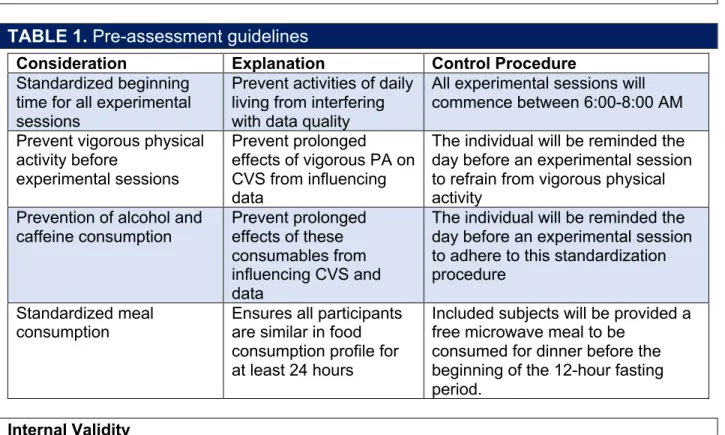
TABLE 1.
Pre-assessment guidelines
Consideration Explanation Control Procedure
Standardized beginning time for all experimental sessions
Prevent activities of daily living from interfering with data quality
All experimental sessions will commence between 6:00-8:00 AM
Prevent vigorous physical activity before
experimental sessions
Prevent prolonged effects of vigorous PA on CVS from influencing data
The individual will be reminded the day before an experimental session to refrain from vigorous physical activity
Prevention of alcohol and caffeine consumption
Prevent prolonged effects of these consumables from influencing CVS and data
The individual will be reminded the day before an experimental session to adhere to this standardization procedure
Standardized meal
consumption Ensures all participants are similar in food consumption profile for at least 24 hours
Included subjects will be provided a free microwave meal to be
consumed for dinner before the beginning of the 12-hour fasting period.
Internal Validity
Investigators followed established screening procedures to recruit a homogenous
sample group. The specific aims of this study are primarily concerned with observing
physiological responses to a behavioral (prolonged sitting) and an environmental (MAT)
stressor. A group relatively similar in age, activity, and health simplifies analysis and
strengthens the validity of experimental conclusions. A challenge investigators faced during study design was the standardization of the response to the MS. Mental alertness is likely
different at different hours of the day. In response, to maintain internal validity, all participants initiated both experimental conditions within 30 minutes of one another, and all experimental
Population/Sampling
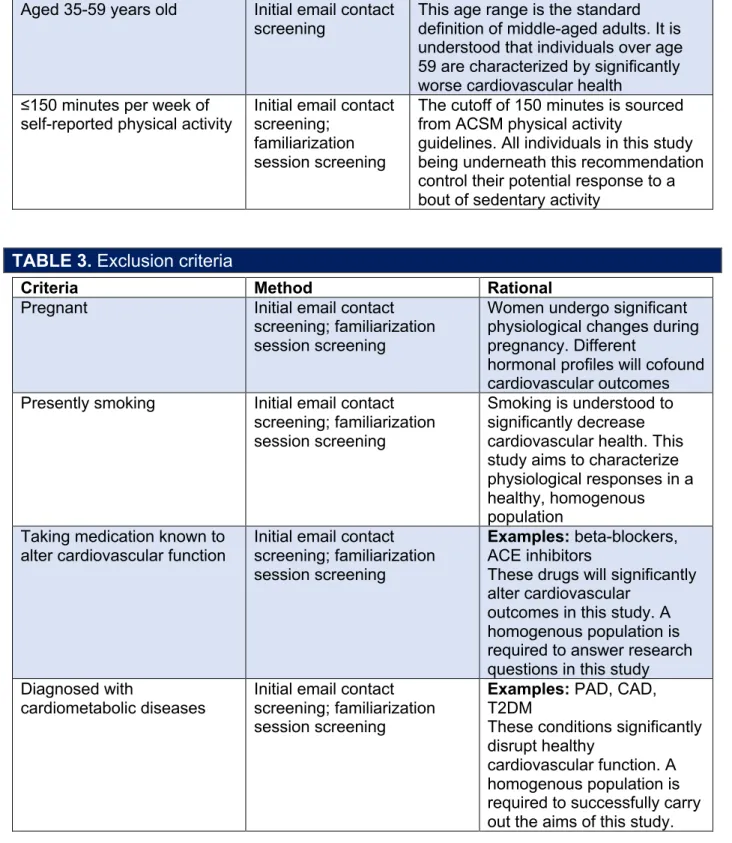
TABLE 2.
Inclusion criteria
Criteria Method Rational
Aged 35-59 years old Initial email contact screening
This age range is the standard definition of middle-aged adults. It is understood that individuals over age 59 are characterized by significantly worse cardiovascular health
≤150 minutes per week of
self-reported physical activity Initial email contact screening; familiarization session screening
The cutoff of 150 minutes is sourced from ACSM physical activity
guidelines. All individuals in this study being underneath this recommendation control their potential response to a bout of sedentary activity
TABLE 3.
Exclusion criteria
Criteria Method Rational
Pregnant Initial email contact
screening; familiarization session screening
Women undergo significant physiological changes during pregnancy. Different
hormonal profiles will cofound cardiovascular outcomes Presently smoking Initial email contact
screening; familiarization session screening
Smoking is understood to significantly decrease cardiovascular health. This study aims to characterize physiological responses in a healthy, homogenous population
Taking medication known to alter cardiovascular function
Initial email contact screening; familiarization session screening
Examples: beta-blockers, ACE inhibitors
These drugs will significantly alter cardiovascular
outcomes in this study. A homogenous population is required to answer research questions in this study Diagnosed with
cardiometabolic diseases
Initial email contact screening; familiarization session screening
Examples: PAD, CAD, T2DM
These conditions significantly disrupt healthy
Sex as a Biological Factor
This study sought to equally split the sample group for ten males and ten females to
represent the general populous.
Ethnicity/Race
This study did not exclude potential participants based on race or ethnicity.
Generalizability
Maintaining the internal and external validity of collected data allowed maximum generalizability to the white-collar worker population. Internal validity was maintained by only
allowing the primary investigators to collect and analyze data to assure quality and consistency. Data outputs were inspected after completion of each experimental session to ensure
high-quality data was collected. All data collection was completed while the participant is in a
seated-upright position
POTENTIAL CHALLENGES & ALTERNATIVE STRATEGIES
Internal validity was maintained by assuring that for each participant in this study,
exposure to the MS in the two experimental conditions was within 30 minutes of one another for
the time of day. For example, if participant one was exposed to the MAT at 8:30 AM for the LONG condition, the participant would have needed to be scheduled to between 7:30-8:30 AM
for the SHORT condition to ensure exposure to the MAT falls within the 8:00-9:00 AM window.
This time consideration provided an extra degree of standardization by maintaining the time at
which the individual is exposed to the laboratory environment. While the SHORT and LONG
conditions were not time-matched amongst all participants, the investigators utilized
accelerometers affixed to the wrist to assess and control for potential activity completed before
Unmet Recruitment Targets
Due to the existing pandemic, researchers were unable to adequately recruit and test
individuals to acquire adequate statistical power on a significantly reduced timeline. This lack of
power inherently reduces the validity of insights and drawn conclusions of this study.
TIMELINE
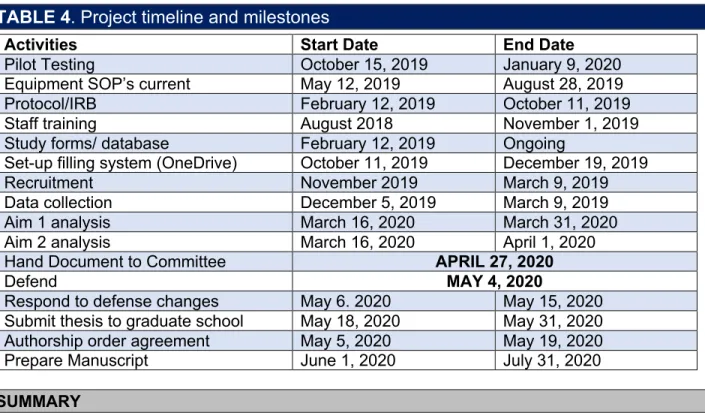
TABLE 4
. Project timeline and milestones
Activities Start Date End Date
Pilot Testing October 15, 2019 January 9, 2020
Equipment SOP’s current May 12, 2019 August 28, 2019
Protocol/IRB February 12, 2019 October 11, 2019
Staff training August 2018 November 1, 2019
Study forms/ database February 12, 2019 Ongoing
Set-up filling system (OneDrive) October 11, 2019 December 19, 2019
Recruitment November 2019 March 9, 2019
Data collection December 5, 2019 March 9, 2019
Aim 1 analysis March 16, 2020 March 31, 2020
Aim 2 analysis March 16, 2020 April 1, 2020
Hand Document to Committee APRIL 27, 2020
Defend MAY 4, 2020
Respond to defense changes May 6. 2020 May 15, 2020
Submit thesis to graduate school May 18, 2020 May 31, 2020
Authorship order agreement May 5, 2020 May 19, 2020
Prepare Manuscript June 1, 2020 July 31, 2020
SUMMARY
Why is This Study Needed?
Investigators were unable to identify an existing study that attempted to research the
cardiovascular response to prolonged sitting and an MS in succession. This research study
attempted to contextualize our understanding of prolonged sitting in a setting that more closely
What is Known
Prolonged sitting significantly impairs cardiovascular function and repeated exposure to
sedentary behaviors is known to increase the risk for CVD’s. Physiological mechanisms defining
how prolonged sitting and MS impair cardiovascular function are understood in isolation and
laboratory settings.
What is Not Known
The interactions between prolonged sitting and MS on measures of cardiovascular
function and AS have yet to be investigated.
Critical Need
More research is required on cardiovascular health in at-risk populations like the
CHAPTER III: METHODOLOGY
PARTICIPANTS
Ten healthy adults were recruited for this study. The population of interest in the Chapel
Hill, NC area was notified via flyers, university emails, and preexisting email listservs. For
inclusion into this study, subjects had to be 35-59 years old and must have reported present
habitual physical activity below ACSM guidelines of 150 minutes per week. Exclusion criteria set
for this study were: currently pregnant, smoking, taking medication known to alter
cardiovascular function, or diagnosed with any known cardiometabolic diseases. Prior to the
commencement of experimental sessions, subjects were familiarized with the protocol and directives of this study and completed written informed consent. This study was approved by the
Institutional Review Board of the University of North Carolina at Chapel Hill and is in accordance with current ethical guidelines.
EXPERIMENTAL DESIGN
This study was a randomized crossover trial with two conditions: (1) SHORT –
completion of 20 minutes of sitting with exposure to a mental stressor and (2) LONG –
completion of two hours of sitting followed by exposure to the same mental stressor. All
experimental visits were conducted in the morning starting between 6:00-10:00 AM to minimize the effects of daily activities on data quality. For the purpose of maintaining external validity, the
time of exposure to the MS in the second condition was to be administered within a 30-minute
window of the first condition’s MS (e.g. Exposure to MS was at 9:00 AM in the LONG condition
FIGURE 2.
Experimental protocol. First experimental condition for all participating
subjects is randomized according to stated randomization procedures.
Visit 1: Familiarization
Potential subjects interested in participation arrived at the Applied Physiology Laboratory
(APL) for discussion with the primary investigators of the study. Subjects interested in
participation after initial discussions were asked to complete a general medical questionnaire
that asked for current health behavior habits and medical history (APPENDIX A). Those eligible
for participation in this study after inclusion/exclusion completed written informed consent (See
APPENDIX B). The investigators provided descriptions of each experimental device used in the
protocol, how they are used in this study, and how and when they were to be affixed to their
body for data collection. Before leaving the APL, subjects were informed of pre-assessment
behavioral restrictions that needed to be followed to ensure quality of data:
Begin Supine Rest
0min 120min
Shift to Seated Begin sitting period
End Prolonged Sitting
165min
SHORT Session Complete
( t = 55 min)
= = = = KEY Supine Sitting
Post-MS Testing Session Mental Stressor (MS) = PA Observation
HRV Attach VICORDER LONG PWV/A (1) (3) PWV/A (1) (3)
Every 5 minutes after MS
Every 5 minutes after MS
Session Complete ( t = 165 min)
-10’ - PWV/A (3) -110’ - PWV/A (3)
-10’ - PWV/A (3)
Continuous data collected until the
• No vigorous exercise 24 hours prior to time of experimental session
• No alcoholic consumption 24 hours prior to time of experimental session
• No caffeine consumption 12 hours prior to time of experimental session
• Consumption of a free standardized meal before beginning of the fasting time
The participant and investigators would then schedule the date and time of the first experimental
session. The first experimental session must be at least 24 hours after the familiarization
session.
Visits 2 & 3: Experimental Visits
After arrival to the APL, investigators discussed with the participant if he or she adhered
to the previously described pre-test behavioral restrictions. If the subject did not adhere,
investigators rescheduled the experimental visit at the earliest convenience to the subject and
research team. Once adherence was assured, collection of basic anthropometrics (weight,
height, BMI, age, etc.) was completed by the primary investigators. A randomization software
(www.randomizer.org) was previously utilized to determine if the present participant would start
the experimental portion of this study with either the SHORT or LONG protocol.
In both protocols, participants rested in a fully supine position for at least 10 minutes.
During this time, investigators affixed VICORDER® cuffs and EKG leads to the participant. Cuff placement on either the left or right side of the body was randomized amongst participants in
this study using the same randomization software. Once these devices are functioning and the individual has had sufficient rest, subjects were shifted into an upright seated position for either
20 (SHORT) or 120 (LONG) minutes. VICORDER® data collection was conducted after ten
minutes of sitting in each condition to achieve baseline measures. At the end of sitting periods in
both SHORT and LONG, participants were exposed to an MS using the standardized mental
central and peripheral PWV and PWA (See Figure 2 for estimated timepoints). Subjects were
maintained in the seated upright position during these testing protocols. Previous studies have
chosen to complete PWV and PWA assessment in the supine position; however, we chose to
maintain the seated position throughout experimental conditions to minimalize the known effect
of changes in body position on central and peripheral hemodynamics68. In both conditions, the
option to watch a low-stimulation nature documentary (Kingdom of the Skies, PBS) during these
sitting periods was offered to prevent boredom and discomfort by the participant. At the end of
the first experimental session, participants were asked to schedule the second experimental
session which must be at least 48 hours after the first session. Participants were thanked for
their cooperation and would receive a report of their cardiovascular health as measured by the
experimental devices after the completion of the second and final experimental session.
Mental Stress – Mental Arithmetic Test (MAT)
The mental arithmetic test (MAT) was the standardized and valid psychological stressor
for this study. The test was approximately five minutes in duration. Participants were instructed
to subtract seven or 13 from a four-digit number as many times as possible for one minute. The
initial number for subtraction was changed every minute during the test. Participants were asked
to subtract in time with a metronome set to 22 bpm (increased by 2-3 bpm with every minute) to
increase the cognitive stress. Amount of subtractions was not recorded as an experimental
measure. See APPENDIX D for full testing documents. The visual analog scale (APPENDIX E)
and Borg Category with Ratio properties (CR10, APPENDIX F) were included in the testing
protocol to assess post-MAT levels of distress. The fogginess scale utilizes a 10-point Likert
scale from 0 “not foggy-very focused” to 10 “maximal fogginess – cannot focus.” This test was
administered in a seated position at PRE-SIT, POST-SIT, and post-MAT experimental time
EXPERIMENTAL MEASURES
Primary Outcome: Brachial-Femoral Pulse Wave Velocity (bfPWV)
Central and peripheral PWV were assessed using the VICORDER® device. This system acquired the primary outcomes using an automated, non-invasive blood pressure cuff system.
The primary outcome for this study is brachial-femoral pulse wave velocity (bfPWV), a reliable measure of central arterial stiffness according to previous research69 and unpublished data from
this lab group. Unpublished findings from this lab group indicate bfPWV as a reliable measure for central arterial stiffness in the seated upright position. This measure is acquired by wrapping
VICORDER® blood pressure cuffs around the participant’s brachial (b) artery site and ipsilateral
thigh for the femoral (f) artery site. Pulse transit time is calculated automatically by the
VICORDER® system. Straight-line distances between measurement sites were recorded
according to manufacturer guidelines to allow the device to calculate bfPWV: the distance
between the sternal notch and umbilicus. The measure was taken after ten minutes of sitting in
both SHORT (PRE-MS) and LONG (PRE-SIT) in triplicate with the closest two values being
averaged together and recorded for further analysis. After 100 minutes of prolonged sitting in
the LONG condition (POST-SIT/PRE-MS), bfPWV was measured again in triplicate. After
exposure to the MS, bfPWV was measured in triplicate immediately after (0-MS) the test and
five, ten, 15, 20, and 30-minutes post-test (5-MS, 10-MS, 15-MS, 20-MS, 30-MS, respectively)
Secondary Outcomes: Additional Measures of Central and Peripheral Cardiovascular Health
Additional PWV measures were taken by the VICORDER® device using three other
sites/arteries: carotid (c), femoral (f), and ankle (a). Two measures of PWV were acquired from
these sites: one for peripheral AS, femoral-ankle PWV (faPWV), and one for central AS,
carotid-femoral PWV (cfPWV). Femoral-ankle PWV has been used in previous studies completed by
this lab group to assess peripheral arterial stiffness. The straight-line distance used for faPWV is
between the superior borders of the pressure cuffs placed over the femoral artery and ankle
site. Due to experimental error, recorded distances for this arterial stiffness outcome were invalid. All transit time data for this outcome were divided by a common distance to investigate
relative changes. Carotid-femoral PWV, a surrogate for aortic arterial stiffness, has been a clinically significant marker of cardiovascular risk70. The straight-line distance for this outcome is
the distance from the sternal notch to the superior border of the femoral cuff minus the distance
between the carotid artery and the sternal notch. Measurements of cfPWV and faPWV were
taken in triplicate alongside bfPWV after ten minutes of sitting in both the SHORT and LONG
conditions and at minute 100 in the LONG condition. These outcomes were measured again in
triplicate approximately 30 minutes post-MS in both experimental conditions.
The VICORDER® device conducted PWA to collect augmentation index (AIx), estimated
central and peripheral systolic blood pressure (SBP, cSBP), stroke volume (SV), cardiac output
(CO), and total peripheral resistance (TPR) consecutively with measures of bfPWV.
Augmentation index is dependent on the pulse waveforms acquired from PWA and provides
supplemental information on arterial stiffness and potential risk for CVD’s71. Completion of PWA
required measurements of peripheral oscillatory SBP and DBP at the brachial sites. These
blood pressure values were recorded at the timepoints PRE-SIT in both the SHORT and LONG
conditions, POST-SIT in the LONG condition, and 0-MS in both the SHORT and LONG
Mechanistic Outcomes: Autonomic Function
LabChart and a PowerLab (ADInstruments) data acquisition system received analog
data from all experimental devices. The software package utilized the electrocardiogram (EKG)
signals to calculate heart rate variability (HRV), or the RR interval generated between two
heartbeats. Five-minute intervals of this data were selected and averaged by the investigators at
all seven time points in the SHORT condition (PRE-MS, 0-MS, 5-MS, 10-MS, 15-MS, 20-MS,
and 3MS) and all eight time points in the LONG condition (PRE-SIT, POST-SIT/PRE-MS, 0-MS, 5-0-MS, 10-0-MS, 15-0-MS, 20-0-MS, and 30-MS).
Mechanistic Outcomes: Calf Circumference
A researcher measured the muscle belly thickness of the calf at the initiation and
completion of the sitting period during each experimental condition to non-invasively observe
potential blood pooling due to prolonged sitting. The leg chosen for this outcome was the leg not
used for measures of arterial stiffness via the VICORDER device and its blood pressure cuffs.
The investigator palpated the thickest portion of the muscle belly and recorded the distance
from the medial malleolus for the first experimental condition. This distance was used during the
second experimental condition to measure calf circumference from approximately the same
latitude. At this latitude, the investigator used a Gulick tape measurer to record calf circumference
Mechanistic Outcomes: Free-Living Activity
Accelerometry was utilized to assess free-living physical activity beyond the
experimental conditions. An wGT3X-BT ActiGraph was used to record raw counts of activity for
translation into four classifications of activity bouts: sedentary, light, moderate, and vigorous.
Activity during experimental conditions was also monitored to ensure participants were inactive
while sitting. Instructions to participants on usage of accelerometry are provided in APPENDIX
C.
RANDOMIZATION
Randomization software provided by a public website (www.randomizer.org) was be
used to assign subjects either to the group completing SHORT or LONG first. This software was
also used to randomize the placement of all VICORDER® cuffs on either the left or right side of
the body. For the MAT, the subtraction of either seven or 13 for the first experimental condition was randomized. The second subtraction number was used for the second experimental
condition. Due to the nature of the experiment, it is impossible to blind the participant and experimenter with the protocol of the ongoing experimental protocol.
SAMPLE SIZE
Calculations to determine the minimum sample size was based on the primary
central vascular health outcome, aortic pulse wave velocity (PWV). The power calculation was
based on reported normal values for the primary outcome, central PWV. Healthy people aged
40-49 maintain an average PWV of 7.5 m/s72. For the current study, we opted to sample based
on a conservative change score of 1 m/s. We also used a conservative usual error of 1.25 m/s based on reported data72. Magnitude-based inference was used to estimate the sample size
required to detect the smallest detrimental (or beneficial) effect in a cross-over study, with the
maximum chances of a type 1 and 2 error set at 5% (i.e. very unlikely). Approximately eighteen
QUALITY CONTROL
For a given outcome, all measurements and analyses were to be conducted by a single
observer. Statistical outputs were observed for quality by an additional member of the research
team to ensure data quality and proper analysis.
DATA MANAGEMENT AND STATISTICAL ANALYSIS
Data management and analysis were completed using several software packages.
Storage and aggregation of experimental data were completed in Microsoft Excel (Excel, IN.,
Redmond, WA, USA). Heart rate variability analysis was conducted using Kubios HRV Standard
Edition v3.3.1. Outcomes derived from HRV were log-transformed account for non-standard
distribution. A dependent t-test was conducted on measures of arterial stiffness, pulse wave
analysis, and heart rate variability between the timepoints of PRE-SIT and POST-SIT in the
LONG condition. Mixed model analyses were performed in Jamovi v0.9 to observe the
cardiovascular response to a mental stressor. Models for arterial stiffness were adjusted for site
of measurement (bfPWV, cfPWV, or faPWV), experimental condition, and experimental time
point. Models for outcomes from PWA and HRV were adjusted for condition and timepoint.
Mean arterial pressure was a set as a covariate for all mixed models. Changes in outcomes are
expressed relative to the values recorded at the PRE-MS/POST-SIT experimental time point. Data files and subjects were depersonalized with the suffix SMS (e.g. Participant 1 = SMS01, 2
= SMS02, etc.). The α-level was set a priori for all statistical procedures at α=0.05. Effect sizes were calculated using Cohen’s d, where <0.20 is considered to be a small, > 0.20 to < 0.50 a
CHAPTER IV: RESULTS
PARTICIPANTS
Participant characteristics are summarized in Table 5. Ten participants were recruited,
but four dropped out due to various reasons (see Figure 3). Participants self-identified as
Caucasian (n=5) and African American (n=1).
FIGURE 3.
CONSORT Diagram
Potential participants emailed
(n=160)
Potential participants responded
(n=27)
Recruited for testing
(n=10)
Data Collection
Valid participants for analysis
(n=6)
Data Analysis
Successful analysis
bfPWV, n=6* cfPWV, n=6 faPWV, n=6** PWA, n=6* Kubios, n=6
Participants who did not respond or were
not interested (n=133)
Individuals did not meet criteria
(n=17)
Sickness, n=1 Time, n=1 COVID-19, n=1
BASELINE DATA
Six participants (42.8 [7.7] y, 33% F, 24.8 [1.4] kg/m2) were successfully analyzed.
There were no significant differences in anthropometric measures based on biological sex.
TABLE 5. Participant characteristics (n=6).
˚C, Celsius; mmHg, millimeters of mercury; cm, centimeter; kg/m2, kilograms per meter squared; min/wk, minutes per week; SD, standard deviation
Control Data: Accelerometry
Measurements of free-living activity before arrival for experimental sessions confirmed
participants were sufficiently inactive. Accelerometry tracked the sample group in sedentary or
light activity for 82.86% of wear time. Accelerometry data also showed participants were
objectively sedentary during experimental conditions (LONG: 98.86% sedentary; SHORT:
98.86% sedentary). Full accelerometry results are provided in Table 5.
All Male Female
Variable n Mean (SD) n Mean (SD) n Mean (SD) p
Ambiance
Temperature,
˚C 5 22.4 (0.55) 3 22.0 (0.00) 2 23.0 (0.00) 0
Humidity, % 5 31.6 (15.60) 34.3 (18.1) 2 27.5 (16.3) 0.698 Barometry,
mmHg 4 753 (9.18) 3 756 (1.41) 2 751 (14.8) 0.654
Participants
Age, years 6 42.8 (7.70) 4 41.5 (9.15) 2 45.5 (4.95) 0.608 Height, cm 6 169 (8.06) 4 173 (6.30) 2 161.0 (2.12) 0.063 Weight, kg 6 71.5 (10.10) 4 76.3 (8.76) 2 61.9 (1.06) 0.093 BMI, kg/m2 6 24.8 (1.36) 4 25.3 (1.44) 2 23.9 (0.22) 0.247 Self-reported
PA, min/wk 6 108 (55.60) 4 110.0 (70.7) 2 105.0 (21.2) 0.93
Free-Living Activity
% in Sedentary 6 (10.40) 39.2 4 34.5 (2.25) 2 48.5 (16.4) 0.129 % in Light 6 43.7 (8.98) 4 48.3 (5.35) 2 34.5 (7.92) 0.059 % in Moderate 6 17.1 (6.12) 4 17.2 (6.20) 2 17.1 (8.49) 0.987 % in Vigorous 6 0.0 (0.00) 4 0.0 (0.00) 2 0.0 (0.00) 0 % in
RESPONSE TO PROLONGED UNINTERRUPTED SITTING Calf Circumference
Full results are displayed in Table 6 A nonsignificant time x condition interaction effect was observed (p=0.078, 95% CI: -1.050, 0.010). A significant main effect for time was observed
(p<0.001, 95% CI: 0.575, 1.105) with values larger in the LONG condition compared to the SHORT condition.
TABLE 6. Reported calf circumferences before and after sitting periods in the SHORT and
LONG conditions.
Mean (SD) p (ES)
Outcome (n=6) PRE-SIT POST-SIT Time Interaction
Calf
Circumference, cm SHORT 35.9 (1.74) 36.4 (1.96) <0.001 (0.904) 0.028 (0.475)
LONG 35.6 (1.86) 36.7 (1.92)
Arterial Stiffness
See Figure 4 for visualization of changes in arterial stiffness. There were no significant
differences observed between the PRE-SIT and POST-SIT timepoints for any measures of
arterial stiffness.
Oscillometric Blood Pressure
There were no significant differences observed between the PRE-SIT and POST-SIT
timepoints for any measures of oscillatory blood pressure (Table 7).
TABLE 7. Response to two hours of prolonged sitting for measures of oscillatory blood
pressure.
Mean (SD) Significance
Category Outcome (n=6) PRE-SIT POST-SIT p ES
Oscillatory Blood Pressure
SBP, mmHg 133.00 (12.10) 131.00 (9.28) 0.365 -0.29 DBP, mmHg 78.30 (6.03) 77.70 (6.20) 0.749 -0.10
Pulse Wave Analysis
All pre-post differences for measures of PWA were observed to be nonsignificant (Table
8).
TABLE 8. Response to two hours of prolonged sitting for measures of pulse wave analysis.
Mean (SD) Significance
Category Outcome (n=6) PRE-SIT POST-SIT p ES
Pulse Wave Analysis
HR, bpm 66.17 (7.98) 68.83 (10.84) 0.407 0.29
SBP, mmHg 165.58 (21.06) 164.33 (15.78) 0.835 0.06
cSBP, mmHg 149.67 (21.68) 146.33 (13.82) 0.751 -0.10
AIx, % 10.67 (10.96) 12.25 (9.28) 0.659 0.13
SV, mL 241.00 (76.43) 245.00 (36.89) 0.522 0.20
CO, L/m 15.28 (3.21) 16.47 (1.49) 0.281 0.36
TPR, mmHg 0.19 (0.03) 0.17 (0.02) 0.244 -0.38 HR, heart rate; bpm, beats per minute; AIx, augmentation index; L/m, liters per minute; CO, cardiac output; TPR, total peripheral resistance; SV, stroke volume; mL, milliliters
Heart Rate Variability
There were no significant differences observed between the PRE-SIT and POST-Sit
TABLE 9. Response to two hours of uninterrupted prolonged sitting for measures of heart rate variability.
Mean (SD) Significance
Category Outcome (n=6) PRE-SIT POST-SIT p ES
FIGURE 4.
Response to prolonged sitting for bfPWV (A), cfPWV (B), faPWV (C). Points
are marginal means from mixed models. Bars represent standard err
16
12
8 bfPWV
(m/s)
TIMEPOINT
7 20
cfPWV (m/s)
TIMEPOINT
9 10 11 faPWV
(m/s)
PRE-SIT POST-SIT
TIMEPOINT 8
9
PRE-SIT POST-SIT
14
10
PRE-SIT POST-SIT
A
B
RESPONSE TO MENTAL STRESSOR: SHORT vs. LONG CONDITIONS
Data collected immediately prior to the initiation of the MAT is designated as the
PRE-MS experimental time point. Due to the inherent structure of the LONG experimental condition,
the POST-SIT timepoint equates to the PRE-MS timepoint in the context of this analysis.
Mental Arithmetic Test Response: Visual Analog Scale
There was no significant difference (p=0.495, ES=-0.39) between experimental conditions in
response to the MAT.
Arterial Stiffness
There were no significant interaction effects observed over time for measures of arterial stiffness (Figure 5 and Figure 6). Main effects for time were nonsignificant for all measures of
arterial stiffness. Main effects for experimental condition were significant with bfPWV smaller in
the LONG condition (p<0.001, ES=-1.81) and faPWV was larger in the LONG condition
(p=0.025, ES=0.59). Visualization of mental stress responses between conditions for each
measure of arterial stiffness is shown in Figure 5 (bfPWV) and Figure 6 (cfPWV and faPWV).
Oscillatory Blood Pressure
Nonsignificant interaction effects were observed for oscillatory SBP (p=0.156, ES=0.68)
and DBP (p=0.455, ES=0.33) (Table 10). A significant condition effect was observed in
oscillatory DBP (p=0.002, ES=0.70) with values 2.6 mmHg higher in the LONG condition. Main