Original Research Article
Histopathological study of prostatic lesions in correlation with serum
prostate specific antigen levels in elderly men
Nikhil S. Deshpande
1, Swati V. Dahe
1*, Anil B. Munemane
1,
Gajanan D. Dhokikar
2, Ravindra R. Karle
1INTRODUCTION
Prostate is the largest accessory gland in males which is situated at the neck of bladder. Prostatic pathologies are commonly seen in elderly men with Benign prostatic hyperplasia (BPH) being the commonest. Prostatic malignancy accounts for second most common clinically detected malignancy which also constitutes fifth most common cause of death due to malignancy in men worldwide.1
In India, Prostatic adenocarcinoma (PCa) is the second to third leading cause of cancer in major cities and shows that majority of the lesions show equal distribution around the country.2 Prostate-specific antigen (PSA) is a serine
protease in the kallikrein family, produced by the secretory cells in the prostatic ducts and acini. Normal prostate architecture keeps PSA confined to the gland while allowing only fraction to be leaked into the circulation which enables its detection in serum. PSA circulates in free
1Department of Pathology, Rural Medical College, Pravara Institute of Medical Sciences (DU), Loni 2Department of Biochemistry, Rural Medical College, Pravara Institute of Medical Sciences (DU), Loni
Received: 11 August 2020 Accepted: 12 August 2020
*Correspondence: Dr. Swati V. Dahe,
E-mail: [email protected]
Copyright: © the author(s), publisher and licensee Medip Academy. This is an open-access article distributed under the terms of the Creative Commons Attribution Non-Commercial License, which permits unrestricted non-commercial use, distribution, and reproduction in any medium, provided the original work is properly cited.
ABSTRACT
Background: Prostatic lesions are common among elderly men with urinary complaints. Variety of prostatic lesions range from inflammatory, benign to malignant pathologies. The Prostate specific antigen (PSA) is secreted by glandular epithelium of prostate shows raised serum levels in these pathologies. Usually significant rise is commonly associated with Prostatic adenocarcinomas (PCa) with exceptions.
Methods: In this retrospective study, total 63 diagnosed cases of prostatic lesions over a one-year period for which serum PSA levels were available, were selected. Cases without serum PSA levels & inadequate biopsies were excluded. Histological diagnosis of prostatic lesions reconfirmed and its correlation with serum PSA was done.
Results: Study included patients with mean age 67.84 years (range: 48-60) at the time of diagnosis. Benign lesions were commonest prostatic lesions accounting for total 54 cases (85.71%) out of which 38 were of Benign prostatic hyperplasia (BPH), 14 cases of BPH with prostatitis while single case each for BPH with granulomatous prostatitis and basal cell hyperplasia. Mean PSA value for benign lesions was 6.57 ng/ml. Total 8 were malignant which included 7 (11.11%) PCa while single (1.59%) case of metastatic transitional cell carcinoma. Mean PSA for PCa were 35.05 ng/ml. Single case (1.59%) of high grade prostatic intraepithelial neoplasia also detected.
Conclusion: Common age group at the time of presentation of prostatic pathologies is 60-70 years. The most common prostatic lesions are benign predominantly BPH. PCa are commonest malignancies. Elevated PSA levels >20 ng/ml are commonly observed in PCa. However lower or normal values don’t rule out PCa.
Keywords: PSA, BPH, Prostatitis, Prostatic adenocarcinoma
and complexed form. Complexed forms are bound to protease inhibitors.3
Serum PSA levels correlate strongly with the risk of prostate cancer. So along with factors like increasing age, race, family history and digital rectal examination findings, serum PSA is commonly used as a screening tool to determine the need for biopsy. PSA levels also appear elevated in conditions including BPH, prostatitis, or extrinsic manipulations of prostate like bicycling, catheterization, etc. Hence other PSA derivatives like PSA density (that is the ratio of PSA to gland volume), PSA doubling time, PSA velocity (that is the change of PSA over time), and age and race specific PSA reference ranges are commonly used to improve the specificity.4-6
Rural population-based cancer registries show PCa as seventh most common malignancy as compared to urban cancer registries in India.2 There are fewer publications
available from rural India correlating PSA levels with the prostatic lesions.7
We conducted this retrospective study to evaluate different prostatic pathologies detected in a rural tertiary care hospital along with their correlation with the Serum PSA levels.
METHODS
This was a retrospective record based study in which we retrieved all the prostatic specimens including Transurethral urethral resection of prostate (TURP) specimens and prostatic core biopsies, received at the Department of Pathology, Rural Medical College, Pravara Institute of Medical Sciences (DU) Loni, Maharashtra, a tertiary care hospital in a rural setup over period of one year (January 2019 to January 2020). All diagnosed cases of prostatic lesions for which serum PSA levels were available were included in the study.
Serum PSA levels were evaluated in department of biochemistry using immunometric assay on ViTROS ECi Immunodiagnostic Systems (Ortho Clinical Diagnostics) on venous blood samples. Cases without in house serum PSA levels and inadequate biopsies were excluded. Out of total 83 prostatic specimens received during the study period, total of 63 cases satisfied the inclusion criteria.
Spectrum of histopathological lesions included BPH, BPH with Prostatitis, BPH with granulomatous prostatitis, basal cell hyperplasia, High grade prostatic intraepithelial neoplasia (HGPIN), Prostatic Adenocarcinoma (PCa) and Metastatic transitional cell carcinoma. All the diagnosed lesions were correlated with serum PSA levels. No follow up data was available.
Fischer’s exact chi-square test was applied. All calculations were done using microsoft excel while statistical test performed using Open Epi software.
RESULTS
Total 63 cases were evaluated. Mean age at the time of diagnosis was 67.84 years with age ranging from 48-80 years. Most common age group was between 60-70 years accounting for 29 (46.03%) of all cases. The frequency of age specific distribution of prostatic lesions is shown in given Table 1.
Table 1: Age specific distribution of total prostatic lesions along with percentage.
S.no. Age in years No. of cases (%)
1 41-50 3 (4.76)
2 51-60 10 (15.87)
3 61-70 29 (46.03)
4 71-80 20 (31.74)
5 81-90 1 (1.59)
Out of total 63 cases, 54 (85.71%) were benign lesions which included 38 (60.32%) BPH alone, 14 (22.22%) cases of BPH with prostatitis while single (1.59%) case each for BPH with granulomatous prostatitis and basal cell hyperplasia. Mean PSA value for benign lesions was 6.57 ng/ml. There were 8 malignant lesions which included 7 (11.11%) Prostatic adenocarcinomas (PCa) and a single (1.59%) case of metastatic Transitonal cell carcinoma (TCC) of bladder. Mean PSA for PCa cases were 35.05 ng/ml. Single case (1.59%) of high grade prostatic intraepithelial neoplasia (HGPIN) also detected. The distribution of various prostatic lesions along with their PSA values is shown in Table 2.
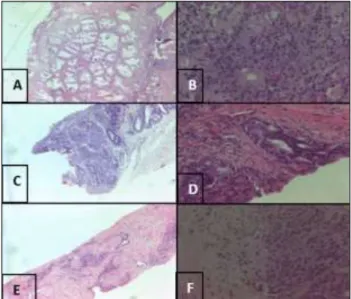
Figure 1: Representative H and E images of (A) Benign prostatic hyperplasia (100x), (B) Granulomatous prostatitis (400x), (C) Basal cell
hyperplasia (100x), (D) High Grade Prostatitic Intraepithelial Neoplasia, (E) Prostatic Adenocarcinoma (PCa) (100x) and (F) Perineural
Representative microphotographs for benign prostatic
hyperplasia, granulomatous prostatitis, basal cell hyperplasia, HGPIN and PCa are shown in Figure 1 (A-F) respectively. Maximum 31 cases were showing PSA values <4 ng/ml. Mean PSA levels of PCa were higher as compared to that of the benign and premalignant counterparts (Figure 2). Four out of 7 PCa showed PSA levels >20 ng/ml while two showed intermediate levels between 4-10 ng/ml and one showed PSA below 4 ng/ml. Both benign and malignant cases were higher in seventh and eighth decade of life. While maximum benign cases presented in seventh decade while maximum PCa cases presented in eighth decade of life in this study Table 3 and 4). Benign lesions and Prostatic adenocarcinomas (PCa) were stratified according to cut off levels of serum PSA of 4 ng/ml (Table 5).
Figure 2: Mean serum PSA values for benign, premalignant and malignant prostatic lesions.
Table 2: Distribution of prostatic lesions with serum PSA.
S. No. Sr. PSA
(ng/ml) BPH
BPH with Prostatitis
BPH with Granulomatous Prostatitis
BCH HG
PIN PCa
Metastatic
TCC Total
1 0-4 20 8 0 0 1 1 1 31
2 4-10 10 2 1 0 0 2 0 15
3 10- 20 6 4 0 1 0 0 0 11
4 >20 2 0 0 0 0 4 0 6
5 Total 38 14 1 1 1 7 1 63
Table 3: Distribution of benign lesions with serum PSA in different age group.
S. No. Sr. PSA (ng/ml) 41-50 51-60 61-70 71-80 81-90 Total
1 <4 2 5 14 8 1 30
2 4-10 0 2 5 5 0 12
3 10-20 0 3 5 2 0 10
4 >20 0 0 2 0 0 2
5 Total 2 10 26 15 1 54
Table 4: Distribution of prostatic adenocarcinoma with PSA in different age group.
S. No. Sr. PSA (ng/ml) 41-50 51-60 61-70 71-80 Total
1 <4 0 0 1 0 1
2 4-10 1 1 0 0 2
3 10-20 0 0 0 0 0
4 >20 0 0 1 3 4
5 Total 1 1 2 3 7
Table 5: Stratification of PSA with benign lesions & prostatic adenocarcinoma with cut off serum psa levels of 4 ng/ml (n=61).
Sr. PSA (ng/ml) Prostatic adenocarcinoma Benign lesions Total
≥4 6 24 30
<4 1 30 31
7 54 61
Fischer Exact chi-square test-0.0529. The result is not significant at p< 0.05 0 5 10 15 20 25 30 35 40
DISCUSSION
Prostate specific antigen (PSA) is a widely used marker for screening and monitoring for prostatic malignancies since its discovery in 1979 by Wang et al. American Cancer Society has recommended annual digital rectal examination and PSA screening for men aged 50 years or above.7 For early detection of PCa age specific PSA cut off
threshold values are needed as a trigger for biopsy. As per study conducted by Agrawal et al mean serum PSA levels appear to be lower for Indian than western population with mean value 1.76 ng/ml.8 Though serum PSA levels is
associated with low specificity in detection of PCa, still it is one of the easy, cost effective and non-invasive method for the screening. In present study, we analysed the serum PSA levels in various benign, premalignant and malignant lesions of the prostate.
In present study, mean age for all 63 prostate cases was 67.84 years with a range of 48-82 years. This was comparable with results of Chauhan et al (mean age 65.5, n=140), Lakhey et al (mean 67.61, n=91), Vani et al (mean age 63.9), Javed R et al, Jayapradeep et al and Banerjee et al (most cases in age group 61-70 years).10-14
Mean age at the diagnosis for BPH in our study was 67.61 years with a range of 48-82 years with maximum cases in seventh decade which correlates with studies conducted by Chauhan et al, Vani et al, Jayapradeep et al, Banerjee et al and Godbole et al.9,11,13,14,15
In the distribution of prostatic pathologies, present study showed, 54 (85.71%) benign lesions and 8 (12.70%) malignant lesions. Benign cases included 38 (60.32%) BPH alone, 14 (22.22%) cases of BPH with prostatitis while single (1.59%) case each for BPH with granulomatous prostatitis and basal cell hyperplasia. While malignant lesions included 7 (11.11%) PCa and a single (1.59%) case of metastatic TCC of bladder. A single case of HGPIN (1.59%). The results are comparable with study by Wadgaonkar et al where they found similar results in the form of 83.75% BPH with and without prostatitis cases, 13.75% PCa, 1.25% metastatic TCC and PIN each.16 The results were also comparable with studies
by Partibhan et al, Chauhan et al, Lakhey et al, Vani et al, Jayapradeep et al, Banerjee et al and Godbole et al for percentage distribution of benign and malignant cases.7,9,10,11,13,14,15
PSA values in cases of benign lesions was <4 ng/ml for most our cases which was similar to that of Partibhan et al, Chauhan et al, Lakhey et al, Banerjee et al, Godbole et al, and Akhter et al.7,9,10,14,15,17 Mean PSA for benign lesions
was 6.57 which is comparable with that of Chauhan et al (mean 5.05).9
PSA values in Pca was elevated >20 ng/ml in most of our cases which was comparable with the studies by Partibhan et al, Chauhan et al, Javed et al, and Godbole et al.7,9,12,15
Mean PSA for PCa was 35.05 which is significantly lower
than the studies by Chauhan et al (mean 59.65) and Akhter et al (mean 703.95).9,17
CONCLUSION
To summarize the results of the study we conclude that the most common prostatic lesions are benign predominantly BPH. PCa are the commonest malignancies. Common age group at the time of presentation of prostatic pathologies is 60-70 years. Elevated levels of PSA >20 ng/ml are commonly observed in PCa. So higher PSA must warrant a careful histopathological examination for PCa as chances of finding malignancy increase. However lower or normal PSA values also does not rule out PCa.
Funding: No funding sources Conflict of interest: None declared Ethical approval: Not required REFERENCES
1. Ferlay J, Soerjomataram I, Ervik M, Dikshit R, Eser S, Mathers C et al. GLOBOCAN 2012: Estimated Cancer Incidence, Mortality and Prevalence Worldwide v1.0. Cancer Incidence and Mortality Worldwide: IARC CancerBase No. 11. Available from: http:/lglobocan.iarc fr: International Agency for Research on Cancer. Accessed on 4th August
2020.
2. Jain S, Saxena S, Kumar A. Epidemiology of prostate cancer in India. Meta Gene. 2014;2:59-605.
3. Ornstein DK, Pruthi RS. Prostate-specific antigen. Expert Opin Pharmacother. 2000;1:1399-411. 4. Aus G, Damber JE, Khatami A, Lilja H, Stranne J,
Hugosson J. Individualized screening interval for prostate cancer based on prostate-specific antigen level: results of a prospective, randomized, population-based study. Arch Intern Med. 2005;165(1):857-61.
5. Thompson IM, Pauler DK, Goodman PJ, Tangen CM, Lucia MS, Parnes HL, et al. Prevalence of prostate cancer among men with a prostate-specific antigen level < or =4.0 ng per milliliter. N Engl J Med. 2004;350:2239-46.
6. Tchetgen MB, Oesterling JE. The effect of prostatitis, urinary retention, ejaculation, and ambulation on the serum prostate-specific antigen concentration. Urol Clin North Am. 1997;24(2):283-91.
7. Parthiban R, Roopa AN, Puttaswamy K, Shariff S. Efficacy of prostate-specific antigen to categorize men with prostate pathology into benign, premalignant, and malignant lesions. J Med Sci Health. 2016;2(1):1-5.
8. Agrawal A, Karan SC. Serum PSA levels in the Indian population: Is it different? Med J Armed Forces India. 2017;73(2):112-7.
correlation with prostate specific antigen levels in a
tertiary care center. 2017;4:328-32.
10. Lakhey M, Ghimire R, Shrestha R, Bhatta AD. Correlation of serum free prostate-specific antigen level with histological findings in patients with prostatic disease. Kathmandu University Medical J. 2010;8(2):158-63.
11. Vani BR, Kumar D, Sharath BN, Murthy VS, Geethamala K. A Comprehensive Study of Prostate Pathology in Correlation with Prostate-Specific Antigen Levels: An Indian Study. Clinc Cancer Investig J. 2015;4:617-20.
12. Javed R, Suresh T, Shetty M. Study of morphological spectrum of prostatic lesions and its correlation with Ki-67 in a tertiary care hospital in rural South India. Al Ameen J Med Sci. 2016;9(3):175-82.
13. Jayapradeep DP, Prakash VB, Philipose TR, Pai MR. Histomorphological correlation of PSA levels in prostatic carcinoma. National J Lab Med. 2017;6:28-32.
14. Banerjee B, Iqbal BM, Kumar H, Kambale T, Bavikar R. Correlation between prostate specific antigen levels and various pathologies. J Med Soc. 2016;30:172-5.
15. Godbole CR, Bhide SP. Study of histopathological correlation of prostate lesions with serum prostate specific antigen levels in a tertiary care hospital. MedPulse Int J Pathol. 2020;13(3):125-9.
16. Wadgaonkar AR, Patil AA, Mahajan SV, Yengantiwar RP. Correlation of serum prostate specific antigen level in various prostatic pathology in elderly men. Int J Basic Appl Med Sci. 2013;3:274-81.
17. Akhter R, Reshi R, Dar ZA, Dar PA. Histopathological study of prostatic lesions on needle biopsies with serum prostate-specific antigen (PSA). Int J Med Med Sci. 2014;6(3):87-91.