Alabi et al. Female Autonomy and Contraceptive Use
ORIGINAL RESEARCH ARTICLE
Does Female Autonomy Affect Contraceptive Use among Women in
Northern Nigeria?
DOI: 10.29063/ajrh2019/v23i2.9
Olatunji Alabi
1,2*, Clifford O. Odimegwu
2, Nicole De-Wet
2and Joshua O. Akinyemi
2,3Demography and Social Statistics, Federal University, Birnin Kebbi, Kebbi State, Nigeria1; Demography and Population Studies Program, School of Public Health and Social Sciences, University of the Witwatersrand, Johannesburg, South Africa2; Department of Epidemiology and Medical Statistics, College of Medicine, University of Ibadan, Nigeria3
*For Correspondence: Email: [email protected]; Phone: 08033592249
Abstract
Literature identified female empowerment as a predictor of positive health behaviour. However, in the context of conservative and traditional society, this is yet to be explored. This paper explores the role of female autonomy in contraceptive use among currently married women in northern Nigeria. Nationally representative Nigeria Demographic and Health Survey (NDHS, 2013) data for 18,534 currently married women in northern Nigeria was analysed. Complimentary log-logistic regression (cloglog) was used to analyse the data. Current use of modern contraceptive was 6.6% among currently married women in northern Nigeria. Results show that female autonomy was significantly associated with modern contraceptive use. Respondents‘ education, wealth status and desire for no more children were associated with higher contraceptive use. Despite the conservative and religious context of northern Nigeria, female autonomy significantly predicts modern contraceptive use. Thus, empowering women in northern Nigeria, especially by education, will enable them to participate in healthy contraceptive decision making. (Afr J Reprod Health 2019; 23[2]:92-100).
Keywords: Female autonomy; Contraceptive; Reproductive health; northern Nigeria; Sustainable Development Goal
Résumé
La documentation a identifié l'autonomisation des femmes comme un indice d'un comportement de la santé positif. Cependant, dans le contexte de la société conservatrice et traditionnelle, cela reste à explorer. Cet article explore le rôle de l'autonomie des femmes dans l'utilisation de la contraception chez les femmes actuellement mariées dans le nord du Nigéria. Des données représentatives de l'enquête sur la démographie et la santé au Nigéria (EDSN, 2013) pour 18 534 femmes actuellement mariées dans le nord du Nigéria ont été analysées. Une régression log-logistique complémentaire (cloglog) a été utilisée pour analyser les données. L'utilisation actuelle de la contraception moderne était de 6,6% chez les femmes actuellement mariées dans le nord du Nigéria. Les résultats montrent que l'autonomie de la femme était associée de manière significative à l'utilisation de la contraception moderne. L‘éducation des interviewées, leur situation financière et leur désir de ne plus avoir d‘enfants étaient associés à une utilisation accrue de la contraception. Malgré le contexte conservateur et religieux du nord du Nigéria, l'autonomie des femmes prédit de manière significative l'utilisation de la contraception moderne. Ainsi, l'autonomisation des femmes dans le nord du Nigéria, notamment par l'éducation, leur permettra de participer à la prise de décisions en matière de contraception en bonne santé. (Afr J Reprod Health 2019; 23[2]: 92-100).
Mots-clés: Autonomie féminine; Contraceptif; La santé reproductive; le nord du Nigeria; Objectif de développement durable
Introduction
Fertility reduction using modern contraceptive for limiting and spacing births in developing countries remains an area of focus for both National and International government. For instance, International government through donor
Alabi et al. Female Autonomy and Contraceptive Use
Nigeria is one of the USAID‘s family planning priority countries. The 2013 modern contraceptive prevalence rate (CPR) of 16% in Nigeria attests to the fact that more is needed to be done to achieve the 36% CPR goal by 20182. Contraceptive prevalence rate varies across regions in Nigeria. For instance, prevalence of use of any contraceptive method was as low as 3.2% in North East and as high as 38% in South West3.
Over the decades, several studies have identified the determinants of contraceptive use. In the 1990s, socio-demographic and economic factors were highlighted as determinants of contraceptive use4. Further, personal and emotional factors – general discomfort, feelings and experience with specific methods among others, were identified as factors influencing contraceptive use among women in United States5. In the Millennium, factors such as women‘s education, husband‘s approval of contraceptive method, age, wealth index and religion were identified as drivers of contraceptive use among women in Tanzania and Nigeria2,6.
Female autonomy as used in this paper connotes female‘s capacity to manipulate her personal environment and take decisions about her concerns. In this context, health, reproductive health, movement, and household decision-making. The role of women‘s autonomy as determinants of contraceptive use was first measured in the early 2000s. It was reported that female autonomy is important in improved women reproductive health generally7. Further, female autonomy was identified as important determinant of contraceptive use among Pakistani women8. Among Indian women, women‘s autonomy significantly predicts contraceptive use9. Recently, female autonomy in terms of joint reproductive health decision making and higher women earning power was identified as significant determinant of contraceptive use among Nigerian couples10. In a qualitative study to determine the role of men in adopting family planning in two selected States of Oyo and Kaduna in Nigeria, authors found some level of lack of female‘s autonomy as a factor preventing uptake of family planning in Nigeria11. Further, lack of women‘s autonomy in predicting low use of contraception among women in Bauchi, north
east Nigeria was implied in a study using mix methods12.
We explored female autonomy in relation to use of modern contraception method among currently married women in northern Nigeria. This is very important because northern Nigeria remains strictly a conservative traditional society with profound male domination. The evident gender segregation in northern Nigeria has been adequately documented in the literature13,14. Cultural and religious dictates have strengthened gender separation for years and thus, enshrined male domination into the societal organisation. This is clearly evident at levels of relationships from household to larger society14.
The practice of purdah system also lent credence to gender separation in northern Nigeria. Married women are restricted in terms of movement and thus usually confined to the house. This has deepened and strongly influenced the low girl-child school enrolment and completion rate. Permission has to be obtained from husband or identified authority within the household before a woman can go out. Even at that, women have to go with veils covering their face. This and other cultural practices have contributed in no small measures to the underdevelopment of women. These have generally hindered women‘s advancement in terms of education, occupation and even political participation. The highest point of the comparative inferiority of women to men is pronounced in the high rate of girl-child under age marriages in the region15,16.
Alabi et al. Female Autonomy and Contraceptive Use
of child bearing age in northern Nigeria, women from the region have also been documented to have low utilization of all forms of maternal and child health services18,19.
Studies on women autonomy and contraceptive use in Nigeria have treated Nigerian women as similar20,21. The few studies that have taken into consideration the regional differences in women‘s characteristics have limited scope. For instance, Aransiola et al11 only looked at one location each from southern and northern Nigeria to demonstrate the effect of lack of female autonomy in family planning adoption decision-making and thus, not representative. In a similar study on sexual autonomy and contraceptive use among Nigeria women, limitation of not taking the different cultural background of women into account in the study, was acknowledged22. In the same vein, Austin1 failed to consider the difference in cultural background of Nigerian women. This limitation especially considering the poor indicators of contraceptive use and the general repressive cultural practices which sees and treats women as inferior to men in northern Nigeria informed this paper. In this paper, we argue that despite the conservative social structure of northern Nigeria, female autonomy is likely to be significantly associated with modern contraceptive use. Thus, we hypothesised that women in northern Nigeria who are autonomous in various indicators of decision-making are likely to be modern contraceptive users.
Methods
Study area and data source
Northern Nigeria- consisting of 19 States out of the 36 States in Nigeria- is noted for low reproductive health services uptake and contraceptive use in particular22. Also, there are evidences of strong socio-cultural and religious predictors of either use or non-use of contraceptive. There is a clear indication of male dominance in the form of gender separation which pervades almost all facet of daily living. Women are generally relegated to the background and are hardly heard. The dominant religion practiced also give some support to the gender separation in the region. The region is predominantly occupied by
the Hausa and Fulani ethnic groups who are mostly agrarian and pastoralists23.
The study utilized 2013 Nigerian Demographic and Health Survey (NDHS). We restricted the analysis to data of 18,534 married women aged 15-49 in the three geo-political zones of northern Nigeria. The 2013 NDHS selected women aged 15-49 across the 36 States and the Federal Capital Territory (FCT) in Nigeria using three staged stratified cluster sampling technique3. At the first stage, the country was stratified into rural and urban locations and 893 localities were selected. At the second stage, 904 primary sampling units referred to as clusters or enumeration areas were selected and household listing was also done at this stage. The third stage, a total of 45 household each was selected from each rural and urban cluster. Samples were weighted to address non-proportionality in selection and different response rate by States. Detail of the sampling procedure used in the 2013 NDHS has been documented in the final report3.
Variables and variables measurement
Alabi et al. Female Autonomy and Contraceptive Use
a single female autonomy variable used at the multivariate level of the analysis. Females who reported autonomy in each measure was coded as ‗1‘ and females who reported non-autonomy were coded as ‗0‘. This was resorted to because of the evidence from various statistic tests conducted (but not reported here) which showed that female economic autonomy may be the driver of the other female autonomy measures.
We controlled for selected demographic and socio-economic variables such as age of respondents, education, residence, religion, occupation type, household wealth status, frequency of exposure to media (magazine, radio and television), political region, and desire for more children in the final model. Test of multicollinearity was conducted for the model and variables found to be highly correlated were dropped in the final model (Table 3).
Analysis
Descriptive analysis of the weighted variables was done using percentages of the selected variables. At bivariate analysis, chi square test of association between measures of female autonomy and contraceptive use was done to identify the dimension of female autonomy that mostly
predicts modern contraceptive use.
Complimentary log-logistic regression (cloglog) was used for multivariate analysis to address the main objective of the paper. This regression method is used when the outcome variable is dichotomous and rear - the percentage who had or experienced the outcome of interest (contraceptive use) is less than 10%. This is considered the most applicable method because the proportion of northern Nigerian women who reported current use of modern method of contraception is less than 10% of the total number of women interviewed. We controlled for the effect of the explanatory variables at the multivariate level of the analysis (Model 1, Table 3). The analysis was restricted to currently married women only because they are the group whose use or non-use of contraceptive may be mostly dependent on the level of autonomy they enjoyed.
Models were fitted for the association between contraceptive use and female autonomy measures using two stage procedures. At stage one, a
univariate model was fitted for each of the variable and those with p-values of less than 0.1 were identified. At stage two, model was fitted with female autonomy variable and explanatory variables with p-value of less than 0.1 selected from stage one. We explained the result of the model using exponentiated coefficient which measures the likelihood of the dependent variable as a factor of the independent variable. The analysis was done at the regional level only (northern region) as the sample size per geo-political region was too small for any robust zone-wise analysis.
Results
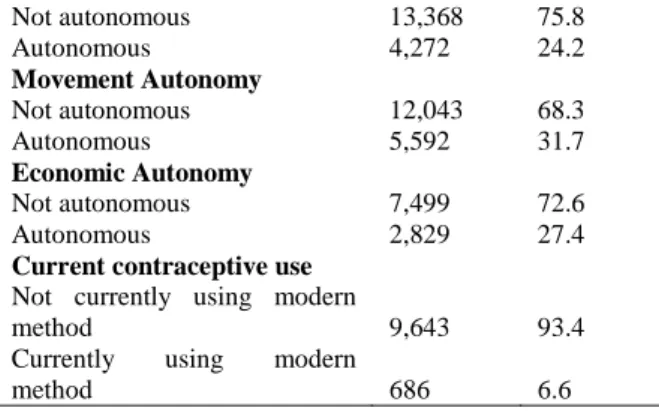
Table 1 shows the result from the descriptive analysis of the respondents. Highest proportion of the women was in 25-29 years age group. More than half of the women were from North West geo-political zone. More than half of them were from monogamous family. Six in ten of the women were from the poor households. Highest proportion (68%) of the women had no education. Majority (78.8%) of the women wanted to have more children. In terms of female autonomy measures, 24.2%, 31.7% and 27.4% were autonomous in terms of health, movement and economic decisions respectively. Less than 10% of the married women were currently using modern method of contraception.
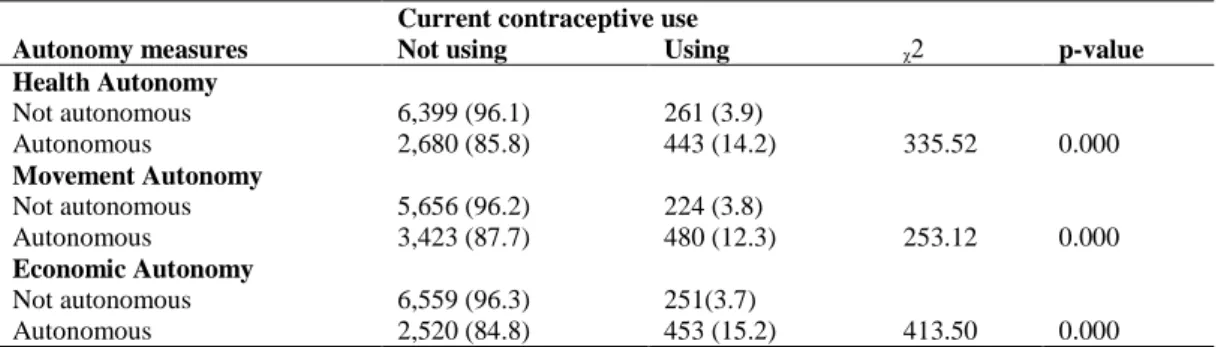
Table 2 presents the bivariate analysis result of the association between the outcome variable (current use of modern contraceptive method) and the measures of female autonomy (health, movement and economic). Majority (86%) of females who reported autonomy in making health decisions were not currently using modern contraceptives. Furthermore, less than 20% of the females who had movement and economic autonomy reported current use of modern method of contraception (12.3% and 15.2% respectively).
Alabi et al. Female Autonomy and Contraceptive Use
Table 1: Distribution of currently married women in northern Nigeria by selected characteristics, NDHS 2013
Background characteristics Frequency Percentage
Age group
15-19 years 2,062 11.1
20-24 years 3,291 17.8
25-29 years 3,930 21.2
30-34 years 2,957 16.0
35-39 years 2,564 13.8
40-44 years 1,901 10.3
45-49 years 1,828 9.9
Level of Education
No education 12,610 68.0
Primary 2,797 15.1
Secondary 2,491 13.4
Higher 635 3.4
Family Type
Monogamous 11,041 59.8
Polygamous 7,416 40.2
Residence
Urban 4,332 23.4
Rural 14,201 76.6
Geo-political zone
North Central 3,869 20.9
North East 4,663 25.1
North West 10,002 54.0
Religion
Christianity 3,137 17.2
Islam 15,109 82.8
Occupation
Not working 6,708 36.3
Professional/clerical 7,821 42.4
Agriculture 1,696 9.2
Manual 2,242 12.1
Wealth Status
Poor 11,368 61.3
Middle 3,349 18.1
Rich 3,816 20.6
Frequency of reading magazine
Not at all 17,064 92.1
Less than once a week 813 4.4
At least once a week 656 3.5
Frequency of listening to radio
Not at all 8,694 46.9
Less than once a week 4,294 23.2 At least once a week 5,546 29.9
Frequency of watching television
Not at all 12,651 68.3
Less than once a week 2,434 13.1 At least once a week 3,449 18.6
Desire for more children
Wants more 13,967 78.8
Wants no more 2,162 12.2
Undecided 1,587 9.0
Health Autonomy
Not autonomous 13,368 75.8
Autonomous 4,272 24.2
Movement Autonomy
Not autonomous 12,043 68.3
Autonomous 5,592 31.7
Economic Autonomy
Not autonomous 7,499 72.6
Autonomous 2,829 27.4
Current contraceptive use
Not currently using modern
method 9,643 93.4
Currently using modern
method 686 6.6
Exp (B) = 2.02, CI: 1.65 – 2.47; p-value<0.001). The likelihood of current use of modern contraceptive was 7 times significantly higher among women aged 30-34 years compared to women aged 15-19 years. The likelihood of current use of modern contraceptive method was significantly higher among women with secondary education (Exp (B) = 4.78, CI: 3.41 – 6.69; p-value<0.001) compared to women with no education. In the same vein, the likelihood of current use of modern contraceptive method was 2 times significantly higher among females from rich households compared to females from poor households. Among women who do not want more children, the likelihood of current use of modern method of contraception was significantly higher compared to women who wanted to have more children.
Model 2 tested association between female autonomy and contraceptive use. Females who were autonomous are four times significantly more likely (Exp (B) = 4.99, CI: 4.14- 6.01; p-value < 0.001) to use modern method of contraception compared to females who were not. The model statistics shows that the overall model was statistically significant in explaining predictors of contraceptive use among married women in northern Nigeria.
Discussion
Alabi et al. Female Autonomy and Contraceptive Use
Table 2: Association between contraceptive use and female autonomy type, NDHS 2013
Current contraceptive use
Autonomy measures Not using Using ᵪ2 p-value Health Autonomy
Not autonomous 6,399 (96.1) 261 (3.9)
335.52 0.000
Autonomous 2,680 (85.8) 443 (14.2)
Movement Autonomy
Not autonomous 5,656 (96.2) 224 (3.8)
253.12 0.000
Autonomous 3,423 (87.7) 480 (12.3)
Economic Autonomy
Not autonomous 6,559 (96.3) 251(3.7)
413.50 0.000
Autonomous 2,520 (84.8) 453 (15.2)
Table 3: Complimentary Logistic model explaining relationship between modern contraceptive use and female autonomy, NDHS 2013
Characteristics Model 1 Model 2
Female Autonomy Exp (B) 95% CI Exp (B) 95% CI
Not autonomous 1 [1,1] 1 [1, 1]
Autonomous 2.02** [1.65, 2.47] 4.99** [4.14, 6.01]
Age group
15-19 years 1 [1,1]
20-24 years 4.05* [1.38, 11.87]
25-29 years 5.25* [1.83, 15.05]
30-34 years 7.49** [2.62, 21.44]
35-39 years 6.53** [2.27, 18.77]
40-44 years 5.82* [2.00, 16.95]
45-49 years 3.28* [1.09, 9.79]
Level of Education
No education 1 [1,1]
Primary 3.12** [2.28, 4.27]
Secondary 4.78** [3.41, 6.69]
Higher 3.98** [2.70, 5.85]
Occupation
Not working 1 [1, 1]
Professional/clerical 1.06 [0.79, 1.42]
Agriculture 0.56** [0.42, 0.75]
Manual
Wealth Status
Poor 1 [1, 1]
Middle 1.93** [1.41, 2.65]
Rich 2.664** [1.93, 3.63]
Frequency of watching television
Not at all 1 [1, 1]
Less than once a week 1.73** [1.31, 2.28] At least once a week 1.19 [0.90, 1.56]
Desire for more children
Wants more 1 [1, 1]
Wants no more 3.18** [2.53, 3.99]
Undecided 1.20 [0.82, 1.75]
have documented the significance of female autonomy in modern contraceptive use however, this is yet to be explored in a conservative and highly traditional society like northern Nigeria. We found that female autonomy matters in determining modern contraceptive use among
Alabi et al. Female Autonomy and Contraceptive Use
contraception among Banglandeshi women26. In Nigeria and Namibia, higher likelihood of contraceptive use among women with greater autonomy and from rich households compared to their counterparts with lower autonomy and from poor households were found28.
Model 1 (Table 3) shows that women who were autonomous were 2 times more likely to use modern contraceptive compared with women who were not autonomous. The level of significant was stronger when the association was explored between modern contraceptive use and female autonomy only. This may be due to the reason that women who are autonomous may be able to negotiate the use of contraceptive such as condom, emergency pills etc. with their husbands for birth limiting and spacing. Also, such women might be able to negotiate safer sex with their husbands/partners and may afford the cost of such contraceptive. This drives home the evidence that female autonomy is an important factor in modern contraceptive use in northern Nigeria. With or without other variables, female autonomy remains a significant predictor of modern contraceptive use.
Results also showed that education, wealth status, desire for no more children and frequency of watching television also determines contraceptive use among the women. This finding is in line with similar studies8, 25, 29, 30. Higher husband-wife educational level led to improved women reproductive autonomy which in turn led to increased use of contraception among Pakistani women31. Further, it was shown that the tendency to use any contraceptive method peaked among women aged 30-34 years. This pattern could be explained by the fact that most women within that age group in the study area must have been nearing their completed fertility and thus may not desire more children. Studies have found that childbearing among women in the study area usually start earlier- with its attendant consequences- than among their counterparts in the southern part of the country32-34. By the time a woman gets to age 30-34 years, they might have achieved their desired family size and want no more children. Thereby uptake family planning services than their counterparts in lower age groups.
The observed higher likelihood of contraceptive use among women with secondary educational level is expected and could partly be explained by the fact that educated women would be able to explore more options of contraceptive methods and decide on the most appropriate method to be used. Further, it is easier for the family planning provider to engage and relate with an educated woman on procedures and likely side effect of chosen contraceptive method than with an un-educated woman. Generally, higher level of education among women has been documented to be associated with improved reproductive health behaviour25,35.
Since Nigeria did not achieve much in terms of contraceptive prevalence during the implementation of the Millennium Development Goals (MDGs) agenda, with an average increase of only two percent from the 2003 figure in 20133, the new 2030 Sustainable Development Goals (SDGs) provides another opportunity to ensure that the goal is met. One of the targets of SDG 3 is to prevent unintended pregnancy through universal access to reproductive health care and this is more apt in regions like northern Nigeria where prevalence of modern method of contraceptive use remains very low despite knowledge and availability of family planning services. Women empowerment and improved general status is a way to ensure this goal is achieved in Nigeria especially in northern Nigeria. Culturally sensitive family planning messages targeted at correcting myths (such as condom use is synonymous to promiscuity) about contraceptive methods need to be aired through the mass media as frequency of exposure to watching television is one of the determinants of modern contraceptive use in the study area. The role of higher educational attainment among women in improving prevalence of contraceptive use cannot be over-emphasized.
Alabi et al. Female Autonomy and Contraceptive Use
reproductive health of girls in the states also require State government by-in right from the beginning to ensure sustainability of the programme. This will prevent the experience of ―end-of project means end of intervention‖ syndrome which has characterized similar donor funded projects in the region in the past. The saying ―educate a woman, and you educate the nation‖ is more apt in the situation of northern Nigeria. Once girl-child education rate improves in the region, it will have a multiple effect on other aspects of human and capital development in the region and Nigeria as a whole.
Conclusion
Examining the role of female‘s autonomy in contraceptive use among currently married women in northern Nigeria showed that female‘s autonomy is an important factor in contraceptive use. General improvement in terms of women‘s education, wealth status and access to media are also key to ensuring contraceptive usage among currently married women in the region. Therefore, ensuring women are autonomous and are better empowered (through education) will help improve on the low prevalence of contraceptive use in northern Nigeria. Intervention to ensure this needs to be pursued with renewed vigor and commitment if the country is to achieve the universal access to reproductive health care by year 2030.
Acknowledgement
We acknowledge the Demography and Population Studies Programme of the University of Witwatersrand, Johannesburg, South Africa for the research fellowship. The management of the Federal University, Birnin Kebbi, Kebbi State, Nigeria is also acknowledged for the permission to attend the fellowship programme. This paper was not funded by any individual or organization.
Authors’ Contributions
OA wrote the first draft. COO conceived the idea of the manuscript, read the draft and make input. NDW also read the draft and provided intellectual input. JOA, OA conducted data analysis. OA
incorporated all the input from COO, NDW and JOA into the final draft. All authors contributed to revising the manuscript and approved the final version.
References
1. Darroch JE and Singh S. Trends in contraceptive need and use in developing countries in 2003, 2008, and 2012: an analysis of national surveys. The Lancet 2013;381(9879):1756-62.
2. Austin A. Unmet contraceptive need among married Nigerian women: an examination of trends and drivers. Contraception 2015;91(1):31-38.
3. National Population Commission (NPC) [Nigeria], ICF International. Nigeria 2013 Demographic and Health Survey. Abuja, Nigeria, and Rockville, Maryland, USA: National Population Commission and ICF International, 2014.
4. Brown SS and Eisenberg L. The best intentions: Unintended pregnancy and the well-being of children and families: National Academies Press, 1995.
5. Oddens B. Determinants of contraceptive use among women of reproductive age in Great Britain and Germany II: psychological factors. Journal of Biosocial Science 1997;29(4):437-70.
6. Anasel MG and Mlinga UJ. Determinants of contraceptive use among married women in Tanzania: Policy implication. Etude de la Population Africaine 2014;28(2):976.
7. Bloom SS, Wypij D and Gupta MD. Dimensions of women‘s autonomy and the influence on maternal health care utilization in a north Indian city. Demography 2001;38(1):67-78.
8. Saleem S and Bobak M. Women's autonomy, education and contraception use in Pakistan: a national study. Reproductive health 2005;2(1):8.
9. Patrikar S, Basannar D and Sharma MS. Women empowerment and use of contraception. medical journal armed forces india 2014;70(3):253-56. 10. Blackstone SR and Iwelunmor J. Determinants of
contraceptive use among Nigerian couples: evidence from the 2013 Demographic and Health Survey. Contraception and Reproductive Medicine 2017;2(1):9.
11. Aransiola JO, Akinyemi AI and Fatusi AO. Women‘s perceptions and reflections of male partners and couple dynamics in family planning adoption in selected urban slums in Nigeria: a qualitative exploration. BMC Public Health 2014;14(1):869. 12. Kana MA, Tagurum YO, Hassan ZI, Afolaranmi TO,
Ogbeyi GO, Difa JA, Amede P and Chirdan OO. Prevalence and determinants of contraceptive use in rural Northeastern Nigeria: Results of a mixed qualitative and quantitative assessment. Annals of Nigerian Medicine 2016;10(1):3.
Alabi et al. Female Autonomy and Contraceptive Use
XXV International Population Conference Tours, Francia; 2005.
14. Makama GA. Patriarchy and gender inequality in Nigeria: the way forward. European Scientific Journal, ESJ 2013;9(17).
15. Kyari GVand Ayodele J: The socio-economic effect of early marriage in North Western Nigeria. Mediterranean Journal of Social Sciences 2014, 5(14):582.
16. Braimah TS: Child marriage in Northern Nigeria: Section 61 of Part I of the 1999 Constitution and the protection of children against child marriage. African Human Rights Law Journal 2014, 14(2):474-488.
17. NPC, ORCMacro. Nigeria 2003 Demographic and Health Survey. National Population
Commission (NPC) [Nigeria] & ORC Macro. Calverton, MD, USA, 2004.
18. Alabi O, Doctor HV, Afenyadu GY, Findley SE. Lessons learned from setting up the Nahuche Health and Demographic Surveillance System in the resource-constrained context of northern Nigeria. Global health action 2014;7(1):23368.
19. Kana MA, Doctor HV, Peleteiro B, Lunet N and Barros H. Maternal and child health interventions in Nigeria: a systematic review of published studies from 1990 to 2014. BMC Public Health 2015;15:334.
20. Viswan SP, Ravindran TS, Kandala N-B, Petzold MG and Fonn S. Sexual autonomy and contraceptive use among women in Nigeria: findings from the Demographic and Health survey data. International journal of women's health 2017;9:581.
21. OlaOlorun FM and Hindin MJ. Having a say matters: influence of decision-making power on contraceptive use among Nigerian women ages 35– 49 years. PloS one 2014;9(6):e98702.
22. Lamidi EO. State variations in women‘s socioeconomic status and use of modern contraceptives in Nigeria. PloS one 2015;10(8):e0135172.
23. Muhammad I, Isamila A and Bibi M. Assessment of farmer-pastoralist conflict in Nigeria using GIS. International Journal of Engineering Science Invention 2015;4(7):23-33.
24. Allendorf K. Couples' reports of women's autonomy and health‐care use in Nepal. Studies in family planning
2007;38(1):35-46.
25. Wado YD. Women‘s autonomy and reproductive health care seeking behavior in Ethiopia. Women & Health 2017(just-accepted).
26. Rahman MM, Mostofa MG and Hoque MA. Women‘s household decision-making autonomy and contraceptive behavior among Bangladeshi women. Sexual & Reproductive Healthcare 2014;5(1):9-15. 27. Adhikari R. Effect of Women‘s autonomy on maternal
health service utilization in Nepal: a cross sectional study. BMC women's health 2016;16(1):26. 28. Bamiwuye SO, De Wet N and Adedini SA. Linkages
between autonomy, poverty and contraceptive use in two sub-Saharan African countries. Etude de la Population Africaine 2013;27(2):164.
29. Fotso J-C, Ezeh AC and Essendi H. Maternal health in resource-poor urban settings: how does women's autonomy influence the utilization of obstetric care services? Reproductive Health 2009;6(1):9. 30. Igbodekwe FC, Oladimeji O, Oladimeji KE, Adeoye IA,
Akpa OM and Lawson L. Utilisation of modern contraceptive among women of childbearing age in resource constraint setting: evidence from 2008 National Demographic and Health Survey in Nigeria. Journal of Health Science 2014;4(3):72-78.
31. Saleem A and Pasha G. Women's reproductive autonomy and barriers to contraceptive use in Pakistan. The European Journal of Contraception & Reproductive Health Care 2008;13(1):83-89.
32. Fagbamigbe AF and Idemudia ES. Survival analysis and prognostic factors of timing of first childbirth among women in Nigeria. BMC pregnancy and childbirth 2016;16(1):102.
33. Amodu OC, Salami B and Richter S. Obstetric fistula and sociocultural practices in Hausa community of Northern Nigeria. Women and Birth 2017.
34. Alabi O, Oyedokun OA, Doctor HV and Adedini SA. Determinants of under-five mortality clustering in a health and demographic surveillance system in Zamfara State, northern Nigeria. African Population Studies 2017;31(1).