Cal Poly Rodeo Observation Deck
Tim Smith, CM
California Polytechnic State University San Luis Obispo, Ca.
This senior project was designed to help continue the winning tradition that the Cal Poly Rodeo program established in 1939 with a new observation deck for the practice arena. The major steps taken to complete this project were design, fundraising and construction. The total area of the deck is approximately 1,100 square feet and includes connections to an ADA approved ramp and multiple staircases. This is a landmark project for the Cal Poly Rodeo program and will assist them in keeping the winning Mustang tradition alive.
Key Words: Observation Deck, Teamwork, Estimate, Schedule, Planning
Introduction
The Cal Poly Rodeo program started in 1939 and has been one of the most winningest programs in collegiate rodeo history. They have a tradition rooted in hard work and determination to be the best program in the nation. To achieve this goal, head rodeo coach Ben Londo has worked tirelessly to improve the program in many ways. In recent years he has completed many great projects such as a new hay barn and new location for the fully rebuilt office trailer. In addition, Mr. Londo has moved the annual Poly Royal Rodeo into Spanos Stadium. This event boasts over 10,000 spectators each of the two nights that it is put on. This event showcases many of the benefits that Cal Poly has and helps to show the great mustang spirit to both new students and alumni.
The Poly Royal Rodeo draws support from many companies not only in the San Luis Obispo area, but from all over California and the country. Much of the money donated goes towards promoting the rodeo program and helping advance the students education. Many of these donors give in excess of $5,000 to the program each year. These donors are invited to the Poly Royal Rodeo to attend as VIP viewers, and are given a great dinner with the rodeo athletes to help them build connections and advance their careers. The problem with this dinner is that there is no good place to hold it. The rodeo program has always struggled with finding a venue to say thank you to these donors. This is where this senior project will help to fill the need and help advance the program.
This senior project is an 1100 SF observation deck that will be constructed off of the existing rodeo office trailer. This deck will give the rodeo program a great space to hold events for the rodeo team and help the athletes not only get better within their sport, but also create lasting connections with many future employers both within the region, and around the country. This deck will be constructed with pressure treated lumber and Timbertek decking material to ensure it will stand the test of time and serve as a great asset for the program for years to come.
Process
As a multi-student project, they needed multiple deliverables, as well as a significant portion of physical building to complete. They mentioned these items to Mr. Londo and he suggested the observation deck as an idea. This would be a very large-scale project with multiple deliverables and challenging construction problems. They decided that it would be an amazing project to complete, not only to help the rodeo program, but to leave a lasting mark on the Cal Poly campus.
The first step in completing the project was to figure out how to build it. This would be a very large deck that would need to be able to support 100+ people and tables with chairs. To tackle this problem, the students turned to local architect Kyle Harris of Harris Architecture. Kyle was kind enough to work with them and donate his services. He began working on the drawings in late December and had a completed set to the students by mid-January. From this point, they needed to work with Cal Poly facilities and inspector Mike Hogan to get the project approved for construction. This was a lengthy process, so the students used the time to develop the schedule and budget, and began fundraising.
This was a large deck, so it carried a large price. The initial estimate for the project was $20,000, including everything from handrails to substructure. The students began the fundraising process by working with Jessica Otten from the CAED office to develop an official Cal Poly Foundation fundraising account. From there she put them in contact with Raymond Lad. Raymond helped the students draft the fundraising email and link to the donation account. The students worked with Raymond and his team to develop a professional email that they could send out to potential donors asking for support. This process took approximately 3 months due to everyone being busy and having other major projects going on. The students received the finished email and began fundraising in early March of 2020.
However, that’s when adversity struck the world. The Covid-19 pandemic swept across the planet forcing societies to lock up and businesses to shut down. The students had fundraised just over $5,000 when the lockdowns began. This was a serious blow to many companies and would impact their ability to donate. The students decided to push ahead with the project and find a way to fundraise the remaining $15,000 needed to fully fund the project. The students called every contact they had at their disposal, and worked tirelessly to raise $11,000 by mid-May. At this point the students were out of options and spoke with Ben Londo about the lack of funding. He agreed to fund the remaining portion of the project from rodeo booster funds, to keep everything rolling forward.
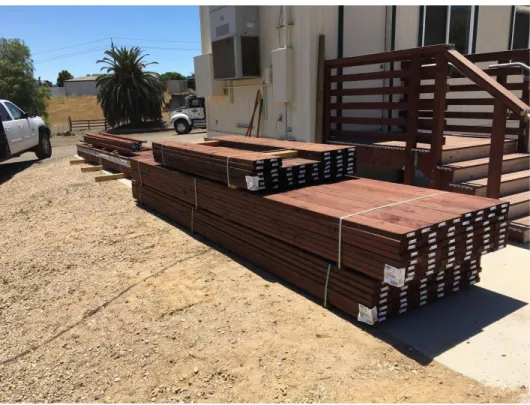
Once the funding was locked down, purchase orders were sent out for lumber and decking material and the students started construction immediately. The students were now on a very tight schedule to complete the project before the end of the school year. Once material arrived construction began on the substructure portion of the deck. The original schedule had 4 weeks slated for construction with completion on April 27, 2020. Dues to many unforeseen complications this date was pushed and the project would be completed mid-June.
Deliverables
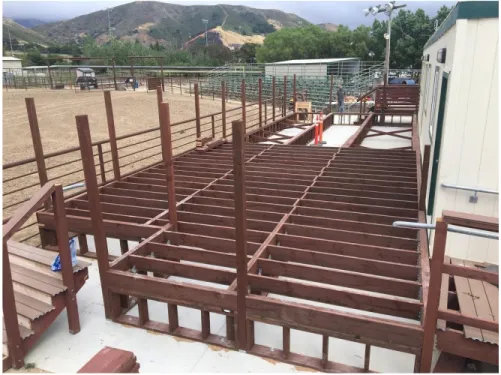
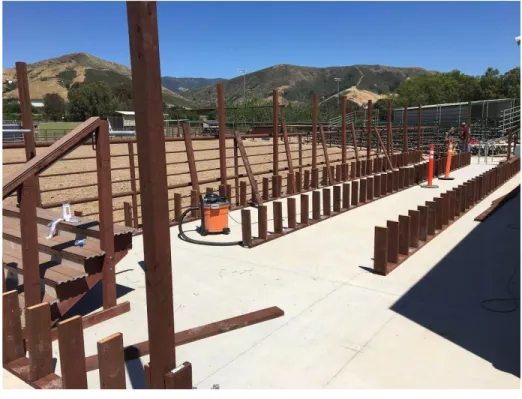
ensure the deck would be placed correctly. After layout, construction began with the first of four short substructures walls consisting of studs with top and bottom plates, that would eventually carry the joists and decking. Construction of these walls began on the wall furthest from the trailer because this was the most complex wall due to intermediate handrail posts. The students worked together to properly construct the walls and install them per plan.
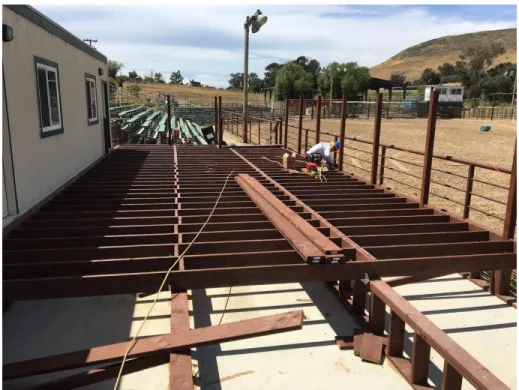
The next step was to run joists and decking material. For this the students began with the ADA ramp tie in and moved across the deck to complete the joists. Working together, they ensured that each joist was in the correct location to make placement of the decking easy. Once joists were completed, the students installed over 2,400 hidden fasteners to tie the decking material to the substructure and complete the deck.
Outside of physical construction, the students had varying deliverables, due to the size of the project. Tim was responsible for creating the schedule and developing the fundraising plan. The first
deliverable was to develop the fundraising account with Jessica Otten from the CAED department. Tim had multiple meetings with her to ensure that all of the donors would have proper access to necessary receipts and other information for tax purposes. After the fundraising account was created, Tim worked with Raymond Lad to develop the fundraising plan and email. The initial plan was to advertise to construction companies and offer benefits based on a certain giving level. The funding plan included five levels of giving, Saddled Up ($100), Out of the Gate ($250), Mustang Spirit ($500), Ridin’ High ($1,000), and Winner’s Circle ($2,500). The giving levels had benefits that were attached to each level. These benefits were negotiated with Ben and included everything from a personalized letter from both students to 4 VIP tickets to the 2021 Poly Royal Rodeo, in addition to a spot on the project plaque. The students had originally generated significant interest at the $2,500 level with many companies, but the donations were dropped to the more popular $1,000 level amid the pandemic.
Tim’s other deliverable outside of construction was the development of the schedule. Primavera P6 was the program that was planned to be used, however, due to program access complications, the schedule was moved into Microsoft Project. Microsoft Project was used to develop the original project schedule including fundraising and construction, and later modified due to the extraneous circumstances. The first schedule was built in December 2019. This schedule had construction starting February 14, 2020 and completing April 13, 2020, giving a few days to prepare for the Poly Royal Rodeo on April 17, 2020.
Lessons Learned
Many mistakes were made on this project which led to vast inefficiencies and slowdown of the schedule. The first lessons learned were in the scheduling aspect of the project. The initial project schedule had about a month and a half for fundraising and then a month for construction. After going through the fundraising process, it was significantly more difficult than originally anticipated. Lack of communication between Raymond and his team and the students led to an extended process. In addition to this, one serious complication was the Covid-19 pandemic. Due to many business closures, and even the complete shutdown of construction in many major areas, companies were much more reluctant to donate.
When the original donor list was compiled, there were 15-20 companies that showed great interest in helping the project and becoming supporters. However, due to the circumstances, only about 7 of those companies actually donated. This significantly hurt the student’s ability to fundraise. In addition to this, busy schedules and other activities drew attention away from the project which further delayed fundraising. If the project were to be done again, fundraising would have definitely benefited from greater persistence, and determination to reach out and raise funds. The fundraising network was so small that when adversity struck and people backed out, there was no other easy place to go and ask. This led to a lack of exposure and in the end a lack of funding that would eventually have to be covered by the rodeo boosters.
One major area where many lessons were learned was throughout the construction process. When doing layout, the students initially tried to simply measure the distance off of the trailer and place the deck that way. It was found out after intense struggle that this method would not work. The next attempt was to measure off of existing layout lines on the slab. This method got the deck relatively square, yet not perfect. If this process were to be done again, benchmark lines should have been made off of the trailer, and layout conducted from those. The mistakes that came during layout were rooted in a lack of planning, and unfamiliarity with the process. The students did work together in a
productive manner to create a layout plan that got the deck very close to perfectly square, planning could help to alleviate some of the mistakes and inconsistencies.
The next major problem encountered was to match the height of the new deck to the existing ADA access ramp and an existing stair landing on the far side of the trailer. The students original plan was to use a CST/Berger rotary laser to find the level plane and match the new deck to that. However, it was found that this laser was inaccurate and would not work for this method. So, the next method was to level using string lines and levels. This method works great for short runs, however, for a deck spanning 60 ft, the string line had excessive sag. The final method was to contact Maino Construction Company, and borrow a more accurate rotary laser.
Conclusion
This project overall was a major success, even with Covid-19 restrictions and many other obstacles, the students were able to persist and complete the project. Many lessons were learned during this project including planning, estimating, scheduling and complex constructability challenges. This was a large undertaking for two students as a senior project, but in the end, it was a rewarding experience that the students and many others will be able to enjoy for many years to come.
Figure 2: Rodeo Observation Deck Joist Progress
Figure 4: Rodeo Observation Deck Lumber Delivery
Figure 6: Rodeo Observation Deck Substructure Progress