Module 7 - I
nverse
T
rigonometric
&
H
yperbolic
F
unctions
A.
Inverse
F
unctions
If y=3x−2, then by transposition, x=y+2 3 . The function x=y+23 is called the inverse function of y=3x−2
Inversetrigonometricfunctionsaredenotedby prefixing the function with ‘arc’ or, more com-monly, by using the −1 notation. For example, if y= sinx,thenx=arcsinyorx=sin−1y.Similarly, ify= cosx,thenx=arccosyorx=cos−1y,andso on.In thischapterthe−1 notationwill beused.A sketchofeachoftheinversetrigonometricfunctions isshowninFig. 21.
Inversehyperbolicfunctionsaredenotedby pre-fixingthefunctionwith‘ar’or,morecommonly,by usingthe−1notation.Forexample,ify=sinhx,then x=arsinhyorx= sinh−1y.Similarly,ify=sechx, thenx=arsechyorx=sech−1y,andsoon.Inthis chapter the −1 notation will be used.A sketch of eachoftheinversehyperbolicfunctionsisshownin Fig. 22.
B.
Differentiation
of
I
nverse
Trigonometric Functions
(i) If y=sin−1x, then x=sin y.Differentiating both sides with respect to y gives:
dx
dy =cos y=
*
1−sin2y since cos2y+sin2y=1, i.e. dx
dy = √ 1−x2 However dy dx = 1 dx dy
Hence, when y=sin−1x then dy
dx = 1
√
1−x2
(ii)Asketchofpartofthecurveofy=sin−1xis showninFig. 21(a).Theprincipalvalueofsin−1x isdefinedasthevaluelyingbetween−π/2and
π/2.ThegradientofthecurvebetweenpointsA andBispositiveforallvaluesofxandthusonly thepositivevalueistaken
when evaluating √ 1 1−x2.
(iii) Given y= sin−1x
a then x a=sin y and x=a sin y Hence dx dy=a cos y=a 1−sin2y =a 1− x a 2 =a a2−x2 a2 =a √ a2−x2 a = √ a2−x2 Thus dy dx= 1 dx dy = √ 1 a2−x2
i.e. when y=sin−1 x a then dy dx= 1 √ a2−x2 Since integration is the reverse process of differentiation then: 1 √ a2−x2dx=sin −1x a+c
(iv) Given y= sin−1 f (x) the function of a function rule may be used to find dy
y 3π/2 π/2 π −π/2 −π −3π/2 +1 x B y = sin1 x A −1 (a) y 3π/2 π/2 π 0 −π −3π/2 +1 x −1 (b) y = cos1 x −π/2 y π/2 0 −π/2 y = tan1 x (c) y π 0 −π 3π/2 π/2 −π/2 −3π/2 y = sec1 x x +1 −1 (d) y π 0 −π 3π/2 π/2 −π/2 −3π/2 y = cosec1 x x +1 (e) y y = cot1 x π 0 π x (f) 0 x −1 −π/2 π/2 C D Figure 21 0 1 2 3 x 1 3 2 −3−2−1 −1 −2 −3 y y = sinh1 x 1 2 3 0 −1 −2 −1 −2 −3 1 2 3 y x y = cosh1 x 1 2 3 0 −1 −2 −3 1 x y y = sech1 x y = cosech1 x x y 0 y = coth1 x x y 0 +1 −1 (a) (b) (c) (d) (e) (f) 0 x y y = tanh1 x +1 −1 Figure 22
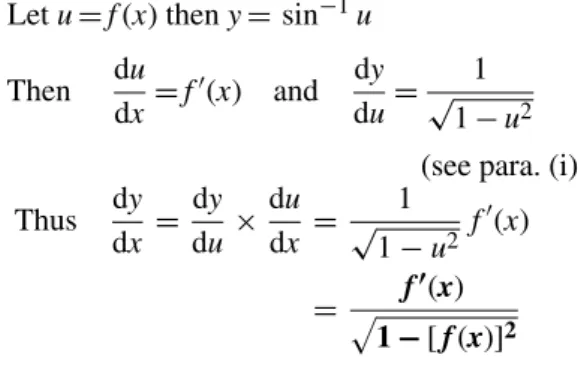
Let u=f (x) then y= sin−1u Then du dx=f (x) and dy du= 1 √ 1−u2
(see para. (i)) Thus dy dx = dy du× du dx = 1 √ 1−u2 f (x) = f(x) 1−[ f (x)]2 (v)Thedifferentialcoefficientsoftheremaining inversetrigonometricfunctionsareobtainedin a similar manner to that shown above and a summaryoftheresultsisshowninTable1.
Table1. Differentialcoefficientsofinverse trigonometricfunctions y or f (x) dy dx or f (x) (i) sin−1 x a 1 √ a2−x2 sin−1 f (x) f (x) 1−[ f (x)]2 (ii) cos−1 x a −1 √ a2−x2 cos−1 f (x) −f (x) 1−[ f (x)]2 (iii) tan−1x a a a2+x2 tan−1 f (x) f (x) 1+[ f (x)]2 (iv) sec−1 x a a x√x2−a2 sec−1f (x) f (x) f (x)[ f (x)]2−1 (v) cosec−1 x a −a x√x2−a2 cosec−1f (x) −f (x) f (x)[ f (x)]2−1 (vi) cot−1 x a −a a2+x2 cot−1f (x) −f (x) 1+[ f (x)]2 Problem 1. Finddy dx given y= sin −15x2.
FromTable1(i),if
y=sin−1 f (x) then dy dx =
f(x)
1−[ f (x)]2
Hence, if y=sin−15x2 then f (x)=5x2 and f(x)=10x. Thus dy dx = 10x 1−(5x2)2 = 10x √ 1−25x4 Problem 2.
(a) Show that if y= cos−1x then dy
dx = 1
√
1−x2
(b) Hence obtain the differential coefficient of y= cos−1(1−2x2).
(a) If y=cos−1x then x=cos y. Differentiating with respect to y gives:
dx dy = −sin y = − 1−cos2y = −√1−x2 Hence dy dx = 1 dx dy =−√ 1 1−x2
The principal value of y= cos−1x is defined as theanglelyingbetween0andπ,i.e.betweenpoints CandD shownin Fig. 21(b).The gradient ofthe curveisnegativebetweenCandDand
thus the differential coefficient dy
dx is negative as shown above.
(b) If y= cos−1 f (x) then by letting u=f (x), y=cos−1u
Then dy
du= − 1
√
1−u2 (from part (a))
and du
dx =f (x)
From the function of a function rule, dy dx = dy du· du dx = − 1 √ 1−u2 f (x) = −f(x) 1−[ f (x)]2
Hence, when y=cos−1(1−2x2) then dy dx = −(−4x) 1−[1−2x2]2 = 4x 1−(1−4x2+4x4) = 4x (4x2−4x4) = 4x [4x2(1−x2)] = 4x 2x√1−x2 = 2 √ 1−x2 Problem 3. Determine the differential coeffi-cient of y= tan−1 x
a and show that the differ-ential coefficient of tan−12x
3 is 6 9+4x2 If y=tan−1 x a then x
a =tan y and x=a tan y dx
dy =a sec
2y=a(1+tan2y) since
sec2y=1+tan2y =a 1+ x a 2 =a a2+x2 a2 = a2+x2 a Hence dy dx = 1 dx dy = a a2+x2
The principal value of y= tan−1x is defined as the angle lying between −π
2 and
π
2 and the gra-dient
i.e. dy dx
between these two values is always positive(seeFig. 21(c)).
Comparing tan−1 2x 3 with tan −1x ashows that a= 3 2 Hence if y=tan−12x 3 then dy dx = 3 2 3 2 2 +x2 = 3 2 9 4+x 2 = 3 2 9+4x2 4 = 3 2(4) 9+4x2 = 6 9+4x2
Problem 4. Find the differential coefficient of y=ln(cos−13x).
Let u=cos−13x then y=ln u. By the function of a function rule,
dy dx = dy du· du dx = 1 u× d dx( cos −13x) = 1 cos−13x 3 −3 1−(3x)2 4 i.e. d dx[ln(cos −13x)]=√ −3 1−9x2cos−13x Problem 5. If y=tan−1 3 t2 find dy dt UsingthegeneralformfromTable1(iii),
f (t)= 3 t2 =3t− 2, from which f(t)= −6 t3 Hence d dt tan−1 3 t2 = f(t) 1+[ f (t)]2 = − 6 t3 3 1+ 3 t2 24 = −6 t3 t4+9 t4 = −6 t3 t4 t4+9 = − 6t t4+9
Problem 6. Differentiate y= cot −12x
1+4x2
Using the quotient rule: dy dx= (1+4x2) −2 1+(2x)2 −(cot−12x)(8x) (1+4x2)2
fromTable1(vi)
=−2(1+4x cot−12x)
Problem 7. Differentiate y=x cosec−1x. Using the product rule:
dy dx =(x) −1 x√x2−1 +(cosec−1x) (1) fromTable1(v) = √−1 x2−1+cosec −1x
Problem 8. Show that if y=tan−1 sin t cos t−1 then dy dt = 1 2 If f (t) = sin t cos t−1
then f(t)=(cos t−1)(cos t)−(sin t)(−sin t) (cos t−1)2
=cos2t−cos t+sin2t
(cos t−1)2 =
1−cos t (cos t−1)2
since sin2t+cos2t=1
−(cos t−1)
= −1
cos t−1
=
(cost−1)2
UsingTable1(iii),when y=tan−1 sin t cos t−1 then dy dt = −1 cos t−1 1+ sin t cos t−1 2 = −1 cos t−1 (cos t−1)2+(sin t)2 (cos t−1)2 = −1 cos t−1 (cos t−1)2 cos2t−2 cos t+1+sin2t
= −(cos t−1) 2−2 cos t = 1−cos t 2(1−cos t) = 1 2
Exercise 20. Differentiatinginverse trigonometricfunctions
C.
Logarithmic
forms
of
the
inverse
hyperbolic
functions
Inverse hyperbolic functions may be evaluated most conveniently when expressed in a logarithmic
form.
For example, if y=sinh−1 x athen
x
a= sinh y. ey =coshy+sinhyandcosh2y−sinh2y=1, fromwhich,
coshy=1+sinh2ywhichispositivesincecosh yisalwayspositive.
Hence ey=1+sinh2y+sinh y
= 1+ x a 2 + x a = a2+x2 a2 + x a = √ a2+x2 a + x a or x+√a2+x2 a Taking Napierian logarithms of both sides gives:
y=ln 3 x+√a2+x2 a 4 Hence, sinh−1 x a=ln 3 x+a2+x2 a 4 (1) Thus to evaluate sinh−1 3
4, let x=3 and a=4 in equation (1). Then sin h−1 3 4 =ln 3 3+√42+32 4 4 =ln 3+5 4 =ln 2=0.6931 By similar reasoning to the above it may be shown that: cosh−1 x a =ln 3 x+√x2−a2 a 4 and tanh−1 x a = 1 2ln a+x a−x
Problem 9. Evaluate, correct to 4 decimal places, sinh−12.
From above, sinh−1 x a=ln 3 x+√a2+x2 a 4 With x=2 and a=1, sinh−12=ln 3 2+√12+22 1 4 =ln (2+√5)=ln 4.2361
=1.4436, correct to 4 decimal places
Problem 10. Show that tanh−1 x a= 1 2ln a+x a−x
and evaluate, correct to 4 decimal places, tanh−13
5 If y=tanh−1x then x a=tanh y. a tanh y= sinh x cosh x = 1 2(ey−e−y) 1 2(ey+e−y) = e2y−1 e2y+1
Thus, x a=
e2y−1 e2y+1
from which, x(e2y+1)=a(e2y−1) Hence x+a=ae2y−xe2y=e2y(a−x) from which e2y = a+x a−x
Taking Napierian logarithms of both sides gives: 2y=ln a+x a−x and y= 1 2ln a+x a−x Hence, tanh−1x a= 1 2ln a+x a−x
Substituting x=3 and a=5 gives: tanh−1 3 5 = 1 2ln 5+3 5−3 = 1 2ln 4
=0.6931, correct to 4 decimal places
Problem 11. Prove that cosh−1 x a=ln 3 x+√x2−a2 a 4
and hence evaluate cosh−11.4 correct to 4 decimal places.
If y=cosh−1 x athen
x
a =cos y
ey=cosh y+sinh y=cosh y±cosh2y−1
= x a± x a 2 −1 = x a ± √ x2−a2 a = x± √ x2−a2 a
Taking Napierian logarithms of both sides gives: y=ln
3
x±√x2−a2
a
4
Thus, assuming the principal value,
cosh−1 x a=ln 3 x+√x2−a2 a 4 cosh−11.4=cosh−1 14 10=cosh −1 7 5 In the equation for cosh−1 x
a, let x=7 and a=5 Then cosh−1 7 5 =ln 3 7+√72−52 5 4 =ln 2.3798=0.8670,
correct to 4 decimal places
Exercise 21. Logarithmicformsofthe inversehyperbolicfunctions
D.
Differentiation
of
I
nverse
Hyperbolic Functions
If y= sinh−1 x then x= sinh y and x=a sinh y dx
dy
a a
=acoshy
Also cosh2y−sinh2y=1, from which, cosh y=1+sinh2y= 1+ x a 2 = √ a2+x2 a Hence dx dy =a cosh y= a√a2+x2 a = √ a2+x2 Then dy dx = 1 dx dy = 1 a2+x2
[An alternative method of differentiating sinh−1 x a is to differentiate the logarithmic form
ln 3 x+√a2+x2 a 4 with respect to x]. dx
Fromthesketchofy=sinh−1xshownin Fig. 22(a)itisseenthatthegradient
i.e.dy
is always positive. It follows from above that
1 √ x2+a2 dx=sinh −1 x a+c or ln 3 x+√a2+x2 a 4 +c It may be shown that
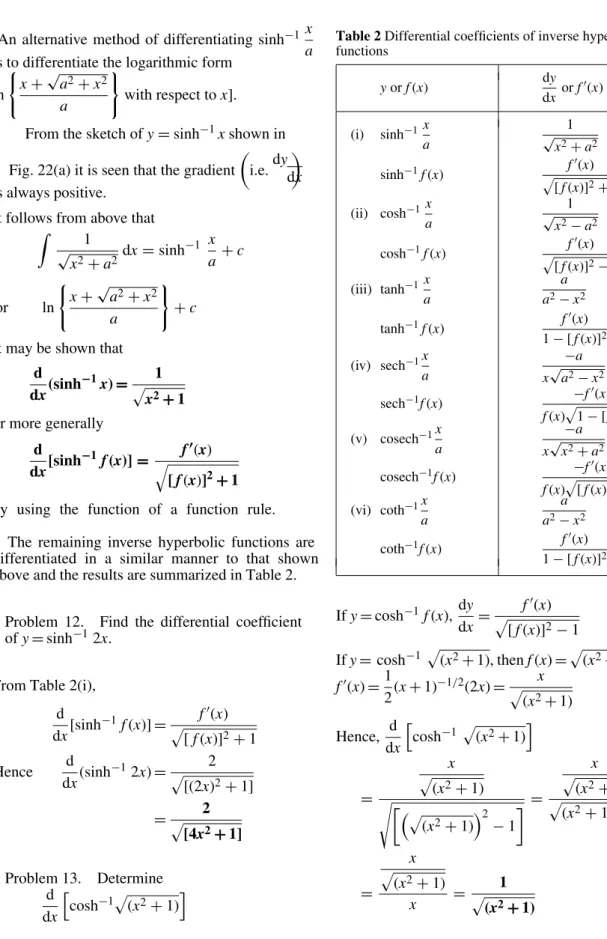
d dx(sinh −1x)= 1 x2+1 or more generally d dx[sinh −1f (x)]= * f(x) [ f (x)]2+1
by using the function of a function rule. The remaining inverse hyperbolic functions are differentiated in a similar manner to that shown aboveandtheresultsaresummarizedinTable2.
Problem 12. Find the differential coefficient of y=sinh−12x.
FromTable2(i), d dx[sinh −1f (x)]= f(x) [ f (x)]2+1 Hence d dx(sinh −12x)= 2 [(2x)2+1] = 2 [4x2+1] Problem 13. Determine d dx cosh−1(x2+1)
Table2Differentialcoefficientsofinversehyperbolic functions y or f (x) dy dx or f (x) (i) sinh−1 x a 1 √ x2+a2 sinh−1f (x) f (x) [ f (x)]2+1 (ii) cosh−1 x a 1 √ x2−a2 cosh−1f (x) f(x) [ f (x)]2−1 (iii) tanh−1x a a a2−x2 tanh−1f (x) f (x) 1−[ f (x)]2 (iv) sech−1x a −a x√a2−x2 sech−1f (x) −f (x) f (x)1−[ f (x)]2 (v) cosech−1x a −a x√x2+a2 cosech−1f (x) −f (x) f (x)[ f (x)]2+1 (vi) coth−1x a a a2−x2 coth−1f (x) f (x) 1−[ f (x)]2 If y=cosh−1f (x), dy dx= f(x) [ f (x)]2−1
If y=cosh−1 (x2+1), then f (x)=(x2+1) and
f(x)=1 2(x+1) −1/2(2x)= x (x2+1) Hence, d dx cosh−1(x2+1) = x (x2+1) (x2+1)2−1 = x (x2+1) (x2+1−1) = x (x2+1) x = 1 (x2+1)
Problem 14. Show that d dx tanh−1 x a = a
a2−x2 and hence determine the differential
coefficient of tanh−1 4x 3 If y=tanh−1 x
athen x
a= tanh y and x=a tanh y dx
dy=a sech
2y=a(1−tanh2y), since
1−sech2y=tanh2y =a 1− x a 2 =a a2−x2 a2 = a2−x2 a Hence dy dx = 1 dx dy = a a2−x2 Comparing tanh−14x 3 with tanh −1 x a shows that a=3 4 Hence d dx tanh−1 4x 3 = 3 4 3 4 2 −x2 = 3 4 9 16−x 2 = 3 4 9−16x2 16 = 3 4· 16 (9−16x2) = 12 9−16x2
Problem 15. Differentiate cosech−1(sinhθ). FromTable2(v), d dx [cosech −1f (x)]= −f(x) f (x)[ f (x)]2+1 Hence d dθ[cosech −1(sinhθ)] = −coshθ sinhθ[sinh2θ+1] = −coshθ sinhθ√cosh2θ
since cosh2θ−sinh2θ=1
= −coshθ
sinhθcoshθ =
−1
sinhθ =−cosechθ
Problem 16. Find the differential coefficient of y=sech−1(2x−1).
FromTable2(iv), d dx[sech −1f (x)]= −f(x) f (x)1−[ f (x)]2 Hence, d dx [sech −1(2x−1)] = −2 (2x−1)[1−(2x−1)2] = −2 (2x−1)[1−(4x2−4x+1)] = −2 (2x−1)(4x−4x2) = −2 (2x−1)√[4x(1−x)] = −2 (2x−1)2√[x(1−x)] = −1 (2x−1)√[x(1−x)]
Problem 17. Show that d
dx [coth
−1(sin x)]=sec x.
FromTable2(vi), d dx[coth −1f (x)]= f(x) 1−[ f (x)]2 Hence d dx[coth −1(sin x)]= cos x [1−(sin x)2] = cos x
cos2x since cos
2x+sin2x=1
= 1
cos x =sec x Problem 18. Differentiate y=(x2−1) tanh−1 x. Using the product rule,
dy dx=(x 2−1) 1 1−x2 +( tanh−1 x)(2x) =−(1−x2) (1−x2) +2x tanh− 1x=2x tanh−1x − 1
Problem 19. Determine dx (x2+4) Since d dx sinh−1 x a = 1 (x2+a2) then dx (x2+a2) =sinh −1 x a+c Hence 1 (x2+4)dx = 1 (x2+22)dx =sinh−1 x 2+c Problem 20. Determine 4 (x2−3) dx. Since d dx cosh−1 x a = 1 (x2−a2) then 1 (x2−a2) dx=cosh −1 x a+c Hence 4 (x2−3) dx=4 1 * [x2−(√3)2] dx =4 cosh−1 √x 3+c Problem 21. Find 2 (9−4x2)dx. Since tanh−1x a= a a2−x2 then a a2−x2 dx=tanh− 1 x a +c i.e. 1 a2−x2 dx= 1 a tanh −1 x a +c Hence 2 (9−4x2) dx =2 1 494−x2 dx =1 2 1 3 2 2 −x2 dx =1 2 1 3 2 tanh−1 x3 2 +c i.e. 2 (9−4x2) dx= 1 3tanh −1 2x 3 +c
Exercise 22. Differentiationofinverse hyperbolicfunctions