ARTIGO ORIGINAL
ABSTRACT
Introduction: The study modelled the physicians predictable allocation by medical specialty, in the horizon of 2025. It was based on the physicians demographics in Portugal and through the development of different future scenarios.
Material and Methods: In the study was developed a Supply Model, which represents the capacity of medical training installed in Portugal, and a Necessity Model that perspective possible futures for the provision of medical professionals.
Results: Each model comprehends several scenarios, according to different context variables (introduction or not of limits to postgraduate training capacity, demographic trends, ratios recommended by Colleges Specialty ...).
Discussion/Conclusion: The models comparison lead to the conclusion that the training system has the capacity to meet the needs of physicians in all scenarios developed, and it even generates a surplus of medical professionals that may not be absorbed by the healthcare system, in the horizon of 2025.
Keywords: Demography; Physicians / supply & distribution; Portugal.
Demography of Physicians in Portugal:
Prospective Analysis
Demografia Médica em Portugal: Análise Prospetiva
1. Centro de Estudos em Geografia e Ordenamento do Território. Grupo de Investigação em Geografia da Saúde. Universidade de Coimbra, Coimbra. Portugal. 2. Grupo de Investigação em Geografia da Saúde. Universidade de Coimbra. Coimbra. Portugal.
Recebido: 17 de Janeiro de 2014 - Aceite: 25 de Fevereiro de 2014 | Copyright © Ordem dos Médicos 2014
Paula SANTANA1, Helena PEIXOTO2, Nuno DUARTE2
Acta Med Port 2014 Mar-Apr;27(2):246-251
RESUMO
Introdução: Partindo da caracterização demográfica dos médicos em Portugal e através do desenvolvimento de diferentes cenários prospetivos, modelou-se a evolução previsível da dotação de médicos, por especialidade, no horizonte de 2025.
Material e Métodos: Foi desenvolvido um Modelo da Oferta, que representa a capacidade de formação de médicos instalada no sistema, e um Modelo de Necessidades, que perspetiva futuros possíveis para a dotação de profissionais.
Resultados: Cada um dos modelos incluiu diferentes cenários, de acordo com variáveis de contexto diversas (introdução ou não de limites à capacidade formativa pós-graduada, evolução demográfica, rácios recomendados pelos Colégios de Especialidade…).
Discussão/Conclusão: Da confrontação dos modelos desenvolvidos e dos respetivos cenários resultou a conclusão de que o sistema tem capacidade para suprir as necessidades de médicos no horizonte de 2025 em todos os cenários modelados, gerando mesmo profissionais que poderão não ser absorvidos pelo sistema de saúde.
Palavras-chave: Demografia; Portugal; Médicos / provisão & distribuição.
INTRODUCTION
In a highly complex system requiring highly qualified resources as it is the area of healthcare, it is crucial to determine human resource allocation requirements.1 This
is a complex issue,2 with multiple aspects and interactions
covering different perspectives on which the health system’s efficacy is based and determined3,4,5 It is therefore important to discuss the future of human resources in the area of healthcare, to analyse current trends and to determine future needs in the near future,2,6,7 including under and postgraduate education.8 In this context, the Ministry of
Health promoted studies in 2007 and 20099,10 aimed at characterizing the Portuguese National Health Service
(SNS - Serviço Nacional de Saúde) (namely physicians)
that allowed for the development of evolutionary scenarios. In a context of major changes in the health system in Portugal regarding human resources, it is essential to characterize physicians within the Portuguese Health System, as well as to develop evolutionary prospective scenarios.11 In the current context, it is also important
to expand this analysis to all active physicians within the system, i.e. including not only the SNS physicians but also
those working in the private and social area, included in the National Health System.
In addition, the organizational changes and reforms in the area of healthcare, as well as the important changes in the professional situation of many physicians, with a high number of retirements in the public health system (most of these occurred before the minimum age for retirement of physicians), lead to a need for the development of knowledge allowing for: i) an adequate planning of Medicine professionals, namely estimating the educational requirements (initial and specialized) and ii) promotion of an adequate number of physicians (globally and by medical specialty) adjusted to the needs of the Health System. This article is based on a study carried out for the General Medical Council (Ordem dos Médicos)11 regarding
the prospective evolution of Portuguese physicians, with two major objectives: i) characterization of physicians entitled to work in Portugal; ii) prediction of the adequate number of physicians to meet the health needs of the Portuguese population in the time horizon of 2025.
The analysis to was adjusted to the current health
35
35 anos a p
rom
ov
er as
ciê
CA
PO
RTUG
UESA
ARTIGO ORIGINAL
reforms and aimed to identify the gap between the needs in terms of the current number of physicians (by specialty) and the expected number of required physicians, in a medium and long-term perspective (in the time horizon of 2025). Our study was specifically aimed at physician’s distribution by the different specialties and to answer the recurrent question in Portugal and in other developed countries6 – Does the number of existing and training
physicians meet the current and future country’s needs?
MATERIAL AND METHODS
Our study was based on demographic data (resident and estimated population for 2025, according to the National Institute of Statistics - Instituto Nacional de Estatística) and
on information obtained from two sources, allowing for the characterization of the physicians working actively in Portugal by December 2011: i) a database provided by the
Administração Central do Sistema de Saúde (ACSS) with
information regarding SNS physicians in mainland Portugal; ii) database provided by the Ordem dos Médicos regarding
the physicians enrolled in the Ordem dos Médicos and not
working for the SNS.
After obtaining the characterization of physicians in 2011 (number of physicians by specialty, age, for instance), the evolutionary scenario modelling (in the time horizon of 2025) was carried out, allowing for a definition of different possible options for the Health System in Portugal, in terms of physician number.
Analysis of the major theoretical projection models of human resources in healthcare (based on supply, demand and benchmarking) shows, that any of them, when considered in isolation, involve both advantages and drawbacks. A composite model has been used, in order to minimize limitations and to maximize potential, established on a projection methodology based on a systemic macro model involving integrated supply/demand projection models regarding the dynamic evolution of support variables.
The option for the development of a physician’s supply/ demand integrated model was based on research in theoretical developments on health’s human resources prospective modelling of demand, as well as on practical exercises of application of these models, carried out in different European countries and in the USA.12 We also
analysed the studies carried out in Spain,13 Belgium14 and in
the USA.15
Regarding supply, we concluded that while some of the models are only based on demographic tendencies to assess the evolution of physician’s supply/demand, others already include other elements aimed to improve their accuracy, as for example the estimated tendency towards the retirement or physician’s mortality rates;; regarding demand, models seeking to include factors as the evolution on health expenditure or the estimated tendency of the evolution of skill-mix in healthcare professions are already in place. These issues introduce an element of sophistication in the prediction capability of the models although there remain
some limitations related, among others, to the presence and reliability of Portuguese sources of information. As such, based on the physician’s allocation for 2011 and considering the health system input (related to undergraduate and postgraduate training) and output streams (related to age limits, which has conventionally been established at the age of 70), two basic models have been developed in order to predict the evolution of physician requirements in Portugal in the time horizon of 2025. These were included in several scenarios according to different context variables – presence of limitations for postgraduate training capability, predicted demographic evolution of the Portuguese population and the recommended physician ratios by specialty, established by the Specialty Colleges within the General Medical Council.
In this context, the following models and scenarios were developed in the present study:
-One model was based on the evolutionary projection of the current conditions in the time horizon of 2025, designated as the Supply Model. This model represents the medical training capability of the health system and includes two scenarios, with variable postgraduate training capability. One scenario – Non-limited Training Supply Scenario -, assumes that postgraduate system will be able to absorb, each year, all the medical doctors applying for postgraduate training; another scenario – Limited Training Supply Scenario -, is based on a maximum specialty internship admission of approximately 1,550 annual vacancies (this limit relates to the average vacancies estimated by the Ministry of Education for the near future training capability of the Health System).16
-The Demand Model, including the introduction of appropriate variables, defined an adequate group of physicians to Portugal’s healthcare demand. This model also includes two different evolutionary scenarios, with the following basic variables:
-Maintenance Scenario of physician/population ratio (per specialty) in 2011 and its projection to 2025.
-Desirable Scenario based on the definition of the adequate physician/population ratio for each specialty, meeting the indications of the 22 Specialty Colleges and adapting them to the population evolution predicted in the time horizon of 2025.
As such, the Supply Model stands for the national capability of training physicians and specialties, which is compared to the Demand Model, aimed to define the number of physicians that Portugal will need in the time horizon of 2025, according to the scenarios that have been designed. When comparing these two models and their scenarios any mismatch between ‘supply’ and ‘demand’ of physicians in the defined time horizon may be identified. Our study has faced some methodological limitations, from which we emphasize: i) the information regarding the physicians registered to the Ordem dos Médicos is limited,
ARTIGO ORIGINAL
in the General Medical Council without a known specialty (17% of physicians); iii) the high degree of uncertainty inherent to broad horizon projections (2025).
RESULTS
By December 2011 there were 43,247 registered physicians in Portugal, from which 58% worked for the National Health Service in mainland Portugal.
Portuguese physicians are globally an ageing professional group as 54% are aged above 50 and 30% are aged between 50 and 59 years-old. In contrast, only 15% of the Portuguese physicians are aged 40 to 49, a fact related to a strong restriction period of access to medical courses in the eighties and in the nineties.
In terms of gender, the national medical profession is a globally balanced profession, with 51% of females.
The last decades have however showed a change in the physician’s demographic pattern in Portugal, with a strong renewal of physicians (31% aged below 39) and a significant increase in female physicians – more than the double in the age group below 39.
Most physicians entitled to work in Portugal are of Portuguese nationality (more than 90%).
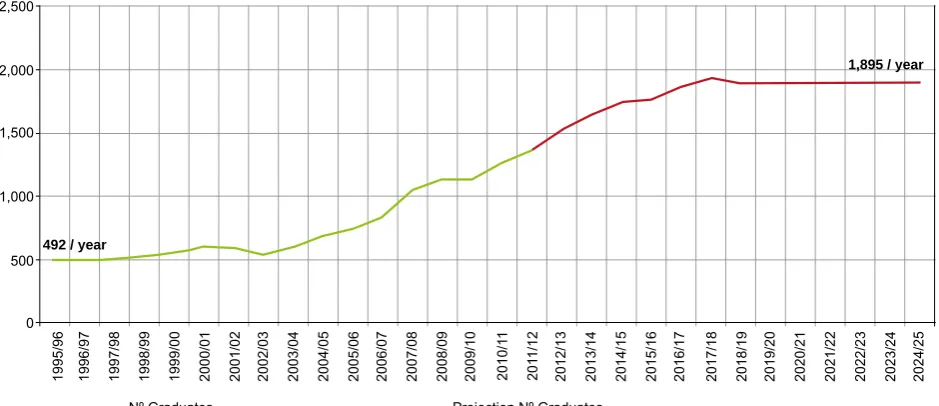
As we described, the scenario modelling considered predicted input and output streams in the health system in the defined time horizon. Therefore, regarding the input into undergraduate medical training, we found a very significant increase in the number of vacancies for admission to the courses (over 250% between 1995 and 2010) as well as in the number of graduates, that suffered a four-fold increase between 1996 and 2010 (1,280 medical graduations occurred in Portuguese universities in 2010) (Fig. 1). Regarding training capability, when considering continuity and stability in the current conditions, approximately 27,000 will graduate in Medicine by 2025 in Portugal, with 1,900 graduations per year from 2016.
Regarding other elements responsible for input into the health system, namely the postgraduate medical training, we found that between 2006 and 2012, the Ministry of Health approved an adequate number of vacancies for Medical Internship considering the number of candidates, for clinical internship as well as for specific training admission. Therefore, we found a global increase in the number of vacancies for admission to both types of training (initial and specific) which, in the case of specific training, reached 67% between 2006 and 2012, representing an increase of 600 vacancies. However, the training capability of the system will be exhausted and it will probably stabilize in 1,550 vacancies, as described.
Regarding the predicted health system output (professional retirement) in the time horizon of 2025, which has been conventionally established at the age of 70, the total of physicians will be 12,473 over the period projected, corresponding to 32% of physicians in a working age by 2011 (Fig. 2).
The simulations carried out according to the scenarios developed present the following results:
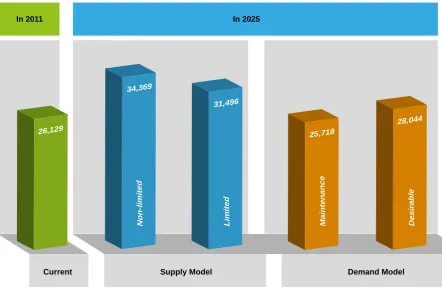
The capacity for specialist physician’s training (Supply Model) leads to a system’s total of physicians in 2025 between 51,800 and 51,900 according to the different scenarios, including specialists, training and non-specialized physicians. Meeting these scenarios requires a 20% increase in the number of Portuguese physicians. The capacity for specialist‘s training in Portugal included in the Supply Model represents a 32% increase of specialists within the health system in the time horizon of 2025 in the Non-limited Medical Internship Training Supply Scenario (20,795 new specialists) and a 21% increase in the Limited Medical Internship Training Supply Scenario (17,891 new specialists);
The specialist demands in the health system for 2025, shown in the Demand Model, come to a variation regarding 2011
Figure 1 - Evolution on the Number of Graduates in Medicine (1996-2025)
Nº Graduates
1995/96 1996/97 1997/98 1998/99 1999/00 2000/01 2001/02 2002/03 2003/04 2004/05 2005/06 2006/07 2007/08 2008/09 2009/10 2010/1
1
201
1/12
2012/13 2013/14 2014/15 2015/16 2016/17 2017/18 2018/19 2019/20 2020/21 2021/22 2022/23 2023/24 2024/25 Projection Nº Graduates
0
500 492 / year
1,895 / year
1,000 2,000
ARTIGO ORIGINAL
between a 7% increase in the Desirable Scenario (14,363 new specialists) and a -2% decrease in the Maintenance Scenario (11,913 new specialists) (Fig. 3).
Therefore, we find a mismatch between the training capability and the predicted demands within the scenarios. The dimension of the mismatch ranges between the following values:
In the Maintenance Scenario group, we would have 8,882 new specialists that could not be absorbed, in a Non-limited Scenario and 5,978 that would be in excess, in a Limited Scenario;
In the Desirable Scenario group, the excessive non-absorbed new specialists would range between 6,432 in the Non-limited Scenario and 3,528 in the Limited Scenario.
DISCUSSION
The development of this type of prospective exercise is strongly conditioned by the reliability of the information database7 on which it is based and Portugal lacks a deeper knowledge regarding national medical activity outside the SNS.
In addition, with the diversity and complexity of factors influencing the evolution of the number of physicians in one country, the regular monitoring of this issue is recommended, allowing for introduction of adjustments and corrections.2
Our study did not consider the geographical distribution of physicians or any other health profession, which represents a major factor for the future evolution of the medical profession. The predicted number of physicians in Portugal may prove to be insufficient for the needs of remote and less attractive areas, while the evolution of other
professions such as nursing or therapeutic and diagnosis technicians may influence the prediction of physician demands, mainly in times of severe economic and financial constraints.
Portuguese physicians’ demographic characterization shows an ageing professional group in which one third of active members will be aged 70 by 2025. This is an important fact in future scenario modelling, showing the need to renovate.
In addition, we should remark that any change in the training capability will only produce any effect from 2020, as the system is already conditioned by the current number of Medical students in training.
We wish to emphasize that the short-term introduction of restrictive measures as for instance the limitation to admission for postgraduate training, will have the effect of creating a group of graduates in Medicine who, under the current rules, will not be entitled to work in an autonomous way (our study was based on a predicted number of 5,450 graduates in Medicine that would not have a medical internship specific training by 2025, within the Limited Training Supply Scenario).
CONCLUSIONS
The determination of an adequate number of health professionals, in their different professions and specialties, at the right moment and place, is one of the greatest challenges for planning and management of healthcare human resources. It is also a difficult exercise, because the determinants of an adequate definition of the number and typology of the professionals within certain
Figure 2 - Annual Retirement Prediction of Physicians within the Health System due to reaching the age of 70 (2012-2025)
0 200 400 600 800 1,000 1,200 1,400 1,600 1,800
2012 2013 2014 2015 2016 2017 2018 2019 2020 2021 2022 2023 2024 2025
273
ARTIGO ORIGINAL
Figure 3 - Comparison between Scenarios – Specialist Physicians
health system are related to a large number of variables – level of universality and coverage of the health system, demographic and epidemiological evolution, evolution of scientific knowledge, information and health technologies, professional skills and functional contents, amongst others.
In the specific case of physicians, the long times associated to their training (in Portugal, a doctor’s specific training has a minimum duration of 11 years) introduces an additional element of complexity to a planning exercise, demanding an anticipation and prediction capability involving a high risk of mismatch to reality.
The most recent research on determinants of demography of healthcare professionals2, mainly
physicians, allows for the conclusion that the tendency of increase in physicians has been kept over the last three decades. These studies establish that this tendency will remain in the future, due to the increasing pressure on healthcare increase in quantity as in quality and this increase on the number of physicians is only limited by the capability of national economies to sustain it.6
The conclusions of our study11 refer the presence of
a training medical system (under and postgraduate) with enough capability to meet the needs of the modelled scenarios. In other words, the comparison between under and postgraduate medical training system capability with the developed Demand Scenario allows for the conclusion that the number of new specialists is adequate to meet demand, even with an excessive presence of specialists
regarding the country’s healthcare demand.
Therefore, we may conclude that there is a mismatch between the capability of producing new specialists and the modelled demand. The predicted dimension of this mismatch ranges between 8,802 and 3,978 specialists that would not be absorbed by the health system, depending on the scenario.
However, this global analysis does not equally reflect the reality of all specialties. The analysis of the relationship between the national training capability expressed on the Supply Model and the predicted demand in the scenarios included in the Demand Model, applied to the 47 medical specialties recognised by the General Medical Council, which shows that there is an excess of training capability in some medical specialties and a deficit in others (a conclusion that should be weakened by the degree of uncertainty due to the described information and methodological limitations).
CONFLICTS OF INTEREST
The authors declare the presence of no conflicts of interest in the writing of this manuscript.
FINANCIAL SOURCES
There were no external financial sources for the writing of this manuscript.
In 2011 In 2025
Current Supply Model Demand Model
26,129
34,369
31,496
25,718
28,044
ARTIGO ORIGINAL REFERENCES
1. Diallo K, Zurn P, Gupta N, Dal Poz M. Monitoring and evaluation of hu-man resources for health: an international perspective. Hum Resour Health. 2003;1:3.
2. Danon-Hersch N, Paccaud F. Future Trends in Human Resources for Health Care: A Scenario Analysis; 2005. [Consultado 2014 Jan 16]. Dis-ponível em: http://books.google.pt/books/about/Future_Trends_in_Hu-man_Resources_for_Hea.html?id=_W05QwAACAAJ&pgis=1. 3. Santana P, Vaz A. Planeamento e gestão dos recursos humanos. In:
Campos L, Borges M, Portugal R, editores. Governação dos Hospitais. Lisboa: Casa das Letras; 2009.
4. Chen L, Evans T, Anand S, Boufford JI, Brown H, M Chowdhury, et al. Human resources for health: overcoming the crisis. Lancet. 2004;364:1984–90.
5. Dussault G, Dubois CA. Human resources for health policies: a critical component in health policies. Hum Resour Health. 2003;1:1.
6. Development O for EC. The looming crisis in the health workforce: how can OECD countries respond? World Health Organization; 2008:99. [Consultado 2014 Jan 16]. Disponível em: http://www.who.int/workfor-cealliance/knowledge/resources/oecd_loomingcrisis/en/.
7. Bloor K, Maynard A. Planning human resources in health care: towards an economic approach, an international comparative review.; 2003:34. [Consultado 2014 Jan 16]. Available at: http://www.hrhresourcecenter. org/node/274.
8. Frenk J, Chen L, Bhutta ZA, Crisp N, Evans T, Fineberg H, et al. Health professionals for a new century: transforming education to strengthen health systems in an interdependent world. Lancet. 2010;376:1923–58.
9. Santana P, Couceiro L, Alves I, Nogueira H, Costa C, Santos R. Carac-terização demográfica dos profissionais de saúde no Sistema Nacional de Saúde Português. Lisboa: ACSS; 2007.
10. Santana P, Peixoto H, Loureiro A, Costa C, Nunes C, Duarte N. Estudo das necessidades previsionais de recursos humanos em saúde: médi-cos. Lisboa: ACSS; 2009.
11. Santana P, Peixoto H, Loureiro A, Costa C, Nunes C, Duarte N. Estudo de evolução prospectiva de médicos no Sistema Nacional de Saúde. Lisboa: Ordem dos Médicos; 2013.
12. Ono T, Lafortune G, Schoenstein M. Health workforce planning in OECD Countries: a review of 26 projection models from 18 countries. 2013: OECD Health Working Papers, Nº 62, OECD Publishing [Consultado em 2014 Jan 16]. Disponível em: http://dx.doi.org/10.1787/5k44t7872cwb-en.
13. Pérez PB, López-Valcárcel BG. Oferta y necesidad de especialistas médicos en España (2008-2025). Canarias: Universidad de las Palmas de Gran Canaria; 2009.
14. Roberfroid D, Stordeur S, Camberlin C, Voorde C Van de, Vrijens F, Léonard C. L’offre de médecins en Belgique. Situation actuelle et défis - KCE reports 72B. Brussels; 2008.
15. Services USD of H and H. The physician workforce: projections and research into current issues affecting supply and demand. USA: HRSA; 2008. p.106.