Volume 3 (2006)
Proceedings of the
Third Workshop on Software Evolution
through Transformations:
Embracing the Change
(SeTra 2006)
Towards Distributed BPEL Orchestrations
Luciano Baresi , Andrea Maurino and Stefano Modafferi
14 pages
Guest Editors: Jean-Marie Favre, Reiko Heckel, Tom Mens
Managing Editors: Tiziana Margaria, Julia Padberg, Gabriele Taentzer
Towards Distributed BPEL Orchestrations
Luciano Baresi1, Andrea Maurino2and Stefano Modafferi1
1Dipartimento di Elettronica e Informazione
Politecnico di Milano
Piazza L. da Vinci 32, I-20133 Milano, Italy
2Dipartimento di Informatica, Sistemistica e Comunicazione
Universit`a degli Studi di Milano - Bicocca Via Bicocca degli Arcimboldi 8, I-20126 - Milano, Italy
Abstract: Web services are imposing as the technology to integrate highly hetero-geneous systems. BPEL, the standard technology to compose services, assumes a single ”orchestrator” that controls the execution flow and coordinates the interac-tions with selected services. This centralized approach simplifies the coordination among components, but it is also a too heavy constraint. To this end, the paper
introduces the idea ofdistributed orchestrationsand presents a proposal to couple
BPEL and distributed execution in mobile settings. The approach —exemplified on a simple case study— transforms a centralized BPEL process into a set of co-ordinated processes. An explicit meta-model and graph transformation supply the formal grounding to obtain a set of related processes, and to add the communication infrastructure among the newly created processes. The paper also presents a com-munication infrastructure based on tuple spaces to make the different orchestrators interact in mobile contexts.
Keywords:WS-BPEL, Graph transformation, Distributed system
1
Introduction
Web services are a well-known technology to implement and deployservice-oriented systems.
Their flexibility is playing a key role to integrate highly heterogeneous systems. Specific tech-nologies are hidden behind simple XML interfaces written in WSDL (Web Services Description
Language [CCMW01]) and services interact by means of SOAP (Simple Object Access
Proto-col) messages —another XML-based technology. The same ease and freedom do not apply to the paradigms with which services can be composed to support business processes. WS-BPEL
(Web Services Business Process Execution Language [BEA03]), the most prominent standard
technology to compose Web services, only allows for a ”strict” centralized approach to
compo-sition, where a singleorchestratorcontrols the execution flow and coordinates the interactions
with selected services.
Ser-vices Choreography Description Language [Nic04]) —instead of orchestrations— support
peer-to-peer interactions among services, and event-based architectures, with WS-Notification [Aka04]
as one of the emerging standards in this direction, support even looser cooperations among Web services, where the interaction is limited to reacting to events generated within the composition. Unfortunately, available technology is still limited and it is not as widely accepted as WS-BPEL. Even if we stick to a workflow-like view of the Web services composition, in many cases, the centralized process needs to be deployed in a distributed setting. The ”conceptual” monolithic process must be partitioned into a well-organized set of sub-processes, and the implied coordi-nation and synchronization actions among the parts must be suitably designed and implemented. This is the case, for example, of cross-departments business processes, where each division is in charge of a particular fragment of the process, and they all concur to the success of the global process. Nowadays, we can also envisage another, completely different, scenario with the cen-tralized model split because it has to be executed by a set of federated mobile devices. No single device has the capability of executing the whole process, but they all can contribute with the ex-ecution of a dedicated portion. The scenario might become even bolder if we thought of moving the partitioning process at runtime to dynamically select and allocate the pieces of a process to the devices that are available, and have enough resources, at a given moment. Nomadic users are supposed to move with their devices, and thus the set of cooperating devices can change. This scenario could be useful for disaster recovery situations, and more in general in all those cases where a stable and reliable network is not available, but the process must rely on a mobile ad-hoc network.
Given the wide diffusion of WS-BPEL, and the good set of supporting tools, the paper tackles the problem of decentralizing the execution of WS-BPEL processes by fostering the idea of
decentralized orchestration. It proposes an automatic and formal approach to partition WS-BPEL processes, and to add the necessary synchronization and coordination stuff. The approach transforms a centralized WS-BPEL process into a set of coordinated processes. An explicit
and precise meta-model [Obj02] and graph transformation systems [BH02] supply the formal
grounding to slice a single WS-BPEL process, obtain a set of related processes, and add the communication infrastructure among the newly created processes to both exchange data and propagate the execution flow. The paper demonstrates the approach on a simple case study.
The approach is supported by two different families of tools, which are currently under
devel-opment. We are working on a CASE tool, based on AGG (Attributed Graph Grammar [Bey92]),
that implements partitioning rules and automatize the whole ”slicing” process. We are also
working on the infrastructure to execute such federated WS-BPEL processes.
The results presented in this paper are an evolution of those presented in [BMM04]. More
specifically, the novel contributions of this paper are: (1) an explicit meta-model for WS-BPEL specifications, (2) partitioning rules that address the information exchange among cooperating processes, (3) partitioning rules for fault, compensation, and event handlers, and (4) a more complete example application.
2
Partitioning rules
This section introduces the approach to transform a WS-BPEL model into a set of federated models. The first part of the section introduces the meta-model, specified to render the key
elements of WS-BPEL, and graph transformation systems. The second part presentspartitioning
rules. It describes one rule thoroughly, and concentrates on the key aspects for the others. Lack of
space does not allow us to present all rules in detail, but interested readers can refer to [BMM05]
for the whole graph transformation system.
2.1 Meta-model
Even if WS-BPEL is a complex workflow language for describing Web services compositions,
Figure1only comprises those elements that are used by our approach, that is, that are handled
within partitioning rules. The meta-model presented here borrows some concepts from the work
presented in [Ga03], but we explicitly decided to get rid of all those elements that, even if are
part of the WS-BPEL specification, and thus should be part of a complete meta-model, are not considered by the partitioning process.
Figure 1: Dedicated WS-BPEL metamodel
Straightforwardly, a BPEL Processcomprises severalBasic Nodes. This class is the
key component of the whole meta-model. Basic Nodes correspond to the basic activities
that can be performed by a WS-BPEL process, like invoke andreceive. Structured
Nodes, which are a specialization of the first ones, correspond to the typical constructs of
workflow languages supposed by WS-BPEL, likeswitch,flow,sequence, andpick. We
treat eachStructured Nodeby means of twoBasic Nodesto identify the first and the
last element of the composed statement. ScopesandHandlersare seen as special-purpose
Structured Nodessince they both embed a set ofBasic Nodes. We do not use contain-ment relations to render the embedding of some nodes into others, but we exploit associations
beginandendto identify the scope of each structured construct.
Nodes are characterized by theorchestratorthat is in charge of their execution and are
among nodes,DataLinks, to define data dependencies among nodes, andDependences, to
relate the pairs ofinvoke/receive Basic Nodesadded to synchronize components that
have to be executed by two different executors (orchestrators).
This is not a ”complete” and constrained meta-model. This means that we cannot be used to probe the consistency of WS-BPEL specifications. The meta-model is simple and ”unprecise” since we assume that initial WS-BPEL models are correct and that the partitioning rules, that is,
the graph transformation rules, only produce correct models1.
2.2 Partitioning rules
Partitioning rules must be precise enough to allow for correct and automatic transformations and are supposed to work on the graph structure (i.e., an instance of the meta-model) that is behind any WS-BPEL process. These two requirements led us to consider graph transformation
systems [BH02], along with the tool support they offer, as the right means to specify them.
Partitioning rules are introduced here incrementally. We start introducing the rules to control
the execution flow, already presented in [BMM04], then we move to those that oversee data
exchange and manage handlers. Since all rules are ”similar”, here we only describe one rule in
detail and we invite readers to refer to [BMM05] for the complete set. All the other rules are
presented by concentrating on the problems behind them, instead of showing how the different instances of meta-model elements are created, deleted, and modified.
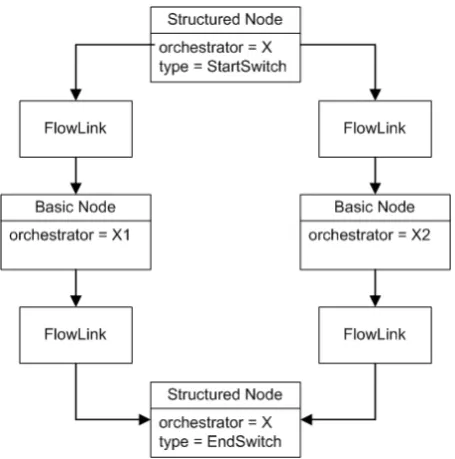
In this paper, we introduce partitioning rulesfor controlling the execution flow by means of
the example of Figure2, which shows the meta-model of a simple WS-BPELSwitchstatement
with aBasic Nodein each branch. The figure also shows that different nodes are associated
with different orchestrators: this means that the designer has already decided how to split the process, that is, how to allocate the different sub-processes on available executors.
To partition the simple example process of Figure 2, we start by setting links to state the
dependence, in terms of execution flow, between two WS-BPEL activities that are controlled by
different orchestrators. Figure3shows the rule. The left-hand side describes when the rule can
be applied, while the right-hand side shows the final result. The rule starts with two nodes that are
associated with different orchestrators and introduces two newBasic Nodesto synchronize
the execution of the first part with the execution of the second part. These two nodes are a pair ofinvoke/receiveactivities to forbid the second activity to start before the completion of the first one.
The partitioning process continues by identifying all the other pairs of nodes that must be
synchronized and by adding special-purposeBasic Nodesto notify the branch followed by
theSwitchto all involved orchestrators.
The partitioning process also takes into account data distribution. According to the WS-BPEL specification, the scope of variables can be global (all activities can use them) or local (e.g., constrained in a given handler or scope). After partitioning, the result is a set of variables (both local and global) that are accessible by their local orchestrators, and a way to propagate their values to the other orchestrators. To cope with this, we added data-dependence graphs to our approach. As discussed in the literature for liveness analysis, in some configurations it is not
1 This is not explicitly demonstrated in this paper, but readers can refer to [BMM04] for a first informal
Figure 2: Example meta-model of a simpleSwitchconstruct
possible to detect, at design time, suitable data dependencies between producers and consumers2. In such situations, the original WS-BPEL description, with that specific assignment of activities to orchestrators, cannot be partitioned. Thus, we also added an analysis phase, before starting the partitioning process, to understand if the approach is applicable.
Since execution and data flows are similar, it is possible to use the same rules defined for partitioning functional dependencies also for building a distributed data dependence graph. Nev-ertheless, in a data dependence graph, a node can be reached by several nodes if producers belong to structured activities.
For example, if we considered aFlowstatement and we suppose that two nodes A and B are
executed in parallel and produce the same variablevfor node C, in a centralized environment
the last activity executed would set the value forv. To preserve such a behavior, we need to
add before the consumer node a Pick Structured Node with two branches: the first to
receive the datum from B and the second from A. The first branch is followed after receiving
a messagereceiveA, while the second is triggered by a messagereceiveB. This means that the
branch followed is driven by the first node that produces data, but the value is received from the second node.
If we consideredWhilestatements, producers and consumers can be organized in different
ways:
• The producer node is executed before the loop and the consumer is executed within the
loop. In this case, we add aSwitch Structured Nodebefore the consumer. If the
iteration is the first, the corresponding switch branch has a node to receive data from the producer; otherwise no operations are performed.
• Producer and consumer are in the loop. The producer is executed before the consumer.
This simple case can be directly solved by using the rules already presented in [BMM04].
• The producer is within the loop and the consumer is executed after the end of the loop. In
this case, we add aBasic Nodeafter the end of the loop to send produced data.
• A producer is before the loop, but another producer is within the loop and after the
con-sumer. To cope with this situation, we add aSwitch Structured Node before the
consumer to distinguish between the first iteration, when the data come from the external producer, and the other iterations, when data come from the internal producer.
Even if our meta-model considers exception handlers as structured activities, they need some specific considerations. First of all, we use the general term exception handler to identify fault, event, and compensation handlers. They comprise two parts: a part that model the raising of the exception, and a part that models the behavior of the handler by using “normal” WS-BPEL activities. Thinking of distributed executions, the second part can be managed with the rules already used for the “normal” behavior, while we need to address more thoroughly the raising of the exception and its propagation to involved orchestrators.
2 Two WS-BPEL activities are interpreted as producer and consumer if the former sets the value of a given variable
Each exception is associated with a scope and the relevant orchestrators are the same as those involved in the corresponding scope. For this reason, we add a synchronization mechanism at the end of each scope to ensure that if an exception is raised in a scope all orchestrators are properly synchronized. The other operation we need to insert is the propagation of the fault to all involved orchestrators. To cope with this, we propose a solution that is very similar to that
used for propagating the value of a variable inSwitchstatements (an orchestrator evaluates it
and then propagates the result to the others).
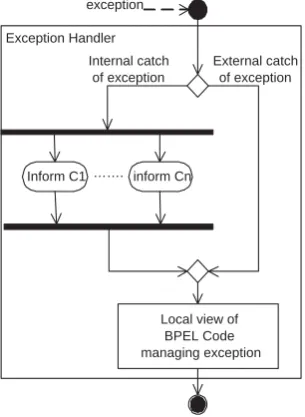
Figure4 shows how to propagate the fault to all the orchestrators involved in a scope. The
Switchis necessary to distinguish if the controller is also the catcher of the exception (e.g., a controlled activity failed) or if it is only involved in the scope.
Exception Handler
Inform C1 ……. inform Cn exception
Local view of BPEL Code managing exception Internal catch
of exception
External catch of exception
Figure 4: Distributed exception handling
This propagation mechanism, along with the synchronization required before the end of the scope, ensures that each exception is properly forwarded to all interested orchestrators.
To create the local processes, we have a dedicated set of rules. Given the orchestrator for which we want to produce the view, the rules are applied as follows. They: (1) remove all theBasic Nodeswhose execution is not controlled by the selected orchestrator; (2) translate
all theStructured Nodes, with the exception ofSequences, that do not include “local”
activities intoSequences with no nodes. The same process, applied iteratively, produces the
partial WS-BPEL models for the orchestrators that are part of the system.
3
Example
par-tially automatic and involves a central management unit (CMU) and several teams that perform required actions on site. CMU manages the activation/deactivation of railroad traffic on a given track. There are also two teams, one for putting and checking signals and the other one for man-aging electrical lines. The latter is further divided in the Electric Maintenance team (EMT) and the Electric Test Team (ETT). There is also a control post (CP) that controls the power supply on tracks. In this example, CP only exposes a Web service that allows to inhibit or reactivate electricity on tracks.
SCOPE
While exit section n do
Put Working in Progress Signal
Ask for disabling railroad traffic
Maintenzance section n
Test section n
Signals Maintenance
Ask for testing signals
Test Signals
Ask for restoring railroad traffic
Restore railroad traffic
Remove "Working in Progress" Signal Ask for disabling current
Ask for restoring current
Disable railroad traffic DCO EMT
ETT Signal Team
Receive confirmation
Receive confirmation
Get Railroad Electric Characteristic
Get Railroad Signal Characteristic
Update Railroad Electric Charac.
Update Railroad Signal Charac.
Figure 5: Example workflow
Figure5shows the example WS-BPEL process rendered as activity diagram. Each swimlane
corresponds to a different controller (orchestrator). For our purposes, we consider each operation as a single task that can be modelled as a WS-BPEL basic activity. A fault handler is associated with the process. It models the possibility of stopping the maintenance activity, and thus resume the availability of the track for the normal train traffic. Notice that the operative teams could be off-line and perform part of their tasks while disconnected.
track. Then, the EMT asks the CMU for disabling the railroad traffic. CMU disables the traffic and gets from the database the information about the electric characteristics and signals of the considered track. After this, the Electric Team and the Signal Team perform their activities in parallel. Electric maintenance is carried out by asking for the inhibition of the track, by dividing it in sections, and by starting maintenance and testing activities on each section. At the end, the power supply is restored. The maintenance of signals is performed by the Signal Team and then signals are tested by the CMU. At the end of their work, both EMT and Signal Team update the corresponding parts of the database. All operations are enclosed in a scope with an associated fault handler that allows the process to be interrupted to restore the normal traffic on the track. After completing maintenance, the EMT asks for restoring the normal traffic and after the CMU
does this, the Signal Team removes theworking in progresssignal.
After explaining the problem, we are ready to apply our partitioning approach. Rules are applied recursively to insert specific coordination activities in the original workflow.
Electric Test Team Electric Maintenance Team Dirigenza Centrale Operativa Signal Team
FAULT HANDLER
On msg: Request for rapid railroad restore
Ask for restoring current
Receive Confirmation Propagate request to Electr.Maint.Team
Propagate request to Electr. Test. Team
Propagate request to Signal Team
FAULT HANDLER
On msg: Propagate Request
FAULT HANDLER
On msg: Propagate Request
FAULT HANDLER
On msg: Propagate Request
Stop current activity
Stop current activity
Stop current activity
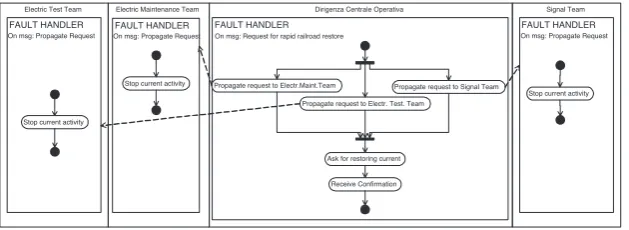
Figure 6: Decentralized fault handler
In our example, we have one fault and it can only be caught by the CMU. With this assumption,
Figure6shows the fault handlers of the different controllers. After the CMU captures the request
for restoring the normal situation, it propagates a message to the other orchestrators to raise an exception in each workflow. After this propagation, it asks the CP for restoring electricity. For security reasons, the procedure would require double confirmation to stop the activities of the operative teams (both CMU and CP would be involved), but this is not important for this example since it would only require that the fault handler be more complex.
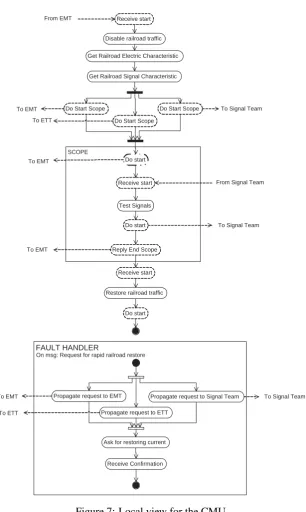
The local view of each orchestrator, that is, its sub-process, can then be extracted from the
modified workflow: Figure7shows the dedicated sub-process for the CMU orchestrator limited
to the execution flow.
As far as data are concerned, the example shows that variablesrailroad electric characteristic
andrailroad signal characteristicare used by different roles (orchestrators). They store
informa-tion that will be updated during the process. In Figure5, the activities that use these variables
are marked withxand+, respectively. In the centralized model, they are global variables, but in
the decentralized scenario they have to be propagated to the correct orchestrators. It is possible
to determine how these variables are used by building the data flow graph. Then, Figure8shows
SCOPE
Test Signals
Restore railroad traffic Disable railroad traffic
Receive start
Receive start
Receive start
Do start Get Railroad Electric Characteristic
Get Railroad Signal Characteristic
Do start
Do Start Scope Do Start Scope
Do Start Scope
Reply End Scope Do start From EMT
To EMT
To ETT
To Signal Team
To EMT
From Signal Team
To Signal Team
To EMT
FAULT HANDLER
On msg: Request for rapid railroad restore
Ask for restoring current
Receive Confirmation Propagate request to EMT
Propagate request to ETT
Propagate request to Signal Team To EMT
To ETT
To Signal Team
Dirigenza Centrale Operativa
Electric Maintenance Team Signal Team
send Railroad Electric Caracteristic Receive Railroad Electric Caracteristic
Get Railroad Signal Characteristic
send Railroad Signal Characteristic Receive Railroad Signal Characteristic
Figure 8: Activities inserted for propagating variables
4
Related work
The problem of workflow partitioning has been well-studied in the field of business process design for some ten years. The issue of workflow distribution still offers interesting aspects to study because of mobile information systems and Web services with the problems that come
with them. In [JSH+01], the authors present a comparison among the different approaches to
distribution.
Cross-Flow [GAHL00] aims at providing high-level support to workflows in
dynamically-created virtual organizations. High-level support is obtained by abstracting services and offer-ing advanced cooperation support. Virtual organizations are created dynamically by contract-based match-making between service providers and consumers. In Agent Enhanced
Work-flow [JOSC98], the agent oriented solution presents the interesting aspect of building execution
plans using a goal approach. Event-based Workflow Process Management [EP99] includes an
event-based workflow infrastructure and model constructs for addressing time aspects of process
management. The main feature of ADEPT [RD98] is the possibility of modifying workflow
instances at run-time. MENTOR [MWW+98] provides an autonomous workflow engine. In
this approach the workflow management system is based on a client-server architecture. The workflow itself is orchestrated by appropriately configured servers, while the applications that invoke workflow activities are executed on the client sites. The METEOR (Managing End to
End OpeRations) [ASC+03] system leverages Java, CORBA, and Web technologies to provide
support for the development of enterprise applications that require workflow management and application integration. It enables the development of complex workflow applications which in-volve legacy information systems and that have geographically distributed and heterogeneous hardware and software environments, spanning multiple organizations. It also provides support for dynamic workflow processes, error and exception handling, recovery, and QoS management.
Exotica [MAGK95] is characterized by the possibility of disconnected operations. It does not
permit complete decentralization because it maintains a central unit and all operations obey a
client/server paradigm. WISE [AFH+99] exploits the Web for its engine and offers an
embed-ded fault handler. WAWM [Rie98] focuses on the problems related to the workflow management
in wide area networks. Mobile [JB96] is developed to support inter-organizational workflows
The analysis of presented models suggests two different and dual approaches to the problem of workflow coordination. The first approach supports the integration of autonomous and preex-isting workflows and it aims mainly at the coordination of different and independent actors. The second approach supports the decomposition of single workflows to support their autonomous execution by means of different engines. Cross-Flow, Agent Enhanced Workflow, Event-based Workflow process Management, Adept, WISE and WAWM belong to the first approach; Mentor, Exotica and Mobile belong to the second one.
Described systems offer three different solutions for the definition of partitioning and alloca-tion rules. The first solualloca-tion proposes specific definialloca-tion languages (Cross-Flow, Agent enhanced workflow, Mentor, Exotica). The second approach proposes the extension of workflow languages with distribution rules (Cross-Flow, ADEPT, WISE, WAWM, Mobile). The third approach does not consider the language for distribution rules (Event-based, workflow Process Management). Cross-Flow belongs to more than one class because the distribution rules are split into several definition parts.
Our delegation model supports disconnected components like Exotica, the independence of workflow engines like MENTOR, and the possibility of modifying the workflow instance at run-time like ADEPT. Moreover, we argue that the mobile environment needs a language strongly oriented to the automatic execution like WS-BPEL, but we do not forget the need for lightness that is a mandatory feature if the system runs on portable devices in ad-hoc networks. As far as the definition of rules is concerned, our approach defines partitioning rules, but does not define allocation rules. It demands them to the specific business process and application domain.
Many of these cited approaches do not consider Web services as available instruments for
decentralizing business processes. A different comment is for [CCMN04], which presents an
approach very similar to ours. The authors use BPEL as workflow model and use the term
Composite Web Serviceto refer to a standard workflow. However, they focus on the problem of assigning workflow portions to specific orchestrators to minimize the traffic among nodes, but they do not provide any specific information about the partitioning rules and/or any proof of their
validity. They introduce the concepts ofControl Flow GraphandProgram Dependence Graph
without providing how they refer to WS-BPEL constructs and activities.
5
Conclusions and future work
The paper has presented our approach towardsdistributed orchestrations. It is the continuation
of the results already presented in [BMM04], and extends them with the partitioning rules for
handling data exchange among orchestrators and for dealing with handlers. Again, the first results are encouraging and are motivating us to continue working on these ideas.
Besides refining the rules, and applying them on further and more complex examples, the key element of our future work is the definition of the infrastructure to accommodate the execution of our federated WS-BPEL processes. We are working on different solutions that allow us to solve different problems. The first option is the use of standard WS-BPEL engines. This is the simplest solution, but it requires that all synchronization and communication problems among orchestrators be faced and solved in the process specifications. We are thinking of adopting
reliability of the supporting infrastructure, cope with the problems that come from producer-consumer analysis, and allow nomadic users to store and retrieve their data in/from dedicated tuples. Finally, we are investigating how to move the synchronization among orchestrators from the WS-BPEL models to the supporting infrastructure by adopting event-based architectures (e.g., WS-Notification) as the means to make the orchestrators communicate.
References
[AFH+99] G. Alonso, U. Fiedler, C. Hagen, A. Lazcano, H. Schuldt, and N. Weiler. WISE:
Business to business e-commerce. InRIDE, pages 132–139, 1999.
[Aka04] Akamai Technologies, Computer Associates International, Fujitsu Laboratories of
Europe, Globus, Hewlett-Packard, IBM, SAP AG, Sonic Software, TIBCO Soft-ware. Web Services Notification. 2004.
[ASC+03] K. Anyanwu, A. Sheth, J. Cardoso, J. Miller, and K. Kochut. Healthcare
enter-prise process development and integration. Journal of Research and Practice in
Information Technology, 35(2), 2003.
[BEA03] BEA and IBM and Microsoft and SAP and Siebel. Business Process Execution
Language for Web Services Version 1.1. 2003.
[Bey92] M. Beyer. AGG1.0 - Tutorial. Technical University of Berlin, Department of
Computer Science, 1992.
[BH02] L. Baresi and R. Heckel. Tutorial Introduction to Graph Transformation: A
Soft-ware Engineering Perspective. InProceedings of the First International
Confer-ence on Graph Transformation (ICGT 2002), volume 2505 of Lecture Notes in Computer Science, pages 402–429. Springer-Verlag, 2002.
[BMM04] L. Baresi, A. Maurino, and S. Modafferi. Workflow partitioning in mobile
in-formation systems. In Kluwer, editor,In Proc. of IFIP TC8 Working Conference
on Mobile Information Systems, volume 158 ofIFIP International Federation for Information Processing, 2004.
[BMM05] Luciano Baresi, Andrea Maurino, and Stefano Modafferi. Partitioning rules for
ws-bpel processes. Technical report, Politecnico di Milano, 2005.
[CCMN04] G.B. Chafle, S. Chandra, V. Mann, and M.G. Nanda. Decentralized orchestration
of composite web services. In In Proc. of the Int. World Wide Web conference
on Alternate track papers & posters, pages 134–143, New York, NY, USA, 2004. ACM Press.
[CCMW01] Erik Christensen, Francisco Curbera, Greg Meredith, and Sanjiva Weerawarana.
[EP99] J. Eder and E. Panagos. Towards distributed workflow process management. InIn proc. of Workshop on cross-Organizational Workflow Management and
Coordina-tion, San Francisco, USA, 1999.
[Ga03] T. Gardner and al. Draft uml 1.4 profile for automated business processes with a
mapping to the bpel 1.0. IBM alphaWorks, 2003.
[GAHL00] P. Grefen, K. Aberer, Y. Hoffner, and H. Ludwig. Crossflow: Cross-organizational
workflow management in dynamic virtual enterprises. International Journal of
Computer Systems Science & Engineering, 15(5):277–290, 2000.
[JB96] S. Jablonski and C. Bussler. Workflow Management: Modeling Concepts,
Archi-tecture and Implementation. International Thomson, 1996.
[JOSC98] D. Judge, B. Odgers, J. Shepherdson, and Z. Cui. Agent enhanced workflow. BT
Technical Journal, (16), 1998.
[JSH+01] S. Jablonski, R. Schamburger, C. Hahn, S. Horn, R. Lay, J. Neeb, and M. Schlundt.
A comprehensive investigation of distribution in the context of workflow
manage-ment. InIn proc. of International Conference on Parallel and Distributed Systems
ICPADS, Kyongju City, Korea, 2001.
[MAGK95] C. Mohan, G. Alonso, R. Gunthor, and M. Kamath. Exotica: A research
perspec-tive of workflow management systems. Data Engineering Bulletin, 18(1):19–26,
1995.
[MWW+98] P. Muth, D. Wodtke, J. Weisenfels, A. Kotz Dittrich, and G. Weikum. From
cen-tralized workflow specification to distributed workflow execution. Journal of
In-telligent Information Systems, 10(2):159–184, 1998.
[Nic04] Nickolaos Kavantzas and David Burdett and Greg Ritzinger. Web Services
Chore-ography Description Language Version 1.0. 2004.
[Obj02] Object Management Group. Meta Object Facility (MOF) Specification - v.1.4.
Technical report, OMG, March 2002.
[RD98] M. Reichert and P. Dadam. Adeptflex−supporting dynamic changes of workflows
without losing control. Journal of Intelligent Information Systems, 10(2):93–129,
1998.
[Rie98] G. Riempp. Wide Area Workflow Management. Springer, London, UK, 1998.