Available online throug
ISSN 2229 – 5046
EFFECT OF CHEMICAL REACTION ON UNSTEADY CONVECTIVE HEAT AND MASS
TRANSFER FLOW IN A VERTICAL CHANNEL WITH WALLS MAINTAINED AT
OSCILLATARY TEMPERATURE AND CONCENTRATION
Dr. P. VIJAYALAKSHMI*, Rt. Prof. D.R.V. PRASAD RAO
Department of Mathematics, Gates Institute of Technology, Gooty, (A.P.), India.
Department of Mathematics, S. K. University, Ananatapur, (A.P.), India.
(Received On: 23-10-17; Revised & Accepted On: 22-11-17)
ABSTRACT
W
e analyze the effect of chemical reaction and thermal radiation on unsteady convective heat and mass transfer flow in a vertical channel whose walls are maintained at oscillatory temperature and concentration. The governing equations are solved by a perturbation technique. The velocity, temperature and concentration, the rate of heat and mass transfer are discussed for different variations of the governing parameters.Key Words: Chemical reaction, Radiation, heat sources, Vertical channel.
1. INTRODUCTION
The process of free convection as a mode of heat transfer has wide applications in the fields of Chemical Engineering, Aeronautical and Nuclear power generation. It was shown by Gill and Casal [9a] that the buoyancy significantly affects the flow of a low Prandtal number fluid which is highly sensitive to gravitational force and the extent to which the buoyancy force influences a forced flow is a topic of interest. Free convection flows between two long vertical plates have been studied for many years because of their engineering applications in the fields of nuclear reactors, heat exchangers, cooling appliances in electronic instruments. These flows were studied by assuming the plates at two different constant temperatures or temperature of the plates varying linearly along the plates etc. The study of fully developed free convection flow between two parallel plates at constant temperature was initiated by Ostrach [19]. Combined natural and forced convection laminar flow with linear wall temperature profile was also studied by Ostrach [20]. The first exact solution for free convection in a vertical parallel plate channel with asymmetric heating for a fluid of constant properties was presented by Anug [2]. Many of the early works on free convection flows in open channels have been reviewed by Manca et al. [11]. Several authors [7, 10, 15, 16, 21,27,28] have investigated convective heat transfer flow in channels under different conditions. There are many reasons for the flow to become unsteady. When the current is periodic due to on-off control mechanisms or due to partially rectified a-c voltage, there exist periodic heat inputs. Hence, it is important to study the effects of periodic heat flux on the unsteady natural convection, imposed on one of the plates of a channel formed by two long vertical parallel plates, the other being held at a constant initial fluid temperature. Recently Narahari [17] has discussed the unsteady free convection flow of dissipative viscous incompressible fluid between two long vertical parallel plates in which the temperature of one of the plates is oscillatory whereas that of the other plate is uniform.
In the context of space technology and in processes involving high temperatures, the effects of radiation are of vital importance. Recent developments in hypersonic flights, missile reentry, rocket combustion chambers, power plants for inter planetary flight and gas-cooled nuclear reactors have focused attention on thermal radiation as a mode of energy transfer and emphasize the need for improved understanding of radiative transfer in these processes. Several researchers [3-6, 8, 12, 13, 21a, 22-26] have studied the effect of thermal radiation on convective heat transfer flow in channels under varied conditions. The thermal radiation effects on heat transfer in magneto-aerodynamic boundary layers has also received some attention, owing to astronautically re-entry, plasma flows in astrophysics, the planetary magneto-boundary layer and MHD propulsion systems. Mosa [14] discussed one of the first models for combined radiative hydromagnetic heat transfer, considered the case of free convective channel flows with an axial temperature gradient. Nath et al. [18] obtained a set of similarity solutions for radiative – MHD stellar point explosion dynamics using shooting methods. Abd-El-Naby et al [1] presented a finite difference solution of radiation effects on MHD unsteady free convection flow over a vertical porous plate.
In this paper, we investigate the effect of chemical reaction and thermal radiation on unsteady convective heat and mass transfer flow in a vertical channel whose walls are maintained at oscillatory temperature and concentration. The governing equations are solved by a perturbation technique. The velocity, temperature and concentration, the rate of heat and mass transfer are discussed for different variations of the governing parameters.
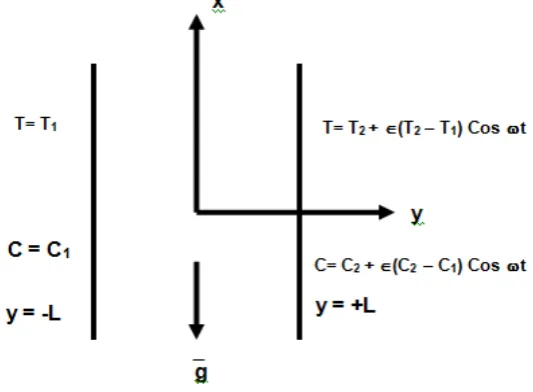
Fig. 1 − Configuration of the problem
2. FORMULATION AND SOLUTION OF THE PROBLEM
We consider the unsteady flow of a viscous incompressible fluid in a vertical channel bounded by flat walls in the presence of temperature dependent heat sources. The unsteadiness in the flow is due to the oscillatory temperature and concentration prescribed on the boundaries. We choose a Cartesian coordinate system 0(x y) with walls at y = ± L by using Boussinesq approximation we consider the density variation only on the buoyancy term also the kinematic viscosity υ,the thermal conductivity k are treated as constants. The equations governing the flow and heat transfer are
g
u
H
y
u
t
u
o o
e
ρ
ρ
σµ
ρ
µ
−
−
∂
∂
=
∂
∂
)
/
(
2 22 2
(1)
y
q
T
T
Q
y
T
K
t
T
C
Rf
p
∂
∂
−
−
−
∂
∂
=
∂
∂
(
)
)
(
02 2
0
ρ
(2)2
1 2
B
C
C
D
k C
t
y
∂
=
∂
−
∂
∂
(3))
(
)
(
0 o o
o
=
−
T
−
T
−
C
−
C
−
ρ
β
β
•ρ
(4) where u is a velocity component in x-direction, T, C are the temperature, Concentration, p is a pressure, ρ is a density, k is the permeability of the porous medium,µ is dynamic viscosity, kf is coefficient of thermal conductivity, βo is coefficient of volume expansion,β
•is the volumetric coefficient of expansion with mass fraction, D1 is the molecular diffusivity, Q is the strength of heat source, σ is the electrical conductivity, µe is the magnetic permeability of the medium.The boundary conditions are u = 0, T = T1, C= C1 y = -L
u = 0, T = T1 + ∈(T2 – T1) cos(ωt), (5) C = C1 + ∈(C2 – C1) cos(ωt) on y=+L
By Rosseland approximation (Brewester [5]) the energy equation reduces to
2 2 3
0 2
2
0
3
16
)
(
y
T
T
T
T
Q
y
T
k
t
T
C
R e f
p
∂
∂
+
−
−
∂
∂
=
∂
∂
∗β
σ
ρ
Introducing the non - dimensional variables
Equations (1 - 3) reduce to (dropping the dashes)
u
M
y
u
NC
G
t
u
)
(
)
(
2 22 2 2
−
∂
∂
+
+
=
∂
∂
θ
γ
(6)2 2 1 2 2 2
3
4
y
N
y
t
P
∂
∂
+
−
∂
∂
=
∂
∂
θ
θ
α
θ
θ
γ
(7)KC
y
C
t
C
Sc
−
∂
∂
=
∂
∂
2 2 2γ
(8) where2 1 2
3
(
)
γ
β
gL
T
T
G
=
−
(Grashof number), 22 2 2 2
ν
σµ
H
L
M
=
e o(Hartmann Number)
f P
K
C
P
=
µ
(Prandtl number),f
K
L
Q
.
2=
α
(Heat source parameter),2 2
ω
L
γ
ν
=
(Wormsely Number),f R e
k
T
N
β
σ
3
4
3 1 •=
(Radiation parameter)1
2 1 2 1 2
1
3
3
4
N
N
P
PN
N
N
α
α
=
=
=
+
, 2 2 1M
M
=
The transformed boundary conditions are u = 0, θ = 0, C=1 at y = -1
u =0, θ = 1 + ∈ cos (ωt), (9) C= 1 + ∈ cos (ωt ) at y = +1
In view of the boundary conditions (5) we assume u = u0 + ∈ eit u1
θ = θ0 +∈ eitθ1 (10) C= C0 +∈ eit C1
Substituting the series expansion (2.10) in equations ( 6 - 8) and separating the steady and transient terms we get
)
(
0 00 2 1 2 0 2
NC
G
u
M
y
u
+
−
=
−
∂
∂
θ
(11))
(
)
(
12 2 1 1 12 1 2
NC
G
u
i
M
y
u
−
+
=
−
+
∂
∂
γ
θ
(12)
0
0 1 2 0 2=
−
∂
∂
θ
α
θ
y
(13)0
)
(
1 2 1 1 2 1 2=
+
−
∂
∂
θ
α
γ
θ
iP
y
(14)0
0 2 0 2=
−
∂
∂
kC
y
C
(15)0
)
(
2 12 1 2
=
+
−
∂
∂
γ
φ
iSc
k
y
C
(16)
2
0 3 1 1
2
(
)
(
)
(
)
(
)
Ch
y
a
Ch
y
Ch
Ch
β
θ
β
β
β
=
−
+
2
4 1 1
2
(
)
(
)
(
)
(
)
Sh
y
a
Sh
y
Sh
Sh
β
β
β
β
−
2 2(
)
0.5
(
)
Sh
y
Sh
β
β
+
2 2(
)
(
)
Ch
y
Ch
β
β
+
10 11 2 2
1
(
)
(
)
(
)
(
)
Sh M y
u
a
Sh
y
Sh
Ch M
β
β
=
−
+
112 2 2
1
(
)
(
)
(
)
(
)
Ch M y
a
Ch
y
Ch
Ch M
β
β
−
13 1 1 1
1
(
)
(
)
(
)
(
)
Ch M y
a
Ch
y
Ch
Ch M
β
β
+
−
+
114 1 1
1
(
)
(
)
(
)
(
)
Sh M y
a
Sh
y
Sh
Ch M
β
β
−
3 1 3(
)
0.5
(
)
Ch
y
C
Ch
β
β
=
3 3(
)
(
)
Sh
y
Sh
β
β
+
41 107 3 3
4
(
)
(
)
(
)
(
)
Ch
y
a
Ch
y
Ch
Ch
β
θ
β
β
β
=
−
+
4
108 3 3
4
(
)
(
)
(
)
(
)
Sh
y
a
Sh
y
Sh
Sh
β
β
β
β
−
4 4(
)
0.5
(
)
Ch
y
Ch
β
β
+
+
4 4(
)
(
)
Sh
y
Sh
β
β
51 109 4 4
5
(
)
(
)
(
)
(
)
Ch
y
u
a
Ch
y
Ch
Ch
β
β
β
β
=
−
+
5110 4 4
5
(
)
(
)
(
)
(
)
Sh
y
a
Sh
y
Sh
Sh
β
β
β
β
−
111 3 3 5
5
(
)
(
)
(
)
(
)
Ch
y
a
Ch
y
Ch
Ch
β
β
β
β
+
−
+
5112 3 3
5
(
)
(
)
(
)
(
)
Sh
y
a
Sh
y
Sh
Sh
β
β
β
β
−
Where 2 2 1,
M
=
M
β
12=
γ
,
β =
22α
2 1 2 1 2 5 2 1 2 4 2 1 2
3
γ
γ
β
α
γ
β
γ
β
=
+
iSc
=
+
iP
=
M
+
i
1 1 2
,
k
=
M
+
β
k
2=
M
1−
β
2,
k
3=
β
2+
β
14 2 1
,
k
=
β
−
β
k
5=
M
1+
β
1,
k
6=
β
1−
M
1 Where a1, a2, a3,…………a112 are constants involving parameters.COMPARISON: For N=0 and α = 0 our results are in good agreement with Narahari [17].
3. SHEAR STRESS, NUSSELT NUMBER and SHERWOOD NUMBER
The Shear stress at the boundaries
L
dy
du
±
=
µ
τ
which in the non - dimensional form reduces to1 2 2 ± = •
=
=
ydy
du
L
ν
τ
τ
The Rate of heat transfer (Nusselt number) at y = ± L is given by
4. RESULTS AND DISCUSSION
In this analysis we investigate the effect of chemical reaction, thermal radiation and heat sources on unsteady convective heat and mass transfer flow of a viscous electrically conducting fluid in vertical channel .The unsteadiness in the flow is due to the oscillatory temperature and concentration.
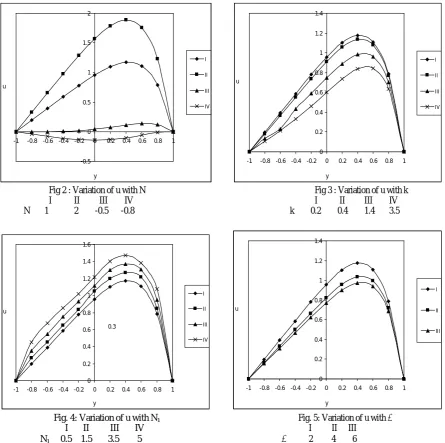
The axial velocity u is shown in figures (2-5) for different values of N, N1, K and α. Figure 2 represents u with buoyancy ratio N. It is found that when the molecular buoyancy force dominates over the thermal buoyancy force the actual velocity enhances in the flow region, when the buoyancy forces are in the same direction and for the forces acting in opposite direction, |u| enhances in the left half and reduces in the right half. Fig. 3 represents u with chemical reaction parameter K. It is found that u depreciates with increase in K in the entire flow region.
-0.5 0 0.5 1 1.5 2
-1 -0.8 -0.6 -0.4 -0.2 0 0.2 0.4 0.6 0.8 1
y u
I
II
III
IV
Fig 2 : Variation of u with N I II III IV
N 1 2 -0.5 -0.8
0 0.2 0.4 0.6 0.8 1 1.2 1.4
-1 -0.8 -0.6 -0.4 -0.2 0 0.2 0.4 0.6 0.8 1
y u
I
II
III
IV
Fig 3 : Variation of u with k I II III IV k 0.2 0.4 1.4 3.5
0 0.2 0.4 0.6 0.8 1 1.2 1.4 1.6
-1 -0.8 -0.6 -0.4 -0.2 0 0.2 0.4 0.6 0.8 1
y u
I
II
III
IV 0.3
Fig. 4: Variation of u with N1
I II III IV N1 0.5 1.5 3.5 5
0 0.2 0.4 0.6 0.8 1 1.2 1.4
-1 -0.8 -0.6 -0.4 -0.2 0 0.2 0.4 0.6 0.8 1
y u
I
II
III
Fig. 5: Variation of u with α
I II III α 2 4 6
-0.2 0 0.2 0.4 0.6 0.8 1 1.2
-1 -0.8 -0.6 -0.4 -0.2 0 0.2 0.4 0.6 0.8 1
y T
I
II
III 0.3
Fig; 6 Variation of θ with N1
I II III N1 0.5 1.5 3.5
-0.2 0 0.2 0.4 0.6 0.8 1 1.2
-1 -0.8 -0.6 -0.4 -0.2 0 0.2 0.4 0.6 0.8 1
y T
I
II
III
Fig .7: Variation of θ with α I II III α 2 4 6
The temperature distribution θ is shown in fig (6-7) for different values of α, N1, Fig 6 represents θ with radiation parameter N1. It is found that the temperature reduces with increase in N1.It is found from fig 7 that the actual temperature depreciates with increase in α.
-0.2 0 0.2 0.4 0.6 0.8 1 1.2
-1 -0.8 -0.6 -0.4 -0.2 0 0.2 0.4 0.6 0.8 1
y C
I
II
III
IV
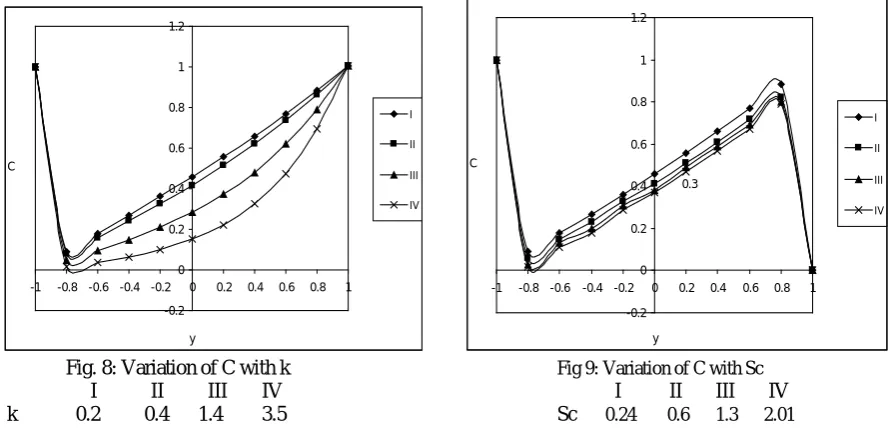
Fig. 8: Variation of C with k
I II III IV
k 0.2 0.4 1.4 3.5
-0.2 0 0.2 0.4 0.6 0.8 1 1.2
-1 -0.8 -0.6 -0.4 -0.2 0 0.2 0.4 0.6 0.8 1
y C
I
II
III
IV 0.3
Fig 9: Variation of C with Sc
I II III IV
Sc 0.24 0.6 1.3 2.01
The concentration C is executed in figures (8-9) for different parametric values. Fig 8 represents C with chemical reaction parameter K. It is found that the concentration depreciates in a degenerating chemical reaction case. From fig 9 we notice that lesser the molecular diffusivity smaller the concentration in the left half and larger in the right half. The skin friction at the plates y=±1 is shown in tables (1-2) for different values at K, α, N1. It is find that the skin friction enhances with increase in |G|. | τ | enhances with α≤4 and with higher α≥6 at both the walls. An increase in chemical reaction parameter k and heat source parameter α at both the walls. With reference to Sc we notice that lesser the molecular diffusivity smaller | τ | at y=+1 and larger at y=-1.
Table – 1: Shear Stress (τ) at y = 1
G I II III IV V VI
103 4.73929 4.4954 4.02999 3.75125 4.83929 5.12929 3x10³ 14.21249 13.48081 12.08743 11.25283 14.5298 14.9289 -103 -4.73391 -4.49002 -4.02745 -3.75083 -4.83929 -5.12929 -3x10³ -14.2071 -13.47543 -12.08489 -11.25191 -14.5298 -14.9289
K .5 1.5 .5 .5 .5 .5
Table – 2: Shear Stress (τ) at y = − 1
G I II III IV V VI VII VIII
103 50.26863 45.2866 40.1245 25.51244 17.38888 9.53230 48.20016 47.79514 3x10³ 150.81130 142.3208 139.0217 76.54269 52.17204 28.60230 144.6030 143.3863 -103 -50.27402 -45.2866 -40.1245 -25.5178 -17.3942 -9.53769 -48.2027 -47.7960 -3x10³ -150.8167 -142.320 -139.021 -76.5480 -52.1774 -28.6076 -144.605 -143.387
N1 0.5 1.5 3.5 0.5 0.5 0.5 0.5 0.5 K 0.5 0.5 0.5 1.5 2.5 3.5 0.5 0.5
α 2 2 2 2 2 2 4 6
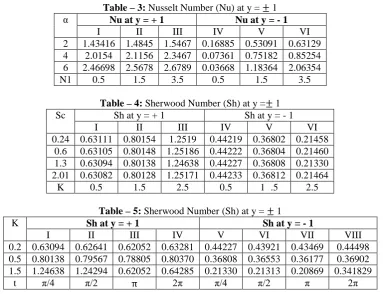
The rate of heat transfer (Nusselt number) is exhibited in tables 3 for different values of α, N1, It is found that an increase in the strength of heat source enhances |Nu| at y=+1 and reduces at y=-1. As time elapses we notice a depreciation in |Nu | at y= ±1. An increase in N1 enhances |Nu| at y=±1.
Table – 3: Nusselt Number (Nu) at y = ± 1
α Nu at y = + 1 Nu at y = - 1
I II III IV V VI 2 1.43416 1.4845 1.5467 0.16885 0.53091 0.63129 4 2.0154 2.1156 2.3467 0.07361 0.75182 0.85254 6 2.46698 2.5678 2.6789 0.03668 1.18364 2.06354 N1 0.5 1.5 3.5 0.5 1.5 3.5
Table – 4: Sherwood Number (Sh) at y =± 1 Sc Sh at y = + 1 Sh at y = - 1
I II III IV V VI
0.24 0.63111 0.80154 1.2519 0.44219 0.36802 0.21458 0.6 0.63105 0.80148 1.25186 0.44222 0.36804 0.21460 1.3 0.63094 0.80138 1.24638 0.44227 0.36808 0.21330 2.01 0.63082 0.80128 1.25171 0.44233 0.36812 0.21464
K 0.5 1.5 2.5 0.5 1 .5 2.5 Table – 5: Sherwood Number (Sh) at y = ± 1
K Sh at y = + 1 Sh at y = - 1
I II III IV V VI VII VIII 0.2 0.63094 0.62641 0.62052 0.63281 0.44227 0.43921 0.43469 0.44498 0.5 0.80138 0.79567 0.78805 0.80370 0.36808 0.36553 0.36177 0.36902 1.5 1.24638 1.24294 0.62052 0.64285 0.21330 0.21313 0.20869 0.341829
t π/4 π/2 π 2π π/4 π/2 π 2π
The rate of mass transfer is shown in tables 4-5 for different values of Sc, k, and t. It is found that the rate of mass transfer enhances at y=+1 and depreciates at y=-1 with increase in Sc. An increase in chemical reaction parameter k results in a depreciation in |Sh| at y=-1 and enhancement at y=+1. An increase in time t results in a depreciation in |Sh| at y=-1 and enhancement at y=+1.
5. REFERENCES
1. Abd El-Naby M.A, Elsayed M.E., Elberabary and Nader Y.A. (2004). Finite difference solution of radiation effects on MHD free convection flow over a vertical porous plate, Appl. Maths Comp. Vol. 151, pp. 327-346. 2. Anug W (1972). Fully developed laminar free convection between vertical plates heated asymmetrically. Int.
J. Heat and Mass Transfer, 15, pp.1577-1580.
3. Bakier A.Y. and Gorla R.S.R. (1996). Thermal radiation effects on mixed convection from horizontal surfaces in porous media Transport in porous media, Vo. 23 pp. 357-362.
4. Brinkman,H,C(1948)A calculation of the viscous force external by a flowing fluid on a dense swam of particles:Application Science Research.Ala.P.81(x).
5. Chamkha A.J., Takhar H.S. and Soundalgekar V.M (2001) Radiation effects on free convection flow past a semi-infinite vertical plate with mass transfer, Chem. Engg. J, Vol. 84, pp. 335-342.
6. Chamkha A.J. (1997) Solar Radiation Assisted natural convection in a uniform porous medium supported by a vertical heat plate, ASME Journal of heat transfer, V.19, pp.89-96.
8. Campo A, Manca O, and Marrone B (2006). Numerical investigation of the natural convection flows for low-Prandtl fluid in vertical parallel-plates channels. ASME Journal of Applied Mechanics, 73, pp. 6-107.
9. Das U.N, Deka R.K. and Soundalgekar V.M.(1996) Radiation effects on flow past an impulsively started vertical plate – an exact solution, J. Theo. Appl. Third Mech., Vol.1, pp. 111-115.
10. Gebhart B (1962). Effect of viscous dissipation in natural convection. J. Fluid Mech, 14, pp.225-232. (x). 11. Gill,W,M and Casal,A.D(1962)A theoretical investigation of natural convection effects in forced horizontal
flows, Amer. Inst.Chem. Engg. Jour.., V..8,pp. 513-520.
12. Jha BK, Singh AK, and Takhar HS (2003). Transient free convection flow in a vertical channel due to symmetric heating. International Journal of Applied Mechanics and Engineering, 8(3), pp.497-502.
13. Manca O, Marrone B, Nardini S, and Naso V (2000). Narural convection in open channels. In: Sunden B, Comini G. Computational Analysis of Convection Heat Transfer. WIT press, Southampton, pp.235-278. 14. Mansour, M.H. (1990). Radiative and free convection effects on the oscillatory flow past a vertical plate,
astrophysics and space science, Vol. 166, pp. 26-75.
15. Meroney, R.N. (2004). Fires in porous media, May 5-15, Kiev, Ukraine.
16. Mosa, M.F. (1979). Radiative heat transfer in horizontal MHD channel flow with buoyancy effects and axial temp. Gradient, Ph.D. thesis, Mathematics Dept, Bradford University, England, UK.
17. Narahari M, Sreenadh S, and Soundalgekar VM (2002). Transient free convection flow between long vertical parallel plates with constant heat flux at one boundary. Thermo physics and Aeromechanics, 9(2), pp.287-293. 18. Narahari M (2008). Free convection flow between two long vertical parallel plates with variable temperature
at one boundary. Proceedings of International Conference on Mechanical & Manufacturing Engineering (ICME 2008), Johor Bahru, Malaysia.
19. Narahari M (2009). Oscillatory plate temperature effects of free convection flow of dissipative fluid between long vertical parallel plates. Int. J. of Appl. Math. And Mech. 5(3). pp 30-46.
20. Nath, Ojha, S.N. and Takhar, H.S. (1991). A study of stellar point explosion in a radiative MHD medium s and space science, V.183, pp. 135-145.
21. Ostrach S (1952). Laminar natural-convection flow and heat transfer of fluids with and without heat sources in channels with constant wall temperatures. Technical Report 2863, NASA, USA.
22. Ostrach S (1954). Combined natural and forced convection laminar flow and heat transfer of fluids with and without heat sources in channels with linearly varying wall temperature. Technical Report 3141, NASA, USA. 23. Pantokratoras A (2006). Fully developed laminar free convection with variable thermophysical properties
between two open-ended vertical parallel plates heated asymmetrically with large temperature differences. ASME Journal of Heat Transfer, 128, pp.405-408.
24. Prasad, P.M.V, Raveendranath, P., Prasada Rao, D.R.V. (2008): Transient hydromagnetic convective heat and mass transfer through a porous medium induced by travelling thermal waves in a vertical channel. Acta Ciencia Indica, Vol. 34M, No.2 pp 677-692.
25. Ramachandra Prasad V, Bhaskar Reddy N and Muthucumaraswamy R (2007). Radiation and mass transfer effects on two-dimensional flow past an impulsively started isothermal vertical plate, Int. J. Thermal Sciences, Vo. 46. pp. 1251-1258.
26. Raptis, A.A. and Singh, A.K. (1985). Free convection flow past an impulsively started vertical plate in a porous medium by finite difference method, Astrophysics space science J, Vol. 112,, pp. 259-265.(x).
27. Raptis, AA and Perdikis, C (1999). Radiation and free convection flow past a moving plate, Appl. Mech. Eng. Vol. 4, pp. 817-821.
28. Raptis, A.A. (1998). Radiation and free convection flow through a porous medium, Int. Commun. Heat mass transfer, Vol. 25, pp.289-295.
Source of support: Nil, Conflict of interest: None Declared.