International Journal Advances in Social Science and Humanities
Available online at: www.ijassh.com
RESEARCH ARTICLE
The Structural Problems Encountered in the Education of Gifted
Students: The Case of BILSEM
Elcik Fatih, Cıngıllıoğlu Salih*
Department of Turkish Language and Literature, Faculty of Education, International Burch University, Bosnia and Herzegovina.
*Corresponding Author: Email: [email protected]
Abstract
This paper investigates the structural problems encountered in the education of gifted students. The population of the study is comprised of 72 Art and Science Centers (ASC) all around Turkey, and 26 centers from various geographical regions of Turkey constitute its sample. The participants of the study were 324 of the approximately 750 teachers and administrators who work at ASCs. This study employed the descriptive survey method. The data collection instrument was devised by the researchers and involved 16 questions. The Cronbach’s Alpha reliability coefficient was calculated as 0.813. Based on the results of the study, the laws and regulations passed for the education of gifted students and the share allocated in the budget of National Ministry of Education are insufficient. The number of the centers opened for the education of such students is not enough, either. Moreover, the centers have many problems such as identification, teacher education, insufficient physical infrastructure, inefficient collaboration with universities and The Scientific and Technological Research Council of Turkey and various unsolved ones. Despite all the adversaries, it is indicated that the ASCs are an appropriate model for the education of gifted students.
Keywords: Gifted students, education, Art and Science Centers, Bilsem.
Introduction
Educated human power is the most important capital of a nation. The discovery of this power and the realization of his or her potential by every individual will be the greatest investment in the future of a nation. It is possible to accept that the technological, economic and military superiority attained by developed countries today is directly proportionate to the qualified human power they have educated.
Gifted individuals have significant roles in the rise and development of a society [1]. One of the most important responsibilities of the modern educational system is to identify gifted children, educate them and enable them to contribute to social development [2].
In the recent history of research on gifted, talented, and creative children, the year of
1957 appears to be an important date. In this year, the Soviet Union launched the first space craft, Sputnik. Meanwhile, the western countries sought the reasons why they had been overtaken by the Soviet Union in the space race. Their investigation revealed that the Soviet Union placed importance on the education of gifted children. Since then, the western countries have accelerated the studies on the education of gifted children, especially on identification of the gifted students and developing appropriate instructional methodology [3].
to give each individual the same education or to deliver the predetermined objectives in a certain period of time. If the students who achieve the objectives well before the determined period of time are not given the opportunity to a specified and enriched education, their educational requirements will not have been met sufficiently [4]. This basic approach of the formal educational system shows that the educational programs in schools are arranged according to the students with medium level intelligence and mildly gifted. As a result, the gifted students remain uninterested in the classes and even become problem students. It is possible to say that ignoring gifted children in school programs is one the significant problems of national educational system today.
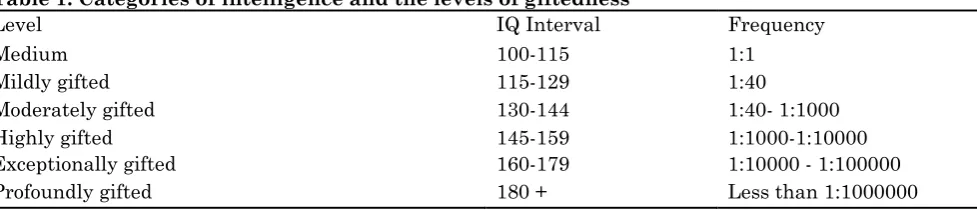
The percentage of gifted and mentally retarded students in the formal educational system is approximately 5 percent. It is accepted that 2-3 percent of them are gifted students [5]. Table 1 show that the number of students whose level of intelligence is from medium to moderately gifted is one in a hundred children, whereas the number of students whose level of intelligence is at higher stages is one in a million. The identification of such a rarely found individual, one in a million, and offering an education suitable to his or her level of intelligence is important both for the individual and the future of humanity [6].
Table 1: Categories of ıntelligence and the levels of giftedness
Level IQ Interval Frequency
Medium 100-115 1:1
Mildly gifted 115-129 1:40
Moderately gifted 130-144 1:40- 1:1000
Highly gifted 145-159 1:1000-1:10000
Exceptionally gifted 160-179 1:10000 - 1:100000
Profoundly gifted 180 + Less than 1:1000000
In the last 60 years in Turkey, the legislation passed for the education of gifted children and relevant educational policies have not been able to prevent some of our gifted students move abroad. This phenomenon, so-called brain drain, is one of the greatest barriers in front of the education of gifted children in the country. Identification of gifted children at early ages, their education and linking this education to practice are among the most important measures that can be taken against this phenomenon. It is imperative and essential for Turkey to seize a revolutionary power to accomplish the education of the gifted, to produce knowledge, to overcome the present problems and to take concrete steps in order to develop nation-wide strategies [7].
In order to offer the targeted education to the gifted students, the educational settings and programs should be designed in accordance with the high level abilities of students and the need for qualified teachers should be met [8, 9]. In recent years, institutions to meet
the abovementioned demand have been opened in Turkey.
certain discipline and a special talent. Finally, the students acquire the skills for preparing and presenting projects [10].
According to Hakan [11], the legislation for the education of gifted students and the money allocated from the budget of national education are insufficient, and the temporary assignment, rather than the appointment, of teachers seriously decreases the quality of teaching staff. The lack of teachers with the desired quality causes problems in the identification and education of gifted students. The insufficient collaboration between ASCs and universities or institutions like The Scientific and Research Council of Turkey (TÜBİTAK) is yet another problem. It is possible to say that ASCs cannot meet the expectations at their present state.
The number of gifted students who have been identified and offered education by ASCs is 10,807 [12]. This number represents approximately 4 percent of the potentially gifted students. In other words, 96 percent of the gifted children cannot benefit from the abovementioned opportunity. The ASCs are insufficient in their capacity. Expectedly, teachers at ASCs have the highest amount of experience and knowledge about the education of gifted students. Therefore, the determination of such experience and its diversion into national educational policies are significant for the solution of systemic and structural problems.
Method
This study employed the descriptive survey method. As is known, descriptive studies aim to describe the problem that is under focus. Survey methods, on the other hand, are based on revealing the current problem as it really is through an objective approach [13].The views of the teachers and administrators who work at ASCs, which are
the unique organizations in the education of gifted children in Turkey, are collected through a 5-point Likert scale data collection instrument developed by the researchers.
Participants
The nationwide ASCs in Turkey in the year of 2014 comprise the population of the study. of the 72 ASCs in all around Turkey, 26 are selected regarding their geographical distribution and the year of their opening. 324 of the total 750 teachers and administrators who work at ASCs participated in the study.
Data Collection and Analysis
Before developing the data collection instruments used in the study, relevant literature was surveyed. Through face-to-face interviews with the teachers and administrators of ASCs responsible for the education of gifted students, essential information was gathered. Following this preparation, a 5-point Likert scale comprised of 20 items was developed.
The developed instrument was presented to the experts in the field. The pilot study of the data collection instrument was conducted with the teachers and administrators of an ASC in Ankara. Based on the feedback gathered, the number of items was reduced to 16. The final instrument that involved 16 items was used to collect data from the teachers and administrators of ASCs. The collected data was exposed to data analysis software. In the analysis of the data, the Cronbach Alpha coefficient was calculated as 0.813. The frequencies obtained through the analysis of data were indicated in graphs and then interpreted.
Findings
The distribution of teachers who took part in the study according to their demographic characteristics is indicated in Table 2.
Table 2: The demographic characteristics of the teachers
Demographic Characteristics Frequency
Women teachers 44,1%
Male teachers 55,9%
Holding an Undergraduate Degree 69,4%
Holding a Master’s Degree 25,3%
Holding a Ph.D 5,2%
55.9 percent of the participants in the study are males, whereas 44.1 percent of them are females. 25.3 percent of the teachers who work at ASCs hold a Master’s degree and only 5.2 percent of them have completed their Ph.D. 80.8 percent of the teachers at
ASCs have an experience of more than 10 years in their jobs.
The distribution of teachers who took part in the study according to their branches is indicated in Table 3.
Table 3: The distribution of teachers according to their branches
Branch Frequency
Administrator 11,7%
Mathematics 10,8%
Science and Technology 7,4%
Physics 5,6%
Chemistry 4,6%
Biology 3,7%
Literature 4,0%
Turkish 7,1%
History 4,3%
Geography 2,8%
Computer 3,1%
Guidance and Counseling 5,6%
Foreign Language 7,1%
Music 5,2%
Art 9,0%
Philosophy 1,9%
Class Teacher 3,4%
Other 2,8%
11.7 percent of the teachers work as administrators, 35.2 percent of them are from branches of quantitative and natural sciences, 36.2 percent are from branches of social sciences, and 14.2 percent are from branches of art.
Table 4 shows the answers by teachers to the public factor of the instrument. The public factor is comprised of 8 items. One of the items is structured negatively.
Table 4: The answers of teachers to the items in the scale The items answered by the teachers of gifted students
(Public Factor)
To
tal
ly
Ag
re
e
Ag
re
e
PAr
tia
ll
y Ag
re
e
D
is
ag
re
e
To
tal
ly
Di
sa
gr
ee
1 The education of gifted students is a responsibility of the
state. 71,3% 22,8% 4,3% 1,2% 0,3%
2 The legislation regarding the education of gifted students
in Turkey is sufficient. 0,3% 0,6% 5,6% 27,5% 66,0%
3 The budget allocated for the education of gifted students in
national education budget should be increased. 61,4% 25,9% 9,3% 2,8% 0,6% 4 Gifted students should receive formal education in a
separate school. 35,2% 34,9% 21,3% 7,7% 0,9%
5 The education of gifted students in homogenous groups in
schools is not an appropriate practice. 7,7% 9,9% 37,3% 20,7% 24,4%
6 The educational practices of private sector for the gifted
children are qualified enough to meet the need. 0,6% 0,9% 12,0% 50,0% 36,4%
7 A national database should be established for the developmental data about identified gifted students in Turkey.
59,6% 31,2% 6,8% 2,2% 0,3%
8 The state should make radical decisions for the education
94.1 percent of the teachers stated that the education of gifted children is a responsibility that falls on the state. Nevertheless, the expectations from the private sector are at high level. 86.4 percent of the teachers mentioned that the private sector does not offer enough practice for the education of gifted students.
The proportion of teachers who think that the legislation for the education of gifted students is insufficient is 93.5 percent. The proportion of the teachers who emphasized that the budget allocated for the education of gifted children from the budget of national education is 87.3 percent.
While the proportion of the teachers who think that the gifted students should receive
education in a separate school is 70.1 percent, the proportion of teachers who think that gifted students should be educated in homogenous groups within the school is 45.1 percent. However, it should not be ignored that the proportion of teachers who partially agree with this item is 37.3 percent.
While 90.8 percent of the teachers mentioned that a national database about the gifted students should be established, 66.9 percent of the teachers emphasized that the state should make more radical and fundamental decisions regarding the education of gifted students.
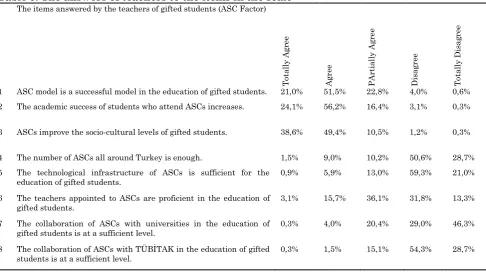
Table 5 shows the answers by teachers to the ASC factor of the instrument. The ASC factor is comprised of 8 items.
Table 5: The answers of teachers to the items in the scale The items answered by the teachers of gifted students (ASC Factor)
T
ota
ll
y
A
gr
ee
A
gr
ee
P
A
rtia
ll
y
A
gr
ee
Di
sa
gr
ee
T
ota
ll
y
Di
sa
gr
ee
1 ASC model is a successful model in the education of gifted students. 21,0% 51,5% 22,8% 4,0% 0,6% 2 The academic success of students who attend ASCs increases. 24,1% 56,2% 16,4% 3,1% 0,3%
3 ASCs improve the socio-cultural levels of gifted students. 38,6% 49,4% 10,5% 1,2% 0,3%
4 The number of ASCs all around Turkey is enough. 1,5% 9,0% 10,2% 50,6% 28,7% 5 The technological infrastructure of ASCs is sufficient for the
education of gifted students. 0,9% 5,9% 13,0% 59,3% 21,0%
6 The teachers appointed to ASCs are proficient in the education of
gifted students. 3,1% 15,7% 36,1% 31,8% 13,3%
7 The collaboration of ASCs with universities in the education of
gifted students is at a sufficient level. 0,3% 4,0% 20,4% 29,0% 46,3%
8 The collaboration of ASCs with TÜBİTAK in the education of gifted students is at a sufficient level.
0,3% 1,5% 15,1% 54,3% 28,7%
71.5 percent of the teachers think that ASC model is a suitable model in the education of gifted students, whereas 79.3 percent of them stated that the number of ASCs is not enough.
While 80.3 percent of the teachers think that the academic success levels of students who attend ASCs increase, the proportion of teachers who think the socio-cultural levels of students increase is 88 percent.
Discussion and Conclusions
Researchers mention that the educational needs of gifted students are different and therefore they need different educational settings and enriched educational programs in addition to the formal educational programs offered in schools [14, 15]. Turkey started to work on projects in Ministry of National Education in 1993 so as to meet the educational needs of gifted students. As a result of these projects, ASCs are opened, which offers education with a method of grouping and enrichment and are attended by students a few days a week. In these centers, both academic and artistic skills of the students are improved [16].
This study, which was conducted with the teachers of the identified gifted students all over Turkey, describes the current situation regarding various factors. A great majority of teachers (94.1%) mentioned that the education of gifted students is a responsibility that falls on the government, 93.5% of them stated that the relevant legislation is not enough, and 87.3% emphasized that more money should be allocated from the budget of the national education.
Developed countries generally conduct the education of gifted students through state initiatives and by allocating considerable budget. Moreover, they support the education of gifted students by new legislation and by providing incentives for the private sector. United States, Israel, Japan, South Korea and some western European countries are examples to such developed countries [17].
According to the internal audit report of ASCs in Turkey in 2010, 99 percent of the budget allocated to special education is diverted to low intelligence groups. The share given to the gifted students from the budget remains less than 1 percent. Moreover, 90 percent of the ASC buildings are reported unsuitable for the education of gifted students [18]. Furthermore, a great
majority of the teachers of gifted students pointed out that the personal information of the gifted students should be stored in databases as a policy of national education. It is among the derived results that the state should take more radical and decisive steps for the education of gifted students as a national educational policy.
Based on the research findings, the proportion of teachers who believe that gifted students should receive education in separate schools is 70.1 percent, while the proportion of those who believe that gifted students should be educated by forming homogeneous groups in the school is 45.1 percent. The proportion of those who mention that the educational activities carried out by the private sector with their own facilities are not sufficient is 86.4 percent. In a study conducted on ASCs, a great majority of teachers and administrators suggested that the formal education for gifted students should be offered in separate school buildings and in a structure like that of Enderun Mektepleri (schools for gifted children in the Ottoman palace to educate the future administrators of the state) of the Ottoman period [19].
Research findings show that ASC model is successful and that the academic and socio-cultural levels of the students significantly increase. However, it is pointed out that its physical and technological infrastructure is insufficient. Only 36.8 percent of the teachers consider themselves as expert and competent professionals. It is possible to derive from findings that the communication of ASCs with universities and TÜBİTAK is weak. All these points are also indicated in internal audit reports and other studies. In spite of the adversaries such as the unreliable tests used in identifying students, incompetent teachers, physical problems, incompatible educational technologies, non-independent buildings, insufficient information exchange with universities and TÜBİTAK, ASC model has been found to be successful [20].
References
1. Ciğerci CZ (2006) Üstün yetenekli olan ve
karşılaştırması. Unpublished Master’s Thesis. Sakarya University, Sakarya, Turkey.
2. Koçak R, İçmenoğlu E (2012) Üstün yetenekli
öğrencilerin duygusal zekâ ve yaratıcılık düzeylerinin yaşam doyumlarını yordayıcı rolü. Türk Psikolojik Danışma ve Rehberlik Dergisi 4 (37): 73-85.
3. Ataman A (2005) Özel eğitime giriş. Gündüz Eğitim ve Yayıncılık, Ankara.
4. Tomlinson CA, Allan SD (2000) Leadership for
differentiating schools and classrooms.
Association for Supervision and Curriculum Development., Alexandria, VA.
5. Marland SP (1972) Education of the gifted and
talented. Government Printing Office,
Washington, DC.
6. Gross M. Issues in the cognitive development of exceptionally and profoundly gifted individuals. In: Heller KA, Monks FJ, Sternberg RJ, Subotnik RF, editors. (2000) International Handbook of Giftedness and Talent. 2nd ed. Pergamon, Oxford. p. 179-192.
7. Levent F, Bakioğlu A (2013) Üstün
yeteneklilerin eğitiminde Türkiye için
öneriler. Üstün Yetenekliler Eğitimi
Araştırmaları Dergisi-Journal of Gifted Education Research 1(1): 31-44.
8. Renzulli JS (1997) The enrichment triad model: A guide for developing defensible programs forgifted. Creative Learning Press, Mansfield.
9. Abraham GC (1982) Gifted education: The recruitment/selection process of teachers for
gifted elementary programs and the
perceptions of teachers and principals. Unpublished PhD Thesis. University of Southern California, California.
10.Bildiren A (2011) Üstün yetenekli çocuklar. Doğan Kitap, İstanbul.
11.Sarı H (2013) Türkiye’de üstün yetenekli çocukların eğitim gördüğü bilim ve sanat
merkezleri için öneriler-editöre
mektup. Üstün Yetenekliler Eğitimi
Araştırmaları Dergisi-Journal of Gifted Education Research 1(2): 146-149.
12.MEB. Özel Eğitim ve Rehberlik Hizmetleri Genel Müdürlüğü, Bilim Sanat merkezleri. (http://orgm.meb.gov.tr/alt_sayfalar/kurum.as p, 10.8.2013)
13.Karasar N (1999) Bilimsel araştırma
yöntemi. Nobel Yayın Dağıtım, Ankara.. 14.Renzulli JS (1999) Reflections, perceptions,
and future directions. Journal for the Education of the Gifted 23(1): 125-146.
15.Fiedler ED, Lange RE, Winebrenner S (2002) In search of reality: Unraveling the myths about tracking, ability grouping, and the gifted. Roeper Review 24(3): 108-111.
16.Tebliğler Dergisi (2001). Bilim Sanat
Merkezleri Yönergesi, Sayı: 2530, Cilt: 64. 17.Levent F. Üstün yetenekli çocuklara devletin
sunması gereken haklar. In: Gülan- A, Şirin MR, Şirin MC, editors. (2011) Yetişkin bildirileri kitabı, Çocuk Vakfı Yayınları, İstanbul. p. 85-102.
18.MEB. (2010). T.C. Millî Eğitim Bakanlığı İç Denetim Birimi Başkanlığı, Bilim ve Sanat Merkezleri Süreci (Üstün Yetenekli Bireylerin Eğitimi) İç Denetim Raporu, 2010/14, Ankara. 19.Keskin MÖ, Samancı NK, Aydın S (2013)
Bilim ve sanat merkezleri: Mevcut durumları,
sorunları ve çözüm önerileri. Üstün
Yetenekliler Eğitimi Araştırmaları Dergisi-Journal of Gifted Education Research, 1(2): 78-96.
20.Gökdere M, Çepni S (2004) Üstün yetenekli öğrencilerin fen öğretmenlerinin hizmet içi ihtiyaçlarının değerlendirilmesine yönelik bir çalışma bilim sanat merkezi örneklemi. Gazi Eğitim Fakültesi Dergisi 24(2): 1-14.
Note:
The acronym for the Turkish phrase Bilim Sanat Merkezi, meaning “Art and Science Center”