Available online throug
ISSN 2229 – 5046
E AND V –MAGIC STRENGTH OF H-MULTIPLE LABELING OF GRAPHS
D. S. T. RAMESH
1, A. SUBRAMANIAN
2AND K. SUNITHA*
31
Associate Professor, Department of Mathematics,
Nazareth Margoschis College, Nasarath, India.
2
Associate Professor, Department of Mathematics,
M. D. T. Hindu College, Tirunelveli, India.
3
Assistant Professor, Department of Mathematics,
Women’s Christian College, Nagercoil, India.
(Received On: 21-11-15; Revised & Accepted On: 17-12-15)
ABSTRACT
A
one-to-one mapf
fromV
∪
E
of a graph G onto the integers{
h h h
, 2 , 3 ,..., (
m
+
n h
)
}
is a E-Magic h-multiple labeling if there exist a constant k such that( )
( ) ( )
( ).
v V e E
k f
d v f v
f e
ε
∈ ∈
=
∑
+
∑
A one-to-one mapf
from V∪
E
ofa graph G onto the integers
{
h h h
, 2 , 3 ,..., (
m
+
n h
)
}
is a V-Magic h-multiple labeling if there exist a constant k such that( )
( )
( )
v N u
f u
f u v
k
∈
+
∑
=
where h is any positive integer. In this Paper, we obtain the E-magic strength ofh-multiple labeling of the path
P
n on n-vertices, the n-bi starB
n n, obtained from two disjoint copies ofK
1,n by joining the center vertices by an edge and the tree<
K
1,n: 2
>
obtained fromB
n n, by subdividing the middle edge with a new vertex.Also we obtain the V-magic strength of h-multiple labeling of the pathP
n on n-vertices and 4-connected graph4,n
H
on n-verticesKeywords: Magic labeling, E-Magic Strength, E-Magic h-multiple labelling, graph
nP
2, V-Magic h-multiple labelingand structure of
H
m n,1. INTRODUCTION
A labeling of a graph G(V,E) is a mapping from the set of vertices ,edges or both vertices and edges to the set of labels. Based on the domain we distinguish vertex labelings, edge labelings and total labelings. In most applications the labels are positive (or nonnegative) integers, though in general real numbers could be used. Various labelings are obtained based on the requirements put on the mapping. Magic labelings were introduced by sedlacek in 1963[6]. In general for a magic type labeling we require the sum of labels related to a vertex (a vertex magic labeling) or to an edge (an edge magic labeling) to be constant all over the graph.
Definition 1.1: For any magic labeling f of G, there is a constant k such that
f x
( )
+
f y
( )
+
f xy
(
)
=
k
,( )
xy
∈
E G
.Corresponding Author: K. Sunitha*
33
Assistant Professor, Department of mathematics,
© 2015, IJMA. All Rights Reserved 48
2. E-MAGIC STRENGTH OF H-MULTIPLE LABELING OF GRAPHS
Definition 2.1 [3]: The E-magic strength of G, Em(G),is defined as the minimum of all k where the minimum is taken over all magic labelings f of G. That is Em(G)=min{k:f is a magic labeling of G}.Let f be a magic labeling of G with the constant k. Then adding all constants obtained at each edge we get
( )
( ) ( )
( )
v V e E
k f
d v f v
f e
ε
∈ ∈
=
∑
+
∑
Definition 2.2: Let h be any positive integer.A one-to-one map
f
fromV
∪
E
of a graph G onto the integers{
h h h
, 2 , 3 ,..., (
m
+
n h
)
}
is a E-Magic h-multiple labeling if there exist a constant k such that( )
( ) ( )
( )
v V e E
k f
d v f v
f e
ε
∈ ∈
=
∑
+
∑
A graph which admits E-Magic h-multiple labeling then it is called E-Magic h-multiple graph.
Theorem2.1:
Em P
(
2n)
=
h n
(5
+
1)
andEm P
(
2n+1)
=
h n
(5
+
3)
Proof: We prove this theorem by assigning a magic labeling to
P
2n andP
2n+1Let
v v
1,
2,...,
v
2n be the consecutive vertices ande e
1,
2,...,
e
2n−1 be the consecutive edges ofP
2nThat is ,
e
i=
v v
i i+1for
1
≤ ≤
i
2
n
−
1
Define
f V
:
∪ →
E
{ , 2 ,..., (2
h
h
n
−
1) }
h
by2 1
2
( ) 1
( ) ( ) 1
( ) (4 ) 1 2 1
i
i
i
f v ih for i n
f v h n i for i n
f e h n i for i n
− = ≤ ≤
= + ≤ ≤
= − ≤ ≤ −
Thus
Em P
(
2n)
≤
h n
(5
+
1)
Since
ε
(
P
2n)
=
2
n
−
1
, and henceε
+ =
v
4
n
−
1
If f is a magic labeling of
P
2n with constantk f
( )
then( )
( ) ( )
( )
v V e E
k f
d v f v
f e
ε
∈ ∈
=
∑
+
∑
That is ,
2 1 2 1
1 2
2 1
(2
1) ( )
2 ( )
( )
(
)
( )
n n
i n i
i i
n
k f
h v
h v
h v
h
f e
− −
= =
−
=
∑
+
+
+
∑
=
2 2 1 2 1
1 1 2
( )
( )
( )
n n n
i i i
i i i
h
f v
h
f e
h
f v
− − = = =
+
+
∑
∑
∑
= 2 1 2(
2
... (4
1) )
( )
n i i
h
h
n
h
h
f v
− =
+
+ +
−
+
∑
= 2 1 2(4
1)(2 )
( )
n i i
h n
n
h
f v
− =
−
+
∑
2 1 2( )
2 (4
1)
( )
2
1
2
1
n i i
f v
h n n
k f
h
n
n
− =−
∴
=
+
−
∑
−
Hence
k f
( )
≥
(5
n
+
1)
h
which implies thatEm P
(
2n)
≥
h n
(5
+
1)
∴
Em P
(
2n)
=
h n
(5
+
1)
Similarly, we can prove that
Em P
(
2n+1)
=
h n
(5
+
3)
Example 2.1: Fig. 2.1 Shows that
Em P
(
9)
=
46
Fig. 2.1
Theorem 2.2:
Em B
(
n n,)
=
h n
(5
+
6)
Proof: Let
V B
(
n n,) { , ; ,
=
u v u u
1 2,...,
u v v
n; ,
1 2,..., }
v
n andE B
(
n n,) {
=
uu vv uv
i,
i,
:1
≤ ≤
i
n
}
Define a function
f V
:
∪ →
E
{ , 2 ,..., (2
h
h
n
+
1) }
h
by( )
if u
=
ih
for1
≤ ≤
i
n f u
, ( )
=
h n
(
+
2), ( )
f v
=
h n
(
+
1), ( )
f u v
=
h n
(3
+
3), ( )
f u u
i=
h n
(4
+ −
4
i
)
for1
≤ ≤
i
n
andf vv
(
i)
=
h n
(2
+ −
3
i
)
for1
≤ ≤
i
n
Clearly f is a E-magic h-multiple labeling of
B
n n, withk f
( )
=
h n
(5
+
6)
and henceEm B
(
n n,)
≤
h n
(5
+
6)
Let f be a E-magic h-multiple labeling of
B
n n, withk f
( )
Then
( )
( ) ( )
( )
v V e E
k f
d v f v
f e
ε
∈ ∈
=
∑
+
∑
1 1
( )
( )
(
1) ( )
(
1) ( )
( )
n n i i
i i e E
h
f v
h
f u
h n
f u
h n
f v
h
f e
= = ∈
=
∑
+
∑
+
+
+
+
+
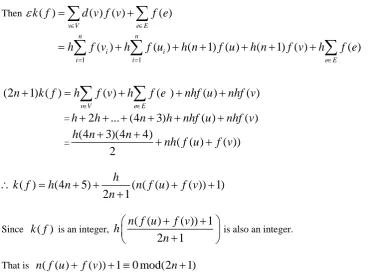
∑
(2
1) ( )
( )
( )
( )
( )
v V e E
n
k f
h
f v
h
f e
nhf u
nhf v
∈ ∈
+
=
∑
+
∑
+
+
=
h
+
2
h
+ +
... (4
n
+
3)
h
+
nhf u
( )
+
nhf v
( )
=
(4
3)(4
4)
( ( )
( ))
2
h n
n
nh f u
f v
+
+
+
+
( )
(4
5)
( ( ( )
( )) 1)
2
1
h
k f
h n
n f u
f v
n
∴
=
+ +
+
+
+
Since
k f
( )
is an integer,( ( )
( )) 1
2
1
n f u
f v
h
n
+
+
+
is also an integer.That is
n f u
( ( )
+
f v
( )) 1
+ ≡
0 mod(2
n
+
1)
And hence
n f u
( ( )
+
f v
( ))
≡
2 mod(2
n
n
+
1)
which implies thatf u
( )
+
f v
( )
≡
2 mod(2
n
+
1)
But
f u
( )
+
f v
( )
≥
3
and thusf u
( )
+
f v
( )
≥
2
n
+
3
( )
(4
5) [ (2
3) 1] / 2
1
k f
h
n
n
n
h
n
∴
≥
+ +
+ +
+
=
h n
(5
+
6)
© 2015, IJMA. All Rights Reserved 50
Hence
Em B
(
n n,)
=
h n
(5
+
6)
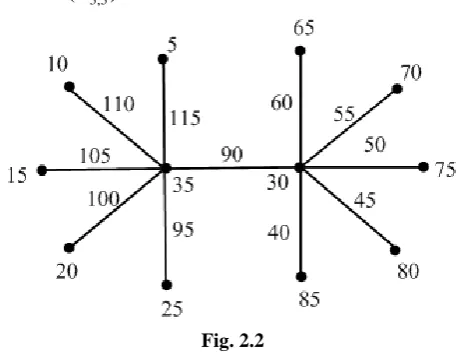
Example2.2: Fig. 2.2 Shows that
Em B
(
5,5)
=
155
Fig. 2.2
Theorem2.3:
Em
(
<
K
1,n: 2 )
> =
h n
(4
+
9)
Proof: Define the labeling f on
<
K
1,n: 2
>
as follows( )
, ( )
2 , ( )
(
3)
f u
=
h f v
=
h f w
=
h n
+
( )
i(
2)
f u
=
h i
+
for1
≤ ≤
i
n
,( )
i(
3
)
f v
=
h n
+ +
i
for1
≤ ≤
i
n
,(
)
(3
5), (
)
(3
4), (
i)
(4
6
)
f uw
=
h n
+
f vw
=
h n
+
f uu
=
h n
+ −
i
for1
≤ ≤
i
n
(
i)
(3
4
)
f vv
=
h n
+ −
i
for1
≤ ≤
i
n
One can check that the above labeling f is a E-magic h-multiple labeling of
<
K
1,n: 2
>
withk f
( )
=
h
(4
n
+
9)
Thus
Em
(
<
K
1,n: 2 )
> ≤
h n
(4
+
9)
Now we show that
Em
(
<
K
1,n: 2 )
> ≥
h n
(4
+
9)
Let f be a magic labeling of
<
K
1,n: 2
>
with constantk f
( )
Then
( )
( ) ( )
( )
v V e E
k f
d v f v
f e
ε
∈ ∈
=
∑
+
∑
That is,
1 1
(2
2) ( )
( )
( )
(
1) ( )
(
1) ( ) 2 ( )
( )
n n i i
i i e E
n
k f
h u
h
f v
h n
f u
h n
f v
h w
h
f e
= = ∈
+
=
∑
+
∑
+
+
+
+
+
+
∑
(2
2 )
( )
( )
( )
( )
( )
( )
v V e E
n
f
h
f v
h
f e
nhf u
nhf v
hf w
∈ ∈
+
=
∑
+
∑
+
+
+
=
h
+
2
h
+ +
... (4
n
+
5)
h
+
nhf u
( )
+
nhf v
( )
+
hf w
( )
=
(4
5)(4
6)
( ( )
( ))
( )
2
h n
n
nh f u
f v
hf w
+
+
+
+
+
(4
5)(4
6)
( ( ( )
( ))
( )) / (2
2)
2(2
2)
h
n
n
h n f u
f v
f w
n
n
+
+
=
+
+
+
+
+
( )
(4
7)
( ( ( )
( ))
( ) 1)
2
2
h
k f
h n
n f u
f v
f w
n
∴
=
+ +
+
+
+
Since
k f
( )
is an integer andf u
( )
+
f v
( )
≥
3
,Em
(
<
K
1,n: 2 )
> ≥
h n
(4
+
9)
HenceEm
(
<
K
1,n: 2 )
> =
h n
(4
+
9)
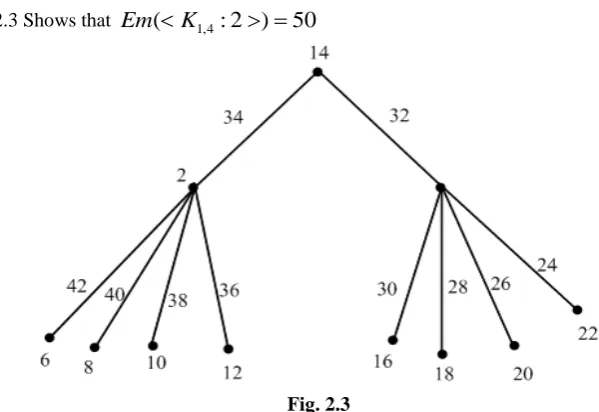
Example2.3: Fig. 2.3 Shows that
Em
(
<
K
1,4: 2 )
> =
50
Fig. 2.3
Definition 2.2: The graph
nP
2 is defined as the disjoint union of n copies ofP
2.Theorem2.4:
Em
((2
n
+
1)
P
2)
=
h n
(9
+
6)
for anyn
≥
0,
n
is oddProof: Let the vertices of
(2
n
+
1)
P
2 beu u
1,
2,...,
u
2n+1; ,
v v
1 2,...,
v
2n+1 and let the edge set be{
u v
i i:1
≤ ≤
i
2
n
+
1}
Define
f V
:
∪ →
E
{ , 2 , 3 ,..., (6
h
h h
h
n
+
3)}
in such a way thatf u
( )
i=
ih
for1
≤ ≤
i
2
n
+
1
( )
i(6
4 2 )
f v
=
h n
+ −
i
for1
≤ ≤
i
n
,(
n i)
(6
5 2 )
f v
+=
h n
+ −
i
for1
≤ ≤ +
i
n
1
,(
i i)
(3
2
)
f u v
=
h n
+ +
i
for1
≤ ≤
i
n
,(
n i n i)
(2
1
)
f u v
+ +=
h n
+ +
i
for1
≤ ≤ +
i
n
1
It is easy to check that f is a E- magic h-multible labeling of
(2
n
+
1)
P
2 withk f
( )
=
h n
(9
+
6)
Let f be a E-magic h-multiple labeling of
(2
n
+
1)
P
2 with constantk f
( )
Then
( )
( ) ( )
( )
v V e E
k f
d v f v
f e
ε
∈ ∈
=
∑
+
∑
(2
1) ( )
( )
( )
v V e E
n
k f
h
f v
h
f e
∈ ∈
+
=
∑
+
∑
=
h
+
2
h
+ +
... (6
n
+
3)
h
=
(6
3)(6
4)
2
h n
+
n
+
(6
3)(6
4)
( )
(2
1)2
h n
n
k f
n
+
+
∴
=
+
=
h n
(9
+
6)
© 2015, IJMA. All Rights Reserved 52
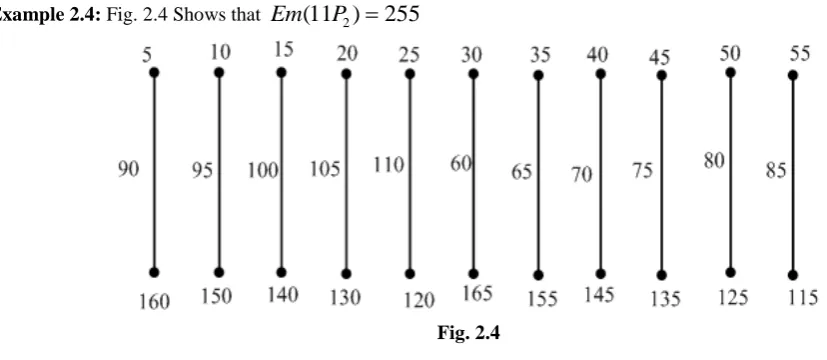
Example2.4: Fig. 2.4 Shows that
Em
(11 )
P
2=
255
Fig. 2.4
Theorem2.5:
Em C
(
2n+1)
=
h n
(5
+
4)
Proof: Let the vertices of
C
2n+1 bev v
1 2...
v
2n+1 1v
Define
f V
:
∪ →
E
{ , 2 , 3 ,..., (5
h
h h
h n
+
4)}
in such a way thatf v
(
2i+1)
=
h i
(
+
1)
for0
≤ ≤
i
n
2(
i)
(
1
)
f v
=
h n
+ +
i
for1
≤ ≤
i
n
, 1(
i i)
(4
2
)
f v v
+=
h n
+ −
i
for1
≤ ≤
i
2
n
, 2 1 1(
n)
(4
2)
f v
+v
=
h n
+
It is easy to check that f is a E- magic h-multiple labeling of
C
2n+1 withk f
( )
=
h n
(5
+
4)
Thus,
Em C
(
2n+1)
≤
h n
(5
+
4)
Let f be a E-magic h-multiple labeling of
C
2n+1 with constantk f
( )
Then
( )
( ) ( )
( )
v V e E
k f
d v f v
f e
ε
∈ ∈
=
∑
+
∑
(2
1) ( )
2 ( )
( )
v V e E
n
k f
h
f v
h
f e
∈ ∈
+
=
∑
+
∑
( )
( )
( )
v V e E v V
h
f v
h
f e
h
f v
∈ ∈ ∈
=
∑
+
∑
+
∑
=
2
... (4
2)
( )
v V
h
h
n
h
h
f v
∈
+
+ +
+
+
∑
(4
2)(4
3)
2
... (2
1)
2
h n
n
h
h
n
h
+
+
≥
+ +
+ +
+
( )
(5
4)
k f
h n
∴
≥
+
2 1
(
n)
(5
4)
Em C
+≥
h n
+
Example2.5: Fig. 2.5 Shows that
Em C
(
9)
=
48
Fig 2.5
Theorem 2.6:
Em P
(
n2)
=
3
nh
Proof: Let the vertices of
P
n2bev v
1,
2,...,
v
nDefine
f V
:
∪ →
E
{ , 2 , 3 ,..., 3
h
h h
nh
}
in such a way that( )
if v
=
ih
for1
≤ ≤
i
n
, 1(
i i)
(3
(2
1))
f v v
+=
h n
−
i
+
for1
≤ ≤ −
i
n
1
, 2(
i i)
(3
(2
2))
f v v
+=
h n
−
i
+
1
≤ ≤ −
i
n
2
Thus,Em P
(
n2)
≤
3
nh
But since
ε
(
P
n2)
=
(3
n
−
3) ,
h
we haveEm P
(
n2)
≥
3
nh
HenceEm P
(
n2)
=
3
nh
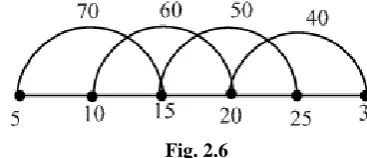
Example2.6: Fig. 2.6 Shows that
Em P
(
62)
=
90
Fig. 2.6
3. V- MAGIC STRENGTH OF H-MULTIPLE LABELING OF GRAPHS
Definition 3.1 [4]: A one-to-one map
f V
:
∪ →
E
{1, 2, 3,...,
m
+
n
}
is a vertex –magic total labeling of G if there is a constant k so that for every vertex u,( )
( )
( )
( )
k
v N u
w u
f u
f u v
k
∈
=
+
∑
=
. So the magic requirement is theassociated weight
w u
k( )
=
k
for all u. The fixed integer k is called the magic constant off
.Definition 3.2 [4]: Let h be any positive integer. A one-to-one map
f
fromV
∪
E
of a graph G onto the integers{
h h h
, 2 , 3 ,..., (
m
+
n h
)
}
is a V-Magic h-multiple labeling if there exist a constant k such that( )
( )
( )
v N u
f u
f u v
k
∈
+
∑
=
. A graph which admits V-Magic h-multiple labeling then it is called V-Magic h-multiple© 2015, IJMA. All Rights Reserved 54
Lemma 3.1: [1] If a non-trivial graph G is vertex magic, then the magic constant k is given by
1
(
1)
2
p
q q
k
q
p
+
+
= +
+
Theorem3.1:
(
)
(5
3)
3
2
n
h n
k P
=
−
if
n
is
odd
and
n
≥
Proof: Let
{ ,
v v
1 2,..., }
v
n be the consecutive vertices and{ ,
e e
1 2,...,
e
n−1}
be the consecutive edges ofP
n.That is
E P
(
n)
=
{
e
i=
v v
i i+1/ 1
≤ ≤ −
i
n
1}
Define
f V
:
∪ →
E
{ , 2 , 3 ,..., (2
h
h h
h
n
−
1)}
as follows 1( )
(2
1)
( )
(
2
)
2
(
)
2
( )
(
)
2
i if v
h n
f v
h n
i
for
i
n
h n i
if
i
is
odd
and f e
i
h n
if
i
is
even
=
−
=
− +
≤ ≤
−
=
−
Let f be an V –Magic h-multiple labeling of a graph G with the magic number k. Then
f E
( )
=
{ , 2 , 3 ,...,
h
h h
hm
}
and( )
( )
(
)
v N u
f u
f uv
k for
all
u
V
∈
+
∑
=
∈
That is
( )
(
n)
( )
(
)
u V u V v N u
nk P
f u
f uv for
all
u
V
∈ ∈ ∈
=
∑
+
∑ ∑
∈
( ) 2
( )
(
1)
(
1)
(
1)
2
u V e E
f u
f e
hn n
hn n
hn n
∈ ∈
=
+
+
=
− +
+
−
∑
∑
(
1)
(
)
(
1)
(
1)
2
n
h n
k P
h n
+
h n
∴
=
− +
+
−
(
1)
2 (
1)
2
(5
3)
3
2
h n
h n
h n
if
n
is odd
and
n
+
=
− +
−
=
≥
Example 3.1: Fig. 3.1 Shows that
k P
(
5)
=
55
Fig 3.1
Remark 3.1: In [5], Bondy and Murty constructed an m-connected graph
H
m n, on n-vertices that has exactly {mn/2} edges. The structure ofH
m n, depends on the parities of m and n; there are three cases.Case-2: m odd, n even. Let m=2r+1.Then
H
2r+1,n is constructed by first drawingH
2 ,r nand then adding edges joining vertex i to vertex i+(n/2) for1
≤ ≤
i
n
/ 2
Case-3: m odd, n odd. Let m=2r+1.Then
H
2r+1,n is constructed by first drawingH
2 ,r n and then adding edges joining vertex 0 to vertices(n-1)/2 and (n+1)/2 and vertex i to vertex i+(n+1)/2 for1
≤ ≤
i
(
n
−
1) / 2
Theorem 3.2:
(
4,)
(13
5)
2
n
h
n
k H
=
+
if
n
is
odd
Proof: Let the vertex set of
H
4,nbe
V
=
{ ,
v v
1 2,..., }
v
n and the edge set ofH
4,n be1 1 2 1 1 2
{
i i/ 1
1}
{
n}
{
i i/ 1
2}
{
n}
{
n}
E
=
v v
+≤ ≤ − ∪
i
n
v v
∪
v v
+≤ ≤ − ∪
i
n
v v
−∪
v v
Define
f V
:
∪ →
E
{ , 2 , 3 ,..., 3
h
h h
nh
}
as follows(6
1
)
1(mod 2)
2
( )
(5
1
)
0(mod 2)
2
i
h
n
i
for
i
f v
h
n
i
for
i
+ −
≡
=
+ −
≡
1(
2
)
1(mod 2),
2
(
)
(
2)
0(mod 2)
2
i i
h
n
i
for
i
i
n
f v v
h
i
for
i
+
+ +
≡
≠
=
+
≡
1(
n)
f v v
=
h
2
1
2 (
)
1, 2,...,
2
(
)
1
3
(3
2 )
,
,...,
2
2
2
i i
n
h n i
for
i
f v v
n
n
h n
i
for
i
n
+
−
−
=
=
+
+
−
=
−
1 1(
n)
(
2)
f v v
−=
h n
+
2
(
n)
2
f v v
=
hn
Suppose there exists an vertex –magic h-multiple total labeling f of a graph G with the magic number k. Then by lemma [3.1],
(
1)
(2 )(2
1)
(2 )
2
1
[2
4
2]
2
(13
5)
2
h n
h n
n
k
h n
n
n
h n
n
© 2015, IJMA. All Rights Reserved 56
Example3.2: Fig. 3.2 Shows that
k H
(
4,7)
=
96
Fig. 3.2
REFERENCES
1. G.Marimuthu and M.Balakrishnan, E-Super vertex magic labelings of graphs, Discrete Applied Mathematics 160(2012) 1766-1774.
2. D.G.Akka and Nanda S.Warad, Super Magic Strength of a graph, Indian J. Pure Appl. math., 41(4):557-568, August 2010.
3. Selvam Avadayappan, R.Vasuki and P.Jeyanthi, Magic Strength of a graph, Indian J. Pure appl.math., 31(7): 873-883, July 2000.
4. C.Y.Ponnappan, C.T.Nagaraj, C.Ranjitham, Vertex-Magic h-Multiple Labeling, International Journal of IT, Engineering and Applied Sciences Research (IJIEASR) Volume 3, No.11, November 2014.
5. J.A.Bondy and U.S.R.Murty, Graph Theory with applications, Macmillan, London, 1976.
6. J.Sedlacek, problem 27.in: Theory of graphs and its Applications.Proc.Symposium, 1963; pp.163-167.
Source of support: Nil, Conflict of interest: None Declared
[Copy right © 2015. This is an Open Access article distributed under the terms of the International Journal of Mathematical Archive (IJMA), which permits unrestricted use, distribution, and reproduction in any medium, provided the original work is properly cited.]