© 2019 by the Serbian Biological Society How to cite this article: Đurović S, Dragičević V, Waisi H, Pagnacco M, Luković N, 425 Knežević-Jugović Z, Nikolić B. Enhancement of antioxidant activity and bioactive
compound contents in yellow soybean by plant-extract-based products. Arch Biol Sci. 2019;71(3):425-34.
Enhancement of antioxidant activity and bioactive compound contents in yellow soybean
by plant-extract-based products
Sanja Đurović1,*, Vesna Dragičević2, Hadi Waisi3,4, Maja Pagnacco5, Nevena Luković6, Zorica Knežević-Jugović6 and Bogdan Nikolić1
1Institute for Plant Protection and Environment, Teodora Drajzera 9, 11000 Belgrade, Serbia
2Maize Research Institute Zemun Polje, Slobodana Bajića 1, Belgrade, Serbia
3Faculty for Ecology and Environmental Protection, University Union-Nikola Tesla, Cara Dušana 62-64, Belgrade, Serbia
4Department of Physical Chemistry, Institute of Nuclear Sciences Vinča, University of Belgrade, Mike Petrovica Alasa 12-14,
Belgrade, Serbia
5Institute of Chemistry, Technology and Metallurgy, Department of Catalysis and Chemical Engineering, University of
Belgrade, Njegoševa 12, 11000 Belgrade, Serbia
6Department of Biotechnology and Biochemical Engineering, Faculty of Technology and Metallurgy, University of Belgrade,
Karnegijeva 4, Belgrade, Serbia
*Corresponding author: [email protected]
Received: January 23, 2019; Revised: March 15, 2019; Accepted: April 8, 2019; Published online: April 9, 2019
Abstract: Polyphenols present in different plant cell organelles increase the resistance of plants to various types of
envi-ronmental stresses. We investigated the possibility of increasing the content of bioactive compounds in the seed of yel-low soybean variety Laura. The soybean was treated during vegetation with five products based on plant extracts, on the assumption of enrichment of plants with various nutrients. Soybean flour extracts were screened spectrophotometrically for total phenolic content and antioxidant activity. The antioxidant activity was evaluated using three methods. The content of phenolic acids was determined by HPLC, and the raw protein content was estimated by the Kjeldahl method. Depending on the treatment, variations in the quantity of individual phenolic acids with up to 90% higher concentration as compared to the control were observed. Controlled usage of certain plant extracts can increase the concentration of the target group of bioactive compounds in the samples. The synergistic effect of proteins and phenolic compounds on the antioxidant activity of extracts was detected. The results of this study are not only important from the aspect of plant resistance to various types of stress, but also when considering soybean as a functional food.
Keywords: antioxidant activity; plant extracts; phenolic acids; soybean seeds
INTRODUCTION
Many compounds of natural origin activate plant me-tabolism by intensifying processes such as photosyn-thesis, respiration, adsorption and transport of ions, and consequently plant growth, contributing to greater bioproduction and yields of wild and cultivated plants.
Soybean (Glycine max (L) Merrill), as one of the major legume plants and one of the five most widespread crops in the world, is a suitable object for exploring the impact of different natural compounds on plants. Soybean is a plant with an extremely favorable chemical
[2], phenolic acids and flavonoids, most of which are isoflavones. Phenolic compounds are one of the larg-est, most widespread and biologically (physiologically and medically) important groups of secondary plant metabolites. They represent an integral part of the cell wall structure, mainly in the form of polymeric ma-terials (e.g. lignin), providing a mechanical support for plant cells and a barrier to microorganisms [3,4]. They also participate in various biochemical processes related to photosynthesis, protect plants from bacteria, fungi and viruses, as well as from mechanical dam-age. Phenolic compounds, together with α-tocopherol and β-carotene, belong to the group of nonenzymatic antioxidants, and have found application in food and pharmaceutical industries [5,6]. In order to improve the chemical composition of soybean seeds, many studies have examined the influence of different methods of seed processing (fermentation and thermal treatment) on the phenolic compound contents [7,8], but there are very few reports on the effect of treatment during the vegetation period, on changes in phenolic compounds and the protein content in soybean seed.
The aim of this paper was to examine the changes in the contents of proteins, phenolic acids and the total phenolic content, and antioxidant activity of soybean seed as a result of the treatment of soybean plants with different products based on plant extracts. The results point to the possibility of producing soybeans with different classes of bioactive compounds, controlled by the application of natural products during the vegeta-tive stage. It can be assumed that soybean seed with an altered chemical composition could positively affect the germination and early stages of plant growth.
MATERIALS AND METHODS Chemicals and reagents
Gallic acid (97.5%), trans-cinnamic acid (97%), p -coumaric acid (98%), caffeic acid (≥98%), ferulic acid (99%); 2,2-diphenyl-1-picrylhydrazyl (DPPH), 6-hy-droxy-2,5,7,8-tetramethylchroman-2-carboxylic acid (TROLOX, 97%), analytical grade water, acetonitrile (≥99.9%), methanol (≥99.9%), were purchased from Sigma-Aldrich (St. Louis, USA); 2,4,6-Tris (2-pyridyl)-s-triazine (TPTZ, ≥99%), was purchased from Fluka, (Büchi, Switzerland); L(+)-ascorbic acid (99%), was
purchased from Acros Organics, (New Jersey, USA); chlorogenic acid (99.5%) was purchased from Chro-madex, (USA); Folin-Ciocalteu reagent was purchased from Reagecon, (Ireland). Kjeldahl catalyst tablets were purchased from Fisher (UK). All other solvents and chemicals were of p.a. grade or higher purity.
Plant material and plant-extract-based products
Pre-extraction preparation of samples
All samples were ground in a laboratory mill (IKA, IP-21, USA) and sieved through a laboratory sieve of 500-μm diameter. Flour samples were defatted in petrol ether in a Soxhlet extractor for 4 h at a sample/solvent ratio of 1:10 g/mL before extraction. The moisture con-tent was determined by gravimetry. Defatted soybean flour (5 g per sample) was dried in an oven at 105°C until a constant mass was attained. This data was used to calculate the amounts of analytes in seed dry mass.
Extraction of free phenolic acids
Defatted soybean flour (0.5 g per sample) was mixed with 10 mL of the extraction solvent (a mixture of methanol and 10% hydrochloric acid at a ratio of 85:15% (v/v)). Selection of this extraction mixture was adopted on the basis of our previous research [11]. Extraction was carried out in a shaker (VXR basic VI-BRAX, IKA) overnight. Samples were centrifuged (15 min at 12000×g in a MiniSpin Eppendorf centrifuge), filtered through a 45-μm syringe filter and subjected to HPLC analysis. Compounds in the supernatant are present in a soluble form.
Alkaline hydrolysis
A precipitate from the previous step was subjected to alkaline hydrolysis (with 10 mL 4 M NaOH, for 4 h at room temperature), to release phenolic acids co-valently bound to other molecules such as fatty acids (soluble esters). A fraction of esterified phenolic acids was separated with 2×15 mL of a diethyl ether (DE) ethyl acetate (EA) mixture (1:1). After centrifugation, the DE/EA layers with isolated phenolic acids were evaporated to dryness in a rotary evaporator at 40-45°C, then dissolved in 2 mL methanol, filtered through a 45-μm syringe filter and subjected to HPLC analysis.
Acid hydrolysis
The lower aqueous layer, remaining after alkaline hydrolysis, was subjected to acid hydrolysis (with 2.5 mL concentrated HCl, for 30 min at 80°C), in order to break chemical bonds and isolate phenolic acids bound to cell wall substances, including pectin, cellulose, hemicellulose, arabinoxylans and structural proteins.
Separation of the released phenolic acids was carried out with 2×15 mL of DE/EA (1:1). After centrifuga-tion, the DE/EA layers with isolated phenolic acids were evaporated to dryness in a rotary evaporator at 40-45°C, dissolved in 2 mL methanol, filtered through a 45-μm syringe filter and subjected to HPLC analysis.
Quantification of individual phenolic acids
Quantification of six monitored phenolic acids was carried out by liquid chromatography. The Shimadzu Nexera HPLC system was used, and separation of phe-nolic acids was performed on an Agilent Zorbax SB C18 column (250×4.6 mm, id 5 μm). The column was thermostatically controlled at 25°C and the flow rate was set to 1 mL/min. A two-component mobile phase was used, comprised of 0.1% formic acid (A) and methanol (B), and the gradient was adopted from Đurović et al. [11]. Identification and quantification of the phe-nolic acids were performed at two wavelengths, at 280 nm for gallic and trans-cinnamic acid, and at 325 nm for p-coumaric, ferulic, chlorogenic and caffeic acids. Identification of phenolic acids was accomplished by comparing the retention time of the peaks to those of standard compounds. Quantitative analysis of phenolic acids was based on calibration curves constructed for each compound identified in the samples. Calibration curves were performed according to Đurović et al. [11]. The results were expressed as µg/g of dry matter (d.m.). A HPLC-DAD chromatogram of a standard mixture of six phenolic acids (concentration of 50 μg/mL), and HPLC-DAD chromatograms of all three fractions of phenolic acids are presented in Supplementary Fig. S1.
Total phenolic content
The total phenolic content (TPC) in all three fractions (free, esterified and bound) was determined by a Folin-Ciocalteu assay using gallic acid (GA) as the standard as described [12]. The absorbance was measured at 765 nm using a Shimadzu UV-2100 spectrophotometer. The concentrations of total phenolic compounds were expressed as mg GAE/g d.m.
Determination of antioxidant activity by the DPPH assay
the antioxidant activity of soybean seeds, the meth-od of Chen and Ho [13] was used, slightly mmeth-odified according to Đurović et al. [11]. The DPPH radical scavenging activity was determined spectrophoto-metrically by measuring the absorbance at 517 nm against methanol and calculated from the standard curve of Trolox reagent. The results were expressed as micromoles of Trolox equivalents (TE) per g of dry matter (μmol TE/g d.m.).
Determination of antioxidant activity by the Briggs-Rauscher reaction method
The dynamics of Briggs-Rauscher (BR) reaction were followed potentiometrically [14]. A Pt electrode was used as a working electrode, while the double junction Ag/AgCl was used as the reference electrode. The initial concentrations of reactants for the BR reaction were [CH2(COOH)2]0=0.0789 mol/L, [MnSO4]0=0.00752 mol/L, [HClO4]0=0.0300 mol/L, [KIO3]0=0.0752 mol/ L and [H2O2]0=1.2690 mol/L. The reaction volume was 25 mL. An aliquot (100 μL) of the soybean extract was added 30 s after hydrogen peroxide addition in a BR oscillatory regime. It is important to note that the experimental setup was adjusted to a human organism, with the temperature maintained at T=37±0.1оС and the BR reaction solution pH of stomach pH<2.
Determination of antioxidant activity by the FRAP assay
The FRAP method (ferric ion reducing antioxidant power assay) is based on the reduction of the Fe3+ -tripyridyl-triazine complex (Fe3+-TPTZ) to the Fe2+ -tripyridyl-triazine complex. The amount of reduced Fe2+-TPTZ complex was calculated from the equation of regression law, which was constructed by measur-ing the absorption of standard aqueous solutions of FeSO4×7H2O at 593 nm. FRAP was performed by the Benzie and Strain method [15] for all three fractions of phenolic acids (free, esterified and bound). Ten-times diluted plant extracts or FeSO4×7H2O solutions (150 μL) were mixed with 2.5 mL of FRAP reagent and incubated at 37°C in a water bath for 30 min. A calibration curve of FeSO4×7H2O was prepared at concentrations ranging from 10-1000 μmol/L. The results were expressed as μmol Fe2+ eq/g d.m.
Determination of total nitrogen (Kjeldahl method) and the protein content
The Kjeldahl method is almost universally applied for the determination of the nitrogen content in plant material [16]. Total nitrogen is then multiplied by a factor to calculate the protein content. A factor of 5.71 was used to calculate the protein content in soybean seeds, according to literature data [17,18]. Soybean flour (0.5 g per sample) was digested in a Kjeldahl digestion flask by boiling with 10 mL of concentrated sulfuric acid and a Kjeldahl catalyst tablet until the mixture was clear (about 2 h) The digest was cooled and 20 mL of distilled water were added and connected for distillation. Ammonia was steam-distilled from the digest to which 50 mL of 32% sodium hydroxide solution were added. The distillate was collected in a conical flask containing 50 mL 0.1 M H2SO4 and Tashiro indicator. The ammonia that distilled into the receiving conical flask reacted with the acid and the excess acid in the flask was estimated by back-titration against 0.2 M NaOH with a color change from purple to green (endpoint). Determinations were made on all reagents alone (blank determinations). Total nitrogen was multiplied by 5.71 to arrive at the protein content. Oil determination
The oil content was determined by the Soxhlet ex-traction method, in accordance with international standard EN ISO 659:2009. Subtraction of the mass prior to and after extraction provides the oil content in soybean seed.
Statistical analysis
RESULTS
Quantification of free, esterified and bound phenolic acids
The identification of phenolic acids in soybean seed extracts was based on external standards of phenolic acids; the compounds corresponding to the peaks were identified after comparing their retention times and HPLC-DAD spectra. HPLC-DAD chromatograms of standards and methanolic soybean extracts in all three fractions are presented in Supplementary Fig. S1. The
amounts of six phenolic acids in three different frac-tions in soybean flour extracts are presented in Table 1 (free fraction), Table 2 (esterified solubilized fraction), and Table 3 (bound fraction). The highest amount of phenolic acids in soybean seed was detected in the free soluble fraction (Table 1). The biggest change was observed in the amount of p-coumaric acid, whose concentration was increased by “Calbit-C”, “Cropmax” and “Zircon” treatments to 39.98%, 42.31% and 40.91% (w/w), respectively. In this fraction, the smallest effect on the variation in the amount of monitored phenolic acids was observed with the treatment with “Ekofus”.
Table 1. Content of six individual phenolic acids in the free soluble fraction (μg/g d.m.) in soybean seeds influenced by treatments with different plant-extract-based products.
“Control” “Vegard” “Ekofus” “Calbit-C” “Cropmax” “Zircon”
GaA 55.85±0.60a 55.97±0.74a 63.61±0.53c 70.25±0.52e 67.21±0.50d 58.86±0.42b
ChA 80.21±0.47c 76.76±0.65b 70.17±0.74a 89.16±0.76ef 88.06±0.49e 84.77±0.53d
CaA 36.66±0.38c 28.71±0.43a 28.12±0.58a 39.22±0.45d 40.05±0.59d 34.72±0.43b
CoA 215.57±0.84a 281.3±1.39c 261.65±1.47b 301.76±1.48d 306.77±1.07f 303.77±1.20e
FeA 156.00±0.56a 179.05±1.30b 157.11±1.10a 181.63±1.23c 187.18±1.27e 184.47±1.14d
TCA 206.33±0.86b 226.00±1.0c 187.6±1.25a 233.96±1.50d 238.34±1.19e 264.09±1.40f
For each treatment, determinations of the phenolic acid contents were conducted in triplicate. Values are expressed as the mean with standard devia-tion (SD). Means followed by same letters within the same row are not significantly different at the 0.05 level.
Abbreviations: GaA – gallic acid; ChA – chlorogenic acid; CaA – caffeic acid; CoA – p-coumaric acid; FeA – ferulic acid; TCA – trans-cinnamic acid.
Table 2. Content of six individual phenolic acids in the esterified soluble fraction (μg/g d.m.) in soybean seeds influenced by treatments with different plant-extract-based products.
Control “Vegard” “Ekofus” “Calbit-C” “Cropmax” “Zircon”
GaA 57.69±0.64c 53.98±0.24b 52.55±0.64a 60.85±0.47d 60.45±0.32d 57.53±0.53c
ChA 52.1±0.51b 56.13±0.36c 45.86±0.44a 58.4±0.57d 58.75±0.35d 59.59±0.48d
CaA 53.77±0.48c 56.02±0.36d 48.7±0.64a 51.68±0.44b 51.59±0.47b 55.68±0.61d
CoA 177.07±0.73a 342.77±0.66f 247.39±1.58c 264.56±1.27d 223±0.99b 268.39±1.29e
FeA 146.28±0.38a 266.24±0.73f 201.7±1.53c 223.73±1.03e 185.63±1.35b 207.05±1.09d
TCA 45.79±0.54a 47.36±0.36c 45.86±0.59a 48.64±0.57d 48.51±0.45d 46.49±0.54b
For each treatment, determinations of the phenolic acid contents were conducted in triplicate. Values are expressed as the mean with standard devia-tion (SD). Means followed by same letters within the same row are not significantly different at the 0.05 level.
Abbreviations: GaA – gallic acid; ChA – chlorogenic acid; CaA – caffeic acid; CoA – p-coumaric acid; FeA – ferulic acid; TCA – trans-cinnamic acid.
Table 3. Contents of six individual phenolic acids in the bound insoluble fraction (μg/g d.m.) in soybean seeds influenced by treatments with different plant-extract-based products.
“Control” “Vegard” “Ekofus” “Calbit-C” “Cropmax” “Zircon”
GaA 69.41±0.63a 71.1±0.57b 75.95±0.59c 80.16±0.54d 80.68±0.56d 80.56±0.46d
ChA n.d. n.d. n.d. n.d. n.d. n.d.
CaA n.d. n.d. n.d. n.d. n.d. n.d.
CoA 45.05±0.49b 42.75±0.21a 44.61±0.50b 49.26±0.47de 46.97±0.54c 48.73±0.51d
FeA 43.79±0.37b 43.08±0.23a 44.8±0.52c 51.35±0.50f 47.66±0.58e 45.58±0.59d
TCA 43.06±0.30a 44.19±0.23b 45.59±0.52c 46.91±0.43d 51.92±0.48e 46.71±0.53d
For each treatment, determinations of the phenolic acid contents were conducted in triplicate. Values are expressed as the mean with standard deviation (SD). Means followed by same letters within the same row are not significantly different at the 0.05 level.
Esterified soluble p-coumaric and ferulic acids showed the biggest changes depending on the type of the treatments (Table 2). The treatment with “Ve-gard” led to an increase in the content of p-coumaric and ferulic acids by 93.58% (w/w) and 82% (w/w), respectively. Although “Vegard” and “Ekofus” exerted the smallest effect on the variations of free phenolic acids (Table 1), their impact was great on the esterified fraction (Table 2).
The smallest amount of phenolic acids was re-leased after acid hydrolysis (Table 3). In this fraction, chlorogenic and caffeic acids were not detected in any sample, and changes in the amounts of other phenolic acids varied significantly less when compared to the free and esterified fractions. Parallel with the free frac-tion (Table 1), treatments with “Calbit-C”, “Cropmax” and “Zircon” increased the amount of phenolic acids in this fraction (Table 3).
The results of ANOVA indicate a statistically sig-nificant difference (p<0.05) in the content of individual phenolic acids depending on the treatment in each fraction.
Total phenolic contents and antioxidant activities of the extracts
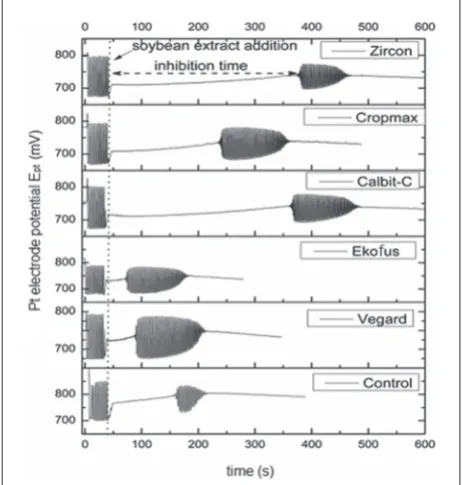
The antioxidant activity cannot be fully described us-ing a sus-ingle method because it is influenced by many factors such as post-harvest storage, processing condi-tions, environmental condicondi-tions, physiological factors in plants, etc. [19,20]. Consequently, it is appropriate to use several assays instead of a single one to evalu-ate and compare the antioxidant activities of different substances of plant origin. Furthermore, antioxidant activities are also difficult to interpret because of the different viewpoints on the molecular mechanisms of free-radical scavenging, and the structural dependency of antioxidant action and different reaction rate con-stants towards radicals or molecules used in different antioxidant assessments. Thus, the antioxidant activi-ties of the investigated soybean extracts were evaluated using different methods: TPC (Fig. 1), free radical scavenging activity by DPPH, reducing power assays FRAP (Fig. 2), and the BR reaction method (Fig. 3).
Comparing the outcomes of TPC, DPPH and FRAP with the results obtained by the BR reaction method,
Fig. 1. Total phenolic content (TPC) in soybean seed influenced by treatments with different plant-extract-based products, determined as mg GAE/g dry matter (d.m.). * – Values followed by the same letters are not significantly different at the 0.05 level.
Fig. 2. Antioxidant activities determined by the DPPH and FRAP assays in soybean seed influenced by treatments with different plant-extract-based products. *– Values followed by the same letters are not significantly different at the 0.05 level.
the best antioxidant activity (which means the high-est inhibition time) was obtained for soybean treated with “Zircon” and “Calbit-C”, while treatments with “Vegard” and “Ekofus” were significantly lacking (Fig. 3). Soybean treated with “Vegard” and “Ekofus” were very similar to each other and exhibited only slightly weaker antioxidant activities than the sample from control plants. According to the BR reaction method, the results obtained from soybean treated with “Crop-max” were between these two groups (Fig. 3).
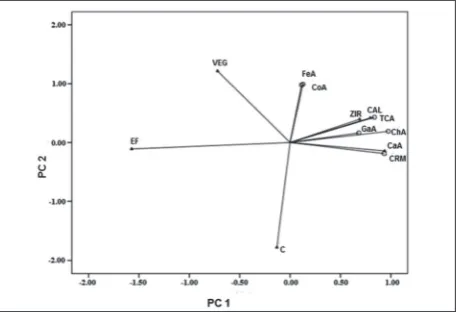
According to the results of PCA (Fig. 4), PC 1 was explained by 57.31%, and PC 2 by 29.96% in total vari-ability. PC 1 was explained by chlorogenic, caffeic and
trans-cinnamic acids with 97.4%, 93.3%, and 83.7%, respectively, while PC 2 was explained by p-coumaric and ferulic acids with 99.1% and 97.8%, respectively.
Protein and oil contents
Fig. 5 shows variations in the protein and oil contents (%, w/w) in soybean seeds from plants treated with five plant-extract-based products. Treatments with “Calbit-C” and “Cropmax” showed a negative influence on the oil content, but a positive influence on the raw protein content, especially “Cropmax”, which increased the protein content for 5.66% (w/w) compared to the control sample.
DISCUSSION
There are many studies on the phenolic compounds and their protective role in plants against a variety of stressors [21-23]. In the present paper, the antioxidant activity of soybean extracts was directly proportional to the total phenolic content. Also, treatment with different natural products (based mainly on plant and algae extracts) can contribute to the accumulation of certain groups of bioactive compounds and make the plant more resistant to the effects of external factors.
The content of all examined phenolic acids in seed samples varied in comparison to the control sample. Our results are in agreement with the Aludatt et al.
[24], where the highest amount of phenolic acids in soybean seed was detected in the free soluble fraction. The authors also confirmed that the major predominant phenolic compounds in full-fat soybean and in defatted soybean meal were ferulic acid and p-coumaric acid, which is similar to the results of the present study. Kim et al. [25] confirmed that p-coumaric and ferulic acids were strongly bound in soybean with cell components, and released after alkaline hydrolysis. This result dem-onstrated that some phenolic acids were synthesized as macromolecular bound components (i.e. polyphenol, tannin, and lignin) to support structural cell wall devel-opment. Chlorogenic, caffeic and p-coumaric acids are intermediates during lignin biosynthesis, while ferulic acid is also probably linked to polysaccharides, lignin, and suberin [26,27]. The smallest amounts of phenolic acids were present in the bound fraction, which is also in accordance with Aludatt et al. [24].
HPLC-DAD chromatograms revealed differences in the phenolic compound profiles in three different fractions of methanolic soybean flour extracts. In ad-Fig. 4. PCA biplot of the phenolic acid profile in soybean seeds
depending on the treatment with plant-extract-based products.
dition to the examined phenolic acids, a large number of peaks that were not the subject of this study were observed. The esterified solubilized fraction is par-ticularly rich in phenolic compounds, while in the bound fraction there is a compound that eluted in 11 min at a high content and which is not present in other forms. Results are in the accordance with the fact that phenolic compounds in soybean and related legumes were mainly presented in esterified-soluble and bound-insoluble forms [28,29]. We assumed that these peaks belong to other groups of phenolic com-pounds, especially to isoflavones. The results of many studies [30-33] confirm that isoflavones are the main class of phenolic compounds in soybean seed. This result could be a good basis for further investigation of the effect of plant-extract-based products on the contents of isoflavones and other groups of phenolic compounds in soybean.
According to the results of the post-hoc Tukey test, it is not possible to observe a regularity in the effect of individual treatments on the content of phenolic acids in soybean flour extracts. Their content randomly changed depending on the fraction in which they were found (free, esterified and bound).
Since antioxidants can act through different mecha-nisms, the antioxidant activities of soybean flour ex-tracts were determined using different assays, DPPH, FRAP and BR. All examined plant-extract-based prod-ucts expressed significant changes in the total phenolic contents and antioxidant activities of the soybean flour extracts. An exception was the treatment with “Crop-max”, which only caused a decrease in TPC and anti-oxidant activities determined by the DPPH and FRAP methods. All other treatments showed a positive influ-ence on the TPC, DPPH and FRAP methods, which is in accordance with several studies [34,35] that showed a positive influence of biofertilizers (based on plant ex-tracts) on the yield, growth and antioxidant activities of different plant species. The results of the post-hoc Tukey test showed that all treatments significantly effected a change in TPC as compared to the control sample. A statistically significant difference in antioxidant activ-ity was not found between the samples treated with “Ekofus” and “Vegard”, while all treatments in relation to the control sample exhibited statistically significant differences in antioxidant activity as measured by both DPPH and the FRAP methods.
Inhibitory effects after the addition of aqueous extracts of soybean flour to an active BR mixture were reported [36]. However, to the best of our knowledge, this is the first time that soybean treated with products based on plant extracts during vegetation were analyzed in the oscillatory Briggs-Rauscher reaction. It is well-known that the BR reaction method provides a “larger antioxidant picture” and can also show a synergistic effect [37]. Therefore, the results obtained by the BR reaction method demonstrated the synergistic effect (of phenolic compounds and proteins) in soybean treated with “Cropmax”, as well as a more favorable outcome of soybean treatment with “Calbit-C” and “Zircon”. This indicated that not only phenolic compounds participated in the inhibition of the oscillatory regime, but also other molecular species (such as proteins and some ions), which influenced the BR reaction, pos-sibly by building and/or stabilizing macromolecular structures in plant cells. In our study, the most positive influence on the TPC, DPPH, FRAP assays and BR reaction method was displayed by “Calbit-C”, which contained water-soluble Ca-lignosulphonate. This is consistent with the fact that Ca2+ in the form of functional Ca-pectate frames the cell walls (as well as many phenolic compounds), rendering them more resistant to different stressors. It also plays an important role in stabilizing the bond of phospholipids and cell membrane proteins, thus maintaining their functional stability [38,39].
Another important group of biologically active compounds in soybean seed are proteins. In this study, we showed that using different types of natural products based on plant extracts can affect the protein content in soybean seed and that the best effect was achieved with “Cropmax”. This was to be expected since “Cropmax” contains about 2% of amino acids, which were proven to have a positive effect on nitrogen metabolism and increased content of raw proteins in plant material [42,43]. The synergistic effect of proteins and phenolic compounds on the antioxidant activity of soybean seed was also observed using the Briggs-Rauscher method.
The use of products based on plant extracts during vegetative growth significantly influences the chemical composition of soybean seeds in terms of variability of the concentrations of phenolic acids in different cell components. A high variability in the protein content and antioxidant potential (determined by different methods) of the seed points to potentially large dif-ferences in the strengths of seedlings obtained from plants treated with these products.
CONCLUSIONS
According to the results obtained by TPC, DPPH, FRAP and the BR reaction method, it can be con-cluded that different types of plant-extract-based products affect the amount of phenolic compounds and antioxidant activity of soybean seeds in different ways. Although there were variations in the quantity of individual phenolic acids in different fractions (free, esterified and bound), all applied products exhibited a positive effect on the increase in concentration of phenolic acids. This paper also shows that the high content of phenolic acids (primarily of p-coumaric and ferulic acids) in soybean seeds contributed to their high antioxidant activity. Controlled use of certain plant extracts can increase the concentration of dif-ferent groups of bioactive compounds in the samples. Amino acid-based products (such as “Cropmax”) increased the amount of raw protein in soybean seed. This is important from the aspect of plant resistance to various types of stress (environmental, mechanical, parasites, viruses), which is of great importance for the vigor of seeds and seedlings during germination and the early stages of vegetative growth, and also from the aspect of using soybean seeds as a potential source of
antioxidants in functional foods and nutraceuticals. Although only one soybean variety (Laura) was tested in this study, the results are satisfactory, especially in light of the described synergistic effects of phenolic compounds and proteins on antioxidant activity. For this reason, they can serve as a good basis for extend-ing research into the effects of plant-extract-based products on other groups of phenolic compounds, both in other soybean varieties and in related legumes.
Funding: This work was supported by the Ministry of Education, Science and Technological Development, projects No. TR 31018, 31037, 37021 and 172015.
Author contributions: Sanja Đurović was the main contributor who performed the work and was responsible for conducting the experiments and for writing the manuscript. Bogdan Nikolić and Hadi Waisi performed the field treatments. Maja Pagnacco contributed to the Briggs-Rauscher antioxidant assay and data interpretation. Vesna Dragičević contributed to the PCA analysis and interpretation of the results. Nevena Luković helped in the protein analysis and interpretation of the results. Zorica Knežević-Jugović and Bogdan Nikolić supervised the data interpretation and manuscript writing.
Conflict of interest disclosure: The authors declare that they have no conflict of interest.
REFERENCES
1. Kuiken KA, Lyman CM, Bradford M, Trant M, Dieterich S. Essential amino acid composition of soybean meals prepared from twenty strains of soybeans. J Biol Chem. 1949;177:29-36. 2. Lee JH, Choung MG. Comparison of nutritional compo-nents in soybean varieties with different geographical ori-gins. J Korean Soc Appl Biol Chem. 2011;54:254-263. 3. Wallace G, Fry SC. Phenolic components of the plant cell
wall. Int Rev Cytol. 1994;151:229-67.
4. Strack D. Phenolic metabolism. In: Dey PM, Harborne JB, editors. Plant Biochemistry.Academic Press, London, UK; 1997. p. 387-416.
5. Ratz-Łyko A, Arct J, Majewski S, Pytkowska K. Influence of polyphenols on the physiological processes in the skin. Phytother Res. 2015;29:509-17.
6. Munin A, Edward-Levy F. Encapsulation of natural polyphe-nolic compounds: a review. Pharmaceutics. 2011;3:793-825. 7. Toda T, Sakamoto A, Takayanagi T, Yokotsuka K. Changes in
Isoflavone Compositions of Soybean Foods during Cooking Process. Food Sci Technol Res. 2000;6(4):314-19.
8. Kumari S, Krishnan V, Sachdev A. Impact of soaking and germination durations on antioxidants and anti-nutrients of black and yellow soybean (Glycine max. L) varieties. J Plant Biochem Biotechnol. 2015;24(3):355-8.
soybean grain induced by organo-mineral foliar fertilizers. Chem Biol Technol Agric. 2015;2:12.
10. Dragičević V, Nikolić B, Waisi H, Stojiljković M, Simić M. Increase of soybean nutritional quality with nonstandard foliar fertilizers. J Cent Eur Agric. 2016;17(2):356-68. 11. Đurović S, Nikolić B, Luković N, Jovanović J, Stefanović A,
Šekuljica N, Mijin D, Knežević-Jugović Z. The impact of high-power ultrasound and microwave on the phenolic acid profile and antioxidant activity of the extract from yellow soybean seeds. Ind Crops Prod. 2018;122:223-31.
12. Gavrilović M, Soković MD, Stanković M, Marin PD, Dajić-Stevanović Z, Janaćković P. Antimicrobial and antioxida-tive activity of various leaf extracts of Amphoricarpos vis. (Asteraceae) taxa. Arch Biol Sci. 2016;68(4):803-10. 13. Chen CW, Ho CT. Antioxidant properties of
polyphe-nols extracted from green and black teas. J Food Lipids 1995;2:35-46.
14. Cervellati R, Höner K, Furrow SD, Neddens C, Costa S. The Briggs‐Rauscher Reaction as a Test to Measure the Activity of Antioxidants. Helv Chim Acta 2002;84:3533-47. 15. Benzie IFF, Strain JJ. The ferric reducing ability of plasma
(FRAP) as a measure of ‘antioxidant power’: the FRAP assay. Anal Biochem. 1996;239:70-6.
16. AOAC. Official Methods of Analysis of AOAC Intl. 16th ed. Method 32.2. Association of Official Analytical Communi-ties, Arlington,VA, USA; 1995.
17. Merrill AL, Watt BK. Energy value of foods: basis and deri-vation. Agriculture Handbook No. 74. Washington, DC: ARS United States Department of Agriculture; 1973. 18. Magomya AM, Kubmarawa D, Ndahi JA, Yebpella GG.
Determination of plant proteins via the kjeldahl method and amino acid analysis: A comparative study. Int J Sci Res. 2014;3(4):68-72.
19. Ksouri R, Megdiche W, Falleh H, Trabelsi N, Boulaaba M, Smaoui A, Abdelly C. Influence of biological, envi-ronmental and technical factors on phenolic content and antioxidant activities of Tunisian halophytes. C R Biol. 2008;331(11):865-73.
20. Li H, Tsao R, Deng Z. Factors affecting the antioxidant potential and health benefits of plant foods. Can J Plant Sci. 2012;92:1101-11.
21. Edreva A, Velikova V, Tsonev T, Dagnon S, Gürel A, Aktaş L, Gesheva E. Stress-protective role of secondary metabo-lites: diversity of functions and mechanisms. Gen Appl Plant Physiol. 2008;34(1-2):67-78.
22. Bartwal A, Mall R, Lohani P, Guru SK, Arora S. Role of secondary metabolites and brassinosteroids in plant defense against environmental stresses. J Plant Growth Regul. 2013;32(1):216-32.
23. Kulbat K. The role of phenolic compounds in plant resis-tance. Biotechnol Food Sci. 2016;80(2):97-108.
24. Aludatt MH, Rababah T, Ereifej K, Alli I. Distribution, antioxidant and characterisation of phenolic compounds in soybeans, flaxseed and olives. Food Chem. 2013;139:93-9. 25. Kim MY, Jang GY, LeeY, LiM, Ji YM, YoonN, LeeSH,
KimKM, Lee J, Jeong HS. Free and bound form bioactive compound profiles in germinated black soybean (Glycine max L.). Food Sci Biotechnol. 2016;25(6):1551-9.
26. Boerjan W, Ralph J, Baucher M. Lignin biosynthesis. Annu Rev Plant Biol. 2003;54:519-46.
27. Dixon RA, Paiva NL. Stress-lnduced Phenylpropanoid Metabolism. The Plant Cell. 1995;7:1085-97.
28. Manach C, Scalbert A, Morand C, Rémésy C, Jime´nez L. Polyphenols: food sources and bioavailability Am J Clin Nutr 2004;79:727-47.
29. Shahidi F, Yeo JD. Insoluble-Bound Phenolics in Food. Mol-ecules 2016;21:1216.
30. Wu Q, Wang M, Sciarappa WJ, Simon JE. LC/UV/ESI-MS analysis of isoflavones in Edamame and Tofu soybeans. J Agric Food Chem. 2004;52:2763-9.
31. Kim EH, Kim SH, Chung JI, Chi HY, Kim JA, Chung IM. Analysis of phenolic compounds and isoflavones in soybean seeds [Glycine max (L) Merill] and sprouts grown under dif-ferent conditions. Eur Food Res Technol. 2006;222:201-8. 32. Lee SJ, Kim JJ, Moon HI, Ahn JK, Chun SCh, Jung WS, Lee
OK, Chung IM. Analysis of isoflavones and phenolic com-pounds in Korean soybean [Glycine max (L.) Merrill] seeds of different seed weights. J Agric Food Chem. 2008;56:2751-8. 33. Yue X, Abdallah AM, Xu Z. Distribution of isoflavones and
antioxidant activities of soybean cotyledon, coat and germ. J Food Process Pres. 2010;34:795-806.
34. Danilčenko H, Dabkevičius Z, Jarienė E, Tarasevičienė Ž, Televičiūtė D, Tamošiūnas A, Jeznach M. The effect of sting-ing nettle and field horsetail extracts on the synthesis of bio-logically active compounds in germinated leguminous and guinoa seed. Zemdirbyste2017;104:337-44.
35. Verkleij FN. Seaweed extracts in agriculture and horticul-ture: a Review. Biol Agric Hortic.2012;8:309-24.
36. Cervellati R, Crespi-Perellino N, Furrow SD, Minghetti A. Inhibitory Effects by Soy Antioxidants on the Oscilla-tions of the Briggs-Rauscher Reaction. Helv Chim Acta 2000;83:3179-90.
37. Milos M, Makota D. Investigation of antioxidant synergisms and antagonisms among thymol, carvacrol, thymoquinone and p-cymene in a model system using the Briggs-Rauscher oscillating reaction. Food Chem. 2012;131:296-9.
38. 38. Murayama D, Sakashita Y, YamazawaYamazawa T, Nakata K, Shinbayashi Y, Palta J, Tani M, YamauchiYamau-chi H, Koaze H. Effect of Calcium Fertilization on Process-ing Properties and Storability of Frozen French Fries. Food Sci Technol Res. 2016;22:451-9.
39. Hepler KP. Calcium: A Central regulator of plant growth and development. Plant Cell. 2005;17:2142-55.
40. Taie HAA, El-Mergawi R, Radwan S. Isoflavonoids, flavo-noids, phenolic acids profiles and antioxidant activity of soybean seeds as affected by organic and bioorganic fertil-ization. Am Eurasian Agric Environ Sci. 2008;4:207-13. 41. Konopka I, Tańska M, Faron A, Stępień A, Wojtkowiak K.
Comparison of the phenolic compounds, carotenoids and tocochromanols content in wheat grain under organic and mineral fertilization regimes. Molecules 2012;17:12341-56. 42. Liu XQ, Lee KS. Effect of mixed amino acids on crop growth.
In: Aflakpui G. editor. Agricultural Science. Rijeka, Croatia: InTech; p. 119-58.
43. Dromantiene R, Pranckietiene I, Šidlauskas G, Pranckietis V. Changes in technological properties of common wheat (Triticum aestivum L.) grain as influenced by amino acid fertilizers. Zemdirbyste 2013;100:57-62.
Supplementary Data Supplementary Fig. S1.