Research Article
a
March
2018
Computer Science and Software Engineering
ISSN: 2277-128X (Volume-8, Issue-3)
Development of New Image Registration Techniques – A
Research Framework
Sindhu Madhuri G.
Research Scholar, Mother Teresa Women’s University, Kodaikanal, Tamil Nadu, India
Indira Gandhi M P
Assistant Professor, Mother Teresa Women’s University, Kodaikanal, Tamil Nadu, India
Abstract: Image is a basic and fundamental data source for the digital image processing. This image data source is required to be processed into information or intelligence and further to knowledge levels where it is required to understand and migrate into knowledge economy systems. Image registration is one of such key and most important process already identified in the digital image processing domain. Image registration is a process of bringing the reference image and sensed image into a common co-ordinate system, and application of complex transformation techniques for necessary comparison of reference with sensed images obtained from different - views, times, spaces, etc., in order to extract the valuable information and intelligence embedded in them. Due to the complexity of overall image registration process, it is difficult to suggest a single transformation technique even for a specific application. In addition, it is highly impossible to suggest one single transformation technique for comparison of various sensed images with a reference image during the image registration process. This research gap calls for the development of new image registration techniques for the application of more than one transformation technique during the image registration process for the necessary comparisons with reference image & sensed images, those are obtained from the available heterogeneous sources or sensors, based on the requirement. In addition, it is a basic need to attempt for the measurement of effectiveness of the image registration process also. Therefore, a research framework is developed for image registration process and attempted for the measurement of its effectiveness also. This new research area is a novel idea, and is expected to emerge as a provision for the knowledge computations with creative thinking through the embedded intelligence extraction during the complex image registration process.
Keywords: IP-Image Processing, IRT-Image Registration Technique, CC-Cognitive Computing, CI-Cognitive Informatics, DM-Denotational Mathematics, RMSRoot Mean Square Error, PSNR-Peak Signal to Noise Ratio, E-Entropy value, IR-Reference Image, IS-Sensed Image, IRS-Registered Image.
I. INTRODUCTION
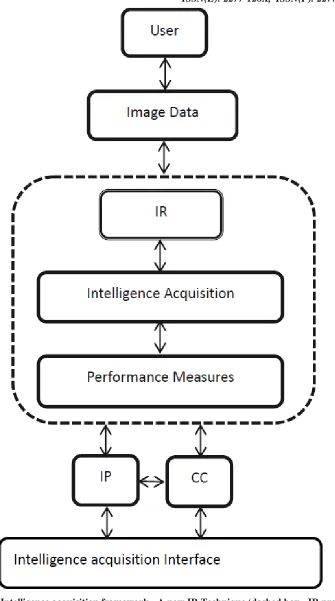
The exponential developments in image processing and unimaginable number of applications for image registration is an impact of worldwide digital revolution aspects practically in every human to and business enterprises [1,2,3,8,9]. Most of the computer based solutions are initially planned as knowledge economy systems, but are developed by humans, and are naturally linked with cognitive computing, where the complex mathematical aspects are unexplained at times. This is due to lack of time, efforts, support, knowledge, requirements, etc., and many. Therefore, a framework is developed in order to acquire the intelligence from images using image registration technique through image processing and cognitive computing paradigm.
II. MOTIVATION
The digital revolution has worldwide impact on each and every aspect that needs new developments always. The acquisition of required intelligence available in the form of images through image processing became a basic activity, where new innovative techniques are essential in image registration. Image registration is one of the essential pre-processing techniques which is already identified for the purpose, but also identified that one such technique is not at all sufficient to meet the purpose, as it is application dependent. The intelligence acquisition from the images is a complex and critical application calls for new image registration techniques. Therefore, a frame work is developed and a new image registration technique is suggested to meet the requirement in this study work.
III. IMAGE PROCESSING
ISSN(E): 2277-128X, ISSN(P): 2277-6451, pp. 50-56
imaging of any object, and its later processing is initiated as image processing are two independent actions, and from which image registration emerged as its essential and inevitable pre-processing activity.
The traditional image processing activity is a core computer application developmental area to science & technology and to facilitate the overall human centered image management. But, due to its exponential growth of huge volumes of image data through various capturing devices and internet, the human centered handling of huge image data is impossible in future. Hence, the combination of image processing and cognitive computing is required to replace this problem as cognitive image processing machines that can think and process, where cognitive image registration plays a key role. Therefore, this trend is particular with knowledge processing movement where the transition from a computational image data processing to cognitive information processing as a paradigm change, which affects the science & technology, worldwide. The transition is a novel idea but its practical implementations needs basic understanding of human brain, complex denotational mathematics that hampers and delays for implementations.
IV. COGNITIVE COMPUTING
Cognitive Computing is a novel paradigm and is used for the development of intelligent computing systems and procedures, and is mostly based on cognitive informatics [10,11,12,13,14]. Cognitive informatics is new discipline that studies the natural intelligence and internal information processing mechanisms of the brain, as well as the processes involved in perception and cognition. Hence, the cognitive informatics is a new and multidisciplinary area for the study of natural human brain thinking, cognition, intelligence, information sciences and internal information processing mechanisms as well as processes involved in the perception, etc. The research work investigates for the natural human brain thinking and processing mechanisms in order to implement for the science and engineering computing applications. This enables to achieve better problem solution skills through study and achieve better results to the critical and complex problems. The cognitive informatics enables to develop and implement computational intelligence mechanisms like human brain. The latest research work and developments in cognitive computing and cognitive informatics are by using denotational mathematics that enables to develop future generation, intelligent, knowledge processing systems, thinking machines, etc, and is called as Cognitive Computers that think.
V. COGNITIVE IMAGE REGISTRATION
The traditional image registration process is a field to facilitate computer based human centered image management and to develop various applications for science & technology in image processing domain, and is used to process reference & sensed images to extract intelligence embedded in them for required application solution. But, is lacking in cognition, as it is a direct application dependent solution development as a preprocessing activity. It is assumed that the ability of human brain is to think and reason, and is the nearest definition to the cognition. Hence, the combination of cognitive computing and image registration is attempted as a framework development.
The importance and essential requirement of image registration technique as a preprocess in image processing is already identified and need more techniques to be developed as it is application dependent. The possibility of the emotion recognition in the image processing domain by using image registration techniques is identified. The acquisitio n, representation, storage and visualization of knowledge are key processes that to be addressed in the knowledge processing systems for cognitive computers. The usefulness of cognitive computing in emotion recognition is already identified and technology is under development by using cognitive intelligence and denotational mathematics. In addition, the human knowledge processing, ensemble learning, cognitive thinking and its memory mechanisms, are also under developmental stages for the cognitive computers that can think.
Recognition of embedded intelligence in the images through image registration is possible through various transformation techniques, and can be extended for the recognition of emotions in the images. This is possible through the development human knowledge processing, knowledge acquisition, ensemble learning and cognitive memory mechanisms by various complex transformations and denotational mathematics. These developments are beyond the scope of the research but an attempt is made as a framework for the development of new image registration technique for intelligence acquisition from the images.
VI. ARCHITECTURE
ISSN(E): 2277-128X, ISSN(P): 2277-6451, pp. 50-56
Figure 6.1: Intelligence acquisition framework - A new IR Technique (dashed box - IR pre-process)
VII. DEVELOPMENT OF NEW IMAGE REGISTRATION TECHNIQUE
ISSN(E): 2277-128X, ISSN(P): 2277-6451, pp. 50-56
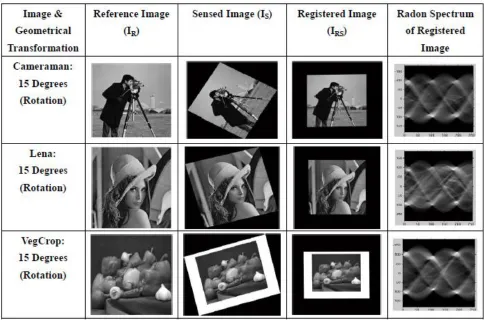
Table 7.1: Radon Transformation (Rotation)
ISSN(E): 2277-128X, ISSN(P): 2277-6451, pp. 50-56
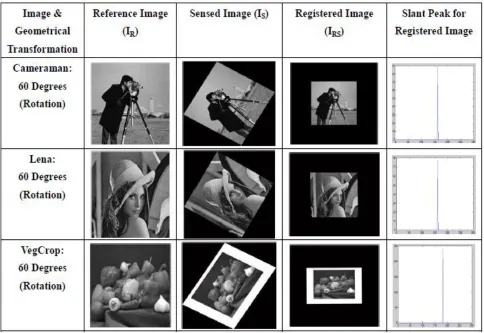
Table 7.3: Slant Transformation (Rotation
ISSN(E): 2277-128X, ISSN(P): 2277-6451, pp. 50-56
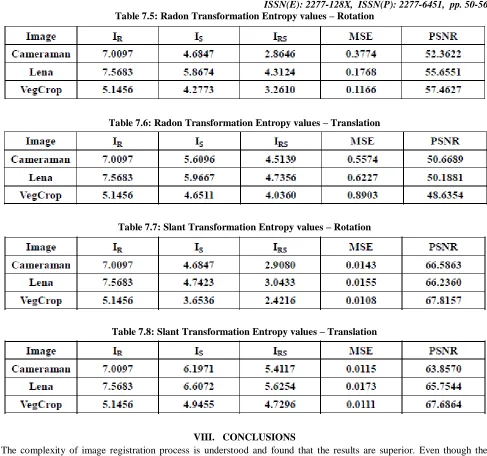
Table 7.5: Radon Transformation Entropy values – Rotation
Table 7.6: Radon Transformation Entropy values – Translation
Table 7.7: Slant Transformation Entropy values – Rotation
Table 7.8: Slant Transformation Entropy values – Translation
VIII. CONCLUSIONS
The complexity of image registration process is understood and found that the results are superior. Even though the developed framework is highly useful and proved for a required application, but efforts are required to extend the work for emotion recognition area of image processing. The future is for systems and applications to accelerate and extract human intelligence, innovation & creativity into them with new class of developments in cognitive computing.
ACKNOWLEDGMENT
The authors submit sincere thanks to the Hon'ble Vice Chancellor, Registrar, DEAN, and all the faculty members of all the departments of the Mother Teresa Women’s University for their high level motivation and encouragement in all respects which gave this exponential progressive research work. Also, we thank all the - students, guest faculty and non-teaching staff of the entire University for their continuous support in all respects to us. This is a part of our research work and corresponding author is Sindhu Madhuri G at [email protected]
REFERENCES
[1] Anna Ursyn, Duality of Natural and Technological Explanations, Maximizing Cognitive Learning through Knowledge Visualization, 2015.
[2] Dr John E Kelly III , Computing, Cognition and the future of knowing: How humans and machines are forging a new age of understanding, IBM Research: Cognitive Computing, IBM Corporation, 2016.
[3] Judith S Hurwitz, Marcia Kaufman, and Adrian Bowles, Cognitive Computing and Big Data Analytics, ISBN: 978-1-118-89662-4, Wiley, 2015.
[4] Sindhu Madhuri G., Classification of Image Registration Techniques and Algorithms in Digital Image Processing - A Research Survey, vol 25, No 2, ISSN: 2231-2803, Sep 2014.
ISSN(E): 2277-128X, ISSN(P): 2277-6451, pp. 50-56
- A Research Study”, IEEE eXplore, ISBN 978-1-4799-8080-2, Apr 2015.
[6] Sindhu Madhuri, G., and Indra Gandhi, M.P., Image Registration with Similarity Measures using Correlation Techniques - A Research Study, IEEE eXplore, ISBN 978-1-4799-7848-9, Dec 2015.
[7] Sindhu Madhuri, G., and Indra Gandhi, M.P., “New Methodology for Image Registration - An Application to Digital Image Processing”, International Journal of Advanced Research in Computer Science and Software Engineering, ISSN: 2277-128X, vol. 6, No. 7, pp. 364-368, 2016.
[8] Srinivas TK, and Ramakrishnan Viswanathan, Cognitive Computing: The Next Stage in Human/Machine Coevolution, Digital Systems & Technology, NASDAQ-100: CTSH, Cognizant, 2017.
[9] Tim M Jones, A beginner’s guide to artificial intelligence, machine learning, and cognitive computing, Developer Works, IBM, 2017.
[10] Yingxu Wang, Developments in Natural Intelligence Research and Knowledge Engineering -Advancing Applications, Edited by Wang, Yingxu, University of Calgary, Canada, Information Science Reference, Sec 3, Ch 10, 2012.
[11] Yingxu Wang, On contemporary denotational mathematics for computational intelligence, Transactions on computational science II, pg 6-29, ISBN: 3-540-87562-X, Springer, 2008.
[12] Yingxu Wang, Cognitive Informatics for Revealing Human Cognition: Knowledge Manipulations in Natural Intelligence, University of Calgary, Canada, Information Science Reference, 2013.
[13] Yong Li and Robert L. Stevenson, Multimodal Image Registration with Line Segments by Selective Search, IEEE Transactions on Cybernetics, vol. 47, No 5, May, 2017.
[14] Zahra Hossein-Nejad, Mehdi Nasri, RKEM: Redundant Keypoint Elimination Method in Image Registration, ISSN 1751-9659, IET Image Process, vol 11, iss 5, pp 273-284, 2017.
ABOUT THE AUTHORS
[1]Sindhu Madhuri G: She is a full time Research Scholar in the Computer Science Department at Mother Teresa Women’s University, Kodaikanal, TN, since Oct’2013. She is a Life member in Computer Society of India and Student Member in IEEE. She has interests in core research areas for the Development of Solutions to the - Gray area problems of computer science in general, and Digital Image Processing, Data Mining, Software Engineering areas in particular, with specialized application domains in Space & Defence Research areas. This is a part of our research work and corresponding author at [email protected].