Available online throug
ISSN 2229 – 5046
International Journal of Mathematical Archive- 5(7), July – 2014 162
EFFECT OF NON- LINEAR DENSITY TEMPERATURE VARIATION
ON MIXED CONVECTIVE HEAT AND MASS TRANSFER FLOW OF A JEFFREY’S FLUID
THROUGH A POROUS MEDIUM IN CONCENTRIC CYLINDRICAL ANNULUS
V. Suresh Babu*
1, U. Rajeswara Rao
2and D. R. V. Prasada Rao
21
Assistant Professor in Mathematics (GEBH),
Ravindra college of Engg. for women, Kurnool, (A.P.), India.
2
Professor, Department of Mathematics, Sri Krishnadevaraya University,
S. V. Puram, Anantapuramu, (A.P.), India.
(Received On: 06-06-14; Revised & Accepted On: 30-07-14)
ABSTRACT
I
n this paper, we discuss the effect of non- linear density temperature variation on mixed convective heat and mass transfer flow of a Jeffrey’s fluid through a porous medium in concentric cylindrical annulus in the presence of heat sources. The equations governing the flow,heat and mass transfer have been solved by employing Gauss-Seidel iteration procedure. The effect of various governing parameters on all the flow characteristics have been discussed graphically. The Shearstress ,rate of heat and mass transfer on the cylinders are evaluated numerically for different variations.Keywords:Jeffery-Six constant fluid, Heat and mass transfer, cylindrical annulus.
1. INTRODUCTION
The increasing costs of energy has lead technologists to examine measures which could considerably reduce the usage of the natural source energy (fossil). Thermal insulations will continue to find increased use as engineers seek to reduce cost. Heat transfer in porous thermal insulation with in vertical cylindrical annuli provides us insight into the mechanism of energy transport and enable engineers to use insulation more efficiently. In particular design engineers require relationships between heat transfer, geometry and boundary conditions which can be utilized cost – benefit analysis to determine the amount of insulation that will yield the maximum investment. Apart from this, the study of flow and heat transfer in the annular region between the concentric cylinders has applications in nuclear waste disposal research. It is known the canisters filled with radio active rays be buried in the earth so as to isolate them from human population and is of interest to determine the surface temperature of these canisters. This surface temperature strongly depends on the buoyancy driven flow sustained by the heated surface and the possible moment of ground water past it. This phenomenon make idealized to the study of convection flow in a porous medium contained in a cylindrical annulus and extensively has been made on these lines (8, 7).
Free convection flow and heat transfer in hydro magnetic case is important in nuclear and space technology (21, 31, 32, 49). Nanda and Purushothama (19) have analyzed the free convection of a thermal conducting viscous incompressible fluid induced by a traveling thermal waves on the circumference of a long vertical circular cylindrical pipe. The solutions of the velocity and temperature fields are obtained using the long wave approximations. Ganapathi and Purushotham (10) have studied the unsteady flow induced by a traveling thermal wave imposed on the circumference of a long vertical cylindrical column of a fluid in a saturated porous medium. The analysis is carried out following White head (39), Neeraja (20) has made a study of the fluid flow and heat transfer in a viscous incompressible fluid confined in an annulus bounded by two rigid cylinders. The flow is generated by periodic traveling waves imposed on the outer cylinder and the inner cylinder is maintained at constant temperature.
Corresponding author: V. Suresh Babu*
11
Assistant Professor in Mathematics (GEBH),
Chen and Yuh (6) have investigated the heat and mass transfer characteristics of natural convection flow along a vertical cylinder under the combined buoyancy effects of thermal and species diffusion. The analysis is restricted to processes in which the diffusion-thermo and thermo-diffusion effects as well as the inter facial velocities from species diffusion are negligible. The surface of the cylinder is either maintained at a uniform temperature and concentration (or) subjected to uniform heat and mass flux. The conservation equations of the laminar boundary layer are solved in finite difference method. Sivanjaneya Prasad (33) has investigated the free convection flow of an incompressible, viscous fluid through a porous medium in the annulus between the porous concentric cylinders under the influence of a radial magnetic field. Antonio (5) has investigated the laminar flow, heat transfer in a vertical cylindrical duct by taking in to account both viscous dissipation and the effect of buoyancy. The limiting case of fully developed natural convection in porous annuli is solved analytically for steady and transient cases by E.Shaarawi and AL–Nimr (4). Philip (22) has obtained analytical solution for the annular porous media valid for low modified Reynolds number. Rani (28) has analyzed the unsteady convection heat and mass transfer through a cylindrical annulus with constant heat sources taking the aspect ratio ‘δ’ as perturbation parameter. The governing equations have been solved by a regular perturbation method. The effect of the traveling transverse wave imposed on the boundary of the cylinders on the velocity, temperature and concentration have been discussed in detail. Srevani (36) has investigated the convective heat and mass transfer through a porous medium in a cylindrical annulus under radial magnetic filed and with soret effect. Taking G/R much less than I the coupled equations governing the flow, heat and mass transfer have been solved by regular perturbation method. The governing equations have been solved by regular perturbation method. Sreenivas Reddy (35) has discussed the soret effect on mixed convective heat and mass transfer through a porous cylindrical annulus. The expressions for the velocity, temperature and concentration have been analyzed computationally for different parameters. Ramakrishna Reddy (27) has analyzed the thermo-diffusion effect on mixed convection Heat and Mass transfer through a porous medium confined in a cylindrical annulus.
A large class of real fluids does not exhibit the linear relationship between stress and the rate of strain. Because of the non-linear dependence, the analysis of the behavior of the fluid motion of the non-Newtonian fluids tend to be much more complicated and subtle in comparison with that of the Newtonian fluids. In the literature, the mechanics of non-linear fluids presents special challenges to engineers, physicists and mathematicians since the non-linearity can manifest itself in a variety of ways. One of the simplest way in which the viscoelastic fluids have been classified is the methodology given by Rivlin and Ericksen[30] and Truesdell and Noll, [37] who presents constitutive relations for the stress tensor as a function of the symmetric part of the velocity gradient and its higher (total) derivatives. In recent years there have been several studies [23,-26, 11,-14] on flows of non-Newtonian fluids, not only because of their technological significance but also in the interesting mathematical features presented by the equations governing the flow. On the other hand, it is well known that the rheological properties of many fluids are not well modelled by the Navier–Stokes equations [14]. It is not possible to obtain a single equation exhibiting all properties of all non-Newtonian fluids from available literature. That is why several models of non-non-Newtonian fluids are proposed. Jeffery-six constant fluid is one of these models. Examples include various suspensions such as coal-water or coal-oil slurries, food products, inks, glues, soaps, polymer solutions, mud, blood at low shear rate, cosmetic products and many others. Al Khatib and Wilson (2) have studied the Poiseuille flow of a yield stress fluid in a channel. Flow of a visco-elastic fluid in a channel of slowly varying width was studied by Frigaard and Ryan (9). Mokhtar et al. (16) have studied the pulsatile MHD non-Newtonian fluid flow with heat and mass transfer through a porous medium between two permeable parallel plates. Mishra et al. (15) investigated a flow and heat transfer of a MHD viscoelastic fluid in a channel with stretching walls. Ali and Asghar (3) have analyzed by oscillatory channel flow for non-Newtonian fluid. Rita and Jyoti Das (29) have studied the effect of heat transfer on MHD oscillatory viscoelastic fluid flow in a channel through a porous medium. Nadeem and Akbar (17) studied the effects of temperature dependent viscosity on peristaltic flow of a Jeffrey-six constant fluid in a uniform vertical tube. Nadeem and Akbar (18) examined influence of heat and mass transfer on a peristaltic motion of a Jeffrey-six constant fluid in an annulus. Akbar et al. (1) discussed simulation of heat transfer on the peristaltic flow of a Jeffrey-six constant fluid in a diverging tube. Analyze the flow a Jeffrey-six constant incompressible fluid between two infinite coaxial cylinders.
The effect of heat transfer on MHD oscillatory flow of a Jeffrey fluid in a channel with slip effect at lower wall. The expressions are obtained for velocity and temperature analytically. The effects of various emerging parameters on the velocity and temperature are discussed through graphs in detail. Vasudev et al (38) have discussed the effect of Heat Transfer on the peristaltic flow of a Jeffery’s Fluid through a Porous medium in a vertical annulus. Recently Sreenath et.al (34) have investigated the effect of quadratic density temperature variation on convection heat transfers flow of a Jeffrey’s fluid in a tube and circular annulus.
In this paper, we discuss the effect of non-linear density temperature variation on mixed convective heat and mass transfer flow of a Jeffrey’s fluid through a porous medium in concentric cylindrical annulus in the
presence of heat sources. The equations governing the flow, heat and mass transfer have
z
T = To T = Ti C = Ci
C = Co
r
g
© 2014, IJMA. All Rights Reserved 164
been solved by employing Gauss-Seidel iteration procedure. The effects of various governing parameters on all the flow characteristics have been discussed graphically. The Shear stress, rate of heat and mass transfer on the cylinders are evaluated numerically for different variations.
2. FORUMLATION AND SOLUTION
We analyse the fully developed, steady laminar free convective flow of a viscous, electrically conducting Jeffrey’s fluid through a porous medium confined in an annular region between two vertical co-axial porous circular pipes in the presence of heat generating sources. We choose the cylindrical polar coordinates system O (r, θ, z) with the inner and outer cylinders at r =a and r = b respectively. The fluid is subjected to the influence of a radial magnetic field (H0 / r).
Pipes being sufficiently long all the physical quantities are independent of the axial coordinate z. The fluid is chosen to be of small conductivity so that the Magnetic Reynolds number is much smaller than unity and hence the induced magnetic field is negligible compared to the applied radial field. Also the motion being rotationally symmetric the azimuthal velocity V is zero.
The boundary conditions are
w (a) = w(b) = 0 (1) T (a) = Ti and
T
(
b
)
=
T
o (2)C (a) = Ci and
C
(
b
)
=
C
o (3)
In the hydrostatic state gives
- ρe g - pe , z = 0 (4)
Where ρe and pe are the density and pressure in the static case and hence
- ρg - pz = - (ρ - ρe) g – pd, z (5)
Where pd is the dynamic pressure
By using (5). We find
)
r
(
f
r
p
d=
∂
∂
(6)Using the relation (3) – (6) the equations governing free convective heat transfer flow under no pressure gradient are w r r + wr / r + (1/(1+λ1))( ( β0 gz (T - Te )+ β1(T - Te )2+ (β• g / υ ) (C - Ce ) - (
ν
/ k) (1/(1+λ1)w = 0 (7)0
)
)(
/
(
)
/
(
/
+
+
1′
−
=
+
r f f err
T
r
Q
k
Q
k
C
C
T
(8)0
/
−
1=
+
C
r
k
C
C
rr r (9)Introducing the non-dimensional variables (r′, w′, θ′ ) as
r ′ = r /a, w ′ = w (a /ν ),
e i e
T
T
T
T
−
−
=
θ
, e i eC
C
C
C
C
−
−
=
′
(10)The equations (7) - (9) reduce to
w r r + (1 /r ) wr – D2– 1 /(1+λ1)) w = -(G/(1+λ1)) (θ+
γ
1θ2+NC) (11)0
/
+
+
1=
+
rr
Q
C
rr
θ
α
θ
(12)0
)
(
/
−
=
+
C
r
Sc
C
C
rr rγ
(13) where)
/
)
(
(
1 2 23
ν
β
g
a
T
T
eG
=
−
(the Grashoff number ),D
21=
(
a
2/
k
)
−
(the Darcy parameter),
)
/
(
C
pk
fP
=
µ
(the Prandtl number),f
k
T
QL
∆
=
2α
(the Heat Source parameter),1
D
Sc
=
ν
(the Schmidt number),βν
β
k
11N
•
1 2 1
D
a
k
=
γ
(the chemical reaction parameter),2 1 1 f
Q Ca
Q
k
T
′∆
=
∆
(the radiation absorption parameter),a
b
s
=
The corresponding boundary conditions are w = 0, θ =1, C=1 on r =1
w = 0,
θ
=
0
,
C
=
0
on r = s (14)The differential equations (11)-(13) have been discussed numerically by reducing the differential equations in difference equations which are solved using Gauss-Seidel Iteration method. The differential equations involving θ0,θ1,
wo and w1 are reduced to the following difference equations
2
, 1 , , 1 1 ,
1
(2 )
1
0
2
i i i2
i i ih
h
Q h C
r
θ
−θ
r
θ
+
−
−
+ +
+
=
(15), 1 , , 1 ,
1
2
1
(
)
0
2
i i i2
i i ih
h
C
C
C
Sc C
r
−r
+γ
−
−
+ +
−
=
(16)2 1 2
, 1 2 1 , , 1 1
1
(2
(
(1
))))
1
(1
)
(
)
2
i i i2
i i i ih
h
w
h D
w
w
G
h
NC
r
λ
r
λ
θ
−
− +
−
− +
+
+ +
= −
+
+
(17)where h is the step length taken to be 0.05 together with the following conditions
,0
1,
,21m C
1,
,01,
C
,21m
2θ
=
θ
=
=
=
,0
0,
,210
w
=
w
=
All the above difference equations are solved using Gauss-Seidel iterative method to the fourth decimal accuracy.
3. NUSSELT NUMBER AND SHERWOOD NUMBER
The heat transfer through the pipe to the flow per unit area of the pipe surface is given by 1
r a
T
q
k
r
=∂
=
∂
which inthe non-dimensional form is
1 1
(
1 e)
rqa
Nu
k T
T
r
θ
=
∂
=
=
−
∂
.The mass transfer through the pipe to the flow per unit area of the pipe surface in the non-dimensional form is
1
1
1
(
1 e)
rq a
C
Sh
D C
C
r
=
∂
=
=
−
∂
.4. DISCUSSION OF THE RESULTS
In this analysis we investigate the effect of chemical reaction and radiation absorption on mixed convective heat and mass transfer flow of a viscous elastically conducting fluid through a porous medium in a circular annulus between the cylinder r = a and r = b with non linear density temperature relation the equation governing the flow Heat and mass transfer have been solved by employing Gauss-Seidal iteration technique.
The axial velocity (w) we shown fig.1-5 for different values G,M, D-1,α ,N,Q1,λ1and γ, γ1 Fig.1 represents w with G, M
& D-1 , it is find that the axial velocity in the left half (1.2,1.4) to the positive and negative in the right half (1.6,1.8),it is found that the axial velocity increases in magnitude with G > 0,the variation of w with Hatt mann number M shows that the axial velocity deprices with increasing N-higher Lorentz force smaller w in the flow region with respect Darcy parameter D-1 we find depreciation in a w with the higher value of D-1. Fig.2 represents the effect of heat source parameter on w. It is found that the increase in the strength of heat source enhances w in the entire flow region while
increasing heat sink(α ≤ 4) enhances w everywhere except in the velocity of r = 1.2 where it depreciates for higher ( α ≥
© 2014, IJMA. All Rights Reserved 166
enhances in the region(1.6, 1.8).Fig,4 represents depicts the nature of w with Q1, the radiation absorption parameter
Q1(<1.5) it is found that w depreciates in the left half and enhances in the right half and for the higher Q1=1.75 we
notice an enhancement in w everywhere in the flow region and for still higher Q1(≥2.5), w enhances in the entire flow
region.fig.5 The variation of w with chemical reaction parameter γ is shown in fig. 4. It is found that the axial velocity enhances in both degenerating and generating chemical reaction case. Fig.6 represents w with visco-elastic parameter
λ1and density ratio γ1 it is found that w experiences an enhancement with increasing λ1 in the entire flow region γ1 an
increase in the density ratio γ1 enhances w in the left half and reduces in the right half. Thus the non-linearity in the
density temperature relation leads to an enhancement in the let half and depreciation in the right half.
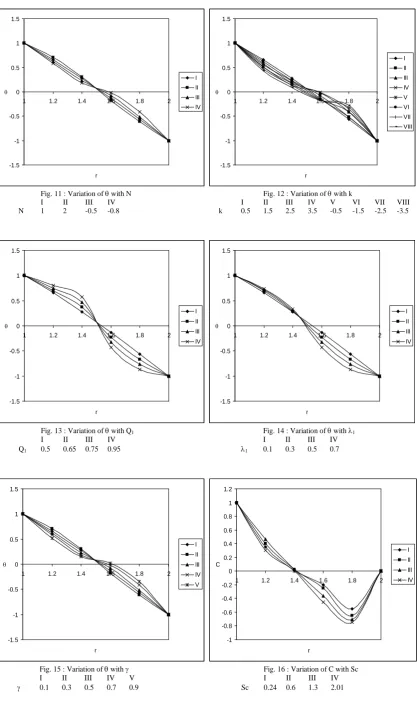
The non-dimensional temperature (θ) is exhibited in the figs.7-15 for different parametric values. We follow the convention that the non-dimensional temperature is positive or negative according as the actual temperature (T) is greater/ lesser than T0, the temperature on the outer cylinder. Fig.7 represents θ with Grashof number G it is found that
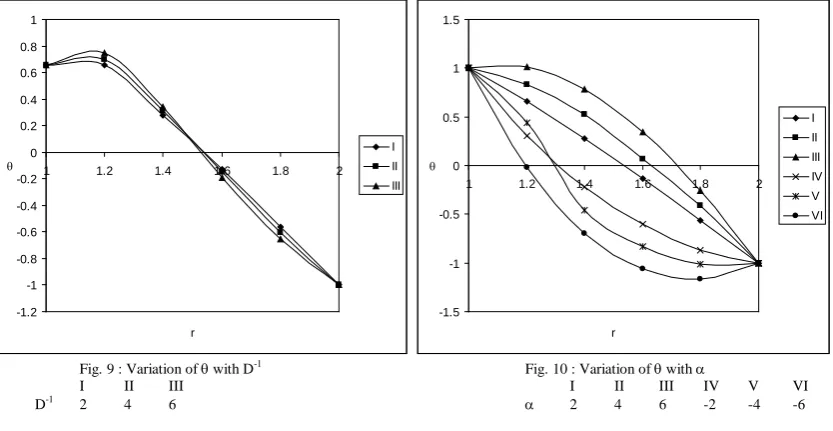
the actual temperature enhances with increase in G in the entire flow region. Fig.8 & 9 represents θ with M & D-1. It can seen from the profiles that the higher the Lorentz force / lesser the permeability of the porous medium smaller the actual temperature. Fig.10 represents the variation of θ with heat source parameter α. We notice an enhancement in the actual temperature with increase in the strength of heat source while increasing the strength of heat sink, the actual temperature reduces in the flow region. Fig.11 represents θ with buoyancy ratio N. It is found that when the molecular buoyancy force dominates over with thermal buoyancy force the actual temperature enhances in the flow region when the buoyancy forces are in the same direction and for the forces acting in opposite directions it depreciate in the region.
The effect of chemical reaction on θ is exhibited in fig.12 it can be seen from the profiles that the actual temperature
enhances in the degenerating the chemical reaction cases and reduces the generating chemical reaction case. Fig.13
represents the variation of θ with radiation absorption parameter λ1 .It is found that the actual temperature θ enhances in
the left half and reduces in the right half of the flow region. Fig.14 represents θ with visco- elastic parameter λ1 higher
the values of λ1 large the actual temperature (Fig.15), the effect of non-linear density temperature relation on θ is
exhibited Fig.15. we observe an enhancement in the actual temperature with increasing density ratio γ1 .
The Non-dimensional concentration (C) is exhibited figures 16& 17. We follow the convention that the non- dimensional concentration is positive or negative according as the actual concentration is greater or lesser than C0, the
concentration on outer cylinder. Fig 16 represents concentrations C with Schmidt number Sc. It is found that lesser the
molecular diffusivity (S0≤ 1.3) larger the actual concentration in the left half and smaller in the right half of the flow
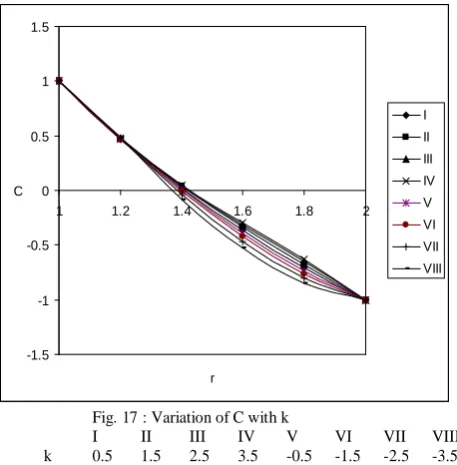
region and for further lowering of the molecular diffusivity smaller the actual concentration in the entire flow region. Fig 17 represents the effective of chemical reaction parameter γ on C. It is found that the actual concentration enhances in the degenerating chemical reaction case and in the generating chemical reaction case, the actual concentration enhances in the left half and reduces in the right half.
-1.2 -1 -0.8 -0.6 -0.4 -0.2 0 0.2 0.4 0.6 0.8 1
1 1.2 1.4 1.6 1.8 2
r θ
I II III
-1.5 -1 -0.5 0 0.5 1 1.5
1 1.2 1.4 1.6 1.8 2
r θ
I II III IV V VI
Fig. 9 : Variation of θ with D-1 Fig. 10 : Variation of θ with α
I II III I II III IV V VI
-1.5 -1 -0.5 0 0.5 1 1.5
1 1.2 1.4 1.6 1.8 2
r θ
I II III IV
-1.5 -1 -0.5 0 0.5 1 1.5
1 1.2 1.4 1.6 1.8 2
r θ
I II III IV V VI VII VIII
Fig. 11 : Variation of θ with N Fig. 12 : Variation of θ with k
I II III IV I II III IV V VI VII VIII
N 1 2 -0.5 -0.8 k 0.5 1.5 2.5 3.5 -0.5 -1.5 -2.5 -3.5
-1.5 -1 -0.5 0 0.5 1 1.5
1 1.2 1.4 1.6 1.8 2
r θ
I II III IV
-1.5 -1 -0.5 0 0.5 1 1.5
1 1.2 1.4 1.6 1.8 2
r θ
I II III IV
Fig. 13 : Variation of θ with Q1 Fig. 14 : Variation of θ with λ1
I II III IV I II III IV
Q1 0.5 0.65 0.75 0.95 λ1 0.1 0.3 0.5 0.7
-1.5 -1 -0.5 0 0.5 1 1.5
1 1.2 1.4 1.6 1.8 2
r θ
I II III
IV V
-1 -0.8 -0.6 -0.4 -0.2 0 0.2 0.4 0.6 0.8 1 1.2
1 1.2 1.4 1.6 1.8 2
r C
I II III
IV
Fig. 15 : Variation of θ with γ Fig. 16 : Variation of C with Sc
I II III IV V I II III IV
© 2014, IJMA. All Rights Reserved 168
-1.5 -1 -0.5 0 0.5 1 1.5
1 1.2 1.4 1.6 1.8 2
r C
I
II
III
IV
V
VI
VII
VIII
Fig. 17 : Variation of C with k
I II III IV V VI VII VIII
k 0.5 1.5 2.5 3.5 -0.5 -1.5 -2.5 -3.5
The rate of heat transfer (Nusselt Number) at the inner and outer cylinders r = 1&r = 2 are shown in tables. 1-8 for
different parametric values. We found that an increase in α ≥ 0 reduces the rate of heat transfer at r = 1and enhances at r = 2 while it enhances with α at both the cylinders. The variation of Nu with M & D-1 shows that higher the Lorentz force / lesser the permeability of porous medium larger Nu at r = 1 and smaller at r = 2.Tables 1-4 with respect to the chemical reaction parameter γ we find that the rate of Heat transfer reduces at r = 1 and enhances at r = 2 in the degenerating chemical reaction case. While generating case Nu enhances at r=1and reduces r =2 for all α>0 and for
α<0, Nu enhances at r =1 and r =2. An increase in the radiation absorption parameter Q1 depreciates Nu on both
cylinders for α≥ 0 and for α < 0, Nu reduces at r = 1 and enhances r = 2 (tables 2-5).The variation of Nu with
visco-elastic parameter λ1shows that an increasing λ1reduces Nu at r=1and enhances at r =2.An increase in the density ratio γ
reduces Nu for α>0 and enhance for α<0 at r = 1 while at r =2, Nu enhances for all α (tables 3-6).
The rate of mass transfer (Sherwood number) at r =1 and r =2 is shown in tables. 7&8. It is found that the rate of mass transfer enhances in magnitude with increase in Schmidt number Sc. Also the rate of mass transfer depreciates in the degenerating chemical reaction case and enhances in the generating chemical reaction case at both the cylinders (tables 7&8).
Table – 1: Nusselt Number (Nu) at r = 1
α 1 II III IV V VI VII
2 -1.609 -1.654 -1.692 -1.614 -1.618 -1.505 -1.692 4 -0.51 -0.581 -0.628 -0.52 -0.527 -0.402 -0.6 -2 -3.823 -3.851 -3.885 -3.825 -3.828 -3.729 -3.889 -4 -4.901 -4.942 -4.98 -4.906 -4.191 -4.813 -4.96
M 2 5 10 2 2 2 2
D-1 2 2 2 4 6 2 2 N 1 1 1 1 1 2 -0.5
Table – 2: Nusselt Number (Nu) at r = 1
α 1 II III IV V VI VII VIII IX
2 -1.609 -1.48 -1.351 -1.223 -1.607 -1.606 -1.612 -1.617 -1.623 4 -0.51 -0.382 -0.253 -0.125 -0.507 -0.505 -0.515 -0.521 -0.53 -2 -3.823 -3.693 -3.564 -3.434 -3.823 0.0984 -3.823 -3.824 -3.826 -4 -4.901 -4.772 -4.642 -4.513 -4.9 -1.612 -4.9 -4.93 -4.999 Q1 0.5 1.5 2.5 3.5 0.5 0.5 0.5 0.5 0.5
Table – 3: Nusselt Number (Nu) at r = 1
α 1 II III IV V VI VII VIII IX
2 -1.609 -1.575 -1.539 -1.499 -1.457 -1.607 -1.606 -1.604 -1.603 4 -0.51 -0.467 -0.421 -0.372 -0.321 -0.507 -0.505 -0.505 -0.499 -2 -3.823 -3.795 -3.765 -3.732 -3.697 -3.823 -3.823 -3.823 -3.823 -4 -4.901 -4.87 -4.837 -4.8 -4.762 -4.903 -4.904 -4.905 -4.907
λ 0.1 0.3 0.5 0.7 0.9 0.1 0.1 0.1 0.1
1
γ
0.01 0.01 0.01 0.01 0.01 0.03 0.05 0.07 0.09Table – 4: Nusselt Number (Nu) at r = 2
α 1 II III IV V VI VII VIII 2 -1.904 -1.886 -1.866 -1.902 -1.9 -1.971 -1.86 -1.861 4 -2.803 -2.783 -2.765 -2.801 -2.799 -2.86 -2.776 -2.779 -2 -0.107 -0.067 -0.031 -0.102 -0.098 -1.196 -0.032 -0.025 -4 0.7685 0.8347 0.7852 0.7671 0.7447 0.8689 0.8603 0.8703
M 2 5 10 2 2 2 2 2
D-1 2 2 2 4 6 2 2 2 N 1 1 1 1 1 2 -0.5 -0.8
Table – 5: Nusselt Number (Nu) at r = 2
α 1 II III IV V VI VII VIII IX 2 -1.904 -1.74 -1.576 -1.413 -1.906 -1.908 -1.901 1.897 -1.893 4 -2.803 -2.639 -2.475 -2.311 -2.807 -2.81 -2.799 -2.794 -2.787 -2 -0.107 0.155 0.2174 0.3799 -0.107 -1.44 -0.107 -0.107 -0.107 -4 0.7685 0.9305 1.0923 1.2541 0.7696 -1.901 0.7671 0.7651 0.7623 Q1 0.5 1.5 2.5 3.5 0.5 0.5 0.5 0.5 0.5
γ
0.5 0.5 0.5 0.5 1.5 2.5 -0.5 -1.5 -2.5Table – 6: Nusselt Number (Nu) at r = 2
α 1 II III IV V VI VII VIII IX 2 -1.904 -1.921 -1.939 -1.959 -1.981 -1.904 -1.904 -1.904 -1.904 4 -2.803 -2.819 -2.837 -2.856 -2.876 -2.804 -2.805 -2.805 -2.806 -2 -0.107 -0.137 -0.17 -0.204 -0.24 -0.106 -0.104 -0.103 -0.101 -4 0.7685 0.7263 0.6814 0.6343 0.5855 0.7719 0.7752 0.7785 0.7817
λ1 0.1 0.3 0.5 0.7 0.9 0.1 0.1 0.1 0.1
1
γ
0.01 0.01 0.01 0.01 0.01 0.03 0.05 0.07 0.09Table – 7: Sherwood Number (Sh) at r = 1 Sc 1 II III IV VI VII 0.24 -8.168 -7.83 -7.567 -8.605 -9.179 -9.949
0.6 -16.01 -15.06 -14.28 -17.18 -18.68 -20.63 1.3 -31.04 -28.92 -27.17 -33.63 -36.89 -41.08 2.01 -46 -42.73 -40.01 -49.99 -54.98 -61.4
γ
0.5 1.5 2.5 -0.5 -1.5 -2.5Table – 8: (Sherwood Number (Sh) at r = 2) Sc 1 II III IV VI VII 0.24 3.051 2.5383 2.0915 3.6495 4.3637 5.2404
0.6 9.3249 8.3323 7.4835 10.505 11.943 13.741 1.3 21.584 19.65 18.013 23.908 26.765 30.376 2.01 34.109 31.207 28.759 37.611 41.932 47.417
γ
0.5 1.5 2.5 -0.5 -1.5 -2.5REFERENCES
[1] Akbar N.S. and Nadeem S, International Communication in Heat and Mass Transfer 38, PP.154, (2010). [2] Al Khatib M.A.M. and Wilson S.D.R., The development of Poiseuille flow of a yield stress fluid, J.
Non-Newtonian Fluid Mech., 100, PP.1–8, (2001).
© 2014, IJMA. All Rights Reserved 170
[4] Al-Nimr. M.A: Analytical solution for transient laminar fully developed free convection in vertical annulai., Int. J. Heat and mass transfer, v.36.pp.2388-2395 (1993).
[5] Antonio Barletle: Combined forced and free convection with viscous dissipation in a vertical duct., Int.J.heat and mass transfer.v42.pp.2243-2253(1999).
[6] Chen, T.S,Yuh,C.F : Combined heat and mass Transfer in natural convection on inclined surface. J.Heat transfer.V.2.pp.233-350 (1979).
[7] Ellahi R., Hayat T, Mahomed F.M, and. Zeeshan A, Commun. Nonlinear Sci. Numer Simulat. 15, PP.322 (2010).
[8] Ellahi R., Hayat T., Javed T and Asghar S, Mathematical and Computer Modelling 48, 1191(2008).
[9] Frigaard I.A. and Ryan D.P., Flow of a visco-plastic fluid in a channel of slowly varying width, J. Non-Newtonian Fluid Mech., 123 , 67–83(2004).
[10] Ganapathy.R and Purushothama R: Fluid flow induced by a travelling transverse wave in a saturated porous medium,:J.Ind.Inst.Sci,V.70 ,pp.333 - 340 (1990).
[11] Hayat T, Asghar S, and Siddiqui, A.M: On the moment of a plane disk in a non-Newtonian fluid, Acta Mech. 136 P.125. (1999).
[12] Hayat T., Khan M and Asghar S: Homotopy analysis of MHD flows of an Oldroyd 8-constant fluid, Acta Mech. 168, PP. 213. (2004).
[13] Hayat T., Asghar, and A.M. Siddiqui : Periodic unsteady flows of a non- Newtonian fluid, Acta Mech. 131PP. 169(1998).
[14] Hayat T., Asghar S., and Siddiqui A.M.: Some unsteady unidirectional flows of a non-Newtonian fluid, Int. J. Eng. Sci. 38 PP. 337. (2000).
[15] Mishra J.P., Shit G.C. and Rath, H.J. Flow and heat transfer of a MHD viscoelastic fluid in a channel with stretching walls, Computer and Fluids, 37(1), 1-11(2008),
[16] Mokhtar, A.A. Eldabe, N.T.and Abou-zeid, M.Y. Numerical study of pulsatile MHD non-Newtonian fluid flow with heat and mass transfer through a porous medium between two permeable parallel plates, Ind. J. Mech. Cont. Math. Sci., 1(1), 1-10. (2006).
[17] Nadeem S and Akbar N.S, Communication in Nonlinear Science and Numerical Simulation 15 pp.3950 (2010).
[18] Nadeem S and Akbar N.S, Heat and Mass Transfer 46 PP.485 (2010).
[19] Nanda.R.S and Purushottam . R: Int. Dedication seminar on recent advances on maths and application, Varanasi (1976)
[20] Neeraja.G: PhD thesis, S.P.Mahila University, Tirupathi, India (1993). [21] Osterle.J.F. and Young F.J.: J fluid Mechanics vol 11.p 152 (1961).
[22] Philip.J.R : Axi symmetric free convection at small Rayleigh number in porous cavities . Int.J.Heat and mass transfer v.25.pp.1689-1699 (1982).
[23] Rajagopal K.R, Longitudinal and Torsional oscillations of a Rod in a Non-Newtonian Fluid, Acta Mech. 49 PP.281(1983).
[24] Rajagopal K.R. and Bhatnagar R.K: Exact solutions for simple flows of an Oldroyd-B fluid, Acta Mech. 113 PP.233 (1995).
[25] Rajagopal K.R: A note on unsteady unidirectional flows of a non-Newtinian fluid, Int. J. Non-Linear Mech. 17 P.369(1982).
[26] Rajagopal K.R: On the Creeping flow of a second order fluid, J. Non-Newtonian Fluid Mech. 48 PP.239(1984).
[27] Ramakrishana Reddy: Hydromagentic convection. Heat and Mass Transfer through a porous medium in channel/pipes with Soret effect, Ph.D thesis submitted to JNTU, Hyderabad, (2007).
[28] Rani.A: Unsteady convective heat and a mass transfer through a porous medium in wavy channel. Ph.D thesis, S.K.U, Anantapur, India (2003).
[29] Rita C. and Jyoti das U. Heat transfer to MHD Oscillatory viscoelastic flow in a channel filled with porous medium, Physics Research International, 2012 pp.1-5 (2012),
[30] Rivlin R.S. and Ericksen, J.L, Rational: Stress-deformation relations for isotropic materials, J. Mech. Anal. 4 pp.323 (1955).
[31] Roots.G.: Int .J.Heat and mass transfer vol3.p1(1961).
[32] Singh K.R and Cowling .T. J : Q.J. Maths Appl.Maths vol 16,p 1 (1963).
[33] Sivanjaneya Prasad,P: Effects of convective heat and Mass transfers on unsteady hydromagnetic channel flows., Ph.D thesis, S.K. University, Anantapur, India (2001).
[34] Sreenath.S, J.Prakash & E.Sudhakara, MHD free Convective flow of a Jeffery fluid in between two coaxial impermeable and permeable cylinders, Int. J. E. IM, V.4, No.2, PP.13-22. (July Dec 2012 )
[35] Sreenivasa Reddy, B :Thermo –diffusion effect on convective heat and mass transfer through a porous medium, Ph.D. thesis, S.K.University, Anantapur , India (2006).
[36] Sreevani .M: Mixed convective heat and mass transfer through a porous medium in channels with dissipative effects. PhD thesis . S.K.University, Anantapur, India (2003).
[38] Vasudev.V, Rajeswara Rao.U, subba reddy M.V., et al., effect of Heat transfer on the peristaltic flow of jefferey fluid through a porous medium in a vertical annulus J.Basic.Appl.Sci.Res., 1(7)751,(2011).
[39] Whitehead.J.A : Observations of rapid means flow produced in mercury by a moving heater,, Geo Phys. Fluid dynamics,vol 3 pp 161-180 (1972).
[40] Yu.C.P and Young.H.: Effects of wall conductance on convective magneto hydrodynamic channel flow., Appl Sci.Res vol 20,p.16 (1969).
Source of support: Nil, Conflict of interest: None Declared