International Journal of Advances in Management and Economics
Available online at:
www.managementjournal.info
RESEARCH ARTICLE
E-Tourism: An Innovative and Sustainable Approach to
Appreciate the Economic Growth in Bangladesh
Mohammad Masrurul Mowla
*Department of Business Administration, International Islamic University Chittagong. Bangladesh *Correspondent Author: Email: [email protected]
Abstract: Digitalization is a pre-condition to ensure sustainable growth. Bangladesh is not fully digitalized country but digitalization process is going fast which is helping every sector to appreciate individual profitability and significant growth. In this phenomenon, Information Technology (IT) is playing a significant role to drive the modern information driven world. IT is creating a bondage between the boundaries and across the sectors, cultures and economies. This study is a descriptive research in nature and done fully based on the secondary information. This study is concentrated on the potentiality of IT to market tourism and provide services to attract more tourists hence contribute more in the GDP of Bangladesh. Study shows that the economy of Bangladesh is growing where tourism sector is still under privileged but growing. In these circumstances, IT can influence the process of international network building which ultimately can speed up the process of economic growth. In the whole world, relationship between exports, tourism and economic growth is still ongoing. Tourism is one of the world’s most rapidly growing industries. It is an information intensive sector and IT’s are the key driver for developing countries (Bangladesh) in organizing and marketing their tourism products and services. Web adoption is this sector is very necessary to communicate and/or deliver travel services to a target market. Providing facilities for inquiry, reservation, communication and booking are examples of adoption of the web to provide travel services.
Keywords: Etourism, ICT, GDP, Digitalisation, Sustainable Development
Introduction
Information technology (IT) is a driving force in the modern information driven the world. ICT’s are transforming the global economy and are creating a linkage between one boundary to another and opportunities that cross sectors, cultures and distances. Tourism comprises the activities of person traveling and staying places outside their usual environment for not more than one consecutive year for leisure, business and other purposes [1].
In recent years there has been an increase of interest in the role of tourism for growth and development for Developing countries (Bangladesh) focus on economic policies to promote international tourism as a potential source of economic growth.
The relationship between exports, tourism and economic growth is still ongoing [2]. Tourism is one of the world’s most rapidly growing industries. It is an information intensive sector and ICT’s are a key driver for developing
Countries (Bangladesh) in organizing and marketing their tourism Products and service. The revolution in ICTs has profound implications for economic, social and cultural development. The most important benefit associated with the access to the new technologies is the increase in the supply of information. Information is shared and disseminated to larger audience [3].
In recent decades, the combination of tourism and Information and Communication Technologies (ICT), has originated considerable changes in tourists’ behaviors as well as whole industry [4]. This study is a descriptive research in nature and done fully based on the secondary information.
Objectives of the Study
To have an idea about the economic impact of tourism on the economy of Bangladesh.
To identify the application of ICT in facilitating the services to attract more customers.
Literature Review
It is the time of globalization; the whole world is in one hand and it is possible only because of information technologies. All sorts of business (service) are able to share information, specifications, production process etc across the national borders. In the last decade the use of information and communication technology (ICT) has boomed in many sectors, such as business, education, commerce etc. All over the world, E-tourism is the terminology generally used to represent the use of ICT in tourism sector to promote and facilitate E-tourism services [1].
Jowkar & Samizadeh [5] stated that E-tourism is the use of information and communication technology (ICT) in tourism which may allow operating tourism in least variable cost, least time and increased work efficiency. Sheldon [6] argued that tourism is acknowledged to be very information intensive. He further stated that information as the ‘life blood’ of the industry, without it, the industry cannot function effectively. The Internet offers the potential to make information and booking facilities available to large numbers of tourists at relatively low costs. It also provides a tool for communication between tourism suppliers, intermediaries, as well as end-consumers [7].
Arne Wiig [8] stated that with the aid of ICT and internet eliminating intermediaries like the travel agent, transaction costs (commissions for instance) may be reduced and secure a higher market share and a higher added value with taking competitive advantages. The great proponent of the national competitive advantage (Micheal E Porter) observes that the major sources of competitive advantage are cost and quality. In one sense, the ICTs enable an organization to exploit all these sources in the best possible way.
It will enable the organization to exploit the advantages available through technological advancements to take timely decision. Because, they give right information at the right time to take decisions and implement [9]. But it never received attention from the government to become a vibrant industry.
Where many countries which start much later than Bangladesh like Maldives, Malaysia, Vietnam, Cambodia, and Laos PDR- have developed their tourism industry much faster than Bangladesh. Information and Communication Technology (ICT) in tourism sector is of special significance, various high-tech information and communication technologies are in use in the tourism sector around the world [10].
The role of information technology in tourism, especially of the World Wide Web increase tremendously over the past year and this trend is continuing [11]. Web adoption is this sector is very necessary to communicate and/or deliver travel services to a target market. Providing facilities for inquiry, reservation, communication and booking are examples of adoption of the web to provide travel services[12].
Most of the research tried to give emphasis for earning of foreign currency by tourism so that the GDP would be increase but at time of globalization we need to add IT for this industry for more export of the tourism. Our National Information and Communication Technology (ICT) Policy include tourism but the activities are not up to mark. To explore more and be attracting to tourist so that it would be the next highest GDP contributor in near future in Bangladesh.
Tourism Industry
Tourism is currently one of the fastest gowning industries across the world. It is primarily a service industry as it does not produce goods but renders services to various classes of people. It is a combination of various interrelated industries and trade like food industry, transport industry etc. It is a complicated business because it involves multiple socio-economic activities like attracting people to a destination, transporting them, housing, feeding and entertaining etc.
In the process it brings about tremendous infrastructural improvements and helps in the development of the region. Perhaps tourism is one such rare industry, which earns foreign exchange without exporting national wealth.
as a single largest net earner of foreign exchange. Tourism, like other economic activities flourishes best when it fits into the context of general economic policies and programmes designed to lead to the optimum growth of the economy of a country as a whole. Tourism industry is currently an extremely sensitive hybrid industry and incorporates distinct features of information society. Although the core product in the industry is physical service, which is produced and consumed in the physical world, it is dominated and achieved though information services.
The perfect integration of information and physical services is the challenge for the contemporary tourism industry across the globe. Hence it is largely an information product. For instance, tourism destinations are those places the environment are assumed to be unique and different from the every day experience. One has to travel to the place of consumption to test the product or services and which cannot be done in advance for a trial. Since, tourism services are consumed the very time they are produced; it is largely based on the social interaction between the supplier and the consumer. The quality of the service or product is mainly defined by the interaction.
To be more elaborate, consumer has access to only an abstract model of the product at the time of decision-making and contractual agreement. Hence decision-making and consumption are separated in time and space. Such gaps can be overcome by the information about the product, which is available in advance to the consumer. Thus, tourism services and product are based on confidence, information and communication.
The mechanism leads to the establishment of specific product distribution and long information and value adding chains.
Economic Effect of Tourism in
Bangladesh
There is variety of economic impact of tourism. Tourism activities change in sales, income and employment in a region. These effects are distinguished in direct, indirect and induced. The total economic impact is the sum of all direct, indirect and induced effects. Effects that are caused from immediate effect of changes in tourist expenditure are called direct effect. There is a backward linkage of some of the industries with the hotels. These industries supply some of the products or services to the hotels. Due to the increased number of tourist supply of these product or services is required in massive volume which is called indirect effect.
For example, the indirect effects of tourism concern all sectors of the economy, especially agri-food industries and all tourism-related services such as air transport. Induced effects are the changes in economic activities resulting from household spending of income earned directly or indirectly as a result from tourism spending. The importance of tourism sector has increased overtime. In 2009-2010, tk 838 lac was allocated for tourism sector from national budget. This has been increased to 1818 in 2011-2012. However, lately there is a decreasing trend in tourism expenditure. In 2013-2014, tourism expenditure in national budget has been falling to 683. This decreasing trend may be due to the political crisis, which discoursed tourism in Bangladesh.
In Bangladesh, government-controlled tourism organization – Bangladesh Parjatan Corporation (BPC) is doing well in terms of profit. In 2008-2009 it lost about 194 lakh taka. However, since then it is making profit. In 2009-2010, the profit was 23.41 lakh taka which has consistently increased to 612.33 lakh taka in 2012-2013. This profit has accompanied by both increasing total income and total expenditure. This total income and total expenditure in 2008-2009 were 3598.6 and 3792.35 lakh taka respectively. These
figures have risen to 7168.33 lakh taka and 6556 lakh taka respectively in 2012-2013. The number of tourists that came to Bangladesh during 2008 to 2012 are shown in Figure 2: The inbound tourism severely falls to 267,107 in 2009 from the previous year 467,332. This may be due to the global financial crisis. The number of tourists, however, show increasing trend after 2009. The inbound tourism has recovered to 303,386 in 2010 and has increased to 588,193 in 2012.
Table 1: Income, expenditure and profit of Bangladesh Parjatan Corporation for 2008-2013
Fiscal Year Total income (Lakh
tk.)
Total expenditure (Lakh tk.)
Profit before tax (Lakh tk.)
2008-2009 3598.60 3792.35 -193.75
2009-2010 4535.88 4512.47 23.41
2010-2011 5966.71 5819.21 107.50
2011-2012 7127.82 6836.62 291.20
2012-2013 7168.33 6556.00 612.33
Source: Bangladesh Parjatan Corporation, 2014
Figure 2: Statistics of tourist incoming in Bangladesh
Source: Bangladesh Parjatan Corporation, 2014
Contribution of Tourism in the
Bangladesh Economy
According to World Travel and Tourism Council (WTTC) report [13] the total contribution of travel and tourism was 4.4% of GDP in 2013 and is expected to grow 7.9%
to 4.5% of GDP in 2014. It is forecasted to rise by 6.5% per annum to 4.7% of GDP by 2024. Notable that, total contribution consists of direct, indirect and induced contribution.
Travel and Tourism generated 1,328,500 jobs directly in 2013 and this is forecasted to grow by 4.0% in 2014. This includes employment by hotels, airlines, travel agents and other passenger transportation services. It will increase by 2.7% per annum on average over the next ten years. The total contribution of
Travel and Tourism to employment was 2.8% of total employment in 2013. This is forecasted to rise to 3.9% of total employment in 2014. By 2024, travel and tourism are forecasted to support 4.2% of total employment.
Figure 4: Contribution of travel and tourism to employment generation
Visitor exports are a key component of the direct contribution of travel and tourism. Visitor spends a good sum of money during their stay in the country. Spending on food, travels, and hotel are included in the visitor exports category. In 2013, Bangladesh generated BDT 8.3 billion in visitor exports.
In 2014, this is expected to grow by 7.1%. By 2024, international tourist arrivals are forecasted to 611,000 generating expenditure of BDT 15.5 billion .Travel and Tourism’s contribution to total national investment will rise from 1.5% in 2014 to 1.6% in 2024.
Figure 5: Contribution of travel and tourism to Visitor Exports ICT and Economic Growth
Development of Information and Communication Technologies (ICT) has transformed the contemporary business environment. It has led to new information economy which is digital in nature. ICT is a broad menology referring to multiple communication technologies which range
ability to reach a global audience, obtain instant market information and conduct electronic business transactions has increased economic efficiency and has opened markets for goods and services from the developing world.
E- Commerce is Expected to Benefit Economic Development in Several ways Through allowing local business access to
global markets
By providing new opportunities to export a wider range of goods and services
By improving the internal efficiency with in the firms.
First, e-commerce allows business to reach a global audience. In Africa, for example, the tourism and handicrafts industries are realizing their ability to deliver their product information directly to consumers.
Tourist lodges, hotels, and governments across the continent now maintain sophisticated websites advertising their unique features, handling booking order, and promoting specials to interested consumers. Similarly, small manufacturers of traditional handicrafts are discovering how ICTs can assist the marketing and distribution of their wares. Secondly opportunities created by e-commerce and its predecessor technologies is that ICTs can create digital market places to manage supply chains and automate transaction, increasing efficiency and opening previously closed markets to firms in developing countries.
Thirdly, e-commerce is improving the culture of business. There are now better intra-firm communications, cost savings procedures, and reductions in the inventory costs leading to better management. Thus ICTs are the backbone of the capital accumulation.
They are connected with new business opportunities, increased trade and investment although they are risks involved sometimes. It suggests a positive relationship between ICT development and economic growth. Indeed an often cited achievement of Indian economy during the last decade has been the emergence of an ICT sector which has shown remarkably vibrancy in terms of output and export growth. However, the contribution of ICT to an economy can be viewed at two different levels.
They are contribution on account on ICT growth and contribution on account of ICT diffusion. While the former refers to the contribution in output, employment, export earning etc on account of the production of ICT related goods and services, the later refers to ICT induced development through enhanced productivity, competitiveness, growth and human welfare on account of the diffusion of this technology to the different sectors of the economy and society.
ICT and Tourism
Contemporary information society has made Tourism a highly information-intensive industry as ICT has a potential impact on tourism business. The role of ICT in tourism industry cannot be underestimated and it is crucial driving force in the current information driven society. It has provided new tools and enabled new distribution channels, thus creating a new business environment. ICT tools have facilitated business transaction in the industry by networking with trading partners, distribution of product services and providing information to consumers across the globe. On the other hand consumers are also using online to obtain information and plan their trip and travel.
Information is the key element in the tourism industry. ICT pervades almost all aspects of tourism and related industry. For instance, we depend upon it right from the scratch while identifying and developing tourisms site and destinations itself. The use of Geospatial Information Technologies in the recent years across the globe for varied purposes is popularly known and Tourism industry has not been an exception in availing its advantages.
Different Aspects of Industry: Application
Site development: GIS used for identification of Tourist site and destinations
Marketing
Advertisement, promotion
Operations
Buying and management of supplies and services
Key Factors for Applying ICT in Tourism
IT education and training for policy makers, managers and other players in the industry
Integration of various sectors like transport, lodge etc.
Technical Infrastructure
Human Infrastructure, which includes skilled people, vision and management.
Legal Infrastructure
Regulation of telecommunication providers
Subsides for Internet service providers
Legal framework for online advertisement or official endorsement for online marketing.
ICT culture
Create and sustain ICT environment
Maintenance and updating of websites
ICT training for all level of workers
Establish electronic linkages between all related sectors
Nexus between ICT and Tourism: A Review
Recent Studies on ICT and tourism has revealed the transition in the industry as a result of ICT impact and have explored its possibility and potential. Analyses some of the major challenges facing tourism industry and outlines the nexus between tourism and ICT. He traces the rapid shift-taking place between ‘traditional tourism sector’ and ‘new tourism industry’.
Technology has a strategic role in reshaping the value chain in the industry and in the process, consumers are gradually adapting to
the new values, lifestyles and new tourism products, which has re-engineered by the new technologies. Although some of the technologies described are now obsolete, the implicit message is relevant and gives an overall review of the changing face of the tourism industry. And Sheldon [6] have examined the main characteristics of the industry structure and the operation of the new technologies in it.
ICT applications in different sectors like airlines, hotels, tour operators, road and rail transport etc is dealt in detail with informative case studies. Some of the world’s largest GDS (Global Distribution System) namely Sabre, Galileo, Amadeus and Worldspsan are examined. Besides analyzing the telecommunication technologies in the industry, the hospitality sector, entertainment sector, transport sector, management sector and other intermediaries have been diligently explored.
Provides a more detailed and logical understating of the industry’s structure by focusing on the concepts, definitions, consumer behavior, economic aspect, market transactions, etc. Information Technology (hardware & software developments), information management, intelligent applications and system integration etc are examined carefully. Additional information on business strategy exploring the relationship between ICT, strategy and organization is also articulated.
Also stressed on strategic management in his book providing a comprehensive overview of both operational and strategic management. Deals with the theory, practice and issues related to tourism distribution.
Transition in the Industry
Technological progress in the recent decades has made tourisms enterprise across the globe more innovative than even before. The three important innovations, which have redefined the organizational structure of world truism industry, are the following.
Development of the Computer Reservation System (CRS)
Development of the Global Distribution System (GDS)
GDS refers to the network connection integrating the automated booking systems of different organizations which enables the user to access it through the intermediation of a travel agency. The supply of services is presently concentrated with four global suppliers owned by airline companies namely Sabre, Amadeus, Galileo International and Worlds pan. The functioning of these companies depends upon a network of agreements with local partners which ensures access to travel agencies all over the world. Important features include:
Network which is based on proprietary system accessible only to professional users
High cost of implementation and maintenance.
Involvement of multinational players (network of hotel chains and airline companies).
Invisible in the market and unknown to the final users as they are not commercial brands.
However, its non-visibility does pose constraints, as it cannot be the successfully exploited by the end user’s market. GDS technology has also broadened the gap between large and medium or small suppliers of tourist services as the former are more benefited. (European e-business market Watch, 2003).
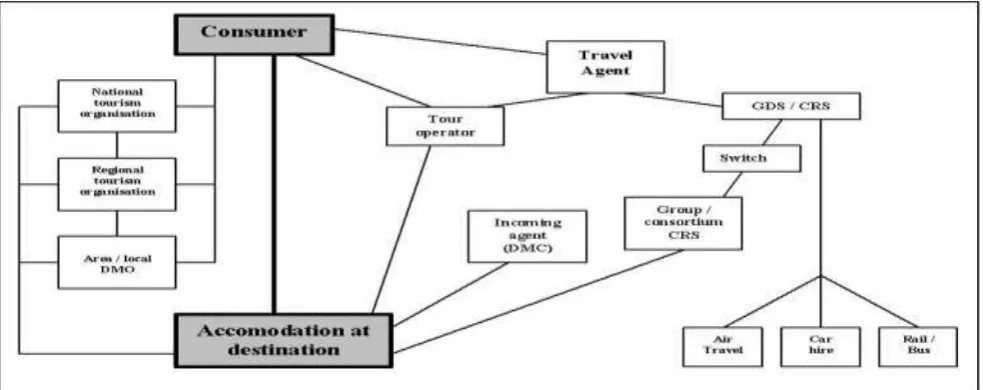
The advantages and evolution of CRS and Internet are well known. Internet strategy has provided all players in the industry an easy access to the end user. Exploitation of opportunities through Internet depends upon marketing strategy, communication strategy, pricing strategy etc. Direct communication with the clients, which is facilitated by the Internet, has made the industry more effective and efficient. For instance, following figures demonstrates the transformation in the industry. The figure bellow represents the Internet based value chains. They represent the changing face of tourism in recent years.
Figure 1: Internet based value chain in Tourism
The overall structure of the industry has been transformed ever since Internet has been the essential communication tool for the industry. Several new developments can be noted.
Direct selling to the customer has increased.
Increase in new intermediaries such as Internet portals specialized in selling tourism products.
Customers have access to the distribution channels traditionally used by tour operators through Internet.
Companies can regularly alter products and services based on the needs and expectations of clients through regular interaction through Internet.
Increase in the transparency and the efficient relationship between customer and management.
However, the increase in the distribution channels is a serious challenge for the industry. It demands critical cooperation across different sectors with in tourism industry. While tourism destination management organizations develop internet portals to distribute information and products, transportation companies offer services for transport.
Communication and network skills are essential in the industry as volumes of information need to be analyzed and exchanged every day between clients and companies. Industry needs professionals who are technically trained to deal with ICT tools, systems and information sources. Tourism professionals also need profound knowledge in areas of marketing, finance, management, statistics, distribution trend etc since it also involves rigorous revenue management. Successful navigation is possible only if professionals have the skill to identify efficient combination of distribution channels and opportunities for cross promotion and cross selling. While such skills get sharpened during work, education on tourism and related areas can be a platform for training the professionals.
The role of ICT is crucial both in theory, practice and praxis. It must be understood in the context of its application as a part of marketing, customer service, revenue management etc. There has been a paradigm shift in the management of contemporary organizations related to tourism industry as a result of the more established relationships between business and technology. Information and communication tools are indispensable to the tourism industry as the ICT system is being rapidly diffused throughout the industry allowing none of the players to break free from its impacts.
Limitations and Future Directions
There is a need for a well-structured Information System or Intelligent System technologies in tourism industry to facilitate the access of tourist information by the users. The current ICT system has certain limitations. For instance, accessing information through Internet and www is an intelligent mean of getting the information, but many a times, the information is highly fragmented.
One shall arrive at it only after intelligent navigation, which is time consuming and
may mislead in the process. Sometimes, presentation of information in the web is not intelligent too. Search engines for tourism should be developed. Facilities to browse according to the topic portals can be made. Wireless is likely to be the next major event in the history of technology. Its application in tourism industry is also likely to increase in future. Mobile services shall continue to be an important channel of information and tourism services distribution for both providers and consumers.
Future mobiles might decrease in size, weight ad prize and likely to increase in power, storage, connectivity, position and capabilities. Electronic personal guide might be in frequent usage. Besides SMS (short message services), WAP (Wireless Application Protocol) standard for accessing the Internet with wireless devices like mobile phones should be increased. GNSS (Global Navigation Satellite System), which gives the position and GPRS (General Packet Radio Services) enabled mobiles which can handle larger amounts of data than the GSM network shall be useful in tourism industry. W-LAN (Wireless Local Area Networks) and Blue tooth, which gives, wireless access at short distance about few meters, can be useful too.
It is also essential that usability studies and research is conducted to examine the ICT integration in tourism and its impact. Usability is the measure to the quality of a user’s experience while using the ICT tools. It could be a product of a system, website, a software application, mobile technology, or nay related technology.
It is important to note the technology and application to work together with respect to bandwidth, user interface, position etc. All applications, technology and services should be user-friendly which can be used both by the veterans as well as the new-bees effectively. Hence technology and services should be effective, efficient and safe. It should have utility value and simple to comprehend.
Conclusion
have access to such knowledge. Educational institute should promote ICT based courses. It should be supported with technical training as well as field-based training and practical experience in the industry. Educational institute specialized on Tourism education, IT educational institutions and tourism industry players like travel agencies, tour operators, hotels, technology providers etc should have a network and have constant interaction in order to develop a skill base for successful tourism industry and a successful
navigation. The industry is generating excessive information and indeed information is the strategic and important resources for the industry. ICT tools are providing new means for analyzing the information for the industry. Emphasis should be upon converting this valuable information to knowledge system. There should be gradual transition from data system to profound knowledge system for the benefit of future generations.
References
1. Bardgett L (2000) The E-tourism Industry, Research Paper, House of Commons Library, 7. 2. Cortés-Jiménez I, Pulina M, Prunera C, Artis M (2009) Tourism and exports as a means of growth. Research Institute of Applied Economics, 10:1-28.
3. Shanker D (2008) ICT and tourism: Challenges and opportunities, Conference on Tourism in India – Challenges Ahead, 15-17 IIMK, 50-58 4. Ramos CM, Rodrigues PM (2010) the
importance of online tourism demands. In 10th International forum on tourism statistics, INE.
5. Jowkar Z, Samizadeh R (2011) Fuzzy risk analysis model for e-tourism investment. International Journal of Management and Business Research, 1(2):69-76.
6. Sheldon PJ (1993) Destination information
systems. Annals of tourism
research, 20(4):633-649.
7. Kim C (2004) E-tourism: an innovative approach for the small and medium-sized tourism enterprises (SMTEs) in Korea.
Viewed: November 12, 2012,
http://www.oecd.org/cfe/tourism/34268048.pdf 8. Wiig A (2003) June. Developing Countries and
the Tourist Industry the Internet Age: The Case of Namibia. In Forum for development studies (30(1):59-87). Taylor & Francis Group.
9. Pankajakshi R, Shailaja ML (2012) the role of information and communication technologies (ICTs) in service sector. World Journal of
Science and Technology, 2(5):66-70. Available Online: www.worldjournalofscience.com
10. Egziabher M (2012) Information Technology: Its Uses in Tourism Industry, (Catering and Tourism Training Institute), viewed: 17, http://195.130.87.21:8080/dspace/bitstream/123 456789/730/1/IT%20in%20Tourism,%20Mekon nen.pdf
11. Nath AV, Menon D (2002) Role of Information Technology in Tourism. PGDIT, IITMK, Google Search. viewed: November 17, 2012 http://fama2.us.es:8080/turismo/turismonet1/ec onomia%20del%20turismo/turismo%20y%20nu evas%20tecnologias/role%20of%20technology% 20information%20in%20tourism.pdf
12. Hussein R (2010) the adoption of web based marketing in the travel and tourism industry: an empirical investigation in Egypt (Doctoral dissertation, University of Nottingham).
13. World Travel and Tourism Council (WTTC): Annual report (2014) The Economic Impact of Travel and Tourism.
14. Scavarda AJ, Lustosa LJ, Teixeira JP (2001) March. The e-tourism and the virtual enterprise. In Proceedings 12th Conference of the Production and Operations Management Society, POM Orlando FL.
15. Bangladeshtourism.gov.bd: Bangladesh Parjatan Corporation (BPC).