Available online throug
ISSN 2229 – 5046
COMBINED EFFECTS OF VARIABLE MAGNETIC FIELD AND POROUS MEDIUM ON THE
FLOW OF MHD FLUID DUE TO EXPONENTIALLY SHRINKING SHEET
RAKESH KUMAR*
Department of Mathematics, Central University of Himachal Pradesh, India.
(Received On: 01-06-15; Revised & Accepted On: 22-06-15)
ABSTRACT
T
he present paper investigates the effects of variable magnetic field and porous media on the flow of viscous fluids over an exponentially shrinking sheet. The boundary layer approximation and similarity transformation in exponential form are used to transform the governing partial differential equations into coupled nonlinear ordinary differential equations. The power series method is utilized to obtain the closed form solution of the governing equations. The results obtained have been presented through graphs and tables, and discussed. The analysis reveals that the flow and heat transfer can be controlled significantly by controlling the suction parameter, magnetic field and porous medium permeability.Keywords: Exponentially shrinking sheet, variable magnetic field and porous media.
INTRODUCTION
The description of the Magnetohydrodynamic (MHD) boundary layer flow due to a stretching/shrinking surfaces find practical applications in many industrial processes such as processing of magnetic materials, MHD electrical power generation, geophysics, glass-fiber manufacturing, production and extraction of rubber and polymer sheets and paper production to name a few of them (Bhattacharyya et al.) [1]. The study of all these cases depend on the flow field and heat transfer characteristics of viscous flows over stretching/shrinking surfaces. Crane [2] was the first researcher to study this class of flow over stretching sheet. Further, Pavlov [3] investigated the effect of magnetic field on the flow over stretching sheet. Later on, the problem of viscous flow due to stretching was extended to three dimensions by Wang [4]. A lot of work on the Newtonian and non-Newtonian fluid flows over stretching surfaces have been done by various researchers, Lin and Chen [5], Vajravelu [6] and Nazar et al. [7] to name a few of them.
A new class of flow was observed by Wang [8] during his investigation for the behaviour of liquid film flow on an unsteady stretching sheet, and the base for the analysis of viscous fluids over shrinking surfaces was provided. Miklavcic and Wang [9] obtained the existence and uniqueness conditions for the similarity solution of viscous fluid over shrinking surfaces and showed that the behaviour of fluid depends on the externally imposed mass suction. The exact solution for the MHD flow of Newtonian and non-Newtonian fluids due to shrinking sheet was investigated by Hayat et al. [10] and Fang and Zhang [11] respectively. The boundary layer flow with power law velocity over shrinking sheet was reported by Fang [12]. The stagnation point flow towards a shrinking sheet was investigated by Wang [13]. The dual and triple solutions were discussed for the MHD non-Newtonian fluid over a shrinking surface by Turkyilmazoglu [14].
During the last several years, almost all investigations were focused on the flow due to linear or non-linear stretching of the sheet. But, the boundary layer flow induced by an exponentially stretching/shrinking sheet has not been studied extensively. Magyari and Keller [15] are assumed to be the first one to study the boundary flow over an exponentially stretching sheet. In sequence of this, some research papers on flows over exponentially shrinking surfaces appeared in literature. The boundary layer flow and heat transfer over an exponentially shrinking sheet was analyzed by Bhattacharyya [16]. The stagnation point flow over an exponentially shrinking sheet was reported by Bhattacharyya and Vajravelu [17]. Rohni et al. [18] investigated the characteristics of the flow at the stagnation point over an exponentially shrinking sheet with mass suction. In all the above studies, the effects of variable magnetic field and porous media on exponentially shrinking sheet are not considered.
Corresponding Author: Rakesh Kumar*
Exponentially Shrinking Sheet / IJMA- 6(6), June-2015.
However, the flow dynamics over an exponentially shrinking sheet is still open and more characteristics are yet to be investigated. Hence, the objective of the present paper is to investigate the effects of variable magnetic field and porous media on the flow due to exponentially shrinking sheet.
MATHEMATICAL FORMULATION
Let us consider the steady two-dimensional boundary layer flow of a viscous, incompressible, electrically conducting fluid and heat transfer over an exponentially shrinking sheet. The applied transverse variable magnetic Field is of the following form:
(
0
,
B
y
,
0
)
B
=
whereB
y
=
B
0
exp
(
x
/
2
L
)
andB
0
is a constant representing the maximum strength of themagnetic field. The porous medium is having the following form:
K
*=
K
0exp
(
−
x L
/
)
andK
0
is a constant.The governing equations of continuity, motion and energy under Boussinesq’s and boundary layer approximations may be written as
0
=
∂
∂
+
∂
∂
y
u
x
u
(1)u
K
u
y
B
y
u
y
u
v
x
u
u
*
2
2
2
ν
ρ
σ
ν
−
−
∂
∂
=
∂
∂
+
∂
∂
(2)2
2
y
T
p
C
k
y
T
v
x
T
u
∂
∂
=
∂
∂
+
∂
∂
ρ
(3)The boundary conditions are given by
( )
( )
(
)
∞
→
=
=
=
+
∞
=
=
=
=
y
as
T
u
y
at
L
x
T
T
x
w
T
T
w
v
v
x
w
U
u
0
,
0
0
2
/
exp
0
,
,
(4)The shrinking sheet velocity
U
w
is given byU
w
( )
x
=
−
c
exp
(
x
/
L
)
, wherec
>
0
is a shrinking constant. HereL
,T
0
,T
w
andT
∞
are the characteristic length of the sheet, mean temperature, temperature of the sheet and ambient temperature of the fluid respectively.We introduce the following similarity transformations
( ) (
x
L
)
f
c
L
exp
/
2
2
ν
η
ψ
=
,T
=
T
∞
+
(
T
w
−
T
∞
) ( )
θ
η
, (5) whereη
is the similarity variable defined by(
x
L
)
L
c
y
exp
/
2
2
ν
η
=
(6)and
ψ
is the stream function which is defined in the classical form asy
u
∂
∂
=
ψ
andx
v
∂
∂
−
=
ψ
.Thus we have thefollowing expressions as
(
/
) ( )
'
η
exp
x
L
f
c
u
=
andν
exp
(
/
2
) ( )
[
η
η
'
( )
η
]
2
L
x
L
f
f
c
v
=
−
+
(7)where prime denotes differentiation with respect to
η
. This suggests that, we can assume( )
(
x
L
)
S
L
c
x
w
v
exp
/
2
2
ν
−
=
, (8)where
S
>
0
is the dimensionless suction parameter.Using equations (5) to (7) in equations (2) and (3), we obtain the following ordinary differential equations
0
1
2
2
2
2
′
−
′
−
′
=
−
′′
+
′′′
f
K
f
M
f
f
f
f
(9)(
)
0
Pr
′
−
′
=
+
′′
θ
θ
The boundary conditions transform to
( )
( )
( )
( )
→
( )
→
→
′
=
=
−
=
′
=
0
0
,
0
0
1
,
1
,
η
η
θ
η
η
η
θ
η
η
as
f
at
f
S
f
(11)The physical parameters of interest in the present problem, the skin friction coefficient
C
f
and the Nusselt numberNu
, are defined by0
2
=
∂
∂
=
y
y
u
w
U
f
C
ρ
µ
(12)0
=
∂
∂
−
∞
−
=
y
y
T
T
w
T
L
Nu
(13)Substituting (5) to (7) into above two equations, we get the following expressions for skin friction and Nusselt number:
(
/
2
)
''
( )
0
exp
Re
2
x
L
f
f
C
=
(14)(
/
2
)
'
( )
0
exp
Re
/
2
−
x
L
Nu
=
−
θ
(15)The non-dimensional parameters introduced in the above equations are:
c
L
B
M
ρ
σ
2
0
=
(Hartmann number),L
c
K
K
ν
0
=
(porous medium permeability) andν
cL
=
Re
(Reynolds number).The differential equations (9) and (10) under the boundary conditions (11) are solved using the series expansion method as suggested by Singh and Dikshit [19].
Let us define
S
η
η
=
,f
( )
η
=
S
F
( )
η
andθ η
( )
=
G
( )
η
(16)The equations (9) to (11) become
0
1
2
2
2
′
=
+
∈
−
′
−
′′
+
′′′
F
K
M
F
F
F
F
(17)(
)
0
Pr
′
−
′
=
+
′′
F
G
F
G
G
(18)( )
( )
( )
( )
( )
2
1
1,
,
1
0
0,
0
0
F
F
G
at
S
F
G
as
η
η
η
η
η
η
η
′
=
= −
=∈
=
=
′
→
→
→
(19)where prime denotes the differentiation with respect to
η
.For large suction,
S
assumes large positive values so that∈
is small. Therefore,F
andG
can be expanded in terms of small perturbation quantity∈
as...
3
3
2
2
1
0
+
∈
+
∈
+
∈
+
=
F
F
F
F
F
(20)...
3
3
2
2
1
0
+
∈
+
∈
+
∈
+
=
G
G
G
G
G
(21)Substituting (20) and (21) into (17), (18) and (19), we obtain the following sets of ordinary differential equations along with the corresponding boundary conditions:
Zeroth Order
O(1)
:0
2
0
2
0
0
0
′′′
+
F
F
′′
−
F
′
=
F
(22)(
0
0
0
0
)
0
Pr
0
′′
+
F
G
′
−
F
′
G
=
Exponentially Shrinking Sheet / IJMA- 6(6), June-2015.
( )
( )
( )
( )
=
( )
∞
=
=
∞
′
=
′
=
0
0
,
1
0
0
0
0
,
0
0
0
,
1
0
0
G
G
F
F
F
(24)First-Order
O
( )
∈
:(
1
/
)
0
0
2
0
1
1
0
1
′′′
+
F
F
′′
+
F
F
′′
−
M
+
K
F
′
=
F
(25)(
1
0
0
1
0
1
1
0
)
0
Pr
1
′′
+
F
G
′
+
F
G
′
−
F
′
G
−
F
′
G
=
G
(26)( )
( )
( )
( )
=
( )
∞
=
=
∞
′
=
′
=
0
1
,
0
0
1
0
1
,
1
0
1
,
0
0
1
G
G
F
F
F
(27) Second-Order
∈
2
O
:(
1
/
)
1
0
2
2
1
2
2
0
4
1
1
2
0
0
2
2
′′′
+
F
F
′′
+
F
F
′′
+
F
F
′′
−
F
′
F
′
−
F
′
−
M
+
K
F
′
=
F
(28)(
0
2
1
1
2
0
0
2
1
1
2
0
)
0
Pr
2
′′
+
F
G
′
+
F
G
′
+
F
G
′
−
F
′
G
−
F
′
G
−
F
′
G
=
G
(29)( )
( )
( )
( )
=
( )
∞
=
=
∞
′
=
′
=
0
2
,
0
0
2
0
2
,
0
0
2
,
0
0
2
G
G
F
F
F
(30) Third-Order
∈
3
O
:(
1
/
)
2
0
2
2
1
4
0
3
1
2
2
1
3
0
3
′′′
+
F
F
′′
+
F
F
′′
+
F
F
′′
+
F
F
′′
−
F
′
F
′
−
M
+
K
F
′
=
F
(31)(
0
3
1
2
2
1
3
0
0
3
1
2
2
1
3
0
)
0
Pr
3
′′
+
F
G
′
+
F
G
′
+
F
G
′
+
F
G
′
−
F
′
G
−
F
′
G
−
F
′
G
−
F
′
G
=
G
(32)( )
( )
( )
( )
=
( )
∞
=
=
∞
′
=
′
=
0
3
,
0
0
3
0
3
,
1
0
3
,
0
0
3
G
G
F
F
F
(33)The obtained solutions of the above equations under the corresponding boundary conditions are:
( )
1
0
η
=
F
(34)( )
η
=
1
−
exp
( )
−
η
1
F
(35)( )
(
)
(
)
( )
(
)
(
(
)
)
( )
2
5 8
1 /
3 4
1 /
1
exp
exp
2
1 2
1 /
exp
4
2
4
M
K
M
K
F
η
= −
+
+
+
+
+
− −
η
−
η
+ +
M
+
K
η
−
η
(36)
( )
( )
( )
(
)
(
)
( )
η
η
(
η
)
η
η
η
η
η
η
η
η
2
exp
17
exp
4
2
2
16
3
exp
24
1
2
exp
4
15
exp
14
exp
19
18
3
−
+
−
+
−
−
−
−
+
−
−
−
+
=
A
A
A
A
A
A
F
(37)( )
η
exp
(
Pr
η
)
0
=
−
G
(38)( )
η
(
)
(
1
exp
( )
η
) (
exp
Pr
η
)
Pr
η
exp
(
Pr
η
)
1
Pr
1
Pr
Pr
1
=
+
−
−
−
−
−
−
G
(39)( )
(
)
(
)
(
(
)
)
(
(
)
)
2 12
exp
Pr
9exp
Pr
10exp
2 Pr
11exp
1 Pr
G
η
=
A
−
η
+
A
η
−
η
−
A
− +
η
−
A
− +
η
(40)The velocity and temperature profiles can be calculated from the following expressions
( )
21 2 3
,
f
′
η
= − + ∈ − ∈
F
′
F
′
F
′
(41)( )
η
=
G
0
+
∈
G
1
+
∈
2
G
2
.
θ
(42)RESULTS AND DISCUSSION
The velocity and temperature profiles obtained in the previous section are evaluated numerically. The influence of the various important parameters like mass transfer parameter, Hartmann number, and Porous medium permeability and Prandtl number on the flow and heat transfer due to a shrinking sheet is discussed. The arbitrary values are chosen for the pertinent parameters of the problem. The values chosen for each of the Figure and Table are:
S
=
3
,M
=
0
.
5
,1
=
K
andPr
=
0
.
71
. Momentum equation solution:For the momentum equation, the velocity profiles are obtained with the variation of mass transfer parameter, Hartmann number, and porous medium permeability.
The Figure 1 shows the behaviour of velocity profiles with the increase of suction parameter. The critical suction parameter for the change of boundary layer thickness is found to be
S
=
2
.
011
. The velocity and boundary layer thickness increases forS
≥
2
.
011
however, the boundary layer thickness reduces forS
<
2.011
.The influence of magnetic field on velocity profiles have been depicted by the Figure 2. Again, the
M
=
2
.
7834
have been found as the critical Hartmann number for boundary layer thickness and velocity profiles. The boundary layer thickness becomes thicker for
M
≤
2
.
7834
and thickness decreases forM
>
2.7834
. It is also clear from this Figure that the velocity decreases with the increasing Hartmann number. The effect of stronger magnetic field is very important in removing the uncertainty in the flow dynamics due to its resisting nature, that is, it makes the similarity solution unique. Since the momentum equation is independent of the Prandtl, therefore, it has no effect on the velocity profiles.Figure 1: Velocity profiles for suction parameter.
Exponentially Shrinking Sheet / IJMA- 6(6), June-2015.
The permeability of porous medium has less effect on the velocity profiles as observed from the Figure 3. This Figure reveals that the velocity increases and boundary layer thickness becomes thinner with the increasing porous medium permeability.
Heat transfer solution:
Figure 3: Velocity profiles for porous medium permeability.
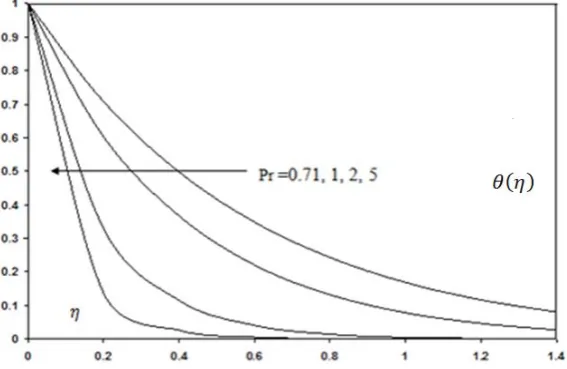
The effect of Prandtl number on the dimensionless temperature profiles are presented in Figure 4. In general, the thermal boundary layer thickness becomes thinner with the increase in Prandtl number. This is due to the physical fact that the increasing Prandtl number decreases the thermal conductivity of the fluid, hence causes a reduction in the thermal boundary layer thickness. The temperature distribution is quite interesting. The wall flux reduces with a flatter temperature near the sheet and the temperature drops fast to the ambient temperature. A higher dropping slope is observed for a higher value of Prandtl number in the fluid at a distance from the sheet.
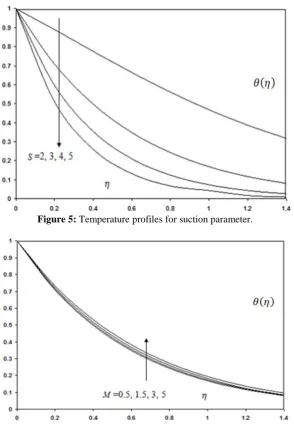
The variations in the temperature profiles for different values of the suction parameter are demonstrated in Figure 5. It is seen that both thermal boundary layer thickness and temperature profiles decreases with the increasing suction parameter.
Figure 5: Temperature profiles for suction parameter.
Figure 6: Temperature profiles for Hartmann number.
In Figure 6, the effect of Hartmann number on temperature profiles is illustrated. The Figure clearly shows an increase in the thermal boundary layer thickness and temperature profiles.
Table-1: Variation in skin-friction coefficients and rate of heat transfer at the surface with respect to suction parameter
The effect of suction parameter, Hartmann number, permeability of the porous medium and Prandtl number on skin-friction coefficient and rate of heat transfer has been presented through Tables 1 to 4. Both skin skin-friction and heat flux increases with the suction parameter as seen in Table 1. Table 2 shows that skin friction decreases for the Hartmann numbers less than the critical Hartmann number, afterwards it starts to increase as Hartmann number crosses the critical value, whereas, the heat flux decreases for all increasing values of Hartmann number. The effect of increasing permeability of the porous medium is found to enhance both skin friction and heat transfer coefficient. This effect is demonstrated from Table 3. As observed from Table 4, the Prandtl number significantly enhances heat transfer coefficient.
S
M
K
Pr
f
′′
( )
0
−
θ
′
( )
0
Exponentially Shrinking Sheet / IJMA- 6(6), June-2015.
Table-2: Variation in skin-friction coefficients and rate of heat transfer at the surface with the strength of magnetic field
S
M
K
Pr
f
′′
( )
0
−
θ
′
( )
0
3 0.5 1 0.71 1.7500 2.1266 3 1 1 0.71 1.5741 2.1075 3 1.5 1 0.71 1.4352 2.0884 3 2 1 0.71 1.3333 2.0693 3 3 1 0.71 1.2407 2.0311 3 4 1 0.71 1.2963 1.9929 3 5 1 0.71 1.5000 1.9547 3 7 1 0.71 2.3519 1.8783 3 10 1 0.71 4.7607 1.7637
Table-3: Variation in skin-friction coefficients and rate of heat transfer at the surface with the permeability of porous medium
S
M
K
Pr
f
′′
( )
0
−
θ
′
( )
0
3 0.5 1 0.71 1.7500 2.1266 3 0.5 2 0.71 1.9630 2.1457 3 0.5 3 0.71 2.0422 2.1521 3 0.5 5 0.71 2.1085 2.1572 3 0.5 10 0.71 2.1600 2.1610
Table-4: Variation in the rate of heat transfer at the surface with the Prandtl number
S
M
K
Pr
−
θ
′
( )
0
3 0.5 1 0.71 2.1266 3 0.5 1 1 3.1605 3 0.5 1 2 8.0679 3 0.5 1 3 16.0860 3 0.5 1 5 49.8590 3 0.5 1 7 129.7000
CONCLUSION
In the present paper, the effects of suction parameter, magnetic field, porous medium and Prandtl number on the flow and heat transfer over shrinking sheet has been investigated. The closed form solutions have been obtained by perturbation technique. The conclusions of the study are (i) the suction parameter and porous medium permeability increase the velocity profiles, whereas, magnetic field has a opposite effect, (ii) the Prandtl number and suction parameter have a reducing effect on the temperature profiles, however, the effect of magnetic field is to enhance the temperature profiles, (iii) the suction parameter and porous medium permeability increase the skin friction and heat transfer, (iv) the skin friction is reduced when the strength of magnetic field is less than the critical value, and thereafter it is enhanced.
APPENDIX
(
)
1
Pr
1
Pr
Pr
1
=
+
−
A
1
Pr
1
2
Pr
Pr
2
+
+
=
A
(
)
4
/
1
8
5
3
M
K
A
=
−
+
+
(
)
2
/
1
4
3
4
M
K
A
=
+
+
(
M
K
)
A
5
=
1
+
2
+
1
/
Pr
2
Pr
2
4
1
2
1
6
A
A
A
A
=
+
−
−
−
−
(
)
+
−
+
+
−
=
2
1
Pr
4
1
Pr
1
2
1
7
A
A
A
A
8
=
(
A
5
+
Pr
)(
1
−
Pr
)
(
1
3
Pr
)
Pr
2
9
=
A
+
−
A
+
A
Pr
3
4
7
Pr
10
=
+
(
)
(
(
1
Pr
)
2
)
8
Pr
2
3
2
Pr
Pr
1
6
Pr
11
+
+
+
+
=
A
A
A
A
12
=
A
10
+
A
11
12
Pr
9
13
A
A
A
=
−
5
2
1
1
A
B
=
−
K
M
A
B
A
14
=
1
−
3
+
+
1
/
A
15
=
1
−
B
1
−
A
4
−
M
−
1
/
K
2
5
16
A
A
=
2
16
17
A
A
=
16
17
2
4
15
14
12
1
18
A
A
A
A
A
=
−
+
+
+
−
17
16
2
2
15
14
8
1
19
A
A
A
A
A
=
−
−
−
+
16
2
14
19
20
A
A
A
A
=
+
+
17
2
15
21
A
A
A
=
−
A
22
=
A
14
+
A
16
REFERENCES
1. K Bhattacharyya, T Hayat and A Alsaedi, “Analytic solution for Magnetohydrodynamic boundary layer flow of casson fluid over a stretching/shrinking sheet with mass transfer”, Chin. Phys. B., 22(2), 024702, 2013. 2. LJ Crane, “Flow past a stretching plate”, Z. Angew. Math Phys. 21(4), 645, 1970.
3. KB Pavlov, “Magnetohydrodynamics”, 10, 146. 1974.
4. CY Wang, “The three dimensional flow due to a stretching flat surface”, Phys. Fluids, 27, 1915-1917, 1984. 5. CR Lin and CK Chen, “Exact solution of heat transfer from a stretching surface with variable heat flux”, Heat
and Mass Transfer, 33, 477-480, 1998.
6. K Vajravelu, “Viscous flow over a nonlinearly stretching sheet”, Appl. Math Comp., 124, 281-288, 2001. 7. R Nazar, N Amin and I Pop, “Unsteady boundary layer flow due to a stretching surface in a rotating fluid”,
Mech. Res. Comm., 31, 121-128, 2004.
8. CY Wang, “Liquid film on an unsteady stretching sheet”, Q. Appl. Math., 48, 601-610, 1990.
9. M Miklavcic and CY Wang, “Viscous flow due to a shrinking sheet”, Q. Appl. Math., 64, 601-610, 2006. 10. T Hayat, Z Abbas and M Sajid, “On the analytical solution of Magnetohydrodynamic flow of a second grade
fluid over a shrinking sheet”, ASME J. Appl. Mech., 74, 1165-71, 2007.
11. T Fang and J Zhang, “Closed form exact solution in MHD viscoud flow over a shrinking sheet”, Comm, Nonlinear Sci. Numer. Simul., 14, 2853-7, 2009.
12. T Fang, “Boundary layer flow over a shrinking sheet with power law velocity”, Int. J. Heat Mass Transfer, 51, 5838-43, 2008.
13. CY Wang, “Stagnation flow towards a shrinking sheet”, Int. J. Nonlinear Mech., 43, 377-382, 2008.
14. M Turkyilmazoglu, “Dual and triple solution for MHD slip flow on non-Newtonian fluid over a shrinking surface”, Computers and Fluids, 70, 53-58, 2012.
15. E Magyari and B keller, “Heat and mass transfer in the boundary layers on an exponentially stretching continuous surface”, J. Phys. D. Appl. Phys., 32, 577-85, 1999.
16. K Bhattacharyya, “Boundary layer flow and heat transfer over an exponentially shrinking sheet”, Chin. Phys. Lett., 28(7), 074701, 2011.
17. K Bhattacharyya and K Vajravelu, “Stagnation point flow and heat transfer over an exponentially shrinking sheet”, Comm. Nonlin. Sci. Numer. Simul., 17, 2728-34, 2012.
18. AM Rohni, S Ahmed and I Pop, “Flow and heat transfer at a stagnation-point over an exponentially shrinking sheet with suction”, Int. J. of Thermal Sci., 75, 164-170, 2014.
19. AK Singh and CK Dikshit, “Hydromagnetic flow past a continuously moving semi-infinite plate for large suction”, Astrophysics and Space Science, 148, 249-256, 1988.
Source of support: Nil, Conflict of interest: None Declared
[Copy right © 2015. This is an Open Access article distributed under the terms of the International Journal of Mathematical Archive (IJMA), which permits unrestricted use, distribution, and reproduction in any medium, provided the original work is properly cited.]