Available online throug
ISSN 2229 – 5046
GENESIS OF MATH FEAR IN SCHOOL STUDENTS
A SCRUTINY USING INDUCED FUZZY COGNITIVE MAPS (IFCM) WITH TOPSIS
Dr. J. KALIGA RANI*
1AND Dr. P. JAYAGOWRI
21
Assistant Professor, Department of Mathematics,
G.T.N ARTS COLLEGE, (AUTONOMUS) Dindigul, Tamil Nadu, India.
2
Dean, Department of Mathematics,
Sudarsan College of Arts and science, pudukottai. Tamil Nadu, India.
(Received On: 05-02-18; Revised & Accepted On: 13-03-18)
ABSTRACT
T
he Common Core concentrates on a clear set of math skills and concepts. Students will learn concepts in a more organized way both during the school year and across grades. The standards encourage students to solve real-world problems. Students do better in school and in life when their parents are engaged in their education. One of the most important roles a family can play in the success of their children is to support their learning in the home. The School provide them good platform and implement virtuous strategies to attain their goals. But still the students are not able to reach the expected framed standards of success. One of the crucial reasons is poor performance in mathematics. Several facets contribute to get deprive score in mathematics but the core aspect is fear towards mathematics. Several extensive studies have been done by the research scholars. just in general, Though the causes of math anxiety was discussed in brief by the educational experts in their perspective, a scientific analysis by applying mathematical techniques has not been undertaken by them. Therefore in this paper the educational and psychological concept of math fear has been integrated with mathematical tool so as to promote the measures of putting down math fear that is prevailing among the school students who are focussed in this research work. In this paper a new modelling approach is proposed highlighting the Genesis of Math fear. The main scope of this work is to upgrade the mathematical ability of the students by developing an efficient technique to minimize the math fear. In this paper IFCM and TOPSIS methods are applied to ascertain the causes and to determine the sequential effects respectively.Key words: Induced fuzzy cognitive maps, TOPSIS, Scenarios, Math phobia.
1. INTRODUCTION
The history of mathematics can be seen as an ever-increasing series of shared by many animals, was probably that of numbers: the realization that a collection of two apples and a collection of two oranges (for example) have something in common, namely quantity of their members
The subject Mathematics has its own characteristics which together crowned it to be the queen of all sciences. It has an extensive application in almost all fields where engineering is not an exception. The School student’s performance in mathematics is poor when compared to all other subjects. The foremost reason is math fear, which is a feeling of intense frustration about one’s ability to do math [2].Several factors such as personal, biological, intellectual, social contribute to math fear. The effects of math anxiety are pernicious as it makes the students to get low score in the examinations which indeed deepen the bitterness towards the subject. It becames a tough job of getting through JEE, REC, NIT, BIT. Therefore the problem of math fear must be resolved for which the causes must be identified. The psychologist’s opinion is that math fear is more emotional rather than intellectual [4]; in that case the prime cause can be recognised and treated for which the tool Fuzzy Cognitive Maps (FCM) has been taken.. In this paper IFCM and TOPSIS methods are applied to ascertain the causes and to determine the sequential effects respectively.
This paper is structured as follows: Section 2 details the methodology. Section 3 contains the causes of math fear in school students. Section 4 elaborates the calculation of the methodology for the given data. Section 5 discusses the experimental result. Section 6 discuss about the remedial measures and section 7 concludes the paper.
© 2018, IJMA. All Rights Reserved 192
2. METHODOLOG
Methodology contains the following blocks
1. Building FCM models using expert’s opinion
2. Making inference after finding the fixed point by using IFCM
3. Simulation of Scenario is composed of two stages, the first is the definition of scenario and the second is inference of FCM.
4. Ranking the scenarios with TOPSIS. The scenario closer to the positive-ideal scenario is the best solution
2.1.1 Fuzzy Cognitive Maps
The pioneer of cognitive maps is Axelrod [1] in the year 1976.Cognitive maps are signed digraph used to analyse the effects of alternatives of the casual assertions of an expert pertaining to specific domain. This has been extended to Fuzzy Cognitive Maps by Kosko [11] in 1986 which is a graphical representation consisting of fuzzy sets as nodes denoting the related factors and its relationships by directed graphs in which the edges connecting the nodes represent the effect of one over the another.
The unique features of FCM are the different intensities of the casual relationships between the nodes and the dynamic system evolving with time. Simple FCM has intensities as {-1, 0, 1} and weighted FCM has intensities in the range [1, 1]. The concept of feedback is also considered, and the effect of change in one concept node may induce corresponding change in the node initiating the change. The core aspects of FCM are, the fixed point attractor which is the hidden pattern, the fixed pattern of node values is attained after several iterations and the other is chaotic attractor which exists after using continuous transformation function.
2.1.2 Procedure of Induced Fuzzy Cognitive Maps
IFCM is an advanced tool used to get refined inference. The problem is defined and the nodes are determined. The connection matrix (M) is obtained from the directed graph drawn from the expert’s opinion. The state vector C1 is made in ON position and C1xM is found and threshold at each stage. The components of C1 are taken separately and the product with M is determined. The vector occurring first with maximum number of ones is considered as C2. The iteration gets terminated when the fixed point is obtained after the same occurrence of threshold value twice. The same steps are followed for all the other vectors to find the hidden pattern. [6]
2.1.3 Fuzzy Dynamics
FCMs are vibrant systems in which the feedback is involved. An effect in the node arises as the result of changes
made in other. Let the initial vector state with n nodes be
X
0=
(
X
10,
X
20,...
X
10)
,
whereX
i0 is the value of the concepti
=
1
at instant t = 0. An iterative vector-matrix multiplication process is done with an activation function todetermine the new values of the node. The vector state Xt+1 at instance t +1 is Xt+1 = f(Xt. A). where A is the adjacency matrix, Xt is the vector state at instant t, f is the sigmoid function defined as
( )
1
(1
x)
f x
e
−λ=
+
(⋋, degree of normalization, ⋋= 5 provides good degree of normalization).The iteration is averted after the attainment of hidden pattern.2.1.4 TOPSIS
A decision matrix D with n alternatives and m attributes is considered. A normalised decision matrix R= [rij] is constructed where
2 1
,
1, 2,... ,
1, 2,...
ij n
ij i
ij
r
j
m i
n
X
=
=
=
=
∑
where xij is the value of the alternative (or scenario)i (i belongs to the union of alternatives
A
,
1
n
i i
A
=
=A
) with respect to the criterion ( or attribute) j ( j belongs to the union of criterionsC
,
1
m
i i
C
=
=C
) Following it the weighted normalised decision matrix V=[vij] is formulated. Vij = rij.wj (wj is the weight of the jth criterion). The positive A+ and negative A-ideal alternatives aredetermined from
(
) (
)
{
max
1,
, max
1,
}
1,
2,
3,...
n n
i ij i ij n
A
+=
=v
j
∈
I
+ =v
j
∈
I
−=
v v v
+ + +v
+
(
) (
)
{
max
1,
, max
1,
}
1,
2,
3,...
n n
i ij i ij n
A
=
=v
j
∈
I
− =v
j
∈
I
+=
v v v
− − −v
−
The separation measures for each alternative to positive ideal alternative is and to negative ideal alternative are as follows
1
1
(
),
1, 2,...
(
),
1, 2,...
m
i j j
m
i j j
d
vij
v
i
n
d
vij
v
i
n
+ +
=
− =
=
−
=
=
−
=
∑
∑
The relative closeness of the ith alternative Ci to the ideal alternative is Ci+ which is defined as i
i i
d
d
λ
− ++
−The larger Ci+ is the better alternative with which the preference order is ranked [7].
3. GENESIS OF MATH FEAR IN SCHOOL STUDENTS-UNDETERMINED FACTORS
We have made a survey of several school students in the district of Dindigul in Tamil Nadu. Questionnaire technique relevant to the topic is used to receive their views. According to their views some of the factors causing math anxiety are considered for our studies are as follows,
C1- Curriculum of Mathematics C2- Traditional Belief
C3-Mythologization of Mathematical Language C4-The learner’s genetic make up
C5-Teaching Style of various person C6- Environment for learning
C7-Unsystematic study processes practiced by the students C8-Lack of Positive Role Models
C9-The high pressure of solving problems within certain time limits C10- Failure in the past C11-Lack of self-confidence
C12-Relationship with past event or mathematics teacher C13-Past bitter experience in a mathematics lesson
C14-Deliver of more concepts at a time by the teacher C15-Lack of good teachers
C1-Curriculum of Mathematics
Mathematics has been centralized as the most important subject, involving formulas, procedures running to several pages to solve problems. In addition the other subjects like physics also involves the concepts of differential calculus and integral calculus that arose a thought of studying mathematics among the students which indeed makes them much distressed.
C2- Traditional Belief
Due to lack of confidence, there lies a belief that only intellectual students can perform well in mathematics. The students also trust the same and still they strongly hope that ability to do maths is a gift only for few.
C3-Mythologization of Mathematical Language
Mathematics has its own vocabulary which makes the listeners inflexible many a times. The terminology, notations used puzzles and sometimes creates commotion in the minds of the students.
C4-The learner’s genetic make up
The role of genetic influence is high in one’s own learning system. Naturally if a student has poor perception of mathematics he is prone to math fear.
C5-Teaching Style of various person
The skill of teaching mathematics is an art. The teacher deserves appreciation only if the communication is perfect. The problems become easier and understandable only if it is solved by the teacher in the board rather it becomes much complicated if the teacher adopts method of dictation.
C6-- Environment for learning
The learning environment stated is related to the influence of society and peer group. The society accepts mathematical scholars as the most respectable dignitaries. The peer group induces negative inspiration towards mathematics saying that mathematics is a fearful subject rather than working together to minimize the complexity. The probability of accomplishing the former task is more than the latter.
C7-Unsystematic study processes practiced by the students
© 2018, IJMA. All Rights Reserved 194
C8-Lack of Positive Role Models
Optimistic Approach is the gate way to success. The students meet several persons in their life among which only a meagre number of people say mathematics is not too difficult where as many of them comments that it is the most difficult subject. So the positive role models encouraging the students are not present up to required level.
C9-The high pressure of solving problems within certain time limits
The students are subjected to solving many problems in mathematics which are time bound. The thought of completing it within the given time itself causes math fear.
C10- Failure in the past
The student if once met with failure in the past feels more disappointed. The continuous failure in mathematics frustrates them and cause math fear.
C11-Lack of self-confidence
The students are not confident enough to feel that they are capable of solving the problems. They lose hope and have a thought that they are not potential enough to solve the problems. This outlook grounds math anxiety.
C12-Relationship with past event or mathematics teacher
The past incidents relating to an event or a person highly influence the present and future scenario. The impact of previous happenings may outbreak math anxiety.
C13-Past Bitter experience in a mathematics lesson
The instance of unpleasant occurrences will surely start the onset of math anxiety as it halts a sturdy rash approach in the minds of the students
C14-Deliver of more concepts at a time by the teacher
The teacher at many occasions gives a lot of information to the students to make them much updated but devoid of the fact that it is a force of overpowering. The students overloaded with information are liable to math fear.
C15-Lack of good teachers
The teachers must be highly qualified and have sound subject knowledge. Only competent teachers can generate good academic record. Partial acquirement of knowledge will never fulfill the needs of the students. This will surely stimulate math fear.
4. IMPLEMENTATION OF THE PROPOSED METHODOLOGY TO THE STUDY
4.1 Method of Induced Fuzzy Cognitive Maps.
Based on the educational expert’s opinion the directed diagram is drawn. The corresponding connection matrix M is given as follows
Trial-1
M=
0 0.75 0.25 0 0 0.25 0 0.25 0.75 0 0.75 0 0 0.5 0 0.25 0 0 0.25 0 0 0 0 0 0 0.75 0 0 0.25 0 0.25 0.25 0 0 0.25 0 0.25 0 0 0.25 0.25 0 0 0.5 0.25
0 0.5 0 0 0 0 0.25 0.5 0.25 0.5 0.75 0 0 0 0 0.25 0.25 0.75 0.25 0 -0.25 0.5 0.5 0.75 0.75 1 0.5 0.75 1 0.5
0 0.25 0.25 0 0 0 0.5 0.25 0.5 0.75 0.5 0 0 0 0 0 0 0 0 0 -0.25 0 -0.75 0 0.25 0 -0.25 0 0 -0.25 0.25 0 -0.25 0.25 -0.25 0 0.25 0 -0.5 0 0.25 0 -0.25 0 0.25
0.5 0.75 0.25 0.5 0.25 0.25 0.25 0.25 0 0.25 0.25 0.25 0 0.25 0.25 0 0.75 0.5 0 0.5 0.5 0.25 0.75 0 0 1 0.75 0.75 0 0.25 0 0.25 0 -0.25 0.25 0.25 0.5 0 -0.25 0.25 0 0 0 0.25 0 0 0 -0.25 -0.25 0.25 -0.25 -0.25 0 0 0 0 0 0 -0.25 0 0.5 0.5 0.25 0.25 0.5 0.5 0.75 0 0.25 0.5 0.5 0.5 0 0.5 0.5
0 -0.25 0.25 -0.25 0 -0.5 0 -0.25 -0.75 -0.5 0 -0.25 0 0 -0.25 0.5 0.5 0.75 0.25 0.5 0 0.25 0.75 0.5 0.5 1 0.5 0.5 0.5 0
Let us consider C1 in the trial 1 by setting the concept C6 to ON state, that is the sixth component vector is set to be 1 and the rest are assigned to be zero.
Let C1 = (0 0 0 0 0 1 0 0 0 0 0 0 0 0 0) Product of C1 and M are calculated↪
C1 × M = (0 0.25 0.25 0 0 0 0.5 0.25 0.5 0.75 0.5 0 0 0 0) ↪(0 1 1 0 0 1 1 1 1 1 1 0 0 0 0) =
'
C
Threshold value is calculated by assigning 1 for values greater than 1 and 0 for the values less than 0. The symbol ↪ represents the threshold value for the product of the result. In accordance to the methodology of IFCM, the components in the Ci’ vector is taken separately and the product of the given matrix is found. The vector which has the maximum number of one’s which occurs first is considered as C2. The symbol ˜ denotes the calculation performed with the respective vector.
C1’M ˜ (010000000000000)M ↪ (100100000010010)
C1’M ˜ (001000000000000)M ↪ (110010100110011)
C1’M ˜ (000001000000000)M ↪ (100000001110100)
C1’M ˜ (000000100000000)M ↪ (000000000100000)
C1’M ˜ (000000010000000)M↪ (100100100010001)
C1’M ˜ (000000001000000)M↪ (111111110111011)
C1’M ˜ (000000000100000)M↪ (011111110011101)
C1’M ˜ (000000000010000)M↪ (010011100100010) C2 = (111111110111011)
C2M = (1.5 3.25 2.25 0.25 1.5-0.25 2.5 2 1.25 2.75 6.25 1.25 1.75 2.75 0.75) ↪ (111110111111111) Similar to the above calculations made we get
C3 = (111100111111111) and C4 = (111100111111111)
Therefore the fixed point is C4 (The iteration gets terminated when the same value occurs twice after applying the threshold values)
Trial-2
Let us consider C1 in the trial 1 by setting the concept C9 to ON state, that is the ninth component vector is set to be 1 and the rest are assigned to be zero.
Let C1 = (0 0 0 0 0 0 0 0 1 0 0 0 0 0 0) Product of C1 and M are calculated ↪
C1 × M = (0.5 0.75 0.25 0.25 0.25 0.25 0.25 0.25 0 0.25 0.25 0.25 0 0.25 0.25) ↪(111111111111011). By applying
the IFCM algorithm we get
© 2018, IJMA. All Rights Reserved 196 In a similar way the other trials are performed and the respective fixed points are obtained. The interpretation is that when the sixth factor is in ON state the factors corresponding to one’s are the possible factors, the same inference is made for the ninth factor. Therefore IFCM method gives the impacts and effects of each concept. A brief discussion about the results of IFCM is given in section 5.
4.2 Ranking by the method of TOPSIS
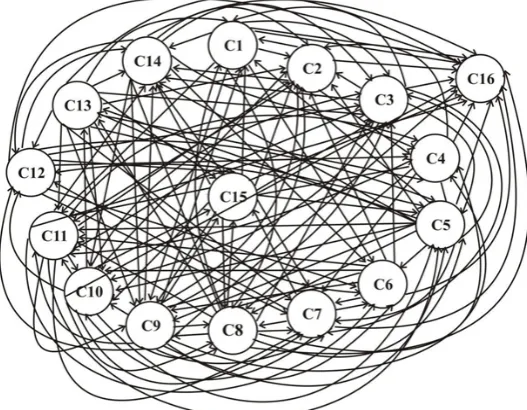
The effects of each factor is given by IFCM which helps in determining the possible outcomes, but the planning strategies can be better formulated only when the comparative analysis is made between the presence of different factors. The degree of effectiveness due to the presence of several factors is determined by TOPSIS. In this method 16 concept nodes are taken for study among which first 15 are same as discussed in section 3 and the 16th concept node is the possibility for the cause of math fear.
Based on the educational expert’s opinion the directed diagram is drawn. The corresponding connection matrix (A) is given as follows:
Figure-2: Fuzzy Cognitive map for 16 × 16 connection matrix A=
0 0.75 0.25 0 0 0.25 0 0.25 0.75 0 0.75 0 0 0.5 0 1 0.25 0 0 0.25 0 0 0 0 0 0 0.75 0 0 0.25 0 0.3 0.25 0.25 0 0 0.25 0 0.25 0 0 0.25 0.25 0 0 0.5 0.25 0.9
0 0.5 0 0 0 0 0.25 0.5 0.25 0.5 0.75 0 0 0 0 0.2 0.25 0.25 0.75 0.25 0 -0.25 0.5 0.5 0.75 0.75 1 0.5 0.75 1 0.5 1 0 0.25 0.25 0 0 0 0.5 0.25 0.5 0.75 0.5 0 0 0 0 0.6 0 0 0 0 0 -0.25 0 -0.75 0 0.25 0 -0.25 0 0 -0.25 0.9 0.25 0 -0.25 0.25 -0.25 0 0.25 0 -0.5 0 0.25 0 -0.25 0 0.25 0.7
0.5 0.75 0.25 0.5 0.25 0.25 0.25 0.25 0 0.25 0.25 0.25 0 0.25 0.25 0.8 0 0.75 0.5 0 0.5 0.5 0.25 0.75 0 0 1 0.75 0.75 0 0.25 0.5 0 0.25 0 -0.25 0.25 0.25 0.5 0 -0.25 0.25 0 0 0 0.25 0 0.7 0 0 -0.25 -0.25 0.25 -0.25 -0.25 0 0 0 0 0 0 -0.25 0 0.8 0.5 0.5 0.25 0.25 0.5 0.5 0.75 0 0.25 0.5 0.5 0.5 0 0.5 0.5 0.5
0 -0.25 0.25 -0.25 0 -0.5 0 -0.25 -0.75 -0.5 0 -0.25 0 0 -0.25 0.2 0.5 0.5 0.75 0.25 0.5 0 0.25 0.75 0.5 0.5 1 0.5 0.5 0.5 0 0.9
0 0 0 0 0 0 0 0 0 0 0 0 0 0 0 0
Table-1: Initial Stimuli A=
NODES INITIAL STIMULI Ii
Ci I1 I2 I3 I4 I5
C1 1 0 0 0 1
C2 1 0 0 0 1
C3 1 0 0 0 1
C4 1 0 0 0 1
C5 0 1 0 0 1
C6 0 1 0 0 1
C7 0 1 0 0 1
C8 0 1 0 0 1
C9 0 0 1 0 1
C10 0 0 1 0 1
C11 0 0 1 0 1
C12 0 0 1 0 1
C13 0 0 0 1 1
C14 0 0 0 1 1
C15 0 0 0 1 1
C16 1 0 0 0 1
Table-2: FCM dynamics results
Table-3:
Normalized Decision matrix
R =
1 1 1 0.993 0.99321 0.9247 1 0.9998 0.9993 1 1 0.99 0.998 1 0.994 1 1 1 1 0.992 0.99321 0.9245 1 0.9998 0.9992 1 1 0.99 0.997 1 0.994 1 1 1 1 0.993 0.99322 0.9246 1 0.99 0.9993 1 1 0.99 0.998 1 0.994 1 1 1 1 0.992 0.99319 0.9247 1 0.997 0.9993 1 1 0.99 0.998 1 0.994 1 1 1 1 1 1 0.9 1 1 1 1 1 1 1 1 1 1
W=0.5 0.7 0.1 0.2 0 0.5 1 0.7 0.8 0.4 0.5 0.7 0.6 0.3 0.5 0
NODES SCENARIOS Si
Ci S1 S2 S3 S4 S5
C1 0.999996 0.999996 0.99983 0.999983 1
C2 1 1 1 1 1
C3 0.992423 0.989013 0.982014 0.982014 1 C4 0.993307 1 0.989013 0.989013 1 C5 0.993307 0.989013 0.982014 0.982014 0.982014 C6 0.924142 0.924142 0.880797 0.880797 0.880797
C7 1 1 1 1 1
C8 0.999985 0.999983 0.999925 0.999925 1 C9 0.99929 0.999089 0.997527 0.997527 1
C10 1 1 1 1 1
C11 1 1 1 1 1
C12 0.999955 0.999955 0.999797 0.999877 1 C13 0.999842 0.999842 0.999447 0.999665 1
C14 1 1 1 1 1
C15 0.999447 1 0.998499 0.998499 1
© 2018, IJMA. All Rights Reserved 198
Table-4: Weighted Normalized Decision Matrix
V=
0.5 0.7 0.0992 0.199 0.3972 0.462 0.6 0.69 0.7994 0.4 0.5 0.69 0.599 0.3 0.499 0 0.5 0.7 0.0993 0.198 0.3973 0.463 0.6 0.68 0.7995 0.4 0.5 0.68 0.598 0.3 0.498 0 0.5 0.7 0.0992 0.197 0.3974 0.462 0.6 0.69 0.7993 0.4 0.5 0.69 0.598 0.3 0.499 0 0.5 0.7 0.0992 0.196 0.3972 0.462 0.6 0.69 0.7994 0.4 0.5 0.69 0.598 0.3 0.498 0 0.5 0.7 0.1 0.2 0.4 0.45 0.6 0.7 0.8 0.4 0.5 0.7 0.6 0.3 0.5 0
In accordance to the TOPSIS methodology, the positive-ideal scenario (PIS) is calculated by the higher scores of each node and the negative-ideal scenario (NIS) is calculated by the lower score of each node. After applying TOPSIS algorithm, the results are shown in table 5
Figure-3: Scenario’s Results
Table-5: TOPSIS Results
I S1 S2 S3 S4 S5
di+ 0.01274 0.012739 0.012738 0.012743 0
di- 0.01233 0.0126 0.01232 0.01233 0.00319
Ci 0.491823 0.497257 0.491659 0.491764 1
Rank 3 2 5 4 1
5. DISCUSSIONS
In the method of IFCM two trials are made in which, in the first one the concept learning environment is considered, in response to it the consequential factors are mathematized curriculum, more traditional belief, mythologization of mathematical language, the learner’s genetic makeup, unsystematic study processes practiced by the students, lack of positive role models, the high pressure of solving problems within certain time limits, high rate of failure in the past, lack of self-confidence, relationship with past event or mathematics teacher, past bitter experience in a mathematics lesson, deliver of much information at a time by the teacher, lack of good teachers.
In a similar manner the results of trial 2 are same as obtained in trial 1. One of the main inferences is that when each of the factors is in ON state the same results are obtained that is the same implication factors are attained.
In the method of TOPSIS the simulated scenarios are ranked as S5 >S2>S1>S4>S3. From this analysis the 5th scenario is ranked first, which elucidates that when all these possible factors are present then the possibility of math fear is very high. The second scenario is ranked second which indicates that the presence of the factors such as C2, C4, C7, C10, C11, C14, C15, C16 reveals that the possibility of math fear is high. Likewise we can conclude the effects of other scenarios.
6. REMEDIAL MEASURES
(i) Motivating and encouraging the students
(ii) Creating a positive approach towards mathematics. (iii)Framing of application oriented curriculum (iv)Use of simple language for teaching mathematics
(v) Following simple to way of teaching methodology instead of complex
(vi)Building good relationship with the students and creating a respect towards the teacher
7. CONCLUSION
This study explores briefly the causes of math fear among the school students. The methodology such as IFCM and TOPSIS used aids in determining the experimental results. A systematic approach of getting remedial measures of educational and psychological aspect of math fear is made in this study. This work explicates the application of mathematics to the real life problems pertaining to academic and emotional perspectives.
REFERENCES
1. Kosko. B., 1986, “Fuzzy Cognitive Maps”, International Journal on Man Machine Studies, Vol 24.
2. Shaintini. C. Devi., Geetharamani.G., J.Arun Pandian, 2015, “Application of Fuzzy Parameterized Generalized Fuzzy Soft Expert Set in Decision Making”, Global Journal of Pure & Applied Mathematics, Volume 11, pages 1627-1634.
3. Kavitha.C, 2015, “ Implementation of Fuzzy Analytic Hierarchy for Selection of Location for Constructing a Firm, Global Journal of Pure & Applied Mathematics, Volume 11, pages 205-213.
4. Axelord, R., 1976, “Structure of Decision: The Cognitive Maps of Political Elites”, Princeton, NJ: Princeton University Press.
5. M.I Nunez-Pena, R. Bono, M. Suarez-Pellicioni., 2015, “Using A Brain-Computer Interface (BCI) in Reducing Math Anxiety: Evidence From South Africa”, Computers & Education, Volume 81, pages 113-122. 6. S. Narayanamorthy and S. Kalaiselvam., 2012, “Adaptation of Induced Fuzzy Cognitive Maps to the Problems Faced by the Power Loom Workers”, International Journal of intelligent systems and applications, Volume 9, pages 75-80.
7. Dr.Kaliga Rani J, Dr.Nivetha Martin, Meenakshi M," Causes of Math Anxiety in Engineering Students-An Analysis using Induced Fuzzy Cognitive Maps (IFCM) with TOPSIS’ , Global Journal of Pure and Applied Mathematics Volume 11, Number 5 (2015), pp. 2705-2718
8. Wang Y.M., & Elhag, T.M.S., 2006, “On the Normalization of Interval and Fuzzy Weights”, Fuzzy Sets and Systems, Volume 157, Issue 8, Pages 2456-2471.
9. Christmas Denhere., 2015,”Casual Attributes of Math Anxiety among Secondary Schools-Learners”, International Journal of Academic and Reflection, Volume 3, pages 1-11.
10. Ramkumar C, Ravanan. R and Narayanamoorthy. S., 2013, “A Fuzzy Mathematical Modelling to Analyse the Major Problems Faced by Gypsies in Tamil Nadu”, International Journal of mathematical Archive. Volume 4, Issue 10, Pages 101-105.
Source of support: Nil, Conflict of interest: None Declared.